

R.I.P. Southern Icons
Jerry Lee Lewis, wildest of pianists and rockabilly lord, died this week after a false report earlier in the week. He was recently inducted into the County Music Hall of Fame, having long been in the one for rock and roll.
When I was at UGA, his wife and he and I went to the same church. I never met either of them, though, because they were such celebrities locally that they were always mobbed.
Vince Dooley, legendary coach who led the Georgia Bulldogs to their previous national championship four decades ago, also passed on this week.
The National Defense Strategy
The Biden administration put out a National Security Strategy last year; the Office of the Secretary of Defense has now put out its companion piece, the National Defense Strategy. This will inform the National Military Strategy yet to come from the Joint Chiefs of Staff.
As a high level strategic document, it's not terrible except in one huge way: it demonstrates that OSD thinks it still has a lot of time. This is made clear right at the beginning.
President Biden has stated that we are living in a “decisive decade,” one stamped by dramatic changes in geopolitics, technology, economics, and our environment. The defense strategy that the United States pursues will set the Department’s course for decades to come. The Department of Defense owes it to our All-Volunteer Force and the American people to provide a clear picture of the challenges we expect to face in the crucial years ahead...
Frankly they'll be lucky if they've got a year before some of these bills come due. Some of it is here already, and more of it is coming faster than 'by the end of this decade' or 'in the crucial years ahead.'
Magic Drinks and Poisons
Professor Emeritus Ann Sheffield begins with the Saga of Olav Tryggvason. It's about twenty minutes for those of you who, like me, enjoy discussions of Norse sagas.
Psychology of Woke
Definitely a confirmation bias issue here, but this does fit my experience of the people I have personally known who partake in this stuff.
One ought always to be suspicious of attempts to psychoanalyze people who have not actually been examined in person, or to apply psychoanalysis [apparently I was not using the right term; see comments. -Grim] not to individuals but groups. Combining that with my own confirmation bias issues on the subject, I can't actually place any confidence in these conclusions; but I forward them for discussion by those of you who might feel competent to do so.
Honors

One of these is me, Christmas 2008. One of the others in the photo, a good friend of mine, sent it to me today. I must have been just back from outside the wire, because I was in armor with a pack slung over my shoulder. I have no memory of what I might have been doing.
Strength Sports & Exploitation
The Washington Post has an exposé today on exploitation of female bodybuilders. Because of the well-known differential in average male and female desires and visual nature of much male desires, these things are always about women being exploited. Gay males do it to males, too, but at a much reduced rate simply because of numbers. Of all the forms of exploitation we regularly encounter, this seems to have been less violent and aggressive than we often find: soft-core rather than otherwise, consensual rather than otherwise, coerced only by offers of money, denial of fair treatment for those who didn't play, or promises of favoritism in treatment if you did.

Possibly this is because the women were stronger than the men who sought to coerce them! Physical strength is a virtue in the strict sense, and has the pragmatic consequences of being protective as well as enabling one to do certain practical things that others cannot do.
I would advance the hypothesis, though, that this would not be found to the same degree in the other strength sports that women participate in -- I mean my own sport of Strongman ("Strongwoman") and Power Lifting. Of the three, bodybuilding is intensely focused on perfecting physical appearance rather than performance at lifting or carrying weight. This results in body styles that are less attractive, but more functional.
These charts are about men, but it's not all that different.
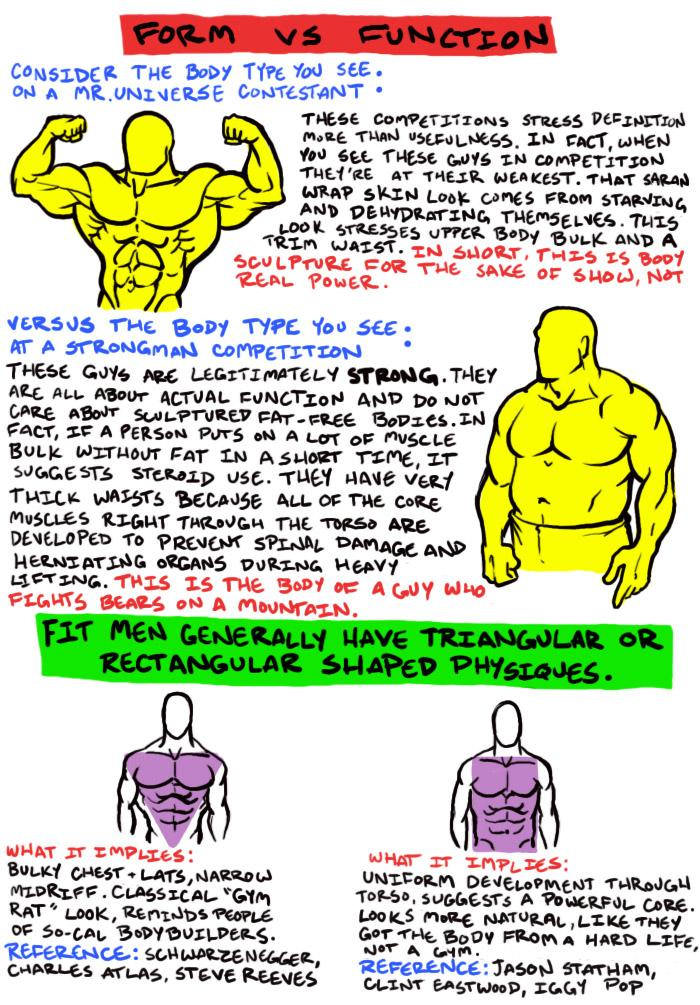
Hollywood loves the bodybuilder physique, the triangular one with the abs and the v-cuts. Conan the Cimmerian tends to be portrayed in movies by bodybuilders like Arnold or Jason Momoa, and also artists who depict Conan usually do so in the bodybuilder physique since Frank Frazetta. They are not, though, as strong as those with the rectangular physique and the thick core muscles. They are just preferred aesthetically. Bodybuilding as a sport focuses on achieving that aesthetic, not on lifting huge weights or carrying them over distances or through obstacles.
My hypothesis is that people who are erotically motivated by sight of strong people probably gravitate towards bodybuilding in a way that they don't towards the other communities. Women who want to compete in a strength sport without such exploitation thus probably have a live option. Women who want to look good in a bodybuilder way, say like a comic book heroine like Red Sonja, are beginning from a path of looking attractive rather than being strong, and that is going to tend to lead to encounters with men like these.
That's not a moral judgment; you should do what you want. If you want to look good, though, you're probably going to have to develop stronger "coping skills" as Mr. Hines likes to call it.

Sharing is Caring
Do yellow jackets get drunk? A social experiment:

UPDATE: Apparently. This one’s definitely not walking straight anymore, and I’ve had to fish him out twice after he fell in.

Men of the North

Thomas Doubting happened across a Scottish Highland Games somewhere or other -- he'll have to tell you the story -- and sent me some photos. As is well known, the Viking heritage in Scotland is very strong, and numerous clans either were founded by Vikings (like Clan Gunn, descended from the Norse Jarls of Orkney) or became interlaced with them (like Clan MacDonald, "the Lords of the Isles" for generations).
Bugs Bunny & Nimrod
I mentioned Nimrod here just this week, but apparently not that many people knew the Biblical figure and the meaning got transformed.
The FBI and an American Journalist's Disappearance
A very disturbing tale at Rolling Stone.
His lawyer declined to comment on accusations that he might have had classified documents, except to state that (a) an investigative journalist just might, if he was looking into government wrongdoing, and (b) the source of that suggestion would have to be an illegal government leak to the press.
[A neighbor] inched closer to get a better vantage, when he saw an olive-green Lenco BearCat G2, an armored tactical vehicle often employed by the Federal Bureau of Investigation, among other law-enforcement agencies. A few Arlington County cruisers surrounded the jaw-dropping scene, but all of the other vehicles were unmarked, including the BearCat. Antonelli counted at least 10 heavily armed personnel in the group. None bore anything identifying which agency was conducting the raid....Meek has been charged with no crime. But independent observers believe the raid is among the first — and quite possibly, the first — to be carried out on a journalist by the Biden administration. A federal magistrate judge in the Virginia Eastern District Court signed off on the search warrant the day before the raid. If the raid was for Meek’s records, U.S. Deputy Attorney General Lisa Monaco would have had to give her blessing; a new policy enacted last year prohibits federal prosecutors from seizing journalists’ documents. Any exception requires the deputy AG’s approval.
So if he was charged with no crime, was he arrested? No one seems to be able to confirm or deny it. He disappeared, though, and has not been seen nor has he posted on Twitter as was his wont. He also 'abruptly resigned' from his job even though his contract was not complete.
His lawyer declined to comment on accusations that he might have had classified documents, except to state that (a) an investigative journalist just might, if he was looking into government wrongdoing, and (b) the source of that suggestion would have to be an illegal government leak to the press.
This caught my eye:
Even stranger, in the months before he vanished, Meek was finishing up work on a book for Simon & Schuster titled Operation Pineapple Express: The Incredible Story of a Group of Americans Who Undertook One Last Mission and Honored a Promise in Afghanistan, which he co-authored with Lt. Col. Scott Mann, a retired Green Beret. Meek even featured a picture of the soon-to-publish book in his bio on social media and frequently tweeted about his involvement. But post-April 27, the book-jacket photo disappeared from his bio, and Simon & Schuster has scrubbed his name from all press materials.
Uh-oh.
Is covering up the administration's wrongdoing in the Afghanistan withdrawal -- which entailed abandoning thousands of American citizens to the Taliban as well as strategic planning so awful as to have been malevolent -- such a high priority at DOJ that it could get the Deputy Attorney General to sign off on it? If not that, what did? Where is Mr. Meek, and why are these corporations for whom he worked suddenly scrubbing his name and pretending he never existed?
This kind of disappearance is well-known in China. It's not supposed to happen here.
In Defense of Chaucer
It is a fact that both of the two most famous writers of late Medieval/early Modern English have long been suspected of rape. Now it appears that there are good reasons to question both accusations. Chaucer's court case has come under investigation by scholars of medieval England, and it turns out not to be a rape case but a labor dispute -- the Latin word 'raptus' in this case meant something more like 'enrapture' than 'rape.' The charge turns out to be that Chaucer had lured a worker away from her previous employer before she had finished her proper term of service.
There, [scholars] found the original writ in the case, from 1379. It showed that Staundon had brought an action against both Chaucer and Chaumpaigne, under a law known as the Statute of Laborers, which had been enacted after outbreaks of the plague had restricted the labor market. It was intended “to combat rising wages, and to prevent the poaching of servants” with the promise of better terms, the scholars write in their blog post.Chaucer, the writ stated, had hired her unlawfully, and then declined to return her to Staundon’s service as requested, causing him “grievous loss.”Those two documents, Sobecki and Roger wrote in a blog post summarizing the discovery, opened up “a radically different reading of ‘raptus.’” Instead of rape, they argue, it can be read as “the physical act of Chaumpaigne leaving Staundon’s service.”
It has long been known that the Great Plague raised the power of laborers to bid for higher wages. The real charge against Chaucer is that he offered her a better deal than she had been getting, and she and he were both sued by her former employer as a result.
The other great writer of that era was Sir Thomas Malory, who was caught up and prosecuted for raping the same woman twice -- but the accusation came not from her, but from her husband. There are reasons to think that the real offense there was that he and she were acting like Lancelot and Guinevere, an affair that might have inspired his lengthy treatment of both that matter and Tristan and Isolde. They come off as some of the most attractive characters in the novel even though both of their long love affairs are technically matters of adultery in cases of arranged marriages.
The scholarship on the Chaucer matter is really excellent, and the article is enjoyable and detailed. A feminist scholar interviewed on the subject is not ready to give up the grievance, which she views as more important than the actual facts:
[She] called the new documents “very exciting” but said the “exoneration narrative” some saw in them was overplayed.“I am eager to see how the conversation unfolds,” she wrote in an email, “but I remain insistent that the questions feminists have raised about the intersection of rape culture and women’s labor should shape our collective approach to these documents.”
By all means, let us not change our interpretation because of the facts.
Death Fixes Everything
In Canada, the health care system has been pushing euthanasia as a cost-cutting solution on patients with expensive care. In Georgia, we have now a similar solution on offer. "Having children is why you’re worried about your price for gas, it’s why you’re concerned about how much food costs.”
It's a Brave New World.
Perhaps it’s all that New World fresh air and pioneering spirit, but Canada is taking to its new euthanasia legislation like a duck to water. It only became legal in June and already about 800 people have received a lethal injection at the hands of a doctor.Where it is beating the Old World euthanasia regimes is in its frank, open and creative ideas for integrating euthanasia into Canadian life. In December two Quebec bioethicists argued in the Journal of Medical Ethics that combining euthanasia with organ donation would be an excellent idea which could yield top-quality organs for needy patients.
"Frank," "open," "creative," "excellent," "like a duck to water," "fresh air!"
"Pioneering spirit!"
Heritage Foundation: The US Military is Weak
Not just 'growing weak,' although the WSJ headline frames it that way. Conservative flagship think tank Heritage says that the status of the military has to be appraised as weak.
Heritage rates the U.S. military as “weak” and “at growing risk of not being able to meet the demands of defending America’s vital national interests.” The weak rating, down from “marginal” a year earlier, is the first in the index’s nine-year history....Heritage says the U.S. military risks being unable to handle even “a single major regional conflict” as it also tries to deter rogues elsewhere.... The Navy has been saying for years it needs to grow to at least 350 ships, plus more unmanned platforms. Yet the Navy has shown a “persistent inability to arrest and reverse the continued diminution of its fleet,” the report says.... the shipbuilding industry has shrunk amid waning demand, and the Navy’s maintenance yards are overwhelmed. Maintenance delays and backlogs are the result of running the fleet too hard: On a typical day in June, roughly one-third of the 298-ship fleet was deployed, double the average of the Cold War.It’s worse in the Air Force, which gets a “very weak” rating.
The Army remains "marginal."
The Marine Corps? "Strong," but weakening:
Of the five services, the Corps is the only one that has a compelling story for change, has a credible and practical plan for change, and is effectively implementing its plan to change. However, in the absence of additional funding in FY 2023, the Corps intends to reduce the number of its battalions even further from 22 to 21, and this reduction, if implemented, will limit the extent to which it can conduct distributed operations as it envisions and replace combat losses (thus limiting its ability to sustain operations).
The whole document would take several hours to read, and more to study carefully, but if you just want the conclusions they are here.
A Request for Elise
Many years ago, we had a discussion about polygamy here that produced a novel argument from Elise about why it was incompatible with our legal system. AVI is having a discussion now, and I wanted to see if you -- Elise -- could recall how your argument went. I saw a court in New York recently recognized a plural marriage as being 'equally valid,' and as I recall your argument was one about the legal rather than the moral tradition. I want to say it had something to do with how benefits are assigned, but I can't quite remember.
Shots from Moonshiner 28

A nice little farm in a Carolina valley.

Atop a bridge over a county line.

Above Lake Fontana.
Two Posts on Religion
One from James, on the disciplines of patience; and one from the Orthosphere, reminding us that there were two beasts.
Now 'beast' as a term is ambiguous. It's not the same, for example, as 'monster.' A monster is always disordered because it violates nature and natural law, the latter of which is derived from the instructions of divine law. A beast is ordinarily natural: Proverbs 12:10 has 'the righteous man has regard for his beast,' meaning whatever animals he might own. There's nothing necessarily disordered about a beast.
So I looked this up in the Sacra Vulgata, which is the oldest language text version of the Bible I can actually read -- Greek and Aramaic are not in my skill set, except for such small things as I've done with Greek in the commentaries here -- and there Proverbs 12:10 has animas rather than bestiam as does Revelations (which in the Sacra Vulgata is called "Apocalypsis"). That suggests to me that the term is intended in its negative connotation, rather than in its natural one.
Nevertheless, the fact that we can find regular and repetitive tokens that instantiate the dynamic described in the prophecy -- the Orthosphere goes from Nimrod to the present Leviathan -- suggests that this sort of creature is produced naturally in the sense of 'ordinarily by the operation of nature.' There's a kind of form involved, in other words: it's a thing that happens 'always or for the most part,' as Aristotle says.
We can distinguish, they usefully note, thusly:
St. Luke tells us that when Jesus first set his face towards Jerusalem, there was a Samaritan village that “did not receive him.” Indignant at this affront, James and a much younger John asked Jesus, “wilt thou that we command fire to come down from heaven.” Jesus, lamb-like in more than appearance, then rebuked them saying,“ye know not what manner of spirit ye are of. For the Son of man is not come to destroy men’s lives, but to save them” (Luke 9: 52-56).The Second Beast calls down fire to destroy anyone who does not worship the First Beast and its “hideous strength.” And it does this “in the sight of man,” nowadays on television, so that others will think twice before inviting such a rain of fire.
That is a very helpful discussion in learning to identify this ordinary thing from the genuinely divine thing it seeks to mimic.
Subscribe to:
Posts (Atom)