
Tolkien as Painter
Smithsonian Magazine has a brief article with a few images from his lesser-known hobby of painting. He was also, of course, a cartographer. Of greater interest than the article itself is the set of links it contains, which go to other collections of his work.

Aristotelian Men's Fashion
Michael Anton, whom I've met several times through a mutual friend, wrote a book on men's fashion that drew its inspiration from Machiavelli's philosophy. Now Anton, I note, is much more inclined to fashionable attire than I am myself. I am however inclined to philosophy, and I realize on reflection that he has a model that with a slight adjustment proves to be much more broadly applicable. With this one small adjustment, it becomes a unified theory for dressing well as a man.

In entirely too brief a summary, Anton suggests that men's fashion (at least for the DC/NYC types such as himself) is a continuum with two poles: the ultra-conservative pole of strict propriety, and the fop. At the one pole is the charcoal grey suit with a white Oxford shirt and a tie that is red, blue, or a mixture of neutral colors that includes charcoal; it should be knotted according to your neck, with those who have long and thin necks wearing Full Windsor knots and those with short thick necks wearing four-in-hands. The foppish pole includes potentially very wild variations, up to and including purple suits and ostrich feathers.
The goal, according to Anton's theory, is to get as close to the foppish pole as you can without looking ridiculous. By remaining rooted in a continuum that traces to the conservative, you can add variations until you get as far away as possible without looking like you are wearing a pimp costume from a 70s exploitation film. In this way you will have an attire that is striking, bold, and develops an internal confidence. If you go too far, you will be a laughingstock. Yet by going as far as possible, you will develop a personal style that is unique and demonstrative.
Now on this base model, different people can go more-or-less far on the scale. A big muscular man can probably wear a purple suit if he wants without anyone laughing at him. One sufficiently physically terrifying can wear broad stripes and carry a skull-tipped walking stick. A weaker man may wish to add only one or two flamboyant touches, but even he should not adhere to the perfectly conservative.
What occurs to me is that this model can be usefully varied by varying the poles. For example, you can hold the one pole steady at conservatism, and replace the fop with the cowboy. Years ago now -- 2004 -- I attended a fundraiser at the Cosmos Club in DC in such an outfit: a charcoal grey suit, but a gambler's vest, cowboy boots, and a bolo tie.
I had never heard of the Cosmos Club. The email invitation I got mentioned the address of the place, and the name, but nothing more about it. Emailed invitations are particularly informal; this one came from a US Marine, for a time after business hours; and it was at a place called a "club." So, naturally I assumed it was a bar of some sort.It happened that I had another engagement in town that required semiformal dress, so I figured I'd take a bit of ribbing. Still, I had no way to change, so I planned to go in my suit. It's charcoal grey, in a traditional cut. I wore it with my black Ariat boots, my black Stetson hat, and a bolo tie.The Cosmos Club turns out not to be a bar at all. It turns out to be...the place where the National Geographic Society was founded in the 19th century. It is contained in a mansion with Second Empire architecture. The interior is as rich as the exterior, and includes numerous treasures of great value, brought back from the corners of the earth and donated by the members.Well, I'm a gambler from way back, so I simply put on my best poker face and walked right in. The doorman bowed as I entered, and I went upstairs to the gathering.After a few minutes, a gentleman came up to me and shook my hand. He introduced himself as LtCol Couvillon, United States Marines, and former military governor of Wasit province."I had to shake the hand of any man," he said, "who could get in here wearing cowboy boots and a bolo tie."
It worked really well, in other words. You could look ridiculous if you overdo the cowboy thing: if I'd shown up in Wrangler jeans tucked into fancy-stitched cowboy boots, with a pearl-snap shirt and a big sombrero, I probably wouldn't have gotten in. But by blending the styles and pushing the alternate pole as far as you can get away with without looking like you're wearing a costume, you have a striking style that carries you.
You can also swap both poles out for other ones. I was thinking about this over the weekend because of the rather piratical style I adopted for the barbecue, which was coupled (excepting the VFD-issued t-shirt) with my more usual biker boots and jeans. You can look ridiculous if you look like you're wearing a biker costume or a pirate costume. John Travolta did the one in Wild Hogs (2007):

If everything you are wearing was bought at a motorcycle shop, you will probably look like a poser wearing a costume. Yet if you swap out the black pants for jeans, the 'biker' wrap for a silk scarf, and so forth, suddenly your aren't wearing a biker costume or a pirate costume. You have a style of your own.
This is similar to Aristotle's approach in his Nicomachean Ethics to finding virtue as the right mean between two extremes. It's not the perfect middle; it will differ for different persons in different situations. Some should go more one way, some more the other. Yet by finding the balance point between two different poles, the one that is right and appropriate for yourself, you come to the best place in matters of fashion as in matters of ethics.
Nor should this be surprising; as I have always said in this space, aesthetics is a division of ethics. The confluence should be expected.
On Human Nature
A professor of psychology writes on studying 'human nature,' as she calls it, in the LA Times. It may be behind a paywall, but here is the part I wanted to discuss.
In the past months, a growing choir of popular media has voiced impassioned concerns with the so-called innateness dogma. These critiques question the possibility that females are instinctively maternal, that biological sex (a notion distinct from gender) is binary, and that biology shapes society... At the root of the anxiety, however, are not the technical scientific merits of these proposals but their social consequences — their potential to elicit harm and perpetuate injustice.
...these concerns have moved to curbing the scientific process itself. In a recent editorial in the journal Nature Human Behavior — one of the leading scientific outlets — the editors have stated that they may request modifications or, in severe cases, refuse publication of “content that is premised upon the assumption of inherent biological, social or cultural superiority or inferiority of one human group over another.”
...Indeed, the notion of inherent cultural differences is not only morally objectionable but also conceptually bankrupt. But inherent biological differences — the topic of much active research — is a different matter. In fact, there is evidence that individual differences in IQ and reading and musical skills are heritable. In the eyes of some, however, this research is socially harmful.
Will restricting investigation into the science of human nature effectively prevent harm and cure the social ills that propagate injustice and prejudice?
Now, her answer to this assumes materialism, which directly defies the largest part of the 'human nature' discussion over the centuries. The Greek version is hylomorphic, with an assumption that there is some kind of form (or Form, for Platonists) governing and organizing the matter. For Christians and similar religious thinkers from the other Western monotheistic religions, this form takes on a spiritual context: it is a God-made or -shaped soul of some description. The author identifies in the piece as a Jew, but her answer dismisses the religious character of the form or the possibility of anything immaterial at work.
It appears that people wrongly consider the psyche as ethereal, distinct from the body. So, they assume that psychological traits cannot be inborn, coded in our bodies from birth. To anyone operating with that assumption, the notion of inborn psychological differences seems frivolous — it smacks of discrimination. It is no wonder, then, that the very talk of human nature seems offensive....
But science says no such thing. First, science tells us that our bodies and minds (or psyches) are one and the same; so, the possibility that a woman’s genes shape her personality ought to be no more controversial than acknowledging their role in shaping her body.
Nor is she willing to go all-in on the idea of seeking the truth wherever it leads in any case:
First, when science directly inflicts harm on people, there is no question that science must yield. Second, talk of inborn group differences can inflict harm. Claims about human nature have been misused to hurt, discriminate and exterminate people... [f]or example, when abortions are curtailed, it is natural for women to fear that talk of “maternal instincts” can be exploited to further limit their reproductive rights.
I suppose it's a baby step in the right direction, at least. It still excludes the bulk of the philosophical tradition, which underlies the whole field that gave rise to the sciences she is interested in -- not merely psychology but biology. I think, and have defended in a paper, that hylomorphism is a better solution than many to many current problems in science from chemistry to biology. That there might be a set of forms inherent in reality that matter is inclined to adhere to would explain, for example, why crabs seem to have evolved multiple times. It makes sense of the relatively rapid timeframe for evolution in general: it's hard to credit a purely random process of occasional mutation with such rapid evolution.
Still, there remain "HERE BE DRAGONS" areas of things that cannot be thought, or at least not expressed -- not even in journals of scientific research. Well, one step at a time.
"The Pandemic is Over"
So says the President, demonstrating clearly that the question was always political rather than medical. The medical facts, whatever they are, do not even get mentioned; there are no statistics quoted. What you hear is that the trade show is back on, and 'look around, nobody is wearing a mask.'
Meanwhile, h/t Wretchard, can we finally get a real investigation into the origins?
Prof. Sachs recently co-authored a paper in the Proceedings of the National Academy of Sciences calling for an independent inquiry into the virus’s origins. He believes that there is clear proof that the National Institutes of Health and many members of the scientific community have been impeding a serious investigation of the origins of COVID-19 and deflecting attention away from the hypothesis that risky U.S.-supported research may have led to millions of deaths. If that hypothesis is true, the implications would be earth-shaking, because it might mean that esteemed members of the scientific community bore responsibility for a global calamity.
"Inconceivable!" says the little Sicilian with the Spaniard and the giant.
Also, Stephen Miller points out, Biden just used the COVID emergency as the legal excuse for enacting a trillion dollar student loan relief plan. But there's no emergency -- only the 'state of emergency' he extended in order to retain extra powers.
VFD Barbecue

For those few of you who know the way, Little Canada’s barbecue is today. Noon to six or until we sell out.
UPDATE: Your hero after many hours of shoveling flaming charcoal into those huge barbecue ovens.

"We Can Read the Scoreboard"
Texas A&M invited Appalachian State University over for a 'tune up' game.
Texas A&M came into this season with a ton of hype, bringing in the number one recruiting class because of all that oil money... A&M head coach Jimbo Fisher almost had an aneurism when Alabama coach Nick Saban called the school out for paying players....A&M has this tradition called the “Midnight Yell,” where every Friday night when the clock turns 12, one of these “hype guys” goes and tries to hype up the crowd by saying the lamest things about the team they’re playing on Saturday.“I Googled this team to make sure they’re even real. I was really confused, because Appalachia is definitely not a state. But, sure enough I found them, and they’re located deep, and I mean deep in the backwoods, just like you would think any hillbilly college that names themselves the ‘Mountaineers.’I just hope that these guys can get here tomorrow alright, because I know for a fact that half of their football team can barely even read the name on their jerseys, let alone read a map.It’s a shame that the only two brain cells that all these guys have left are gonna get knocked out by our wrecking crew defense tomorrow.”
The final score was Appalachian State 17, Texas A&M 14. Better luck next year, 'wrecking crew.'
Logical Engineering in an Analogical World
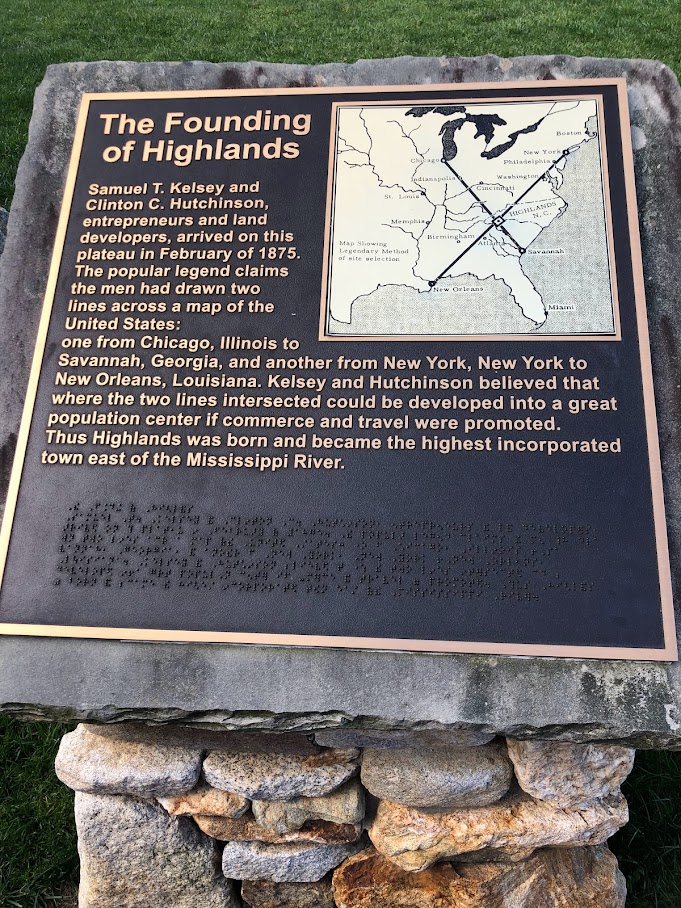
On the subject of local plaques, here is one I love about the founding of Highlands, NC. It describes the story as a 'local legend,' but it makes perfect sense. If you drew the lines just as shown on the map, logic would seem to dictate that there would be a nexus point exactly where Highlands happens to be.
The only problem is that it's four thousand feet up from Savannah to Highlands, and you can avoid that problem by going through Atlanta instead. Atlanta, whose original name was 'Terminus' because so many different railroads terminated there, already existed in 1875: in fact, it was on its second incarnation. The need for the nexus point was real, real enough that even Sherman couldn't obliterate the city forever. In the physical world we inhabit, though, geography as well as math and logic must be considered.
Here's a shot of the Old Edwards Inn in Highlands. I left in the street in front of it so you could get a sense of how steep the hills are. That's one thing in San Francisco, where the steepness is justified by the fact that there's an excellent natural harbor right there. It's another thing in Highlands, which was just never going to be a commercial hub. It is a resort, though, allowing richer people from the real terminus to escape the summer heat through the miracle of elevation.

The Rutherford Expedition
On the grounds of the Federal courthouse in Waynesville, North Carolina, stands a statue that bears this plaque:
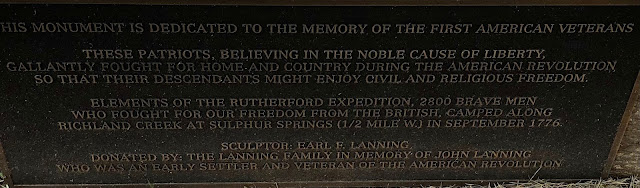

The Rutherford Expedition was, depending on which sources you consult, either a formative frontier experience that may have been crucial to the success of the American Revolution, destroying dozens of villages and driving hundreds of Cherokee into Tennessee and Florida; or a minor and halting action that burned an empty town at Cullowhee [or Cowee -- see comments] and maybe as many as five more.
What is clear is that it was a reprisal, though, for Cherokee raids following their decision to align with the British against the frontier settlements. Cherokee leadership decided to align with the distant British in order to drive out the proximate settlers, struck first, and lost in the resulting action. That's not a moral judgment against the Cherokee, for whom that might have made strategic sense had the British proven a reliable ally that could help them against the frontiersmen they decided to try to drive out. The British power in the back country was not great, however, and the Cherokee found themselves having the war brought back to them by angry frontiersmen organized into irregular light horse and infantry.
There are several other monuments in the region to this expedition. For now, at least, they aren't related to the Civil War -- when the Cherokee Nation allied with the Confederacy -- so they are not being targeted for removal.
FBI Whistleblowers: "White Supremacy" Threat Way Overblown
The President of the United States is opening a forum at the White House to discuss the danger of white supremacism, but FBI insiders are saying that the threat is already greatly overblown for political reasons.
[These insiders] say bureau analysts and top officials are pressuring FBI agents to create domestic terrorist cases and tag people as White supremacists to meet internal metrics.“The demand for White supremacy” coming from FBI headquarters “vastly outstrips the supply of White supremacy,” said one agent, who spoke on the condition of anonymity. “We have more people assigned to investigate White supremacists than we can actually find.”The agent said those driving bureau policies “have already determined that White supremacy is a problem” and set agencywide policy to elevate racially motivated domestic extremism cases as priorities.“We are sort of the lapdogs as the actual agents doing these sorts of investigations, trying to find a crime to fit otherwise First Amendment-protected activities,” he said. “If they have a Gadsden flag and they own guns and they are mean at school board meetings, that’s probably a domestic terrorist.”
The Gadsden flag is not, of course, a symbol of 'white supremacism' but of the American Revolution; more recently, it was adopted by the TEA Party as a protest against excessive American taxation.
As I've said before, the South I grew up in had occasional Klansmen appear in robes on the courthouse square to recruit and pass out literature. I haven't seen one since I was a boy. Even in the area of the country most inclined to Confederate sympathy, the Klan and its ilk are no longer welcome: haven't been in a very long time. This is wholly to the good, but it's a sea change since the days of my grandfather when they were a secret society with real power in the South.
If that's true here, I can't imagine it's not true a fortiori everywhere else. There are white supremacist prison gangs because of the unethical way in which we operate our prisons, creating a space in which banding together by ethnicity is both necessary for physical protection (because we allow the prisons to be so dangerous that joining a racist criminal gang seems like a sensible thing to do) and not disrupted by officials (who doubtless know exactly who is in what gang, but permit it to go on). These gangs are dangerous in a few communities in which there are enough former prisoners that there's out-of-prison overlap with the prison gang; they're not a big threat to mainstream America, but insofar as they deserve police attention it should be focused on the specific problem that actually exists.
Trying to paint the whole culture as if it were racist and wicked is the real point, though. That kind of widespread wickedness is said to require and justify widespread, and deep, control over the lives of everyone. Yet for the most part Americans have rejected all this and are determined to get along, and for the most part we do just that -- as we ought, as is right and proper, both good and very welcome as a change from the days of my grandfather. We make progress in decency in spite of our authorities' attempts to divide us and control us.
The No Justice Department
The Durham investigation has entered its terminal phases with little to show, occasioning celebration from the left. It looks like no more charges will be brought over the lies to the FISA court by the FBI, the spying on a presidential campaign, or the bending of the whole system into a corrupt servant of one political party. The process just drug everything out until it could close past the statute of limitations.
Meanwhile Carter Page, whose name was defamed by the lies used to spy on the presidential campaign -- and himself -- is likely to receive no compensation in civil court either. The fatal flaw for him was an inspector general report that described all the FBI lies as "errors" caused by a "sloppy" process: in other words, like the Durham investigation, the system protected itself from accountability.
Such is the best we can hope for out of the system: it is operating exactly as designed and intended.
UPDATE: DOJ obstructed its own investigation into HRC, argues RealClearInvestigations. The investigation into Team Trump is being handled differently, with an eye towards not just prosecution but shutting down the whole organization as a political force.
UPDATE: DOJ issues subpoena to conservative group in Alabama demanding: “any draft legislation, proposed legislation, or model legislation.” This included all their communique on the subject, e.g., “any social media postings.” All such would be protected First Amendment activity.
Bounty of Summer, Promise of Fall
Pinto beans drying in the sun, with new greens started that need cooler weather for growing.

I put up another gallon of salsa yesterday, fire roasted tomatoes, homegrown habaneros.
Jupiter in the East
All month, but especially around the 26th, Jupiter will be especially visible and clear in the eastern sky.
House Republicans: Nobody's Keeping Election Records
It is very unlikely that a letter from House Republicans is going to produce any motion at the Justice Department, but they're trying anyway.
In the letter, first obtained by the Daily Caller, the lawmakers mention an America First Policy Institute (AFPI) report titled “National Review of Retaining Election Records from the 2020 Election,” which concluded that many of the most heavily populated jurisdictions across the country are not complying with the records retention requirement under the Civil Rights Act of 1960.
AFPI’s report states that only six of 100 of the most heavily populated counties that were contacted by AFPI for information were able to give them their actual voter files from the 2020 election as required by law. Some of the counties failed to retain the records while others did not have timestamped records going back to the 2020 election. The lawmakers were, to put it mildly, displeased.
You can't audit the results if there aren't any records of the results. This is a misdemeanor offense, but it's a Federal offense: failure to retain records is supposedly punishable by up to a year in prison and a thousand dollar fine. Yet apparently almost no jurisdictions are bothering to obey the law.
Happiness is an Activity
The Spectator article says 'a choice,' but it's not just a choice: having made the choice, you must also do the thing. It is an activity, as Aristotle says, one that produces a happy and honorable life through action.
This subject was raised here in 2006, by the way. I happen to know that because I was trying to find an old argument in the archives, but was not able to do so. I was an almost unimaginably different person in 2006, which was before I went to Iraq and before returning to the careful study of philosophy. Yet I can see a clear link in the text between who I was and who I have become.
The Stamp Act

A new report says that Americans spend more on taxes, on average, than on food, clothing, and health care combined.
What do we get for all that money, again? Not food or clothing or health care. A military that can't win its wars and that is currently fighting a war against pronouns; a justice system that is increasingly targeting political opposition as actual criminals; an education system that turns our youth against their nation and its heritage, with a negative correlation between the cost of the system and its ability to produce people who can read and write and do mathematics; roads, I guess. Some of them are all right. Not so much around here, but the interstate system is fairly nice. The Post Office works reasonably well, but it's been privatized.
No, what we mostly get are massive transfer payments to people who don't work. This is exactly what Aristotle warned against happening in a democracy: the people voting themselves access to other people's money. It was important that an oligarchy should operate this way, he says in the Politics; that's the only way people will put up with having no power over their situation, if you make sure they are at least made comfortable at public expense. In a democracy it is supposed to be destabilizing, as the (relatively) wealthy will come to resent it and will want to replace the system with one that protects them from being plundered.
That raises the question, once again, of whether this is in fact in an Aristotelian sense a democracy: this is not the 'democracy versus republic' debate, but merely a question about whether this is a government in which power is widely distributed, a government of the many. Is it that, or is it now a government in which real power is concentrated among a few? If the former, this approach is destabilizing. If the latter, it's the very root of the government's stability.
How Does One Cheat at Chess?
In an article with an obscene title, it is revealed that the reigning chess grandmaster withdrew after defeat at a recent tournament. Speculation is that he thinks his opponent is cheating.
Now I can see how you could cheat at chess in a one-on-one match where your opponent had been drinking and wasn't paying very close attention to the board. Otherwise, and especially in a tournament with all eyes on the board, I think it's a game that is robustly resistant to cheating. Are you going to slip pieces onto or off of the board while no one is watching? You are not. Are you going to peer into your opponent's brain to see what they're planning? You are not.
The speculation -- which is where the obscenity comes from -- is that maybe someone else is secretly watching the game and cuing him in on how to move. You still need someone who is better at chess than the reigning grandmaster to accomplish this, and if that person exists why wouldn't they just come win the game themselves?
Games where cheating is possible are more likely to feature cheating, and the more you make cheating possible and convenient the more cheating you are likely to get. On which subject:
An independent panel of experts on computer systems and election security issues has concluded a lengthy investigation into the voting systems currently in place in the state of Georgia and sent recommendations to the State Election Board and Georgia Secretary of State Brad Raffensperger. The current system primarily relies on touchscreen voting machines produced by Dominion Voting Systems. The audit must not have gone very well because they advise that the state discontinue the use of the Dominion machines and move immediately to hand-marked paper ballots. They are also recommending a much broader series of mandatory audits of the results after the initial count is concluded. These changes, they say, will not only afford greater accuracy but increased public confidence in the outcome. But at least initially, it doesn’t sound as if Raffensperger and the rest of the board are warming up to the idea.
You don't say.
If you want public confidence in elections, you should do the things that make cheating harder -- or impossible, insofar as you are able. The more you make it easy to cheat, such as putting control of the elections on machines with invisible processes which machines are in the control of partisans to the election, the more likely it is that there will be cheating and the less confidence people will have in the election anyway. It is first nature for human beings to cheat their way to power, especially if it is easy to do and there are protections against being caught. Only a few develop their second natures -- trained Aristotelian virtues -- so highly as to overcome the first-nature tendency.
Politicians are not generally among these people. Chess grandmasters might hopefully be.
Venison Steak Pie

Inspired by the earlier discussion of venison recipes, I decided to make a great big steak pie this morning. This one features venison browned to a light sear in iron with salt and pepper, then added brown mustard and Worcestershire, then a bunch of mushrooms and onions that survived a cube steak meal earlier this week, then some leftover Guinness gravy from the same cube steak meal. To this I then added chunks of sharp Cheddar, so they would melt into gooey sections of cheese without becoming homogenous with the gravy and venison. The pie is short crust, high protein whole wheat mixed with reserved bacon grease and suet for the fat. Spring water dough, as our water comes from one of the springs here on the mountain.
A Healthy Conversation About Free Drinks
Now I've bought many drinks for others in my lifetime, but mostly these were rounds for the boys, or occasionally a girl who was there as part of comradery. These are not the free drinks that Ms. Brown wants to talk about. She wants to talk about the ones that are purchased as a sort of cheap courtship. I found the discussion somewhat astonishing, as well as a welcome reminder that getting older is not all bad because it excuses us from this sort of thing.
On the one hand, gender justice!
On one hand, accepting a drink can be a no-brainer — especially for women. In a country where female employees are paid just 89 cents for every dollar their male counterparts earn, why wouldn’t you take a free drink from a stranger you hardly know? “Men spend more on drinks than women because women are, a lot of the time, getting bought drinks,” says economist, influencer, and self-described “financial pop star” Haley Sacks (better known by her alias Mrs. Dow Jones). “Which I’m all for because there is a wage gap. As long as you feel comfortable, I think that’s totally fine.”
So it's women, then, who get bought drinks? These champions of human equality don't buy men drinks?
In a VinePair study that polled dozens of subjects across the gender spectrum about their experiences buying and receiving drinks at bars, 83 percent of women and gender non-conforming respondents said they’d never bought a potential romantic interest a drink. When asked the reason, responses ranged from “drinks are expensive and I’m a girl,” to “because the patriarchy owes me” to “I hate men.”
If I'm following this discussion, 'gender non-conforming' has just been admitted to be a synonym for 'women,' and a large number of them don't buy drinks for potential romantic partners because they hate the entire opposite sex. That ought to work out well.
Lest you think this economic justice issue resolves the matter, though, there remains the injustice of the men thinking they might be buying a chance at some interest from the women accepting their free drinks. Well, "women" turns out to need more elaboration in the eyes of the author.
In a sense, accepting these drinks without reciprocating can act as a way for femme-presenting individuals to take power back.... With that in mind, a “free” drink can always come with a price — even those that haven’t been altered in any way. Some folks may see the act as a transactional one and therefore expect something in return, whether that be sex or simply prolonged chatting. “Just because you bought me a drink, I still don’t owe you a conversation,” Cockson says. “But there’s this weird pressure that sets in.”Our poll respondents tended to agree. “It just seems to place a weird expectation — even though I know I don’t owe the person anything in return beyond a ‘thank you,’ I’m never sure if they’ll be thinking the same way,” one woman commented. “It just feels awkward to carry on a conversation with a stranger out of obligation.”
Two things that strike me immediately about this bit:
1) "Femme-presenting" sounds like it entails a different set of ethical issues, especially insofar as this is seen as being a precursor or preliminary to some sort of romantic or sexual relationship. You may not be obligated to go down the path at all, not even as far as conversation; but some of you in the 'femme-presenting' category are going have an additional set of discussions you need to have with the man from the bar somewhere along the way.
2) Carrying on awkward, obligatory conversations with people who won't go away is one of the more difficult parts of life, but strangers are the easiest variation. Wait until it's your neighbor who just loves to bend your ear for hours at a time while not leaving your front porch, or that cousin you were trying to avoid who also wants to borrow more money.
The piece goes on after this to explore the duties of bartenders towards their guests and more fretting about feminism. It does end on some sensible advice, though:
If your gut is telling you “no,” consider heeding Cockson’s advice: “Pay for your own drinks.”
Generally you can't go far wrong in life if you're figuring out how to pay your own freight.
Subscribe to:
Posts (Atom)