

Elite Education
My own has not been elite, but public state school, except for two years. In the early 1990s I attended the Paideia School in Atlanta for my last two years of high school, and that is very much a feeder school for elite education (although my family could not afford to send me to such). The youth I encountered there were completely different from anyone I had ever known before; the education included exposure to the progenitors of Critical Race Theory, and Critical Theory in general, to alternative religions including Wicca (then a tiny minority, now bigger than Presbyterianism), and of course to intense forms of feminism.
So I read this essay from Swarthmore with a kind of interest. He is arguing that elite education is, on its own terms, despicable and impermissible.
Surely there is no credible theory of social justice, or at least no view that would attract Swarthmore professors, according to which it could count as just to spend so much more on educating our students than on the rest of their cohort. In a just world, a college like Swarthmore simply wouldn’t exist. The mere possibility would be regarded as obscene.
Well, indeed: this is what the Marxists (or Hegelians) would call an internal contradiction, the sort that will ultimately force you to evolve to a new plane of understanding. But all of reality is supposed to be like that, if you read Hegel.
He's read Marx, anyway.
On my first day of teaching at Swarthmore I was asked if I would serve as faculty adviser for the Conservative Society. This came as a surprise. I was just about to publish a book called Plato as Critical Theorist, my job talk had been about the ideal of socialism and I had recently voted for Jeremy Corbyn as Labour leader. Did the students know something I didn’t? The answer was yes. They knew that student societies can only exist if they have a faculty adviser, for one thing, but they also knew there was no one else they could ask. The fact that I had written an article called “Why Conservatives Should Read Marx” was sufficient to demonstrate my interest in engaging with conservative ideas and, given the political climate at Swarthmore, that was all they felt they could ask for. “You could give us a critical eye on our activities,” the society’s president wrote, “and help us come up with hard questions for our guest speakers and for ourselves.” I worried about my reputation on campus but decided I couldn’t let the students down.
Good for you. It's a start.
It's a hard question, though. There really aren't any schools for ordinary people that are even capable of aspiring to the level of education you'd want in whomever you put in charge. There should be; Catholic schools should teach Aquinas and Aristotle, and even Avicenna and Maimonides. They should be able to train you in the modern and Enlightenment theories without committing to them, showing you where they are strong and where they might be weak.
Ultimately the goal has to be training those few of the ordinary people's children who have both the interest and the aptitude, that they might be raised to the Guardians (as Plato put it -- and in no way endorsing Plato's totalitarian model). The governing system needs to be voluntary, so that no one makes money off of command of others. You have to make your money off of service to others. That's the only moral way, the only way to avoid the corruption that Weber points out is a necessary feature of constant government (see the archives on Weber).
This is also Aristotle's insight, re: his decision that only the middle class can be trusted with political power because they'll want to politics to the bare minimum so they can get back to earning their living on their private economic activity.
Yet someone ultimately must exercise political power, even if as a volunteer; and they need to be virtuous, and they need to be educated. The elite generally are not virtuous because, for reasons of their class, they live in luxury and ease. Virtue requires practice, and practicing in circumstances of hardship. It cannot be cultivated to a great deal in luxury.
But education requires ease, as Plato and Aristotle note: you cannot sit and study if you must work all the time. The elite thus easily build a surplus of education, but a deficit of virtue as compared to ordinary people.
A strenuous education was Plato's response: put them to hard training, military training, so that they cannot avoid developing the difficult virtues. Yet they will also be subject to education, and provided just enough ease for that. Theodore Roosevelt argues for the strenuous life on similar terms, although he was himself too much an elite to understand how his beloved cowboys were unlikely to have the leisure to grasp Plato at length.
It is a very difficult matter. Some combination of hardship -- war, ideally, if Aristotle is right; training for war at least, if Plato is right -- and leisure has to be made available, and for everyone who shows the potential to understand. Yet the hard work also has to be done; firewood has to be cut, or pipelines run; water must be carried from the river or the well, or plumbing maintained.
We have not reached any kind of ideal. Rule by the educated is enervating because they lack virtue. It is what is killing our society right now. Rule by the virtuous is right and proper, but they also need not to be ignorant of the knowledge that the wise of endless generations have produced. That requires education, of some kind and to some degree.
Pause and reflect on this.
Goodnight, Sonny Chiba
The martial arts film star has died at 82. Quentin Tarantino was impressed with him; not only was he featured in Kill Bill (Volume One), as noted, his Street Fighter films were introduced in the opening scene of True Romance (an underappreciated movie). Here are some of those scenes.
He might also have been influential in William Gibson's choice to set the opening of his breakthrough novel, Neuromancer, in Chiba City.
West's Founding XI: Honor and Shame in Politics
This is an underappreciated area of philosophy, though it is where I have spent an awful lot of my time. West points out that political power is insufficient to actually govern, and as such that what the Founders called the "law of fashion" (see prior posts) ends up being the most important law of all. What people happen to honor, or are willing to shame, ends up governing a great deal more of human behavior than the positive law -- and can even alter whether or not the positive law can be enforced, or upon whom, as we saw in the non-prosecution of last year's BLM riots (versus the objectively similar behavior on display on 6 January, which are being aggressively prosecuted because of the comparatively unfashionable nature of the perpetrators).
West points out that politics not only ends up depending on these forms, it can influence them as well. Funeral orations, speeches in general, the granting of and celebration of military awards and decorations, and political symbolism are all ways of using honors to hold up ideals for aspiration. West has an extended discussion of the Great Seal of the United States that intends to show how the Founders held up the Roman model as a kind of ideal, and likened their project especially to Virgil's heroic treatment of the founding of Rome.
To some degree this underlines a problem with this approach, which is that fashions change and therefore honors of prior generations wash out. The Founders may well have been just as careful in their construction of the symbolism of the Great Seal as he says; and perhaps it had their intended message, down to the untranslated Latin references to Virgil, in their own generation. No one except a few specialists now reads Virgil in Latin; almost no one reads Virgil at all. The symbolism is lost, the honors are not noticed, and the symbol now looks just like a weird pyramid with an all-seeing-eye atop it.
Similarly, the fashion of respect passed that caused the daughters and granddaughters of Civil War Veterans to erect so many monuments to their fathers and grandfathers at the close of those mens' lives -- the great period of Civil War monuments is 1900-1920, when a youth of 20 in 1860 would have been 60 to 80 years old. The Daughters of the Confederacy knew their fathers and grandfathers, as did the parallel Union organizations. They honored them as much for the men they had been later in life, acting as fathers and grandfathers, as for what they did in the great and terrible moments of their youth. But they also honored that, because they had grown up hearing the stories of sacrifice and suffering from their elders.
None living today knew the men, nor heard their stories from them. And so, to us, the monuments -- which are honors -- are important only for our own purposes. Few of us care for them even for their historical interest; almost none care for honor itself so much as to revere the impulse to honor one's elders for its own sake. Therefore our present generation destroys such monuments for their own internal reasons, honoring themselves instead (and not apparently even caring whose monuments they are, or what they did, as witnessed by the destruction of monuments to Lincoln and Grant as well as Lee and Stonewall Jackson).
These are titanic matters of the first importance to human society; few understand how powerful or how deep they are. West's chapter is a little dry, but at least its presence shows that he is cognizant that it is a topic that deserves discussion.
Assabiya
Lee Smith and Rod Dreher are making an explosive charge about the CIA's operations in Afghanistan.
The reality is that America lost its war in Afghanistan more than a decade ago, roughly around the time when CIA officers began bribing aging warlords with Viagra. The Americans knew all about the young boys the tribal leaders kept in their camps; because the sex drug helped Afghan elders rape more boys more often, they were beholden to America’s clandestine service. Losing Afghanistan then is the least of it. When you choose to adopt a foreign cohort’s cultural habits, customs for which the elders of your own tribe would ostracize and perhaps kill you, you have lost your civilization.
This is part of an overarching analysis of why the American elite has comprehensively failed, and why the barbarians in Afghanistan found them easy to beat.
Dreher warns that he thinks the likely outcome is a totalitarian system, such as the one that replaced the Russian Empire after the fall of the Tsars. I think that's wrong; the totalitarians are the ones in the elite now. What's likely here -- as R. E. Howard wrote -- is likewise the return of barbarism. Our barbarians are healthier, though: strong, honest, and with a love of liberty enforced with arms.
The French, Too
Under the commander in chief, our military is less daring and capable than French police. C’est dommage.
That Was Four Days Ago, Five
People are pointing out that it was only two days ago — Monday — when Afghans desperate to flee the Taliban were falling to their deaths from American planes. Fair; apparently the President has lost track of time.
In two or three days, though, it will have been four or five days ago. Had he given the answer then, when it was accurate, it would have been a horrible thing to say. How can you trivialize this, least of all by suggesting that the passage of a few days should put us beyond it? On 9/11, twenty years ago, we saw people choosing such a death over the horror of their situation; and it remains deeply tragic after all this time.
PRC Funded China Trips for Anti-Audit Dems
Surprise.
Hey, why would Chinese Communists be aligned with those trying to suppress audits of the election? Coincidence?
State Dept. Bureau In Charge of Afghan Evacuation Defunded
Trump's State Department -- which chafed under his authority the whole four years -- never really wanted to establish the Contingency and Crisis Response Bureau, but Trump wanted it to prevent Benghazi-style embarrassments. Biden's team defunded it in June, so it wasn't there to help evacuate Americans in Afghanistan.
Communists Outed by Communist Purge
Current Affairs is a lefty magazine that extends even to outright Communism at times. For example, from their current edition here is an argument that you should be breaking things at work (to keep your capitalist bosses from replacing workers with machines); and here is an argument that gay marriage was secretly just a plot by the wealthy to obtain benefits for themselves (one that, along the way, celebrates the descent of American sexual culture into complete chaos).
The magazine just fired almost all of its staff because they were trying to organize a worker's co-op.
Not a surprise for those who read the history of actual Communist states.
UK Forces Still Running Patrols into Kabul
Apparently hotly opposed by the US commander, the UK's 2Para are running patrols to pick up and transport citizens -- theirs, Irishmen, but also others who want to be moved safely -- to the airport. Read this exclusive thread on the topic.
Czech Republic Enshrines Right to Arms in Constitution
The language is peculiar to my ear, but it's an honorable action all the same.
The amendment states that “the right to defend one’s life or the life of others, even with the use of weapons, is guaranteed.”
Read about how this came to be at the link.
The idea, according to one person quoted in the article, is to form a civilian militia.
Maybe you ask why this additional constitution law helps us to secure our civil gun ownership against EU restrictions, because EU restrictions are more powerful than basic laws of EU countries – this constitutional right is just first step. The second step, which will follow and already is in our parliament and senate for discussion is, that the our government – especially our Ministry of Interior affairs in, collaboration with Ministry of Defense, make a project which is called “defined state backups” and that means that all gun owners can sign to a special training with guns covered by state armed forces. This course should deepen the civil gun owners skills to defend lives before special police forces arrives. It is our reaction on terrorism and the cases with active shooter in schools, public areas, etc. We know that the police cannot be everywhere. That means that all the gun owners which undertake this training and make a promise, will become let’s say part of interior security. The interior security is one of a fields where EU has no rights and then we can say – OK, you cannot tell us which kind of guns or size of magazines we can have, because this is strictly in our competition for our internal safety.
That's precisely correct both conceptually and as a means of execution.
A Happier Topic
Here is a collection of online, searchable 18th and 19th century cookbooks. One of them is a treatise on brewing beer from 1795, which points out that even in those days government was screwing up basic things: brewhouses were required by law not to move their coolers without notifying the excise official, but brewers in private homes could move them about the house as conditions warranted.
Lars Walker on the State of the World
Our old friend Lars Walker, translator and author of numerous books (some of which we've delved into deeply here), has thoughts about the future.
I don’t want to write about the state of the world. I’m not very happy about the state of the world, or the nation, or the state, or the community.... At bedtime, I’ve been reading Jeremiah. Appropriate, in a tragic way. There’s Jeremiah, this young man who loves God, and what job does God give him? “Tell the people to repent or they’ll be punished. They won’t listen to you, but tell them anyway.”“God loves you and has a wonderful plan for your life.” The problem is, His idea of wonderful is different from ours. From mine, anyway.If I didn’t have a strong impression (very likely wrong) that I have a Calling to finish my Erling saga before I die, I’d be strongly considering taking up an even more unhealthy lifestyle, just to avoid the disaster that seems inevitable now.
One might reasonably take up riding motorcycles, which brings joy even in times of crisis. Alternatively, one might stick around in the hopes of dying honorably in battle -- it seems more and more likely that we might get a chance.
The important thing is to live and die with honor. If you want advice I would say to finish your saga, but practice with your sword as well.
Austin Bay: Afghanistan Debacle Inexcusable
It didn't have to be this way. A well-executed withdrawal would have saved their lives and perhaps saved the anti-Taliban government. The acronym is NEO -- Noncombatant Evacuation Operation -- "the departure of civilian noncombatants and nonessential military personnel from danger in an overseas country to a designated safe haven ... "
The U.S. military is highly skilled at NEO. Even a NEO involving an area as large as Afghanistan could have been planned and prepared in 30 to 45 days if the Joint Chiefs of Staff had coordinating power and the State Department arranged for temporary refugee housing in third-country safe havens. The decision to withdraw from the huge air base at Bagram was utterly stupid, at least until threatened Afghans were extracted.
President Joe Biden gave his withdrawal speech on April 14. There was time. Incompetent, arrogant and oblivious White House leadership compounded by obscenely bad interagency planning created the horror we witness and the slaughter to be.
UPDATE: Hey, how about Ryan Crocker?
“I’m left with some grave questions in my mind about his ability to lead our nation as commander-in-chief,” Crocker, who led the U.S. Embassy in Kabul from 2002 to 2003, then again from 2011 to 2012, told The Spokesman-Review.
“To have read this so wrong – or, even worse, to have understood what was likely to happen and not care,” he added.
Crocker, who also represented the U.S. in Afghanistan under the Bush administration from 2002 to 2003, said the collapse of Afghan forces amid the U.S. troop withdrawal was the result of “a total lack of coordinated, post-withdrawal planning on our part.”
“That’s why this is all so sad,” he added. “It is a self-inflicted wound.”
A Modest Proposal on Afghanistan
People are treating the Taliban like they're ten feet tall, but they haven't actually won a gunfight with us in twenty years. Why not take Bagram back by force, and stage a proper retreat action once we've secured Kabul?
We wouldn't have to stay any longer than necessary to pull out the eleven thousand Americans there, plus our soldiers and Marines. We also don't have to accept letting the Taliban roll over us or dictate terms to us.
Sweden and Its Example
Sweden's seven-day moving average of deaths has been zero for a little while now. Two weeks ago, people were critical of the government's 'laxity' given the new variant; but it's still zero two weeks on.

Looks terrifying, right? But you have the option to select for 'deaths,' and in rural America deaths are at zero in much of America; in some places there are still single digit or low-double digit deaths.


Our county locked down way back a year and a half ago, but has been back to normal for quite a while. Almost no one wears masks, restaurants are open for in-room dining, businesses are back open. I gather that's typical for rural America. I keep mentioning that we haven't had a death since February, but I got to thinking maybe that's just good luck. Maybe deaths are higher in other rural counties; surely they are in the cities.
Now if you go to the CDC website to look at county-level data, here's what they'll show you first: 'community spread.'

Looks terrifying, right? But you have the option to select for 'deaths,' and in rural America deaths are at zero in much of America; in some places there are still single digit or low-double digit deaths.

So rural America is less prone to death; that makes sense because of less crowding and so on. It's almost the same for the metro counties, though, with a handful of exceptions.

It seems as if there's plenty of room here for a Sweden-style solution to most of America, at least.
Of course, you could take the position that 'even one death is too many,' and lock down like New Zealand at the first confirmed case. But they're a remote island nation where keeping cases to zero is an imaginable goal, even if it's probably impossible in the long run. That's not true of the United States, where international commerce is centered. Even if we had control of our southern border, we'd still have a lot of people coming and going at ports and airports across the country.
Ten Thousand Journeys
The approximately ten thousand American civilians left in Kabul have been told to head to the airport, but they’re on their own getting there.
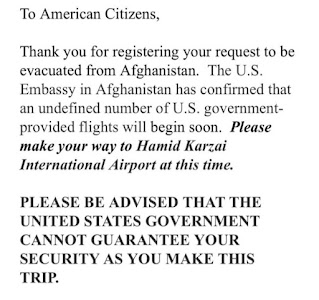

Hope the women had the foresight to buy burqas.
West's Founding, X: Sex and Marriage
West points out that there is little in the Founding core documents on these topics because they were quite uncontroversial matters in the Founding era. Nevertheless they are so important to our own time that he decided they merited a chapter. He had to dig deeper to come up with material, looking at state and local laws, legislative statements and debates, court cases and rulings, even personal correspondence between John and Abigail Adams.
The findings are not very surprising. The Founders endorsed a rational, reasoned account of traditional Judeo-Christian moral views on sex and marriage. They rejected Islam's approach by name (235), not because of prejudice but because they felt it degraded women's natural right to equality and reduced them to near-slavish status. They approved of monogamous marriage, barred polygamy, sodomy, and bestiality; they banned prostitution and pornography as being contrary to the success of marriage, which they viewed as a fundamental institution of a natural society -- as well as a natural right of men and women, provided they took only one spouse of the opposite sex and with due reflection.
West finds that the laws on sex were very strict, but barely enforced. In principle sodomy was a capital crime in many places; Jefferson proposed to reduce the penalty to castration for men and nose-piercing for women. Massachusetts' adultery law prescribed public display on the gallows followed by whipping of up to 39 stripes, plus imprisonment and/or fines. In fact, though, there is no evidence that these corporal penalties were carried out, and there are only two recorded capital cases West could find. One of these was in a case of sodomy against an unwilling youth, and as a result the death penalty might have been as much for the rape as for the homosexuality. The other might have been a bestiality case, but it is not clear. (230-1)
This was how Georgia handled sodomy cases even in my own lifetime. In principle it was a felony, whether the sodomy was oral or anal, homosexual or otherwise. In practice almost no one was ever prosecuted for such a thing; the only case I know of was of a guy who admitted to it on the stand in the course of his divorce case. He ended up going to prison for what he'd confessed to under oath, but his wife (an equal partner in theory) was not prosecuted because she had not confessed.
West says, "For the most part, this de facto 'don't ask, don't tell' policy on sexual misconduct continued from the founding until... the 'surge of interest in victimless crime, in vice, in sexual behavior, at the end of the nineteenth century," i.e., the rise of the Progressive age. West documents that it was the Progressives who banned birth control, and pushed for aggressive enforcement of sexual morality laws. He quotes one of the Progressives on the subject, who wrote that the "purpose of the state... [is] the perfection of humanity;... the perfect development of the human reason, and its attainment to universal command over individualism[,]" (234) The 1910 encyclopedia article on crime praises the apparently rising crime rate because "it is almost in every case due to the enactment of new laws, police regulations, etc., with the stricter enforcement of social and hygienic regulations -- an indication, therefore, of social progress rather than the reverse." (ibid)
The common law inherited from Britain that continued at the Founding did place a significant limit on women's equality if and only if they became wives: their legal personhood was collapsed with their husband's ('one flesh' and all that), and he was therefore in charge of any money and property they held in common. Single women and widows had the same civil rights as regarded owning property or businesses (witness Betsy Ross), but this was not true for married women whether or not they had children. (237).
These laws were not immediately changed at the Founding, because the status of the family was uncontroversial in the society of that time, but they did begin to change in ways that asserted women's natural rights after 1776. Courts as early as 1816 held that, though a wife could not make a legally binding contract under the common law, husbands were bound to obey any contract their wife made provided that it was reasonable. (238) Courts also departed from the English common law that permitted husbands to "moderately chastise" (i.e. beat) their wives, holding that "the right of chastising a wife is not... recognized by our law." (ibid) The continual evolution of the laws after the Founding was in that direction, until we arrived where we are today.
Another thing that changed after 1776 was that American women no longer were expected to abide by their parent's wishes on whom they should marry, but were free to choose their husband. (241) West claims that "After 1776, the American family was increasingly based on a new view of wives as equal partners with their husbands, although men and women were still expected to occupy partially separate spheres in life." (ibid) He cites a number of publications from the period that praised women as the moral center of the family as evidence that women were increasingly entrusted by society with the right to make decisions about what morality required of their families as well as themselves. "Historian Linda Kerber has called this new idea of women's role 'republican motherhood," West notes, citing her work Women of the Republic. (ibid)
Once again West cites Locke mostly to point out that he has seen little evidence that the Founders read him on the subject; once again he does not cite Kant, whose work is quite close to the approach West attributes to the Founders. Kant, just as West says the Founders did, essentially endorsed the Judeo-Christian traditions on sex and marriage but put a coat of 'practical reason' paint on them rather than citing the tradition or the Bible. Kant also reasoned that marriage was a natural right of individuals, so much so that any individual had a right to insist that a society that had somehow not made legislation permitting marriage must do so on demand. Kant likewise reasoned to the conclusion that sex was only permissible in marriage, in a 'natural' way (i.e. one capable of producing children), and that marriage was a natural law institution consisting of exactly two parties of the opposite sex from one another. The Kantian project and the Founding project are quite different, but they are both expressions of the Enlightenment in this way (although, as you will recall from earlier sections of this review, West thinks the Founders were fairly suspicious of the Enlightenment's claim to rely on reason alone as a guide).
In any case, this chapter is unsurprising but was worth putting together. This is true even though I imagine it was a lot of work, compared with other chapters, because it required a lot more digging. Still, it is helpful to have it all spelled out.
Harmless enemy, treacherous friend
Mark Steyn.
The world-record brokey-brokey-brokeness manifested by the current spending bills is only possible because the US dollar is the global currency. When that ends, we're Weimar with smartphones. Clearly, Chairman Xi and his allies occasionally muse on the best moment to yank the dollar out from under. If you were in Beijing watching telly today, would you perhaps be considering advancing those plans?
Subscribe to:
Comments (Atom)