Trigger Warning
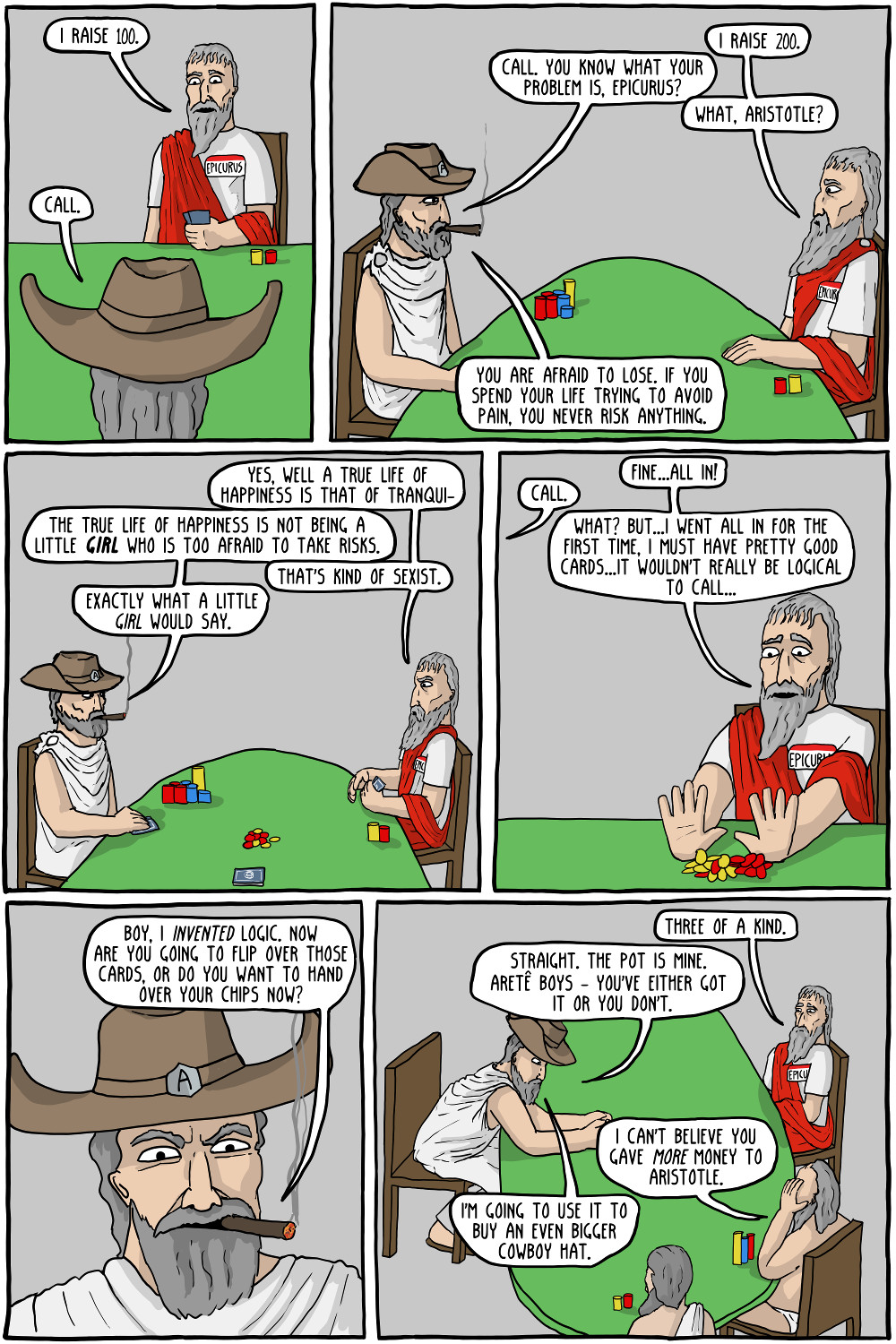
Arete, Boys
Now do basketball scholarships
Plato's Parmenides IX, The One IV
Again, I'll put this past the jump. Just to remind you, this is a very extended discussion in which Parmenides proposes to talk through both sides of every part of the question. So the traps get run one way: "What if the One is not?" And then the other: "What if the One is?" Problems abound on every side. At this point the problems are going to start looking familiar, because we found them running the traps the one way; you'll see the same problems arising if we make the contrary assumption about the One.
With any luck we'll get through this in one more post after this one.
"The Disintegration Directive"
Someone else voices my usual rant
From Hugo Gurdon, Washington Examiner editor-in-chief:
In 1985, singer Bob Geldof was interviewed backstage at London’s Wembley Stadium about the massive Live Aid rock concert he’d organized . . . raising money for famine relief in Ethiopia . . . .
At this moment, the greatest triumph in his already successful career, Geldof remarked with a note of bitter irony that Live Aid involved “the privatization of compassion.” He didn’t mean it as a compliment. “Privatization” had become a dirty word in the left-wing lexicon, as industries previously taken over by socialist governments were released from central control and sold to the public as businesses quoted on stock exchanges.
Geldof’s comment struck me forcefully at the time, for it was the precise opposite of what I took then and still take to be the gem-like truth stated by columnist T.E. Utley that one of the cruelest aspects of socialism is that it delegates compassion to the state. Socialism encourages individuals to think caring for their neighbor is not their responsibility but is, instead, a function of government.
Socialists often suggest that private provision of help for the needy is a failure of the state. [Senator Bernie] Sanders has spoken disdainfully of charity, as have many unappealing politicians elsewhere. They regard the care of others through individual acts of kindness as demeaning the recipient because they believe or at least declare that goods and services received should be taken as a right rather than accepted as a gift. One also suspects that socialists dislike charity because it places a claim on them as individuals, which they’d rather shrug off.
Eudaimonia is Not Therapy
I was going to leave this article alone, even though it addresses something I've been wondering about, until the last paragraph. The subject is the infusion of therapy-speak into everyday life.
It's from the New Yorker, so 'everyday' means 'everyday upper-middle-class-and-higher life within certain fashionable communities.' Still, I know at least one person who services such a community, and runs a business doing it centered on Facebook and Instagram. She is all the time telling her clients how important it is to "heal" their "trauma." As far as I can tell her clients are at least relatively rich white women. Maybe some of them genuinely have trauma, but it seems to be the kind of stuff the article talks about:
During this exchange, Twitter served me an advertisement that urged me to “understand my trauma” by purchasing a yoga membership. Ridiculous, I thought. I’m not a sexual-assault survivor. I’ve never been to a war zone. But, countered my brain, after four years of Trump and four seasons of covid, are you not hurting? The earth is dying. Your mother issues! Your daddy issues! A clammy wave engulfed me. My cursor hovered over the banner.
So, as I said, I was going to leave it alone. After all, I don't want to beat up on fragile people, and these people are genuinely so fragile that they think they are being traumatized by living the life of a wealthy white woman in the better neighborhoods of the richest country on earth. There's definitely something wrong with them, but it isn't "trauma." Pointing out that their entire worldview is fundamentally unhealthy might seem like I was beating up on the weak.
But then that last paragraph:
Therapy seems to have absorbed not just our language but our idea of the good life; its framework of fulfillment and reciprocity, compassion and care, increasingly drives our vision for society. Writing this piece, I thought especially of the Greek concept of eudaimonia, or human flourishing. Some might call it blessedness. In any case, it seems worth talking about.
No, you thought wrong.
Eudaimonia is often translated as "flourishing" or simply as "happiness," but the real thing it means is being fully engaged in pursuing excellence with all your vital powers. Now she says she's never been traumatized because she's never been to war; but in fact, war is the closest thing I've seen to eudaimonia.
Aristotle says that the goal of ethics is eudaimonia, a state of happy flourishing that you find when all of your vital powers are aligned in rational activity. More, he says, to fully experience this state you need a community that is set up to support it. The military deployed comes much closer to attaining Aristotle's ideal than anything else I've seen in the world. Everyone is working together towards some strategic good. They all have different jobs, but those jobs must align. Thus, there is constant rational communication and consideration of how to align different fires on a target, or different staff sections on a mission. This 'small, close knit' community is also a community that works together toward some goods that they pursue together through rational activity.
War being war, as Clausewitz says, 'everything is simple, and the simplest things are hard.' Thus, one needs all of one's vital powers in alignment to accomplish these goals. It is a very engaging sort of life.
It may well be that the broader society lacks a number of things that these smaller, close-knit and rationally ordered communities offer. Are these goods we can replicate? Certainly: any number of organizations could be set up to pursue goods in this way, although they will not all be as fully engaging of all of one's vital powers absent the extremes of war.
Are they goods that we do replicate? No, not really, not for the most part.
You develop tight knit friendships at war -- and then, if you study philosophy, you notice that Aristotle's ethics ends with a long discussion of the importance of friendship.
If you want to find eudaimonia, stop ever going to therapy. Stop focusing on your problems, whatever they are. The only thing to do with death -- and whatever you disliked about your childhood -- is to ride off from it. Go join the local volunteer fire department, and work with them putting out fires or saving lives in medical emergencies. Study philosophy and argue about Truth and Justice with friends over beer. Take up an extreme sport with a good community that supports each other. Ride motorcycles. Ride horses. Learn a martial art and practice it intensely.
Do everything you can except dwelling issues of 'care' and 'sensitivity' and all the 'hurts' and 'trauma' you've suffered. Stay away from anyone who tries to convince you that you're a suffering victim, or who is willing to treat you like one if you ask -- or so you'll pay them to help you dwell on your 'problems.' Dwelling on your problems is in fact the problem. Do great things instead.
Cause of death
Heroic Materialism
Raven mentioned this series, and this is the conclusion of it.
He says at the end that the collapse of Marxism -- a little over-eager, sadly -- left us with no alternative but "Heroic Materialism." By this I assume he meant that we should endeavor to live boldly and virtuously according to the ancient pattern, but with no belief in any metaphysical beings or realities that might reward such virtues in an afterlife. We should do well because doing well led to physical prosperity; and if it didn't, quite, we should work harder, because working harder might. But ultimately it is heroic because it is a fight without hope; and worse, without faith.
"Night shall be thrice night over you,
And heaven an iron cope.
Do you have joy without a cause,
Yea, faith without a hope?"
Plato's "Hidden Theorem on Distribution of Primes"
Against Karl Popper
I've always liked Popper's answer, but hear them out. First, what is the answer?
Popper was struck by Einstein’s prediction. “Now the impressive thing about this case,” he wrote decades later, “is the risk involved in a prediction of this kind.” Had the measurements found Einstein in error, Popper said, the physicist would have been forced to abandon his theory. Popper built his demarcation criterion around the bravado of wagering against refutation: “One can sum up all this by saying that the criterion of the scientific status of a theory is its falsifiability, or refutability, or testability.”
Second, what was the answer meant to contrast?
All demarcation criteria are designed to exclude something. What Popper really wanted to do was to show why psychoanalysis and Marxism were not scientific. Those theories had been widely understood as “scientific” in his Viennese milieu because of a logical empiricist theory called verificationism. According to this view, a theory is scientific if it is verified by empirical data.
From my perspective, successfully excluding Marxism and psychoanalysis from science justifies the project. However, others have disagreed, and not only Marxists and psychoanalysts.
First, it is difficult to determine whether you have actually falsified a theory.... Not so fast. How do you know that your experimental result was accurate?
That's a terrible objection. Falsification is about whether or not the theory could in principle be falsified. The fact that it may be hard to do is quite different from the objection to Freud's theories, wherein a man who e.g. didn't appear to have any Oedipal concerns would just be said to be suppressing or projecting them or whatever. Marxism, too: Lenin wrote a book about how Marx's theory's failure to materialize was just a further proof of how right he was about the evils of capitalism. These theories aren't falsifiable because they let you just tell another story about how they were right all along.
Yes, the instrument could be wrong; do it again. But if there's not a fact of the matter that could falsify a theory if known, it's not science.
The second problem with Popper’s proposal has to do with the actual demarcations it gives us. The very minimum we should expect from a demarcation criterion is that it slices the sciences in the right places. We want our criterion to recognize as scientific those theories that are very generally accepted as hallmarks of contemporary science, such as quantum physics, natural selection, and plate tectonics. At the same time, we want our criterion to rule out doctrines such as astrology and dowsing. Popper’s falsifiability standard is not especially helpful in this regard. For starters, it is difficult to present the “historical” natural sciences, such as evolutionary biology, geology, or cosmology—those fields where we cannot “run the tape again” in the laboratory—exclusively in terms of falsifiable claims. Those sciences provide persuasive explanations of nature through the totality of a narrative chain of causal inference rather than a series of empirical yes-no votes. Popper thus inadvertently excludes important domains of contemporary science.
I would argue that this is also a terrible objection. To say that you want to "slice the sciences in the right places" indicates that you think you already know where the slices should be made. Actually, Popper raises an important objection to theories even from these widely recognized fields: they aren't doing quite the same thing as the sciences that can provide replicable testing, and their theories remain rather more theoretical as a consequence. They're not in the same category as Marxism, but maybe that only means that there is Hard Science, and then degrees of distance from it. I'm inclined to score this Popper 2, objections 0 so far.
The situation with inclusion is even worse. The difficulty was sharply expressed by philosopher of science Larry Laudan in an influential article from 1983. Popper’s criterion, he wrote,
has the untoward consequence of countenancing as “scientific” every crank claim that makes ascertainably false assertions. Thus flat Earthers, biblical creationists, proponents of laetrile or orgone boxes, Uri Geller devotees, Bermuda Triangulators, circle squarers, Lysenkoists, charioteers of the gods, perpetuum mobile builders, Big Foot searchers, Loch Nessians, faith healers, polywater dabblers, Rosicrucians, the-world-is-about-to-enders, primal screamers, water diviners, magicians, and astrologers all turn out to be scientific on Popper’s criterion—just so long as they are prepared to indicate some observation, however improbable, which (if it came to pass) would cause them to change their minds.
OK, that one's better. Popper's criterion may not be sufficient to exclude fields that are easily falsifiable because they are crazy. We might need to address that objection to have a proper definition of hard science. That seems to be the evolving position, and it's not that hostile to Popper: he said something important, but he may have mistaken that something for everything.
Other approaches might prove more successful. Philosopher and former professor of biology Massimo Pigliucci, for example, has suggested that the problem with falsicationism is its one-dimensionality, not its effort to establish clear criteria. Perhaps we could add more dimensions that correspond to the heterogeneity of scientific practice.
You Don't Say
Theroux gets that readers might perceive him as cranky, but he thinks the problem might be with the readers.
Paul Theroux gets older.
His new novel tells the story of Joe Sharkey, an aging North Shore surfer... Sharkey feels acutely that he is being overtaken by younger surfers with big endorsements. For him, surfing was a way of life, an existence centered on catching waves, a commitment to the ocean.
Theroux sees surfing as a metaphor for his own life.... like the surfer past his prime, he is not immune to feeling forgotten, to the sense that the world has become hostile to the pure joy of the waves. There’s a fear of being overlooked, unread.
“I was once a hot shot, I was once the punk,” Theroux said. “And anyone who has once been a punk, eventually you’re older, and you see the turning of the years as it is."
Well, he has had more attention than most; and more wealth and success, too. But there is still a kind of universality to the experience of growing older.
"Conservatism" is No Longer Enough
Fewer are willing to take the next step and accept that most people living in the United States today—certainly more than half—are not Americans in any meaningful sense of the term.I don’t just mean the millions of illegal immigrants. Obviously, those foreigners who have bypassed the regular process for entering our country, and probably will never assimilate to our language and culture, are—politically as well as legally—aliens. I’m really referring to the many native-born people—some of whose families have been here since the Mayflower—who may technically be citizens of the United States but are no longer (if they ever were) Americans. They do not believe in, live by, or even like the principles, traditions, and ideals that until recently defined America as a nation and as a people. It is not obvious what we should call these citizen-aliens, these non-American Americans; but they are something else.
That's a very grave problem statement. Is it just? I wonder about the percentage -- "certainly more than half" may be overstating the numbers -- but it is certainly true of some percentage. Percentages aside, too, it seems to be true especially of the part that occupies all the seats of power: in government, both elected and the bureaucracy; in corporations; in the media, to include news, social media, and entertainment; and, at the moment at least, even in top positions of the military.
Sad times for MIT
[C]alling for increased media literacy can often backfire: the instruction to ‘question more’ can lead to a weaponization of critical thinking and increased distrust of media and government institutions . . . . [C]alls for media literacy can often frame problems like fake news as ones of personal responsibility rather than a crisis of collective action. . . . [Anti-maskers] value unmediated access to information and privilege personal research and direct reading over "expert" interpretations. . . . As a subculture, anti-masking amplifies anti-establishment currents pervasive in U.S. political culture. . . . Data literacy, for anti-maskers, exemplifies distinctly American ideals of intellectual self-reliance, which historically takes the form of rejecting experts and other elites. The counter-visualizations that they produce and circulate not only challenge scientific consensus, but they also assert the value of independence in a society that they believe promotes an overall de-skilling and dumbing-down of the population for the sake of more effective social control. As they see it, to counter-visualize is to engage in an act of resistance against the stifling influence of central government, big business, and liberal academia . . . . Most fundamentally, the groups we studied believe that science is a process, and not an institution.The solution?
Convincing anti-maskers to support public health measures in the age of COVID-19 will require more than ‘better’ visualizations, data literacy campaigns, or increased public access to data. Rather, it requires a sustained engagement with the social world of visualizations and the people who make or interpret them."Social," posited as an alternative to data literacy and explained as a "sustained engagement with the social world," remains a little fuzzy to me. Shaming? Censorship? Police raids? How I hope this turns out to be a Sokal hoax.
Holy Week
28 After Jesus had said this, he went on ahead, going up to Jerusalem. 29 As he approached Bethphage and Bethany at the hill called the Mount of Olives, he sent two of his disciples, saying to them, 30 “Go to the village ahead of you, and as you enter it, you will find a colt tied there, which no one has ever ridden. Untie it and bring it here. 31 If anyone asks you, ‘Why are you untying it?’ say, ‘The Lord needs it.’ ” 32 Those who were sent ahead went and found it just as he had told them. 33 As they were untying the colt, its owners asked them, “Why are you untying the colt?” 34 They replied, “The Lord needs it.” 35 They brought it to Jesus, threw their cloaks on the colt and put Jesus on it. 36 As he went along, people spread their cloaks on the road.
You try riding an unbroken colt sometime, and see if it's as easy as that for you.