

Watch Out For The Traumatized, Part II
Exactly as predicted, the government has chosen the easy and wicked route.
Also, suffering poverty means that you are dangerous:
A small percentage of teens who are depressed or bullied will respond with violence. After reading a recent report on school violence from the U.S. Secret Service, however, you’d be led to believe that every one of them is a potential mass-murderer.Seeking help, then, is a red flag. That should not have any negative unintended consequences whatsoever.
“Secret Service research findings [indicate that] targeted school violence is preventable,” the U.S. Secret Service’s National Threat Assessment Center (NTAC) Director James Murray writes in a new NTAC report. All schools have to do is treat any student in any sort of distress as a potential danger to everybody else and respond accordingly....
"This approach is intended to identify students of concern, assess their risk for engaging in violence or other harmful activities, and implement intervention strategies to manage that risk. The threshold for intervention should be low, so that schools can identify students in distress before their behavior escalates to the level of eliciting concerns about safety.... The fact that half of the attackers had received one or more mental health services prior to their attack indicates that mental health evaluations and treatments should be considered a component of a multidisciplinary threat assessment, but not a replacement. Mental health professionals should be included in a collaborative threat assessment process that also involves teachers, administrators, and law enforcement."
Also, suffering poverty means that you are dangerous:
The Secret Service lists the following household “difficulties” as contributing to the likelihood of a young person one day coming to school with the purpose of murdering his associates:Naturally, of course, the remedy for your weakness is that your whole family should be disarmed by government agents.
• Bankruptcy
• Eviction
• Homelessness
• Failure to Pay Child Support
• Foreclosure
• Fraudulent Check(s)
• Lien
• Low Income
• Poverty
Most attackers used firearms, and firearms were most often acquired from the home: Many of the attackers were able to access firearms from the home of their parents or another close relative. While many of the firearms were unsecured, in several cases the attackers were able to gain access to firearms that were secured in a locked gun safe or case. It should be further noted, however, that some attackers used knives instead of firearms to perpetrate their attacks. Therefore, a threat assessment should explore if a student has access to any weapons, with a particular focus on weapons access at home. Schools, parents, and law enforcement must work together rapidly to restrict access to weapons in those cases when students pose a risk of harm to themselves or others.Once again, exactly as predicted. "Since it is the only thing that is really likely to work, though, injustice is the most probable outcome of future government action on this issue. My sense is that we have much more to fear from any government attempts to address mass killings than we have to fear from the tiny number of killers, bad as they are."
Traditional Mongolian Music Vs. The Hu
After being introduced to The Hu here recently, I checked out the original folk style. I don't remember ever hearing Mongolian throat singing before, and I haven't decided what I think about it yet.
Here are two songs about Chinggis Khaan (apparently the Mongolian transliteration for the name), one traditional and one by The Hu.
The lyrics below the second video introduced me to Tengrism, a Central Asian religion which apparently is undergoing a revival since the fall of the Soviet Union.
Interesting stuff.
Here are two songs about Chinggis Khaan (apparently the Mongolian transliteration for the name), one traditional and one by The Hu.
The lyrics below the second video introduced me to Tengrism, a Central Asian religion which apparently is undergoing a revival since the fall of the Soviet Union.
Interesting stuff.

The Family that Slays Together, Stays Together
Dateline Florida: "A home invasion was stopped by almost every member of the family. The family awoke to the noise of the burglar trying to break in and everyone grabbed their guns. One member of the family fired a warning shot through the glass to deter the burglar but was unsuccessful. The intruder broke through the door and which point every member fired at him."
Warning shots are never a good idea. Shoot to stop, or don't shoot at all.
Warning shots are never a good idea. Shoot to stop, or don't shoot at all.
PETA vs UGA
The notoriously idiotic vegan activists demand that UGA permanently retire Uga, the beloved bulldog mascot.
That dog has a happier life than most people.
That dog has a happier life than most people.
Cultural Revolution
Most of the way through an article on how crazy Progressives are boosting Trump's re-election chances, a Maoist note:
These stories in which doctors lop the breasts off of teenage girls, or peeling the skin off a boy’s penis and inverting it to make a fake vagina, are a long, long way from Yale Stadium or the faculty lounge. But there is a continuum here. Left-wing extremists are controlling institutions, mostly because liberals within those institutions and fields are afraid to say no to whatever the extremists want. And conservative lawmakers are afraid to touch this stuff too.We do need to figure out how to put the brakes on some of this stuff. Perhaps educating the young about Mao is one way to do it; the "Red Guards" these young activists are emulating didn't end up in a happy place. The reason was the same: even for someone as committed to cultural revolution as Mao, cultural stability turned out to be important enough that his own nurtured movement could not be allowed to continue to exist.
Many, many people feel powerless to stop these cultural revolutionaries. (By the way, I’ve reached out to the reader who commented here the other day about his wife, a Chinese immigrant who saw people killed during the madness of Chairman Mao’s Cultural Revolution, bursting into tears when she saw the raging mob at Berkeley on the TV news the other night; she wept because she fears for her adopted country, and doesn’t understand why Americans can’t see the mounting danger. I am going to have an interview with her in this space soon.)
Aristotle Ascends
Via Arts & Letters Daily, scientists are echoing Aristotle -- and have much to learn yet. One example:
Augustine's interpretation of evil as privation of the good shows how this can work. Can an all-good God make evil, and if not, how can evil come to be? Augustine's answer is that evil is a failure to achieve the fullness of the good inherent in God's creation. Evil is a privation. Notice that this is just another way of saying that evil is a failure to actualize the potential good in something.
Still, discussions of this sort are exactly the kind of 'learning from Aristotle' that we could all stand to do. "Aretê, boys: You've either got it or you don't."
Edward Feser, in his contribution to Neo-Aristotelian Perspectives, draws a parallel between this teaching and the idea of the “block universe,” which is based on the theories of Einstein and his teacher Hermann Minkowski. The block-universe concept holds that we must understand time as a fourth dimension tied up with the three dimensions of space, so that the universe is like a four-dimensional block that contains all of space and time — past, present, and future. Minkowski would refer to this four-dimensional block as “world,” because the mathematical formulation suggested that all of time is already established, just like space. Our common-sense notion that space is static, allowing us to move around within it, whereas time “flows,” taking us along with it, is illusory. Just as the universe doesn’t have an “up” or “down,” so likewise there is no past or future, except in the sense that it seems that way to us. Much like for Parmenides there is only the Whole, for Minkowski and Einstein there is only the “world.”Well worth reading in full, though I dissent from his understanding of Aristotle as offering 'privation' and 'actuality vs. potentiality' as two different ways of overcoming the Parmenides problem. To say that a doctor comes from a non-doctor and to say that a non-doctor realizes their potential to become an actual doctor is just two ways of saying the same thing. As Aristotle also says, in his description of potentiality, 'one cannot make a saw out of wool.' That is to say that wool is even more deprived of the actuality of the saw than is raw iron. The "two" models are just different ways of describing one.
Feser’s critique of the “block universe” borrows key moves from Aristotle’s responses to Parmenides, though because he does not explicitly engage with them, it is unclear to what extent he is aware of the borrowing. In the beginning of the Physics, Aristotle explicitly distinguishes Parmenides and his disciple Melissus from other thinkers whom he calls “students of nature” (physiologoi). Parmenides and Melissus were not students of nature, according to Aristotle, because they denied motion, relegating it to mere appearance: “To investigate whether Being is one and motionless is not a contribution to the science of Nature.” The teaching that change is an illusion is not a teaching on nature, according to Aristotle, because it does not explore the origins or birth of things. Aristotle says he sees no requirement to engage seriously with this teaching in the Physics (remember, physis means both “nature” and “birth”), just as the geometer is not required to engage with those who reject his premises. (As we shall see, Aristotle nonetheless does briefly engage with Parmenides later in the Physics.)
Feser’s essay is constructed as a series of ducks and dodges that allow the Aristotelian idea of change or motion to survive the various challenges of the block universe’s severe determinism, in which the future is already fixed. It isn’t until the end of the essay that Feser hits on the most forceful point, the one that most closely resembles Aristotle: Even if the universe is really a four-dimensional block, “there would be nothing about its nature that requires that a block universe of precisely that sort, or any block universe at all for that matter, exists.” Just as Parmenides’ denial of motion is not an explanation of the origins of things, so the block universe is not an explanation of why we have this universe rather than some other one. The theory that explains the universe as a whole cannot explain the particulars. But note how Aristotle’s original critique is more forceful than Feser’s: Those who do not examine coming-into-being, and thereby fail to explain the world as it is, do not examine nature.
This should be a sobering call to today’s scientists, for Parmenides’ reasoning was sound in many respects, and our thinking today strongly resembles his.
Augustine's interpretation of evil as privation of the good shows how this can work. Can an all-good God make evil, and if not, how can evil come to be? Augustine's answer is that evil is a failure to achieve the fullness of the good inherent in God's creation. Evil is a privation. Notice that this is just another way of saying that evil is a failure to actualize the potential good in something.
Still, discussions of this sort are exactly the kind of 'learning from Aristotle' that we could all stand to do. "Aretê, boys: You've either got it or you don't."
The CIA vs. Donald Trump
A review of Andy McCarthy's new book, by Spengler, that veers into some strange territory toward the end.
DB: PSYOP Authorized to Wear Tin-Foil Berets
The metallic new beret comes as a compromise between the Special Forces community and the Psychological Operations community. While PSYOP argues that it was technically the first SOF organization, tracing its lineage to PSYWAR, Special Forces argues that PSYOP is dumb.Haters.
Also in satire, the BB has a photo that's worth the price of admission.
Taking the fifth back
In our ordinary lives, we often draw unfavorable inferences from information someone chooses to withhold from us. The impeachment fiasco, however, reminds us why the Constitution forbids using the accused's silence as a presumption of guilt.
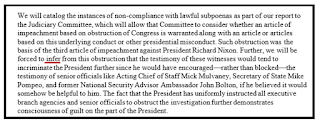
Adam Schiff is reduced from impeachment by hearsay all the way down to impeachment by inference: The fallback position is that President Trump did something "incompatible" with his office: impeachment by irreconcilable differences.

Adam Schiff is reduced from impeachment by hearsay all the way down to impeachment by inference: The fallback position is that President Trump did something "incompatible" with his office: impeachment by irreconcilable differences.
REH was Right, Again
The concept of the world of Conan, by Robert E. Howard, is that civilization rises and falls many more times than history tells us. This, worlds of advanced culture and adventures untold of exist to be explored.
Evidence for that proposition continues to appear.
REH was not alone, of course; not even the first.
Evidence for that proposition continues to appear.
REH was not alone, of course; not even the first.
The modern man looking at the most ancient origins has been like a man watching for daybreak in a strange land; and expecting to see that dawn breaking behind bare uplands or solitary peaks. But that dawn is breaking behind the black bulk of great cities long builded and lost for us in the original night; colossal cities like the houses of giants, in which even the carved ornamental animals are taller than the palm-trees; in which the painted portrait can be twelve times the size of the man; with tombs like mountains of man set four-square and pointing to the stars; with winged and bearded bulls standing and staring enormous at the gates of temples; standing still eternally as if a stamp would shake the world. The dawn of history reveals a humanity already civilized. Perhaps it reveals a civilisation already old.
Missing the point
CNN mysteriously got a sneak peak at IG Horowitz's upcoming Dec. 9 report on the scandal that led to a FISA warrant ostensibly aimed at investigating Carter Page as a clandestine Russian agent. CNN is spinning the story this way: yes, it's true that a lower-level FBI lawyer falsified a document that supported the FISA warrant, but the FBI has fired him, and anyway any "mistakes" (I love it) fail to "undermine the premise for the FBI’s investigation." CNN characterizes the premise as the notion “that Russia interfered in the 2016 election.”
What was that premise again? As Andrew McCarthy explains, CNN evidently is not (yet) trying to deny that the criminally faked supporting document could undermine any credible allegation that Carter Page was complicit in any Russian interference. The important fudge here is CNN's startling assertion that "the premise for the FBI's investigation" is Russian election interference. That might be a premise for some kinds of inquiry, but not a FISA warrant.
If an adequate premise for a FISA warrant were a mere suspicion of Russian skullduggery in an election, the Crossfire Hurricane gambit would be golden. That the Russians in fact attempted to interfere is not in controversy. The problem for Clapper, Brennan, McCabe, et al. (and the Obama White House may be included in that "al."), is that a FISA warrant to eavesdrop on a U.S. citizen requires a lot more than a suspicion that Russia is up to no good. It requires a showing that the citizen targeted for eavesdropping, Carter Page, is knowingly engaged in clandestine activities, potentially in violation of federal criminal law, on Russia's behalf.
Page has never been charged with a crime. Nor did the architects of Crossfire Hurricane inform the FISA court that Page had cooperated with the FBI in the past in successful prosecutions against Russian provocateurs. What does the basis for fingering Page as a Russian agent look like if you subtract whatever the fake document said, and add in the FBI's long track record of successful reliance on Page's voluntary assistance reporting on illicit Russian overtures? What's more, might these changes in the FISA presentation have undercut the FBI's and DOJ's showing that intrusive eavesdropping was necessary because other investigative tools were unavailable?
As McCarthy says,
What was that premise again? As Andrew McCarthy explains, CNN evidently is not (yet) trying to deny that the criminally faked supporting document could undermine any credible allegation that Carter Page was complicit in any Russian interference. The important fudge here is CNN's startling assertion that "the premise for the FBI's investigation" is Russian election interference. That might be a premise for some kinds of inquiry, but not a FISA warrant.
If an adequate premise for a FISA warrant were a mere suspicion of Russian skullduggery in an election, the Crossfire Hurricane gambit would be golden. That the Russians in fact attempted to interfere is not in controversy. The problem for Clapper, Brennan, McCabe, et al. (and the Obama White House may be included in that "al."), is that a FISA warrant to eavesdrop on a U.S. citizen requires a lot more than a suspicion that Russia is up to no good. It requires a showing that the citizen targeted for eavesdropping, Carter Page, is knowingly engaged in clandestine activities, potentially in violation of federal criminal law, on Russia's behalf.
Page has never been charged with a crime. Nor did the architects of Crossfire Hurricane inform the FISA court that Page had cooperated with the FBI in the past in successful prosecutions against Russian provocateurs. What does the basis for fingering Page as a Russian agent look like if you subtract whatever the fake document said, and add in the FBI's long track record of successful reliance on Page's voluntary assistance reporting on illicit Russian overtures? What's more, might these changes in the FISA presentation have undercut the FBI's and DOJ's showing that intrusive eavesdropping was necessary because other investigative tools were unavailable?
As McCarthy says,
If the narrative taking shape is that there may have been some abuses but it doesn’t change the fact that Russia meddled in the election, that misses the point. The questions are: What was the FBI’s evidence — which it represented as verified information in the warrant application — that the Trump campaign was in a cyberespionage conspiracy with the Kremlin? What evidence led the Bureau and the Justice Department to allege that Carter Page — who as late as spring 2016 was apparently cooperating in a federal prosecution of Russian spies — was a willful agent of the Putin regime engaged in clandestine activities against his own country?When we find out what the fudged evidence was, we'll be better able to issue comforting assurances that it was extraneous to pinning suspicion on Carter Page. It won't be enough for the FBI and CNN to conclude airily that the faked document was extraneous to the general idea that the Kremlin was trying to stir up trouble in a U.S. election.
Rolled Turkey
We've eaten a lot of turkey over the years, so much so that it's not an exciting meal even on Thanksgiving. In lean years we'd buy frozen turkeys after Christmas, when the price would hit annual lows, and store twelve or fourteen of them in our big freezer. That works out to about one a month, and turkeys take a while to eat, so at this point I'm not generally fired up to have turkey ever at all.
So I'm going to try something very different this year. Here's a French fellow explaining the concept with a chicken, but it'll work on a turkey too.
With an interesting stuffing and some decent spices, that might make for something a little less dull than another roast turkey.
So I'm going to try something very different this year. Here's a French fellow explaining the concept with a chicken, but it'll work on a turkey too.
With an interesting stuffing and some decent spices, that might make for something a little less dull than another roast turkey.
America, Republic and Empire
Quite a remarkable piece of thought-provoking writing. Dr. Codevilla, for those of you who know his work.
John Soloman Again
Tex mentioned him the other day. He's no longer employed by any reputable journalistic outlet as far as I can tell, and The Hill is 'reviewing' his earlier reports. In these intensely partisan times, that could mean that he's been publishing accurate information that defies the media's preferred narrative and that of their political allies; it could also mean that he's violated standards in a way that should be a serious concern to readers. I'm not sure which is the case, or if it's a mixture of both.
In any case, he has a blog now. If you're interested in his side of the story, that's where you can find it.
In any case, he has a blog now. If you're interested in his side of the story, that's where you can find it.
The NYT Against Impeachment
Not the NYT itself, not as a corporate body, but they did publish an opinion piece against it. Good for them: it's more than I expected. It's a pretty good piece.
I hear Fiona Hill loud and clear when she says she was angry when she discovered that the President had set up a parallel process to her own integrated, complex interagency process -- one that was operating without coordinating with them and pursuing goals she and others in the interagency thought unwise and even against American interests. I can understand how that would make you angry. In Iraq once we found out accidentally that Division had sent a guy who reported directly to the Commanding General to meddle in a matter likely to produce violence in our AO, without anyone telling us or warning us. Of course we were understandably angry about that, and the complaint is a rational one -- in our case, it put our lives and our people's lives at risk, just through a lack of coordination. Anger is a reasonable response in such a case.
Nobody thought, though, that the Commanding General should be relieved over it. Clearly he had authority to do it. Clearly here, too, the President has authority to override the interagency, or even just to ignore the interagency. The chain of command does not place the consensus of the bureaucracies over the elected president. As the author of this piece says, too, this particular president was elected precisely on the argument that the bureaucracies needed to be drained of influence. That's what he said he was going to do if elected, and he was -- like it or not, and many of us would have preferred someone else, in my case Jim Webb. Our preferred candidates made arguments too, and they didn't win.
UPDATE: The Nation also publishes an article against.
Mr. Trump’s opponents treat norms as if they were laws. But Mr. Trump openly campaigned in 2016 as someone who would rescind the nonlegal norms of American politics. He said he would “drain the swamp.” Washington’s traditional way of doing business, the legal but corrupt trade in money and influence, was something he was elected to attack. He has only contributed to the problem in the eyes of his critics, but for supporters the goal remains the same.If the investigations he was pursuing were reasonably indicated by the facts, it's not wrong to have asked for them even if it also benefits him politically (and then only in theory, contingent on the increasingly-unlikely success of Joe Biden in becoming his opponent). All of the witnesses this week agreed that the Hunter Biden matter created at least an appearance of conflict of interest; given Joe Biden's position as a high public official, and the direct relationship between himself and firing the man prosecuting his son's company, that seems correct. If there is a clear appearance of a conflict of interest, what could be more proper than to ask for it to be investigated to clear up whether there was wrongdoing? We have a treaty with Ukraine governing just that kind of investigation, one that was signed by Bill Clinton and that Joe Biden himself voted to ratify.
Mr. Trump was also elected to transform America’s foreign relations. The nation’s leadership in both parties and the Civil Service had embroiled the country in endless wars and a string of humiliations. That Mr. Trump considers officials serving in places like Ukraine to be part of the problem he was elected to solve is no secret. The testimony such officials have so far offered during impeachment hearings bears him out: Their view of American objectives is different from his....
Testimony at this week’s impeachment hearings from Gordon Sondland and other witnesses only underscores the point: President Trump believed it was right to call for Ukraine’s new president, elected on an anti-corruption agenda, to dig into and make public the links between his country, its government, its oligarchs and oil companies, and American political figures like the Bidens. The questions he was pursuing were bigger than the 2020 election.
I hear Fiona Hill loud and clear when she says she was angry when she discovered that the President had set up a parallel process to her own integrated, complex interagency process -- one that was operating without coordinating with them and pursuing goals she and others in the interagency thought unwise and even against American interests. I can understand how that would make you angry. In Iraq once we found out accidentally that Division had sent a guy who reported directly to the Commanding General to meddle in a matter likely to produce violence in our AO, without anyone telling us or warning us. Of course we were understandably angry about that, and the complaint is a rational one -- in our case, it put our lives and our people's lives at risk, just through a lack of coordination. Anger is a reasonable response in such a case.
Nobody thought, though, that the Commanding General should be relieved over it. Clearly he had authority to do it. Clearly here, too, the President has authority to override the interagency, or even just to ignore the interagency. The chain of command does not place the consensus of the bureaucracies over the elected president. As the author of this piece says, too, this particular president was elected precisely on the argument that the bureaucracies needed to be drained of influence. That's what he said he was going to do if elected, and he was -- like it or not, and many of us would have preferred someone else, in my case Jim Webb. Our preferred candidates made arguments too, and they didn't win.
UPDATE: The Nation also publishes an article against.
The Mysterious Case of Carter Page
One of the shoes we've been waiting to see drop in the "Russia Russia Russia!" case was that of Carter Page, the guy against whom the FISA warrant was actually issued. What's been quite mysterious about his case is the complete lack of charges brought against him for anything at all. The government convinced the FISC that he was dangerous enough to require a robust intelligence collection effort, which allowed them to intercept every communication he had with anyone, and all of their communications as well. The Mueller team prosecuted crimes aggressively, whether or not they were actually related to Russia -- indeed, the folks who went to jail all went down for something else.
So why was Carter Page never charged with anything? Surely, in collecting all of his communications, they must have found something? Surely they'd charge him with anything at all to justify the collection effort, rather than leave it looking as if the very collection effort hadn't proven justified by the facts?
Now we get some evidence for the first time about what's been going on with him.
So why was Carter Page never charged with anything? Surely, in collecting all of his communications, they must have found something? Surely they'd charge him with anything at all to justify the collection effort, rather than leave it looking as if the very collection effort hadn't proven justified by the facts?
Now we get some evidence for the first time about what's been going on with him.
Horowitz reportedly found that the FBI employee who modified the FISA document falsely stated that he had "documentation to back up a claim he had made in discussions with the Justice Department about the factual basis" for the FISA warrant application, the Post reported. Then, the FBI employee allegedly "altered an email" to substantiate his inaccurate version of events. The employee has since been forced out of the bureau.This will be interesting.
In its initial 2016 FISA warrant application, the FBI flatly called Page "an agent of a foreign power."
Sources told Fox News last month that U.S. Attorney John Durham's separate, ongoing probe into potential FBI and Justice Department misconduct in the run-up to the 2016 election through the spring of 2017 has transitioned into a full-fledged criminal investigation -- and that Horowitz's report will shed light on why Durham's probe has become a criminal inquiry.
Boys Need Fathers
Two pieces on the same subject, both by women. One of them is by Shireen Qudosi, who works on counter-extremism projects and thus naturally connects the issue to that of the mass killing problem. Some of you mentioned lack of fathers in the comments to that post, so here's some additional support for your ideas. (Here's more.)
The second is from Belinda Brown in the UK. I'm not very convinced by some of her evidence about the difference between boys and girls -- if girls 'don't want any conflict' and 'try to be equals' and 'forget who won' in conflicts between themselves, I've never noticed it, but I have noticed girls forming intense friendships that fall apart and never recover over internal conflicts. I've also noticed girls forming larger cliques with rigid hierarchies. Although actually her structure is ambiguous enough that I'm not sure if she means 'girls' or 'female chimpanzees' in that section, so perhaps it holds for chimps. In any case, her real topic is boys, and what she says there is more interesting.
Both of the pieces reference mythic-language books about the meaning of manhood, both of which have the word "Warrior" in the title. My sense is that it is society's attempts to get rid of the warrior aspects that is causing a lot of the problems for boys and men; perhaps it lies at the back of the whole of the problem.
The second is from Belinda Brown in the UK. I'm not very convinced by some of her evidence about the difference between boys and girls -- if girls 'don't want any conflict' and 'try to be equals' and 'forget who won' in conflicts between themselves, I've never noticed it, but I have noticed girls forming intense friendships that fall apart and never recover over internal conflicts. I've also noticed girls forming larger cliques with rigid hierarchies. Although actually her structure is ambiguous enough that I'm not sure if she means 'girls' or 'female chimpanzees' in that section, so perhaps it holds for chimps. In any case, her real topic is boys, and what she says there is more interesting.
Both of the pieces reference mythic-language books about the meaning of manhood, both of which have the word "Warrior" in the title. My sense is that it is society's attempts to get rid of the warrior aspects that is causing a lot of the problems for boys and men; perhaps it lies at the back of the whole of the problem.
Subscribe to:
Posts (Atom)