Lunacy

I know it's Salon, and I shouldn't expect much, but even by those jaded standards, the explanation offered by Chauncey deVega (if that really is his name) for robust Trump support among "white voters" leaves me blinking rapidly.
The idea behind white identity politics is that there is a subset of white voters and/or white Americans in general who feel a sense of attachment to their group. They feel a sense of solidarity. They think that their race and their racial identity is important to who they are, and that influences how they see and view the political world. Tied up in that sense of identity is the belief that whites are losing out in the United States and that their status and their power are somehow under threat. Subsequently, these white voters are responding to that politically by supporting policies and candidates that they view as protecting their group and preserving its status.
I do support Trump's policies from a belief that they protect my interests, and I will grant that I perceive my interests as under threat. The source of the threat, nevertheless, doesn't take the form of dark skin, though it's true that a candidate who has nothing to point to but his skin (approvingly, and mine, disapprovingly) will arouse my suspicion. The argument has devolved to "Of course you only think that way because you're blinded by race, so listen to me while I obsess on race." Supposedly I'm motivated by fanatical loyalty to Social Security and Medicare (which I don't even like), primarily because they are the kinds of things white people like.

Chauncey's whole argument is that, Trump being indisputably contemptible, there's only one explanation remaining for my support: I'm evil, too. And how are people evil today? Only in one way: racism. Q.E.D. Even my otherwise inexplicable sense of oppression by "non-believers" can be explained by racism, because if you scratch the surface, white evangelicals are simply terrified racists who hate brown people.

And then it seems I overlook Trump's "gross disregard for the Constitution."  Where do people even get this stuff? Chauncey might as well be beaming Martian at me.

What to do? Chauncey advocates court-packing, "discarding any notions of civility and compromise," using social media to correct a pro-right advantage (you need special spectacles to detect that), and using
simple, clear direct messaging which speaks to both emotions and the facts: The Republicans are trying to kill you. The Republicans are making you sick. Republicans don't care about your family. Republicans don't want you to vote. Republicans are stealing your money and giving it to rich people. Donald Trump thinks you are stupid.
Would that primitive bludgeon of a message square any less with reality if you substituted "Democrats" for "Republicans"?  Is there anything left in politics of this stripe but projection?

Don't Be Ridiculous

They're being ridiculous.
One of the arresting officers at yesterday's #NeverAgainAction can be seen sporting a Molon Labe tattoo, a prominent slogan of contemporary fascism.
1) Those kids are only being arrested because they want to be arrested. It's a form of protest, probably negotiated with the police in advance to ensure they will receive light or dropped charges, good treatment, and short stays in detention that can be used as bragging rights as demonstrators.

2) "Molon Labe" as a sentiment is opposed to overbearing governments; I take it to mean that this officer is refusing to enforce gun control laws he might see as unconstitutional. That's the opposite of fascism, when even the actual officers of the state posit limits to state authority they would refuse.

Guns and the Anarchist

A left-leaning anarchist writes about guns.
In Stone Mountain, Georgia, when a group of us marched through the streets to celebrate the cancellation of a Klan rally on February 2, we were accompanied by local activists with rifles and ARs slung over their shoulders; the police kept their distance, which was an extraordinary sight for someone used to New York City’s ultra-aggressive, hyper-militarized NYPD. As the black militant liberation group the Black Panthers showed back in the 1960s, as the Zapatistas showed in the ’90s, and as anarchists in New Orleans showed during the aftermath of Katrina, when cops and other fascists see that they’re not the only ones packing, the balance of power shifts, and they tend to reconsider their tactics.

To be honest, the thought of a world in which the state and their running dogs are the only entities with access to firearms sends a shudder down my spine.

Leftist gun ownership is about protecting marginalized communities


Not everyone should have access to guns — domestic abusers, for example, have proven by their actions that they cannot be trusted with that kind of responsibility — and not everyone needs it. No one without a significant amount of training should be handling a firearm at all, which is why I think designated community patrols made up of well-trained, highly trusted individuals who are chosen by and held accountable to said community (and who do not hold any or less power than anyone else due to their position) is a far better and more equitable defense model than messy “everyone gets a gun!” rhetoric.

I’m also not interested in creating a parallel cultural universe wherein balaclava-clad “gun bunnies” pose for the ’gram (I’d much rather shore up support for Rojava’s all-women YPG Women’s Defense Unit). I’m interested in reclaiming the notion of armed self-defense from those who have long used it as a cudgel to repress dissent and terrorize marginalized communities, and emphasizing its potential as a transformative tool toward collective liberation.

There is a long history of leftist gun ownership, and a concurrent theme of state repression against it.
"Designated community patrols made up of well-trained, highly trusted individuals" is more or less exactly the original vision for local militias as the primary defense of a free state; and concerns about a militarized police are quite similar to the Founders' concerns about a standing army.

There are two criticisms I would make, all the same.

1) It's hard to square 'designated... highly trusted' with 'protecting marginalized communities.' When you move from a universal individual right that can only be lost by demonstrated criminality (I agree with the domestic violence disqualification, for example), you allow space for marginalization to occur. In fact, that is exactly how the racist roots of gun control worked: through processes of restriction to 'trusted' members of the community, which just so happened to disqualify people of a particular race. This subject, of which she makes much in her essay, is extremely well-known to those of us on the right; it's been one of our chief arguments for at least a couple of decades.

If you want to protect marginalized communities, you have to prevent marginalization of individuals. Otherwise, you'll find that your marginalized community gets marginalized one individual at a time. There are some clear and acceptable reasons to marginalize an individual, but the defense of an individual right is necessary to ensure that distrusted communities aren't shut out of the right to the tools they need to defend themselves.

2) It would be wiser to make common cause with the gun-rights right than to try to set up against us. The temptation to do that is clear in the current culture wars; we're just used to thinking of each other as opponents at least, enemies at worst. That said, there's an opportunity not to be missed here. She's saying very little I haven't said myself in these pages, from praise for the original pre-criminal Black Panther project to a defense of the general idea (inherent in the NRA's original mission, which provided firearms and training to Freedmen in the South) that the individual right to keep and bear arms is a necessary part of the defense of human dignity. The argument that we can't rely on the police to protect us? Regular feature of the Hall. The argument that having only the servants of the state armed all but ensures tyranny? All the time here.

If we can't find a way to be allies, we'll end up killing each other. That won't protect anyone's community. The idea should be -- as it was framed by the Founders, even if they did not actually live it out this way -- to set up these local militia as guarantors of a state of liberty for all. That's harder to square with anarchism than it is with citizenship, because it is something like citizenship that creates and binds individuals together with common duties toward one another that wouldn't exist naturally. Minarchism makes more sense than anarchism, in other words.

Funding the Trans*ition

It's the usual TIDES Foundation suspects, of course, but there's an interesting twist on why it's a priority.
Why do they care? The obvious answer is: money.

Melding this manufactured medical issue with civil rights frame entails the continuance and growth of the problem. Transgenderism is framed as both a medical problem, for the gender dysphoria of children who need puberty blockers and are being groomed for a lifetime of medicalization, and as a brave and original lifestyle choice for adults. Martine Rothblatt suggests we are all transhuman, that changing our bodies by removing healthy tissue and organs and ingesting cross-sex hormones over the course of a lifetime can be likened to wearing make-up, dying our hair, or getting a tattoo. If we are all transhuman, expressing that could be a never-ending saga of body-related consumerism.
The amounts being spent to advertise and advance this lifestyle choice seem vast until you compare it to the amounts that would be spent by a society that invests in a lifetime of additional medical supplies and treatments. If even an extra few percent could be convinced to do it, purveyors of such technologies would make back their investments many times over.

To a certain degree technological change makes these kinds of things likely. William Gibson was imagining cyber and biotech allowing people to alter their bodies decades ago; one gang he envisioned replaced their teeth with animal fang implants. We will be in charge in a new way, and that means we can treat the body as an opportunity for a kind of art.

Against that challenge, of course, stands the Aristotelian philosophy we've been discussing. Because it sees nature as the source of the good, it will be predisposed to reject adopting a lifetime of pharmacology to suppress hormones or provide humans with wolf-like teeth. The role of art, for Aristotle, is to perfect the goods inherent in nature but imperfectly or incompletely realized. Dental surgery to fix improperly-grown teeth is good because it improves the perfection of a natural good; pulling out the teeth and replacing them with wolvish fangs that do not fit the natural diet of a human being is bad because it works against rather than with the goods of nature.

"Well, we can change our dietary tract too, someday, at least in principle; and we can grow 'meat' in vats that will avoid any ethical problems with switching to an all-meat diet; and we can force, with drugs and surgery, our bodies to accept all this, becoming artists of ourselves."

Perhaps. But there is something to be said for being able to sleep under the stars, with no medicine and no technology, to survive on natural strength rather than technological infrastructure. Aristotle has an advantage here, even in spite of all the long years and great changes.

Hearty and Hellish!

Per Gringo and my conversation, in the Jug of Punch post below, it turns out that "Hearty and Hellish!" was actually the name of the album -- recorded live at a nighclub in Chicago in 1962.


"Hellish," they said. Well, "-ish" is the ultimate in approximations.

Deadly Force Authorized

You'll want to carefully consult your local laws to be sure how this works for you, but in most parts of America it would be considered reasonable to shoot someone if they tried to hit you with a crowbar or tire-iron. It would be less reasonable to shoot someone for throwing a milkshake at you, except if it became sufficiently commonplace that milkshakes were really chemical weapons.

Powerline wonders about how long this sort of thing will be allowed to go on. My guess is that it will go on for a while, until someone's patience wears out. Then, when the cost of this sort of behavior suddenly becomes much higher -- and especially if juries refuse to convict people for defending themselves, lowering the probable cost of defensive action -- suddenly it won't be necessary to worry about it that much.

UPDATE: Wretchard makes sense like always.
It's not surprising that the French Terror began with the purge of the moderates and the urgency of virtue. As Robespierre put it, virtuous men have no choice but to employ any means necessary:
If the basis of popular government in peacetime is virtue, the basis of popular government during a revolution is both virtue and terror; virtue, without which terror is baneful; terror, without which virtue is powerless. Terror is nothing more than speedy, severe and inflexible justice; it is thus an emanation of virtue; it is less a principle in itself, than a consequence of the general principle of democracy, applied to the most pressing needs of the patrie.
He also says "the combativeness of the last few days alarmed those accustomed to regarding themselves as civilized." Well. Oddly once I thought of myself that way; I wrote that the essence of a gentlemen was "to bear arms, in defense of country and civilization." Surely I still think that, somewhere in my heart. I've spent many years becoming educated, if not precisely civilized; I pursued and gained advanced degrees in both history and philosophy. Whatever it means to have a civilization, history and philosophy are at the core of it.

More and more, though, I think of the Conan quote from last week, and find that my eyes linger on my axe.

Ignoring Warning Signs

Bret Stephens issues a clear and sober warning:
Promising access to health insurance for north of 11 million undocumented immigrants at a time when there’s a migration crisis at the southern border? Every candidate at Thursday’s debate raised a hand for that one, in what was surely the evening’s best moment for the Trump campaign.

Calling for the decriminalization of border crossings (while opposing a wall)? That was a major theme of Wednesday’s debate, underlining the Republican contention that Democrats are a party of open borders, limitless amnesty and, in time, the Third World-ization of America.

Switching to Spanish?... Eliminating private health insurance[?]...

And then there are the costs that Democrats want to impose on the country. Warren, for instance, favors universal child care (estimated cost, $70 billion a year), Medicare-For-All ($2.8 trillion to $3.2 trillion annually), student-debt cancellation and universal free college ($125 billion annually), and a comprehensive climate action plan ($2 trillion, including $100 billion in aid to poor countries), along with a raft of smaller giveaways, like debt relief for Puerto Rico....

Throughout the debates, I kept wondering if any of the leading candidates would speak to Americans beyond the Democratic base.... [Nope!]

None of this means that Democrats can’t win in 2020. The economy could take a bad turn. Or Trump could outdo himself in loathsomeness. But the Democratic Party we saw this week did even less to appeal beyond its base than the president. And at least his message is that he’s on their — make that our — side.
Did anyone listen? No, they called him a "white nationalist" like he was a member of the Aryan Brotherhood or something.

How about Andrew Sullivan? Is he a Klansman too? He's actually asking that question, except he mentions "Japan" and "China" in place of his own name.

The thing is that these guys are really against Trump, and trying to keep the Democrats from making a massive mistake. This is as clear a warning as you could ask, from people who are your friends and want you to win. I've never seen this movie, but this clip has come up from time to time. It seems appropriate to the moment.


UPDATE: Colonel Kurt, who is less concerned what anybody calls him, sums up.
But it was the thought part where they came together in a festival of insane acclamation. They agreed on everything, and it was all politically suicidal. Yeah, Americans are thrilled about the idea of subsidizing Marxist puppetry students and getting kicked off their health insurance so that they can put their lives in the hands of the people who brought you the DMV.

Exactly who, outside of Manhattan and Scat Francisco, think Americans are dying to stop even our feeble enforcement of the border, make illegal immigration not illegal, never send illegals home once they get here and – think about this – take our tax money to give these foreigners who shouldn’t even be here in the first place better free health care than our vets get? That should go well in places like Wisconsin, Michigan and Pennsylvania. I eagerly await Salena Zito’s interview with a bunch of construction workers at a diner near Pittsburg who tell her, “It really bugs me, Lou and Joe here that those people coming into the country illegally aren’t getting free heath care on our dime. We all want to work an extra shift so we can give it to ‘em. We need a president who finally puts foreigners first! Also, we all agree we ought to give up our deer rifles because people in Cory Booker’s neighborhood can’t stop shooting each other.”

Spirituality and Such

A set of meditations from Presidential candidate Marianne Williamson (h/t Wretchard).

From 2010: The Boar's Head

This one's from Tex, being recipes for several classic pig's head dishes. We're a long way from Christmas, but since it crossed my screen tonight, I wanted to bring it forward.

Here's the carol, too, while we're on the subject. It's a long way to Christmas, but it's not bad to be reminded of it even at this distant hour.

From 2007: Choosing a Stetson

I came across this post while looking for something else. It's useful, practical advice that holds true still as far as I know. If you get one of the good ones they're good hats; I wore one to the Philippines (which I gave away to a member of the RP military) and another Iraq the whole time I was out there, and it served in the desert as well as in the wood.

The Jug of Punch

Before the merry month of June ends, we should have a listen to this beautiful piece.

Two from AL Daily

The first one wonders if AI means the end of anonymous authorship. Maybe looking backwards, but couldn't an AI serve to randomize your language just enough to ensure you weren't recognizable? Seems like more of an arms race than a finale.

On "The end of enchantment" and the Enlightenment. I obviously disagree that ending animism or enchantment is a necessary product of reason; panpsychism is as old as Plato, and inherent in the Neoplatonic philosophy that I think is the closest human beings have gotten to the truth. Praise for the Frankfurt school strikes me as short-sighted, but it's worth reading all the same because of this insight:
[A] surprising 83.3 per cent of Americans believe in either guardian angels, demonic possession or ghosts, and there is evidence for similar belief patterns in western Europe. (I should note that disenchantment should not be confused with secularisation. The sociological evidence suggests that de-Christianisation, while usually equated with secularisation, often correlates with an increase in belief in spirits, ghosts and magic – not the reverse.) Nor are sociological surveys the only evidence. If one views Europe and North America through the same sort of anthropological lens that European and American anthropologists are used to directing abroad, it seems hard to defend the notion that the ‘modern West’ is straightforwardly disenchanted. There are plenty of examples.

Walmart sells ‘Sage Spirit-Smudge Wands’ and clothing chains such as Urban Outfitters sell ‘healing crystals’ and tarot cards. You can go on eBay right now and pay an Australian ‘white witch’ to perform a ritual to summon a djinn and bind it to an object of your choice. Celebrities such as Anna Nicole Smith and Bobby Brown have publicly described having sex with ghosts. Coffee shops and co-ops throughout the US and much of western Europe display flyers advertising ‘palm readers’, ‘energy balancing’ and ‘chakra work’. Even if you ignore the Harry Potter craze and other fictionalised depictions of wizards, ghosts and witches, studies of American reading habits suggest that ‘New Age’ print culture is incredibly lucrative, with ‘non-fiction books’ about magic, guardian angels and near-death experiences frequently appearing in the upper echelons of Amazon’s bestseller lists. And the past 15 years have seen a proliferation of ‘reality’ television series that claim to report evidence for ghosts, psychics, extraterrestrials, monsters, curses and even miracles.
This pattern is older than the Frankfurt School, as it was known to Chesterton. Like Chesterton, we sit in a strange place with regards to it. On the one hand, Chesterton favored Roman Catholicism over some other variations of Christianity -- and especially materialism -- just because it offered him the opportunity to believe in faerie.
The Christian is quite free to believe that there is a considerable amount of settled order and inevitable development in the universe. But the materialist is not allowed to admit into his spotless machine the slightest speck of spiritualism or miracle. Poor Mr. McCabe is not allowed to retain even the tiniest imp, though it might be hiding in a pimpernel. The Christian admits that the universe is manifold and even miscellaneous, just as a sane man knows that he is complex. The sane man knows that he has a touch of the beast, a touch of the devil, a touch of the saint, a touch of the citizen. Nay, the really sane man knows that he has a touch of the madman. But the materialist’s world is quite simple and solid, just as the madman is quite sure he is sane.
It seems as if there is a health that attends to belief in the imp, in the not-quite-settled and not-quite-understandable nature of reality. Which indeed there is; philosophy can sketch the limits of reason readily. Kant does so in his first critique, and prior philosophers come to the ineffable regularly. The worst thing to believe is that reality is purely rational, subject to human science, and completely comprehensible. Chesterton is not wrong to say that madness lies that way.

On the other hand, healing crystals are bunk, and the 'white witch' isn't really sending you a magic item with a bound jinn.

A Real Russian Information Operation

Vladimir Putin does not have "traditional values." Vladimir Putin is a former KGB agent turned gangster-government strongman. So when he says things like this, it's worth remembering that he's not advocating things he really believes in; he's advocating things he thinks will exacerbate divisions in the West.

It would behoove us to find a way to attain the stability associated with 'traditional values' without playing into the hands of people like Putin.

Serious People

"Medicare for All" was already supposed to cost a nearly unfathomable amount of money. What if we were to pledge to add to it the costs of anyone from anywhere in the world who shows up here needing health care, regardless of whether or not they have any sort of visa or legal right to enter the country?


As I've said in this space before, I'd love to hear the plan to save the Medicare we have before they start telling me that they're going to institute Medicare for All. That was when I assumed that "all" meant "all Americans," rather than "∀." It's a logical principle easy to script: (∀x)Fx->Gx. That is, 'for all x, if x is a person who needs healthcare, x gets it for free.'

People ask, "But how will you pay for it?" They answer, "We'll print the money we need." Well, yes, you can print money. Can you also print the doctors you'll need? This way lies inflation, sure, but the bigger problem will be scarcity of medical resources -- just as our largest population of American citizens, the Boomers, reach the age at which their need for medical resources will be greatest.

It's madness. Every single one of them put their hands up for it.

Just Not Getting It

The SCOTUS issued what strikes me as a completely weird decision today on the census. As I'm sure you've heard, they declared that the administration's explanation for wanting to ask whether counted people were citizens was "insufficient," and sent the case back down for more consideration once a fuller explanation was provided.

I'm unclear on exactly why any explanation is needed. This is surely what a census is supposed to do. What exactly is the census for if it isn't to count the number of citizens in each state? Is there some reason the United States government shouldn't be allowed to know how many people are inside a given state who aren't citizens? By law, all of those people should have a legal status registered with the government, after all: a visa or a permanent residency, for example. Conducting the census is an actual Constitutional duty of the Federal government. Why should the government need to explain itself at all?

Political Courage in Contemporary America

Tim Young: I dont know about you guys, but I thought the bravest, most courageous moment of the #DemDebate was when Julian Castro defended a transgender woman's right to have an abortion.
I wonder how long it will be before "Life of Brian" is held to be hate speech -- not because it makes fun of Christianity, but because of this scene:

Dan Crenshaw vs. Google

The tech giants seem determined to force a conflict in terms of their effect on our self-governing republic, and they're starting to get one.

Tulsi Beats Warren

Her argument that she is 'the most qualified to be commander-in-chief' is not quite right, but she is the most qualified of the ones who have any kind of chance. They're running a bunch of career politicians, so she's the closest thing: a real military officer, albeit one who served in a medical staff role rather than one who would have "commanded" in the ordinary military sense of the term.

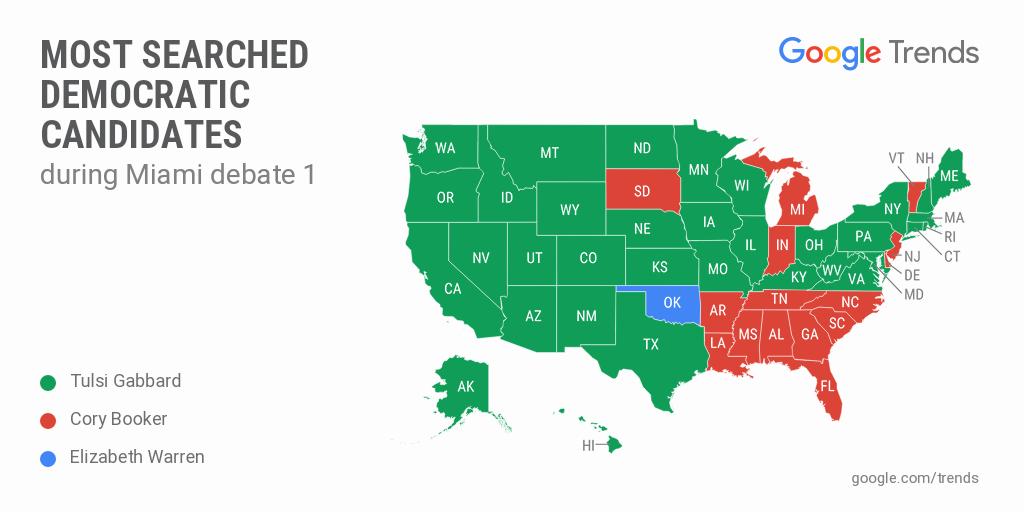
She won the Drudge Poll and the Google Search quasi-poll, and Reason was impressed with her.

I like Tulsi, as I've said before. It's just hard to imagine turning the keys over to her given her courting gas-my-own-population Assad. On the other hand, she has been a strident defender of religious liberty at a time when that liberty is under heavy assault. We could certainly do worse than to have her head the Democratic ticket.

UPDATE: TNR strikes a measured tone:
Over the course of two hours, approximately seven minutes were devoted to the top existential threat facing humanity. And only four of the ten candidates on stage were asked directly about how they intend to rapidly reduce carbon emissions over the next eleven years—something that must be done to preserve a livable planet for future generations.... It was, to put it lightly, a disgrace—and not just because climate change was the number one issue that Democratic voters wanted to see discussed at the debate. The debate itself was held in Miami, Florida, a city that’s literally being swallowed by the rising ocean.
If you are curious, Tulsi's "vision" says some very sweet things about the environment, but has zero specifics on exactly how to attain any of them.

The debates

John Podhoretz on the elevated tone we can expect:
The only way these debates will matter is if they are exciting. And the only way to ensure that people keep watching them as the months pass, and thereby create a sense that the Democratic Party is full of life, is if these first debates reward their interest with fireworks.
It’s the shmendricks who need to set the debate hall on fire — you know, the ones you’ve never heard of, like the governors of Climatechangiana and Potsmokia and the House members from Whereverdude and Freestuffistan.
If only I had more confidence one of those guys wasn't going to end up with the nomination.

Bill Barr, Bagpiper

With the full marching band backing him up it's hard to hear how good he is, but it's a fine look for an Attorney General.