Baggett’s [B-24] was badly hit, and the crew were ordered to bail out. The Japanese pilots then attacked U.S. airmen as they parachuted to earth.Field & Stream called it one of the greatest feats ever accomplished with a .45. As for Baggett, he apparently survived the war and lived to a prosperous ripe old age.
Two of Baggett’s crew members were killed, and Baggett, though wounded, played dead, hoping the Japanese would ignore him. One Zero approaching within several feet of Baggett, then nose-up and in an almost-stall, the pilot opened his canopy. Baggett shot at the pilot with his .45 calibre pistol. The plane stalled and plunged to the earth, with Baggett becoming legendary as the only person to down a Japanese airplane with a M1911 pistol.

Sea Story
One I hadn't heard before:

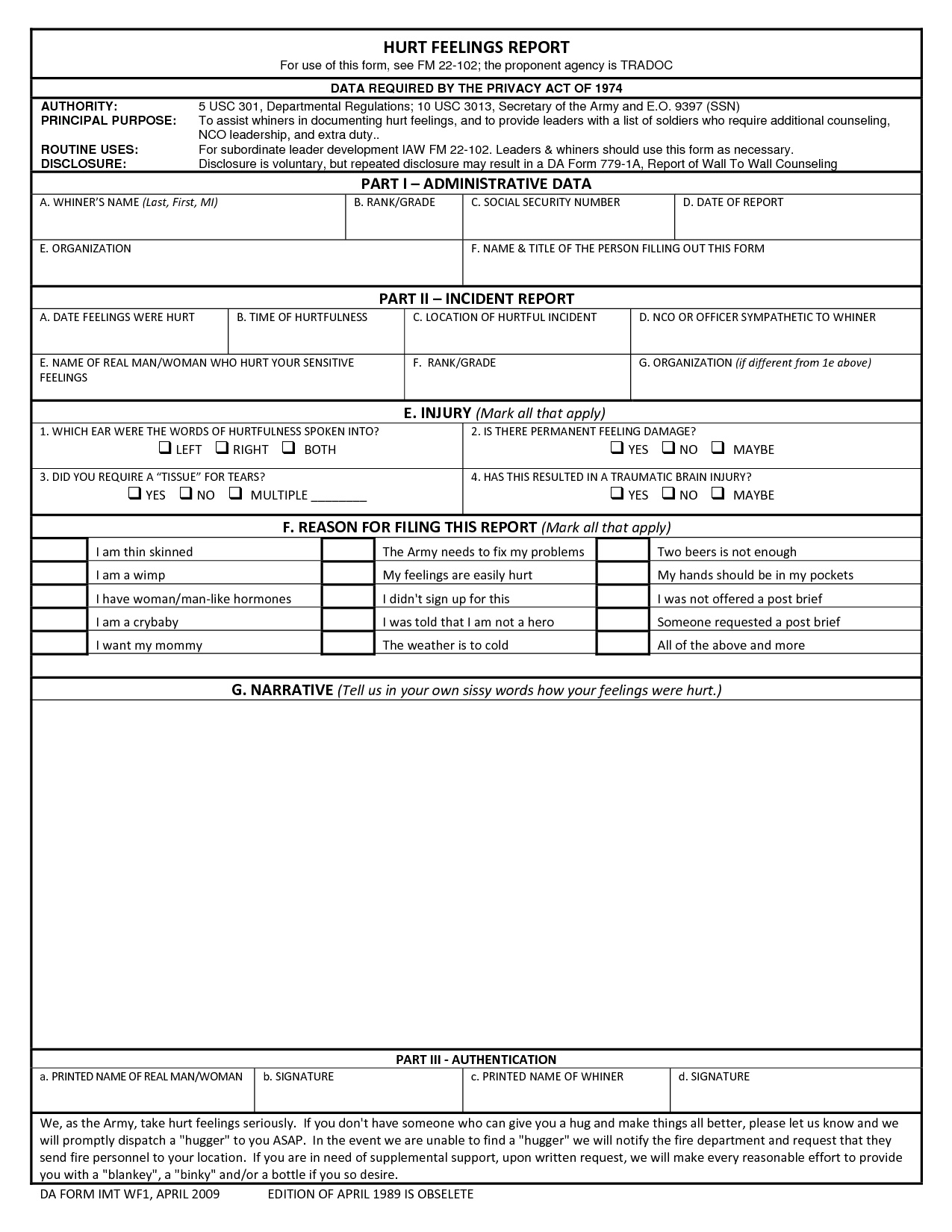
The 'Hurt Feelings Report' Goes Live
No way.
A school in Delaware apologized on Wednesday, Feb. 17, 2016, after a staff member accidentally sent a snarky "Hurt Feelings Report" to parents.It looks like the one we've been passing around for years as a joke. I wonder if the parents got the joke?
The Pope Is Making News Today
I have a lot of respect for Pope Francis, but he should probably not opine on American politics without taking more care to understand the situation. When Donald Trump can make you look like you haven't really thought through your position, you're having a bad day.
Of more interest may be his remarks on an exception to the Church's ordinary prohibition of birth control, which draws a bright line between birth control and abortion. This is the sort of thing he's better placed to talk about. I suspect there's a danger, if that's the right word, that most American Catholics would be only too happy to take that distinction and run with it. Almost no Americans of any stripe are opposed to birth control on moral grounds. If the Church intends to maintain that prohibition as a usual thing, exceptions will need to be very carefully drawn.
Of more interest may be his remarks on an exception to the Church's ordinary prohibition of birth control, which draws a bright line between birth control and abortion. This is the sort of thing he's better placed to talk about. I suspect there's a danger, if that's the right word, that most American Catholics would be only too happy to take that distinction and run with it. Almost no Americans of any stripe are opposed to birth control on moral grounds. If the Church intends to maintain that prohibition as a usual thing, exceptions will need to be very carefully drawn.
A Crucial Demographic in Nevada Speaks
Up until now, I thought Bernie was winning women in this age bracket, but I suppose there are interested exceptions.
The Hearing Protection Act
Speaking of gun rights legislation, HR 3799 is in committee in Congress. It would remove suppressors and "silencers" from the National Firearms Act, making them readily available for use by individuals. As someone who both shoots guns and rides motorcycles, all I have to say is -- what did you say? I couldn't quite hear you.
Altamont South
A sold out concert in Tampa, Florida may lack the usual police protection.
Probably this lady will get her way again, as the sense of duty toward securing the concert-goers overwhelms the bad taste in the mouths of off-duty police.
But hey -- if the police thing doesn't work out, she can always try the Outlaws.
In the wake of Beyonce’s controversial Super Bowl halftime performance of her new song “Formation” — which critics say contains an anti-cop message — police and politicians around the country have been speaking out against it.I didn't see the Superbowl, but I did see a lot of mockery of her for having demanded a police escort that closed off an entire highway for her motorcade -- in order to sing a song about the evils of cops. That's par for the course with these celebrities, though. I may field occasional criticisms of police, but I don't ask them to bow and scrape to me while I do it. In fact, I try to leave them alone, and if I do have to call them for some reason -- usually a neighbor's escaped livestock, out here -- I always treat them with the courtesy and respect due to someone who shows up when called to do a hard job.
But the criticism could be manifesting itself in practical ways, given what’s happened since police in Tampa, Florida, got a request to work her April 29 concert in town.
Usually off-duty officers sign up to work concerts and sporting events for extra cash, but to date no officers have signed up for the show, WTVT-TV reported. And given it’s expected to sell out, that could be a security issue.
While police spokesman Steve Hegarty couldn’t tell the station if zero sign-ups means local cops are angry with Beyonce, he did say the show would have security.
Probably this lady will get her way again, as the sense of duty toward securing the concert-goers overwhelms the bad taste in the mouths of off-duty police.
But hey -- if the police thing doesn't work out, she can always try the Outlaws.
Georgia Legislature Update: Campus Carry Passes House Committee
House Bill 859 has made it out of its initial committee, and can now proceed to the House Rules Committee. You can write the members of that committee to urge its passage here. However, I expect it will pass out of this committee whether or not you write anyone: the chairman is a co-sponsor.
Georgia is in a weird position on campus carry because it passed two laws with different language recently. Students for Concealed Carry explain after the jump. This law would clarify the situation legislatively, rather than waiting for a court to do it -- which could result in someone who thought they were obeying the law going to jail, if the court decides against them.
Oddly, HB 859 seems to undo a feature of Georgia's weapons carry laws I normally tout as a highly desirable feature: it severs handguns from knives. I often prefer to carry a knife instead of a handgun, as it is useful in far more situations and eliminates the dangers of overpenetration, ricochet, and similar risks in highly populated areas. (Obviously, it does this at the cost of limiting your effective range, and knives require much more training and practice to be effective.) HB 859 would allow people who have undergone background checks and obtained the weapons carry permit to carry handguns only on school property (and not to sporting events).
Georgia is in a weird position on campus carry because it passed two laws with different language recently. Students for Concealed Carry explain after the jump. This law would clarify the situation legislatively, rather than waiting for a court to do it -- which could result in someone who thought they were obeying the law going to jail, if the court decides against them.
Oddly, HB 859 seems to undo a feature of Georgia's weapons carry laws I normally tout as a highly desirable feature: it severs handguns from knives. I often prefer to carry a knife instead of a handgun, as it is useful in far more situations and eliminates the dangers of overpenetration, ricochet, and similar risks in highly populated areas. (Obviously, it does this at the cost of limiting your effective range, and knives require much more training and practice to be effective.) HB 859 would allow people who have undergone background checks and obtained the weapons carry permit to carry handguns only on school property (and not to sporting events).
Turkish Fascism
The piece I mentioned below deserves a longer consideration. No one knows what to do about Turkey, which is a NATO ally that is -- to quote what I wrote earlier this week -- "openly Islamist, deceitful, and murderous, [and that] does not deserve our support." Nevertheless, the treaty obligation requires us to fight in their defense should the war they and Russia are playing at starting break out into full scale.
I suspect Russia believes we would not, especially under Obama, actually come to their aid with more than symbolic force. There is some reason to doubt they are right about this supposition. We moved F-15C fighters to Turkey following the movement of Russian air superiority fighters to Syria earlier this fall. In response, probably, came Russia's deployment of S-400 missiles in Syria. The older F-15C is not thought capable of defeating this system. Of the fighters we have, only the F-22 and F-35 incorporate stealth technology completely enough that we think them safe against the S-400 system. We deployed four(!) F-22s to Germany in August on an operational basis.
Does that mean we're getting ready to fight the Russians? Perhaps -- these are two of several shifts that suggest we are at least bluffing our readiness to do so. A bluff is rational, since the best outcome would be avoiding a Russian test of our treaty commitments entirely. Unfortunately, bluffs by this administration are likely to be called because they have been called in the past and have proven to be empty. Syria itself is the leading example, thanks to the President's so-called "red line" on chemical weapons use. Putin probably doubts that there is anything behind these moves besides bluster.
He's probably right to probably think that.
All of that leaves us with a quandary about Turkey. It's a major problem.
Further, if liberalization and democratization of Turkey is the very reason they are turning Islamist, what policy choices do we have in front of us for improving that alliance should it survive? Endorsing the fascism? But the fascism is now part of the Islamist problem. Endorsing more democracy? That's how we got the fascist Islamists. Endorsing a liberal but anti-democratic coup? Overthrowing, in other words, a NATO ally?
The conclusion that the administration does not have any idea what to do with Turkey is warranted. The best choice might be to preemptively expel them from NATO for their genocidal policy against the Kurds. Then the Russians could do what they liked to Turkey without endangering NATO, which would be reserved for its more obvious and plausible function of defending liberal democracy in Europe. That would concede the Middle East to the Russian/Iranian alliance, however.
I suspect Russia believes we would not, especially under Obama, actually come to their aid with more than symbolic force. There is some reason to doubt they are right about this supposition. We moved F-15C fighters to Turkey following the movement of Russian air superiority fighters to Syria earlier this fall. In response, probably, came Russia's deployment of S-400 missiles in Syria. The older F-15C is not thought capable of defeating this system. Of the fighters we have, only the F-22 and F-35 incorporate stealth technology completely enough that we think them safe against the S-400 system. We deployed four(!) F-22s to Germany in August on an operational basis.
Does that mean we're getting ready to fight the Russians? Perhaps -- these are two of several shifts that suggest we are at least bluffing our readiness to do so. A bluff is rational, since the best outcome would be avoiding a Russian test of our treaty commitments entirely. Unfortunately, bluffs by this administration are likely to be called because they have been called in the past and have proven to be empty. Syria itself is the leading example, thanks to the President's so-called "red line" on chemical weapons use. Putin probably doubts that there is anything behind these moves besides bluster.
He's probably right to probably think that.
All of that leaves us with a quandary about Turkey. It's a major problem.
American democracy could survive as a liberal democracy despite the heavy repression of socialists and radical labour. However, in much of Europe, these forces were so strong [in the 1930s] that the state’s repressive apparatuses expanded indefinitely. When they were not sufficient, civilians were mobilized, and fascism was born.What sense does it make to have a major alliance with a fascist, Islamist power? Is it worth defending should the Russians decide to smack it around, at the cost of war with Russia? Certainly not. If the NATO alliance is fractured by our failure, though, can it be saved for the more plausible cases? What if Russia moves to reconquer the Baltic states it ruled as the Soviet Union? Are they worth fighting for, at the cost of war with Russia? What about Norway?
What is clear, in light of the Turkish case, is that liberalisation and democratisation cannot go hand-in-hand for an extended period of time in structurally weaker societies. While the spoils of a semi-productive model could satisfy many social groups, the downturn of the world economy after 2008 gradually dynamited the cash basis of the AKP’s consent. In this new global scene, the party had to incorporate more and more Islamist cadres to retain a mobilised base, but these very cadres pushed the regime into a collision with Israel, the liberal intelligentsia, and various (local and foreign) capitalist interests.
Under increasing pressures from the emboldened cadres (and the opening granted by the Arab Spring), the party’s hardly contained imperial ambitions were bolstered further and eventually ran out of control. Becoming more Islamist first seemed to be a wonderful resolution to the problems created by slowing economic growth, but this political choice backfired.
Further, if liberalization and democratization of Turkey is the very reason they are turning Islamist, what policy choices do we have in front of us for improving that alliance should it survive? Endorsing the fascism? But the fascism is now part of the Islamist problem. Endorsing more democracy? That's how we got the fascist Islamists. Endorsing a liberal but anti-democratic coup? Overthrowing, in other words, a NATO ally?
The conclusion that the administration does not have any idea what to do with Turkey is warranted. The best choice might be to preemptively expel them from NATO for their genocidal policy against the Kurds. Then the Russians could do what they liked to Turkey without endangering NATO, which would be reserved for its more obvious and plausible function of defending liberal democracy in Europe. That would concede the Middle East to the Russian/Iranian alliance, however.
Twitter Diplomacy
A sharp criticism of Samantha Power, but by extension of the Obama foreign policy regime.
Power’s tweets are a legitimate response to a horror that is unfolding daily. What’s so odd about them is the Twitter account they come from belongs to the American Ambassador to the United Nations, who has been a member of Obama’s inner circle since before he hit the campaign trail in 2007. Hence, Ambassador Power’s doe-eyed outrage against the policies that she helped to shape in her time in the White House and whose current public face is literally Samantha Power leaves a casual observer a bit slack-jawed. Is the real Samantha Power being held prisoner in the U.N. basement with access to Twitter, while a Davos-friendly version of Arya Stark from Game of Thrones impersonates Power in policy meetings?John Kerry is involved in the Twitter diplomacy, too, as OpenDemocracy notes:
Because, they decide after a lengthy analysis, nobody in the administration knows what to do about Turkey.“Humanitarian aid to [civilians] must be allowed immediately. ‘Surrender or starve’ tactics are directly contrary to the law of war.”Any western leader might easily use these words to scold the Turkish state, and its starvation of Kurdish towns to the south-east of the country. But it would be highly unlikely. In fact, John Kerry’s tweet was aimed at the Syrian regime, not the Turkish one.
Why do American leaders describe Assad’s strategy of ‘surrender or starve’ as a war crime, while they ignore Erdoğan’s?
The Texas Plan, Part III
The third of Abbott's proposed amendments would restore the balance of legislative and executive power that existed before the New Deal, and specifically before Roosevelt's Supreme Court-packing scheme intimidated the Court into letting him do what they had repeatedly held to be unconstitutional.
Looking back over my work in assembling that quite incomplete list, I see that Abbott's solution is the very one I was endorsing eight years ago: not just this shift, but a constitutional convention to restrain the SCOTUS and the regulatory agencies. It would be a huge change. The argument against it has to do with the complexity of the economy and society: a Congress that had to pass all the laws would be unable to come up with nearly so many laws and regulations and standards. We would have a much less managed society and economy.
The compensation would come in the legitimacy of the rules we did pass. Now, most of Federal law is created without you or your representatives being involved in the process, or even knowing about it. That's not obviously legitimate in a representative democracy, or a democratic Republic. If "No taxation without Representation" is a founding principle, well, every regulation is a kind of tax: compliance takes time and, yes, money. Regulations of such complexity that you cannot be sure you are following them all -- and we are very far past that threshold -- destroy the legitimacy of the whole scheme. They also create a great danger of partisan tyranny through prosecutorial discretion: if we are all guilty of transgressing these hidden laws, the government can punish its enemies and reward its favorites simply by choosing where and on whom it enforces the law.
The amendment suggests a course that will not be easy, but I think the hardships are necessary to the legitimacy, and stability, of our government. I have thought so for a long time.
III. Prohibit administrative agencies—and the unelected bureaucrats that staff them—from creating federal law.At this point, this would make a massive change in the way the Federal government does business. Administrative rules now make up the bulk of Federal law, including the bulk of Federal felonies for which you can be sent to prison for years. This is another one of those issues that readers of the Hall have read about for years. Here's a longer piece from 2007 that talks about administrative regulation as well as the explosiveness of SCOTUS picks. (Here is a post from the same year on the problems of over-regulation for government itself, from the perspective of trying to be sympathetic and helpful to the State Department.)
Looking back over my work in assembling that quite incomplete list, I see that Abbott's solution is the very one I was endorsing eight years ago: not just this shift, but a constitutional convention to restrain the SCOTUS and the regulatory agencies. It would be a huge change. The argument against it has to do with the complexity of the economy and society: a Congress that had to pass all the laws would be unable to come up with nearly so many laws and regulations and standards. We would have a much less managed society and economy.
The compensation would come in the legitimacy of the rules we did pass. Now, most of Federal law is created without you or your representatives being involved in the process, or even knowing about it. That's not obviously legitimate in a representative democracy, or a democratic Republic. If "No taxation without Representation" is a founding principle, well, every regulation is a kind of tax: compliance takes time and, yes, money. Regulations of such complexity that you cannot be sure you are following them all -- and we are very far past that threshold -- destroy the legitimacy of the whole scheme. They also create a great danger of partisan tyranny through prosecutorial discretion: if we are all guilty of transgressing these hidden laws, the government can punish its enemies and reward its favorites simply by choosing where and on whom it enforces the law.
The amendment suggests a course that will not be easy, but I think the hardships are necessary to the legitimacy, and stability, of our government. I have thought so for a long time.
Honor and Monuments- Now that's a knife!

Grim's post below about the Merlin cave and it's monument to Merlin- the carving in the rock of the wizards face, brought to mind another monument I'd seen recently, alas not in person but perhaps someday- Sverd i Fjell. It's near Stavenger, Norway and memorializes the battle most symbolic of the unification of Norway, the Battle of Hafrsfjord, where King Harald Hårfagre (Fairhair) united most of Norway under one crown, effectively marking the origins of the modern Norway.
The largest sword represents that of the victorious King Harald, with the two smaller swords representing those of the two defeated petty kings. The swords are about ten meters tall, making them rather impressive in scale. Similarly to Merlin's Cave, it's a beautiful natural location of historic significance, where a memorial has been placed, and in my opinion, in an effective and powerful way, boldly marking the place and presenting some information and raising one's curiosity to learn more about that which is here memorialized, I would think. It also makes it quite clear what it took to give birth to a nation.
While I'm at it- here's another monument in natural stone like Merlin's Cave-
the Löwendenkmal, or Lion of Lucerne.

It's a memorial to Swiss Guards massacred in the French Revolution in 1792 at the Tuileries Palace.
This one I have had the honor of seeing in person. As I recall, having seen it in photographs prior to going there, I was rather surprised at the scale of it. Because of the pool of water in the foreground, photos never really give a true sense of it's scale. The sculpture is about 33 feet long and 18 feet high, not the 1:1 scale I had always assumed in seeing the photos.
Partly because of the sculpture itself, and partly because of the setting, it's quite moving. Mark Twain describes it better than I ever could (from "A Tramp Abroad"):
"The most mournful and moving piece of stone in the world."
"The Lion lies in his lair in the perpendicular face of a low cliff — for he is carved from the living rock of the cliff. His size is colossal, his attitude is noble. His head is bowed, the broken spear is sticking in his shoulder, his protecting paw rests upon the lilies of France. Vines hang down the cliff and wave in the wind, and a clear stream trickles from above and empties into a pond at the base, and in the smooth surface of the pond the lion is mirrored, among the water-lilies.
Around about are green trees and grass. The place is a sheltered, reposeful woodland nook, remote from noise and stir and confusion — and all this is fitting, for lions do die in such places, and not on granite pedestals in public squares fenced with fancy iron railings. The Lion of Lucerne would be impressive anywhere, but nowhere so impressive as where he is."
I think these two monuments are quite powerful, each in their own way. Maybe if I'm lucky, some day I'll win a commission to design a memorial for some event or person of significance. I'd think it a great honor. I would only hope I could do so well as these.
Lincoln on the Supremacy of the Courts
Dad29 reminds us that Lincoln was not a fan of conceding moral questions to the Supreme Court. Indeed, it was opposition to one such decision that brought him into politics -- and the Republican party into being.
...Perhaps the most famous opponent of judicial supremacy in our nation’s history was Abraham Lincoln, who as President directly defied the abominable and inhuman monstrosity that was Chief Justice Taney’s ruling in 1857’s Dred Scott v. Sandford.Far from the Supreme Court being the obvious answer to the problem of state slavery, for a time it was slavery's most prominent defender.
"...the candid citizen must confess that if the policy of the Government upon vital questions affecting the whole people is to be irrevocably fixed by decisions of the Supreme Court, the instant they are made in ordinary litigation between parties in personal actions the people will have ceased to be their own rulers, having to that extent practically resigned their Government into the hands of that eminent tribunal."
Two from Arts & Letters Daily
One on Thoreau and his view of life:
Thoreau is less an ecologist than a thinker obsessed with the problem of life in a properly ontological sense. By this I mean not only that everything in his world—from stones to humans—is alive, but also that in his philosophy life is afforded the status of a force that precedes and generates all individuations and into which individual forms dissolve. Consequently, death is considered a process of deformation but not of cessation. Differently put, in Thoreau’s world death does not have the power to interrupt life but instead functions as the force of its transformation, enabling us to experience finitude while ushering us into what remains animated.And one on Shakespeare and his evolution as a writer, as seen through a (disputed) earlier edition of Hamlet:
[T]he Bad Quarto moves more swiftly to its bloody climax, so that it could be said to lose — or never have had — the very quality that gave birth to the phrase "Hamlet-like."
Most people don’t realize the Hamlets they read are not the Hamlets Shakespeare wrote. They’re, more often than not, a cut-and-paste, conflated version that mixes and matches some of the best bits from the Good Quarto and the Folio. "The pales and forts of reason," "the mote it is to trouble the mind’s eye," and "nothing either good or bad but thinking makes it so" are each in either the Quarto or the Folio but not in both.
This Guy
Draft-dodger Donald Trump once said that the danger he faced from getting sexually transmitted diseases was his own “personal Vietnam.”All right, let's add a complete incapacity to distinguish virtue from vice to your list of qualifications.
In a 1997 interview with shock jock Howard Stern, Trump talked about how he had been “lucky” not to have contracted diseases when he was sleeping around.
“I’ve been so lucky in terms of that whole world. It is a dangerous world out there. It’s scary, like Vietnam. Sort of like the Vietnam-era,” Trump said in a video that resurfaced Tuesday on Buzzfeed, “It is my personal Vietnam. I feel like a great and very brave soldier.”
Merlin's Cave
Below Tintagel Castle lies a sea cave that has long been associated with Merlin. Lately the British government has decided that this national heritage site should boast art as well as natural beauty. They hired a sculptor to work the rock into Merlin's face.

The decision has not pleased everyone. I expect that is probably always true. Mt. Rushmore and the Crazy Horse monument both have their critics, though they are far larger works to be sure. There is always some question about whether we can really improve upon the beauty of nature, as well as some reason to object to the politics: whenever you honor someone or something, even a myth, you do so by raising it above the things you didn't choose to honor. Rarely will there be no one to object.

The decision has not pleased everyone. I expect that is probably always true. Mt. Rushmore and the Crazy Horse monument both have their critics, though they are far larger works to be sure. There is always some question about whether we can really improve upon the beauty of nature, as well as some reason to object to the politics: whenever you honor someone or something, even a myth, you do so by raising it above the things you didn't choose to honor. Rarely will there be no one to object.
When Uther in Tintagil past away
Moaning and wailing for an heir, the two
Left the still King, and passing forth to breathe,
Then from the castle gateway by the chasm
Descending through the dismal night—a night
In which the bounds of heaven and earth were lost—
Beheld, so high upon the dreary deeps
It seemed in heaven, a ship, the shape thereof
A dragon winged, and all from stern to stern
Bright with a shining people on the decks,
And gone as soon as seen. And then the two
Dropt to the cove, and watched the great sea fall,
Wave after wave, each mightier than the last,
Till last, a ninth one, gathering half the deep
And full of voices, slowly rose and plunged
Roaring, and all the wave was in a flame:
And down the wave and in the flame was borne
A naked babe, and rode to Merlin's feet,
Who stoopt and caught the babe, and cried "The King!
Here is an heir for Uther!" And the fringe
Of that great breaker, sweeping up the strand,
Lashed at the wizard as he spake the word,
And all at once all round him rose in fire,
So that the child and he were clothed in fire.
The Texas Plan, Part II
The second proposed amendment is one that has been hugely popular with states as a proposal -- there are almost enough states demanding it to force the Constitutional convention on this point alone.
II. Require Congress to balance its budget.The only thing that I can think to say against this is that the amendment might need a waiver for high emergencies such as wars. Of course, any waiver can be abused, and is likely to be. Still, you can't always fight a war on a budget, and some wars are necessary for the survival of the nation. Those of you who are Keynesians may wish to see this extended to business cycle events, although the evidence of the last decade should probably cause us to re-examine the validity of Lord Keynes' theories on that point.
Someone You Know
A former Marine who participated in one of the most iconic moments of the Iraq War was knocked unconscious and robbed by Black Lives Matter activists in D.C.
BLM can't be held responsible for everybody who claims to be acting in its name, and it has some reasonable points worth considering. They had better get a handle on this kind of thing quick, though, or it will destroy any momentum the movement has. People will be rooting for more police violence if this kind of thing becomes normal.
A Marine vet who served in Iraq and Afghanistan became the target of an assault while eating at a McDonald’s Friday night in northwest DC. Metro PD is now investigating the incident and looking for five suspects between the ages of 16 and 21.It being D.C. he was completely defenseless against mob violence, as the law requires.
According to the Daily Caller News Foundation (DCNF), the group of teens started harassing Christopher Marquez while he was eating — surrounding his table and asking him: ‘Do you believe black lives matter.’ They also started calling him a racist....
[T]he manager at the fast food chain reviewed surveillance video and informed Marquez that after he walked out of the restaurant, one of the teens struck him on the side of the head knocking him unconscious. The others robbed him, taking off with his wallet, which contained $400 in cash, all his ID’s and three credit cards.
BLM can't be held responsible for everybody who claims to be acting in its name, and it has some reasonable points worth considering. They had better get a handle on this kind of thing quick, though, or it will destroy any momentum the movement has. People will be rooting for more police violence if this kind of thing becomes normal.
Adventures in Machiavelli
In addition to being a political philosopher of the first water, Niccolo Machiavelli also wrote operas. The University of Georgia has decided to perform one, "The Mandrake," originally an opera about the degree to which men will set aside their moral limits in order to pursue longed-for desires. This being 2016 in America, the opera will not be performed with the original music.
“We’ve made them rap songs with lots of stomps and percussion type beats,” Marotta said.And this being 2016 on an American college campus, the opera will be cast in order to make a point about gender.
In order to change up the stereotypes and force the audience to ask deeper questions about power play and gender roles, all of the male roles will be played by women and all the women roles are to be played by puppets.
The Texas Plan, Part I
Cassandra suggested a series of posts exploring the Constitutional amendments proposed by Greg Abbott. I think her intent is that we should look at them critically, to see if they need refinement.
Since states are forbidden to raise tariffs that would isolate their markets, the law of supply and demand means that any supplier in any state affects the market as a whole. The same is true for people who elect not to become suppliers. It is not clear what aspect of life is thus outside the expanded scope of Federal power under this revised understanding of the Interstate Commerce Clause. Presumably, the state can regulate any sort of economic production or non-production: you can be made to do or not do anything at all, and more than that, you can be told not just that you must do it but how to do it as well.
If this section has a weakness, it lies in the fact that the language does not specify that it is talking about "economic" activity. Presumably as written this would strip the Federal government from any power to regulate any sort of activity that occurs wholly within a state. On the other hand, the limiting force of the word "economic" is not clear to me: the Interstate Commerce Clause, which clearly is limited to economic activity, has somehow expanded to embrace any sort of activity or non-activity. It may be that there are very few human activities that cannot be described as economic.
I am going to propose a general standard for considering these amendments, which is that it is best if they start off stronger to leave room for negotiation in the necessary Constitutional convention. The amendments should be a little stronger than necessary going into the convention, so that what emerges from the convention is more likely to be adequate medicine.
Discuss.
I. Prohibit Congress from regulating activity that occurs wholly within one State.My sense is that this is intended as a reinforcement of the limits of the Interstate Commerce Clause against SCOTUS overreach. As you know, a long series of SCOTUS rulings have expanded that power until it is essentially unlimited: it is now a power to regulate any economic activity that has any effect on commerce sufficient to plausibly affect interstate prices, but also power to regulate economic non-activity that might affect prices where the Federal government would like to require some activity (e.g., health insurance purchases you haven't been making).
Since states are forbidden to raise tariffs that would isolate their markets, the law of supply and demand means that any supplier in any state affects the market as a whole. The same is true for people who elect not to become suppliers. It is not clear what aspect of life is thus outside the expanded scope of Federal power under this revised understanding of the Interstate Commerce Clause. Presumably, the state can regulate any sort of economic production or non-production: you can be made to do or not do anything at all, and more than that, you can be told not just that you must do it but how to do it as well.
If this section has a weakness, it lies in the fact that the language does not specify that it is talking about "economic" activity. Presumably as written this would strip the Federal government from any power to regulate any sort of activity that occurs wholly within a state. On the other hand, the limiting force of the word "economic" is not clear to me: the Interstate Commerce Clause, which clearly is limited to economic activity, has somehow expanded to embrace any sort of activity or non-activity. It may be that there are very few human activities that cannot be described as economic.
I am going to propose a general standard for considering these amendments, which is that it is best if they start off stronger to leave room for negotiation in the necessary Constitutional convention. The amendments should be a little stronger than necessary going into the convention, so that what emerges from the convention is more likely to be adequate medicine.
Discuss.
Syria, Reality and Metaphor
Wretchard pens a piece responding to an earlier piece by Peggy Noonan, which likens the geopolitical moment to a gamble. It's most rational to bet when you have good cards, Wretchard notes, but also when you have terrible ones: bluffing is the only option to avoid losing then.
I would dispute that. As a lifelong poker player, I almost always fold a bad hand. Bluffing works best when you almost never do it. Then, people who have called you in the past have learned that your cards are always strong when they try you. At that point you can get one over on them from time to time. The small cost of losing the ante now and then by folding weak hands preserves your ability to win a pot when it matters, later on, with a weak hand.
Wretchard's point is that America gambled a lot on Obama and has lost. With Obama at the head of the table, not only America but everyone -- allies and enemies alike -- have lost so much that they can no longer afford to play.
Russia, just because it is weak and on the verge of crisis, will expand again. The one way for a weakened power to enrich itself is by stealing. Europe is too weak to resist. The next expansion will probably be in the Baltics, and aimed at breaking NATO by proving its treaty guarantees are worthless. Russia may wish to prove that first with Turkey, where the stakes are lower and the NATO power much less sympathetic. The Turkish government, openly Islamist, deceitful, and murderous, does not deserve our support.
China is likely to be consumed with its own problems for some time, and not to look too far abroad for a while.
And Syria, as a real front and not just a metaphor? It is a massacre, a war being waged by clearing the land of people because it is easier to rule over an empty waste. The Russians have only doubled-down on Assad's policy of destroying civilian infrastructure. The Iranian-backed militias are as bad as ISIS, who are backed by our allies the Turks. The West will do nothing to stop it, not for a year at least, if indeed we ever do.
I would dispute that. As a lifelong poker player, I almost always fold a bad hand. Bluffing works best when you almost never do it. Then, people who have called you in the past have learned that your cards are always strong when they try you. At that point you can get one over on them from time to time. The small cost of losing the ante now and then by folding weak hands preserves your ability to win a pot when it matters, later on, with a weak hand.
Wretchard's point is that America gambled a lot on Obama and has lost. With Obama at the head of the table, not only America but everyone -- allies and enemies alike -- have lost so much that they can no longer afford to play.
Kerry is probably accurate in saying of Syria that "there is no military solution to this conflict" because no one is strong enough to emerge the victor. The failed Obama gambit drained so much energy from international system that it cannot rebuild order yet paradoxically left more than enough fuel to burn what was left.A new world order may not emerge. We may see a collapse of world order, and the rise of local hegemonies. The one power that has gained in the last year is Iran. It is going to be richer and stronger, even as it tears down other oil-producing powers by flooding the market with crude. Iran is likely to emerge the leader of the Middle East's northern crescent, from Afghanistan to the Levant.
The ruined cities of Homs or Aleppo may come to perfectly symbolize the current predicament, examples of once bustling places now without the wherewithal to rebuild yet with more than enough to destroy. Like the militias in those agonized cities the post WW2 Security Council members are no longer strong enough to pursue an independent strategy. They will be forced into a constantly shifting constellation of coalitions each competing and cooperating with the other to ensure survival and acquire gains.
Russia may pair off in its facile way with first one partner then another. Turkey will play the same duplicitous game, only more duplicitously, as will China. And Europe will do what is necessary to survive. In both the international and domestic political spheres, -- betrayal and counterbetrayal -- will become the rule rather than the exception. And this will continue until a new order emerges.
Russia, just because it is weak and on the verge of crisis, will expand again. The one way for a weakened power to enrich itself is by stealing. Europe is too weak to resist. The next expansion will probably be in the Baltics, and aimed at breaking NATO by proving its treaty guarantees are worthless. Russia may wish to prove that first with Turkey, where the stakes are lower and the NATO power much less sympathetic. The Turkish government, openly Islamist, deceitful, and murderous, does not deserve our support.
China is likely to be consumed with its own problems for some time, and not to look too far abroad for a while.
And Syria, as a real front and not just a metaphor? It is a massacre, a war being waged by clearing the land of people because it is easier to rule over an empty waste. The Russians have only doubled-down on Assad's policy of destroying civilian infrastructure. The Iranian-backed militias are as bad as ISIS, who are backed by our allies the Turks. The West will do nothing to stop it, not for a year at least, if indeed we ever do.
Subscribe to:
Posts (Atom)