The Ignorance of History


Let's have a short history lesson on the origin of the National Rifle Association, courtesy of Wikipedia.
The National Rifle Association was first chartered in the state of New York on November 17, 1871 by Army and Navy Journal editor William Conant Church and General George Wood Wingate. Its first president was Civil War General Ambrose Burnside, who had worked as a Rhode Island gunsmith, and Wingate was the original secretary of the organization. Church succeeded Burnside as president in the following year.

Union Army records for the Civil War indicate that its troops fired about 1,000 rifle shots for each Confederate soldier hit, causing General Burnside to lament his recruits: "Out of ten soldiers who are perfect in drill and the manual of arms, only one knows the purpose of the sights on his gun or can hit the broad side of a barn." The generals attributed this to the use of volley tactics, devised for earlier, less accurate smoothbore muskets.

Recognizing a need for better training, Wingate traveled to Europe and observed European armies' marksmanship training programs. With plans provided by Wingate, the New York Legislature funded the construction of a modern range at Creedmore, Long Island, for long-range shooting competitions. Wingate then wrote a marksmanship manual.
Got that? The NRA was founded by Civil War Union military leaders who recognized that northern prowess with rifles was lacking in the late war with more-rural Southerners. The purpose of the organization was to train potential soldiers in case it became necessary again to suppress a Southern independence movement.

Another mission it took on was arming and training Freedmen in the South. Don't take my word for it.


You can see the full version here.

The NRA was always "the Black NRA." They went to some trouble and expense, from the very beginning, to be just that thing. I would wonder at this shocking ignorance, except that it is such a piece of the historical ignorance of our gentle and generous friends on the Left.

For Those Of You In The Mighty 9th

As you know if you've been watching the last week with an eye for it, Congressman Doug Collins is sounding like a pretty serious "No" at this point on Syria. He's holding a telephone town hall tomorrow night to talk about it with anyone from the district who wants to call in.
This week, I returned to Washington for the House Foreign Affairs Committee's special hearing on Syria. This was the opportunity for Secretary Kerry, Secretary Hagel, and General Dempsey to make President Obama's case for why we should pursue military intervention in Syria. As I said at the time, I left that room with more questions than answers, and I don't believe they made their case.
You can see video of my questions in that hearing here, but tomorrow night, I want to hear your questions.
I'm holding a telephone town hall meeting to talk about Syria on Monday night. The call will start at approximately 7:25 PM, and you are welcome to call in if we don't call you first. The phone number is877-229-8493 and the passcode you'll need to enter is 111377.
I've said what I have to say about it at BLACKFIVE.

Getting one's bearings

One of my husband's war-gaming buddies provided him with this link.  An unusually impenetrable lecture on missile guidance, or an explanation of the rhetorical style of our foreign policy as recently announced?  You be the judge.

Bits of a Good Day

And then the local Oktoberfest (of which my photos have been seized by the NSA -- or, beer prevented me from properly saving. Whichever).

Bier of the night: Paulaner Oktoberfest.
Best song of the night: a xydeco piece with yodeling.
Best line of the night: in the middle of a (different) yodeling piece, the singer calls out "Everyone! Sing along!"

Prost, y'all!

History and Abduction

I think this is a really neat paper, a Master's Thesis from Canada.  It shines light on two very different debates:  a debate within the field of history about the reality of abductions in Medieval England, and our current debate over the value of higher education.

On the question of abductions, the author has taken the tactic of examining fifty court cases with surviving documentation.  The result casts some of our assumptions in a new light.

Both the finding and the method casts some light on our discussions about the value of higher education.  Many have argued, on reasonably good grounds, that higher education no longer provides the same value to students that it has in the past.  Education past the bachelor's degree, and particularly in the humanities, is especially subject to this line of attack.

There is one thing, though, that all these extra history and literature majors are doing:  they enable us to go over the historical record with a fine-tooth comb to a degree never before possible.  The value to the students may be questioned, but the value to the rest of us -- as long as these programs continue to produce students who perform quality research -- is not always adequately considered.  We really benefit from these minute but significant adjustments in our understanding of the past.

(H/t:  Medievalists.)

Building zaps citizens

London now features a building with a curved glass wall that acts as a solar lens strong enough to melt plastic on parked cars.


A military "Onion"

Bookworm is right:  I didn't even get past the titles before I laughed out loud:
[A] friend of mine directed me to a site called The Duffle Blog, which is a military satire site. It's dedicated to churning out such articles as "US Praises Massacre Of Syrian Civilians Without Use Of Chemical Weapons" [and] "Admin Error Sends Bradley Manning to Death Row, Nidal Hasan to Gender Reassignment Surgery." Even the title is funny.
The article about Hasan and Manning was filed by one of the Korean Airline pilots, apparently.  New since Bookworm's post: John Kerry Announces Protest of Syrian Conflict As Soon As He Finishes Starting It.

Off Again

I will be gone for a few days, escorting some friends from foreign lands around the Smoky Mountains and the Blue Ridge. They wanted to see some of America's beauty, and I'm only too happy to show them a part of what I know of it. We'll be riding, hiking and camping until Monday.

The Feast of St. Monica

St. Monica was the mother of St. Augustine. It is impossible to think seriously of Christianity as we know it today without dealing with Augustine's influence. But once he was no Christian at all, just a man, and a man particularly given to the pleasures of the flesh. His father was a difficult husband, at times violent.

But his mother was Monica, a woman of virtue who prayed readily for her husband and child.

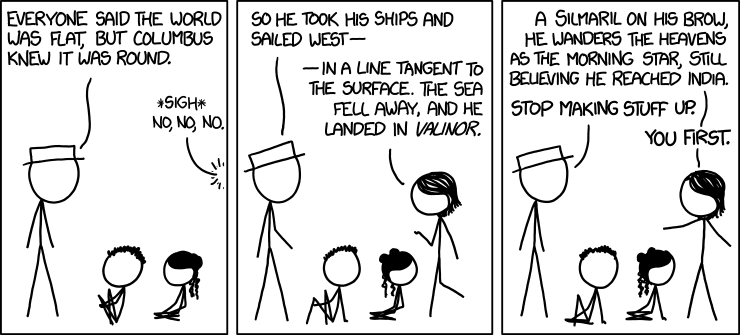
Off on a Tangent

XKCD illustrates a point we talked about recently.


A Pity They Can't Both Lose

Today I witnessed a confrontation between two characters so despicable that I was sorry to have to take sides, mentally though in no way practically, with one of them.

I was crossing the street in a small Southern city when it happened.  Perpendicular to my own crossing -- which is to say, against the light -- a large and muscular man in shorts, apparently drunk at two in the afternoon, was also crossing the street.  A little black car apparently decided that trespass justified nearly running him over, perhaps in an attempt to scare him straight.  He was carrying a beverage of some sort in a styrofoam cup, which he dashed against the window of the black car as it passed.


The car slammed to a stop -- now out in the intersection -- and a very large woman got out and started yelling.  "Oh, H#LL no!" she began, pink cell phone in her hand, proclaiming that she was going to call the cops because he was crossing against the light, and he had better not leave before they got there to arrest him.

I hope she did call them, because she was guilty of several crimes.  Her interlocutor wasn't actually doing anything worse than the misdemeanor offense of jaywalking -- impossible to prove, though I know he was guilty of it -- which doesn't rise to the level of offense at which citizens may exercise their arrest powers. Nor are you generally entitled to put someone's life at risk to demonstrate your annoyance at their violation of a minor point of legal protocol.  

Good thing we have equality under the law!  We can all be held to the same standard these jokers require to keep them from killing each other.  That's the way to guarantee human liberty.

Riding through Georgia


Why Is The Golden Age of Television So Dark?

Megan McArdle asks a question I am singularly unqualified to answer, as with one exception I don't watch television (and I watch it only on Amazon Prime), and haven't seen any of the shows she's talking about. I'm going to pose an answer anyway, one that has nothing to do with the specifics of the shows, but has instead to do with the history of the cinema that these shows are replacing.

Gangster movies do indeed date to the beginnings of the cinema, but there was a moment about a generation ago when they became extremely popular. It would be easy to say that this was simply because they were particularly excellent -- The Godfather and The Godfather II routinely top the lists of great movies in Hollywood history.

But they were excellent for a reason, and the reason has to do with a function they were serving. There was a famous essay -- I wish I could remember the title or author, and perhaps one of you will remind me -- that held that the gangster film was uniquely poised to permit Hollywood to explore tragedy. At this point the Cold War was deeply established, and American audiences were enforcing on Hollywood its duty to demonstrate that the American way was finally a story of happy endings. The counterculture that produced Easy Rider was still the counter- and not the leading culture; generally, comedies and action films and romantic comedies and even dramas all usually ended on an up-note. American audiences wanted to believe that, if you were a good person and lived according to your own virtues, things would work out.

The one genre where that wasn't required was the gangster film. Here, the essential evils to which the gangster had to commit were enough that even the most sympathetic gangster could be punished by fate without the audience rejecting the film. It was a way of re-enabling the tragic function, which Aristotle talks about in the Poetics. It's an important and very high function of drama, and the gangster film allowed you to explore it in the context of the day.

It also allowed -- because the ending would be tragic -- characters who could offer a strict critique of the American way. Read the analysis of the scene which precedes these words:
This is the very first scene in the movie (though the dialogue is truncated for the big screen) for a reason. Francis Ford Coppola and Puzo understood the need to show the alternate moral universe of the mafia. Rahe points out that it’s no coincidence that the undertaker’s name is Amerigo Bonasera, which translates into “Goodnight America.”

Paul Rahe brilliantly explores the question of whether someone can be “armed” with “true friends” and still be a “good American.”
The only television show I've watched in the last five years is Sons of Anarchy. Its second season explores the positive aspects of that ideal. Its subsequent seasons explore, so far, the negative. It also seems to be a tragedy, based loosely on Hamlet.

But it also seems to be exploring the idea of the old view of friendship versus the American rule of law. And it does it in the context of an America in which the rule of law seems to be of a different character than a generation ago. Don Corleone complained that judges 'sell themselves,' and the process was slow to boot: in the new shows, the agents of the Federal government particularly are baleful, not just corrupt but wicked. Yet when -- spoilers, as they say -- the CIA proves to be behind the effort to smuggle guns to one of the Mexican drug cartels wreaking havoc in California, the show is not leading but following the news.

It may be the reason gangster 'films' are so pervasive on the new television are the two old reasons: that it as a genre permits a genuine tragedy, and that it permits a clear-eyed critique of the American system. But it may also be that the American system isn't as healthy as it used to be, and the critique is therefore more persuasive. At some point, the tragedy will fall away, and people will simply accept these gangsters as heroes, full stop.

McArdle's alternate theory asks, "What will you do for an encore?" But the encore follows naturally, if I am right.

Thoughts on Some Possible Solutions to the Knowledge / Information Problem

Grim and Cass have brought up some partial solutions, or at least ideas of places to look, and I ran across another today.

In the comments to The Knowledge Problem, Grim brings up the following:

1) Time is short, but art is long. One of the ways in which we approach this problem is to learn what those before us knew. This not only helps us by teaching us how to recognize where they went wrong, but it provides us with a platform from which to criticize our own paradigms. Without an alternative, as you said, we cannot.

2) We have vital decisions to make, but urgency and importance are two different axes. Some decisions are really more vital, but there is time to consider more carefully; others are really more urgent, but not so important. One way of approaching the problem is to make sure we are making this distinction, so we focus the short time on problems that are both urgent and important; then problems that are urgent but somewhat important; and then on problems that are important but not urgent, leaving the unimportant problems generally to slide.

3) All you say in principle 3 is true, but we must still decide and act. One way to act is to learn to recognize areas in which the best available information is more likely to be wrong -- or, areas where being wrong is more likely to be disastrous. I am thinking here of Taleb's "The Fourth Quadrant," which is a typology of problems that lets you know that you can proceed without too much fear in some areas, but need to be very cautious about taking risks in others. So that is an aspect of your problem: developing similar typologies of kinds of problems, and also of kinds of "knowledge" that are more likely to be wrong.

Grim also proposed:

The justification step is disposable, if the relationship to the truth is really there. And that means that knowledge isn't JTB, but (as the externalists say) a relationship with the truth. [1]

Cass also brought intuition into the discussion, and I think intuition might be an important part of the solution.

Then, this morning I ran into the Wikipedia article on bounded rationality, which seems to be addressing the same, or at least similar, ideas.

Bounded rationality is the idea that in decision-making, rationality of individuals is limited by the information they have, the cognitive limitations of their minds, and the finite amount of time they have to make a decision. It was proposed by Herbert A. Simon as an alternative basis for the mathematical modeling of decision making, as used in economics and related disciplines; it complements rationality as optimization, which views decision-making as a fully rational process of finding an optimal choice given the information available. Another way to look at bounded rationality is that, because decision-makers lack the ability and resources to arrive at the optimal solution, they instead apply their rationality only after having greatly simplified the choices available. Thus the decision-maker is a satisficer, one seeking a satisfactory solution rather than the optimal one. Simon used the analogy of a pair of scissors, where one blade is the "cognitive limitations" of actual humans and the other the "structures of the environment"; minds with limited cognitive resources can thus be successful by exploiting pre-existing structure and regularity in the environment.

I will certainly be reading more about this idea.

----

1. It seems a bit unfair to only post this much. This was the conclusion to an extended argument Grim made in the comments to the earlier post, and to get the full implications I think the whole argument should be read.

Defining the Problem, Part 2: Knowledge, or Information?

Plato discussed the idea that knowledge is justified true belief (JTB), and historically a lot of philosophers have accepted this definition. With JTB, we only know something if  it is true, we believe it, and we have good reasons for believing it. There are some serious challenges to this idea of knowledge, but generally philosophers agree that a belief must be true to be considered knowledge; there is no such thing as false knowledge.

Information, on the other hand, can be simply a collection of data, whether true or not. Knowledge, then, is information that is true, justified, and believed.

The most recent (though probably not final) formulation of what I have called The Knowledge Problem goes like this:

1. Time is really short.
2. We have vital decisions to make.
3. It is impossible to get enough verified information out of an ocean of unverified data to make the best possible decisions, and sometimes the information we need just isn't available.
4. We need sufficient information that is good enough to allow us to generally make good decisions and to minimize the harm when we make bad decisions.

But is that really a knowledge problem? Or is it an information problem? After discussing the issue in that previous post, I'm beginning to think it's more of an information problem. Building up a body of knowledge is probably one of the answers to the problem.

What do you think? Knowledge Problem, or Information Problem? Naturally, feel free to help refine my four points or bring up related issues.

Completing an Entirely Frivolous Day in the Hall

I am doing some important things today, just not here.

UPDATE: Ok, now we're really finished for the day.

The German Quiz

I'm officially 80% German, according to the very lustig "how German am I" test from Hipstery.com. The average is just 65%. I’m as German as Pfand, Apfelsaftschorle and shouting at people who commit minor legal infractions. Unglaublich! Don’t even try and beat my score.
Heh.

A Striking Image

Here's an image I'm sure I'll have use for from time to time.

40 maps

Maps that sort things in an unusual way.