I hate to break it to that guy, but Bush ain't coming and neither is Obama. Funny, though, that it's Bush he's calling for and not Obama.


The Android Trebuchet:
You know what would be fun? Building a massive siege engine and setting it to be triggered by a cell phone.
They used an Android cellphone, a computer the size of a credit card and a Blue Tooth receiver to trigger the wooden weapon, known as a trebuchet, during the first "Storm the Citadel Trebuchet Competition" in Charleston over the weekend.Be fair, engineer. They threw live people, too.
The trebuchet was used during medieval times to break down fortifications.
"They also threw dead people," said Dennis Fallon, dean of engineering at The Citadel, a military college with about 2,100 male and female cadets. "What we have done in military history is not always something to be proud of."
Mobs and Leaders
Mobs and Leaders
In this video, an angry crowd struggles to regulate itself, with the help of a few individuals who struggle to find words and gestures that will return people to their senses. This is the long version, almost 12 minutes. There are shorter versions on YouTube, but it's worth watching this one in full to observe the crowd dynamics.
H/t Dane101.com via Hotair.com.
For FbL:
FbL wanted to try the skillet/broiler pizza hack, but didn't want to buy another skillet. While I dispute the premise that one has 'enough' skillets if one does not own at least one cast iron skillet, she wondered if this griddle could work.
I usually use mine for outdoor cooking over open fires, but I thought it could possibly work if you laid it across two burners. Iron is pretty good about equalizing heat. I tried it today, making a small square pizza in the middle of the burner but overlapping with each eye.
The iron equalized heat as well as I'd hoped, so the pizza was evenly crisp on the bottom. There is one disadvantage to this griddle compared to the skillet, which is that it is a lot heavier. When it is super hot, coming back out of the broiler especially, the extra weight increases the risk of burns even through oven mitts.
Still, it worked.
Angry
Why Are Men Angry?
Somebody's really let these folks down, because they haven't conveyed what the intimate is about. The intimate exists for two reasons: to shelter you and give you a place to regain strength; and to let you experience the unity with another that is the true depth of humanity. A man or a woman alone may experience their own depths, and perhaps in contemplation approach some of the depth of being itself: but to experience the depth of humanity requires another.
The marketplace in general has taken over far too much of our lives. There are a lot of modes of human life that aren't based on it, and generally the better ones: love, friendship, service (such as military service), meditation, thought. The last two are solitary occupations. Only in our intimate friendships do we Americans manage to get away from the ruthless competition and find a way to experience another in these better ways.
One intimate mode is the bond between family: that bond created by man and wife and child, which ties bloodlines together and extends across generations. This is the special bond of marriage, which deserves defense as a space consecrated for just that purpose.
Another -- sometimes together with marriage, sometimes not -- is the bond between lovers. This bond exists because of the second function of sex that Thomas Aquinas noted: the unity of the male and female, allowing a merging of individuals that alone creates a truly human nature. Though it is sexual, it need not be the sex of intercourse: it is a depth shared between a man and a woman who love each other with this passion, though they may touch no more than their hands.
Another is the bond between true friends, which Aristotle viewed as necessary to the best life. This bond can be as strong as the others, because trust and love of your friend allows you to understand each other. That common understanding lets you seek the true and the beautiful together.
Insofar as the young are approaching 'the sexual marketplace' as a sexual marketplace, they have made the core error before they appear in it. If they are angry about the results they are getting, the right answer is to re-examine their assumptions about what they should be seeking.
Kay Hymowitz writes a followup to a piece that I didn't link the first time, because it is well-traveled ground for us. Here it is, though, for reference.
Apparently she got some negative feedback.
About a week ago, The Wall Street Journal published an excerpt of my new book, which argued that the new stage I call pre-adulthood—the twenties and early thirties—was not bringing out the best in single young men. Some men didn’t like it. As in, “cancel-my-subscription-the-writer-should-contract-such-a-bad-case-of-carpel-tunnel-syndrome-she-never-writes-again” didn’t like it.I thought her point was that these weren't men, a point with which I completely agree. Now she has a new point, though:
But a lot of the responses unwittingly proved my point—and another one: Men are really, really angry.
Let’s call it gender bait and switch. Never before in history have men been matched up with women who are so much their equal—socially, professionally, and sexually. By the time they reach their twenties, they have years of experience with women as equal competitors—in school, on soccer fields, and even in bed. They very reasonably assume that the women they are meeting at a bar or café or gym are after the same things they are: financial independence, career success, toned triceps, and sex.What was the bait, again? That your intimate life could based on the same ideal of competition that forces you to scramble in every other aspect of your life?
That’s the bait; here comes the switch. Women may want equality at the conference table and treadmill. But when it comes to sex and dating, they aren’t so sure. The[y] might hook up as freely as a Duke athlete. Or, they might want men to play Greatest Generation gentleman. Yes, they want men to pay for dinner, call for dates—a writer at the popular dating website The Frisky titled a recent piece “Call me and ask me out for a damn date!”—and open doors for them.
Somebody's really let these folks down, because they haven't conveyed what the intimate is about. The intimate exists for two reasons: to shelter you and give you a place to regain strength; and to let you experience the unity with another that is the true depth of humanity. A man or a woman alone may experience their own depths, and perhaps in contemplation approach some of the depth of being itself: but to experience the depth of humanity requires another.
The marketplace in general has taken over far too much of our lives. There are a lot of modes of human life that aren't based on it, and generally the better ones: love, friendship, service (such as military service), meditation, thought. The last two are solitary occupations. Only in our intimate friendships do we Americans manage to get away from the ruthless competition and find a way to experience another in these better ways.
One intimate mode is the bond between family: that bond created by man and wife and child, which ties bloodlines together and extends across generations. This is the special bond of marriage, which deserves defense as a space consecrated for just that purpose.
Another -- sometimes together with marriage, sometimes not -- is the bond between lovers. This bond exists because of the second function of sex that Thomas Aquinas noted: the unity of the male and female, allowing a merging of individuals that alone creates a truly human nature. Though it is sexual, it need not be the sex of intercourse: it is a depth shared between a man and a woman who love each other with this passion, though they may touch no more than their hands.
Another is the bond between true friends, which Aristotle viewed as necessary to the best life. This bond can be as strong as the others, because trust and love of your friend allows you to understand each other. That common understanding lets you seek the true and the beautiful together.
Insofar as the young are approaching 'the sexual marketplace' as a sexual marketplace, they have made the core error before they appear in it. If they are angry about the results they are getting, the right answer is to re-examine their assumptions about what they should be seeking.
Moral Realism & Horses
Moral Realism & Horses:
Living creatures can move, but the lower animals are no freer than the stones. They are being driven either by internal instincts or by outside influences: the sensation of light, or pressure (like a fly buzzing off to avoid a swat), or the smell of food, things like that.
We can generalize this by saying that unfree acts are acts where X does Y because Z acts upon them: the ice sublimates because the sun shines on it. Natural laws rule these kinds of actions.
We have the ability to make choices. At least some of the time, we think about alternatives and decide to do one thing over another: or we find that there is a problem in between us and what we want, and we think through a solution to the problem. We may be less free than we often think we are, but at least some of the time we reason things through and make a choice: for example, we encounter a difficulty with our engine, reason what is likely to be the problem, and go about arranging a fix.
My favorite example was Sequila, who decided she didn't want to go riding one day. She saw me coming with a rope, and then -- when I looked away to open the gate -- lay down in a hollow so I wouldn't be able to see her.
That's an impressive bit of reasoning! She not only formulated a stimulus-response (man with rope means go riding: I don't want to go riding) but hit upon a plan of action that showed she understood the limits of my vision. Horse vision is different from ours: they have a nearly panoramic view. If I had tried to hide from her that way, it wouldn't work, because looking at the gate wouldn't have precluded me from seeing her.
She wasn't responding to instinct; I'd never observed her to lie down before. She was thinking through a problem.
How do I know that? Because I recognize the process from having thought through problems as well.
It didn't work, by the way:

Doesn't she look happy?
Immanuel Kant argued* that we can recognize this kind of reason only spontaneously: that is, only because we know it from ourselves. If someone were acting according to an order of reason that was different from ours, we wouldn't understand the rules, and probably wouldn't recognize it as reasoned behavior.
If we can recognize reason across species, then, the order of reason certainly exists across human cultures. If any morality tracks to reason, then, that part of morality is real: it is not cultural, but something arising from reality rather than human artifice.
Kant thought all morality could be demonstrated rationally. I don't agree; I find his critics persuasive who point out that it isn't really possible to generate positive duties from his categorical imperatives. If I may only act in a way that can be universalized without contradiction, I still don't have to act in any particular way.
It is possible, though, to generate some negative duties: that is to say, limits. "Thou shalt not" is a valid universal form for many moral questions. Thou shalt not steal, for Kant (as for your mother) because if everybody did it.... For Kant, the problem is that people steal to gain an advantage in property; but if everyone stole all the time, you couldn't guard the gains that you're trying to win. Theft cannot be universalized without destroying itself; it is therefore forbidden by reason.
So, here is a second type of real morality: "true limits" to go with "true virtues."
We still end up relying on culture for a lot of pretty crucial questions. However, these are good reasons to believe that at least some morality is embedded in the structure of the world.
* Readers interested in this point are referred, not to Kant!, but to Sebastian Rödl's Self-Consciousness. Like Kant, he doesn't extend his picture to non-human animals; but the persuasive arguments for why we recognize reason only spontaneously, and why the order of reason must be one, are just as strong pointed at higher animals like horses. We know they are thinking, because we recognize it.
Rödl would probably be unhappy with my use of his theory, as his theory hinges on language (a thing horses possess but only as body language, not the thought-formulating language that the philosophical tradition usually wants to insist upon). His tradition, though, probably requires him to accept my usage even if he doesn't like it. German Idealism is tied to Hegel's phenomenology of mind, which includes an account of what pre-language consciousness is like. In general I agree with Hannah Arendt's account of Hegel ("large parts of his work can be read as a running polemic against common sense"), but a German idealist can't easily walk away from it without giving a careful account of what he wants to replace it with. Further, in Hegel's defense, that the horse's development of mind ends just where he seems to believe that language would be required for further development. I have my own reasons for believing that thought and language are not as connected as modern philosophy usually assumes, but that (like proving the existence of free will) is another post for another day.
This is the second post in a series; the first is here. In the first post, we discussed whether there are real morals, or only culturally relative ones. My belief is that there are at least two types of real morals, and I argued for one of them initially: what we might call "true virtue."
There's a second type I identify, which needs more argument to establish. In the comments to that first post, I asked for someone to explain how we know when an animal is thinking -- not just reacting from instinct. RCL took up the challenge.
What these answers come down to is this: we know the horse is thinking because we recognize what it is like to be a thinking animal from ourselves. T99 got it precisely:Winema
Horses Thinking... *First of all I know you know!
As I said, observe Ms. Winema Toby Riddle...
1. Like many horses she knows when you put a kid on her and she takes care of them. While I'm out of town I'm leasing her to a friend. She was complaining to me that her two kids can't get her to trot. You know the answer don't you? My pal Paul told her the same thing I did, she knows they aren't balanced, she knows they're kids, she won't kick up because she's protecting them from themselves. When they ask right and they're set correctly she'll trot. Hell she'll take off at the least hint if you're in balance.
2. If I haven't been there for more the a few days; if I've just come by and worked her out and left for the last couple visits Toby's going to teach me some kind of lesson for the first 15 to 20 minutes guaranteed! She's always keeping score. Typical woman.
3. As a prey animal they're bred to be careful. They can imagine unspeakable danger from any rustle in the willows down a creek bed. Reaction only? Perhaps but it's thought and learning that enables them to put aside that reaction once they've gained confidence in their rider and through experience.
4. They can plan. They sometimes know what you're going to do before you do and they're ready for you. When they're being ornery they set you a trap. When you're working together they get there before you have to tell them.
5. We all know plenty of horses who can open any latch or get into some container or pantry that you'd never figure anyone could manuever with just teeth and lips.

I never know that anyone is "thinking," except insofar as they can communicate something to me that reminds me of the internal process I identify by the work "thinking." Horse and dogs do that to a limited extent by showing me that they are remembering things or have solve problems.Let's say you go hiking in Tallulah gorge, and you see a boulder on the high walls when you hike out, but find that same boulder on the ground when you come back. What caused the change? It was acted upon by something else. Maybe someone pushed it; certainly the force of gravity acted upon it. It didn't make a free choice to come down into the valley.
Living creatures can move, but the lower animals are no freer than the stones. They are being driven either by internal instincts or by outside influences: the sensation of light, or pressure (like a fly buzzing off to avoid a swat), or the smell of food, things like that.
We can generalize this by saying that unfree acts are acts where X does Y because Z acts upon them: the ice sublimates because the sun shines on it. Natural laws rule these kinds of actions.
We have the ability to make choices. At least some of the time, we think about alternatives and decide to do one thing over another: or we find that there is a problem in between us and what we want, and we think through a solution to the problem. We may be less free than we often think we are, but at least some of the time we reason things through and make a choice: for example, we encounter a difficulty with our engine, reason what is likely to be the problem, and go about arranging a fix.
My favorite example was Sequila, who decided she didn't want to go riding one day. She saw me coming with a rope, and then -- when I looked away to open the gate -- lay down in a hollow so I wouldn't be able to see her.
That's an impressive bit of reasoning! She not only formulated a stimulus-response (man with rope means go riding: I don't want to go riding) but hit upon a plan of action that showed she understood the limits of my vision. Horse vision is different from ours: they have a nearly panoramic view. If I had tried to hide from her that way, it wouldn't work, because looking at the gate wouldn't have precluded me from seeing her.
She wasn't responding to instinct; I'd never observed her to lie down before. She was thinking through a problem.
How do I know that? Because I recognize the process from having thought through problems as well.
It didn't work, by the way:

Immanuel Kant argued* that we can recognize this kind of reason only spontaneously: that is, only because we know it from ourselves. If someone were acting according to an order of reason that was different from ours, we wouldn't understand the rules, and probably wouldn't recognize it as reasoned behavior.
If we can recognize reason across species, then, the order of reason certainly exists across human cultures. If any morality tracks to reason, then, that part of morality is real: it is not cultural, but something arising from reality rather than human artifice.
Kant thought all morality could be demonstrated rationally. I don't agree; I find his critics persuasive who point out that it isn't really possible to generate positive duties from his categorical imperatives. If I may only act in a way that can be universalized without contradiction, I still don't have to act in any particular way.
It is possible, though, to generate some negative duties: that is to say, limits. "Thou shalt not" is a valid universal form for many moral questions. Thou shalt not steal, for Kant (as for your mother) because if everybody did it.... For Kant, the problem is that people steal to gain an advantage in property; but if everyone stole all the time, you couldn't guard the gains that you're trying to win. Theft cannot be universalized without destroying itself; it is therefore forbidden by reason.
So, here is a second type of real morality: "true limits" to go with "true virtues."
We still end up relying on culture for a lot of pretty crucial questions. However, these are good reasons to believe that at least some morality is embedded in the structure of the world.
* Readers interested in this point are referred, not to Kant!, but to Sebastian Rödl's Self-Consciousness. Like Kant, he doesn't extend his picture to non-human animals; but the persuasive arguments for why we recognize reason only spontaneously, and why the order of reason must be one, are just as strong pointed at higher animals like horses. We know they are thinking, because we recognize it.
Rödl would probably be unhappy with my use of his theory, as his theory hinges on language (a thing horses possess but only as body language, not the thought-formulating language that the philosophical tradition usually wants to insist upon). His tradition, though, probably requires him to accept my usage even if he doesn't like it. German Idealism is tied to Hegel's phenomenology of mind, which includes an account of what pre-language consciousness is like. In general I agree with Hannah Arendt's account of Hegel ("large parts of his work can be read as a running polemic against common sense"), but a German idealist can't easily walk away from it without giving a careful account of what he wants to replace it with. Further, in Hegel's defense, that the horse's development of mind ends just where he seems to believe that language would be required for further development. I have my own reasons for believing that thought and language are not as connected as modern philosophy usually assumes, but that (like proving the existence of free will) is another post for another day.
Adventures in Frosting
 Adventures in Frosting
We recently celebrated our neighbor's mother's 90th birthday, a party that featured a demonstration of line-dancing by the birthday girl and her dance group. This admirable woman moved in with our neighbors a few years ago and swiftly became the county canasta champion. Mean poker player, too.
My contribution was the birthday cake. I had convinced my neighbor (the birthday girl's daughter-in-law) that store-bought sheet cake can't complete with a real home-baked cake. That meant, of course, that I would have to decorate the cake as well. I thought it would be no problem, but I didn't take into account that the cream-cheese-and-butter frosting for carrot cake is stiffer than most. I managed to blow out not one but two pastry-bag frosting extruders and suffered a little panic as the deadline approached for driving the cake over to the beachfront venue. Nevertheless, it all came out right in the end and tasted wonderful. Another neighbor cooked a killer brisket, and the hostess brought cole slaw, while various sides and hors d'oeuvre showed up with other guests. A fine day.
Here was something funny. A guest exclaimed to me over the moistness of the cake. I was perplexed; this is a perfectly ordinary recipe. I recited the ingredients: carrots, sugar, flour, eggs, oil -- "Oh, oil!" she exclaimed knowingly. "That explains it." I wonder: has she so swallowed the dietary nonsense of recent decades that she's been trying to bake without shortening? Probably with fake sugar and eggs, too. No wonder a real but pedestrian cake recipe tastes like a revelation to her. (She'd probably have died on the spot to hear what the frosting was made of. No icing-whiz? No Splenda?) It's true that carrot cake in a store or restaurant often tastes like rubber iced with snot. Is that the problem? Is it carrot cake by DuPont?
If you don't want to feed the multitudes, the recipe for a more moderate quantity of cake follows. I tripled this to make four 9x13 cakes, which I combined into one 18x26 sheetcake by cutting off their interior sides so they'd fit together snugly. Once they were frosted, you couldn't tell they hadn't all been baked in one pan together.
Carrot Cake
1 lb carrots, grated2 cups sugar
1-1/2 cups oil (I used canola)
4 eggs
2 cups AP flour
2 tsp baking powder
2 tsp baking soda
1 tsp salt
1/2 cup (or more) coarsely chopped pecans
1/2 cup (or more) dried cranberries (or raisins if you prefer it sweeter)
Cream Cheese Frosting (that's "Icing" to y'all up north)
3 packages (8-oz. standard size) of cream cheese1-1/2 sticks unsalted butter (12 T)
1 tsp vanilla extract
confectioner's sugar to taste (maybe 1/2 cup by my standards, but I like a tart frosting to contrast with the sweet cake)
Preheat oven to 325 F. Combine sugar and oil with a mixer, then beat in the eggs one at a time. In a separate bowl, combine or sift together the flour, baking powder, baking soda, and salt, then mix these dry ingredients into the wet ones. When the flour is well incorporated, stir in the nuts and fruit. Lightly oil the pans (three 9-in cake pans or two bread pans), then lay a sheet of wax paper on the bottom and oil that, too. Bake for about 45 minutes or until a toothpick comes out clean. Turn out onto oven racks to cool, removing the wax paper carefully.
To make the frosting, let the cream cheese and butter come to room temperature, then combine them with a mixer, add the vanilla, and then add the powdered sugar to taste. Frost the cakes after they have thoroughly cooled. The cakes can keep at room temperature overnight, but the frosting will look best if applied the day you will serve the cake. The frosting should be refrigerated if you make it ahead of time, and it will be easier to stuff it into the frig if it's still in a bowl rather than on a big cake. Bear in mind that the frosting must come to room temperature before it will be easy to work with.

Food for Thought
THE BIASING EFFECTS OF MORALITY
I saw this quote the same week John Tierney's NYT article about bias and the lack of intellectual conformity in the social sciences came out. Arguably, the single most fascinating line in Tierney's article was this one:
This quote was endlessly repeated on conservative blogs because frankly, it was just so darned useful. I couldn't help hoping, though, that one of us might turn it around - see if the other side of that double edged sword sliced as cleanly?
I liked the first statement because there's a very large grain of truth in it.
There happens to be a very large grain of truth in the second statement too, but I have to admit it doesn't sit nearly so well with me. Haidt's comments came to mind again when I saw this item from Glenn Reynolds. I'll admit to being briefly encouraged by Glenn's characterization of game as cartoonish. The rest of his comment - the part about being glad these men were 'getting help' - disturbed me a bit.
I want to see young men become more confident with women. I want them to succeed, if by "success" one means being able to approach women, talk to them, hopefully date them, form relationships (married or otherwise) that make both the man and the woman happy. But I don't see any particular value in teaching men to despise women, nor in teaching them tricks that make it possible to "bang" large numbers of shallow, confused and impressionable young women who would normally be out of their league (if we accept the self professed goals of the game community). There have always been ways to trick or pressure people into doing things they wouldn't otherwise be inclined to do. If human beings weren't vulnerable to such tactics, peer pressure wouldn't work. But the mere existence of a thing doesn't legitimize it.
It doesn't make it the right thing to do. It doesn't make the end justify the means, nor does it make two wrongs suddenly equal a right. What disturbs me is the omission of morality - and humanity - from this equation. Let's say that we accept the existence of a supposedly universal male desire for promiscuous, consequence free sex. Moreover, let's stipulate that what is natural is somehow inherently good, both for society and for the individual.
Rather a stretch, isn't it? But I'm willing to play along just to see where it takes us.
If (as conservatives so often assert) men and women are different and thus naturally want different things, by what logical or conservative principle do we wish for men to get what they want at the expense of women getting what they want? If it's "natural" for all - or even most - men to want consequence free sex and all - or even most - women to want families and committed relationships (and if these two desires are at odds with each other), then men can only get what they most desire by denying women what we most desire. And vice versa.
That's a pretty dismal view of male-female relations; it turns partnership and mutual support into a zero sum game in which men and women are pitted against each other:
It's funny - for years now I've watched men argue that porn is just fantasy - that it has nothing to do with what they want in real life. Suddenly now porn is being cited as indicative of what men really want to see happen in the real world (in other words, they want sexual needs gratified with no work and thus won't do anything that frustrates this desire)?
Wow. Really? I have to say that I had a higher opinion of the male half of humanity. This is the problem with reducing complex issues to simplistic formulas:
From where I sit, it was not the rise of women but the spread of Christianity and Judeo-Christian values that turned Western civilization against centuries-old practices like slavery and prostitution. And last time I checked, for most of its history men have been the intellectual and political force that turned the words of a Jewish carpenter into the world's largest religion.
I'm not sure what makes so many men fall all over themselves in their haste to reduce their own sex to little more than an utterly amoral collection of uncontrollable urges, but I suspect that confirmation bias has a lot to do with it. That's the only explanation I can come up with for arguments that discount so much contrary evidence.
Or maybe that's just what I want to believe - the biasing effect of my own morality :p
Update: "Most boys are raised by divorced women with an axe to grind against men."
*Sigh*
I realize we ladies are not exactly known for our mathematical prowess, but even I know that less than 34% doesn't add up to "most":
... we must always be aware of how pervasive the confirmation bias is. Whatever we want to believe, we set out to look for any evidence that supports that belief. If we find even a single piece of evidence that supports what we want to believe, we feel like we're done, we've done our homework and we can now be certain about what we believe. Everyone does this, on both sides, and therefore, people disagree with each other while both being certain that they're right.
It especially means that we must be aware of the problem of moral diversity and moral teams. Whenever there is a moral team that has no moral diversity and is trying to study the other team, we can pretty much bet money – we can take 3-1 odds – that they're going to get it wrong. They can't get it right because the biasing effects of morality are so strong.
- Jonathan Haidt
I saw this quote the same week John Tierney's NYT article about bias and the lack of intellectual conformity in the social sciences came out. Arguably, the single most fascinating line in Tierney's article was this one:
“Anywhere in the world that social psychologists see women or minorities underrepresented by a factor of two or three, our minds jump to discrimination as the explanation,” said Dr. Haidt, who called himself a longtime liberal turned centrist. “But when we find out that conservatives are underrepresented among us by a factor of more than 100, suddenly everyone finds it quite easy to generate alternate explanations.”
This quote was endlessly repeated on conservative blogs because frankly, it was just so darned useful. I couldn't help hoping, though, that one of us might turn it around - see if the other side of that double edged sword sliced as cleanly?
“Any time conservatives see women or minorities underrepresented by a factor of two or three, our minds jump to [any explanation that doesn't involve] discrimination or bias,” ...“But when we learn that conservatives are underrepresented in academia by a factor of more than 100, bias and discrimination no longer seem so implausible, do they?”
I liked the first statement because there's a very large grain of truth in it.
There happens to be a very large grain of truth in the second statement too, but I have to admit it doesn't sit nearly so well with me. Haidt's comments came to mind again when I saw this item from Glenn Reynolds. I'll admit to being briefly encouraged by Glenn's characterization of game as cartoonish. The rest of his comment - the part about being glad these men were 'getting help' - disturbed me a bit.
I want to see young men become more confident with women. I want them to succeed, if by "success" one means being able to approach women, talk to them, hopefully date them, form relationships (married or otherwise) that make both the man and the woman happy. But I don't see any particular value in teaching men to despise women, nor in teaching them tricks that make it possible to "bang" large numbers of shallow, confused and impressionable young women who would normally be out of their league (if we accept the self professed goals of the game community). There have always been ways to trick or pressure people into doing things they wouldn't otherwise be inclined to do. If human beings weren't vulnerable to such tactics, peer pressure wouldn't work. But the mere existence of a thing doesn't legitimize it.
It doesn't make it the right thing to do. It doesn't make the end justify the means, nor does it make two wrongs suddenly equal a right. What disturbs me is the omission of morality - and humanity - from this equation. Let's say that we accept the existence of a supposedly universal male desire for promiscuous, consequence free sex. Moreover, let's stipulate that what is natural is somehow inherently good, both for society and for the individual.
Rather a stretch, isn't it? But I'm willing to play along just to see where it takes us.
If (as conservatives so often assert) men and women are different and thus naturally want different things, by what logical or conservative principle do we wish for men to get what they want at the expense of women getting what they want? If it's "natural" for all - or even most - men to want consequence free sex and all - or even most - women to want families and committed relationships (and if these two desires are at odds with each other), then men can only get what they most desire by denying women what we most desire. And vice versa.
That's a pretty dismal view of male-female relations; it turns partnership and mutual support into a zero sum game in which men and women are pitted against each other:
If one accepts the hard-to-dispute premise that, between the sexes, women prefer a higher-sexual-cost regime in which men are supposed to "work for it," as it were, and men prefer a lower-sexual-cost regime in which their sexual needs can be gratified with almost no work whatsoever (compare and contrast female wish-fulfillment romcoms with male wish-fulfillment pornos, or even James Bond movies, actually), then of course it makes sense that women, rather than men, have a sound motive for increasing the sexual penalties for promiscuous sex whereas men have stronger motive for decreasing them.
It's funny - for years now I've watched men argue that porn is just fantasy - that it has nothing to do with what they want in real life. Suddenly now porn is being cited as indicative of what men really want to see happen in the real world (in other words, they want sexual needs gratified with no work and thus won't do anything that frustrates this desire)?
Wow. Really? I have to say that I had a higher opinion of the male half of humanity. This is the problem with reducing complex issues to simplistic formulas:
... lefty feminists continue to insist that it is men, of all people, who workin' as hard as they can to keep women chaste. To keep women from having sex with them, in other words. To make women feel bad about the occasional one night stand so that men can't have the occasional one night stand.
Does this sound like men to you? Or does it sound like a fantasy farce of cartoon men, wearing the Black Hats of Insanely-Counterproductive Sexual Prohibition, concocted by a blame-shifting villain-needing sexual cult?
From where I sit, it was not the rise of women but the spread of Christianity and Judeo-Christian values that turned Western civilization against centuries-old practices like slavery and prostitution. And last time I checked, for most of its history men have been the intellectual and political force that turned the words of a Jewish carpenter into the world's largest religion.
I'm not sure what makes so many men fall all over themselves in their haste to reduce their own sex to little more than an utterly amoral collection of uncontrollable urges, but I suspect that confirmation bias has a lot to do with it. That's the only explanation I can come up with for arguments that discount so much contrary evidence.
Or maybe that's just what I want to believe - the biasing effect of my own morality :p
Update: "Most boys are raised by divorced women with an axe to grind against men."
*Sigh*
I realize we ladies are not exactly known for our mathematical prowess, but even I know that less than 34% doesn't add up to "most":
The percentage of children under 18 living with two married parents declined to 66 percent in 2010, down from 69 percent in 2000.
Mad Max
Autoduel on Ice:
It's been a while since we had a Borderline Boys post. I like this one: "If Mad Max had a fortress of solitude in Sweden, this is about what it would look like."
This may explain the Scandinavian fascination with rockabilly music that Joel and I were noticing recently.
UPDATE: Today from BSBFB, the Saudi version. I call this one "rotating the tires while the tires are rotating."
The Patriot Game
The Patriot Game:
Come all you young rebels,
and list' while I sing;
for the love of one's country
is a terrible thing.
BillT reminds me of an old song in the comments, below, to T99's post on chart-toppers. Now here was a song that deserved to top the charts: it didn't, but it should have.
Until 9/11, Americans tended to support the IRA: God knows I did. The assumption was that defending national sovereignty against foreign oppression was a natural right, for Ireland as much as for the Founders. Watch this now, and look at the masked men. Are they right? Were we wrong? What if the Libyans now fighting for freedom have to resort to masks of this kind?
One wants to say that they are good men, who did terrible things. The song is ready to say that with us. Are we sure?
and list' while I sing;
for the love of one's country
is a terrible thing.
BillT reminds me of an old song in the comments, below, to T99's post on chart-toppers. Now here was a song that deserved to top the charts: it didn't, but it should have.
Until 9/11, Americans tended to support the IRA: God knows I did. The assumption was that defending national sovereignty against foreign oppression was a natural right, for Ireland as much as for the Founders. Watch this now, and look at the masked men. Are they right? Were we wrong? What if the Libyans now fighting for freedom have to resort to masks of this kind?
One wants to say that they are good men, who did terrible things. The song is ready to say that with us. Are we sure?
Tallulah Gorge:Below Bridal Veil Falls
In northeast Georgia, the Tallulah river has cut a remarkable gorge into the earth. Cutting through a dome rock formation, it has produced a chasm lined with granite stones worn smooth.

Oceana Falls
The gorge floor is mildly perilous in only a few places, where these smooth stone walls could lead one to tumble a few tens of feet into the river below. The chief danger is in getting wet. All the same, access to the floor is controlled by Georgian DNR Rangers.

February Runoff into the Gorge
You have to cross the river, which makes this an odd choice of hikes for February. The recent warm weather, though, made it perfect.

Tallulah River
The trail is rough, and includes a lot of clambering over boulders. It's a fun hike if you are in the area, and in the mood for something just strenuous enough to get the blood going, but short of real rock climbing.


In northeast Georgia, the Tallulah river has cut a remarkable gorge into the earth. Cutting through a dome rock formation, it has produced a chasm lined with granite stones worn smooth.

The gorge floor is mildly perilous in only a few places, where these smooth stone walls could lead one to tumble a few tens of feet into the river below. The chief danger is in getting wet. All the same, access to the floor is controlled by Georgian DNR Rangers.

You have to cross the river, which makes this an odd choice of hikes for February. The recent warm weather, though, made it perfect.

The trail is rough, and includes a lot of clambering over boulders. It's a fun hike if you are in the area, and in the mood for something just strenuous enough to get the blood going, but short of real rock climbing.

Striking
Striking:
Following up on T99's earlier post about feminine beauty, a post on facial averages for Hollywood celebrities. The results are unsurprising to anyone who watches movies.
What is more surprising to me is this:
The average golden age actress comes from this set:
Who's missing? 
Maureen O'Hara. I thought this "average" was built around her: but it turns out she wasn't even included in the sample.

Chart-toppers
 Chart-toppers
Someone has collected 5-second snippets from every #1 Billboard Hot 100 hit from the system's 1958 start through 1992. I'm too young for the very earliest hits, a few of which don't sound all that familiar (except for the regular intrusions of Elvis classics, of course). About the time the Beatles show up, February 1, 1964, with "I Wanna Hold Your Hand," it seems that every third song is theirs. This part I know quite well, through about the mid-80s. Rather suddenly, I'm recognizing only every tenth song; the rest just sound like generic 80s movie soundtracks. By the early 90s, I'm recognizing every 20th song, apparently having tuned out thoroughly by then.
It's strange how out of order some of these seem. I never would have guessed that "Do Wah Diddy" hit #1 at about the same time as "The House of the Rising Sun." They seem in memory to belong to different decades. "My Girl" and "Eight Days a Week" were from the same month? And both predated "I'm 'En-er-y the Eighth, I Am"? That Herman's Hermits album, by the way, was the first I ever purchased, at the age of nine.
A full list of the hits by year is here. Is it just me, or did something really awful happen in 1974? I like about three songs on that list, but the rest give me hives.
H/t Brandywine Books.
The Saga Of Biorn from The Animation Workshop on Vimeo.
There's some curious theological implications here...
Female Beauty

 Female Beauty
Maggie's Farm had this link to a Geekologie site with composite photos depicting the "average" face of women of a number of ethnicities. The program produces faces of quite remarkable beauty. Of the dozens of examples, I found that the average French face seemed the most familiar or "American" to me, while the Uzbek face was by far the most beautiful.

Psych Phot
Psychic Photography:
Well, yes, actually it does. Space-time persistence theorists believe that -- in spite of our experience of 'living through' time -- we are in fact a static, four-dimensional object, extended in three physical dimensions plus time. Something that was significant to that object "later" is still a part of the single object, in the way that one face of a cube is still part of the same cube as the opposite face. I know a doctor of physics and metaphysics who is quite certain this is correct.
I'm not convinced, myself. Without going so far as persistence, you can still argue that the mind can move freely in the four dimensions: for example, how many of us have sat in our chair at work on Monday morning and imagined being at a cookout the previous Saturday? Your conscious mind can readily "image" that time and place for you; it may be that your unconscious mind can reach forward. It may not be reaching for a certain future that you 'already inhabit,' as the persistence theorists believe; perhaps it is only reaching to a likely future.
Or possibly it's all bunk; but how then to make an image of Voyager's pictures of the moons of Jupiter years before anyone has seen them?
This makes for interesting reading: an account of a man who could make Polaroid pictures with his mind. There's an account of the attempt by skeptics to prove he was faking (none of which succeeded); but the author is credulous.
What is most striking about the Serios thoughtographs is the power of their imagery as a manifestation of the creative process. In these strange pictures, real objects or places appear to have merged with (or been altered by) the material of Serios's unconscious. Some of them juxtapose target images (of familiar buildings, monuments, houses, and hotels) with what appear to be images of day residue, haunting shadows of unfamiliar forms and structures. Others seem to incorporate both past and future events in an odd, shadowy collage. On one occasion, for example, the target image appeared superimposed on a second image that resembled the space probe Voyager 2. After the session, Serios, a space buff, confessed that he had been preoccupied with the progress of the space mission at the time and was unable to clear it completely from his mind.This seems to run afoul of a few different problems. Does philosophy contain anything that might explain them?
Other images could have been obtained only as a result of knowledge or perspectives unavailable at the time. For example, after seeing magazine photographs taken from Voyager 2 of Ganymede, a moon of Jupiter, Eisenbud suddenly recognized some of Serios's previously unidentified thoughtographs as images of the moons of Jupiter. That made sense, as Serios had long been obsessed with Voyager 2; what did not make sense, however, was that those thoughtographs had been produced years before the Voyager 2 pictures were taken. He also occasionally produced pictures that would be possible only from a midair perspective, including an exposure showing part of Westminster Abbey, and an image of a Hilton hotel in Denver.
Well, yes, actually it does. Space-time persistence theorists believe that -- in spite of our experience of 'living through' time -- we are in fact a static, four-dimensional object, extended in three physical dimensions plus time. Something that was significant to that object "later" is still a part of the single object, in the way that one face of a cube is still part of the same cube as the opposite face. I know a doctor of physics and metaphysics who is quite certain this is correct.
I'm not convinced, myself. Without going so far as persistence, you can still argue that the mind can move freely in the four dimensions: for example, how many of us have sat in our chair at work on Monday morning and imagined being at a cookout the previous Saturday? Your conscious mind can readily "image" that time and place for you; it may be that your unconscious mind can reach forward. It may not be reaching for a certain future that you 'already inhabit,' as the persistence theorists believe; perhaps it is only reaching to a likely future.
Or possibly it's all bunk; but how then to make an image of Voyager's pictures of the moons of Jupiter years before anyone has seen them?
Cuts
Cuts:
By this I do not mean that it isn't a good idea: in general, it probably is. The easiest way for a cut to become politically possible is if it is a Republican priority (say, a new engine for the F-35). While in the short term that means a government that is only executing the program of the left, it leads by example, and more importantly, it refocuses the minds of the party of the right on the question of cutting, not spending.
Even so, the runaway problems are three:
1) Medicare,
2) Medicaid,
3) Un- and underfunded retirement benefits, including Social Security, government pensions, and government health care plans.
Here is a chart showing the explosive growth of these three types of problems. This is not new; we've been talking about unfunded pensions here since 2007. My thoughts back then pretty much echo my thoughts now: the political system will not be able to address cutting these things, which means that the cuts will come in the form of systemic collapse. That means a kind of tribalism, not solely based on blood ties, but on ties of kinship and friendship.
Well, and that was the old system: and mostly it worked. Sometimes it didn't, which is why Social Security was a popular idea. Nobody wanted a situation where elderly people were dying in the street after a lifetime of work.
A bigger problem, though, is that our economic system has changed in fundamental ways over the last sixty years. The capitalist system of the 1950s assumed that everyone would be a jobholder, because there was so much labor that needed to be done. Automation was in its infancy, so even on an assembly line you needed a massive number of people to put things together. It was still difficult and expensive to ship things around the world, so you needed people for your factories who lived close by, and the factories needed to be close to their customers. In the offices, the absence of things like copiers and computers meant huge pools of typists were necessary just to ensure that adequate copies of important documents were made, properly formatted.
By the 2000s, automation had progressed to the point that a huge number of workers were no longer needed in the factories. Manufacturing as a sector of the economy continues to outproduce China and to grow in real dollars, but jobs in manufacturing shrank from the 1970s through today.
Similar things happened to typists and secretaries, whose jobs were steadily cut by improved technology. Now even executives tend to type their own letters in word processors, and as many copies as they need are a couple of clicks away.
That's called efficiency, and it is a major reason that the US economy remains so much more productive than the rest of the world. Capital is cheaper than labor, so the investment of capital meant that profits rose as costs fell.
Profits, though, don't go to everyone. The benefits of automation are for the owners of the machines: the workers without jobs not only do not benefit, but are positively harmed.
In addition, the ease and cheapness of global shipping means that it is now feasible to make things abroad. Improvements in telecommunications make it easier still.
The upshot of all of this is that -- not to put too fine a point on it -- there's a lot less labor that needs to be done. There will be less labor needing to be done in the future.
For now that means persistently high unemployment. In the future, it means a day when we have to face the reality of permanent unemployment for a large part of the population.
That means rethinking our basic model about how we adjudicate resource distribution in America. For as long as the nation has been in existence, that was done in terms of their pay for employment.
It may have to be done differently in the future, and we don't have a good model. On the one hand, it is simply unreasonable to ask people who are permanently out of work to get by on nothing. They can't. On the other, direct payments from the government -- entitlements, that is -- have a soul-destroying quality when applied as welfare instead of retirement pay. This is true in Saudi Arabia, for example, where the massive wealth of the society is such that everyone gets a stipend. They all hire servants to do all the labor; but it somehow fails to be the happiest place on earth.
For the short term, we need to cut spending and entitlements; but for the long term, we need to look at new ways of raising revenue. There are good arguments against corporate taxes, though it seems fair to suggest that some of the benefits of the efficiency of automation should go to the people who are put out of work. It may also be the case that we need to look at ways of raising revenue from the world at large to help pay for the Navy that guards their trade lanes, thus providing a benefit to their nations as well as our own.
This is a pretty sticky problem. The only answer we've come up with so far is to make-work through bubbles: that is, since we don't need any more than we have, we'll spend money on things we just want. That got us many McMansions with tile kitchens, and for a while it paid for many construction workers; but it was never sustainable. We need a better answer.
Reason offers an analysis of the current political situation, with a one-step solution.
We may not be France yet, but there are disturbing signs that Americans may be ready to take to the streets angrily in defense of their government deals and giveaways. (Some polls showing a lack of support for the very idea of public employee unions are encouraging, but it doesn’t take a majority to cause civil unrest.) Wisconsin may be the first sign that, no matter how much support one can gin up for shrinking government, actual attempts to restrain a free-spending government will be met with strong political counterforce—even when that interest is overpaid teachers and big-money unions.All politically possible cuts must be supported. That's interesting, but it is not a solution to the current problems.
The threat of federal government shutdown, happening simultaneously with the Wisconsin crisis, demonstrates that the fiscal crisis is multileveled, and no one wants to allow it to be dealt with seriously....
The only really serious position moving forward about government size and government spending is how to cut it, and how soon. While the fight to cut specifics here and there may seem ugly and unfair, all cuts need to be supported, wherever they seem politically possible.
By this I do not mean that it isn't a good idea: in general, it probably is. The easiest way for a cut to become politically possible is if it is a Republican priority (say, a new engine for the F-35). While in the short term that means a government that is only executing the program of the left, it leads by example, and more importantly, it refocuses the minds of the party of the right on the question of cutting, not spending.
Even so, the runaway problems are three:
1) Medicare,
2) Medicaid,
3) Un- and underfunded retirement benefits, including Social Security, government pensions, and government health care plans.
Here is a chart showing the explosive growth of these three types of problems. This is not new; we've been talking about unfunded pensions here since 2007. My thoughts back then pretty much echo my thoughts now: the political system will not be able to address cutting these things, which means that the cuts will come in the form of systemic collapse. That means a kind of tribalism, not solely based on blood ties, but on ties of kinship and friendship.

Well, and that was the old system: and mostly it worked. Sometimes it didn't, which is why Social Security was a popular idea. Nobody wanted a situation where elderly people were dying in the street after a lifetime of work.
A bigger problem, though, is that our economic system has changed in fundamental ways over the last sixty years. The capitalist system of the 1950s assumed that everyone would be a jobholder, because there was so much labor that needed to be done. Automation was in its infancy, so even on an assembly line you needed a massive number of people to put things together. It was still difficult and expensive to ship things around the world, so you needed people for your factories who lived close by, and the factories needed to be close to their customers. In the offices, the absence of things like copiers and computers meant huge pools of typists were necessary just to ensure that adequate copies of important documents were made, properly formatted.
By the 2000s, automation had progressed to the point that a huge number of workers were no longer needed in the factories. Manufacturing as a sector of the economy continues to outproduce China and to grow in real dollars, but jobs in manufacturing shrank from the 1970s through today.
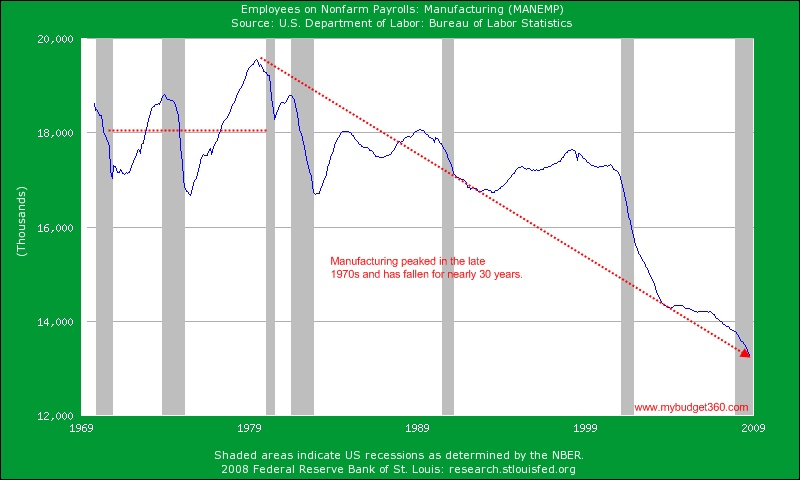
Similar things happened to typists and secretaries, whose jobs were steadily cut by improved technology. Now even executives tend to type their own letters in word processors, and as many copies as they need are a couple of clicks away.
That's called efficiency, and it is a major reason that the US economy remains so much more productive than the rest of the world. Capital is cheaper than labor, so the investment of capital meant that profits rose as costs fell.
Profits, though, don't go to everyone. The benefits of automation are for the owners of the machines: the workers without jobs not only do not benefit, but are positively harmed.
In addition, the ease and cheapness of global shipping means that it is now feasible to make things abroad. Improvements in telecommunications make it easier still.
The upshot of all of this is that -- not to put too fine a point on it -- there's a lot less labor that needs to be done. There will be less labor needing to be done in the future.
For now that means persistently high unemployment. In the future, it means a day when we have to face the reality of permanent unemployment for a large part of the population.
That means rethinking our basic model about how we adjudicate resource distribution in America. For as long as the nation has been in existence, that was done in terms of their pay for employment.
It may have to be done differently in the future, and we don't have a good model. On the one hand, it is simply unreasonable to ask people who are permanently out of work to get by on nothing. They can't. On the other, direct payments from the government -- entitlements, that is -- have a soul-destroying quality when applied as welfare instead of retirement pay. This is true in Saudi Arabia, for example, where the massive wealth of the society is such that everyone gets a stipend. They all hire servants to do all the labor; but it somehow fails to be the happiest place on earth.
For the short term, we need to cut spending and entitlements; but for the long term, we need to look at new ways of raising revenue. There are good arguments against corporate taxes, though it seems fair to suggest that some of the benefits of the efficiency of automation should go to the people who are put out of work. It may also be the case that we need to look at ways of raising revenue from the world at large to help pay for the Navy that guards their trade lanes, thus providing a benefit to their nations as well as our own.
This is a pretty sticky problem. The only answer we've come up with so far is to make-work through bubbles: that is, since we don't need any more than we have, we'll spend money on things we just want. That got us many McMansions with tile kitchens, and for a while it paid for many construction workers; but it was never sustainable. We need a better answer.
MikeD's Avatar
Meet MikeD's Avatar:
MikeD gave an amusing take on his experience with reality simulations in our recent discussion. We laughed, but apparently this is the fellow you were simulating.
H/t: Al Fin.
Age-Appropriate Stupidity
 Age-Appropriate Stupidity
I enjoyed Assistant Village Idiot's essay today about "kids today" and "kids yesterday." He suggests that these complaints suffer from the usual problems of nostalgia's rose-colored lenses. He also posits his pet theory that the most economical explanation of the social changes of the last century is that teenagers in the 50s acquired disposable income for the first time in history. This theory parallels the notion that obesity and other diseases of plenty are a result of millions of years of evolution amid scarce resources, suddenly confronting an embarrassment of riches that our genes aren't prepared for.
Almost my favorite part, though, was this comment quoting an exchange between the writer and his 13-year-old daughter:
D: When you get your license, our auto insurance costs will increase dramatically.
E: Why?
D: Because 16 year olds are stupid.
E: Thanks Dad.
D: Nothing personal. All 16 year olds are stupid. I was stupid when I was 16. It's just the nature of things.
E: Nothing personal?
D: No. And it may be small comfort to know that older people are also stupid. People are just stupid generally. The difference is that as you get older, the kind of stupidity changes. It tends to be less immediately life-threatening, and tends more toward the kind of stupidity that merely ruins your life -- or what's left of it. Insurance companies don't care about that.
That gave her something to chew on.
Subscribe to:
Posts (Atom)