Mine Is An Evil Laugh

BWHAAHAHAHAHAHAHA!!!!

Hahahahahahahahahhahahahahahahaha.

The law apparently bars members of Congress from the federal employees health program, on the assumption that lawmakers should join many of their constituents in getting coverage through new state-based markets known as insurance exchanges.

But the research service found that this provision was written in an imprecise, confusing way, so it is not clear when it takes effect.

The new exchanges do not have to be in operation until 2014. But because of a possible “drafting error,” the report says, Congress did not specify an effective date for the section excluding lawmakers from the existing program.

Under well-established canons of statutory interpretation, the report said, “a law takes effect on the date of its enactment”
unless Congress clearly specifies otherwise. And Congress did not specify any other effective date for this part of the health care law.
Allahpundit adds, "Who knew that when Pelosi said they’d have to pass the bill so that people could find out what’s in it, 'people' meant Congress?"

Interesting

Interesting:

It's become a working assumption of our culture that there are real differences between men and women, but that racism is really a sort of falsehood that we carry around with us. An odd report lends some credence to the idea that might be the case.

Never has a human population been found that has no racial stereotypes. Not in other cultures or far-flung countries. Nor among tiny tots or people with various psychological conditions.

Until now.

Children with Williams syndrome, a rare genetic disorder that makes them lack normal social anxiety, have no racial biases. They do, however, traffic in gender stereotypes, said study researcher Andreas Meyer-Lindenberg of the University of Heidelberg in Germany.
So, a disorder can block racial prejudice; but people continue to recognize and impute importance to sex differences even here.

Which, by the way, what are the "gender stereotypes" at work here?
That is, 99 percent of the 40 children studied pointed to pictures of girls when asked who played with dolls and chose boys when asked, say, who likes toy cars.
Unlike the racial stereotype questions, that is a question with a fairly high predictive value. The probability of X given Y is the test here: does the probability of a child being naughty (X) vary substantially given their race (Y)? Not that I know of, factoring for socioeconomic differences. Yet the probability of playing with dolls instead of cars (X) really does vary substantially given sex (Y). While far from a perfect predictor, sex does offer substantial predictive value here.

That's why the race questions are questions about prejudice. In order to test whether they are prejudiced about sex -- rather than merely performing rational calculations, as well as a child might be expected to do -- we'd need similar questions. Yet sex proves to be a reasonable predictor for "naughtiness" too!

A Paradox of Defense

A Paradox of Defense:

George Silver, a seventeenth century gentleman, wrote:

Set two unskillful men together at the rapier and dagger, being valiant, and you shall see, that once in two bouts there shall either one or both of them be hurt. Then set two skillful men together, being valiant at the rapier and dagger, and they shall do the like. Then set a skillful rapier and dagger man, the best that can be had, and valiant man having no skill together at rapier & dagger, and once in two bouts upon my credit in all the experience I have in fight, the unskillful man, do the other what he can for his life for the contrary, shall hurt him, and most commonly if it were in continuance of fight, you shall see the unskillful man to have the advantage. And if I should choose a valiant man for service of the prince, or to take part with me or any friend of mine in a good quarrel, I would chose the unskillful man, because unencumbered with false fights, because such a man stands free in his valor with strength and agility of body, freely takes the benefit of nature, fights most brave, by loosing no opportunity, either soundly to hurt his enemy, or defend himself.

But the other standing for his defence, upon cunning Italian wards, Punta reversa, the Imbrocata, Stocata, and being fast tied unto these false fights, stands troubled in his wits, and nature thereby racked through the largeness or false lyings or spaces, whereby he is in his fight as a man half maimed, loosing the opportunity of times and benefit of nature, & whereas before being ignorant of these false rapier fights, standing in the free liberty of nature given to him by God, he was able in the field with his weapons to answer the most valiant man in the world, but now being tied unto that false, fickle uncertain fight, thereby has lost in nature his freedom, is now become scarce half a man, and every boy in that fight is become as good a man as himself.
Now, we know that doesn't prove out: but it is definitely the case that you go through a period in which you become less effective when you are learning a new art. The man who walks in off the street will throw a punch or a kick without thinking about it; after he has been taught for a while, he will be focusing his mind on every aspect of the punch and the kick, trying to plan his next moves, and thereby lose all these advantages that Silver describes.

This is why boxers practice combinations: so they can train their body to react without thought, but bring the art into their subconscious. This is why the Zen martial arts practice "no mind," for the same reason. And it is why Bruce Lee said, "Before I learned martial arts, a punch was just a punch and a kick was just a kick. When I studied martial arts, a punch was no longer just a punch and a kick was no longer just a kick. Now I understand martial arts, and a punch is just a punch and a kick is just a kick."

A Georgia SCOTUS Justice?

A Georgia SCOTUS Justice?

I'm sure that none of the President's potential nominees are going to be wholly acceptable to me, but it isn't to be expected that they should be. That said, this one sounds much better than the others I've read about:

Former Georgia Supreme Court chief justice Leah Ward Sears is also on the short list, a senior White House official tells ABC News.‬

Sears, who will turn 55 in June, was the first female African-American chief justice in US history, and when nominated for the state supreme court by then-Gov. Zell Miller in 1992, she became the first woman and the youngest person to ever sit on the court.‬

She stepped down from the court last year and currently practices law at Schiff Hardin.‬

A graduate of Emory University Law School, Sears was on President Obama’s short list last year. A member of the left-leaning American Constitution Society, she is also a friend of conservative Justice Clarence Thomas.‬
Two things about her are good things to know. The first is that she was appointed by Zell Miller, who -- while certainly not a Republican-style conservative -- was no leftist even during his centrist period, when he believed more in governmental activism than he did later. Second, her ability to maintain a friendship with Clarence Thomas suggests that she is not predisposed to despise conservatives, as so many on the left seem to do. That quality -- the ability to see past our differences and maintain a friendship in spite of philosophical disagreements -- is one that we should value very highly in a potential Justice.

Of course, all I know about her is what I've read in the source linked here; this is merely an initial impression. Still, given that the President is certain to appoint someone with whom I have strong disagreements on judicial and legal philosophy, this one sounds initially like the sort of opponent I would prefer.

Avrix

Avrix mi Galanica:

Helmets Galore

Helmets Galore:

Thanks to Dellbabe, we have an impressive selection of helmets, with a few statues to boot.


Handouts

Handouts:

An odd thing to say during tax week: "No one I’ve met is looking for a handout" JWF reminds us of some of Obama's supporters, who very much were looking for a handout.

Yet what struck me about the line was something different: why would a tax refund be a "handout" in any case? I'll be getting a tax refund this year, partially because I paid withholding at a higher rate than proved to be necessary, and partially because we bought a house and were eligible for the tax credit associated with that.

In the first case, it's not a "handout," because the government is simply returning money of mine that they've held onto for a year or so, collecting the interest (which they will be keeping).

In the second case, it's not a handout, because the government is still returning my money. It's just decided, for policy reasons, that they might like to have me spend my money directly to help stabilize the housing market, rather than spending my money for me. All that money was paid by me into the fund, though, and they held onto it. If they send it back, it was mine to start with.

It's important to understand how this works, because this 'health care' business is going to work the same way. The government decided to make itself a party to my transaction, in order to make housing purchases more attractive. We bought the house back in the fall. The government will, they say, return the tax credit to me soon. So essentially I fronted the money twice: once to the government (in taxes), and once to the bank (for the house). The government held onto "their" portion of that money for another six months (collecting the interest!). Now presumably they'll consent to keep their part of the bargain by refunding "their part" of my money to me.

This was Dennis the Peasant's explanation of how your forced health insurance purchases will work. If you are in the income range to be eligible for government "assistance," it comes as a refundable tax credit. So, this is the deal:

1) You front the money, both by paying taxes and paying for the insurance.

2) Maybe we'll pay you back the tax part.

3) We keep the interest.

4) We kindly imply, on tax week, that we don't think you're "looking for a handout" by collecting your refund.

What a deal!

Politically Correct Stoics

Politically Correct Stoics:

In the opening pages of Dr. Lara Denis' "Kant's Conception of Virtue, we find an interesting account of the Stoic position on happiness.

No matter how poor, ill, or hated the virtuous person is, Stoics claimed she is happy.
I would love to see the citation for any Stoic writer who "claimed she" would be happy.

I understand that the idea behind this sort of locution, and I realize that it's probably the editors of the journal applying a "standard" to the author's text. Nevertheless, in the interest of making female readers feel good about being included, or perhaps making the point that women should always be included, they have introduced an inaccuracy into the text.

You might say that's a small thing, but philosophers have written papers over whether "London is pretty" and "Londres est jolie" can be said reliably to express the same belief. Not only does substituting "he" and "she" fail to express the same proposition, one of the propositions is true and the other is false.

Aside from the political correctness that bedevils academic writing these days, the piece is a good one; it offers a brief history of how the concept of "virtue" has evolved, at least as far as Kant. However, I think she misses the real truth about these different visions of virtue: they aimed at producing different kinds of people. Particularly with the ancients, it won't do to say that Aristotle thought X was virtuous, and St. Thomas Aquinas added Y to the concept. Aristotle was trying to create a man who was a Homeric hero, with a love of wisdom ("Cunning as the gods in council," as they said of Odysseus), personal courage, friendships and magnificence. St. Thomas Aquinas was ready to dispense with magnificence in the Homeric sense of the term, defined wisdom completely differently, and in addition added Christian charity (caritas), faith, and hope.

Sedition

Sedition:


'If the EPA gets no budget... if HHS gets no budget...'

Well, actually, that would be a revolution in and of itself.

Should we defend Israel?

Should We Defend Israel?

I don't mean, "Should America defend Israel?" with this question. It's plain enough, under this administration, that America won't.

What I mean is, should we? We remember the Abraham Lincoln Brigade and the Lafayette Escadrille: so we could consider the option of an independent military response by American fighting men, who act as free citizens without reference to our government.

Is this something we should consider? American Jews might well do so, for reasons of religion and community; but what of the rest of us? If so, why? If not, why not?

Benvenuto Cellini

Benvenuto Cellini:

I have a few more pictures of the Met, thanks to Dellbabe, that I will post up over the weekend. Today I wanted to put up something a little different. Italian artist Benvenuto Cellini produced some of that type of Renaissance sculpture that once fired the world's imagination. It combines heroic realism with the ancient myths, as in this statue of Perseus with the head of Medusa.


In addition to his sculpture, painting, and goldwork, he wrote an autobiography that an email group I read has been discussing this week. It's a fascinating piece, which has seventy-nine mentions of the word "sword" and fifteen more of "dagger," including here:

Walking with all haste, I passed the bridge of the Exchange, and went up along a wall beside the river which led to my lodging in the castle. I had just come to the Augustines—now this was a very perilous passage, and though it was only five hundred paces distant from my dwelling, yet the lodging in the castle being quite as far removed inside, no one could have heard my voice if I had shouted—when I saw four men with four swords in their hands advancing to attack me.
It's a remarkable piece, more like The Three Musketeers than any work of nonfiction. There are duels and murders, revenge and brawls, necromancers calling forth demons, vanished lovers. There is also a description of the business of making art, especially certain medals of steel that were desired by the Pope.
Go get 2 big mirrors.

Put them opposite one another.

Stand between them and look into one.

Seems to go on forever, right?

That's sort of the feeling I get when I read articles like this.

Music for a Thursday

Music for a Thursday:

Let's start with an interesting piece, not exactly like anything you'll probably have heard lately.


And now a Spanish piece:


Just right for spring, I'd say. Perhaps a cup of sangria would go with it, in the long afternoon.

Phronesis

Phronesis:

This is the kind of thing that breaks a man's heart:

Where does morality come from? The modern consensus on this question lies close to the position laid out by the eighteenth-century Scottish philosopher David Hume. He thought moral reason to be “the slave of the passions”. Hume's view is supported by studies that suggest that our judgements of good and evil are influenced by emotional reactions such as empathy and disgust. And it fits nicely with the discovery that a rudimentary moral sense is universal and emerges early. Babies as young as six months judge individuals on the way that they treat others and even one-year-olds engage in spontaneous altruism.... I predict that this theory of morality will be proved wrong in its wholesale rejection of reason. Emotional responses alone cannot explain one of the most interesting aspects of human nature: that morals evolve.
That would be a shocking, revolutionary idea except that Aristotle came up with it. The process is called phronesis.

Constitutional Convention Roundup

Constitutional Convention Roundup:

The idea that the states should call a constitutional convention -- supported here, as regular readers well know -- is apparently starting to pop up in a lot of places. Here are a few places that are talking about the idea.

The Wall Street Journal

The Washington Post's Ezra Klein (opposed, naturally)

The Epoch Times: "In South Carolina, Lt. Gov. Andre Bauer is asking state lawmakers to support a resolution calling for a constitutional convention to amend the Constitution and overturn 'socialized medicine.'"

Politics at Gather.com

FOX News

See also this piece on "the Virginia Plan," which demonstrates that the Founders considered and rejected the idea that the Congress should be able to overturn state legislation.

An Oakeshott Type XVI:

This sword type is the kind Ewart Oakeshott classified as a XVI.


Albion Swords makes several modern versions of this type, including this one. You can see all the plates from the I:33 manual that they mention thanks to ARMA.

Trial by Ordeal

A Defense of Trial by Ordeal:

I was interested by this paper on trial by ordeal (h/t: Instapundit). The author uses economic theory to suggest that trial by ordeal actually sorted outcomes correctly. The concept is that belief in the reality of miracles would cause innocent men and women to choose the ordeal; guilty men and women would refuse. Priests would judge whether the person choosing an ordeal was sincere or cynical, and then manipulate the ordeal so as to ensure the correct outcome.

Several counterarguments arise immediately in one's mind, but he seems to offer an explanation for all of them as you go through the piece. Are they sufficient explanations? I'll leave that as an exercise to the reader.

What I would like to add is that the idea of priestly manipulation of justice goes very well with our debate from last year about trial by combat. One of the reasons that priests would have objected so strongly to being forced into trial by combat was that it put justice in the hands of the warrior class, instead of in the hands of fellow priests. One of the reasons that the warriors might have been so staunch in their insistence on trial by combat as a final appeal was to preserve their independence from such manipulation.

This works if warriors are cynical about priestly manipulation of the ordeals, but also if they are not. An innocent warrior might reasonably prefer to fight than to carry a hot iron bar, trusting God to protect him in either case, but being more comfortable in his vocation. A guilty warrior, expecting God to convict him, might reasonably prefer to die with honor than to be burned by boiling water, and then disgraced by execution. With cynical warriors of either type, the odds of success must seem higher in trial by combat, where they need only do what they have spent their lives training to do.

An interesting piece. Good work.

Discussion Plutarch.

Ok, I hope everybody has had a chance to read the lives mentioned here.

So, what do you all think? Was Plutarch's comparison apt?

Discuss. Support your arguement.

UPDATE: Bumped to the top by Grim because of the importance of the discussion; newer posts below.
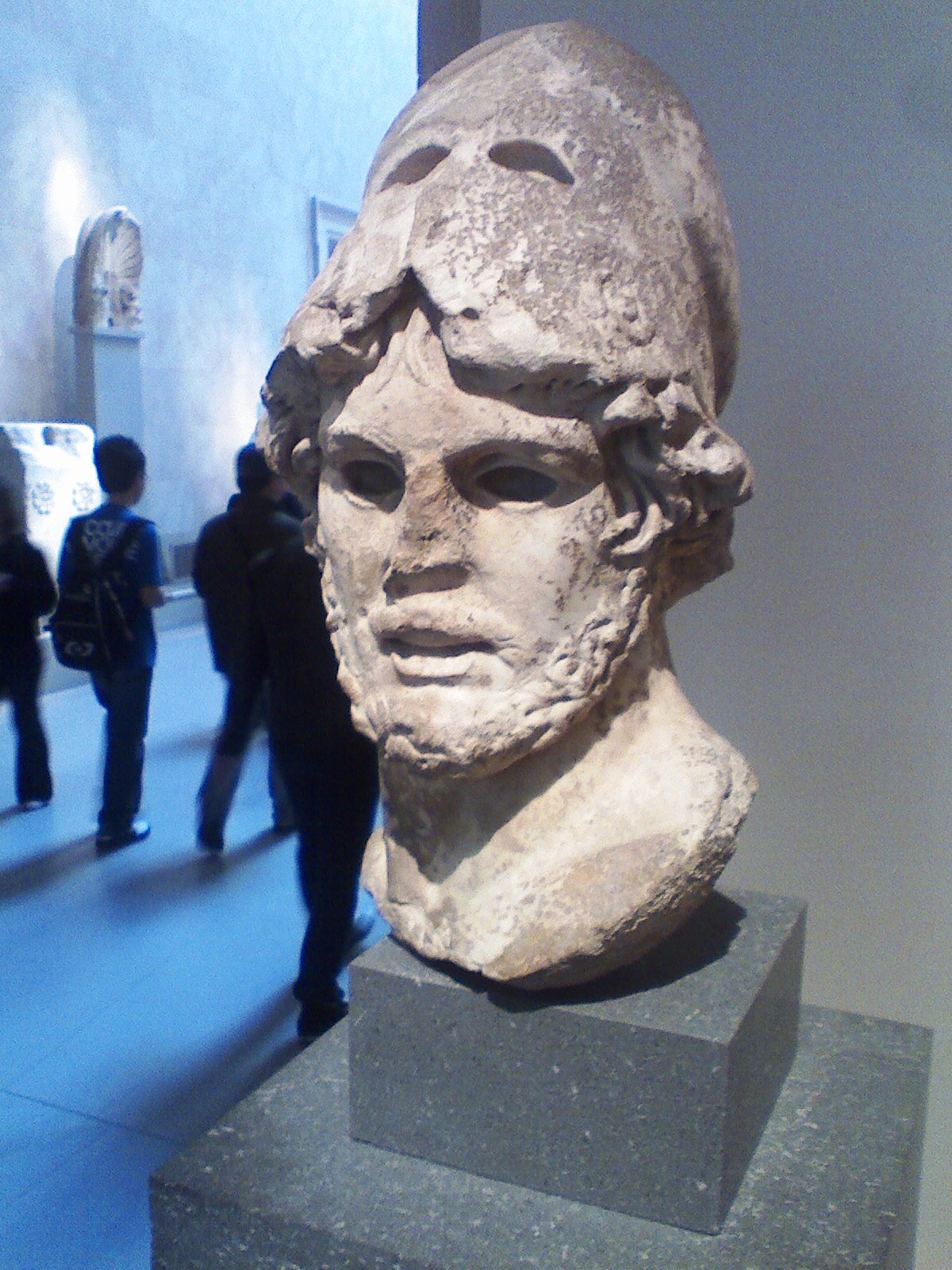
The Met, IV:


An opinion on Iran

An Informed Opinion on Iran:

Michael Totten has an interview with a CIA agent from Iran's Revolutionary Guards. He has an opinion on the subject of why Iran wants nukes.

MJT: So do you think if they acquire nuclear weapons they will actually use them?

Reza Kahlili: They will.

MJT: Against Israel?

Reza Kahlili: You have to look at the parallel projects that they're working on, the missile delivery system and the nuclear project. Currently they cover part of Europe. Their goal is to cover all of Europe. They're not going to announce they have a bomb unless they have overcome the glitches of putting together a nuclear bomb and a nuclear warhead. But once they do that, they will make enough bombs so that all of Europe is under their coverage. Then they will begin their most aggressive behavior in trying to control the Middle East, moving toward the goal of destroying Israel, bringing the imperialistic system of economics to a halt, creating chaos, and waiting for the Mahdi to appear. It's all right out in the open. Just look at their Mahdi philosophy.
What does he think we should do about it?
Immediately, the Western countries should cut off all shipping lines and air lines, and deport all Iranians who work in offices connected to the Iranian government. They're Quds Force members. They're intelligence guys. Deport them. And stop sending refined oil to Iran. They rely on that.

Corner the country and give them a deadline. And if the Iranian government doesn't give up its program, take it out. Do not allow this country to become nuclear armed. Sanctions are not going to work.

In the worst case scenario, if there is a military confrontation, do not invade the country. Do not destroy the country. Take the Revolutionary Guards out. If you take the Revolutionary Guards out, this government can't last 24 hours.

We know all their bases. We know all their officers. We know all their buildings. If they move in convoys, take them out. And that will be the end of this government.
Predictions like that are common: often it proves that an enemy you expect to destroy quickly and easily proves much more dangerous than you expected. Collapsing central authority with no ground forces to restore order would be, essentially, the same core mistake made in Iraq when we disbanded the Iraqi army and put nothing in its place.

Could the Iranian people restore order themselves? It's possible. It's also possible that different factions could spark a civil war that would consume the lives of thousands or hundreds of thousands.

While I have no desire to wage war with Iran, though, I do believe he's right about their penchant for confrontation. There is no doubt that Iran has been hip deep in supporting every kind of terrorism and insurgency, and their weapons -- planted by insurgents they trained -- have killed many American soldiers and Marines. Why wouldn't they use a nuclear weapon, when they've never hesitated to use any other weapon that came to their hand?