Election Fraud

Election Fraud:

Feeling bad about how little trust there is in our elections? Read this, which features famous gunfighter Johnny Ringo in the role of Democratic Party delegate and election official:

Almost every election in the post-Civil War era held the fervor of a religious crusade, and the first Tuesday in November of 1880 caused high fever in the West. Republican James Garfield [Who was later assassinated... -Grim] and Democrat Winfield Hancock battled for the presidency, while Pima County [Arizona]'s most contested race centered on Bob Paul's bid to unseat Sherriff Charile Shibell. Garfield won the presidency by fewer than 10,000 popularvotes.... The race in Pima County proved even more complex. Democrat Shibell, despite appointing Wyatt Earp as his Tombstone district deputy, was perceived as more an administrator than a tough lawman and received the support of the [outlaw gang known as the] cowboys. Oddly, outlaw John Ringo served as a delegate at the Pima County Democratic convention despite a question of his legitimacy because he had no legal residence. The Democrats chose to avoid problems and seat Ringo [shades of The Man Who Shot Liberty Valance, there]....

Shibell won reelection by a close margin as rumors ran through town of massive election fraud. The San Simon Cienega precinct recorded 103 votes for Shibell and one for Paul, in a district that had no more than 50 eligible voters. All but one of the 23 Democrats on the ticket received those 103 votes... while nearly all the Republican candidates polled only one vote each. The [Tombstone] Epitaph noted: "The odd vote is said to have een cast by a Texas cowboy, who when questioned as to why he was voting the Republican ticket, said: 'Well, I want to show those fellows that there wasn't any intimidation at this precinct.'"

From Casey Tefertiller's Wyatt Earp: The Life Behind the Legend, p. 53-4. Election fraud on the frontier... but of course, we know it was better in the cities. Ha ha!

Well, out of such things is democracy made. Maybe it will make you feel better about the current situation -- or even the problems in Iraq, where democracy is having a similarly rough start amid armed and dangerous factions.

CFR Thailand

CFR on Thailand:

The Council on Foreign Relations has a new fact sheet on the Thai insurgency. I appreciate people trying to make the complex nature of the insurgency easy to understand, and for the most part this is a good primer. On the other hand, there's this:

Why isn’t the new government’s approach working to end the insurgency?

Experts say Thaksin's stance set in motion a rise in bloodshed that will take time to control. "Once the spiral of violence starts it is difficult to stop," says Croissant. Liow predicts "the problem will get worse before it gets better" and that Thaksin's policy mistakes "set the government behind several decades in terms of critical intelligence gathering" necessary for effective counterinsurgency operations.
What? You stage a military coup against an elected government and suddenly you get "decades" before you have to prove effectiveness in your COIN activities? Maybe we should revisit that Arkin idea after all...

Seriously, guys, that's not helpful. The military coup in Thailand seems to have had the backing of the palace, which is a reasonable source for legitimacy -- the monarchy in Thailand is not only widely beloved, but has produced monarchs of the sort you really might want to follow, including the current one. Cutting them "decades" of slack, however, is too much. Ultimately, if you just want to say that the King's people were right to back the overthrow of the democracy, just say it.

Trunk Monkey

The Trunk Monkey:

I know it sounds odd, but I have seen nothing lately so encouraging about the good sense of the American people than this ad. That is, of course, precisely right.

Arkin II

Arkin II:

I don't think I'm going to spend any more time on Arkin, thanks. However, he's decided he's enjoying the attention, and so has a second piece on the awfulness of the military (at least, that part of it which supports the war it's fighting).

In deference to my diverse readership, I'll offer links to three different pieces, from which you can choose depending on your own leanings.

If you want an outraged-but-reasoned response, here's Cassandra.

If you want a thoughtful-but-not-especially outraged response, try Ed Driscoll.

Or, if you want the full flavor of outrage, there's always Jimbo.

As for me, I think I'm going to take Eric Blair's position -- forget this guy.

J. Reagan

The Ultimate Indoor Philosophy:

Via Arts & Letters Daily, we have an article on Judith Reagan. Reagan, who once promised to 'eat the testicles' of a man who'd crossed her by giving someone besides her a job she wanted, practices what must be the last word in indoor philosophy.

It would have been a hard couple of months, even if she had been eating.

Judith Regan loves to fast. She likes the high you get, the way it makes you feel clear, intuitive, even telepathic, transforming your skin into a baby’s and launching your energy level into the stratosphere. Says Natalia Rose, Upper East Side detoxing guru, “She loves eating really clean. When I tell her my big picture of how I want everyone to understand their connection to the light, and by healing each other we heal the world, she totally believes that.”
Later in the article, our guru of this particular metaphysics explains the system further.
A gorgeous brunette in a striped cashmere sweater drifted into the room—it was Natalia Rose, on to talk about a book that she had published with Regan, and about living clean. “Negative emotions are something in a food context,” said Rose, her face glowing with health. “What’s happening in our head is happening in our colon.”
So, human morality is reducible to brain activity; and brain activity is reducible to colonic activity. If indoor philosophy is the philosophy of people who spend their lives inside rooms, this is the philosophy that arises from living in just one room: the bathroom.

It's interesting that the philosophy claims a higher ethical purpose: "to heal the world." All that is demanded of devotees, however, is obsessive attention to themselves. By purchasing extravagant diets and trips to exotic spas, they purify themselves to the point that they become a healing force in the world.

Sound familiar? By pursuing their connection to the 'inner light' through devotion to attending to their body, they are fulfilling Chesterton's prediction perfectly.
Of all conceivable forms of enlightenment the worst is what these people call the Inner Light. Of all horrible religions the most horrible is the worship of the god within. Any one who knows any body knows how it would work; any one who knows any one from the Higher Thought Centre knows how it does work. That Jones shall worship the god within him turns out ultimately to mean that Jones shall worship Jones. Let Jones worship the sun or moon, anything rather than the Inner Light; let Jones worship cats or crocodiles, if he can find any in his street, but not the god within.
Well, how does that doctrine work itself out? Let Reagan tell us herself.
In her office the day before she was fired, she had a meeting with Anna David, the author of the book Party Girl—You’re so gorgeous you should be on the cover of your book!—and chatted in the corridors with some of her staff: One of the moms told her about her ex-husband, who seemed to be ignoring their kids at Christmastime and reneging on special presents. “Of course he doesn’t have to get them presents,” she fumed. “He’s a man—the only thing they’re good for is semen. They’re inseminators! That’s all they are!”

A stray male walked down the hallway.

“Not you,” she called after him, dissolving in laughter. “Every man except you!”
Ah, yes. Spreading healing among... well, not "mankind," exactly, but perhaps to the occasional "stray male."

Of course, if Judith shall worship Judith, it makes sense for her to feel that Jones has fallen from the pure faith. If the image of perfection is your own perfect self, than anyone who is different from you -- by sex, by race, by metaphysics -- is removed from that purity precisely by the degree of difference. Even if Jones were a fellow devotee, he is a man. Probably his colon is unclean; certainly his chromosomes are.
Well, this works.

And Arkin can DIAF.

Ahem

Ahem:

You should probably read Fuzzy's post about Mr. Arkin. This is a remarkable sort of writing:

These soldiers [from the NBC piece, who said you can't support the soldiers without supporting their mission] should be grateful that the American public, which by all polls overwhelmingly disapproves of the Iraq war and the President's handling of it, do still offer their support to them, and their respect.

Through every Abu Ghraib and Haditha, through every rape and murder, the American public has indulged those in uniform, accepting that the incidents were the product of bad apples or even of some administration or command order.
I'd have to say that the soldiers probably are grateful to their fellow American citizens who do support them. I'm not sure they ought to be grateful to Mr. Arkin's ilk, who would like to suggest that Abu Ghraib and Haditha, rape and murder are not unusual violations of the military's accustomed discipline and honor.

Nor do I think that they shouldn't be allowed to say what they said. There is a fine line in what military men can express in terms of political ideas, but given that these were low-ranking servicemen plainly speaking for themselves, I think they're in line.

Oh, Arkin also goes on to suggest that a military coup would be likely, 'if this weren't the United States.' I agree that the United States is uniquely unlikely to suffer a military coup, but I wonder if he has given any thought as to why that might be. "Because the military wouldn't consider participating in a coup," is one answer; "Because the American people are well enough armed to resist it" is another. Neither of these stabilizing factors have anything to do with Arkin's kind.

Not Quite Yet

104.3: Not Quite Yet

I went into the barn this morning to get the axe, and the radio was on (as always). It was set to 104.3 FM out of Atlanta, which is a country music station. The disc jockey was saying that it was George H. W. Bush's birthday, and he was going skydiving as he always did.

'President Bush won't be joining him,' the jockey said. 'He wanted to go, but the last time he got into an airplane he couldn't find the way out. See, he has this problem finding exits. Yeah.'

That was a poor attempt at humor, I thought, just from a structural view. A joke normally relies on something unexpected to create the sense that there's something funny about what was said. This wasn't humor, but simple mockery. I thought to myself, "That's the end for Bush, then. When they feel comfortable mocking him on country music stations in Atlanta, it's all over."

Well, I went off and did some chores, and about half an hour later was back in the barn to get some hay. The disc jockey had a caller on the air -- which this station normally doesn't do, I don't think -- and she was reading him the riot act.

"I love George Bush," he was saying defensively. "I mean, I think he makes fun of himself sometimes?"

She gave him another load of verbal buckshot.

The message is clear: If you're Leno or Letterman, or MTV, or a disc jockey on a rock and roll station, or a professional comic, or just about anyone else, you can make fun of the President.

If your business is country music, though, it's still not quite time. Willie Nelson excepted, of course -- old Willie can do just about what he wants. He's earned it.

Maybe if it had been a better joke?

I don't recall Clinton having defenders who were ready to assert that it was wrong to mock him; maybe there were some, but I seem to remember him being roundly mocked by everyone, left and right, although for different reasons. Probably that's to do with the fact that Clinton's supporters weren't Southerners, for whom it's important that the people they respect not be mocked. GWB seems to have hit rock bottom in terms of his approval ratings, but that bottom is solid. That lady who called the radio station wasn't someone I'd be in a hurry to tangle with, from the sound of her.

I don't think this is an important story, just an interesting one.

ABTF

"A Bridge Too Far":

Given the difficulties with the "New Blogger," I'll take the liberty of reminding everyone that we were meant to watch the movie this weekend. If you have comments, leave them here. It's a fine discussion to be had.

Which reminds me -- Eric, you get to pick the next movie. I don't think you've picked yet. I'm only going to ban Gladiator. Anything else is fair game.

Updation

Updation:

I apologize to all my co-bloggers, who will have to create Google accounts to post here. Blogger went through the "hey, want to Beta test the New Blogger?" phase, to the "the New Blogger is now available!" phase, and has finally reached the, "The New Blogger is now mandatory if you ever want to access your blog again, buddy," phase.

So, we're stuck with it. Hopefully it won't be too painful.

On a happier note, I see that FreeSpeech is up and running again. Del Simmons used to run one of the best blogs in the 'sphere, until... well, let's call it a little lesson in the dangers of unbridled libertarianism. It was a great theory, giving anyone who asked an author's account, but in practice...

Anyway, once he gets his legs under him, I'll expect to see some good discussions going on over there again.

(The title of this post is in honor of the Commissar.)

Indoor Philosophy

Indoor Philosophy:

Edward Abbey famously slammed a whole school of metaphysics using a phrase I think he had from Muir himself. Muir used the phrase "indoor philosophy" to explain why Bostonians in the company of Emerson refused to let the old man join in one of Muir's wild treks.

He seemed as serene as a sequoia, his head in the empyrean; and forgetting his age, plans, duties, ties of every sort, I proposed an immeasurable camping trip back in the heart of the mountains. He seemed anxious to go, but considerately mentioned his party. I said: "Never mind. The mountains are calling; run away, and let plans and parties and dragging lowland duties all gang tapsal-teerie. We'll go up a caƱon singing your own song, "Good-by, proud world! I'm going home, in divine earnest. Up there lies a new heaven and a new earth; let us go to the show." But alas, it was too late,—too near the sundown of his life. The shadows were growing long, and he leaned on his friends. His party, full of indoor philosophy, failed to see the natural beauty and fullness of promise of my wild plan, and laughed at it in good-natured ignorance, as if it were necessarily amusing to imagine that Boston people might be led to accept Sierra manifestations of God at the price of rough camping.
Abbey took the phrase and used it as a weapon. "In metaphysics, the notion that earth and all that's on it is a mental construct is the product of people who spend their lives inside rooms," he said. "It is an indoor philosophy."

I find that I have the same complaint with Stephen Pinker's latest, "The Mystery of Consciousness." This is a fascinating piece, as it should be since it treats a fascinating problem. What is the nature of consciousness?

I'd like you to read his article in full, but I want to treat a couple of parts of it. First, the scientific data he advances to us is full of import. The advances in our understanding of the working of the brain are astonishing at times, and something I greatly enjoy thinking about. His explanation of how people are less rational than they think they are, or even than they seem to be, is I think one of the most useful lessons to be learned about Mankind.
When an experimenter got people to endure electric shocks in a sham experiment on learning, those who were given a good rationale ("It will help scientists understand learning") rated the shocks as more painful than the ones given a feeble rationale ("We're curious.") Presumably, it's because the second group would have felt foolish to have suffered for no good reason. Yet when these people were asked why they agreed to be shocked, they offered bogus reasons of their own in all sincerity, like "I used to mess around with radios and got used to electric shocks."
There is a lot to be said for his work on "the Easy Problem," as he calls it. What I want to point to is what he has to say about "the Hard Problem."
The Hard Problem, on the other hand, is why it feels like something to have a conscious process going on in one's head--why there is first-person, subjective experience. Not only does a green thing look different from a red thing, remind us of other green things and inspire us to say, "That's green" (the Easy Problem), but it also actually looks green: it produces an experience of sheer greenness that isn't reducible to anything else. As Louis Armstrong said in response to a request to define jazz, "When you got to ask what it is, you never get to know."

The Hard Problem is explaining how subjective experience arises from neural computation. The problem is hard because no one knows what a solution might look like or even whether it is a genuine scientific problem in the first place. And not surprisingly, everyone agrees that the hard problem (if it is a problem) remains a mystery.
He says this early in the piece, but then goes a long time before he explains what he means by 'not a genuine scientific problem in the first place.' What he means is that it may not be possible to approach the problem through science.
TO APPRECIATE THE HARDNESS OF THE HARD PROBLEM, CONSIDER how you could ever know whether you see colors the same way that I do. Sure, you and I both call grass green, but perhaps you see grass as having the color that I would describe, if I were in your shoes, as purple. Or ponder whether there could be a true zombie--a being who acts just like you or me but in whom there is no self actually feeling anything. This was the crux of a Star Trek plot in which officials wanted to reverse-engineer Lieut. Commander Data, and a furious debate erupted as to whether this was merely dismantling a machine or snuffing out a sentient life.

No one knows what to do with the Hard Problem. Some people may see it as an opening to sneak the soul back in, but this just relabels the mystery of "consciousness" as the mystery of "the soul"--a word game that provides no insight.

Many philosophers, like Daniel Dennett, deny that the Hard Problem exists at all. Speculating about zombies and inverted colors is a waste of time, they say, because nothing could ever settle the issue one way or another. Anything you could do to understand consciousness--like finding out what wavelengths make people see green or how similar they say it is to blue, or what emotions they associate with it--boils down to information processing in the brain and thus gets sucked back into the Easy Problem, leaving nothing else to explain. Most people react to this argument with incredulity because it seems to deny the ultimate undeniable fact: our own experience.

The most popular attitude to the Hard Problem among neuroscientists is that it remains unsolved for now but will eventually succumb to research that chips away at the Easy Problem. Others are skeptical about this cheery optimism because none of the inroads into the Easy Problem brings a solution to the Hard Problem even a bit closer. Identifying awareness with brain physiology, they say, is a kind of "meat chauvinism" that would dogmatically deny consciousness to Lieut. Commander Data just because he doesn't have the soft tissue of a human brain. Identifying it with information processing would go too far in the other direction and grant a simple consciousness to thermostats and calculators--a leap that most people find hard to stomach. Some mavericks, like the mathematician Roger Penrose, suggest the answer might someday be found in quantum mechanics. But to my ear, this amounts to the feeling that quantum mechanics sure is weird, and consciousness sure is weird, so maybe quantum mechanics can explain consciousness.

And then there is the theory put forward by philosopher Colin McGinn that our vertigo when pondering the Hard Problem is itself a quirk of our brains. The brain is a product of evolution, and just as animal brains have their limitations, we have ours. Our brains can't hold a hundred numbers in memory, can't visualize seven-dimensional space and perhaps can't intuitively grasp why neural information processing observed from the outside should give rise to subjective experience on the inside. This is where I place my bet, though I admit that the theory could be demolished when an unborn genius--a Darwin or Einstein of consciousness--comes up with a flabbergasting new idea that suddenly makes it all clear to us.
I'll ask Karrde, given that his education in mathematics is far better than mine, to explain how mathematics has some problems that cannot be solved even in theory. The point is that science as a whole has some similar limitations. There are some questions it cannot answer, even in theory. Pinker's answer is that this is a fault of our brains; but perhaps someone may develop a better theory. Yet this too is subject to the limit that Dennett identifies.

What this means is -- barring some future Einstein who throws open windows that for now are closed to us -- what we have in the "Hard Problem" is a problem of metaphysics, not a problem of science. Metaphysics is in the realm of philosophy, which is an art rather than a science.

Metaphysics is the art of trying to guess the rules that lay behind the world. For example, given a world in which conscious people suffer terribly, inevitably decay and die -- well, what kind of a world is that? We can learn everything there is to know about how people suffer and decay and die, without knowing anything more about why the universe is set up that way.

A famous example of a metaphysical question is the status of the human fetus. Is it a person, or is it a clump of cells? There is finally no scientific way to decide. You can know a lot of scientific facts about it. You can know the moment when it can survive outside the womb, for example. You can know the point at which its genetic code is set. You can know the point at which it develops a brain.

None of those items of knowledge, though, do anything at all to answer the question, "Is it a person?" Finally, you just have to go with your gut.

Metaphysics is ultimately about judgment calls, which you make as much because they feel right for any other reason. This is where we return to the problem of "indoor philosophy." The philosophy that is all in the head uses only the rational part of the brain; metaphysics cannot be done there only. You need to feel as well as think to come to stable results.

Pinker's conclusion is that we should find the Easy Problem destructive to our idea of a soul; and that we should therefore rebuild our metaphysics based on his best guess about the Hard Problem.
Whatever the solutions to the Easy and Hard problems turn out to be, few scientists doubt that they will locate consciousness in the activity of the brain. For many nonscientists, this is a terrifying prospect. Not only does it strangle the hope that we might survive the death of our bodies, but it also seems to undermine the notion that we are free agents responsible for our choices--not just in this lifetime but also in a life to come. In his millennial essay "Sorry, but Your Soul Just Died," Tom Wolfe worried that when science has killed the soul, "the lurid carnival that will ensue may make the phrase 'the total eclipse of all values' seem tame."

MY OWN VIEW IS THAT THIS IS backward: the biology of consciousness offers a sounder basis for morality than the unprovable dogma of an immortal soul. It's not just that an understanding of the physiology of consciousness will reduce human suffering through new treatments for pain and depression. That understanding can also force us to recognize the interests of other beings--the core of morality.
He's entitled to that view, which I think is honestly delivered. He tells us cleanly where the lines are -- this is science, and that is just how I feel about it. Nothing wrong with that.

My own sense is different, and it is just as well informed. This is the one place where the old advertising line really works: "I'm not a doctor, but I play one on TV." That's all right. Playing one on TV imparts its own sense of things, which a real doctor would not have. This isn't a medical question. I'm not a neuroscientist, but I am a man.

My sense of things is that the brain and its activity isn't all there is; that it is as if we were studying a television set. You can study the television, and it will show you everything about how the picture is being formed on the screen. Every process involved is resident right there in the television. If you damage parts of the set, the reception blurs. The television still thinks its putting the image together correctly, but we can see it isn't -- just like a damaged brain can't quite get its information together, but can't tell that it is failing to do so.

Yet you can break that set with a hammer, and the signal is still there. You can't see it anymore -- without the set, have no way of sensing that it still exists -- but you can't stop the signal. That's my sense of the soul, and of what it means to die.

Eyesight works that way. The eye receives and the brain interprets light. The eye takes the light waves, converts them into electric signals that the brain can understand, and the brain projects them into a three-dimensional image of the world around you. It's fair to say that there may be seven dimensions instead of three, and our brain simply can't understand or interpret them.

What you can't do is get hung up on the eye and the brain, and forget that the light came from somewhere. If the eye shuts down, the light is still there. If the television set breaks down, the signal is still there. If the brain shuts down, the soul is still there.

That's an outdoor philosophy. I can't prove it, but I've felt the cold and seen death, and it seems right to me. I recognize that it's subject to McGinn's problem -- that it is a sense that may simply be a quirk of the brain. Well, it may be. But so, as the man himself says, may be any other explanation.

A scientist, who spends his life in rooms, may come to love the rational too much. A man has a rational and an irrational side to his soul. The scientist, focusing so much on the one, may come to see the other as a liability, a quality to be overcome with data and analysis.

So it may be, in scientific questions. I'm not against rationality, and I am eager to learn what new secrets science has to reveal.

But science has a place, and metaphysics another. Until and unless some future Einstein finds a way to transport these questions from the one realm to the other, we should approach them as whole men. That's a metaphysical position too -- a belief that the irrational part of us is valuable and vital, and something we should seek to involve in the most important questions of life.

I can't prove it, anymore than Pinker can prove the opposite. I invite the reader to follow Muir -- to camp rough in the high country -- to meet the brown bear of the forest -- and see if he still doubts it.

Perhaps it's only a trick of the brain that makes the man accept it. But perhaps that is the brain he was meant to have; perhaps that is the man he was meant to be.

Meant by whom? I don't know. But I have heard that a man can seek manifestations in the Sierra.

ABG

"Orchid Daze" at the ABG:

Today, grandma was meant to run off with the boy, and I was meant to take my wife on a nice horseback ride up into the Georgia hills. This plan changed due to a last-minute invitation by grandma to the wife to go down to the Atlanta Botanical Gardens for an art show. The "Orchid Daze" exhibit featured blown-glass orchids, mixed in with the large collection of real orchids, and glass frogs in with the real Amazon frogs, which was to inspire a blah-blah-blah about the cunningness of man-made artwork to reflect the beauty of nature.

It's not that I don't know anything about art. It is, I think, that I know too much about it. My mother (that is, grandma) is an artist and an art-teacher; as I just mentioned, my wife is an equine artist. I've grown up with art education, then, and when dating I spent years hanging around the world-famous Savannah College of Art and Design, discussing art theory and going to exhibits both of famous artists and up and coming ones. I've been surrounded by art and art theory, folk art and fine art, since I was a child.

I've long ago figured out that there are just three kinds of artists: craftsmen, spiritualists, and people who are faking it. There are more of the last kind than anyone else, and they make up almost all the "concept" artists. The more somebody has to say about what their art means, the less it is really worth. Not in terms of dollars -- most consumers of art aren't smart enough to see through the line of salesmanship to realize they are buying a piece of canvas with one red line on it. (This is a fact that the Pop Artist, Warhol and the like, openly enjoyed.) The real depth of the work, though, is not going to be found in concept art.

This Frabel is a craftsman, and his stuff is good. His orchids in particular are very good. It's no wonder they liked them at the garden -- but if you're not that into orchids (and I am definitely not), you'll quickly tire.

On the other hand, there was some faker art out in the gardens that was... well, as you'd expect it wasn't that great. There was one real exception to the rule, however: the six-ton skull.

What made this piece great was not the concept, which... ah, well, read the article if you want the line of chatter. Supposedly it's all about earthy feminism and a 'new age of martiarchy.' Hey, maybe some people find it deeply feminine to sit in a giant skull and meditate. That wasn't what made it work, though.

What made the six-ton skull great wasn't its feminist qualities, but the fact that it was a huge, brightly-colored skull that you were allowed to crawl on. It wasn't its ability to speak to martiarchy, in other words, but its ability to speak to children.

Every child in the place, and especially every boy, loved it. They could clamber all over it. They could sit in the nose like a chair. They could crawl down into the jaws and howl out through the teeth. They could stick palm fronds out through the mouth like a big tongue, and try to "lick" other kids as they ran past. They could sit inside and scream, making it echo.

They loved it. That doesn't make it "great art" -- after all, kids love Barney the Dinosaur. Still, it does make it a worthy investment on the part of the Garden. I say that without knowing exactly how much was invested -- even a six-ton skull is only so valuable. Assuming they didn't let the line of chat drag more money out of them than was reasonable, though, it was a nifty thing to buy.

Oz Day

Happy Australia Day:

I had meant to say some words about the wonderful people of Australia, our most faithful ally and truest friend in the world. I had meant to say something about their history, landscape, and enviable culture.

But why gild the lily? (H/t: InstaPundit.)

PJM 2

PJM Specials Today:

The second part of the "Islands" series is available. It's interesting to see his comments on the role of "political correctness," Philippines style, in hampering the GWOT. To whit, if the government is seen as being too compliant with the US, political opposition flares. Thus, needed laws don't get passed.

There is certainly some truth to the complaint. There is another side, too. In Indonesia, for example, the US State Department pushed pretty hard -- and Australia's Foreign Ministry also -- for radical cleric Abu Bakar Bashir to be arrested on charges of supporting terrorism. The Indonesian government ended up doing just that, but the charges that were necessary to satisfy the US/Oz were not supportable given the admissable evidence and judicial climate. As a result, Bashir ended up getting off lightly. His early freedom was taken as a public rebuke to the US and made him a rallying point for Islamists in Indonesia.

Still, the point is well taken. You have to balance the pressure you bring to bear with the reality of the political situation. Less than optimal results happen if you err on either side.

Today's report from Baghdad is here.

HiHK: ID

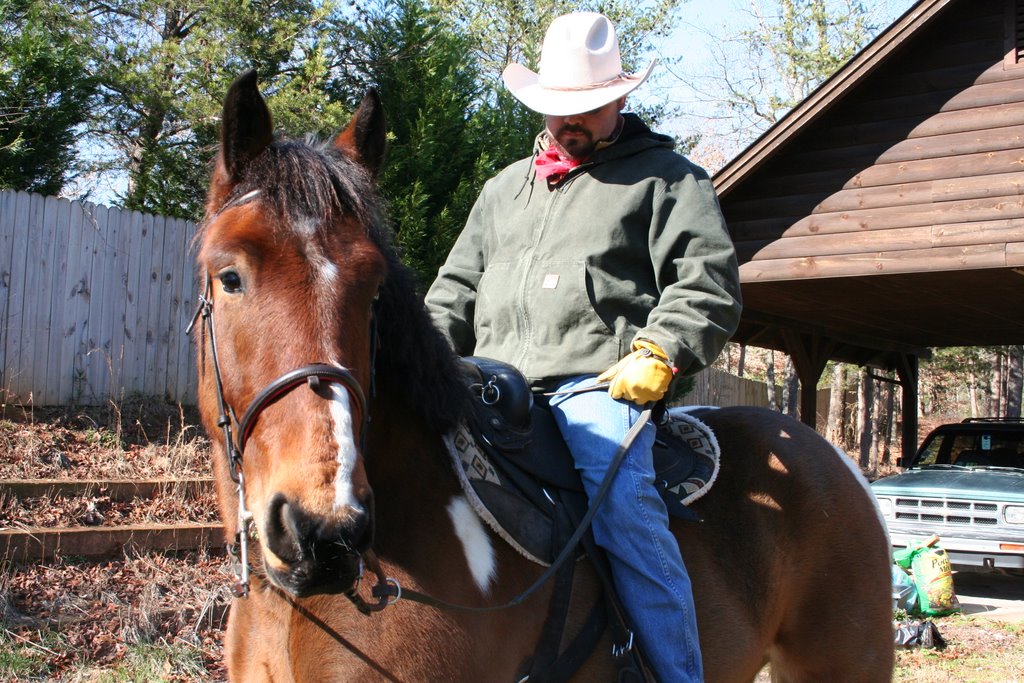
Horses I have Known II: Design v. Evolution

Since you folks liked the horse pictures so much the last time, I thought I'd post a couple more. I have all these pictures because my wife, who is an equine artist (chiefly a sculptrix, but also a painter) is always trotting out to get photos of the beasties to use as references.

Today's horse is Tobias:


(The truck in the background, for reasons most of you will understand, is named "Serenity.")

Tobias is obviously a draft horse, a heavy, stocky horse of substance. Drafts are cold bloods, horses that we have for hundreds of years bred to be powerful, and easygoing. This is because they are meant to pull carts or plows, or work in teams, and it is harder to control a horse in that context than it is to do so while riding them with proper tack. As a result, you need a brave horse (i.e., it won't spook easily) that is gentle and easygoing.

The problem is that the horse's evolved nature runs totally against both propositions. In spite of their size, horses are prey animals in the wild. They are thus conditioned by a million years' survival to spook easily, and to respond to such spooks by running like the devil in the opposite direction. These are not desirable qualities, but they are deeply embedded. (A side note -- there is a piece in this month's Equus that argues that cold bloods branched off from the rest of horses at a much earlier period in evolution, which explains both their different dietary needs and some tempermental differences. See "Nutrition: Feeding Big Eaters" in the EQ Consultants column, p. 74-5.)

What can you do about that? Well, one thing you can do is breed horses that aren't particularly smart. They will go happily about their business because they are bad at threat recognition. However, genuinely dumb horses create other problems for the working horseman.

What people have done instead is select horses for breeding that have shown a certain tendency to go on "autopilot" when they're in harness. Humans do this too, so you'll understand what I mean. If you regularly make a trip by car, you get to where you can make it without thinking about it. Thus, your brain is free to be otherwise occupied. You may only be pulled back to full consciousness if something unexpected happens on the road. If a semi suddenly pulls out in front of you, you're suddenly "awake" -- but otherwise, the autopilot takes you there.

The best draft horses are bred for a similar quality. Tobias is a good example. He is a smart beast, when he's out of his harness -- but you tack him up, and he sort of sighs and his brain goes away. He does his job, but you can tell he is not all there while you're working him.

For example, he will walk straight into a tree.

You have to be very careful, therefore, about where this horse's ears are pointed. That's where he's going to go. If they're pointed at a tree, you have to turn him. This is the opposite of a horse like the Colonel, who has a good sense for his surroundings. The Colonel has excellent trail sense. Tobias is smart enough to have it, and in alarming situations -- for example, if you are riding him down a steep and rocky hillside -- you can feel his brain come awake. Like with you and the semi, he's suddenly "all there" and careful. Most of the time, he's not, and you'd better be watching where he's going.

He's a good looking beast, though:


Tobias is a former driving horse, and has only recently begun to be trained for trail riding. He hasn't learned to neck-rein yet, which is one of the things I like to teach the horses. He still rides like he thinks he's pulling a cart, and he still steers like a wheelbarrow.

He has the best of his breeding, though. He's gentle and sweet, and he never fails to come over when he sees you to seek some friendly attention. He's afraid of absolutely nothing -- today I thought he was going to run the UPS truck off the road rather than give way. He's a bit lazy, which is common with cold bloods, but he's a good horse all around.

Best to BlSp

Good Wishes to BloodSpite:

Horseman and former Special Forces blogger Bloodspite had some hard news this week. I'm a little late getting to this, as I don't get around to reading "the community" as quickly as some -- but I do get by eventually. I join with Fuzzy in wishing him all the best.

It looks like people have been responsive, but for what it's worth -- drop him an email, if you have the time.

Dick Cheney's death stare

"Dick Cheney's Death Stare"

Heidi at Euphoric Reality laughs at Wolf Blitzer, who backpedals as fast as I've ever seen a media personality go. His guest was Dick Cheney, and so of course it was necessary to ask about his lesbian daughter.

This is such a popular topic that Google shows over million hits. Yay.

I understand Wolf's real question, which was this: "Focus on the Family is an important Republican interest group. They've taken it upon themselves to lecture your daughter and suggest she is immoral. Don't you wish to defend her against them, and therefore create a rift within your party?"

Of course, the answer is, "No, and no thanks for asking."

It's none of Focus on the Family's business, of course, and they could usefully shut up. The same goes for people who would like to publicize the dispute to the greatest degree possible, because it might hurt the Republican party. I have noticed that busybodies, in both parties, have trouble minding their own business. I believe there is even a Hank Williams song on the topic.

For those who can't carry a tune, a nice quiet death stare is almost as good.

Op Baghdad

Operation Baghdad:

PJM also has a reporter in Baghdad. Mohammed Fadhil is reporting on the fighting in the city. The reporting is informative, and the picture of the Stryker flying the Jolly Roger is worth the price of admission by itself.

RF in PHIL

Islands in the War:

Richard Fernandez of the Belmont Club, longtime resident of the Philippines, is back there on special assignment to PJM. He has a very useful writeup on the background of the conflict in the southern, Muslim regions. He also has a much darker forecast than mine about the region's prospects.

For example, when counterterrorist intelligence learned that Jemaah Islamiyah cadres were being trained in terrorist skills in a Moro Islamic Liberation Front area, they hesitated to raid the site because the Moro Islamic Liberation Front was a officially a "peace partner" of the government.

A Filipino intelligence official attempted to square the circle by persuading his Muslim contacts in the MILF to attack the JI camp with government sanction. Asked whether this may have tipped the JI off into escaping, the official said "That was a risk, but what else was there to do? The official policy is to pursue a political settlement whether anyone really wants it or not." But if the chance of a comprehensive political solution seemed distant ("They’ll solve the Israeli-Palestine problem before we solve this") a military solution seemed equally remote.

I still think exactly that is the way forward -- using the MILF's natural pursuit of its own interests to deny the area to the JI. The MILF has been a "peace partner" in more than name, having assisted government forces on several occasions; and its spokesman, Eid Kabalu, has a devotion to peaceful rhetoric unusual in armed Muslim movements. Even when his brother was killed by police in a drug raid, he kept to formulations built around investigations and negotiations. Rhetoric is just words, but you'd have to go a long way to find another movement of this type which was as willing to be judicious with its words.

There is little doubt that some elements of the MILF, and its parent organization the MNLF (Moro National Liberation Front), have had contacts with terrorist groups. There are persistant reports that the two have allowed terrorists to train in their camps. However, there is also a record of cooperation -- sometimes grudging, sometimes ready -- that marks the MILF and MNLF alike as a different sort of movement from al Qaeda or Jemaah Islamiyah. If the right tools can be found, we should be able to disaggregate the MILF from the true terrorist groups in Southeast Asia. Given the fact that Mindanao is beyond the capacity of the RP government to truly control, that seems a wise policy.

Knife Fighting

Knife Fighting Link:

Kim du Toit suggests this as a preemptive defense, should you shoot someone who comes at you with a knife. The original post is here. The pictures are graphic.

I'd like those of you who are interested in the subject of knife fighting to take a look at those pictures. This is what a good knife can do when used improperly.

Photo 1 shows three slash wounds across the back, two across the spine. The knife was used right-to-left on the top, left-to-right on the second wound, and top-to-bottom on the vertical wound. In each case, the knife was used to slash instead of stab, and it was held with the blade leading -- whereas it should have been held with the backstrap leading.

The wounds did serious damage to the muscle, but were not in any way life-threatening (save for the possibility of blood loss). The two vertical wounds could have been stabs directed at the spine, in almost any situation in which it was possible to deliver those two blows. The vertical wound should have been a stab driven into the lung.

If the knife had been held correctly (the opposite way from how it was held), and the knife's wielder had known where to stop slashing and drive it home, the victim here would be dead.

Photo 2 is the same, but a single wound. A stab delivered there would have penetrated the liver and/or lower lung, depending on the angle.

Photo 3? Again, the same. I wonder if these wounds were all delivered by the same person. The incompetence is noteworthy. The fighter had four separate opportunities to kill his opponent, but delivered blows that were only ugly, not incapacitating.

Absolutely any of those wounds could have been fatal, and would surely have been incapacitating, if the wielder had known how to fight. If you are interested in the ancient arts of fencing and bladework as a form of self-defense, learn from the example. Hold the blade upwards toward your thumb, not downwards toward your little finger. Slash until you are over something vital, then drive home with the weight of your body behind the attack.

This is the way to use a blade. A gun automates this process, and is therefore easier for some, either physically or mentally. If you choose a blade, though, this is how it is done.