Col. Kurt: Reject Freaks and Weirdos

Kurt Schlichter does have a way with words.
Have you noticed the absolute freakshow quality of the people who want to keep us in chains? Perhaps it’s one thing to be repressed by people who are at least nominally badass, like Romans or Mongols. But these geebos who make up the Democrat Party’s loudmouth wing? The sexually hopeless toads outraged because other people who might someday know the loving touch of another human can’t whack their babies? No. Not only does their tyranny fail the freedom test, it fails the aesthetic test....

[J]ust look at the antics of that fascist disinformation girl. She sings show tunes. She’s into Harry Potter – non-threatening sensitive and magical boys are sooooo dreamy. She’s also eager to shove you into a train car headed to a gulag, and as it pulls away from the station she’ll be shouting at you ruffians to use your inside voices.

That’s right – the mediocre girl who played the lead in your high school’s production of “Hello, Dolly!" – which you skipped to go pound Buds with your pals like normal people – is the harbinger of tyranny.
Young Arlo Guthrie described the crowd at Woodstock thus. Somehow they've taken over.


UPDATE: On reflection, COL Kurt is of course being too harsh here. That's his thing. Yet there is also an Aristotelian point about power and virtue. Power is the most dangerous human quality, and a wise society strictly limits its existence to only absolutely necessary cases, and then further limits its concentration. Where power is unavoidable, power should not be entrusted to people who are not virtuous; having the right virtues to exercise an office is in fact the major qualification for holding that office. These are the true virtues, the classical ones: wisdom, courage, moderation, self-discipline. 

We use the phrase "virtue signaling" to indicate what is actually a vicious behavior. People who engage in it are trying to exercise power that they haven't earned. The Biden administration is engaging in attempting to govern almost exclusively as a performance of virtue signaling, and these appointments are themselves signals of that sort. It's no wonder that everything is falling apart.


"Ultra MAGA"

Now MAGA stands for "Make America Great Again." Therefore, "Ultra MAGA" would imply an intense devotion to doing things that would make America great again. 

Old Uncle Joe Biden seems to think that is a bad thing. What's his alternative? Not making America great again? Making China or Iran great? CNN refers to this as him 'sharpening his midterm message,' but it had better get sharper than this if he wants to make any sense to voters -- who happen, ex officio, to be Americans.

Let Me Explain the Two Rules of Business


LAT: Roe Was Never That Great

I expect to learn that the draft we've seen is merely Alito's argument to the court, rather than a final decision; but it is interesting to see no less than the LA Times admitting that Roe was actually a badly reasoned decision. "Shaky legal foundation" means that we understand why we're going to lose this thing we really care about. 

Confer Mt. 7:24-27.

Philosophy on Abortion

I've written about this at length over the years, but I find this morning that search engines like Google and DuckDuckGo can't find anything I've written on the subject. So let's run through it one time quickly.

1) Abortion kills a living, individual, human being. 

1a) Living: Philosopher Hans Jonas points out that the activity that is life, what makes a living being different from a rock, is that the living being is taking resources from nature and putting it into its own order. Your body does this all the time. You eat, your body digests the food and breaks it into constituent elements or molecules, and then puts those things into the order of your muscles, bones, organs. That's life. That's what life means; that's what life is. A child is doing that from the moment of conception, dividing and ordering, taking resources from its mother to bring itself into the order that also is itself. 

Cf. Aristotle Physics II.1: "Of things that exist, some exist by nature, some from other causes." That's what he meant too: the baby in an important sense causes itself to come to be ('by nature'), whereas the rock came to be because of forces not its own. Heat created magma, uplift created cooling, weather broke it from the earth and made it a rock rather than a part of a mountain. Life entails having a nature, an order of your own, taking from the world and putting a part of the world into your own order.

So: abortion kills a living being.

1b) Individual: The order that the being is putting itself into is its own. It is not its mother's, nor its father's. Even in the case of twins, quickly the orders begin to diverge from each other and are subtly different. The child is a unique being. The child is not you: the child is himself or herself.

1c) Human: Nevertheless, all children have an order that is recognizably human. It is genetically distinct and different from other sorts of beings, e.g. dogs or bats.

Therefore: It is proven that abortion kills a living, individual, human being.

2) Aborted children are usually innocent in the strict sense of the word.

2a) Innocence implies absence of guilt. As a rule, guilt is a matter of the will. The child's will, before birth, is in a minimal state of activity: the child can move about the womb of its own free will in the later stages, but for the most part his or her actions are informed by instinct rather than will. Growing, for example, is an act of the child but not a chosen or willed action.

2b) Occasionally guilt can occur accidentally. When a child's body embeds itself in an intratubal manner, the child through no act of will is going to be guilty of killing his or her mother. Other times, children die in the womb and cannot be ordinarily expelled. These children, likewise, are accidentally guilty of killing their mother through sepsis and the like. This is not guilt in the strict sense, but by analogy; but it is nevertheless the sort of thing that might license violence in self defense (see 3, following). If someone is accidentally about to kill someone, and there is not time or space to reason with them about it, you might reasonably use violence to stop them from doing so.

3) Usually violence towards another individual human being is only justified by defense of self or another who is innocent.

3a) From 2b, I can see limited cases in which abortion is fully justified. If the mother would die and, therefore, the child will also die, it is sensible to save the one life that might be saved. If there's a legitimate choice between saving either life but not both, the mother might sensibly defend her own life if she chooses to do so. This is not the position of the Church, please note; it is a place where I dissent from the Church's teachings for what I take to be honest and honorable reasons. I trust in forgiveness if I am in error.

4) Thought experiment A: The Deer Hunter

4a) Though it is here proven that the child is a living, individual human being, it is sometimes argued that we cannot really know if the child is a 'person' or not. This strikes me as a fiction created for the purpose of creating an ambiguity that might allow for an immoral action, exactly like 'race' was invented as a concept in order to create a class of human beings whose interests might be ignored for convenience. 'Personhood' separate from 'the category of being a living individual human being' is almost nonsense; it could in principle extend to aliens or some such, but even then it would still embrace all living individual human beings.

4b) However, consider the case of a person who has a duty to feed his family. Times are hard and they are hungry. He takes his rifle and goes out into the woods to hunt for food. After a long time, he sees movement. At that distance, though, he cannot quite be sure if what he is seeing is another person or a deer. It could be a deer, but it also might be a neighbor who is walking in the woods in a deer-colored coat. May he morally shoot what might be another person, being uncertain? 

4c) He may not. If he fires and it turns out to be a deer, all is well; but if he fires, and it turns out to be his neighbor, he is guilty of manslaughter. Choosing not to fire, by contrast, is always guiltless. 

4d) The needs of his family for food might be considered a mitigating factor in determining just punishment, but not a sufficient justification for the manslaughter.

4e) Therefore, uncertainty about the personhood of the child is not a defense for killing it. The only certainly moral choice in cases of uncertainty about personhood is not to choose to kill.

5) Thought Experiment B: The Artificial Womb

5a) Another defense of abortion that is sometimes made is that women should not be forced to harbor a child to term if they do not wish to do so. Consider -- as is not hard -- a technology that would allow the child to be safely transferred to an artificial womb, so that the woman did not have to carry the child if she did not wish. Would she still have the right to kill the child, if there were an alternative?

5b) I submit that her bodily autonomy would be adequately preserved if she were free to remove the child to an artificial womb. However, notice that in such a case she would still have duties to her child. Just as a father has to pay child support even if he is not otherwise involved in the child's life, so too would she -- equal rights, equal duties -- have to pay for the support of a child she engendered even if she did not otherwise wish to be involved with the child.

5c) The current status allows a pernicious inequality of rights and duties between men and women, by allowing women to dispose of the child and/or their duties to the child (many states have surrender points where a living child can be abandoned without questions), but requires men to be responsible for 18 years regardless of their choice. This is a basic unfairness in our legal structure.

5d) More, it violates natural law as regards the woman and the child. The purpose of traditional institutions like marriage is the recognition that humanity naturally produces children, and children by nature need to be supported and educated to adulthood so that they can assume proper places in society. Children are due this from their parents by nature. That is true for both parents. It is a natural duty that our society has for decades attempted to relieve for women.

Conclusion: Except in rare cases as provided in (3a), abortion is morally wrong. It ought to be dealt with accordingly. 

Punk Voters Not Entirely Happy With 'Their' Party

“We, therefore, vow to use every procedural and political tactic possible to guarantee every woman imprisoned for seeking abortion access is given a $50 tax credit for the fourth quarter of the fiscal year 2023. All they have to do is fill out and sign ten simple forms at our web portal, which we expect will be up and running at some point in the next one to three years.”

It's the kind thing to do

Beltane

From Wikipedia:
Beltane (/ˈbɛl.teɪn/) is the Gaelic May Day festival. It is held on 1 May, or about halfway between the spring equinox and summer solstice. Historically, it was widely observed throughout Ireland, Scotland, and the Isle of Man. In Irish the name for the festival day is Lá Bealtaine ([l̪ˠaː ˈbʲal̪ˠt̪ˠənʲə]), in Scottish Gaelic Latha Bealltainn ([l̪ˠaː ˈpjaul̪ˠt̪ɪɲ]) and in Manx Gaelic Laa Boaltinn/Boaldyn. It is one of the four Gaelic seasonal festivals—along with Samhain, Imbolc and Lughnasadh—and is similar to the Welsh Calan Mai.

Apparently they've been doing a fire festival in Edinburgh since 1988. The BBC has pictures from this year's seasonal fest. 

Orienteering

There’s one of those map overlays, which we discussed in the comments to the last post on topic. 

It turns out that I do know how to do this stuff, which was gratifying to learn. 


A Tragedy in Rooster


This is one of the saddest songs ever written about cock-fighting. It's a sport that I understand remains popular in Mexico and among the Mexican population -- I mean those born in Mexico, rather than Americans of Mexican descent. But it was also popular in China, when I lived there: there was a place called Hangzhou Birds' Paradise that featured daily cock fights. Perhaps there's some ambiguity in the word "paradise" in Mandarin.

In any case, rope in if you decide to listen to this. It's a genuine tragedy.

The Cathedral of May

Happy May Day from the mountain. 


The devil you say

Next these extremists will start talking about patriotism and the U.S. Constitution.
[M]otherhood is used in women’s Jan. 6 legal defenses to make women appear more sympathetic, by emphasizing their caretaking roles and status as “good” mothers and grandmothers who are devoted to their husbands and families. Such defense strategies paint a picture of these women as nurturers who love their families and are committed to raising productive citizens in an attempt to outweigh the serious charges they face.
My favorite parts of the article: the "historical" context of mothers sewing KKK hoods and homeschooling. My guess is that they're teaching the kids to sew KKK hoods in those homeschools.

Thank goodness no one is teaching the tykes anything horrifying in the government schools.

There's an even worse image-rehabilitation program afoot: the effort to humanize fetuses by revealing their gender, which makes birthing persons more reluctant to kill them.

The new DGB has its work cut out for it.

Orienteering Preparation

It's proven to be hard to locate the proper gear for orienteering -- at least in the timeframe required, i.e., by Monday night. We're supposed to come up with enough baseplate compasses for everyone, plus the kind of map layovers that make grid-finding easy. The latter do not exist at all in any local hiking or outdoors outfitter. The former are sold out in most of the nearby towns, as the one thing tourists know they need before going into the Wild is a compass -- although most of them probably barely have an idea how to use one. Still, A+ for effort on behalf of the local hikers. Maybe we'll have fewer search and rescues this year.

I've taken on this particular task, and have so far been to "hiking" stores in Cashiers and Highlands that were completely barren, an "outdoors outfitter" in Sylva that had five, and a similar store in Bryson City that had two (but better ones). We already had a couple up at the department, so that's probably enough: but we may all have to share the same gridding overlay. 

Today while I was in Bryson City I ate at the worst 'Italian' restaurant I have ever encountered. I'll avoid giving out the name, but it's the only Italian restaurant in Bryson City. Western North Carolina has much to recommend it, but not its take on ethnic food. The tendency is to strip out every kind of spice,. reducing to the absolute basic ingredients. 'Mexican' food -- if you don't go to the increasingly common taco trucks run by actual Mexicans -- is likely to be meat, beans, cheese and sour cream, plus tortillas, with no spice of any kind beyond salt and maybe black pepper. (Especially near and over the Virginia border, there's a local 'white sauce' that is truly horrendous.) 

Now just to be clear. this only bothers me when it's presented as something it's not. There's a restaurant down the street called The Iron Skillet whose flavor profile is more or less exactly the same. It's fine. You can get pork chops (seasoned with white flour, salt and pepper), bacon, eggs, gravy, and it's authentic home cooking. Nothing wrong with the food not being spicy; and the local cuisine is just not. What bothers me is going into a "Mexican" restaurant or an "Italian" restaurant and receiving something that is very much not.

In this case, the food was also bad. The black bean soup I had was literally just black beans from a can, heated in water, with plain white rice and a dollop of sour cream added. This was followed by 'chicken parmigiana,' which was clearly a frozen patty they bought somewhere and reheated, served with overcooked spaghetti and what tasted exactly like Ragu spaghetti sauce on top of it. 

It was terrible, but because I weigh 240 pounds and am a Strongman competitor I ate every last bite of it, desperately needing the protein and calories by lunchtime. The waiter kept commenting on how much I must be enjoying the food since I was demolishing it as fast as he put it in front of me. I didn't have the heart to tell him. 

There is at least one exception on the 'ethnic food in Western North Carolina' rule. There is -- for Mike G, or others who may be passing through the area -- a fantastic Thai restaurant by the railroad tracks between Sylva and Dillsboro. The lady who owns and runs it is really from Thailand. It's amazing, but order at least two dishes because her idea about the amount of food a man needs at a meal is honestly Southeast Asian. So is her cooking, though, so spring for the pair.

There are also some great native Western North Carolina restaurants in Dillsboro, including especially the Heywood Smokehouse. The local barbecue is great, maybe as good as barbecue is anywhere. Nothing wrong with the local cuisine when they're making their own food. 

Rough Weather

Spring can bring rain, but May and October are usually the two most pleasant months of the year. Nevertheless earlier this week, AVI was talking about an old song that I happen to know well. In the discussion I mentioned that exposure to hard weather will take it out of you in about three hours -- after that, if you haven't got shelter, you're going to start making mistakes. 

This wasn't a random fact off the top of my head. We're doing Search and Rescue training this month, and I attended a four-hour training session on Monday night. The point was about setting priorities if you happen to be the first person to come upon someone, wounded or hypothermic or alone in the wilderness. People tend to think about food in survival situations, but you can survive without food for a long time. Water? Days. But you can die of exposure in less than a day, as our musical guest explains.


Our instructor is a man I greatly like. He's some kind of old Army, though he hasn't copped to it exactly; post-Nam Ranger, I'd guess. In his sixties he still BASE jumps and does SCUBA diving into caves. He's an old hillbilly who hates cities and has every kind of Deplorable instinct, another old Southern Democrat like me. 

And just now and then, amidst his long discourse on all these topics, he'll depart into extraordinary explanations that quote physics formulas from memory and then explain how they apply to survival situations. Somebody asked him about those Mylar 'space blankets' they sell. Shouldn't we carry them to wrap up hypothermia victims so they'll warm? Nope, it turns out: his account of why they're useless in those cases was one of the most erudite things I've ever heard, coming from a guy you'd probably have thought a backwoods redneck if you didn't stop and listen to him talk for a long while. 

Here's the formula, by the way. The example is of the surface of the moon, but this is physics, so it applies to the hypothermic guy who fell in a mountain creek with exactly equal force. 

Next week is orienteering, which I think I know how to do. I learned it many years ago and have done quite a bit of it, but I won't be surprised if I understand it better after he's done teaching us.

Quit showing our evidence to people

If I understand the problem correctly, the DNC worries that leaks from the January 6 witchhunt are causing voters to care even less about the agenda they hoped to push just in time for the mid-terms. If they'd been able to keep the evidence under wraps, it would been much more convincing later when they finally decided to unveil it with the proper dramatic flourish. Voters stubbornly keep telling pollsters they couldn't care less and wish their representatives would focus on inflation and the economy.

The only solution I can think of is to censor discussion of irrelevancies like inflation and force everyone to focus on the approved narrative.

Speaking of inflation, Chuck Schumer has a brilliant solution: raise taxes. Schumer didn't try to explain how raising taxes could curb inflation, but the WSJ notes that it's a recognized tenet of Modern Monetary Theory or, as I like to call it, Magic Money Tree. The theory is that raising taxes "removes spending power from the rest of us." Of course, it hands that spending power over to the government, which cheerfully indulges it, but because the money will be spent on things like solar panels it doesn't lead to inflation. That's where part of the Magic comes in. I think the idea is that you decrease demand (you won't) without decreasing supply (again no). As I see it, you decrease demand from citizens while matching it with demand from the government, so no net change in demand, and you decrease supply because government spending is never as economically efficient as citizen spending. At best you leave supply unchanged; I sure can't see how you increase it.

November can't come too soon. Mad economics must be voted out of office.

Those tea leaves are hard to read

Manchin keeps saying he doesn't want to spend a boatload of tax money, because it's making inflation worse. But it's so hard to understand what he means. We keep asking and asking, and all he does is repeat that he's not going to support that program. We ask what it will take to get him to support that program, and he says there isn't anything, he's just not going to do it. And now time's running out, with the mid-terms coming up. It's so unfair. Why can't he stop being so coy?

Why don't you spend your money on what I want?

One of the funnier wails over Elon Musk's announced takeover of Twitter is the now-popular complaint that he could have used "his" (by which they mean "our") $44 billion to end world hunger or (insert pet cause here). I have my usual objection to the neverending quest of virtue-signallers to find a way to make other people pay for the sacrifices that will make them feel personally generous, but there's another idiocy about this complaint. For one thing, Musk hasn't spent the money yet, but for another, when he does, the money doesn't disappear. It just moves into the hands of all the people who used to own Twitter stock. All of those enlightened stockholders are free as a little blue bird to spend the money eliminating world hunger. Each of them can do his tiny part, or they can form a band of brothers and do it jointly.

Not that it's so easy to get a large group of people to march in lockstep toward the One True Goal for which their money is certified appropriate, but that sounds like an argument in favor of concentrating wealth in the hands of a few oligarchs. You can then hope they agree with you, or can be bullied into agreeing with you, or will submit to your confiscation their wealth for the one true certified worthy purpose.

Killing Giants

Dropped a big tree today. It was an old, dead Hemlock. I've been watching it for years, hoping it would lean and fall on its own where it wouldn't threaten anyone. But it was right over the road, which is really a right-of-way over my land and not a state maintained road. If it killed anybody, it was my responsibility. For a long time I hoped it might fall safely, though I always worried about it. Over the last few days, though, it began to look very dangerous.

So today -- after a VFD call in the morning -- I decided that it was time to take that responsibility. It seemed clear in its leaning and compression, but I had no idea what it was like on the inside. Once I started cutting, it might do anything. I took out the initial wedge where I wanted it to fall. In fact it almost fell after the felling cut, but instead settled back and collapsed it, becoming secure again. I made a second felling cut, three-quarters deep like the first one, and it still wouldn't fall. So now there were three very deep cuts were in it, and it seemed perfectly serene while also being totally unstable. 

I put a rope on it, but my longest rope wasn't as tall as the tree. I wrapped that rope around an oak, and got the thing rocking just by pulling it myself. Still nothing. 

Finally I brought my truck up, tied the rope to the hitch, and eased it taught. Then, in 4x4, I let it pull just a little more tension in the line until I heard and saw it break in the rearview mirror. Since I knew the rope was shorter than the tree, I punched the gas to break the rope and get out from under it. The thing fell exactly where I had been meaning to drop it seven hours earlier. 

I sawed it into logs, and rolled them off the road and down the mountainside. My neighbor showed up for this last part, which was physically the hardest part though definitely the least dangerous. 

My neighbor's wife had been there earlier, and she said that she'd noticed a couple days ago that it had gotten looking more dangerous. My neighbor himself said the same thing as we were moving the pieces, that it had really become clear that it was a danger. This evening the UPS driver showed up to pick up a package, and he remarked that he'd had his eye on that tree for a while, and had been worried about it for a long time. 

Big, dead trees will kill you. Malory's knights fighting giants did no greater feat than we do when we take one of these things down.  

USMC Knife Fighting, WWII Training Film


This knife-fighting video is extremely well-grounded. Some of it (like the low thrust they're teaching) only works with a long blade, though -- note how long that bayonet is they're using. That's not a Navy Mark 2, the immediate ancestor of the Kabar. Other techniques, like the double parry, are very solid even with shorter blades. The move to a quick hand cut followed by more deadly techniques is also very well-grounded, as is the inclusion of wrist-grabbing and other grappling as a way of controlling blades.

Those techniques are Great Masters of Europe fencing techniques, descended from the rapier fighting of the Spanish, Italian, and French masters and the Elizabethans who learned from them. They had long ago passed out of Olympic fencing. I had no idea they were still current as late as WWII. 

That said, they're all subject to George Silver's critique of them: He thought that the average brawler from the docks would easily overcome the finest techniques, though they would work against someone else schooled in this form of fencing. You'd probably get a lot further rushing them than adopting a proper fighting stance and trying to out-fence them, and that's assuming (as the video does) that they might be equally armed and not possessed of a rifle and friends quickly called-for. I doubt this sort of fencing made much of a difference in the Pacific Theater of WWII, if indeed anyone ever attempted it at all. 

Still, it's interesting to see the old ways so well preserved in an unexpected place.

Your terms are acceptable

Defense One:
In his recent démarche to the U.S. demanding an end to military support for Ukraine, Putin has helpfully provided a list of those capabilities Russia most fears. The U.S. should treat this message not as a Russian ultimatum but rather as a Ukrainian shopping list.

Mules

Hero


I know this one. 

Lever Gun


 It occurred to me that you might like to see the thing. 

Equality Under the Law

A lot of the right this week is upset at Florida for having removed a special set of legal protections for Disney. It seems odd to me that restoring Disney to a status of equality under the law, using ordinary legislative means, is considered to be a violation of the 'rule of law.' 

I wonder -- not to be a conspiracy theorist -- if Disney isn't paying for some of this sort of coverage. This is close to incoherent, and these people are not idiots.

Moonshine

My mother reminds me that the father of a friend of mine was the last person sent to prison for making moonshine. His son later married one of my best friends, whom I wish I knew about. She was a good friend. 

Yeah, Obviously


AVI reposted this regional dialect quiz. 

The biggest difference between my dialect and the one native to these mountains is that I was raised with the standard Southern “ya’ll,” whereas here they say “you ‘uns.” Or “we ‘uns,’” as appropriate. In the Deeper South where I was raised we don’t have a first person plural other than “We.”

Insurrection

A Congresswoman from Georgia is being grilled today over whether her attempts to raise questions about the 2020 elections -- which, to be clear, were clearly stolen, illegal, unconstitutional, and illegitimate -- amount to disqualifying insurrection under the 14th Amendment.

Now we all know that the elections featured as many ballots as necessary that were delivered by illegal means like dropboxes. These were not approved by state legislatures nor Congress, as the Constitution requires; and there is no way of knowing if any of them, let alone all of them, accurately represented the will of a real live citizen voter. Being illegal the election was also unconstitutional, and therefore the government of the United States* is illegitimate.

My Congressman, Madison Cawthorn, is under a similar cloud. He is an idiot, however, so I won't be too sorry if he doesn't make it. Still, the principle is important: one ought to be able to object to illegality and fraud without it being deemed 'insurrection.' One might also reasonably fight an insurrection, if necessary to prevent illegality and fraud by the powerful; but that is a separate matter.


* Excepting the 2/3rds of the Senate elected in a different year, and arguably also the President and Vice President, who were elected by the Electoral College. However, determining who the proper electors were was intensely connected to the illegal election, so one might argue that the Executive Branch is entirely illegitimate at this point. 

Bake the Gender-Affirming Abortion

The Biden administration moves to force religious health care workers to violate their faith, or else lose their jobs.

If their kids are going to pre-kindergarten or public K-3 school while they work, the hope must be that maybe they'll be forced to provide 'gender affirming' medicines to their own children soon. That'll fix those religious people.

Bee

Two more from the Paper of Record.

Flight from Combined Arms

This is a longer piece at Task & Purpose, which is very critical of the USMC's new force development plan. Here is their summary:
  • Fires and sensors will take precedence over maneuver warfare.  
  • Defense will be favored over offense.  
  • Marines will not possess the type of units and equipment needed to “close with and destroy” an enemy.
  • Infantry will no longer be the mainstay of the Corps; missiles and technologies are to be its strength.
  • Without tanks and sufficient cannon artillery, there will be no basis for combined arms.
  • Marines will not have a mobile, protected, direct-fire weapons system for the first time since 1923.
  • The conviction that every tactical unit must have an integral direct and an indirect fires capability will no longer exist (Loitering precision munitions may alleviate this to some degree).
  • Smaller rifle companies and infantry battalions will belie the preference for large units that can cover more ground and absorb significant casualties and continue to fight. In short, these battalions will be less resilient.  
  • III MEF (Marine Expeditionary Force) will no longer be a repository of capabilities used to form task-organized units for missions across the spectrum of conflict. The capabilities of I MEF and II MEF to do the same will be reduced greatly.
The Navy recently unveiled a plan for its future, as well, which has also been harshly criticized by people I take seriously on the subject (as well as people I don't know at all who are still making reasonable points). Of course 'it isn't the critic who counts, but the man in the arena,' as Theodore Roosevelt said. Still, nothing coming out of the leadership of the Department of the Navy is inspiring me to great confidence that they are actually setting the stage for winning wars. 

Lever Guns

I am a big fan of lever-action rifles. I don’t think any of these tips are very surprising, but it was fun thinking about shooting anyway. 

At Least They're an American Company

SpaceX is beating Russian jamming -- and the DOD's capabilities to do the same. 

Better precedent

Speaking of the bad precedent we set with unjustified mask policies, this Powerline article pretty much nails the legal frailty of the CDC mandate. There are actually rules for how even benign and omniscient federal agencies can impose mandates, which the CDC refused to follow.

Congress delegated certain powers to CDC under the 1944 Public Health Services Act, 42 U.S.C. § 246(a), including the power to impose emergency "sanitation" requirements. U.S. District Court Kathryn Mizelle found that masks did not qualify as emergency "sanitation,
even assuming that the CDC was substantively correct that masks, if imposed legally, would slow COVID transmission. (A big "if," but she gave it to them.) Sanitation normally refers to things like disinfection of premises or euthanizing infected herds. These are precautionary measures that must be implemented immediately if they are to have effect. They are not comparable to masking the entire human population for two years. Federal nannies typically experience difficulty understanding the difference between a long-term situation that calls for considered legal action and an emergency that allows them to throw the rule book on the fire. You need an emergency measure? OK, impose it very briefly while you run the traps on the usual legal requirements for an extension.

Supposing for argument's sake that a case can be made to mask the entire human population for two years, there's a process for that, too. It includes a proposed regulation followed by a public notice and comment period. The CDC skipped this step entirely, employing the perfunctory defense that a public review would be “impracticable, unnecessary, or contrary to the public interest.” Why? Because we said so. The CDC merely recited the statutory language, except to make the extraordinary argument that public review would be futile because the CDC's mind was already made up. "Shut up, they explained."

It takes chutzpah to claim that one's mind is so made up that it would be pointless to discuss the issue, while failing to articulate the reasoning when hauled into court over it. I look forward to November. May these people be banished from power for a long, long time.

The unmasking

Masks are a touchy subject, and when I elect to post about the statistical evidence about the efficacy of any COVID strategy, I hesitate to tread on the sore spots felt by people who've lost friends to COVID. I'm thinking especially of AVI here. Nevertheless, I'm linking to this Powerline article because, if the chart is valid at all, it strikes me as powerful evidence that mask mandates were a hugely misguided strategy. Naturally anyone who wants to mask should do so, but we did unnecessary damage to our culture and our country by imposing masks on the unconvinced.
It would have been nice if mask mandates had worked to lessen the toll of an ugly disease, but wishing don't make it so. It may even be the case that masks might have worked if the public had implemented them more effectively, but even if that was possible, mandates clearly weren't the tool to make it happen. Genuinely convincing people of the efficacy of masks might conceivably have made the public employ them in a way that might have worked, though we'll never know now. In any case, imposing the mandates on the unwilling made the job of convincing people otherwise at least less probable, if not downright impossible. We squandered credibility that we may regret having lost in some future crisis. We also set some horrible political precedents that I believe the most ardent mask proponents will live to regret.

Algorithms and Heuristics

Judging solely by the heuristic that she has dyed her hair light blue into middle age, I assume that Dr. Cathy O'Neil and I don't share many opinions in common. However, her new work on the harm caused by social media algorithms strikes me as correct and well-considered.

What, by your own understanding, constitutes shame? Is it universal?

It’s universal. But shaming always happens with respect to a norm. And those norms aren’t necessarily universal. Shame is a social thing that happens in the context of feeling like you’re unworthy and you’ll be unlovable by your community....

Do algorithms target shame, or just anything that is popular?

I think algorithms are optimised to service that which will arouse us the most. That usually means outraging us so we perform shame. In our filter bubble, our in-group, the algorithm serves to us the most outrageous thing that some other filter bubble has managed to arrive at, so we have the opportunity to be righteous and lob shame on to that other group, and to create this shame spiral.

That's a nice insight. Social media algorithms do two things, then: first, they identify by our likes and engagement how to aggregate us into online communities of norms; then, they pit those communities against each other by identifying the most egregious violations of one community's norms by another community (which is not, by its own norms, doing anything wrong). 

The result is an online society that is tearing itself apart, screaming at each other all the time. If you actually go out into physical America, it's a nice place full of nice people. If they disagree with each other, they manage to live side-by-side by simply living and letting-live. Online, though, we are driven by the social media companies into intense, daily conflict that is profitable for them because it maximizes page views and advertising revenue -- and, by driving hotter and more frequent engagement, also helps them develop deeper pictures of our individual and communal likes and dislikes. 

It is, in other words, a grave threat to the stability of this and any nation with a substantial online aspect.

A useful comparison and contrast is provided by the current conflict over Libs of TikTok, which is a meta social media aggregator: it lives on Twitter, but curates videos from TikTok. As Mark Hemingway points out, those doxing the curator in order to attack her don't actually grapple with the content she has been curating. They just assume it is bigoted by nature, and go after her for it. 

The comparison lies in the fact that both she and Twitter are attempting to drive conflict within society by pointing out ways in which other parts of society violate the norms of her part. The contrast is that this is being done by a human being who is actually watching and considering the videos, and pushing out those that point to potentially serious issues that need addressing -- especially in terms of how children are being exposed to intense sexualities in public school, and at young ages. Living and letting-live is a good thing, but the public school aspect especially means that this is an area of common concern where commonly-acceptable standards are needed. Confer also Tex's linked powerful and disturbing essay from yesterday on the importance of protecting especially female children but also children and women in general from sexual violence: it isn't just bigotry, but a defense against predation.

Some of this stuff is necessary in a society that has very different norms embedded in its different parts, but which has to learn to live together. Yet the algorithmic violence, artificial and encouraged so that these corporations can profit off the strife they build up, is causing unnecessary and intense harm to us all. 

Beauty Brings us Closer to God

...and this is particularly beautiful and of the season- I wish it were longer, but their primary job is education.  Perhaps if we're lucky, they'll find a way to make some proper recordings.


All Things Censored

When we lived in China more than twenty years ago, I used to punish bad students by making them stand up and sing their national anthem. Being singled out and made a display was the punishment; I picked the anthem because I figured they couldn’t get in trouble for singing it. 

Apparently that has changed

Particularly bold students would try to defy me by singing some live song or something instead. They thought I couldn’t tell, which would have been true except for the reaction of the other students. I couldn’t have cared less, though. 

Speaking the truth

There's a new genre of "how I transformed from a leftist to a conservative" stories, all fascinating, but this is one of the most harrowing and thoughtful I've read.
Because of my experiences, and the newly fashionable denial of reality being promoted by progressives, I find myself sitting with the politically homeless. For now, we are all retreating to old-fashioned liberalism with unlikely new friends—an exodus to a land none of us can see. This divergent group of progressive dissenters won’t find a land flowing with milk and honey, but we might find a place to speak the truth, to cling to those who belong to us, and protect the vulnerable. I’m not sure there is any higher purpose to politics anyway.

Easter

Some reflections on the divine consciousness on Easter, inspired by a pair of posts by AVI.

What was it like for God to look down upon his son on the cross? The short answer that we get from theology is that it is impossible to know because of the limitations of the human mind: we can say some things about it, but we can't experience it. The knowledge of God (here is Aquinas) is perfect, and it extends to all things that follow from his activity -- including the activity of creation. However (see article 7), God does not know things discursively, i.e., as we do via one thought following from another. God apprehends the whole at once, including all of time. (There is a whole lot more to say here, if anyone is interested and wants to ask questions about it.) 

So teaches the theology of the Catholic Church, but also of the Aristotelian branches of Judaism and Islam. Specific to Easter, then, what was it like for God to look upon the cross? Not anything like what it would be for any of us. The point of the Incarnation may have been, then, to allow an aspect of God to experience this mode of mind that -- theologians think -- is not normally available to him. 

But it was not God the Father, but Jesus, who went to Hell. Still too, there, Jesus did not go to Hell as any of us might if condemned to it: Jesus went as master and harrier, and with all the keys. 

These experiences are therefore not like our experiences. They are God's own adventures, unique to himself, which we can observe but in which we cannot readily partake. The Lord giveth and the Lord taketh away, but this thing at least has not been given. Our imaginations are inadequate to grasping the mystery. 

Happy Easter -- or Passover, if any of you are Jewish; or Ramadan, as it happens to be, if any of you are Muslim. I'm not aware of any, but I bid welcome to all people of honor and good will. 

Dumas the Cook

When I was a youth I loved The Three Musketeers. I eventually read all million-plus words of the full series, though none of it was as satisfying as the original. I didn’t read a work as ambitiously long until I tackled the Prose Lancelot years later. 

It turns out that Dumas also wrote an ambitious cookbook. Like Chesterton he was a man who greatly appreciated the table, so it’s probably pretty good stuff. 

Good Evening


Gandalf responded to “Good morning!” rather explosively in The Hobbit. I mean that it is a pleasant evening, and I hope that yours is good also. I’m not suggesting that it is an evening to be especially good upon; but it is Good Friday, so I suppose it’s good in that way too. 

I’m frying chicken. There seems to be a full moon rising. I had time for a motorcycle ride late this afternoon, and for a moment all seems well. 

Will no one rid us of this pestilent free-speecher?

Can Elon Musk be stopped? They'll pull out all the stops to try. He's an existential threat, according to their own sniveling, hysterical complaints. Tyrants throughout history have seen this clearly.
If you are offering policies that really benefit nobody but yourself, you have to lie about them, and you must prevent anyone from complaining about it.

Do they care what they say any more?

When Texas Gov. Abbott first started threatening to ship illegal immigrants to blue strongholds, my concerns were only two: I don't want my own allies to join in the ongoing use individual immigrants as pawns in political theater, and I don't want to hear empty threats. The White House inadvertently made an almost valid point by observing that Texas has no authority to lock anyone up on a bus for transport.

This week Abbott resolved both concerns by following through, and by bussing only consenting immigrants to D.C. The White House rather adroitly, if not very credibly, took the line that they were pleased as punch. “So it’s nice the state of Texas is helping them get to their final destination as they await the outcomes of their immigration proceedings,” press secretary Jen Psaki said. The White House got several local communities to make public statements about how thrilled they were to welcome their new neighbors. These protestations may conceivably have been genuine; I wouldn't mind welcoming some immigrant families in my own neighborhood, as long as we were too overwhelmed by numbers and everyone understood that the goal was to assimilate, get employed, and stay off welfare. It was perhaps a little embarrassing to the D.C. spokesmen that the bus was full of single men, not families, but hey. They can meet nice girls here.

Today, however, the Department of Homeland Security showed that it hadn't been read in on the routine. Chris Magnus, head of Customs and Border Protection, complained that Texas can't just be bussing illegal immigrants to distant communities and dropping them off without asking first--that's the feds' job. Abbott was "hurting the government’s efforts to coordinate how the migrants are released." Abbott was "taking actions to move migrants without adequately coordinating with the federal government and local border communities"--again, exclusively the feds' prerogative. He objected that Texas was "interfering with those immigration proceedings by moving the migrants around to places the government may not be able to track"--like the nation's capital? I suppose Mr. Magnus will get some help revising and extending his remarks today.

A Beautiful Morning

More wrench-turning this morning. I actually like vehicle maintenance as long as nothing goes wrong. This morning I set up my grandfather’s old air wrench, which is a joy to use. If I had a better compressor, I imagine that there’s little it couldn’t handle. As it is, even the little compressor is adequate to most jobs. 

Little stuff today: an oil change and rear brakes. Hopefully it will be a pleasant job on a beautiful morning. 
UPDATE: And it’s done, a little before noon. 

A Blackfoot Looks at Conan

His experience was very similar.
Imagine you’re a Blackfeet kid growing up in the windswept pastures twenty miles east of Midland, with no other Blackfeet around. Like Conan the Wanderer, -the Adventurer, -the Outcast, I was out in the trackless wastelands, far from civilization. The way I saw it, we’d come up the same. Conan’s homeland of Cimmeria was high and lonely? From our back porch in West Texas, I couldn’t see a single light. Cimmeria was packed with formative dangers? Every third step I took, I found myself entangled in barbed wire or jumping back from a rattlesnake. And when I mapped Cimmeria—the land Conan spent decades away from—onto my world, it could have been Montana, where the Blackfeet are.

For some values of "free"

A Princeton professor says he “envision[s] a free speech and academic discourse that is flexed to one specific aim, and that aim is the promotion of social justice, and an anti-racist social justice at that.”

Princeton presumably has some bright people on its faculty, so they should be able to work out that speech and academic discourse aren't particularly free if they're "flexed to one specific aim." He's free to flex his own speech toward that aim, of course. The problem arises when he "flexes" everyone else's to the same rigid direction.

I wouldn't censor this dolt, of course. I confine myself to ridiculing him. I'd even debate him if he'd up his intellectual game, starting with figuring out what words mean. "Flexing to an aim" is a seriously weird form of discourse.

Aquinas on Anger, Fin

This is the last article on anger, and I'm going to go through it a little differently because I want to talk about the Greek a bit. It is a technical question on the psychology, to whit, are the species of anger correctly assigned?

Here are the objections.
Objection 1. It would seem that Damascene (De Fide Orth. ii, 16) unsuitably assigns three species of anger—"wrath," "ill-will" and "rancor." For no genus derives its specific differences from accidents. But these three are diversified in respect of an accident: because "the beginning of the movement of anger is called wrath cholos, if anger continue it is called ill-will menis; while rancor kotos is anger waiting for an opportunity of vengeance." Therefore these are not different species of anger.

Note that this middle species, menis, is the term Homer used for the wrath of Achilles. I suppose the Trojans should be glad they didn't see his kotos

To say that no species derives its specific differences from accidents is to say that all species differences are substantial. Aristotle divided the world into substances and attributes. A substance, classically, is the kind of thing that can reproduce itself -- man, horse, dog, but somehow also by extension stone, Accidents are qualities these substantial things have that they might not have had: a big stone, a grey stone, a buried stone. So what this objection is saying is that it's only accidental that an anger has 'just begun,' or 'has continued a while.' We'll see how Aquinas responds.

Objection 2. Further, Cicero says (De Quaest. Tusc. iv, 9) that "excandescentia [irascibility] is what the Greeks call thymosis, and is a kind of anger that arises and subsides intermittently"; while according to Damascene thymosis, is the same as the Greek kotos [rancor]. Therefore kotos does not bide its time for taking vengeance, but in course of time spends itself.

The Greek thymos is often translated as "spiritedness." Plato gives it as one of the three parts of the soul, below reason but above the base inclinations. He assigns it as the chief attribute of the warrior "Guardian" class in his ideal city, ruling over base people but being ruled and directed by those few who are guided chiefly by reason.

The -is is similar to the -icitis that you get in a medical diagnosis. Your appendix is a good thing, or at least not a bad one; appendicitis is a diseased condition of the organ. It is proper to be spirited; but anger is a diseased form.

Objection 3. Further, Gregory (Moral. xxi, 4) gives three degrees of anger, namely, "anger without utterance, anger with utterance, and anger with perfection of speech," corresponding to the three degrees mentioned by Our Lord (Matthew 5:22): "Whosoever is angry with his brother" [thus implying "anger without utterance"], and then, "whosoever shall say to his brother, 'Raca'" [implying "anger with utterance yet without full expression"], and lastly, "whosoever shall say 'Thou fool'" [where we have "perfection of speech"]. Therefore Damascene's division is imperfect, since it takes no account of utterance.

OK. Those are the objections. What does Aquinas say about them? He says that the division is correctly given, citing Aristotle as an authority to reinforce some Christian authorities. He replies to each of the objections in technical ways.

These questions of psychology aren't very interesting: 'how is joy divided into technical parts?' I can't get very excited about it, but read it if you'd like and ask questions if you'd enjoy. The Greek, though, is pretty fun.

More wildlife

My same lurking neighbor caught an excellent portrait of one of the three alligators who live in our pond. This one's getting big. He stays politely in his area and has never menaced our cats or dogs, thank goodness.

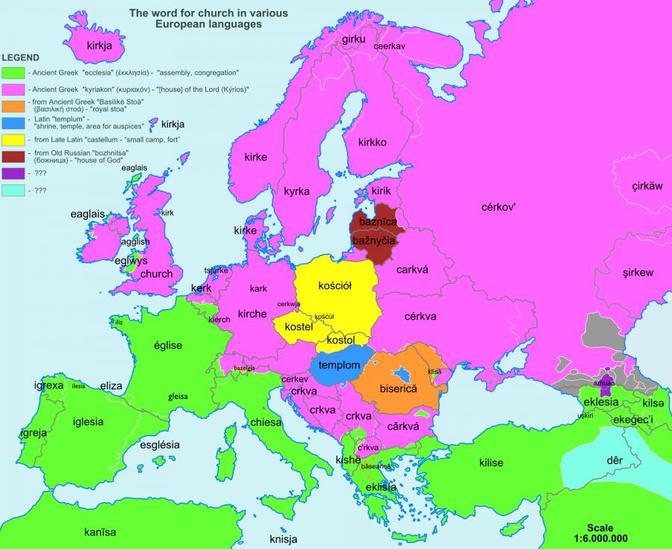
Ecclesia

On Palm Sunday, an etymological reflection of just how important the Ancient Greek world was to the Church. Both of the leading terms still used today derive from Greek, not Latin or Germanic forms — nor Aramaic. So too “Basilica,” not as common but used widely for very important churches. 


I would have told you that ‘kirk” was Germanic, being a Scots word related to “church” but derived from interaction with the Scandinavians (cf. Iceland). And it is, but based on an even older word derived from the Greek. 


Aquinas on Anger, VIII

I really wanted to get to Article VII because Aristotle here is quoted saying something that I think is badly argued. The question of the article is whether we can, or can't, have anger without having a relationship of justice with the object of our anger. 
I answer that, As stated above (Article 6), anger desires evil as being a means of just vengeance. 

This is a real problem, but we'll roll with it for now. A relationship of justice between you and whatever you're angry at (or vice versa) would seem to need to exist, because if there were no justice relationship you would presumably not be angry at having justice violated. That part is straightforward.

But what is a 'justice relationship'? Aristotle and I disagree about where justice arises in human relationships. For Aristotle it appears to arise at the level of politics, not at the level of family or individual relationships as between father and son. Indeed, Aquinas quotes him saying that in this article: "Further, "there is no justice towards oneself . . . nor is there justice towards one's own" (Ethic. v, 6)."

So here's what Aristotle says at Aquinas' 'link' to the EN: 

For justice exists only between men whose mutual relations are governed by law; and law exists for men between whom there is injustice; for legal justice is the discrimination of the just and the unjust. And between men between whom there is injustice there is also unjust action (though there is not injustice between all between whom there is unjust action), and this is assigning too much to oneself of things good in themselves and too little of things evil in themselves. This is why we do not allow a man to rule, but rational principle, because a man behaves thus in his own interests and becomes a tyrant. The magistrate on the other hand is the guardian of justice, and, if of justice, then of equality also. And since he is assumed to have no more than his share, if he is just (for he does not assign to himself more of what is good in itself, unless such a share is proportional to his merits-so that it is for others that he labours, and it is for this reason that men, as we stated previously, say that justice is 'another's good'), therefore a reward must be given him, and this is honour and privilege; but those for whom such things are not enough become tyrants.

The justice of a master and that of a father are not the same as the justice of citizens, though they are like it; for there can be no injustice in the unqualified sense towards thing that are one's own, but a man's chattel, and his child until it reaches a certain age and sets up for itself, are as it were part of himself, and no one chooses to hurt himself (for which reason there can be no injustice towards oneself). Therefore the justice or injustice of citizens is not manifested in these relations; for it was as we saw according to law, and between people naturally subject to law, and these as we saw' are people who have an equal share in ruling and being ruled. Hence justice can more truly be manifested towards a wife than towards children and chattels, for the former is household justice; but even this is different from political justice.

We should note immediately that most Americans -- at least -- would object to the formulation that a master cannot be unjust to his slave because the slave belongs to him. Most of us would argue that the master is already being unjust to the slave by pretending to own him. The Bible speaks of slavery a great deal, and does not categorically reject it as we; but in Aquinas' day the Church had moved to ban the practice between Christians as fundamentally unjust given the special equality Christians had as brother sons of God. 

Since you were supposed to try to save souls, if you encountered non-Christians you were supposed to convert them rather than enslave them. 

Also, I note that it is only at the level of politics coming to be that this kind of injustice is possible. There might be a natural capacity to enslave another, but there can't be a natural right to do it because the other has the same nature as you: a rational human being. If you have natural rights to freedom, he must as well. It is only the rise of positive law that creates this kind of injustice, and enshrines a 'right' to do this as a master and owner rather than just another free man. 

Therefore, I submit that Aristotle is wrong about where the justice relationship properly arises: that it arises not at the political level, but at the level of personal relationships. These are also, sadly, often the place where we most regularly and intensely experience anger. We may be unjust to each other there, too; but at least we do not have armies and towers and systems of justice standing over us and telling us that we must submit to a law that renders us a slave.

But set that aside: would we accept that a father cannot be unjust to his children? We would not accept that. There are many duties we think a father owes to his children, and failure to provide those things is an act of injustice. If you starve your children rather than feeding them, that is unjust. If you drink up the family wealth, you have acted unjustly and deprived your young sons of the standing they had a reason to hope to have when they became adults and masters of themselves.

For the purpose of the consequences of this bad argument, it is certainly not true that you cannot be angry with your children -- which would follow if we accepted Aristotle's argument. Since you cannot have a justice relationship with them -- and cannot be unjust to 'your own' -- it would therefore be impossible to be angry with them. This is manifestly untrue. I daresay no parent has ever raised a child without being angry at them, and vice versa. 

It is also not true, as Aristotle says and Aquinas endorses, that you cannot be angry with the dead.

"...according to the Philosopher (Rhet. ii, 3), 'it is impossible to be angry with insensible things, or with the dead': both because they feel no pain, which is, above all, what the angry man seeks in those with whom he is angry: and because there is no question of vengeance on them, since they can do us no harm."

This is another area disproven by human experience. Many times we are angry with the dead; although, unlike Aristotle, we are not obligated to imagine them as being free from all possibility of vengeance or pain. Yet even if we do so imagine them, often we are angry at them because of their tragic choices, and the harm and injustice they have done. This can certainly last well beyond the fact of their death.

In any case, this article strikes me as going wrong in a number of places. It relies on one of Aristotle's mistakes -- he was human, however great his mind, and made a few. That leads to bad consequences for our understanding.

Aquinas on Anger, VII

Article VI says that "anger desires evil." That is a very strange thing for Aristotle to say, because he defined the good in terms of desire: the good is what all things desire. (Aquinas followed him, and Avicenna, in the first part of the Summa which concerns the nature of God and thus goodness itself.) 
I answer that, Since goodness is that which all things desire, and since this has the aspect of an end, it is clear that goodness implies the aspect of an end.... Beauty and goodness in a thing are identical fundamentally; for they are based upon the same thing, namely, the form; and consequently goodness is praised as beauty. But they differ logically, for goodness properly relates to the appetite (goodness being what all things desire); and therefore it has the aspect of an end (the appetite being a kind of movement towards a thing).

So this is a real problem, because now evil is the object of desire -- and therefore a good to be pursued. But that can't be, Aquinas has already told us.  

No being can be spoken of as evil, formally as being, but only so far as it lacks being. Thus a man is said to be evil, because he lacks some virtue; and an eye is said to be evil, because it lacks the power to see well.

This is Augustine's point, which we were just discussing recently, and a place where Aquinas and Aristotle differ. Evil properly speaking can't exist for Aquinas; it is only a privation or a lack of something desirable, something beautiful, i.e. something good. To say that anger desires the lack of something desirable does not make sense. 

It especially does not make sense given that anger is associated here with justice, and has been said to be partially governed by reason and mercy. Justice is a good, not an evil. Injustice is an evil, because it is the lack of something desirable, i.e. justice. 

Human will, unlike God's, can be disordered and therefore sinful. If what anger desires is evil, though, it is very basically and radically disordered -- which is the opposite of what Aquinas has been arguing heretofore. 

Aquinas on Anger, VI

 Article V looks very dense, but its easy to sketch. The question is whether desire or anger is more natural to man. Aquinas references Aristotle's Physics II to say that things are 'natural' to us if they are things that arise from our own nature. This is Aristotle's answer to why things move in different ways: because they have different natures. If you drop a stone, which has the nature of earth, it will move toward the earth. If you pour out a bucket of water, which has the nature of water, it will move to a middle position -- the stone would fall through the lake, but the water will join it. Air naturally sits above them, and fire rises upwards. 

And if you turn loose of a bird, it will move through the air wherever it wants -- because it is free to follow its animal nature, and thus to move where it wants to move; but it will fly instead of crawling because of its specific nature, which is that of a bird rather than simply an animal generally. 

Desire is more natural in the general nature of man and all animals; all things want what they desire, and they desire the goods that allow them to continue their existence and that of their species. But specific creatures have specific natures too. Man's is that of a rational animal. Thus, anger -- which responds 'somewhat' to reason -- is more natural to him than desire. 

However, by the same argument reason is more proper to him yet; anger must be governed by reason to be fully in accord with his nature.

“Rich kids can always get Algebra or Calculus”

On Substack, Bari Weiss sums up the week's craziness, including California's decision to trap all 8th graders in pre-algebra in the interest of the usual murky goals. She quotes Freddie DeBoer's observation that families with extra cash will just hire tutors, so this equity-inclusion push will consign only the smart poor kids to the needlessly crummy education track. The truth is, though, that these days any kids can get decent algebra or calculus instruction with or without a tutor. Even the poor kids have some kind of access to the internet, where the educational resources are nearly endless. Any kid that was likely to be able to pick up calculus from high school lectures will be able to get it from internet lectures, if not from a book. You don't even have to be Isaac Newton, who, when he found he lacked this essential tool, simply created it during one of the Western World's more famous lockdowns.

On the other hand, the way things are going, will there still be colleges where you can go anywhere with higher math? I'd love to see aspiring young workers skip the whole thing, learn the math on their own, and get jobs in STEM industry, minus the political indoctrination.

The lockdown link by the way, is a windy attempt to explain why no one should feel bad about not doing world-changing work during lockdown because privilege or something. The problem certainly isn't just that we lack a one-in-a-billion talent! Probably any of us could have pulled it off if we had a Universal Basic Income and some domestic servants.

Wildlife

This fox made an appearance on my lurking neighbor's driveway:

Aquinas on Anger, V

I have time for a second round of this today, and I find I'm warming to the subject. So, Article 4: Does Anger require an act of reason? Passions usually don't, because --as mentioned -- they were thought to be things that you experience passively. They come upon you, and you experience them. 

Anger seems to be a passion, and thus it shouldn't require an act of reason. If that were true, it means several important things in the Aristotelian system. Most crucially, it means it is a lower thing that is more animal than human (this is raised directly in the article). Reason is the human quality; we share many sensations and passions with animals, but they were not thought to share our access to the order of reason. (This was held to be true through the Modern era, which in philosophy means the 18th century. There are strong reasons to doubt it now; but see the reply to objection 2, where even Aquinas creates some doubt.) 

Aquinas quotes Aristotle's discussion to show that anger is at least amenable to reason.  
...anger is a desire for vengeance. Now vengeance implies a comparison between the punishment to be inflicted and the hurt done; wherefore the Philosopher says (Ethic. vii, 6) that "anger, as if it had drawn the inference that it ought to quarrel with such a person, is therefore immediately exasperated." Now to compare and to draw an inference is an act of reason. Therefore anger, in a fashion, requires an act of reason.

That's a funny argument for Aristotelian psychology. Romantic love, the most canonical of passions, also seems to be amenable to reason in that way. You can (and we all do) reason about people you've fallen in love with, and if it's a really bad idea, you can often decide not to pursue your love. It doesn't make as good a novel, but it happens every day.

The answer to that objection is 'reply to objection one.' Aquinas has a part of the rational soul that was absent in Aristotle. The will -- which is Biblical and Christian rather than ancient Greek -- allows human beings to subject even their passions to reason. In that way it improves and perfects even the strongest passions, by making them subject to rational thought.

This cuts against the idea that anger and vengeance are per se good, however: if God gave you the capacity to moderate these feelings with reason, and if (as Aristotle had argued, and Aquinas agrees) reason is a higher faculty than sensitive emotions, then it is only proper to be angry if and insofar as reason agrees with anger. But reason is not a passion, but an activity; and it is not irrational, but rational by nature. A human being was given the faculty for a good cause, and it isn't wrong to experience anger or even to act upon it. Yet we see here why we are morally obligated to subject any sort of anger or desire for vengeance to our rational nature. 

Or, I suppose, we can go to Confession. As Captain Thomas Bartholomew Red said, "What do you think Confession's for?" That line, from a very immoral man's film about the very immoral business of piracy, always struck me as intensely pragmatically wise.

God Bless the American Jury

It’s the last stronghold of freedom. They just did it again. 

Aquinas on Anger, IV

This has been a deeply profitable, honorable and honest discussion which is almost entirely unlike the kind of useless talk we have so much of. Good for you. 

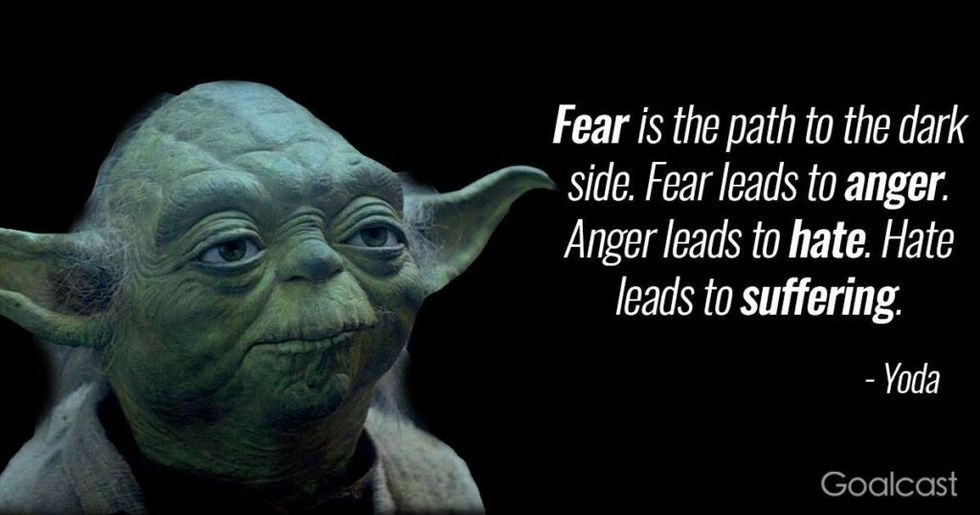
Article 3 gets us even into deeper Yoda territory: anger leads to hate, we are warned specifically in the second objection. It is a kind of desire, a longing of the sort that often leads to damnation. It mixes with sorrow, which is not itself bad -- it can sometimes be a very worthy emotion -- but how brightly that contrasts with the discussion of anger's beauty. 

Aquinas takes a bold strategy here: he simply makes a division. "On the contrary, The concupiscible is distinct from the irascible faculty. If, therefore, anger were in the concupiscible power, the irascible would not take its name from it."

That is to say, anger is too pure to be a kind of desire because anger is its own thing. And that's probably right. It ought to be, I guess, since it's included in the doctrine of the largest faith in human history. It's been true enough that we've accepted that argument for nigh a thousand years.

He actually gives more than a bald assertion. It's rooted in Aristotelian psychology, which you can give as much weight or not as you prefer.

"I answer that, As stated above (I-II:23:1), the passions of the irascible part differ from the passions of the concupiscible faculty, in that the objects of the concupiscible passions are good and evil absolutely considered, whereas the objects of the irascible passions are good and evil in a certain elevation or arduousness. Now it has been stated (Article 2) that anger regards two objects: viz. the vengeance that it seeks; and the person on whom it seeks vengeance; and in respect of both, anger requires a certain arduousness: for the movement of anger does not arise, unless there be some magnitude about both these objects; since "we make no ado about things that are naught or very minute," as the Philosopher observes (Rhet. ii, 2). It is therefore evident that anger is not in the concupiscible, but in the irascible faculty."

That may be hard to follow. Here's a helpful analogy, I hope: I said something very similar in the comments to the post on 1883. Yellowstone is like desire, what Aquinas is calling the 'concupiscible passions.' Yellowstone is about a man who loves his home, and wants to maintain it. Ultimately it means a lot to him, but in the end -- as people keep pointing out to him -- if he loses it won't be that bad. He'd just have to sell the land for a lot of money, and could go do something very similar somewhere else like Oklahoma.

1883 is high art. It's the best thing I've seen in years. 'The irascible passions are good and evil in a certain elevation or arduousness,' that's how Aquinas puts it. It's not just whether you cowboy here or there; it's life and death, good and evil, love and hate, the very highest things we know how to want as human beings. For Aquinas, that's so different from things like mere sexual passion as to be categorically different. It's literally not the same thing at all.

Snowfall

What we often call The Blizzard of ‘93 came in April, so it’s not like I have never see this before. I’ve seen it once. 

1883

I am only a few episodes into this, but I cannot recommend it strongly enough. It’s a work of real, substantial beauty. 

Passacaglia


That’s not a lute, exactly. It’s a theorbo, arguably the most beautiful musical instrument ever made by the hands of man. Almost the most beautiful instrument simpliciter, excepting only the sword. 

Aquinas on Anger, III

I'm going to move on to the second article: whether the object of anger is good or evil. It seems like anger is a bad thing; certainly our popular culture claims that it leads in bad directions. 


Aquinas says that's wrong. The argument he give is striking: "Augustine says (Confess. ii, 6) that "anger craves for revenge." But the desire for revenge is a desire for something good: since revenge belongs to justice. Therefore the object of anger is good."

Is that right? Is revenge good? You have here the authority of two canonized saints that it is.

You know, I'm just going to stop there for today. That's already plenty to discuss.


Voice of reason?

I'm less skeptical than many on the right about Ukraine, so Col. Douglas MacGregor is saying things in this interview that I don't like hearing. Nevertheless he's worth listening to. Obviously he has many views about the Trump and Biden administrations that line up very closely with my own prejudices.