It turns out the health insurance agent I talked to earlier this week probably was mistaken. It seems that, as of January 1, 2015, no one will legally be able to sell me high-deductible affordable coverage, with or without medical underwriting, "on" or "off" the exchange. It's all gone after this next year.
So to recap: For over a decade we've had a high-deductible policy ($10K per person/$15K for the two) with Blue Cross. It's very good PPO coverage, decent network, covers all the usual stuff, but a high deductible. By law, it must be replaced with a deductible that's $3,750 lower per person ($2,500 for the two) but costs $4,800 more a year, and offers no new benefits of any conceivable use to us now or ever. We have to decide whether to pay the extra $4,800 a year, or go without insurance for the first time in our lives.
We don't "insure" for medical costs that are reasonably likely in an ordinary year; we "budget" for those. Insurance is for very unlikely harmful developments. We rely on insurance in case (1) we have a medical problem that would make our lives unendurable or kill us, (2) that can be cured, and (3) that would cost enough to blow our live savings. All three of conditions (1)-(3) have to happen before the insurance will make a difference to our life savings. If the medical problem isn't that serious and we can't pay for it, we'll do without. If the medical problem is serious but can't be treated effectively, we'll do without. If the medical problem is serious and can be treated and wouldn't obliterate our live savings, we'll pay for it ourselves.
The policies offered on the exchange on a subsidized basis (the only way to avoid the huge price hike) are all HMOs. If my information is correct, they're the worst possible sort of "closed network" HMO; you're covered in the network, but outside the network, you don't just get a lower co-insurance rate, you get zero. This is a sign of the deteriorating insurance climate, where squeezing down the network is the last option available for cost control. In contrast, in our PPO, if we go out of network, we suffer only a partial loss of benefits, and there's still a cap on total out-of-pocket expense, though higher than the in-network cap. If we stay in network, the doctors who have accepted Blue Cross are prohibited from charging us more than the Blue Cross rate, so the entire bill either counts against our deductible or is paid at the usual co-insurance rate. If we go out of network, the doctor charges what he charges, not Blue Cross's fantasy of what he should charge; we're responsible for 100% of the "excess" price, and only the fictitious price counts against our deductible or is paid at our co-insurance rate. But even then, we get a certain amount of help with catastrophic bills, and it is possible to put an upper limit on how much destruction can be visited on our life savings by a medical catastrophe.
A closed-network policy HMO would do us almost no good at all. We want coverage only if there is a very serious problem, and that is the last time we'll be willing to settle for a Tier-4 doctor in the next county. Our life savings would be nearly at as much risk with such a policy as if we were going bare. So our decision, which we'll face in late 2014 when our current policy is destroyed by the ACA once and for all, is (1) go bare or (2) pay $4,800 a year more (minimum) for a PPO plan with a decent network of doctors and hospitals. What makes the choice even more difficult is that Blue Cross reportedly is going to lose doctors and hospitals even from its PPO networks, though probably not as many as they'll lose from their HMO networks.
Going bare would mean saving about $11K every year. That's enough to build up a pretty impressive warchest against the possibility of an expensive disease. And we have to consider, now, that we're taking a gamble only on horrible medical bills for a maximum of one year, depending on what month the disaster lands in. After that, we can just sign back up for insurance for the following year. (And who knows? Medicare may actually survive long enough to kick in in 7-9 years.) The IRS penalty for going bare would be negligible and uncollectible anyway. Crazy, but going bare seems like the rational choice.


This week on appeal
The D.C. Circuit Court of Appeals struck down the federal district court ruling requiring Catholic business-owners to offer health coverage that includes birth control.
The Fifth Circuit Court of Appeals struck down the federal district court ruling that recently had overturned certain aspects of the recent Texas state law banning late-term abortions and requiring abortionists to maintain privileges at nearby hospitals in case of emergency. The Texas law is now back in effect. (Link fixed!)
The Fifth Circuit Court of Appeals struck down the federal district court ruling that recently had overturned certain aspects of the recent Texas state law banning late-term abortions and requiring abortionists to maintain privileges at nearby hospitals in case of emergency. The Texas law is now back in effect. (Link fixed!)
Provider shock
Awesome. Who would have guessed that the insurance jammed down our throats by the compassionate new law would keep its costs down by eliminating doctors and hospitals from our networks? There are all kinds of tasty treats hidden in this shiny new law.
And if you thought that the big problem this week was limited to about 5% of the market -- and who cares about such a tiny voting bloc, right? -- it seems that closer to 90 million people are at risk of losing the coverage they wanted to keep. But no problem: they can all just shop around in the new market, right?
I thought my expectations about this program were about as bad as possible, but these people are surprising even me.
This is a good one, too: We had to take your insurance off the market, because we made a central planning decision that people probably weren't going to be willing to buy it any more once they saw our fabulous new product. That's capitalism.
And if you thought that the big problem this week was limited to about 5% of the market -- and who cares about such a tiny voting bloc, right? -- it seems that closer to 90 million people are at risk of losing the coverage they wanted to keep. But no problem: they can all just shop around in the new market, right?
I thought my expectations about this program were about as bad as possible, but these people are surprising even me.
This is a good one, too: We had to take your insurance off the market, because we made a central planning decision that people probably weren't going to be willing to buy it any more once they saw our fabulous new product. That's capitalism.
(Pictures of) Guns are Scary
But sometimes the Bill of Rights wins anyway. If you're a public school that wants to ban a t-shirt message, don't pick one that celebrates the NRA, because they've got lawyers who will come and help the students. Pretty good lawyers, too:
In the face of public ridicule and legal action the school district came to its senses and issued an apology. In a statement published by Michael L. Christensen, Superintendent of Schools, Orange Unified School District, the school district said the shirt was okay to wear to school, and promised to provide training to staff aimed at preventing future incidents. The matter now seems to be resolved, and the NRA has given Haley a carton of the banned t-shirts to give to her friends, to wear to school if they want to.
Voting with their feet
And may many more do so. While there is still some freedom to make business decisions rather than comply with central diktats, it's good to see people move their businesses to states that don't treat them like milk-cows.
The Pro-Transparency Plank
This is the most complicated of the planks in my proposed platform, but that's because it's going to take a lot to reform the government. The first goal here is to make individuals in government more responsive to the needs of the citizenry by putting them on the same ground as the citizen, eliminating special privileges and immunities that allow them to callously destroy lives, careers, businesses, etc. An equally important goal is to restore public faith in the institutions of government.
Part 1: Let's begin with Rand Paul's proposed constitutional amendment that no law can be made "applicable to a citizen of the United States that is not equally applicable to Congress ... the executive branch of Government ... the judges of the Supreme Court ... and judges of such inferior courts as Congress may from time to time ordain and establish." Then let's expand it to do away with judicially created immunities, as proposed by the Sage of Knoxville.
Part 2: Require laws to be written in common language and require a review period of 1 business day for each 10 pages in a bill. Once introduced, no vote can be taken on a bill until its review period has passed. Any changes to the bill require a new review period based on the total number of pages in the bill. The review period could be circumvented in the case of local or national emergencies, but only for bills that deal solely with the emergency (i.e., if someone tacked on an amendment for building an amusement park, the bill would have to go through the normal review period).
Part 3: Work together with private transparency organizations to create better transparency laws. Work with privacy organizations to create safeguards for privacy from government snooping. Put teeth into transparency and privacy laws by making non-compliance or overly-long response times by government officials or employees crimes, potentially leading to prison sentences.
Part 4: Another pair of Instapundit suggestions:
A. Cut pay to Congress and cut presidential travel when they haven't passed a budget.
B. If a government official or employee takes a lobbying or other private, government-related job within five years of leaving office, they must pay a 50% tax on that income.
Part 1: Let's begin with Rand Paul's proposed constitutional amendment that no law can be made "applicable to a citizen of the United States that is not equally applicable to Congress ... the executive branch of Government ... the judges of the Supreme Court ... and judges of such inferior courts as Congress may from time to time ordain and establish." Then let's expand it to do away with judicially created immunities, as proposed by the Sage of Knoxville.
Part 2: Require laws to be written in common language and require a review period of 1 business day for each 10 pages in a bill. Once introduced, no vote can be taken on a bill until its review period has passed. Any changes to the bill require a new review period based on the total number of pages in the bill. The review period could be circumvented in the case of local or national emergencies, but only for bills that deal solely with the emergency (i.e., if someone tacked on an amendment for building an amusement park, the bill would have to go through the normal review period).
Part 3: Work together with private transparency organizations to create better transparency laws. Work with privacy organizations to create safeguards for privacy from government snooping. Put teeth into transparency and privacy laws by making non-compliance or overly-long response times by government officials or employees crimes, potentially leading to prison sentences.
Part 4: Another pair of Instapundit suggestions:
A. Cut pay to Congress and cut presidential travel when they haven't passed a budget.
B. If a government official or employee takes a lobbying or other private, government-related job within five years of leaving office, they must pay a 50% tax on that income.

The Pro-Cannabis Freedom Plank
As the next part of my series exploring a winning political platform for the next two elections, here is my Pro-Cannibis Freedom plank:
Return control over cannabis possession, growing, sales, and use to the states. Keep importation illegal, and continue to use the DEA to stop cannabis from coming in, but let each state decide how to handle this drug. In addition, immediately convert federal prison sentences for cannabis-related crimes other than importation to parole.
There are several goals here: Move back toward the original interpretation of the Commerce Clause, reduce prison expenses, refocus anti-drug activities to more serious drugs, and try not to enrich drug lords.
Return control over cannabis possession, growing, sales, and use to the states. Keep importation illegal, and continue to use the DEA to stop cannabis from coming in, but let each state decide how to handle this drug. In addition, immediately convert federal prison sentences for cannabis-related crimes other than importation to parole.
There are several goals here: Move back toward the original interpretation of the Commerce Clause, reduce prison expenses, refocus anti-drug activities to more serious drugs, and try not to enrich drug lords.
When you lose CNN . . .
Anderson Cooper, well-known right-wing extremist at CNN, reports on White House tactics to intimidate health insurance industry representatives:
Legacy
He's chosen the blunder for which he'll be remembered.

One of the comments I'm seeing most often now is "I guess Ted Cruz was right."

One of the comments I'm seeing most often now is "I guess Ted Cruz was right."
Still lying
They can't quit lying even now. This is from Kathleen Sibelius's testimony before Congress this morning:
Ms. Sebelius announced that she was now shouldering the blame: "I'm accountable." Resign, lady, and forfeit your public pension benefits, then we'll talk.
Anyone who thinks this treatment isn't scheduled to land next on people with employer-provided insurance is a fool. They're just coming for us in manageable chunks, hoping we won't stick together.
“Mr. Chairman, there was no change,” Sebelius said. “The regulation involving grandfathered plans, which applied to both the employer market and the individual market, indicated that if a plan was in effect in March of 2010, stayed in effect without unduly burdening the consumer with reducing benefits and adding on huge costs, that plan would stay in effect and never have to comply with any regulations of the Affordable Care Act.”*
“That’s what the grandfather clause said. The individual market which affects about 12 million Americans, about 5 percent of the market. People move in and out. They often have coverage for less than a year. A third of them have coverage for about six months. And if a plan was in place in March of 2010 and again did not impose additional burdens on the consumer, they still have it. It’s grandfathered in.”In what universe? My policy dates back over a decade. Blue Cross didn't reduce my benefits or add any "huge costs" to my old policy. They just canceled it and offered a new and improved consumer-friendly policy that costs $4,800 a year more in return for a $3,750 reduction in deductible.
Ms. Sebelius announced that she was now shouldering the blame: "I'm accountable." Resign, lady, and forfeit your public pension benefits, then we'll talk.
Anyone who thinks this treatment isn't scheduled to land next on people with employer-provided insurance is a fool. They're just coming for us in manageable chunks, hoping we won't stick together.
The Pro-Immigration Plank
In an earlier post, I proposed a new platform for whichever party wants to adopt it. Here's the Pro-Immigration plank:
Allow all of the legal immigrants US businesses need. Tempered by background checks, annual income minimums, and health insurance requirements, give work visas to pretty much any foreign national who can get an America-based company to hire them before they come to the US (they need to have a job waiting when they cross the border). Don't set maximum limits; let the market decide.
Things I'd like to add to this, but which may be a bridge too far:
1. Implement something like the DREAM Act; don't punish the kids of illegals.
2. Since the overwhelming majority of illegal immigrants appear to be from Mexico, cut a deal with the Mexican government. We'll give illegals here legal status, but Mexico has to pass reciprocal laws that give US citizens in Mexico all the rights Mexican citizens in the US have, and make immigration to Mexico easier for Americans.
3. Make immigration violations permanently bar someone from getting a visa to enter the US.
Allow all of the legal immigrants US businesses need. Tempered by background checks, annual income minimums, and health insurance requirements, give work visas to pretty much any foreign national who can get an America-based company to hire them before they come to the US (they need to have a job waiting when they cross the border). Don't set maximum limits; let the market decide.
Things I'd like to add to this, but which may be a bridge too far:
1. Implement something like the DREAM Act; don't punish the kids of illegals.
2. Since the overwhelming majority of illegal immigrants appear to be from Mexico, cut a deal with the Mexican government. We'll give illegals here legal status, but Mexico has to pass reciprocal laws that give US citizens in Mexico all the rights Mexican citizens in the US have, and make immigration to Mexico easier for Americans.
3. Make immigration violations permanently bar someone from getting a visa to enter the US.
Ray of hope?
I'm awfully confused about what the ACA does and not permit in the way of escape. I've just been on the phone with a very helpful health insurance broker, recommended by our State Farm agent, who says that there will be off-exchange policies available as well as exchange policies. The prices quoted to me by Blue Cross so far, and all the price quotations that I've been able to find on the internet, apparently are for exchange policies: Bronze, Silver, and so on. They can be bought without going on the non-functional website, but their prices (not counting subsidies) are the same either way. Off-exchange policies have to comply with some aspects of the ACA but perhaps not all; it may be possible, for instance, to get more flexibility about deductibles. If we stay with Blue Cross, we can avoid the pre-existing condition problem. Even better, it may be that we can avoid it even if we switch to a new company like United Healthcare, which the broker believes has a better network and a better claims-paying record. He also claims that many doctors and hospitals (like the Memorial-Hermann networks and Baylor University here in South/Southeast Texas) are dropping Blue Cross at the end of this year. United Healthcare, in contrast, is preserving its network.
Because all the insurance companies are scrambling to make sense of the new regulatory environment, he can't get us options and prices yet, but he believes he will be able to do so in a few weeks. Possibly there's still some way out of this mess--some way for us to continue to buy the cheaper, higher-deductible catastrophic stop-loss coverage we prefer.
I enjoyed talking to the guy. He hates the new law as much as I do, and enjoyed hearing about Chris Matthews's hilarious new outrage about Benghazi.
Because all the insurance companies are scrambling to make sense of the new regulatory environment, he can't get us options and prices yet, but he believes he will be able to do so in a few weeks. Possibly there's still some way out of this mess--some way for us to continue to buy the cheaper, higher-deductible catastrophic stop-loss coverage we prefer.
I enjoyed talking to the guy. He hates the new law as much as I do, and enjoyed hearing about Chris Matthews's hilarious new outrage about Benghazi.
"Why wasn't I told about this?"
I guess this is what happens when you let the veil of denial slip. First, 60 Minutes has the gall to do a piece on Benghazi. Softball, and sadly late, but better than the nothing-burger than preceded it. Next, Chris Matthews actually watches it, because I guess it's inside his bubble, and wakes up in a whole new world with some questions scratching irritably at his brain:
JAY NEWTON-SMALL: Well, Hillary in her testimony before Congress said she was there, she was, you know, on the ground, in the State Department listening to the response in real time on the phone as it was happening, and so, she knew what was happening. But again, they also testified that there were waves of attacks, so they thought that, you know, after the first wave that things were quieting down. That’s when they said, well, maybe we don’t need to send help, and help was really far away. It wasn’t like it was next door. It was several hours away in Italy, so –
MATTHEWS: But the fight went on for seven hours.
NEWTON-SMALL: Yeah, but then if you’re doing it in waves, you think the attack is over and sending somebody is not going to help anymore, right? Then all of a sudden, they attack again.
MATTHEWS: I’m going to ask you something. If that what your brother or father in there, would you say that’s an acceptable response? ‘Oh, it’s probably over by now, it’s no good to send anybody.’ Or would you say, ‘I don’t care if it’s over or not, I’m going to collect the bodies if nothing else. I’m going to get there and show I cared.’ That’s what I’d do.Wakey, wakey.
A Winning Platform for 2014 & 2016
Over the next week, I would like to introduce a set of ideas I have for building a winning political platform for 2014 & 2016.
My proposed platform for either major party would go something like this:
The X Party: Pro-Immigration, Pro-Transparency, Pro-Opportunity, Pro-Conscience, Pro-Health Freedom, Pro-Cannabis Freedom
Certainly, I am not an expert in government, politics, policy, etc., and it's likely one or more of my ideas will be dumb, unworkable, etc. But I thought I'd take a swing at it anyway.
I'll post details on my ideas for each plank over the next week. Meanwhile, I'm interested in hearing your ideas for a 2014 / 2016 platform in the comments.
My proposed platform for either major party would go something like this:
The X Party: Pro-Immigration, Pro-Transparency, Pro-Opportunity, Pro-Conscience, Pro-Health Freedom, Pro-Cannabis Freedom
Certainly, I am not an expert in government, politics, policy, etc., and it's likely one or more of my ideas will be dumb, unworkable, etc. But I thought I'd take a swing at it anyway.
I'll post details on my ideas for each plank over the next week. Meanwhile, I'm interested in hearing your ideas for a 2014 / 2016 platform in the comments.
When you lose NBC
About six hours ago, NBC posted an article pointing out that President Obama had known all along that millions of Americans would lose their insurance coverage. As of this posting, there were almost 3,400 comments, mostly of the mad-as-hornets variety. No one seems much interested in listening to administration mouthpieces explain how we all really should have known this was coming, so it wasn't exactly the same thing as a lie. (I actually did expect part of it; I always believed they'd find a way to kill my individual policy, and have said so often. But I confess I didn't expect that it would be almost twice as expensive to buy a replacement with a somewhat lower deductible, or that others would see increases of 300% or 400%.)
A man quoted in the article is coming to the same conclusion Raven and I are mulling over: shouldn't we withdraw from this crooked game? I want to see civil disobedience on a scale so massive it changes how all Americans look at the progressive agenda for decades.
It's almost unbelievable, but Valerie Jarrett and other administration hacks have taken to Twitter to push this talking point:
A handful of them are starting to make a fuss about demanding a refund from CGI for its work on the website. It's the wrong part to focus on, and it shouldn't keep them from getting hung upside-down from lampposts, but it's a slight movement in the right direction: a cheering sign that there is a healthy panic building in Congress. I'd like it to reach the quivering, heart-palpitation stage, so I was pleased to read this purported quotation from someone described as high up in Democratic party circles: "The Democratic Party is f**ked." I couldn't agree more, sir. It should be discarded entirely, and we should start with something new.
But something tells me that, after a few days of this, many of them will decide that it's really only about 15 million people affected, and they can afford to ignore them. It will be up to the rest of the voters to decide if they'll be allowed to get away with that.
A man quoted in the article is coming to the same conclusion Raven and I are mulling over: shouldn't we withdraw from this crooked game? I want to see civil disobedience on a scale so massive it changes how all Americans look at the progressive agenda for decades.
It's almost unbelievable, but Valerie Jarrett and other administration hacks have taken to Twitter to push this talking point:
Nothing in the ACA forces people out of their plans. No change is required unless ins. companies change their existing plan.Right, so it's not the law that's destroying your insurance policy, it's just the insurance company's compliance with the law that could cause a little problem. That's how much respect they have for us. Well, it's slightly comforting to know they're desperate to pretend the law isn't destroying the insurance coverage of millions of Americans; up to now, they were trotting out the explanation that, yes, the coverage was being taken away, but it was for our own good. Also, it should be easy to get bi-partisan support for that bill to allow us to keep our existing coverage, right? Because the law's not destroying it in the first place, so we're all good here. I know I can count on Democrats in Congress to step up.
A handful of them are starting to make a fuss about demanding a refund from CGI for its work on the website. It's the wrong part to focus on, and it shouldn't keep them from getting hung upside-down from lampposts, but it's a slight movement in the right direction: a cheering sign that there is a healthy panic building in Congress. I'd like it to reach the quivering, heart-palpitation stage, so I was pleased to read this purported quotation from someone described as high up in Democratic party circles: "The Democratic Party is f**ked." I couldn't agree more, sir. It should be discarded entirely, and we should start with something new.
But something tells me that, after a few days of this, many of them will decide that it's really only about 15 million people affected, and they can afford to ignore them. It will be up to the rest of the voters to decide if they'll be allowed to get away with that.
Improving old stories
Or at least, finding a new hook. We recently watched the 2004 movie "King Arthur," whose conceit was that it would be a more historically plausible approach to the traditional tale. In this version, Arthur is the son of a Roman father and a Celtic mother. He leads a band of mounted warriors commandeered from a conquered Sarmatian tribe somewhere in the Caucasus, who are promised that if they serve for 15 years they will earn their freedom. Lancelot is one of the Sarmatians, conscripted as a teenager. Guinevere is a young Woad woman rescued from the dungeon of a Roman aristocrat whom Arthur is sent to rescue from Injun territory north of Hadrian's wall, on the eve of Rome's abrupt withdrawal from Britain in "453 A.D." Merlin is the mysterious leader of Guinevere's blue-painted people. There's kind of a plot, in which Woads and Sarmatians resent their subjugation by both Romans and newly arrived Saxon invaders. Arthur carries a grudge against the Saxons for having killed his Celtic mother in a raid some years earlier and, in any case, is disgruntled by his superiors in the Roman army and thinks Guinevere isn't too hard to look at. There are some battles at Hadrian's wall involving cavalry attacks, zillions of flaming arrows, something in the nature of napalm, and trebuchets with flaming missiles. The Romans leave, the Saxons lose, and the Celtic Woads take Arthur as their king while looking forward to a couple of years of security before the Saxons return and overrun their territory completely.
The timing is a bit odd, since Rome withdrew from Britain in 407 A.D., not 453 A.D. Setting aside the minor chronological slippage, I suppose it's not hard to buy the retreating Romans, about to take the last helicopter out of Saigon, as privileged types with a somewhat nominal approach to their Christianity and an effete Italian accent; the fact remains that all the Christians are two-faced cowards. The Sarmatians are real enough; the Romans did conscript some of them, possibly for use in pacifying Britain, among other tasks. It doesn't seem likely, however, that they should have had such elaborate armor, or even stirrups, let alone "Greek fire," in 5th century Britain. Someone involved in the screenplay should probably have dreamed up a plot device whereby ancient Asian knowledge came over with the Sarmatians, like Conan with his "secret of the steel."
For all this historical revision, did we at least get a creative re-imagination of the classic elements of the Arthurian legend, such as the extraordinary honor of a band of men beating back brutal chaos, or the famous love triangle? Eh, not really. When the story begins, Arthur has been leading his band of proudly pagan Sarmatians for 15 years and enjoys their loyalty and respect. His callous Roman superiors force him to lead his men on a suicide mission on the eve of an honorable retirement that would have allowed their promised return to Sarmatia. While rescuing the unappealing Roman V.I.P., Arthur frees some mistreated Woads, including Guinevere, and begins to lecture them about natural rights. He becomes disillusioned with the decadent and faithless Romans, choosing instead to make common cause with the Woads in a forlorn-hope stand against the invading Saxons. Guinevere joins the battle as a prenaturally effective archer and broadswordsman, all 105 bright blue pounds of her. Lancelot and Guinevere share about two misty glances before Lancelot is killed in battle, after which Arthur defeats the Saxons with the Woads' help and marries Guinevere to unite their people. There's barely an Excalibur and only a few lines for Merlin.
All in all, I preferred the 1981 "Excalibur." If the story's going to be anachronistic anyway, it would have been nice to preserve the aura of fantasy and mystery along with a plot and characters that made more sense. Although the cast included some of my favorite actors, they were mostly wasted.
It's been a while since I've seen a really satisfying historical drama with a real plot come out of Hollywood. On the other hand, we watched a surprisingly engaging if silly Godzilla-eats-New-York flick the other night: an indie production purporting to have been filmed with a hand-held video camera operated by a small band of hip young urban dwellers. If you grant them the Godzilla, much of the rest of the story was believable and even moving.
The timing is a bit odd, since Rome withdrew from Britain in 407 A.D., not 453 A.D. Setting aside the minor chronological slippage, I suppose it's not hard to buy the retreating Romans, about to take the last helicopter out of Saigon, as privileged types with a somewhat nominal approach to their Christianity and an effete Italian accent; the fact remains that all the Christians are two-faced cowards. The Sarmatians are real enough; the Romans did conscript some of them, possibly for use in pacifying Britain, among other tasks. It doesn't seem likely, however, that they should have had such elaborate armor, or even stirrups, let alone "Greek fire," in 5th century Britain. Someone involved in the screenplay should probably have dreamed up a plot device whereby ancient Asian knowledge came over with the Sarmatians, like Conan with his "secret of the steel."
For all this historical revision, did we at least get a creative re-imagination of the classic elements of the Arthurian legend, such as the extraordinary honor of a band of men beating back brutal chaos, or the famous love triangle? Eh, not really. When the story begins, Arthur has been leading his band of proudly pagan Sarmatians for 15 years and enjoys their loyalty and respect. His callous Roman superiors force him to lead his men on a suicide mission on the eve of an honorable retirement that would have allowed their promised return to Sarmatia. While rescuing the unappealing Roman V.I.P., Arthur frees some mistreated Woads, including Guinevere, and begins to lecture them about natural rights. He becomes disillusioned with the decadent and faithless Romans, choosing instead to make common cause with the Woads in a forlorn-hope stand against the invading Saxons. Guinevere joins the battle as a prenaturally effective archer and broadswordsman, all 105 bright blue pounds of her. Lancelot and Guinevere share about two misty glances before Lancelot is killed in battle, after which Arthur defeats the Saxons with the Woads' help and marries Guinevere to unite their people. There's barely an Excalibur and only a few lines for Merlin.
All in all, I preferred the 1981 "Excalibur." If the story's going to be anachronistic anyway, it would have been nice to preserve the aura of fantasy and mystery along with a plot and characters that made more sense. Although the cast included some of my favorite actors, they were mostly wasted.
It's been a while since I've seen a really satisfying historical drama with a real plot come out of Hollywood. On the other hand, we watched a surprisingly engaging if silly Godzilla-eats-New-York flick the other night: an indie production purporting to have been filmed with a hand-held video camera operated by a small band of hip young urban dwellers. If you grant them the Godzilla, much of the rest of the story was believable and even moving.
Samhain
The festival of "summer's end" falls traditionally on the thirty-first of October, but the hour came early this year. We had our first freeze on Saturday, a light freeze of exactly thirty-two degrees Fahrenheit that nevertheless brought ruin to many of the herbs. In preparation we took in the last harvest from the garden that we expect; if we get one more out of this week of warmer weather, that will be nice but unexpected.
The last tomatillos and some of the jalapenos got turned into a salsa verde, while the last guajillo chiles and some more of the jalapenos became a fiery red pepper sauce. We drew up many sweet potatoes and ordinary ones as well.
What really made the day, though, was the final basil harvest. Because it was dark by the time I got to it, and I didn't want the leaves to lose any of their freshness before I made them into pesto, I substituted some ingredients. I was out of both Parmesan and Romano cheeses, but I had some very strong and crumbly three-year-old cheddar that I used instead. I was also out of pine nuts, so I substituted walnuts. The result was an exceptionally creamy pesto with a smoother flavor.
The last tomatillos and some of the jalapenos got turned into a salsa verde, while the last guajillo chiles and some more of the jalapenos became a fiery red pepper sauce. We drew up many sweet potatoes and ordinary ones as well.
What really made the day, though, was the final basil harvest. Because it was dark by the time I got to it, and I didn't want the leaves to lose any of their freshness before I made them into pesto, I substituted some ingredients. I was out of both Parmesan and Romano cheeses, but I had some very strong and crumbly three-year-old cheddar that I used instead. I was also out of pine nuts, so I substituted walnuts. The result was an exceptionally creamy pesto with a smoother flavor.
The Longest Three Inches
Presumably the longest three inches in the universe is the distance across the event horizon of a black hole. If one ship was just this side of it and the other just the other side they would be completely and irrevocably out of communication with each other, presuming the first ship could stay away from the horizon.
Aside from that, the 'longest three inches' is the distance between you and the bolt you need that just fell down inside your motorcycle. You know it's there. You know, as a matter of physics, that it can't be more than three inches away. But finding it -- ah! Two hours went by taking apart everything I could easily disassemble and reassemble in that time. I ran a magnet all over everything, rocked the bike back and forth, and rolled it forward and back. Nothing.
I finally just found another bolt of the same diameter and cut it with a Dremel to fit the length.
Aside from that, the 'longest three inches' is the distance between you and the bolt you need that just fell down inside your motorcycle. You know it's there. You know, as a matter of physics, that it can't be more than three inches away. But finding it -- ah! Two hours went by taking apart everything I could easily disassemble and reassemble in that time. I ran a magnet all over everything, rocked the bike back and forth, and rolled it forward and back. Nothing.
I finally just found another bolt of the same diameter and cut it with a Dremel to fit the length.
A Request for My Fellow Bloggers
Would you mind if I added labels to some of your posts? I am trying to go back and review discussions we've had on various topics, and labels would make it easier to find things in the archives.
I would only add labels for the topics I'm looking at, and I would be careful to only use the general topics for label names. E.g., education, health care, logic, Aristotle, chivalry, etc. I would avoid adjectives and category names that might be seen as imposing judgments (e.g., bad government, idiocy). You could always remove or change labels as well, though I understand that might be a bit of a hassle if you felt it was necessary to do that to preserve the integrity of the original.
My goal is to be able to find all the posts that relate to a particular topic of discussion so I can review them, learn from them, avoid repeating discussions, use them as a springboard for future posts, etc.
What do you think?
I would only add labels for the topics I'm looking at, and I would be careful to only use the general topics for label names. E.g., education, health care, logic, Aristotle, chivalry, etc. I would avoid adjectives and category names that might be seen as imposing judgments (e.g., bad government, idiocy). You could always remove or change labels as well, though I understand that might be a bit of a hassle if you felt it was necessary to do that to preserve the integrity of the original.
My goal is to be able to find all the posts that relate to a particular topic of discussion so I can review them, learn from them, avoid repeating discussions, use them as a springboard for future posts, etc.
What do you think?
Health, political variety
I'm seeing an encouraging trend. Even on comments sections at progressive bastions like The New York, New York Magazine, the L.A. Times, and the Washington Post, the sentiment is vehement and very nearly unanimous against the Obamacare rollout. A lot of things about the program are confusing, but the idea that millions of Americans are losing their insurance invokes the crystal clear, infuriating memory of the repeated promise "If you like your plan, you can keep it. Period." The sticker-shock is dramatic. There are critical comments on many centrist or left-of-center sites (not just National Review or the Wall Street Journal) getting hundreds of up votes and zero down, which I've never seen before. Something's changing. To the occasional complaint that any opposition to the plan is a vote for heartless treatment of the uninsured, the routine answer is "Where is your compassion for the millions of people losing their insurance?" It's not just the broken website that's a problem any more.
Is it possible that the Obama administration has finally overplayed its hand? The arguments in support of Obamacare are increasingly desperate--it's really a Republican plan, it's too soon to panic over a few unimportant glitches, if people are losing their insurance we're really doing them a favor--and they're being met with derision. Even better, they're being met with some clear thinking about why it's wrong for the proponents to make these decisions for other people, and to dragoon other people into their misguided redistributionist ambitions. Suddenly everyone understands that there's no such thing as a free lunch. Some of these ideas have been taking form for a long time, but it's as though they're suddenly ready to burst onto the stage.
Is it possible that the Obama administration has finally overplayed its hand? The arguments in support of Obamacare are increasingly desperate--it's really a Republican plan, it's too soon to panic over a few unimportant glitches, if people are losing their insurance we're really doing them a favor--and they're being met with derision. Even better, they're being met with some clear thinking about why it's wrong for the proponents to make these decisions for other people, and to dragoon other people into their misguided redistributionist ambitions. Suddenly everyone understands that there's no such thing as a free lunch. Some of these ideas have been taking form for a long time, but it's as though they're suddenly ready to burst onto the stage.
A comment to cheer me up
From the comments section to a puff piece at the New Yorker:
The President prefers it when his stenographers say "quality, affordable health care." So work on incorporating that next time.
It is also important not to mention the flagrant deceptions he and most other Democrats have ladled out about the ACA for the last four years. You get full marks on this.
You could have blamed Republicans more for their complicity in this mess. You typed "Republicans" three times as often as "Democrats" so I know your heart's in the right place, but more diversion/distraction is needed. No R's voted for the ACA, making it all the more vital that they be invoked as much as possible.
Overall this is B- propaganda. We expect A-level work from The New Yorker.
Don't blame us, we wanted single-payer
I'm confused. Democrats passed Obamacare without a single Republican vote in the House or Senate. If they really wanted single-payer, couldn't they have passed it the same way?
Looks like what stopped them wasn't the threat of Republican "nay" votes; they got those anyway. What stopped them was a whole bunch of Democrats who would have jumped ship.
Looks like what stopped them wasn't the threat of Republican "nay" votes; they got those anyway. What stopped them was a whole bunch of Democrats who would have jumped ship.
Down from the ledge again
After days of unceasing worry about how to deal with health insurance that will suddenly start costing an additional $5,000 a year because Congress has taken the cheaper product I preferred off the market, I achieved some clarity last night. First, at some price, it makes more sense for me to bank the premiums and save them each year against a medical catastrophe. We must just have reached that price. In the past, I always defined "medical catastrophe" as expensive medical treatments that would be needed for years and years, possibly for the rest of our lives, which might well be decades. Now, a medical catastrophe is only what we may be faced with for a year of treatment, after which we can sign back up, assuming Obamacare is not repealed--and when are entitlements ever repealed?
If by some miracle it is repealed, and we couldn't get reinsured, well, we'd have to join the ever-growing ranks of people traveling to Mexico, Costa Rica, or Asia for some treatments. Anyway, who says the expensive medical treatments are ever going to make sense just because they exist? We'll always have the choice of dying in whatever comfort can be achieved with some morphine. Morphine will always be available one way or the other, if only on the black market. I'm amazed by what my friends at church routinely bring back from periodic trips over the border to the south. We're not quite as trapped as I frantically imagined. It's only in very recent years that people thought there was some alternative to facing illness and death with as much simple dignity and comfort as possible, especially once they'd reached middle age. Maybe the alternative is simply more illusory than I always assumed.
I've also been giving a lot of thought to how to avoid, at all costs, dying in a hospital or nursing home. I've seen how that works too many times now. It came to me: I don't have to. Morphine again. I've seen at least two people now review their medical situations dispassionately and say, no, thanks, not for me. It's not something to save up for or insure against the expense of. It's something to be declined, like an invitation to be tortured to death over a period of months or years. Thanks, but no!
In the light of these realizations, when Congress destroys my health insurance next year, maybe I'm not facing a $5,000 annual increase in living expenses. Maybe I'm about to cut $5,000 out of my living expenses instead, by going bare. (Sure, there will be a fine, but if I had enough income to care, I probably could shrug off the doubled premiums. What's more, I never overpay my taxes and therefore never ask for a refund.) Maybe, for people not working full-time for an employer who provides (and can obtain) what HHS thinks is proper insurance, insurance is simply a thing of the past. Maybe for us, it's a strictly cash-basis medical system from now on.
I haven't decided for sure to go bare. It's possible I can eat the problem as long as the current estimate of our future premiums holds true. But I don't believe it will; we're in a death spiral on enrollment and premiums. Something will have to give. The premiums will have to go up even further. To the extent that the public is clamoring for a change, they're appalled that deductibles are so high, not that they can't buy higher ones. If they get their way, I still won't be able to buy the high deductible I want, and premiums will go up to compensate for the lower deductibles. There have to be an awful lot of people like me who are just now realizing that going bare is now a one-year risk calculation. It's got to fly apart.
Many people have advised me to shoot for some of the wonderful new subsidies they'll be handing out if they ever get the website working. Having assets rather than income to live on, I probably could qualify for subsidies until they get smarter about the needs-based restrictions. I'm of two painfully divided minds. On the one hand, it feels like giving in to a particularly filthy shakedown: we double your costs and then get you dependent on a subsidy to make it humanly possible to pay the new bill. On top of that, it feels not only humiliating but wrong, like taking money out of the collection plate at church. On the other hand, if my church were taken over by smiling, caring thugs who robbed me as I came in the door, maybe I'd feel differently about robbing the collection plate on the way back out.
I feel the social contract has been broken. I have to rethink how I will live with these people. My final moment of clarity last night was this: these idiots should not have the power to cause me to live one more moment in fury and anxiety. I have a good life. I'll keep living it until they come down the driveway, armed, to roust me. If I get sick, I get sick. If the system is going to crash and burn, I'm in as good a position as anyone to make the best of it. After that, I got a good night's sleep.
If by some miracle it is repealed, and we couldn't get reinsured, well, we'd have to join the ever-growing ranks of people traveling to Mexico, Costa Rica, or Asia for some treatments. Anyway, who says the expensive medical treatments are ever going to make sense just because they exist? We'll always have the choice of dying in whatever comfort can be achieved with some morphine. Morphine will always be available one way or the other, if only on the black market. I'm amazed by what my friends at church routinely bring back from periodic trips over the border to the south. We're not quite as trapped as I frantically imagined. It's only in very recent years that people thought there was some alternative to facing illness and death with as much simple dignity and comfort as possible, especially once they'd reached middle age. Maybe the alternative is simply more illusory than I always assumed.
I've also been giving a lot of thought to how to avoid, at all costs, dying in a hospital or nursing home. I've seen how that works too many times now. It came to me: I don't have to. Morphine again. I've seen at least two people now review their medical situations dispassionately and say, no, thanks, not for me. It's not something to save up for or insure against the expense of. It's something to be declined, like an invitation to be tortured to death over a period of months or years. Thanks, but no!
In the light of these realizations, when Congress destroys my health insurance next year, maybe I'm not facing a $5,000 annual increase in living expenses. Maybe I'm about to cut $5,000 out of my living expenses instead, by going bare. (Sure, there will be a fine, but if I had enough income to care, I probably could shrug off the doubled premiums. What's more, I never overpay my taxes and therefore never ask for a refund.) Maybe, for people not working full-time for an employer who provides (and can obtain) what HHS thinks is proper insurance, insurance is simply a thing of the past. Maybe for us, it's a strictly cash-basis medical system from now on.
I haven't decided for sure to go bare. It's possible I can eat the problem as long as the current estimate of our future premiums holds true. But I don't believe it will; we're in a death spiral on enrollment and premiums. Something will have to give. The premiums will have to go up even further. To the extent that the public is clamoring for a change, they're appalled that deductibles are so high, not that they can't buy higher ones. If they get their way, I still won't be able to buy the high deductible I want, and premiums will go up to compensate for the lower deductibles. There have to be an awful lot of people like me who are just now realizing that going bare is now a one-year risk calculation. It's got to fly apart.
Many people have advised me to shoot for some of the wonderful new subsidies they'll be handing out if they ever get the website working. Having assets rather than income to live on, I probably could qualify for subsidies until they get smarter about the needs-based restrictions. I'm of two painfully divided minds. On the one hand, it feels like giving in to a particularly filthy shakedown: we double your costs and then get you dependent on a subsidy to make it humanly possible to pay the new bill. On top of that, it feels not only humiliating but wrong, like taking money out of the collection plate at church. On the other hand, if my church were taken over by smiling, caring thugs who robbed me as I came in the door, maybe I'd feel differently about robbing the collection plate on the way back out.
I feel the social contract has been broken. I have to rethink how I will live with these people. My final moment of clarity last night was this: these idiots should not have the power to cause me to live one more moment in fury and anxiety. I have a good life. I'll keep living it until they come down the driveway, armed, to roust me. If I get sick, I get sick. If the system is going to crash and burn, I'm in as good a position as anyone to make the best of it. After that, I got a good night's sleep.
Vote for Heinlein
I've never even heard of any of these other "famous" people from Missouri. Of course I'm voting for the Master.
It can't fail
Obamacare can't "fail," because it was never designed to work in the first place.
The only problem is that they didn't expect it to fail this fast. Such a brutally obvious face-plant playing out in the news within a year of the midterm elections, in ways obvious to some of the lowest-information voters with the murkiest political philosophies, can't have been in the game-plan.
The only problem is that they didn't expect it to fail this fast. Such a brutally obvious face-plant playing out in the news within a year of the midterm elections, in ways obvious to some of the lowest-information voters with the murkiest political philosophies, can't have been in the game-plan.
Warning
"I did not read the instructions, because I am a man." This Amazon product review page is worth a read. Many customers have been inspired to flights of composition by their remarkable experiences. It's a little rude, so don't go there if you're easily offended. My husband and I, being barbarians, have tears streaming down our faces, especially the part about the frozen brussels sprouts.
Talking me down from the ledge
Jonah Goldberg gives it a try:
Barack Obama, who holds a patent on a device that hurls aides and friends under a bus from great distances, also understands [the need to be the least acceptable available scapegoat]. That is why Kathleen Sebelius these days looks a lot like a Soviet general on his way to brief Stalin on the early "progress" in the battle of Stalingrad.
. . . [A]s I've written many times, I don't think we have much reason to fear traditional jack-booted dictators in this country. Ironically, the main reason we don't have to worry about them is that we worry about them so much. . . . Deep in American DNA is a visceral aversion to despotism. Sometimes, during a war or other crisis, it can be suspended for a while, but eventually we remember that we just don't like dictators.
The bad news is that we don't feel that way -- anymore -- about softer, more diffuse and bureaucratic forms of tyranny. Every American is taught from grade school up that they should fear living in the world of Orwell's 1984. Few Americans can tell you why we shouldn't live in Huxley's Brave New World. We've got the dogmatic muscle and rhetorical sinew to repel militarism, but we're intellectually flabby when it comes to rejecting statist maternalism. We hate hearing "Because I said so!" But we're increasingly powerless against, "It's for your own good!"
. . .
For instance, when the national-security types intrude on our privacy or civil liberties, even theoretically, all of the "responsible" voices in the media and academia wig out. But when Obamacare poses a vastly more intrusive and real threat to our privacy, the same people yawn and roll their eyes at anyone who complains. If the District of Columbia justified its omnipresent traffic cameras as an attempt to keep tabs on dissidents, they'd be torn down in a heartbeat by mobs of civil libertarians. But when justified on the grounds of public safety (or revenue for social services or as a way to make driving cars more difficult), well, that's different.
And it is different. Motives matter. But at the same time, I do wish we looked a bit more like the America Edmund Burke once described:
In other countries, the people, more simple, and of a less mercurial cast, judge of an ill principle in government only by an actual grievance; [In America] they anticipate the evil, and judge of the pressure of the grievance by the badness of the principle. They augur misgovernment at a distance; and snuff the approach of tyranny in every tainted breeze.
. . .
The remarkable thing about this is that there's no real executive experience in his explication of his executive experience. Yes, the candidate can fire people from the campaign. But being the candidate and being the campaign manager are as different as being the lead singer for Spinal Tap and being the band's manager. On the campaign trail, Obama's job was to "be Barack Obama," to sound smart and charismatic and rev up the crowds. He's still playing that part rather than fulfilling the job description.
And no one will tell him. That's why, I suspect, when he went to check on the progress of the site's development he had no idea how to ask questions that would get at the reality of the situation. Bureaucrats, apparatchiks, and contractors blow smoke. That's what they do. Obama has no idea how to cut through the smoke. He thinks being president involves constantly going out and giving speeches to crowds that love him about how hard he's working rather than actually, you know, working. It's all very meta. He's playing president Obama because he doesn't know how to be president Obama. I think that when he went out on Monday and did his infomercial schtick in the Rose Garden -- Operators are standing by! It's not just a website; it's a floorwax! etc. -- he honestly thought he was fixing the problem. Well, I've done my part!I can't link to this, because it comes from his email feed, but Goldberg usually has good stuff up at NRO.
Ways to be effective
Tools:
When Virginia's Fauquier County cited farmer Martha Boneta last year for hosting a birthday party for eight 10-year-old girls because she did not have a permit and site plan, little did county officials think they would set off a revolution for legal remedies against such abuses.Push, keep pushing, and push some more.
Horse Soldiers: USMC Edition
Tom sends a link to a page devoted to the China Marines. It's a chapter of the Corps' history that few know about, but a very interesting one.
On New Forms of Government
Over at VC, Elise and I began a discussion late in the comments to a post that probably deserves to be considered independently.
Elise asked:
That might also work, and really we should be talking about different ways of thinking about it. So, I'd like to propose a discussion of the subject. Consider it theoretical, if you like. There's no need to commit to doing it in actuality, but let's talk about how it might be done if we were to do it.
What I was thinking of was a Parliamentary form of government with a Civil Service, like the British have: but whereas the analog to the House of Commons and the heads of the departments of the Civil Service would be selected by lot (to avoid the corruption the Athenians saw, and to keep the Civil Service from overwhelming the elected branches as it has often done in Britain), the analog to the House of Lords would be elected.
This elected branch would be empowered both to repeal laws and Civil Service regulations it decided were out of line with the constitutional order, or the rights of citizens, but also to generally oversee in an adversarial way all the exercise of government. It would not be empowered to make laws, or to enact new regulations, or to exercise force of any kind against citizens not acting as a part of the government. It would serve a formally adversarial role to the government, with each member of this house responsible to their constituents and to a constitutional oath.
Against government actors, though, it would need the full array of powers: subpoena, arrest, and an independent power to punish according to whatever forms were usual (i.e., not 'cruel and unusual' punishments, but exactly the same order of punishments that would normally be applied against citizens).
Elise asked:
What does abandoning ship mean here? Secession for some States?I replied:
I think that's the right solution, really. Peaceful and constitutional dissolution of the union, followed by erecting new unions of like-minded states. The Federal government is dragging everyone down.Elise responded:
We might also give some thought to how to avoid the problem in the future. In ancient Athens they believed that any electoral system was going to be impossibly corrupt: even before the innovation of using public funds to buy votes (or whole constituencies), the rich could use private funds to buy them. Their belief was that no system based on elections was sustainable because of the bedrock corruption native to such systems.
They still wanted to distribute power among the many, though, and not to have an elite or a tyrant. So they did something very similar to what William F. Buckley suggested with his 'first 300 people in the phone book' quip: they chose citizens to fill political offices by lot. You held the office for as long as you held it, and then you were replaced by a new lot.
You'd want to think about how to build the pool so that the lot was taken only among people who were qualified. Having established some basic qualifications for given offices, though, everyone who met those qualifications would go into the pool and the chosen would hold the office for a term.
It might make sense to have a bifurcated system, with elections for direct representatives responsible to their constituents for some functions, but lotteries for other offices. In general I would think you'd want representatives empowered specifically to limit government's power over citizens, and lot-chosen officers to exercise power (rather than restrain it).
Having established some basic qualifications for given offices, though, everyone who met those qualifications would go into the pool and the chosen would hold the office for a term.To which I would respond:
Sounds kind of like jury duty - an interesting idea.
In general I would think you'd want representatives empowered specifically to limit government's power over citizens, and lot-chosen officers to exercise power (rather than restrain it).
Interesting again. Perhaps a variation on the tricameral idea: one house to propose laws; one to pass the proposals (or not); only that exists solely to repeal laws?
That might also work, and really we should be talking about different ways of thinking about it. So, I'd like to propose a discussion of the subject. Consider it theoretical, if you like. There's no need to commit to doing it in actuality, but let's talk about how it might be done if we were to do it.
What I was thinking of was a Parliamentary form of government with a Civil Service, like the British have: but whereas the analog to the House of Commons and the heads of the departments of the Civil Service would be selected by lot (to avoid the corruption the Athenians saw, and to keep the Civil Service from overwhelming the elected branches as it has often done in Britain), the analog to the House of Lords would be elected.
This elected branch would be empowered both to repeal laws and Civil Service regulations it decided were out of line with the constitutional order, or the rights of citizens, but also to generally oversee in an adversarial way all the exercise of government. It would not be empowered to make laws, or to enact new regulations, or to exercise force of any kind against citizens not acting as a part of the government. It would serve a formally adversarial role to the government, with each member of this house responsible to their constituents and to a constitutional oath.
Against government actors, though, it would need the full array of powers: subpoena, arrest, and an independent power to punish according to whatever forms were usual (i.e., not 'cruel and unusual' punishments, but exactly the same order of punishments that would normally be applied against citizens).
What state are you?
Can't resist those quizzes. Psychically, my husband belongs in Montana and I in Colorado, but neither of us can tolerate the cold. I like to think that our atypical little Texas county is our own private Montana/Colorado.
Practical politics
Speaking of ways to achieve the necessary changes in Congress and the White House, such as ballot security, I enjoyed this comment on a forum:
Since Medicaid requires photo IDs, is it a health suppression law?
The possum
Things I did not know about opossums:

1. Natural immunity. Opossums are mostly immune to rabies, and in fact, they are eight times less likely to carry rabies compared to wild dogs.
2. Poison control. Opossums have superpowers against snakes. They have partial or total immunity to the venom produced by rattlesnakes, cottonmouths and other pit vipers.
3. Omnivores galore. . . . They have an unusually high need for calcium, which incites them to eat the skeletons of rodents and road kill they consume. They're the sanitation workers of the wild. . . .
7. Impressive tails. . . . Opossums have been observed carrying bundles of grasses and other materials by looping their tail around them; this conscious control leads many to consider the tail as a fifth appendage, like a hand.
And a bonus for the Scrabble players: Male opossums are called jacks and females are called jills. The young are referred to as joeys, just like their Australian cousins, and a group of opossums is called a passel.

Perils of the code
For you IT types. Go here for the whole thing, which is supposed to be set to a tune I'm not familiar with, "Leslie Fish":
Deep in engineering down where mortals seldom go,
A manager and customer come looking for a show.
They pass amused among us, and they sign in on the log.
They've come to see our pony and they've come to see our dog.
. . .
From briefcase then there comes a list of things we must revise,
And all but four within the room are taken by surprise,
And all but four are thinking of their last job with remorse;
The customer, the manager, the doggie, and the horse.
. . .
Three things are most perilous,
Connectors that corrode,
Unproven algorithms,
And self modifying code.
The manager and customer are quick to leave this bunch,
They take the dog and pony and they all go out to lunch.
Now how will we revenge ourselves on those who raise our ire?
Write code that self destructs the day the warranties expire.
We misunderstood him
When the president said, "If you like your coverage, you can keep it," what he really meant was, "If we like your coverage, you can keep it."
I want this law dead, and I want some political careers ended. We've got a lot of work to do in the coming election year.
The U.S. individual health insurance market currently totals about 19 million people. Because the Obama administration's regulations on grandfathering existing plans were so stringent about 85% of those, 16 million, are not grandfathered and must comply with Obamacare at their next renewal. The rules are very complex. For example, if you had an individual plan in March of 2010 when the law was passed and you only increased the deductible from $1,000 to $1,500 in the years since, your plan has lost its grandfather status and it will no longer be available to you when it would have renewed in 2014.
These 16 million people are now receiving letters from their carriers saying they are losing their current coverage and must re-enroll in order to avoid a break in coverage and comply with the new health law's benefit mandates––the vast majority by January 1. Most of these will be seeing some pretty big rate increases.We are excited to be among those 16 million Americans! Blue Cross tells me that my plan is not grandfathered, and that I get to pick a new one. The new options are much, much nicer. My betters in the Nanny State know that I never should have preferred low-cost high-deductible coverage of the sort that is now illegal for Blue Cross to offer me. Instead, I get a brand-new policy with a deductible that is $3,750 lower. And it only costs $4,800 a year more than my old policy! Thank you, Mr. President!
I want this law dead, and I want some political careers ended. We've got a lot of work to do in the coming election year.
Sigh no more
My linguistics reading of late is alerting me to survivals of archaic forms in popular culture. The genius of Shakespeare and the King James Bible translation ensures that we never quite stop incorporating the English of 500 years ago into modern speech. Last night I spent enjoyable hours watching Joss Whedon's recent production of Shakespeare's comedy "Much Ado About Nothing," staged in the present but using the original text. Beatrice and Benedick are two young misfits everyone knows have to get together, though they think they hate each other. They ultimately join forces to solve the problems of the secondary couple, Claudio and Hero, who have been tricked into an apparent tragedy that all comes right in the end.
Shakespeare often included bits of doggerel or folksong into his plays, with language that was archaic even in his time. Modern adaptations tend to set them to tunes either in a style they take to be period-appropriate or in a style that's current for the production. The song that caught my ear last night was "Sigh No More" (or, as we'd say today, with our Celtic restructuring of Germanic grammar: "Baby Don't You Cry"). It uses the old-fashioned trochaic meter (DAH-duh), to which Shakespeare often switches from his usual iambic (dah-DUH) when giving voice to the old powers, like the witches in "Macbeth" ("Double, double, toil and trouble/Fire burn and cauldron bubble") or the fairies in A Midsummer Night's Dream ("Lord, what fools these mortals be!").
"Sigh no more" is a lament over the inconstancy of men, the counterpoint about male infidelity set into a play about the deadly consequences of even a false suspicion of female unchastity:
Kenneth Branagh's "Much Ado" of a few years back set "Sigh, No More" to a pretty, old-fashioned tune and has the partygoers break into a fine barbershop-quartet performance. Great stuff.
Joss Whedon adapts the same song to a nice jazzy lounge number, suitable for some relaxing entertainment at an elegant house party, with pretty acrobats out by the pool. (The film was shot in twelve days at Whedon's home while he was taking a break from final editing on "The Avengers." The actors are many of his regulars.)
Here's a snappy 1940's take:
Branagh directed a playful "Love's Labour's Lost" (a financial flop) set in the 1939 and using show tunes and modern dance, including the "Charleston." He emphasized the play's iambic beat by setting the lines "Have at you now, affection's men at arms" to a tap-dance exercise, then breaks into Irving Berlin's "Cheek to Cheek":
I'm sorry that film didn't do well. It's the kind of thing that makes my husband run out of the room, but I love dramas in which people spontaneously burst into song and dancing.
Shakespeare often included bits of doggerel or folksong into his plays, with language that was archaic even in his time. Modern adaptations tend to set them to tunes either in a style they take to be period-appropriate or in a style that's current for the production. The song that caught my ear last night was "Sigh No More" (or, as we'd say today, with our Celtic restructuring of Germanic grammar: "Baby Don't You Cry"). It uses the old-fashioned trochaic meter (DAH-duh), to which Shakespeare often switches from his usual iambic (dah-DUH) when giving voice to the old powers, like the witches in "Macbeth" ("Double, double, toil and trouble/Fire burn and cauldron bubble") or the fairies in A Midsummer Night's Dream ("Lord, what fools these mortals be!").
"Sigh no more" is a lament over the inconstancy of men, the counterpoint about male infidelity set into a play about the deadly consequences of even a false suspicion of female unchastity:
Sigh no more, ladies, sigh no more;
    Men were deceivers ever;
One foot in sea and one on shore,
    To one thing constant never;
        Then sigh not so,
        But let them go,
    And be you blithe and bonny;
Converting all your sounds of woe
    Into "Hey nonny, nonny!"

Sing no more ditties, sing no more,
    Of dumps so dull and heavy;
The fraud of men was ever so,
    Since summer first was leavy.
        Then sigh not so,
        But let them go,
    And be you blithe and bonny;
Converting all your sounds of woe
    Into "Hey, nonny, nonny!"
Kenneth Branagh's "Much Ado" of a few years back set "Sigh, No More" to a pretty, old-fashioned tune and has the partygoers break into a fine barbershop-quartet performance. Great stuff.
Joss Whedon adapts the same song to a nice jazzy lounge number, suitable for some relaxing entertainment at an elegant house party, with pretty acrobats out by the pool. (The film was shot in twelve days at Whedon's home while he was taking a break from final editing on "The Avengers." The actors are many of his regulars.)
Here's a snappy 1940's take:
Branagh directed a playful "Love's Labour's Lost" (a financial flop) set in the 1939 and using show tunes and modern dance, including the "Charleston." He emphasized the play's iambic beat by setting the lines "Have at you now, affection's men at arms" to a tap-dance exercise, then breaks into Irving Berlin's "Cheek to Cheek":
I'm sorry that film didn't do well. It's the kind of thing that makes my husband run out of the room, but I love dramas in which people spontaneously burst into song and dancing.
Aristotle on Causality
I'm moving into Aristotle's Physics and it depends heavily on his theories of causality, so I thought I'd start with Andrea Falcon's SEP article on that.
According to Falcon, Aristotle proposes that we have knowledge of a thing only when we understand its causes, and he proposes four possible causes: material, formal, efficient, and final.
The final cause for a statue is the statue itself.
With the final cause, Aristotle's theory is teleological; the purpose of a thing is a kind of cause of it. Because of this, he has been accused of anthropomorphizing nature, attributing to it psychological reasons for the way things are. However, while the theory can take desire, intention, etc., into account, the final causes of natural things don't require psychological causes. For example, Aristotle explains that the 'final cause' for why frontal teeth are sharp and back teeth are flat is because that is the best arrangement for the survival of the animal.
A couple of other key points are that, in studying nature, we should look for generalities. We aren't concerned about exceptions; we are trying to discover the rules. He also doesn't require that we use all four causes. In some cases, like the bronze statue, the formal and final causes are the same. In some cases the efficient cause is enough. For example, Aristotle explains a lunar eclipse with an efficient cause: the earth comes between the moon and sun.
The idea of a final cause was controversial in Aristotle's day. (I think it became controversial again in the 18th or 19th century.) Many philosophers* proposed that material and efficient causes were good enough. Aristotle claimed that material and efficient causes alone failed to account for regularity. If we ask, why are front teeth sharp and back teeth flat, material and efficient causes alone leave us with coincidence; animals produce offspring like themselves, and that's it. There is no reference to this arrangement making survival easier. Final causes, on the other hand, allow us to say that teeth are arranged that way to make survival easier; they explain the regularity in ways that material and efficient causes do not.
Leaving Falcon behind for a moment, why did final causes become controversial in the 18th or 19th century? Because teleological explanations seem to imply Nature has a personality. Before this time, Christian philosophers who adopted Aristotle would often point to God to provide final causes: Why were front teeth sharp and back teeth flat? God designed the animal that way to improve its chances of surviving. But God had to be killed in the Enlightenment (Hegel proclaimed it long before Nietzsche) and all that sort of thing removed. Biology today still uses teleological terms, but they intend them in reverse: the animal survives better because the teeth are arranged that way, and survival means a better chance of reproducing, which produces offspring with teeth arranged that way.
Next up, a dive into the Physics.
---
* Science as the organized / methodical study of nature was a branch of philosophy up through the Scientific Revolution, and some branches of science (such as physics) were still called 'natural philosophy' up into the 19th century.
According to Falcon, Aristotle proposes that we have knowledge of a thing only when we understand its causes, and he proposes four possible causes: material, formal, efficient, and final.
The material cause: “that out of which”, e.g., the bronze of a statue.
The formal cause: “the form”, “the account of what-it-is-to-be”, e.g., the shape of a statue.
The efficient cause: “the primary source of the change or rest”, e.g., the artisan, the art of bronze-casting the statue, the man who gives advice, the father of the child.
The final cause: “the end, that for the sake of which a thing is done”, e.g., health is the end of walking, losing weight, purging, drugs, and surgical tools.
The final cause for a statue is the statue itself.
With the final cause, Aristotle's theory is teleological; the purpose of a thing is a kind of cause of it. Because of this, he has been accused of anthropomorphizing nature, attributing to it psychological reasons for the way things are. However, while the theory can take desire, intention, etc., into account, the final causes of natural things don't require psychological causes. For example, Aristotle explains that the 'final cause' for why frontal teeth are sharp and back teeth are flat is because that is the best arrangement for the survival of the animal.
A couple of other key points are that, in studying nature, we should look for generalities. We aren't concerned about exceptions; we are trying to discover the rules. He also doesn't require that we use all four causes. In some cases, like the bronze statue, the formal and final causes are the same. In some cases the efficient cause is enough. For example, Aristotle explains a lunar eclipse with an efficient cause: the earth comes between the moon and sun.
The idea of a final cause was controversial in Aristotle's day. (I think it became controversial again in the 18th or 19th century.) Many philosophers* proposed that material and efficient causes were good enough. Aristotle claimed that material and efficient causes alone failed to account for regularity. If we ask, why are front teeth sharp and back teeth flat, material and efficient causes alone leave us with coincidence; animals produce offspring like themselves, and that's it. There is no reference to this arrangement making survival easier. Final causes, on the other hand, allow us to say that teeth are arranged that way to make survival easier; they explain the regularity in ways that material and efficient causes do not.
Leaving Falcon behind for a moment, why did final causes become controversial in the 18th or 19th century? Because teleological explanations seem to imply Nature has a personality. Before this time, Christian philosophers who adopted Aristotle would often point to God to provide final causes: Why were front teeth sharp and back teeth flat? God designed the animal that way to improve its chances of surviving. But God had to be killed in the Enlightenment (Hegel proclaimed it long before Nietzsche) and all that sort of thing removed. Biology today still uses teleological terms, but they intend them in reverse: the animal survives better because the teeth are arranged that way, and survival means a better chance of reproducing, which produces offspring with teeth arranged that way.
Next up, a dive into the Physics.
---
* Science as the organized / methodical study of nature was a branch of philosophy up through the Scientific Revolution, and some branches of science (such as physics) were still called 'natural philosophy' up into the 19th century.
Lost arts
From the 1911 Encyclopedia Britannica entry on "Turkey" (the bird kind). You can't find genteel trashtalk like this any more:
The bibliography of the turkey is so large that there is here no room to name the various works that might be cited. Recent research has failed to add anything of importance to what has been said on this point by Buffon (Oiseaux, ii. 132-162), Pennant (Arctic Zoology, pp. 291-300)--an admirable summary--and Broderip (Zoological Recreations, pp. 120-137)--not that all their statements can be wholly accepted. Barrington's essay (Miscellanies, pp. 127-151), to prove that the bird was known before the discovery of America and was transported thither, is an ingenious piece of special pleading which his friend Pennant did him the real kindness of ignoring.
It's Not A Double-Standard If You Never Thought Of It
A friend of mine sent me this picture, which I found rather surprising. I don't think it's a double standard, so much as their just not being interested in the quality of boys' toys to the same degree. I had honestly never thought of their point at all. Of course I remember He-Man, who was just a cleaned-up kids version of Conan, a physically similar character.
All three are really popular, which may say something about what is really going on here. When we talk about Conan books, the usual screed against them is that they represent a simple kind of male wish-fulfillment. I think that's unfair: at least the original R. E. Howard stories are really quite good. But it might be true for He-Man.
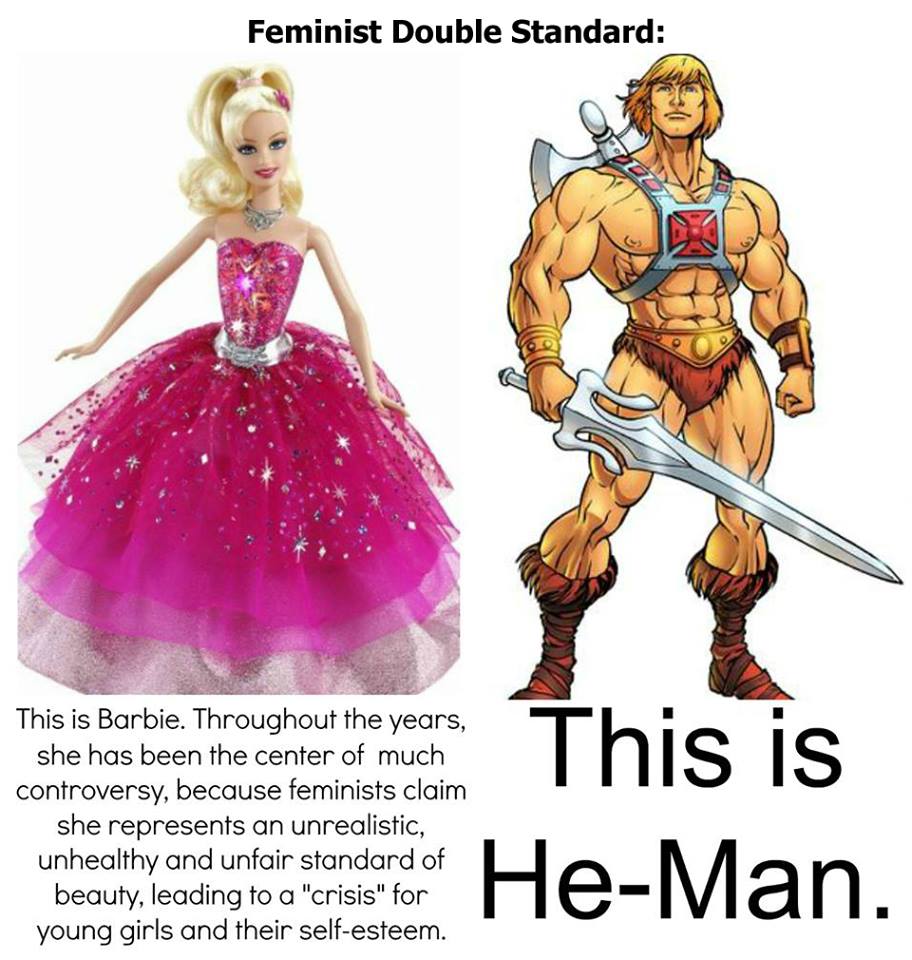
All three are really popular, which may say something about what is really going on here. When we talk about Conan books, the usual screed against them is that they represent a simple kind of male wish-fulfillment. I think that's unfair: at least the original R. E. Howard stories are really quite good. But it might be true for He-Man.
My New Favorite Syllogism
The moon is made of green cheese. Therefore, either it is raining in Ecuador now or it is not.
In our earlier discussions of logic, the failure of modern logic to take relevance into account seemed to me a great failure. Specifically, I maintain that the forms of natural language cannot be entirely separated from the content, no matter how many logicians deeply pine for such a situation.
Now, to the extent that modern logic is a branch of mathematics, I have no problem with it. It has found uses in computer programming and probably other fields, and it's an interesting intellectual exercise in itself. It is to the extent that modern logic attempts to use natural language to create or understand meaning that it fails.
Relevance / Relevant logicians have tried to develop formal expressions of relevance and have come closer to making premises and conclusions relevant to each other, but they haven't solved the problem entirely.
As for me, while I fully understand there are practical uses for modern logic, it seems that Aristotelean logic is superior for analyzing arguments in natural language. Else, it is either raining in Ecuador, or it is not, because the moon is made of green cheese.
Project Euler and Self-Directed Learning
Problem 2
Each new term in the Fibonacci sequence is generated by adding the previous two terms. By starting with 1 and 2, the first 10 terms will be:
1, 2, 3, 5, 8, 13, 21, 34, 55, 89, ...
By considering the terms in the Fibonacci sequence whose values do not exceed four million, find the sum of the even-valued terms.
Apropos of Tex's recent post on child-centered learning, I thought I'd add this.
Computer programming is a hobby of mine and something I am very interested in getting better at, but I was never good at math. Call me lazy, but the most difficult thing in math classes was keeping my eyes open; after missing the instruction, the problems were often impossible. (If it's impossible, it's not difficult, you see.) The textbooks were even more boring than the teachers, so they were no help, either.
In the last few years I've become increasingly interested in learning more math, but the problem is where to begin and how to approach it. I dread taking university math courses, an expensive cure for insomnia in my experience. Then I read James Somer's article, How I Failed, Failed and Finally Succeeded in Learning How to Code, where he introduces Colin Hughes, a British math teacher and the creator of Project Euler.
The core of Project Euler is a set of math problems designed to be solved by simple computer programs. Currently, there are more than 400 and Mr. Hughes adds a new one each weekend during the school year (he takes summers off). Interestingly, other than a simple explanation like the one above, he provides no instruction in math with the problem, but after you give the correct answer, it opens up a discussion thread for everyone who has solved the problem to share their solutions and comments with each other.
My route to solving these problems has generally been either to just start writing the program, if I immediately grasped the problem (like Problem 2 above), or if I didn't, to look up related math topics on Wikipedia, which has a surprisingly large number of helpful articles. I try to find a principle that will allow me to solve that type of problem (I avoid simply searching for the problem itself; some unsporting types have posted their solutions publicly). After solving the problem, I go through a dozen or so solutions from others who have also solved it.
Hughes explains his method like this: "The problems range in difficulty and for many the experience is inductive chain learning. That is, by solving one problem it will expose you to a new concept that allows you to undertake a previously inaccessible problem. So the determined participant will slowly but surely work his/her way through every problem."
That seems to be how it's working for me. While the problems have gotten more difficult, I've become quicker to pick up on patterns in numbers and, when I don't understand a problem, I have a better idea of how to approach finding the answer. I've built up a better understanding of how numbers work together, a clearer understanding of some math concepts, an appreciation for different types of math (number theory, graph theory, combinatorics, etc.) and am solving the problems faster. I am, in fact, learning math.
My proudest achievement there so far has been solving problem 15. Wikipedia was entirely useless (I later found out that I was looking in the wrong articles), so I had to sit down with pen and paper and work through simpler versions of the problem until I found a pattern. Then I created my own formula to solve the problem, implemented it, and it worked. It took me nearly a week of spare time. Then I went into the discussion forum for that problem and found two vastly simpler ways to solve it, and of course I got a good laugh out of that. Then it was on to the next problem.
Are Republican insurgents reactionary?
To the contrary, Richard Fernandez argues that they're the only ones looking forward:
The elite can only continue to sustain itself by borrowing. That was what the crisis was about, borrowing. Obama’s basic demand was simple: let me borrow and borrow without limit. His ‘victory’, if so it can be called, is the victory of a bankrupt who has compelled his relatives to mortgage the farm so he can return to his losing streak at the casino.
. . . It has been argued and proved by natural disasters that the entire fabric of civilization is but nine meals from anarchy. After 3 days without food most people are willing to do anything to anybody to get a meal. The hard reality is that the current deficit system will inexorably create a situation when the grub literally runs out.
. . . [William Galston's OpEd at the WSJ] argues that the conservative insurgency is rooted in some kind of atavism; that it arises from a nostalgic hankering after an America long past in the face of new demography. Nothing could be further from the truth. The hell with demography. People would be just fine with changes in demography if only times were good. When times are bad homogeneity is irrelevant. Rats of the exact same breed will fight to the death over the last piece of cheese.
It’s the cheese that matters. The conservative insurgency is rooted in a lack of money. And so will the coming liberal one. The unrest is not driven by a desire to return to the past. On the contrary it is propelled almost entirely by the growing belief that there is no future.
Government work in its purest form
More on yesterday's subject of how the executive training for President that consists of running a successful campaign doesn't necessarily translate into the expertise needed to run the nation's healthcare system:
Complex regulations, the flexibility of peanut brittle, and a system that rewards rule-followers and connections, not ability to do good work? Now that the problem has been identified, we learn that it couldn’t be fixed because of fear of transparency and political liability, and that no one will be held accountable for it. That’s not an isolated problem of government function. That’s a distillation of government function, a metaphor for the entire thing, and again, it was faith in this entity that animated Obamacare.
The budget that isn't
Peter Schiff nails it: "Whatever the crisis, the real one will be much worse because we did raise the debt ceiling. . . . The debt ceiling is not a ceiling. We should just call it the debt sky!" I'm increasingly impatient with stories about the cost of the government shutdown, the danger of default, the "gridlock" in Washington, and all the rest of it. Yes, it's all unappealing, but it pales in comparison with the alternative, which is a cheerful, cooperative status quo. When a boat is about to go over the falls, a snag in the river is the least of its worries. I feel more like Michael Walsh at PJ Media:
The GOP is not, in any meaningful sense, a conservative, first-principles, Constitutionalist party — and unless it’s subsumed by the Tea Party, it never will be. Rather, it’s content to be the lesser half of the Permanent Bipartisan Fusion Party as long as it can collect some of the pork scraps from underneath the table of the Permanent Bipartisan Fusion Government. No wonder they keep losing — they like it.Update: While Fitch generated some spookified coverage earlier this week by putting the U.S. credit rating on a downgrade watch, the Chinese rating agency Dagong went ahead and made it official. One big difference between the two, besides decisiveness, is that Fitch blamed its action on "political brinksmanship," as if a soothing compromise could fix the problem. Dagong, for its part, issued the downgrade after everyone got chummy on a compromise:
[T]he temporary fix of the debt issue would not defuse the fundamental conundrum of the U.S. fiscal deficit or improve repayment ability in the long-term, but could trigger defaults at any time in the future.
"The deal means only an escape from a debt default for the time being, but hasn't changed the fact that the growth of government borrowing has largely outpaced overall economic growth and fiscal revenues". . . .Who care what China thinks? Admittedly I don't look to a Communist regime for economic wisdom. On the other hand,
Dagong estimated that the U.S.'s foreign creditors could have suffered an estimated loss of $628.5 billion between 2008 and 2012 due to a weakening of the U.S. dollar.
China, sitting on the largest stockpile of foreign exchange reserves in the world, is the biggest holder of U.S. treasuries.For now, China seems not to have much choice but to invest in U.S. treasuries. It will be interesting to find out what happens when that changes.
The martial metaphor
Jonah Goldberg takes on the question of how government can be so good at somethings and so inept at others.
Whenever I make the argument that government is very bad at doing things like Obamacare, the liberal response is invariably to offer counter-examples. "The military is awesome! . . . "We sent a man to the moon!"
What liberals never appreciate is that in all of these counter-examples there's something else going on. The institutional cultures that won World War II or put a man on the moon or that discover some new protein are not strictly speaking government cultures. While none of them are immune from bureaucratic stupidity and inefficiency, ultimately higher motivations win out.
How the Marines' esprit de corps differs from the post office's esprit de corps should be pretty obvious. But even in the other examples, the cultural core of excellent government institutions is driven by something greater than a mere paycheck and significantly different from simple "public service." The NASA that sent men to the moon was imbued with a culture not just of excellence and patriotism but the kind of awe and wonder that cannot be replicated by the Department of Health and Human Services. Moreover, for scientists passionate about space and the race to get there, there was simply no place else to be. That meant the very best people were attracted to NASA. Even if, for some strange reason, you're passionate about writing billions of lines of code for a website and managing health-insurance data, there are still better things to do with your time than work on Obamacare.
I want to be fair to government workers. Many individuals who work for government are dedicated to doing excellent work for the public good. But I'm talking about culture here. President Obama talks as if, absent a war or other national crisis, the entire government can still be imbued with the spirit of sacrifice and excellence that won World War II or put a man on the moon. And that's just crazy talk.
Obama, the permanent campaigner, believes that governing should be more like campaigning. Everyone unified towards a single -- Obamacentric -- purpose. Everyone loyal to his needs. Everyone in agreement with his agenda. In 2008, when asked what management experience he had, he said that running his campaign proved he was ready for the presidency. That should have been the moment when we all heard the record-scratch sound effect and said "What's that now!?" Even if Obama deserved all of the credit for his campaign's successes, campaigning and governing are fundamentally different things. Campaign culture allows for people to be fired. It also rewards excellence, which is why some very young people rise very quickly in the campaign world, while it's far more rare in civil service. Campaigns have a deadline-driven, crisis-junky energy and sense of team loyalty that is at least somewhat analogous to a war or some other crisis. That's why the Obama campaign website was great. It's also why the Obamacare website's error page has an error page.
Re-poop-ulation
It's funny how much easier it is to talk about this kind of thing as long as we call it "probiotics."
Not fit to print
The L.A. Times isn't in the least embarrassed to admit that it censors all letters to the editor that challenge climate-change orthodoxy. You might wonder if that's not even more extraordinary in light of the recently updated IPCC climate-change report, which nearly comes right out and admits that the evidence for recent warming isn't there and that something is drastically wrong with the models. Not so. The only important part of the new IPCC report apparently is the conclusory statement that scientists are 95% certain that they're right about at least half of climate change. So what should we think about the fact that the IPCC's third, fourth and fifth assessment reports, with their increasingly strident warnings, were published against a background of rising CO2 levels combined with a complete absence of detectable warming? Shut up, the L.A. Times editorial staff explains. This isn't politics. This is science. Everything else is conspiracist ideation of the sort that you might expect from free-market enthusiasts.
Consensus is a great thing when you can screen out all the dissenting voices. What do they know, anyway? Are they on the approved government-funded commissions? No? Then they're politically suspect anarchists, and it's a shame that the First Amendment can't be revised to shut them up. Speaking of consensus, if we get to use that as a substitute for logic and evidence, Anthony Watts helpfully compares his traffic against anti-denier sites like Real Climate and Skeptical Science. Presto! He wins, so he must be right.
Consensus is a great thing when you can screen out all the dissenting voices. What do they know, anyway? Are they on the approved government-funded commissions? No? Then they're politically suspect anarchists, and it's a shame that the First Amendment can't be revised to shut them up. Speaking of consensus, if we get to use that as a substitute for logic and evidence, Anthony Watts helpfully compares his traffic against anti-denier sites like Real Climate and Skeptical Science. Presto! He wins, so he must be right.
What do these people want?
More fun as Ivy Leaguers try to come to grips with a Tea Party that won't go away. We have the classic Yalie approach in the post below. For another view of Tea Partiers, equally distorted by a prism of malice but not so ignorant, try Harvard professor Theda Skocpol's interview at Salon. To an impressive degree, she's allowing data about Tea Partiers to moderate her knee-jerk assumptions. For instance, while she spouts the usual line that a streak of racist xenophobia infects the movement, she also acknowledges that the more powerful meaning of symbols like the Confederate Flag is "regional resistance to federal power" and nullification. She also doesn't buy the usual accusation that the movement is Astroturfed, though she's alarmed by the big-money organization that allows a group like Jim DeMint's Heritage Foundation to scare the pants off of squishy Republicans who are thinking of caving on a vote, because the legislators know what's coming at them in the next primary if they do. (The TPs may not have the big numbers, but they're ferociously active in primaries.) Skocpol would like to think that moderate Republicans are going to start pouring money and organization into counterattacks at the primary level, but she's not fooling herself enough to predict it yet. She also warns that it's a mistake to predict a Democratic or moderate-Republican sweep in 2014, because mid-term behavior traditionally favors highly engaged activists.
There's an amusing section in which she struggles to understand what's got everyone's dress up over his head about a benevolent and moderate law like Obamacare. On that subject, she hasn't quite brought herself to look honestly at what motivates her opponents. To her credit, she's gone as far as to understand that the law is fundamentally redistributionist, and that some people don't much care for that aspect. Otherwise she's drawing a blank.
Skocpol closes with a doleful (and slightly sour-grapes) view of the Left's ability to go toe-to-toe with extremist Republicans:
There's an amusing section in which she struggles to understand what's got everyone's dress up over his head about a benevolent and moderate law like Obamacare. On that subject, she hasn't quite brought herself to look honestly at what motivates her opponents. To her credit, she's gone as far as to understand that the law is fundamentally redistributionist, and that some people don't much care for that aspect. Otherwise she's drawing a blank.
Skocpol closes with a doleful (and slightly sour-grapes) view of the Left's ability to go toe-to-toe with extremist Republicans:
There’s also a whole series of reasons why older conservative voters, backed by ideologues, have this combination of apocalyptic moral certitude with organization that really gets results. Especially in obstructing things in American politics.
I don’t happen to think that the left and the center-left could imitate this. For one thing, they don’t have the presence across as many states and districts. But it’s also not clear it’s a model worth imitating. I think the real problem that you’ve got right now on the left is how to defeat this stuff, how to contain it, how to beat it — given the permeability of American political institutions to this kind of thing. And I don’t think it’s clear what’s going to happen.
Those people
Yale's Daniel Kahan doesn't know any Tea Partiers, but disapproves of them heartily, so he was shocked to discover that there is a slight statistical correlation between Tea Party beliefs and scientific comprehension. Not that he lets this get in the way of his abiding faith in the inferiority of their beliefs:
Of course, I still subscribe to my various political and moral assessments--all very negative-- of what I understand the "Tea Party movement" to stand for. I just no longer assume that the people who happen to hold those values are less likely than people who share my political outlooks to have acquired the sorts of knowledge and dispositions that a decent science comprehension scale measures.
I'll now be much less surprised, too, if it turns out that someone I meet at, say, the Museum of Science in Boston, or the Chabot Space and Science Museum in Oakland, or the Museum of Science and Industry in Chicago is part of the 20% (geez-- I must know some of them) who would answer "yes" when asked if he or she identifies with the Tea Party. If the person is there, then it will almost certainly be the case that that he or she [and] I will agree on how cool the stuff is at the museum, even if we don't agree about many other matters of consequence.But, as Bookworm Room points out, it doesn't even occur to him that this means he might want to look more carefully at the basis for the political views of these people who, to his surprise, turn out not to be ignorant fools. The comments on Kahan's blogpost are brutal; apparently he got linked by Politico, Watts Up with That, and Ace of Spades. As one commenter said:
And they said George Bush [w]as incurious. If my business was studying the intelligence of the population, I'd be embarrassed admitting I hadn't met such a large swath of the population. Yet, this author takes joy in the fact. Or else he's just laying the groundwork to defend his findings from his peers. Either way, such a shame there's so little curiousity in academia these days.
Burros in wells
Wired explores child-directed education. I never know what to think of these proposals, which sometimes sound like such obvious good sense and at other times degenerate into stupid chaos. If the article is at all accurate, though, one dirt-poor school in Matamoros stumbled onto a winning formula. The class did have the advantage of one clearly exceptional student:
To test her limits, [the teacher] challenged the class with a problem he was sure would stump her. He told the story of Carl Friedrich Gauss, the famous German mathematician, who was born in 1777.
When Gauss was a schoolboy, one of his teachers asked the class to add up every number between 1 and 100. It was supposed to take an hour, but Gauss had the answer almost instantly.
“Does anyone know how he did this?” Juárez Correa asked.
A few students started trying to add up the numbers and soon realized it would take a long time. Paloma, working with her group, carefully wrote out a few sequences and looked at them for a moment. Then she raised her hand.
“The answer is 5,050,” she said. “There are 50 pairs of 101.”Not only this budding little Gauss but the whole class responded well to the teacher's style of provoking their curiosity and then making them figure things out on their own. After a year of his approach, standardized tests showed a decrease in failing math scores from 45% to 7%, and in failing language skills from 31% to 3.5%. Excellent scores increased from 0% to 63%. Paloma's score was the highest in Mexico. I liked this story, which the teacher told his class:
One day, a burro fell into a well, Juárez Correa began. It wasn’t hurt, but it couldn’t get out. The burro’s owner decided that the aged beast wasn’t worth saving, and since the well was dry, he would just bury both. He began to shovel clods of earth into the well. The burro cried out, but the man kept shoveling. Eventually, the burro fell silent. The man assumed the animal was dead, so he was amazed when, after a lot of shoveling, the burro leaped out of the well. It had shaken off each clump of dirt and stepped up the steadily rising mound until it was able to jump out.
Juárez Correa looked at his class. “We are like that burro,” he said. “Everything that is thrown at us is an opportunity to rise out of the well we are in.”
"What am I missing?"
It's a minor improvement, surely, that this poor child posting at the Daily Kos is confronting the painful task of reconciling data with mental models. He's discovering to his horror that, although he was promised that Obamacare would reduce his health insurance costs, in fact his premiums are about to double. How can this be, he wails?
He should start with the understanding that all that business about lowering premiums was complete balderdash intended to tamp down the fires of resistance long enough to get through a couple of election cycles. It's impossible to believe anyone was serious about floating those claims. Then our callow young poster should consider the real aim of collectivized medicine, considered in the most favorable light to its proponents, which is to even out the good and bad luck of a population with a mix of sicker, healthier, younger, and older members, some of whom are exposed to the expense of pregnancy (their own or a dependent's), or heart disease, or cancer, and some of whom are less so. If such a motive is confronted honestly, it should be blindingly obvious that young, healthy people are going to take it in the shorts in terms of increased costs. How else could it work?
But as usual, this young fellow was hoping that things could get cheaper for all those unlucky people without getting more expensive for people in his relatively fortunate position. His consent was bought cheap, without his ever having to consider the cost. Now he has to think about what it's worth to him to be compassionate.
Lately, I'm noticing something else odd. A lot of the outrage over the newly-rolled-out premiums is over the horrifying discovery that the only way to keep premiums down is to have high deductibles and co-pays. As my husband noted, all you have to do is add in health-savings accounts and you get a proposal that W might have floated. Maybe my high-deductible, low-premium policy is going to survive this debacle after all. What's more, maybe a lot more people are going to get used to the idea of buying insurance for cash, rather than having their employer purchase it for them with invisible money. Maybe they're also going to get used to buying most of their medical care with cash (in all but the most medically disastrous years), so that they start noticing price signals again. Heck, maybe we'll even start getting price signals again.
Wouldn't it be ironic if Obamacare didn't destroy the American health system, after all, but avoided doing so only by destroying what collectivists imagined were the functional bits?
He should start with the understanding that all that business about lowering premiums was complete balderdash intended to tamp down the fires of resistance long enough to get through a couple of election cycles. It's impossible to believe anyone was serious about floating those claims. Then our callow young poster should consider the real aim of collectivized medicine, considered in the most favorable light to its proponents, which is to even out the good and bad luck of a population with a mix of sicker, healthier, younger, and older members, some of whom are exposed to the expense of pregnancy (their own or a dependent's), or heart disease, or cancer, and some of whom are less so. If such a motive is confronted honestly, it should be blindingly obvious that young, healthy people are going to take it in the shorts in terms of increased costs. How else could it work?
But as usual, this young fellow was hoping that things could get cheaper for all those unlucky people without getting more expensive for people in his relatively fortunate position. His consent was bought cheap, without his ever having to consider the cost. Now he has to think about what it's worth to him to be compassionate.
Lately, I'm noticing something else odd. A lot of the outrage over the newly-rolled-out premiums is over the horrifying discovery that the only way to keep premiums down is to have high deductibles and co-pays. As my husband noted, all you have to do is add in health-savings accounts and you get a proposal that W might have floated. Maybe my high-deductible, low-premium policy is going to survive this debacle after all. What's more, maybe a lot more people are going to get used to the idea of buying insurance for cash, rather than having their employer purchase it for them with invisible money. Maybe they're also going to get used to buying most of their medical care with cash (in all but the most medically disastrous years), so that they start noticing price signals again. Heck, maybe we'll even start getting price signals again.
Wouldn't it be ironic if Obamacare didn't destroy the American health system, after all, but avoided doing so only by destroying what collectivists imagined were the functional bits?
Whirlygigs
In the comments section to an earlier post I gave my initial guess about how a helicopter must work. The part about each rotor blade acting like a fixed wing in terms of the general Bernoulli lift principle was right. The guess about the tail rotor counteracting the spin that the main rotor otherwise would put on the body was right. There are other ways to skin that cat, such as mounting two counterrotating main rotors. Sometimes those are fore-and-aft, or side-by-side, but they can also be mounted on the same axle, one over the other. They can even be side by side and so close that they must be carefully timed to avoid collision between the intermeshed blades. Yikes.
But my intuition about how the main rotor could be made to tilt the body (to go forward/backwards/right/left) was completely wrong. It turns out each rotor blade can tilt on its long axis, in two ways. They can be tilted all in lockstep, which affects their general lifting power. But what's really nifty, and what I never would have guessed, is that the machine will automatically cause each rotor to tilt individually just as it reaches the point in its cycle that's in the direction the pilot wants to go, and then flip back when it passes that point. Now that's a fast adjustment! I had vaguely in mind that the whole rotor system, including its axis, must be tiltable, but then on reflection that couldn't have been right. Tilt each rotor blade one at a time as it reaches a particular point in its superfast rotation! Very clever. No wonder helicopters need such obsessive levels of maintenance.
And now for Bernoulli, and my indistinct memory of reading a quibble about the explanation for lift that we carry around in our heads: the wing is shaped with a big curve on top and a much flatter one below, so when air passes it must go faster on top in order to traverse the same distance, resulting in higher pressure below the wing and lower pressure above, ergo lift. But, you ask, who says the the air on top has to get to the back of the wing at the same time as the air below? And in fact it doesn't: it gets there a lot faster; the air on the bottom never catches up. Hmm.

The Wiki lift article claims that the Bernoulli equation itself just describes what will happen if you assume a speed differential above and below the wing, which can be observed experimentally. In order to explain and predict the observed speed differential, you need a more involved treatment of conservation of momentum, mass, and energy, and Navier-Stokes equations that can't readily be solved, and simplifying assumptions about viscosity that allow them to be approximated for some conditions. I'll just have to take their word for it: experimentation tells us that if you mold a proper wing shape and use the right angle of attack at a good speed, you'll get an airspeed differential and lift. In my brain, that gets filed under "magic."
But my intuition about how the main rotor could be made to tilt the body (to go forward/backwards/right/left) was completely wrong. It turns out each rotor blade can tilt on its long axis, in two ways. They can be tilted all in lockstep, which affects their general lifting power. But what's really nifty, and what I never would have guessed, is that the machine will automatically cause each rotor to tilt individually just as it reaches the point in its cycle that's in the direction the pilot wants to go, and then flip back when it passes that point. Now that's a fast adjustment! I had vaguely in mind that the whole rotor system, including its axis, must be tiltable, but then on reflection that couldn't have been right. Tilt each rotor blade one at a time as it reaches a particular point in its superfast rotation! Very clever. No wonder helicopters need such obsessive levels of maintenance.
And now for Bernoulli, and my indistinct memory of reading a quibble about the explanation for lift that we carry around in our heads: the wing is shaped with a big curve on top and a much flatter one below, so when air passes it must go faster on top in order to traverse the same distance, resulting in higher pressure below the wing and lower pressure above, ergo lift. But, you ask, who says the the air on top has to get to the back of the wing at the same time as the air below? And in fact it doesn't: it gets there a lot faster; the air on the bottom never catches up. Hmm.

The Wiki lift article claims that the Bernoulli equation itself just describes what will happen if you assume a speed differential above and below the wing, which can be observed experimentally. In order to explain and predict the observed speed differential, you need a more involved treatment of conservation of momentum, mass, and energy, and Navier-Stokes equations that can't readily be solved, and simplifying assumptions about viscosity that allow them to be approximated for some conditions. I'll just have to take their word for it: experimentation tells us that if you mold a proper wing shape and use the right angle of attack at a good speed, you'll get an airspeed differential and lift. In my brain, that gets filed under "magic."
Subscribe to:
Posts (Atom)