Kung Fu

Kung Fu & Philosophy:

An interesting pair of posts by Chinese philosopher Peimin Ni. He makes the interesting leap about two-thirds of the way into the first post:

This kung fu approach shares a lot of insights with the Aristotelian virtue ethics, which focuses on the cultivation of the agent instead of on the formulation of rules of conduct. Yet unlike Aristotelian ethics, the kung fu approach to ethics does not rely on any metaphysics for justification. One does not have to believe in a pre-determined telos for humans in order to appreciate the excellence that kung fu brings. This approach does lead to recognition of the important guiding function of metaphysical outlooks though. For instance a person who follows the Aristotelian metaphysics will clearly place more effort in cultivating her intelligence, whereas a person who follows the Confucian relational metaphysics will pay more attention to learning rituals that would harmonize interpersonal relations. This approach opens up the possibility of allowing multiple competing visions of excellence, including the metaphysics or religious beliefs by which they are understood and guided, and justification of these beliefs is then left to the concrete human experiences.
The second post is here, and explores the link between metaphysics and the martial arts. I'm not sure if he realizes it, but he hits upon the core difference between Buddhist and neo-Platonic traditions -- which include many Christian, Jewish and Islamic philosophers.
Wu insisted that I be seated in the most prominent spot, and placed himself and all his associates at the table in lesser positions. With the ritual setting in order, he then humbly presented me a classic martial arts manual, and asked if I could explain the introduction of the book for him. “It is full of philosophical terms,” he said. “I have trouble understanding it.”

I looked at the manual. It was on a martial arts style called xingyi quan. While the main body of the book was about postures and movements of the body and energy, which Mr. Wu had no trouble interpreting, the introduction was basically a treatise about metaphysics. It contained views derived from the Song dynasty neo-Confucian scholar Zhou Dunyi, in which an abstract concept, called wuji, the ultimate non-being, takes a central role as ontologically prior to taiji (t’ai chi), or “the primordial ultimate.” Oddly enough, the author offered no indication about how the ideas should be translated into the martial arts, as if it were all self-evident.
What he means here is that the existence of taiji depends on the existence of wuji. This kind of priority is similar to the kind the Persian philosopher Avicenna describes between his own "necessary existent" and the first emanation. It isn't 'prior' in terms of time, because the first emanation is necessary and therefore eternal. Thus, there was never a time when both things did not exist; but one of them depends on the other for its existence.

The distinction to be made here is the difference between the wuji concept, and the neo-Platonic idea of what the One is like. That would be interesting to explore; it's a shame he didn't. Since he invokes Aristotle, however, it's worth noting that Aristotle has a similar concept at work in his physics (James Wilberding wrote about this in "Creeping Spatiality," if anyone is interested).

In any case, it's not right to say that Aristotle isn't also interested in social harmony. Aristotle wrote the Politics on the subject of how to build a state that sustains a space for the best kind of life (the kind of flourishing life that he describes in the Nicomachean Ethics). The ethics is likewise concerned with social relations: a number of the virtues are specifically about relationships with others, for example justice and magnanimity. He pays particular attention to the importance of friendship to the good life.

It's a different vision, but I don't think it's right to say that it is different because one is social and the other is individual.

Oh, the more obvious question: just how does the ontological priority of wuji inform martial arts? Neo-Confucianism has a form/matter distinction very much like the ancient Greeks and Christian philosophers. Form (li, or principle, in the Chinese) and matter (qi) are both ways of actualizing potentials: form is a kind of potential, in that the set of forms govern all things that matter can possibly be, whereas matter is potential in that it can assume many forms. (For example, water can assume the form of a liquid or a gas.) When matter takes on a form, it becomes an instance of that form, and thus there is an actuality of what was previously a potential.

Matter, for the Chinese as for the Greeks, was inherently chaotic: unprincipled, that is. Neo-Confucianism was interested in li, that is, in trying to bring your matter in alignment with the ideal embedded in the principle.

What the martial artist is asserting is that getting there isn't good enough: you also have to look beyond that. Getting a single principle perfect only makes you a perfect single instance of something. That isolates you from the nature of every other principle, as well as from the nature of the matter you are dominating. Li perfected is a pole.

Thus we see the point: taiji means "ultimate ridgepole," whereas wuji means "without ridgepole." Reaching that ultimate limit means distancing yourself from everything else.

The greatest mind will be able to achieve wuji, which essentially involves setting aside the law of non-contradiction. It is reaching the pole, and embracing all the other poles as well; so that all distinctions collapse, and what remains is perfect actuality. Not perfect potential: potential was what we started with. Wuji implies the actuality, and indeed the assertion is that such is the actual nature of reality.

What does that mean to the martial artist? In focusing on mastering the sword, you may forget that you might resolve a dispute with a flower. The true master will not forget, but will think of his mastery only as a starting point.

Irish Crochet Lace

Irish Crochet Lace

My sister, God bless 'er, sent me a fantastically beautiful book for Christmas on making Irish crochet lace. The instructions look surprisingly straightforward, considering how elegant and intricate the designs are. This picture isn't from the book, but it's comparable. Basically, you make the individual motifs, which aren't too awful, and you tie the whole thing together with the standard netting pattern. So the real trick is not so much the difficulty of the stitching as being able to visualize the pattern, which is where all the lovely pictures come in.

I made pillowcase edgings for my female relatives this year, and I was pleased with how they came out, but this new stuff is going to be a real leap upward. I believe the first thing I'll work on will be a christening gown for my newest great-nephew. Since I can't find a good picture of a christening gown online, here's another sample pattern:

Snow on Christmas Day:

And on the Feast of Stephen.


A fine feast to you all.

On the Feast of Stephen

On the Feast of Stephen:


We know that in Ireland, today is Wren's Day. This involves the funerals for wrens killed by young boys, who collect money for the occasion. There is a particularly merry song associated with the custom.


Did you know that the Welsh also have an interesting custom?

Ancient Welsh custom... [included] "holming" (beating or slashing with holly branches) of late risers and female servants.
The Internet doubtless contains some relevant video for this custom as well; but I think I'll demur posting any such things here. Such joyful play is best practiced in private spaces.

Against the Tea Party

Against the Tea Party:

The first one, that is. Cassandra raised the question a month or so back; here's the New Yorker, finally catching up to her.

Tarring and feathering was so popular in New England in the seventeen-sixties and seventies that at least one observer thought Americans had invented it, though in fact it has been around since at least the twelfth century. What was it like? Pine tar, used to waterproof ships, is liquid at room temperature and, in most cases, was probably applied unheated. Feathers were obtained either from fowl (the smellier the better) or from cushions. The third and most essential ingredient was exposure. One customs agent was kept outdoors in his “modern jacket” until he was frostbitten. “They say his flesh comes off his back in Steaks,” a woman reported afterward. Victims felt a lingering shame, though the frostbitten customs agent, a resilient personality, petitioned King George III to dub him a “Knight of the Tarr.”...

George Washington disapproved of the Tea Party, and Benjamin Franklin called it “an Act of violent Injustice on our part.” But the Revolution was not yet in the hands of the Founders, although it had left those of the merchants, who now dodged and stalled as the people—passionate and heedless of economic niceties—called for a ban on all tea, even what was smuggled from the Dutch.
As insurgencies go, tarring and feathering is not so bad: we're accustomed to seeing insurgents express their distress by bombing crowds of women and children, rather than applying some mild discomfort to individuals singled out for their own personal actions. Still, a relative judgment may not be the right way to approach the question: perhaps it's not enough to be better, but rather to be good. I'll leave that for the discussion.

In Excelsiis

In Excelsis:


Iraqi Christmas

The Spirit of Martyrs:

Iraq's Christian community has come under great strain, enduring a massacre at its leading cathedral earlier this year. Today, however, they were out in defiance of tyranny. This, I suppose, is the spirit of the martyrs: and an act of great faith.

In the Philippines, a bomb targeted a Catholic church today. I met a priest when I was in the southern Philippines, and visited his church. He kept a monkey on a harness, which was attached to a ring that ran along a wire so that the monkey could climb all over the church without escaping. That priest was a brave man, too.

The Boar's Head

Merry Christmas:


I didn't get to make that boar's head this year after all, partially because I couldn't convince anyone else that they would enjoy eating it. I will be making the roast duck, which everyone thought they would like.

Again this year I am fortunate enough to be home with family, rather than abroad. We'll see what next year brings! In the meantime, be well, and be merry.

UPDATE: Amusingly, I didn't get to eat the duck either. I did make it, but about two hours short of being ready, a huge snowstorm blew up. As we were visiting family for Christmas, and did not want to become trapped, we had to leave early. I left instructions for finishing the dish, which I understand they did. I'll let you know what they thought of it. Christmas dinner for me: leftovers!

That's OK, though. This is the first White Christmas I've ever seen in my home state. For an hour today I drove in a snowstorm. I can make a duck any day: but snow, in Georgia, on Christmas, is a thing I never thought I'd live to see.

UPDATE: My sister sends a picture of the famous duck.


It was good enough that my father called me to report on how much he'd enjoyed his three servings of it. Since he normally does not care for any food that is even slightly unusual, that's a very high compliment. I'll have to try it again sometime. Thanks to T99 for recipe advice. I ended up combining several, and going with a very slow (five hour) roast.

Christmas in Bethlehem

Christmas in Bethlehem:

If you are so blessed as to be able to manage a pilgrimage to Bethlehem this year, your hosts have a message for you: "No crosses, please."

This Christmas, tourists and pilgrims to the Holy Land will need to keep their piety under wraps. AsiaNews reports that in Bethlehem, the city of Jesus’ birth, the Cross has been banned for fear of stirring up unrest among followers of Islam[.]
All the same, it sounds like a lot of people are going.

The Suit

The Suit:

The business suit is a very odd garment, if you pause to think about it. If you are like me, and wear one perhaps three times a year, you think about its oddness every time you don one. It is made of wool on the outside, unless it is silk or broadcloth; but feels like satin pajamas on the inside. In this as in its color scheme, it is exactly backwards, according to Chesterton: "Becket wore a hair shirt under his gold and crimson, and there is much to be said for the combination; for Becket got the benefit of the hair shirt while the people in the street got the benefit of the crimson and gold. It is at least better than the manner of the modern millionaire, who has the black and the drab outwardly for others, and the gold next his heart."

Neither is the wool on the outside the kind of sturdy wool that holds up to serious wear. It is so thin as to tear at the slightest catch. And it is not wool to keep you warm: if there is any frost about, you will need another coat besides your "coat."

And of course it is worn with the necktie, that sketch at a scarf that does nothing to really warm the throat. The sole surviving purpose of the necktie is to give an otherwise stolid garment the opportunity for individual flair; but not too much!

The Economist celebrates this odd garment, on its 150th anniversary. That is the formal date they assign it: but the roots, they say, go back to Charles II, the Merry Monarch, best of the Stuart kings.

It proves to have an interesting story, in other words: and that may save the thing, which otherwise fails my usual tests for garments on every level.

Mirrorshades

Mirrorshades:

Bruce Sterling is definitely one of the people I'd like to hear from about Wikileaks.

One minute’s thought would reveal that a vast, opaque electronic spy outfit like the National Security Agency is exceedingly dangerous to democracy. Really, it is. The NSA clearly violates all kinds of elementary principles of constitutional design. The NSA is the very antithesis of transparency, and accountability, and free elections, and free expression, and separation of powers — in other words, the NSA is a kind of giant, grown-up, anti-Wikileaks. And it always has been. And we’re used to that. We pay no mind.

The NSA, this crypto empire, is a long-lasting fact on the ground that we’ve all informally agreed not to get too concerned about. Even foreign victims of the NSA’s machinations can’t seem to get properly worked-up about its capacities and intrigues. The NSA has been around since 1947. It’s a little younger than the A-Bomb, and we don’t fuss much about that now, either.

The geeks who man the NSA don't look much like Julian Assange, because they have college degrees, shorter haircuts, better health insurance and far fewer stamps in their passports. But the sources of their power are pretty much identical to his. They use computers and they get their mitts on info that doesn’t much wanna be free....

Now, Tim May and his imaginary BlackNet were the sci-fi extrapolation version of the NSA. A sort of inside-out, hippiefied NSA. Crypto people were always keenly aware of the NSA, for the NSA were the people who harassed them for munitions violations and struggled to suppress their academic publications. Creating a BlackNet is like having a pet, desktop NSA. Except, that instead of being a vast, federally-supported nest of supercomputers under a hill in Maryland, it’s a creaky, homemade, zero-budget social-network site for disaffected geeks.

But who cared about that wild notion? Why would that amateurish effort ever matter to real-life people? It’s like comparing a mighty IBM mainframe to some cranky Apple computer made inside a California garage. Yes, it’s almost that hard to imagine.

So Wikileaks is a manifestation of something that this has been growing all around us, for decades, with volcanic inexorability.
This is another one of those Joseph Schumpeter arguments about entrepreneurial models. The reason that Marx's monopolies never succeeded in crushing all competition, as he thought they would, is that these advantages -- small, amateurish, and hard to imagine -- are permanent and powerful.

Yes!

Now You're Talking:

Bob Owens is right on the money:

Laws of course vary from state to state, but the simple fact is that the large majority of states — even those that allow concealed carry — have lacked the foresight to see a concealed carry permit holder as anything other than a civilian protecting himself or herself. They have yet to grasp the fact that concealed carry permit holders are the first line of defense against a Mumbai-style attack.
That's a point we've made here often, and for a long time. The citizen has both the right and the duty to defend the Republic, the common peace, and the lawful order. He should also have access to the tools.

Against Human Rights

Against Human Rights:

If the title of this post sounds vaguely sacrilegious to you, Dr. John Gray says, it's because you are a victim of Utopian piety:

From Jimmy Carter onward, this tenet came to be invoked as “the guiding rationale of the foreign policy of states.” Almost never used in English before the 1940s, “human rights” were mentioned in the New York Times five times as often in 1977 as in any prior year of the newspaper’s history. By the nineties, human rights had become central to the thinking not only of liberals but also of neoconservatives, who urged military intervention and regime change in the faith that these freedoms would blossom once tyranny was toppled. From being almost peripheral, the human-rights agenda found itself at the heart of politics and international relations....

THE MOST damaging effect of Rawls’s work was the neglect of the state that it produced. The natural rights that were asserted in the early modern period by Hobbes and other thinkers were closely linked with the modern state that was emerging at the time. As Moyn notes, the “freestanding individual of natural rights . . . was explicitly modeled on the assertive new state of early modern international affairs.” Hobbes was insistent that the right to self-preservation can be protected by a state that accepts no limits on its authority to act—otherwise, there is only a “war of all against all” in which everyone must be on guard against everyone else. Other rights theorists such as Locke, more recognizable as liberals in a modern sense, wanted to impose substantive limits on what governments could legitimately do; but they too were clear that rights could only be respected in the context of an effective modern state. Human rights might in some sense exist prior to the state, but without the state they counted for nothing....

A willed ignorance of history was also at work. If rights are universally human, embodying a kind of natural freedom that appears as the accretions of history are wiped away, the past has little significance. But if human rights are artifacts that have been constructed in specific circumstances, as I would argue, history is all-important; and history tells us that when authoritarian regimes are suddenly swept aside, the result is often anarchy or a new form of tyranny—and quite often a mix of the two.
The examples the author draws on center around Iraq, of which he is a critic; but I would like to point to another example that may be more relevant to us. In "Philosemitic Discourse in Imperial Germany," Alan Levenson points to what must have seemed to Jews to be a glorious flowering of pro-Jewish sentiment in 20th century Germany. Yet it was not nearly as deep as it seemed:
Within the program of legal, economic, and intellectual modernization that led to the emergence of a German bourgeoisie and a unified nation, Jewish equality was regarded as a by-product. Analyzing the nexus of Jews and German liberals, Pulzer concludes that although the Jews "had good friends and allies, few were prepared to put the defense of Jewish rights above all other priorities."
We've seen a similar movement in this country as regards the claims to "rights" made by homosexual advocates. The claims are being forwarded as by-products of an expansion of individualist "rights" that people want for reasons of their own. For example, the argument for reforming marriage is an outgrowth of the highly individualist reading of marriage: that marriage is really no more than a contract between the two individuals undertaking it, and therefore the happiness of those individuals is its paramount purpose. Given that understanding of marriage -- not marriage as a forging of new kinship bonds, a uniting of families across generations, or a sacred oath, but just a kind of contract that only the two individuals have any right to criticize -- the equal-protection challenge makes a kind of sense. We often speak of marriage as a partnership, but here it is read as exactly and only a kind of business-partnership: a union undertaken freely by two autonomous individuals, for their own pursuit of happiness.

That understanding explains the explosion of divorce, which is a far more important cultural phenomenon in America. If this reading of marriage is the right one, then it is a kind of slavery for someone to remain in a marriage if their happiness lies elsewhere. After all, they entered the union to pursue happiness: if they now see their happiness elsewhere, and remain in the marriage merely to make the other partner happy, they have become enslaved. That is the real thing that the hard-core individualist wishes to avoid: and thus, this understanding of marriage is to be insisted upon at all costs. Gay marriage follows logically from this foundation; but it is a by-product.

Dr. Gray's point about the importance of the political institutions is therefore well-founded: once the institutions of German liberalism foundered, all that philosemitism went entirely away. In a sense it was never real, because it was founded not on love for the thing -- that is, Jewishness -- but merely a convenient by-product of the pursuit of the other things really loved.

(An aside: this is one reason, along with the change in American demographics toward a more robustly Christian society, that I warn that the current movement toward "gay rights" is probably at its high water mark. Take this warning, if you wish, for it is a sincere one. Just as there are many false friends, who seem to be on your side but who are really chasing things of their own, there are some false foes. I may be opposed to your project, but that is likewise for reasons of my own that have nothing to do with gays. It does not mean that I have anything against you, no more than it means that those currently helping with your project really love you for yourself.)

Where Dr. Gray is weaker is in failing to recognize that political institutions are not the only relevant ones. Social and cultural institutions are likewise crucial to making rights actual. Marriage is a good one, since we started with it: it is the institution that supports and defends the next generation, gives them shelter and support until they can make their own way. As it collapses, demographic changes make society less stable: and therefore less able to support "rights" claims for everyone. The extreme form of this is the demographic collapse that Mark Steyn warns about, whereby demographic changes cause the fall and subordination of the culture that ever believed in the "rights."

The rise of "right to serve" in the military is probably the worst case of misunderstanding here. The military is the final hedge that defends the space in which these rights are actual, rather than theoretical. In making individual dignity more important than military necessity, the whole liberal project is endangered.

Of course this is no surprise to readers of the Hall. If you are new to the discussion, there is a whole set of links on the sidebar under the heading "Frith and Freedom" that is relevant. Rights may come from God or from nature, but they come to be actualized only because we make a fellowship fit to defend them. We must drive back the world, make a space, and hold it.

Within that space, yes, we can have all the equality and rights we care to defend. We must never forget that the space has to be defended, though: the institutions are its pillars, and our frith is its walls. The rights live inside the space: they cannot survive outside of it, and do not belong on its frontiers. That is the place where the hard things are done, the things that hold back the world.

Books for Christmas

Books by Companions of the Hall:

If you're looking for a good book to buy for someone, allow me to remind you that two of our friends are published authors. These books would make excellent gifts. (I list them in alphabetical order, to avoid suggesting any preference between the two.)

Tale of the Tigers by Juliette Akinyi Ochieng.

West Oversea by Lars Walker.

Totality

Totality:

The photos I took of totality didn't come out very well, but here is an early one as we approached it.


These things are best viewed with good company.


Orion was majestic tonight, just off the moon.

The stars shines itself,
The bright moon by another;
As one might, in love, for thou.

Firewood

Against the Cold:

We had some bitter cold earlier this month, although the last few days have been more normal for Georgia in December. Still, since we were called to start burning fires earlier this year, I have laid in a little more wood this week. There is plenty of standing deadwood on the property, already seasoned for the man who will fell the tree, buck it into logs, and break it with an axe.

Here are the stacks of wood I've had time to add this week. This wood is northern red oak and hickory, mostly, though there is quite a bit of dogwood: we had a blight come through and slay many of the dogwoods in the area.


Below is small cache of red oak. Most of this tree was rotten at the top and the bottom, but the core was beautiful.


This stack is dogwood and cherry at the top, red oak in the middle, poplar below.


This is mostly oak and dogwood.


This last one I'm not sure about. It was an oak of some sort, giant and dead, and leaning against a beautiful white oak that deserved to be liberated from it. I'm not sure the exact subspecies, though: this page makes me think it may have been a "Shumard's oak," but I claim no certainty about it.

Read This

Entrepreneurial Government:

Walter Russell Mead has a interesting article that lies somewhat along my own way of thinking.

The bureaucratic state is too inefficient to provide the needed services at a sustainable cost – and bureaucratic, administrative governments are by nature committed to maintain the status quo at a time when change is needed. For America to move forward, power is going to have to shift from bureaucrats to entrepreneurs, from the state to society and from qualified experts and licensed professionals to the population at large.

This doesn’t mean that government becomes insignificant. The state will survive and as social life becomes more complex it will inevitably acquire new responsibilities – but it will look and act less like the administrative, bureaucratic entity of the past. The professional, life-tenured civil service bureaucrat will have a smaller role; more work will be contracted out; much more aggressive efforts will be made to harness the power of information technology to transfer decision making power from the federal to the state and local level. All this change runs so deeply against the grain for many American intellectuals that they have a hard time seeing it whole, much less helping make the reforms and adjustments these changes demand.
Yes, but let's ask the more important question: where do we draw the line? What functions absolutely demand an actual officer of the government, commissioned or elected? Which ones can be executed by a private actor, under the authority of the government?

The answers may lead to some interesting places. For example: military force? No, the Constitution provides a clear authority for Congress to contract that out ("letters of marque and reprisal"). Congress considered (but rejected) a bill to delegate that authority to the President just a couple of years ago. It was a Ron Paul bill, and for now is without support beyond his small following; but nevertheless, the authority for such practices is certainly there.

Your Government in Action


Your Government in Action

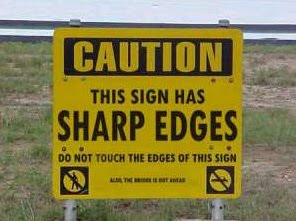
I can only imagine the stimulative effect of the tax money that must have been used to put up this sign, which is post-modern in its self-referential beauty.


H/t Ace's overnight thread via the NPH.
The Hall Bedecked:

While we lack the elegance of T99's lovely home, we have arranged things in a way that matches the merriment of the season.


The skull over the mantel looks on jars of homemade crystallized ginger root and cookies, as well as my great-great grandfather's musket.


The Christmas tree. Slightly obscured are the knights and castles carved into the chest beside; more obvious, the bamboo root carved into the shape of a Chinese guardian spirit.


We have also arranged for a general winter feast:


Even horses can't eat that fast, though, so it needed to be stowed against the cold, wet winter we're expecting here.


Preparation is everything! I have laid in a duck and a ham, and some beer, many pounds of flour and sugar and coffee and other good things.

Fire is needed by the newcomer
Whose knees are frozen numb;
Meat and clean linen a man needs
Who has fared across the fells,

Water, too, that he may wash before eating,
Handcloth's and a hearty welcome,
Courteous words, then courteous silence
That he may tell his tale[.]

Chinese & Philosophy

The Chinese Student of Western Philosophy:

This interesting article touches on the experience of a teacher of political philosophy with numerous Chinese students. They've settled on some interesting choices, and he has some thoughts as to why these particular thinkers of interest to someone rooted in Chinese culture.

I was particularly taken with the wisdom of the one student, who refused an English language immersion course in order to study Latin.

Headlines

Headlines:

Today's news: Marine Commandant demonstrates the courage to speak the truth as he sees it, in spite of his CINC's opposition. The Washington Post refuses to make headlines out of its headline-grabbing poll, showing heightened opposition to Obamacare. Congress continues to set new records, both in spending and in popularity.

Havamal on the Holidsys

The Hávamál on the Holidays:

Many of you will soon be undertaking travel to distant places, in the cold and the snow. I wish to remind you of some very good advice.

1

The man who stands at a strange threshold,
Should be cautious before he cross it,
Glance this way and that:
Who knows beforehand what foes may sit
Awaiting him in the hall?

...

11

Better gear than good sense
A traveler cannot carry,
A more tedious burden than too much drink
A traveler cannot carry,

12

Less good than belief would have it
Is mead for the sons of men:
A man knows less the more he drinks,
Becomes a befuddled fool[.]
...

15

Silence becomes the Son of a prince,
To be silent but brave in battle:
It befits a man to be merry and glad
Until the day of his death[.]
And remember this also, you who travel:
38

A wayfarer should not walk unarmed,
But have his weapons to hand:
He knows not when he may need a spear,
Or what menace meet on the road.

The Small Laws

The Small Laws:

The other day, I saw a strange post at Volokh, asking whether and why adult incest should be banned by law.

Now, it's a known fact that electing a Democratic president very often leads to challenges to the basic foundations of society. I'm not sure just why this is true; as a lifelong Democrat myself, until the formation of the Tea Party, I can't think of any good reason it should be true. There are plenty of Southern Baptists among the Democratic Party; there are plenty of Catholics; and their most devout voters, the black community, are stridently religious.

Nevertheless, elect a Democrat to the White House, and suddenly you're talking seriously about whether or not there is really a rational basis for banning incest.

Dad29 has the right answer about all this, which is of course to be found in a Chesterton quote.

When you break the big laws, you do not get freedom; you do not even get anarchy. You get the small laws.
What you get, that is, is petty tyranny. A law that denies the will of the vast majority will need invasive powers if it is to enforce its authority. It will need to control you: if not your very thoughts, at least your expressions of those thoughts.

We gain a freedom to commit incest with our adult children: a freedom almost no one wanted, and which freedom almost everyone will resolve by hurling it away -- as one ought to do if one should discover something filthy in one's hand. That, though, brings us back around to Dr. Nussbaum's point, and our earlier discussion of it.

Oh, by the way, why is this incest thing suddenly something that people are willing to step up and defend? I can't help but notice that the guilty party is a noted Palin critic; and, I suppose, that suggests to a certain set that he must therefore be in the right. We need, then, to find out how we have gone wrong, in condemning behavior practiced by so obviously correct and wise a man.

I gently suggest: possibly not.

Matthew 5:9

Blessed are the Peacemakers:

I don't know how much peace was made by Ambassador Richard Holbrooke, who has died unexpectedly at the age of 69. The position is an honorable one, though, if undertaken properly with a serious heart. My condolences to his family.

UPDATE: I said above that I didn't know how much peace he had made, which was true in the literal sense: there's little enough in Afghanistan, and I wasn't familiar with his earlier career. This morning's biography in the Washington Post, though, makes it sound like he may have done quite a bit to forge peace, especially in the wars following Yugoslavia's collapse. It's worth reading.

The Piano Arrives!

The Piano Arrives!

I'm taking custody today of my good friend's dog, a dog I'm awfully fond of, for a month or so while she goes on her annual holiday walkabout. Since she lives several hours away, I normally would count on her to deliver him to me, or at least meet me halfway. Not today, though: the gorgeous 9-foot grand piano has arrived. I drove up to admire it and play for a while.

What a beautiful, beautiful instrument. This picture shows my friend, an accomplished flutist, playing a duet with her young son. Fifteen years ago when she turned up pregnant, she could hardly imagine becoming a mother, let alone that her son would become this fine musician. The last time he was at my house noodling around on my piano, I thought he was pretty good for such a young man, fourteen years old. That was nearly a year ago. In the intervening months he's progressed by leaps and bounds. He played some Rachmaninoff and Brahms and Mozart and Liszt, but as my heart belongs to Chopin, he indulged me with the lovely Nocturne in C sharp minor, which you can listen to here, played by another very young person:

We goofed around playing Richard Strauss's Four Last Songs, with my friend playing the vocal parts on her flute, her son sight-reading the left hand of the piano accompaniment and me trying to sight-read the right hand. We made a mess of it, but I haven't had so much fun for ages. When I haven't been to her home for a while, I forget what a paradise of music and art it is. You can barely walk through any room without tripping over looms and spinning wheels. And although I didn't get to stay long, I now have my beloved Chuck, the chocolate lab, here for a month-long visit, making us a four-dog household. Who could ask for more?

Don't Forget the Shower

Don't Forget the Shower

The Geminid meteor shower is beginning already and will get better all night long. Right now they're coming about one every two or three minutes. Look east at Gemini, the two-star constellation a bit north of Orion and slightly lower in the sky. The meteors will appear to be radiating straight out of Gemini in all directions. Most of the ones we saw were a good hand's breath away from Gemini.

Mainstreaming the Constitution

Mainstreaming the Constitution:

Amazing!

A year ago, no one took seriously the idea that a federal health care mandate was unconstitutional.
No one?
A number of readers have taken issue with my saying that "no one" took this idea seriously. It would probably be better to say that very few experts on constitutional law thought there was much chance that the law could be successfully challenged on constitutional grounds. Some chance, but not much. And I think that is unquestionably true. The mainstreaming of this argument over the last 12 to 18 months is little short of remarkable.
This is one of those 'nobody I know voted for Nixon' things. By "no one" he means to say "no academic scholars of the law that I habitually read"; and by "mainstreaming" he means that "main stream" which is composed of constitutional scholars, Federal judges, and the like.

What he's missing is that, actually, everyone believed it was unconstitutional except for a few lawyers and leftists. The reason this argument could so quickly become "mainstream" in his technical sense is that it was already mainstream in the actual sense.

Ms. McArdle writes:
I've yet to see a major story showing how health care reform is working better than expected. So far, everything from the claims that Democrats would get a bounce in the polls after passage, to the promises that you could keep your insurance if you liked it, to the legal issues, turn out to have been overoptimistic at best.
Yes, that's true. So is this, from Professor Richard Epstein:
The key successful move for Virginia was that it found a way to sidestep the well known 1942 decision of the Supreme Court in Wickard v. Filburn, which held in effect that the power to regulate commerce among the several states extended to decisions of farmers to feed their own grain to their own cows. Wickard does not pass the laugh test if the issue is whether it bears any fidelity to the original constitutional design. It was put into place for the rather ignoble purpose of making sure that the federally sponsored cartel arrangements for agriculture could be properly administered.

At this point, no District Court judge dare turn his back on the ignoble and unprincipled decision in Wickard. But Virginia did not ask for radical therapy. It rather insisted that “all” Wickard stands for is the proposition that if a farmer decides to grow wheat, he cannot feed it to his own cows if a law of Congress says otherwise. It does not say that the farmer must grow wheat in order that the federal government will have something to regulate.....

Virginia has drawn a clear line that accounts for all the existing cases, so that no precedent has to be overruled to strike down this legislation. On the other hand, to uphold it invites the government to force me to buy everything from exercise machines to bicycles, because there is always some good that the coercive use of state authority can advance.
Dr. Epstein really gets to the core of the problem with the law, and the reason it is so blatantly unconstitutional. It is unconstitutional not for some technical reason attuned to some careful reading of precedent, but because it effectively eliminates all restraints on government power. Establishing a form of government that was restrained to only essential powers was the reason for writing a Constitution in the first place. If the Founders had wanted a state with unlimited power to do "good," they could have named an Imperator, and set standards for choosing one who was more-or-less reliably good.

Instead, they created a government of and for the people, most of whom won't be all that good. Such a government needs to be carefully limited. That's what the Constitution exists to do. A law that slaps aside those limits is unconstitutional at its very heart: it is poisonous to the character of the American project.

Every Tongue

"...And Every Tongue Shall Confess..."

Aye, and every block of wood.


And why not every block of wood, if it comes to that?

Face-blind

Face-Blind:

What if you couldn't recognize faces?

It's an amazing faculty, actually: try this optical illusion, and you'll see that you can easily recognize the faces even at extremely low resolution.

A great deal of the human mind is biologically ordered to focus on this, which means that we are normally very good at it. It is normal for animals to be good at particularly important adaptive traits, and incapable of others that would seem to be as easy. "It is fairly easy to teach a dog to walk on its hind legs, but virtually impossible to teach it to yawn for a food reward. Cats can be taught to escape from boxes by pushing a sequence of buttons and pulling strings, but cannot learn to escape by scratching themselvs."*

That latter claim is kind of surprising, since you'd think you could use the ordinary kind of operant conditioning to train the cat. Apparently not!

Neither can you learn to recognize faces, apparently: you either can or cannot. You can train to recognize different kinds of faces: when I first started dealing with horses, I couldn't tell any two brownish horses apart; eventually, I could not only recognize but read the face of a horse, determining its sex and so on from the facial structure. You can do that with higher animals generally. In doing so, though, you're not generating a new mental faculty: you're only training one you have by nature.

* Stephen Budiansky, The Nature of Horses (New York: The Free Press, 1997), 158.

. . . and Action

and . . . Action


The completed Christmas tree, two full weeks before the day. And all the ornaments boxes stashed back away, whew. Now we're off to a neighbor's house to pick sour oranges, to be made into vinegar, candied peels, marmalade, and anything else we can think of, then a historic homes tour, or at least what pass for historic homes in such a young area.


And tonight, caroling! Speaking of which: "Snow had fallen, snow on snow, snow on snow . . . ." Not here, of course, but it looks like much of the rest of the country is getting snowed in this week.

Filibuster

If You Must Filibuster...

...do it the old fashioned way.

Sanders began his speech on Friday at 10:24 a.m. and wrapped up just before 7 p.m. He has threatened to filibuster the Obama-GOP deal when it is brought to the Senate floor next week.
That reminds me of a joke.

A Texan walks in to an Irish bar in Boston. He walks up to the bar, takes a big wad of cash out of his coat pocket, and slams it down. "I've always heard that you Irish are big drinkers," he said. "I've got five hundred dollars here that says that not one of you can drink ten pints of Guinness back to back, without stopping. Who's the man who'll prove me wrong?"

The bar gets real quiet, and people look a little uncomfortable. Finally, one guy gets up and slips out the door.

The Texan smiles and puts his money away, and orders a bourbon. A little while later, though, the guy who had slipped out comes back. He walks up to the Texan, and says, "Is the bet still on?"

"You bet!" the Texan says. The bartender pulls the ten pints, and the little fellow starts to drink them.

He gets one down easy, and two, and three, and four... but he starts to slow down around five, and six... he's looking pretty unsteady by seven and eight... and he's barely holding together at nine. Still, with a great effort and some deep breaths in between, he manages to drink down the last, tenth pint.

"Amazing!" the Texan says, handing him the money. "I didn't think anyone could do it. But let me ask you this -- I saw you step out when I first got here. Where did you go?"

"Oh, well," the Irishman said. "I wasn't sure I could drink that much beer at once, so I went to the other pub down the street to try it out!"

Senator Sanders was trying it out today. I think he can do it.

Q of Day

Now That's Something You Don't See Every Day:

It's kind of amazing to watch this clip, and see (a) the current President of the United States cut completely out of the frame; and (b) the former President of the United States tell him to "please go," and then (c) carry on a press conference that was far more insightful and in depth than any we've seen from the sitting President.

Yet here we are.


The worst thing about this clip is the feeling that -- policy differences aside -- nearly all of us would be happier of the illusion of Bill Clinton taking over again were a reality.

Ode to the Gun

Ode to the Gun

A friend sent me a collection of gun sayings, some I hadn't heard before:

"Those who hammer their guns into lows, will plow for those who do not." -- Thomas Jefferson

"I ask, Sir, what is the militia? It is the whole people. To disarm the people is the best and most effectual way to enslave them." -- George Mason

Firearms stand next in importance to the constitution itself. They are the American people's liberty teeth and independence . . . from the hour the Pilgrims landed to the present day, events, occurrences and tendencies prove that to ensure peace security and happiness, the rifle and pistol are equally indispensable . . . the very atmosphere of firearms anywhere restrains evil interference -- they deserve a place of honor with all that's good." -- George Washington.
The email also included this summary of post-gun-control extermination of citizens. The timing of numbers of exterminations sound right to me, though I can't vouch for the timing claimed for the various gun-control measures:
In 1929, the Soviet Union established gun control. From 1929 to 1953, about 20 million dissidents, unable to defend themselves, were rounded up and exterminated.

In 1911, Turkey established gun control. From 1915 to 1917, 1.5 million Armenians, unable to defend themselves, were rounded up and exterminated.

In 1938, Germany established gun control. From 1939 to 1945, a total of 13 million Jews and others who were unable to defend themselves were rounded up and exterminated.

In 1935, China established gun control. From 1948 to 1952, 2o million political dissidents, unable to defend themselves, were rounded up and exterminated.

In 1964, Guatemala established gun control. From 1964 to 1981, 100,000 Mayan Indians, unable to defend themselves, were rounded up and exterminated.

In 1956, Cambodia established gun control. From 1975 to 1977, one million educated people, unable to defend themselves, were rounded up and exterminated.

Defenseless people rounded up and exterminated in the 20th Century because of gun control: 56 million.

H/t to Fascist Soup for the Safe Family Gun Guide.

Druid Fix Update -- Lights

Druid Fix Update -- Lights

Before I'd used up all the lights in the box, the NPH diffidently suggested there might be enough already. Bah, I said, you're a bomb-throwing anarchist. Everyone knows the rule at this time of year: if enough is enough, too much is just right. It's no time to be throwing tradition out the window.

Tomorrow I can start on the ornaments.

A Poem from China

A Poem from 中国:

The Nobel Peace Prize is a joke. Except when it's not.

I had imagined being there beneath sunlight
with the procession of martyrs
using just the one thin bone
to uphold a true conviction
And yet, the heavenly void
will not plate the sacrificed in gold
A pack of wolves well-fed full of corpses
celebrate in the warm noon air
aflood with joy

Faraway place
I’ve exiled my life to
this place without sun
to flee the era of Christ’s birth
I cannot face the blinding vision on the cross
From a wisp of smoke to a little heap of ash
I’ve drained the drink of the martyrs, sense spring’s
about to break into the brocade-brilliance of myriad flowers

Deep in the night, empty road
I’m biking home
I stop at a cigarette stand
A car follows me, crashes over my bicycle
some enormous brutes seize me
I’m handcuffed eyes covered mouth gagged
thrown into a prison van heading nowhere

A blink, a trembling instant passes
to a flash of awareness: I’m still alive
On Central Television News
my name’s changed to “arrested black hand”
though those nameless white bones of the dead
still stand in the forgetting
I lift up high up the self-invented lie
tell everyone how I’ve experienced death
so that “black hand” becomes a hero’s medal of honor

Even if I know
death’s a mysterious unknown
being alive, there’s no way to experience death
and once dead
cannot experience death again
yet I’m still
hovering within death
a hovering in drowning
Countless nights behind iron-barred windows
and the graves beneath starlight
have exposed my nightmares

Besides a lie
I own nothing

Liu Xiaobo, a poet and literary critic, is the recipient of the 2010 Nobel Peace Prize. China has forbidden him to travel to the award ceremony, which will be held on Friday in Oslo. This poem was translated by Jeffrey Yang from the Chinese.
That's the kind of thing that the prize was supposed to be about. The thing has power, if it is used wisely.

December Night Sky

December Night Sky

I've just found a fine site for guiding our night sky observations. I just enjoyed watching all three short videos about what we see with amateur equipment (naked eye or ordinary binoculars) in December. Not only will we have a full lunar eclipse on the night of the Solstice, but there is a good meteor shower on December 13 and 14. The shower starts in Gemini, which is in the eastern sky to the left of Orion. Many of the meteors will seem to fly right at Orion. The site also recommends to our attention this pretty double cluster just to the right of Cassiopeia, in the Milky Way in the northern sky.


Druid Fix

Druid Fix

I have to admit that last year I was -- just very slightly -- disappointed in my Christmas tree. The selection at the local tree-mart was poor, the tallest trees were not quite as tall as advertised, and my tree was a trifle skinny. Not being totally enthralled by my Christmas tree, an unusual experience, threw me off to a surprising degree. I felt disloyal and ungrateful.

Not this year! I chose a tree without unwrapping it, trusting in its generous height and thickness, and it has not disappointed me now that we've lugged it painfully upstairs and set its limbs loose. Oh, it was a heavy one! We almost had to call for help. Here it is, awaiting decoration, a full nine feet tall and more than five feet across at the base. Wait till you see it all done!


UPDATE: Don't let another minute go by before you check out Lars's link to some amazing nativity sets here. And I agree with Lars, the dog nativity is awesome.


Hope

Reasons for Hope:

Well. Isn't this interesting.

So, other than this having something to do with the situation in Korea, why would you do that in December?

hat tip: Fark

RIP Elizabeth Edwards

Rest in Peace:

My condolences to the friends and family of Elizabeth Edwards.

No Longer Shocked

No Longer Shocked:

What happens when the art world can no longer shock us?

[O]nce you've seen Duchamp's "Fountain" and gotten the joke, is there anything worth revisiting in it? Whatever frisson it might once have delivered was used up in its first display. Once the shock is gone, all that's left is a urinal.

The heirs of Duchamp can't even count on the benefit of an initial shock. Pity the poor artist who would try to get a rise out of an audience these days....
On the contrary, this is a great time to be an artist -- if you're willing to do the work involved in mastering the skills of an artist. Once shock can no longer create a cheap and easy effect, what remains is skill and beauty. The artist coming up today, who is willing to put the work in to truly learn how to paint or sculpt, will find that the art world is finally ready to receive the things of value.

DADT

DADT:

Cassandra asked for a link to the post I wrote last weekend at BLACKFIVE, Against DADT Repeal. The interesting thing about that post, I thought, was the quality of the comments: we had some excellent and insightful arguments made on both sides of the question, with relatively little of the bad manners that can often characterize this particular debate.

Politics

The Politics of Disgust and Humanity:

The American Spectator has a review of Dr. Martha Nussbaum's book From Disgust to Humanity (hat tip for the review to the always-excellent Arts & Letters Daily). The review is not particularly glowing. The reviewer has some good points.

To the consternation of secular liberals, much of this opposition is grounded in religious faith. But no one should exaggerate the intensity of this opposition; most Americans, for instance, do not hate homosexuals. Indeed, it is more reasonable to suppose that most religious opponents of the gay rights movement accept the words commonly attributed to Saint Augustine: "Hate the sin, but love the sinner."...

[S]he asks her readers to think of sexual orientation in the same way that most of us think of religion. That is, we may disagree with a neighbor's religious convictions, but we ought to respect his or her right to worship freely (or not to worship at all). This analogy has some value, but not as much as Nussbaum believes, because there is a fundamental distinction between religious belief and conduct, and the freedom of the latter must be less than that of the former. (So to cite an important Supreme Court ruling, there is no "free exercise" right to ingest peyote as part of a religious ritual.)

Nussbaum, however, briskly moves from "sexual orientation" to "sexual conduct" and wants us to accept them as essentially the same.
I'm not sure the reviewer is entirely fair to Dr. Nussbaum's core argument about the idea of a 'politics of disgust.' What she's really arguing is that feelings of the type broadly called disgust are often purely irrational, and not therefore good reasons for rules. Why not? A minimum standard for 'a good reason' is that it should be based on reason, which by definition isn't purely irrational. Indeed, most modern thinkers would say it should be purely rational -- but I don't think that's right, for as we've discussed, the ancient notion of reason was able to embrace both the true and the beautiful. We'll return to that, as it's highly relevant to this problem.

To give Dr. Nussbaum her due, then, what he characterizes as her "casual use" of the word is actually her point. The feeling of disgust does occur in children learning about sex, and also in India when some castes ponder the untouchables, and also in a wide variety of other cases. Some of this may be purely irrational; other things (like the reaction when seeing a person with a serious deformity) has an underlying reason we can grasp (a revulsion of that type might have helped our ancestors avoid a serious disease), but it is one that is irrelevant or useless in modern life. Furthermore, in acting out of disgust of this type, we are failing to treat those people who are 'untouchable' or afflicted with a deformity with the respect due to human beings.

That far, at least, her argument is surely a reasonable one: indeed, it's an argument which is wholly compatible with what the Judeo-Christian ethos that the reviewer is defending. This very principle is what took saints in to live among lepers.

So what about the true and the beautiful? I think Dr. Nussbaum goes wrong in failing to grasp that 'the Good Life' is about human flourishing; and part of flourishing is in structuring your life in accord with the true and the beautiful. The problem with her approach is that it concludes that we should embrace being disgusted, because that means we are challenging irrationality. A life in which I simply accept being disgusted is not a flourishing life; it's a miserable life.

The right approach is to recognize the beauty that comes from a life lived in love and service. That approach is transformative. It also shows the way that even a purely irrational disgust can be brought under the order of reason -- not, that is, of pure rationality, but of reason of the great and ancient type. The virtue of love and charity transforms disgust into beauty. That life is the good life, the life of a soul that is truly flourishing.

Finally, there are many disgusting things that are disgusting for reasons -- that is, not out of pure irrationality. When we come across such a thing, we may well be right to abhor it. Reason, far from being opposed to such a reaction, may endorse just that.

A cappella rhapsody

A cappella rhapsody:

I just don't seem to be interesting in anything late except food and singing:


I'm afraid this is a very silly arrangement:

Mahogany Duck

Mahogany Duck

We're thinking the recipe we remember was something like this one, which uses tea, of all things. We had forgotten the tea part until this reminded us. It turned the duck such a stunning color. It tasted something like Chinese spare ribs.

Another favorite duck recipe in this household, but perhaps not one that's particularly suitable for a Christmas feast, is from my personal hero, Mario Batali, who has never yet let us down with any recipe. This is a Duck Stew Foggia Style with Olives and Fennel Seeds, and a guest remarked that it was "good enough to suck on." Unlike the Mahogany Duck, it's troublesome but not ridiculous.

Now it's noon, and I've fooled around all morning with recipes, after playing hookey from church, when I meant to make this an "all grapefruit, all the time" day in the kitchen. I'm making a grapefruit pie (I know, you don't think it's sounds good, but it's delicious nevertheless) and a batch of candied grapefruit peels, also surprisingly delicious. So I'm off to work. Stop distracting me!

Soused Hog's Face

Soused Hog's Face

Nothing gets the NPH going in the morning like a request for an obscure recipe. He's been pulling all kinds of books down off the shelves in response to Grim's call to arms.

Our thoughts went immediately to Jack Aubrey, so we started with Lobscouse & Spotted Dog, the official cookbook of our beloved Patrick O'Brian Aubrey/Maturin series, which quotes the following exchange from Post Captain:

'It's all one, sir' said Killick. 'Miss told me to say the pig weighs twenty-seven and a half pound the quarter, and I am to set the hams to the tub the very minute I come aboard -- the souse she put aside in thicky jar, knowing you liked 'un. The white puddings is for the Doctor's breakfast.'

'Very good, Killick, very good indeed,' said Jack. "Stow 'em away.'

'To think a man's heart could break over a soused hog's face,' he reflected.
The cookbook then gives this "period" recipe:

1 pig's head, about 1 pounds, cleaned but not skinned
2 lbs. (6 cups) white cornmeal
3 cups white wine
3 cups white vinegar
1 cup water
2 bay leaves
1 T salt
12 peppercorns
1 knob fresh ginger, about 1 inch long, sliced
1 nutmeg, cut in half

Place the head in a large bucket with half the cornmeal and cold water to cover. Soak 2 hours or longer.

Remove the head from the water, rinse well, and place in a large pot with the remaining cornmeal and water to cover. Bring to a boil, covered, and simmer 3 hours. Remove from the pot. When it is just cool enough to handle, pick all meat from the bones. Reserve the tongue and ears.

Wring out a cloth in warm water. Put all the meat into the cloth and tie up as tightly as possible. Chill until firm.

Combine the wine, vinegar, 1 cup water, and the spices. Untie the cloth and pack the meat into a crock. Add the tongue and ears. Pour the wine mixture over the meat. Weight the meat to keep it submerged (a plastic bag partly filed with water works nice.). Seal the crock and store in a cool dark place for up to 2 weeks before serving. Serves 6.

(This recipe is followed by one for stewed boar with "well-tasting soft dark things" identified by the Catalan word "bolets" in Master and Commander, and translated as "porcini mushrooms" by the cookbook's authors.)

The River Cottage Meat Book I mentioned recently also has a section on "headcheese," a/k/a "brawn," that suggests adding a couple of "trotters" (pig's feet) to make sure there will be enough gelatin for the meat to set:

1 pig's head, quartered
2 pig's trotters
2 onions, peeled and quartered
A large bundle of herbs -- parsley, bay leaves, thyme, and marjoram
A cheesecloth bag of spices (1-2 t each of cloves, coriander seeds, and mixed peppercorns)
A handful of chopped parsley
Juice of 1/2 lemon
Salt and freshly ground black pepper

Cut the ears away from the head and scrubb them thoroughly under a warm tap (pigs have ear wax too). Remove any bristles with a razor or tweezers. Then place with the quartered head in brine for 24 hours. [From another page: brine should be 2 lbs of salt for every 3-4 quarters of water, cooled thoroughly after the salt is dissolved. A potato should float if the brine is salty enough.]

Place the quartered head, ears, trotters, onions, bundle of herbs, and bag of spices in a large stockpot. Cover with water and bring slowly to a gentle simmer. For the first 30 minutes of cooking, skim off any bubbly scum that rises to the surface. Cook, uncovered, at a very gentle simmer for about 4 hours altogether, until all the meat is completely tender and coming away from the bones. Top up the pan occasionally as the water level drops.

When cooked, lift out the meat and leave until cook enough to handle. Pick all the meat, skin, and fat off the head bones (it should fall off quite easily). Peel the coarse skin off the tongue and discard. Roughly chop all the bits of meat, including the fat and skin and the tongue, and toss together with the chopped parsley and the lemon juice. (Everything except the bone and bristles can go into a headcheese, but if you want to make it less fatty, just discard some of the really fatty pieces at this stage.) Season to taste with a little salt and pepper.

Remove the herbs, onions, and spices from the cooking liquor and strain it through a fine sieve or, better still, cheesecloth. Stir a few tablespoons of this gelatine-rich liquid into the chopped meat to help the headcheese set as it cools. Pile the mixture into terrine dishes (1 large, or 2 or 3 small ones), or a pudding basin. Place a weighted plate or board on top and put in the refrigerator to set.

A headcheese can be turned out of its mold on to a plate to serve. Serve cold, in slices, with pickles.

The cookbook then adds a variation: fried headcheese. "Put a couple of slices in a pan and melt gently over a low heat. Pour off a little of the excess fat, then turn up the heat so the meat begins to fry. Add a little garlic if you like. . . ." This is what I call a cookbook.

And since the recipe recommends pickles, now would be a good time to mention the success we've been having this month with kosher-style garlic dill pickles. You don't use vinegar; the souring comes from the lacto-baccilli guys that live on the surface of cucumbers fresh from the garden. Grocery-store pickles have had all that scrubbed off of them and sealed out by wax. You just pop the cukes in a crock with dill and garlic in a very strong brine and a handful of grape leaves for tannin (to keep them crisp), and sure enough a week or two later they're starting to taste like kosher dills. The recipe ways they should be thoroughly sour in one to four weeks. We've enjoying these so much that I regret the short overlap in cuke, dill, and grape-leaf seasons. We didn't start trying the recipe until the cukes were almost finished producing. We got the recipe from Wild Fermentation, an altogether inspiring cookbook.

One final pig's recipe is from The Whole Beast: Nose to Tail Eating, and calls for more vegetables. It also recommends setting aside the ears to make Sorrel, Chicory, and Crispy Ear Salad, an "ideal accompaniment" and a dish surely destined to become a Christmas tradition in your household:

1 pig's head, rinsed thoroughly
4 pig's trotters
2 onions, peeled
2 carrots, peeled
2 leeks, cleaned
2 stalks of celery
2 heads of garlic, skin on
zero of 2 lemons
A healthy splash of red wine vinegar
a bundle of fresh herbs tied together
2 bay leaves
a scant handful of black peppercorns (tied in cheesecloth -- or you will be picking them out of the cooked meat forever)
sea salt

Place the head and trotters in a large pot, cover with water, and add all the other ingredients except salt. As soon as you have brought it up to a boil, reduce to a very gentle simmer, skimming as you go.

If using, extract the ears after about 1 hour, rinse them, and dry them carefully. When you can eel the cheek starting to come away from the bone (this should take about 2-1/2 hours), remove everything from the liquor and discard the vegetables. Return the liquor to the heat to reduce by about half, then season with salt, remembering this is served cold, which subdues flavors. While still warm, pick through the trotters and pig's head, retrieving the flesh, especially peeling the tongue. The snout is neither fat nor meat; do not be discouraged [Fear not! as the angels said], it is delicious in your brawn.

Line our terrine with plastic wrap and fill with the retrieved meats. Pour in enough of the reduced liquor just to cover, slamming the mold on the kitchen counter to shake out any air bubbles. Leave to set overnight in the fridge, and before you serve it, remove it in good time to acclimatize without being so warm it is soft and sweaty.

A Young Leader

A Young Leader

I drove to Houston today for a terrific shape-note singing. This youngster is the newest member of an extensive and famous shape note clan (the Owens), where they start training 'em young. He had learned several songs and was completely comfortable marching to the center of the "open square" and announcing his choice. (The leader chooses the song from the many hundreds available in the two books we usually use.)

Silas is so young he could barely make us understand the numerals when he identified the song by its number, but his mother helped translate. He sang out and was a good leader. He's enthusiastic about beating the time, one of the principal duties of the leader.

The singing lasted six hours, counting dinner on the grounds. Now I'm so hoarse I can barely talk. I know that professional singers can belt it out for hours without losing their voices, but I've never learned the trick. Though I can sing ordinary music for several hours, shape note singing is basically shouted, and it does me in. What a wonderful time I had. I got to lead four or five times. Having all the singers aim at you in the center is overwhelming.