Oh, Yawn, Yawn

Careful Moderation:

From today's column, our friend Mr. Brooks tries another stab at understanding the Tea Party. This time, he gets it pretty much right:

As government grew, the antigovernment right mobilized. This produced the Tea Party Movement — a characteristically raw but authentically American revolt led by members of the yeoman enterprising class.
Better than "WalMart Hippies," at least. However, it seems like he hasn't fully grasped how the Tea Party influences what he sees as a 'standing script' of American life.
The government war is playing out just as you’d expect it to, strengthening those with pure positions and leaving those of us in the middle in the cross-fire. If the debate were about how to increase productivity or improve living standards, people like me could play. But when the country is wrapped up in a theological debate about the size of government, people like me are stuck crossways, trying to make distinctions no one heeds.
I doubt that's true. First of all, he doesn't actually attempt to draw any wise distinctions here; this is just a meditation on how difficult it is for people like him to have people further to the right energized and powerful.

More, though, the Tea Party movement is a "small government" movement, but it's not an "anti-government" movement; and it isn't a "small government" movement in some sort of generic way. Rather, it has a very precise set of goals: it wants "small" government, but more than that, it wants explicitly Constitutional government.

The Federal government has quite a few legitimate functions. The Tea Party doesn't want to see the military done away with, for example; it doesn't want to see air traffic control shut down. It does want to see the Constitution respected, and for the Federal government to stop doing things where it does not have clear, specific authority. It wants to see the government shrunk as a practical matter, but only because the government has so far exceeded its Constitutional role.

When the government is doing all and only the things it is supposed to do, the Tea Party will be satisfied. When the Federal government can point to specific authorization for every function it is performing, and abandons all the functions that do not have specific authorization, that will be enough. The Tea Party doesn't just want "small government," in other words. It wants Constitutional government. It wants the government to take the Constitution seriously, and agree to be constrained by it instead of constantly trying to stretch its powers ever farther.

Barter & Health Care

Barter & Health Care:

So, apparently today the big thing for the 'progressives' is this video.


This is supposed to be evidence of the woman's idiocy, but phrased as it is -- as a comment about what people used to do in "the old days," before health insurance -- it's quite true. This is what they used to do, if they couldn't pay the country doctor in cash.

If we were to indict Obamacare on one thing, it might even be this thing: why is it that doctors aren't free to consider barter for poor, rural patients today? It is because they have to carry malpractice insurance, which forces them to set rates of pay above the level that the poor can afford.

What was the #1 thing we could have done to address that? Tort reform. What was the #1 thing left out of Obamacare?

Tort reform.

Doctors today have a lot of problems: huge student loans, for example. Yet if you could do something to get the tort/malpractice issue under control, they'd be a lot more free to help the poor get the care they need, at a price they could afford. Barter isn't as absurd as the Left seems to think: my father traded an old truck for roof repairs just this year. These things happen out in the country; why shouldn't they?

A lot of the price issue with health care has to do with access to new and expensive technology, including diagnostics and drugs. Barter can't do anything much to address that issue. Yet, if we wanted to enable a class of "country doctors" who could work among the poor and make their living in the old fashion, tort reform is the #1 thing that is keeping that old reality from being possible today. That's a shame, and it's a shame that Harry Reid explicitly chose not to address that issue. It would have made things easier for doctors, and for the rural poor: but I guess the thing that really matters is ensuring that insurance companies and the trial lawyer lobby have their interests protected, instead.

The Simplicity Movement

The Simplicity Movement:

Another one from Arts & Letters Daily is this piece on a magazine, and a movement, that is not quite what it would like you to believe.

Welcome to the simplicity movement, the ethos whose mantras are "cutting back," "focusing on the essentials," "reconnecting to the land" - and talking, talking, talking about how fulfilled it all makes you feel. Genuine simple-living people - such as, say, the Amish - are not part of the simplicity movement, because living like the Amish (no iPod apps or granite countertops, plus you have to read the Bible) would be taking the simple thing a bit far. Modern simplicity practitioners like Jesus (although not quite so much as they like Buddhist monks, who dress more colorfully) because he wore sandals and could be said to have practiced alternative medicine, but they mostly shun religious movements founded in his name. Thus, simplicity people are always eager to tell you how great the Amish are, growing their own food (a highly valued trait among simplicity people), espousing pacifism (simplicity people shy away from even just wars), and building those stylishly spare barns (aesthetics rank high in the simplicity movement), but really, who wants to have eight kids and wear those funny-looking hats?

For similar reasons, genuinely poor people don't qualify for the simplicity movement, mostly because of their awful taste in everything from beer to bling to American Idol. Tattoos, flatbill caps, Ed Hardy T-shirts, and chin piercings are not the stuff of the fashion pages in Real Simple.

Hunting is usually taboo in the simplicity movement because it involves guns (hated by the professionally simple) and exploitation of animals (ditto). However, if you're hunting boar in the upscale hills ringing the San Francisco Bay so as to furnish yourself a "locally grown" boar paté, as does Berkeley professor and simplicity movement guru Michael (The Omnivore's Dilemma) Pollan, or perhaps to experience an "epiphany," as another well-fixed Bay Area boar hunter recently told the New York Times, you're doing a fine job of returning to the simple life. Indeed, the Times article was replete with quotations from portfolio managers, systems analysts, and graphic designers who have taken up shooting boar, deer, and bison in their spare time because it affords them a "primal connection" with the food on their plates and is also "carbon-neutral" (zero "food miles" if the deer you slay happened to have been munching the tulips in your backyard). But if you're a laid-off lumber mill worker bagging possums in Eutaw Springs, S.C., because your main primal connection with food is that you don't have much money to spend on it....
You get the idea.

Debates

A Poll About A Debate:

To whit, is there one?

Fifty-nine percent (59%) of Americans now believe there is a significant disagreement within the scientific community over global warming, up seven points from early December just after the so-called “Climategate” scandal involving doctored or deliberately undisclosed scientific evidence first broke.
That seems like an odd thing to ask in a poll question. If you'd like to get a positive answer to the question, however, you can do so at Climate Debate Daily. You won't fail to understand the true answer to that question after perusing it for a while; and if you visit it regularly, you'll be as up to date as most anyone on the topic.

Climate Debate Daily is run by the same people who bring you one of my favorite of all internet sites, Arts & Letters Daily. They track not just the Arts and Humanities, but also quite a bit of science. Today they have a piece on the evolution of childhood play, and how playfulness is linked to high intelligence.

There's even an illustration.

UPDATE: Here's one reason that one might be suspicious of some of the climate change "science."
This week, the Belfast ecologist who collected most of the data, Professor Mike Baillie, described the ruling as "a staggering injustice ... We are the ones who trudged miles over bogs and fields carrying chain saws. We prepared the samples and - using quite a lot of expertise and judgment – we measured the ring patterns. Each ring pattern therefore has strong claims to be our copyright. Now, for the price of a stamp, Keenan feels he is entitled to be given all this data."
Science is not supposed to be about proprietary data. One of the bedrock principles of science is that it is open, so that experiments can be understood and replication can be attempted by anyone who questions your findings. If you "copyright" your source data and refuse to reveal it, you're failing to do science at all.

How are your human rights?

How Are Your Human Rights?

For those of you who don't read BLACKFIVE, the State Department is taking public comment on your human rights. You may have some comments. It's good that you do.

Two Strong

Two Strong Articles:

One on Mae West, and Congress.

Another on Argentina, and how the US could be come a nation on a similar downward course.

SCOTUS Picks

SCOTUS Picks and the Senate:

The negotiations continue, as the President considers his options. The stakes are high:

“The Senate’s reputation is on the line,” said Reid, referring to the need to seat a new justice in time for the fall term.
(Stops laughing and picks self up off the floor, eventually.)

Seriously, though, there are some high stakes involved. Of the nominees, I continue to favor former Georgia Chief Justice Sears, for the reasons described here. I've still heard nothing disqualifying about her, and she does have the good qualities mentioned in the previous post. Assuming nothing truly horrible appears, I would be willing -- for what it's worth -- to write my Senators to urge her confirmation. The Senate's "reputation" aside, it would be good for the country if we could have a relatively easy confirmation process, and a candidate whose view of conservatives embraced the notion that they could be friends in spite of disagreements.

Left on Citizenship

Arizona:

The Left side of the blogosphere really doesn't like Arizona's new law requiring presidential candidates to produce proof of citizenship. Some of these responses are quite remarkable.

I understand the need they feel to defend the President on this score. However, leaving this President out of it entirely -- isn't this a perfectly reasonable requirement? Let's look at the Constitution.

First, the Constitution has fairly minimal requirements for who can be considered a possible President:

No person except a natural born Citizen, or a Citizen of the United States, at the time of the Adoption of this Constitution, shall be eligible to the Office of President; neither shall any Person be eligible to that Office who shall not have attained to the Age of thirty-five Years, and been fourteen Years a Resident within the United States.
So, can a felon be considered? Certainly! Can someone be elected to the office who is currently in prison? Yes! (And then he can pardon himself!) If you want to exercise your second amendment rights in Georgia, you must provide your fingerprints to the state for a thorough background check; but that isn't necessary to be President.

However, you must be (a) a natural-born citizen, (b) thirty-five years old, and (c) a resident for fourteen years. (That means I would be ineligible: I lived in China ten years ago!)

Now, why should the states have any say in requiring that you prove these minimal standards are met?
Each State shall appoint, in such Manner as the Legislature thereof may direct, a Number of Electors, equal to the whole Number of Senators and Representatives to which the State may be entitled in the Congress: but no Senator or Representative, or Person holding an Office of Trust or Profit under the United States, shall be appointed an Elector.
So, the state legislature may direct the manner of the appointment of electors. What does that mean?

Well, one thing it means is that the states can impose requirements on electors. Electors must, say, be college graduates; or they must not be felons; or whatever else you might require (except that no persons holding an office of trust or profit, senators nor representatives may be appointed).

For example, you can require them not to be faithless, according to SCOTUS:
A faithless elector is one who casts an electoral vote for someone other than whom they have pledged to elect, or who refuses to vote for any candidate. There are laws to punish faithless electors in 24 states. In 1952, the constitutionality of state pledge laws was brought before the Supreme Court in Ray v. Blair, 343 U.S. 214 (1952). The Court ruled in favor of state laws requiring electors to pledge to vote for the winning candidate, as well as removing electors who refuse to pledge. As stated in the ruling, electors are acting as a functionary of the state, not the federal government. Therefore, states have the right to govern electors.
So, can the state require its electors to sign a pledge that they will vote for no candidate who has not produced proof that they meet the minimal requirements for the office under the U.S. Constitution? I can't see any Constitutional reason why they could not do so.

Ought the states to do so? Well, somebody should be in charge of ensuring that the Constitutional requirements are met. I'm not sure the state level is ideal, as it would leave some states open to not ensuring that the Constitution was being followed; but there definitely needs to be some place in the procedure where some competent authority checks to ensure that the law is being followed. This isn't a small matter, after all. We're talking about the President of the United States. If the Constitution isn't to be enforced in this matter, which involves the greatest concentration of power and authority within the entire government, where shall it be enforced?

Wither Stoicism?

Wither Stoicism?

Joseph Epstein, whom I have quoted here rarely but with warm approval, considers the Stoics from the perspective of a grandfather.

Epicurus, who met with friends (disciples, really) in his garden in Athens, devised a program to rid the world of anxiety. His method, like most methods of personal reform, had set steps, in this case four such steps. Here they are:

Step One: Do not believe in God, or in the gods. They most likely do not exist, and even if they did, it is preposterous to believe that they could possibly care, that they are watching over you and keeping a strict accounting of your behavior.

Step Two: Don’t worry about death. Death, be assured, is oblivion, a condition not different from your life before you were born: an utter blank. Forget about heaven, forget about hell; neither exists — after death there is only the Big O (oblivion) and the Big N (nullity), nothing, nada, zilch. Get your mind off it.

Step Three: Forget, as best you are able, about pain. Pain is either brief, and will therefore soon enough diminish and be gone; or, if it doesn’t disappear, if it lingers and intensifies, death cannot be far away, and so your worries are over here, too, for death, as we know, also presents no problem, being nothing more than eternal dark, dreamless sleep.

Step Four: Do not waste your time attempting to acquire exactious luxuries, whose pleasures are sure to be incommensurate with the effort required to gain them. From this it follows that ambition generally — for things, money, fame, power — should also be foresworn. The effort required to obtain them is too great; the game isn’t worth the candle.

To summarize, then: forget about God, death, pain and acquisition, and your worries are over. There you have it, Epicurus’ Four-Step Program to eliminate anxiety and attain serenity. I’ve not kitchen-tested it myself, but my guess is that, if one could bring it off, this program really would work.

But the real question is, even if it did work, would such utter detachment from life, from its large questions and daily dramas, constitute a life rich and complex enough to be worth living? Many people would say yes. I am myself not among them.
I know a lady who used to say that "Evil is detachment." The Buddha and the Stoics both seem to disagree. Discuss!

Guns and Bazookas

Guns and Bazookas:


So, the question is, apparently, "Does your right to keep and bear arms extend to bazookas?"

In point of fact, it does; the National Firearms Act establishes regulations under which you might, if you choose and if you meet the regulations.

These things are considered relics, and Ed Morrissey at Hot Air says that "No one needs a bazooka[.]" Can we construct a case in which there is a reasonable need for a citizen who is not a member of the government to own or keep a bazooka or similar weapon?

I think we can, using the recent case against a former Blackwater president as a model. The case is a very strange one: he's accused of trying to use the government as a "straw man" in purchasing automatic weapons. It'd be odd to attempt to hide a criminal conspiracy by crafting a written agreement with the local Sheriff to carry it out. (Why isn't the Sheriff in the dock too?)

In any event, why did Blackwater want automatic weapons? At least partially for a fully legitimate purpose: to train for missions protecting State Department employees. The State Department has reasons to want an independent protective capacity in places like Iraq and Afghanistan, so they will not be reliant on the US military for transportation. They also wish to preserve the sense that diplomats are unarmed; so they want to outsource this capacity.

The Founders recognized a very similar concept with their granting to Congress of the right to issue letters of marque and reprisal. This allowed you to arm ships with artillery, to conduct raids on enemy shipping, etc.

So yes, the right to keep and bear arms does extend to "bazookas" and like weapons. However, it's reasonable for the government to institute a much higher standard for regulation here than with personal defensive weapons. Perhaps Congress should get back in the business of issuing letters of marque, thereby certifying groups like Xe as potential recipients of State and similar contracts. Certainly the extensive background checks involved in Class III licenses represent another form of such regulation. But whereas rifles, pistols, swords and knives ought to be regulated either not at all, or by a "shall issue" permit at most, these other weapons might be reasonably regulated in a stiffer fashion.

That does not, however, mean that there is no right at all. Such regulations would not be creating a right that other citizens don't have; it would simply be going to an extra length to ensure that you haven't done anything that ought to disqualify you, such as engaging in criminal enterprise.

A useful history lesson

A Useful History Lesson:

The Politico points out that President Obama's attempt to discipline those Democrats who broke with him on HCR may actually help them out:

During the 1938 midterms, Roosevelt stepped up pressure on recalcitrant lawmakers, campaigning against conservative Southern opponents of the New Deal....

FDR, according to one aide, wanted “to make an object lesson” of Georgia Sen. Walter George “because he thought such a defeat would furnish a lasting lesson to the Southern bloc in Congress” — conservative Democrats who helped torpedo parts of Roosevelt’s agenda....

George called Roosevelt’s appearance “a second march through Georgia.”

FDR’s statements even forced some liberal state officials to remain aloof. But after Georgia Gov. Eurith Rivers, architect of the state’s “Little New Deal,” remained neutral, FDR halted Georgia’s public works aid for nearly a year.
The result of his aggressive involvement? George kept his seat.

From AllAfrica

The Ancient Kings:

From AllAfrica, a piece on why Africans survived colonialism:

Yes, the indigenous people of the Americas were almost wiped out, but many colonised Asians and conquered Europeans also survived. Why doesn't Museveni also say that Asians and Europeans do not die easily? Now, like with victory, we can speak of the management of defeat and subjugation. You can have a vision as a powerful emperor, but you can also have a vision as a leader of weak slaves.

If you like, Africans are tough humanoids, but maybe the way some of their leaders handled the colonial invaders prevented their annihilation.

It is the same today. The concept of the sovereignty of Africa as one people is of course a complete myth.

Museveni and Col. Gaddafi who sing (albeit in different keys) about Africa's oneness know it. The nearest thing to sovereignty was tribal sovereignty.

If today, for instance, Bunyoro Kingdom attempted to forcefully assert its sovereignty over the oil reserves in its territory, Gen. Museveni, no more kindly than a colonial governor, would unleash his military might to crush Bunyoro nationalism.

Words like "reactionaries", "idiots" and "saboteurs" would fly around. So the Banyoro avoid upsetting Museveni, precisely because they know that Africans die very easily; not the other way round.
That's unusual humility, and rightly said. Tribal sovereignty is the most natural form of human authority; it is the natural government of humankind. It is the overwhelming force of the state that suppresses it. This has been going on for a long time: the ancient kings, the empires, the modern state. Maybe it's good and maybe it's not, but the tribes are always there to take things back up if the states should finally fail.
The Devil is always in the details.
A computer game retailer revealed that it legally owns the souls of thousands of online shoppers, thanks to a clause in the terms and conditions agreed to by online shoppers.

The retailer, British firm GameStation, added the "immortal soul clause" to the contract signed before making any online purchases earlier this month. It states that customers grant the company the right to claim their soul.

Apparently the thing is an April Fool's joke, but still.

The power of contracts and deals runs very deep in Western civilization. God knows what could be conjured with something like this.

The Left is Right

The Left is Right:

The Founders were scoundrels! Well, one of them, anyway. There's just no excuse for turning in a book 220 years late.

Trust the Gov't?

The Headline is Not The News:

Headline: "Majority" says you can't trust the government.

Actual story: "Nearly 80 percent."

That's quite a delta.

Good Line Zero

Good Line, Zero:

From Hot Air, on the President's "like it or not, we remain a dominant military superpower" remark:

There’s nothing factually incorrect about what the President said. It’s the tired, bloodless way he said it that provoked a sharp Sarah Palin response. It was a far cry from the way someone like JFK or Reagan would address the same topic. They would have seen the responsibility of power as a challenge we should rise to meet, with confidence and determination, and offered thanks to God that America is the nation entrusted with this challenge.

Sadly, the America of new frontiers and bright mornings was long ago. Today we live in Hospice America, where caretakers with first-class temperaments and sharply creased trousers make us comfortable in the face of inevitable decline… and forward the bills for our end-of-greatness care to our children, who will go bankrupt paying them.

More On Music, Men and Women

More on Men, Women, and Music:

I think I'm convinced by Eric and Bill's posts that we were right to conjecture that folk music would be more interesting, set to electric guitar, than any of these "dude music" forms being written today. The two samples are different, though: Eric's are genuine folk tunes being set to electric guitar (the "All Around My Hat" piece really was good); Bill's shows a band trying to write music with a foundation of serious poetic and eternal themes. That's half the conjecture.

The other half is that -- while there is nothing wrong with writing a song that is about a man's perspective, or a woman's perspective -- achieving a balance might actually improve the quality of the song. Curiously, the next piece of evidence in favor of that comes from the example that the ladies at TigerBeatdown chose as an example of anti-"dude music."


They praise this as an example of female rebellion, and "a venue for angry or self-obsessed or confrontational expression." Probably it's all of those things, and it may be (I take them at their word that, for them, it is) successful in that regard.

However, they also wanted to "talk about these women musically," so let's do that. Musically, this is a terrible song! It's grating; the electric guitar is merely repetitive; and however powerful the protest lyrics are, you'll have to look them up in order to realize it. You can barely make out a word she sings.

Now, P.J. Harvey is not a terrible musician! She has a voice that has a tremendous power and fascinating range: it's just not on display there. But try this:


That's a remarkable piece. I have a feeling that you could remove the electronics and improve it, by removing the distortion that the electronics so often produce (especially live). It's got a simple blues feel, but there's a lot going on with the lyrics: it touches a deep tradition we have on how love, even honest and real love, can destroy as well as save.

Now, how does that meet our test? Could a man sing that song? I think so, if it were the right man: he would need a powerful voice to handle what she's set down here. Putting a man in the role of the singer of this song would change the meaning of the song somewhat: how should a woman react to a lover who curses God and makes deals with the devil in order to be with her? With alarm, one would think! After all, if he will defy God 'to bring her his love,' how ready is he apt to be to accept her "no" if she offers it? If he's ready to accept hell to assert his love, how much will he fear prison if she refuses him?

Yet the song is universal enough that there's room for that change; it doesn't render the song absurd. So we might say that this is a balanced song. (Is it important that a male or female singer be optional? I don't think so, personally; a song that needed to be sung by a man, or a woman, would qualify as 'balanced' if it told the truth about both men and woman. However, in their first post, these ladies had mentioned songs being written around male vocals; so it's worth examining that issue to see if it matters.)

Is it stronger than the rage-filled song, as music? I think it is; but the question is, does that strength come from the fact of it being more balanced, or is it accidental? It seems right to say that songs that represent something honest about the condition of men and women ought to be more powerful than songs that are honest about one sex only, in just the way that the truth is more powerful than a half-truth. The latter may deceive for a time, and therefore seem powerful; but deception is only human, and can therefore only persist for a time.

The truth is a force of nature. Capturing that in music ought to produce true power, the kind that raises mountains or grinds them down.

Are there more examples? What is the strongest half-truth song you can think of for us to examine? I don't think it would even be fair to compare it with the strongest songs of Truth: the fourth movement of the 9th symphony, for example. We might try to take the strongest half-truth songs, and compare them to ordinary songs of truth. My thesis is that the songs of truth will win; but let's see what we come up with.

I'd like to tap some of our lady readers to offer some of their favorites as well. I know one of Cassandra's, at least, that may qualify as a song of truth:


That's a very powerful song, and it's powerful just because of the truth it tells. The music is pleasant, but you can compare versions of the song recorded by a younger lady with a different vocal quality, and see how very well it stands up. She doesn't have the breath to hold the notes anymore; and it doesn't matter.

UPDATE: Here is a post by a writer who differs on P. J. Harvey, and thinks her whole power is that she scares him:

Harvey’s music feels dangerous, harsh, and epic—everything rock music is supposed to be—and it’s this sense of danger that ultimately elevates Rid of Me... [she] goes so far beyond traditional models of decorum and taste that every note becomes a bold gesture, an affront to society at large.
Perhaps I just find gestures designed to cause affront more boring than bold; certainly, I find that I'm as unmoved by the alleged scariness as the authors of the first piece were by "dude music's" focus. It's fine for someone to write music that's about that, but it lacks the power to move me. That was their original point in the first article: this kind of music doesn't make me feel anything. As a half-truth, it is meaningful only to those invested in the half-truth; for those outside it, it's empty.

Continuing the theme.

Submitted for your listening pleasure, because, unlike the music of most bands formed in the ‘70s, Jethro Tull’s was meant to be *listened* to rather than danced to. The songs tell stories. They’re meant to draw you to the tale-teller on an individual basis as a listener rather than a participant – which, I guess, is the reason Jethro Tull never caught on with the “I Didn’t Understand The Words, But I Can Dance To It” Crowd™.

Eric gave you a plethora of riches from Steeleye Span, and bade you choose one or all, as suited you.

I’ll give you only two, but these are of my choosing. Moths, the first selection, throws an interesting twist to Grim’s question: “If you did this song on an electric guitar, it would be more interesting and better than any 'dude music.' How much of that is the viewpoint, and how much is the music itself?”

The music is complex and mixes modern instruments with old – Ian Anderson is credited with being the first to introduce the flute into Rock, and the only musician to use it as the lead instrument – and the lyrics would not be out of place at gentlefolks’ table.

No visual, but the sound quality is the best of those I previewed, and I previewed for the *listening*.

Of course, if I thought your attention span was as short as mine, I might have

Hmmmmmm.

Ummmm – anybody know where was I going with this?

And the first moths of summer
suicidal came
to join in the worship
of the light that never dies
in a moment's reflection
of two moths spinning in her eyes
.

The second is Broadsword. The music has a more dramatic theme, and the choice of instruments – still a mix of old and new -- reflects it. The lyrics are those of a warrior lord – instructions to his squire, prayers before battle followed by orders to his soldiers as to the location of the battlefield and their formation on it. Although the melody wouldn't be out of place today, the words would be anachronistic -- and probably abhorrent -- to a typical modern audience.

And, as befits a heroic tale, some heroic scenery. The volume isn’t the best, but the words are clear, and the viewing doesn't detract from the listening.

Tull and Tolkein. I think JRR would approve.

Bring me my broadsword and clear understanding.
Bring me my cross of gold as a talisman.
Bless with a hard heart those who surround me.
Bless the women and children who firm our hands.
Put our backs to the north wind. Hold fast by the river.
Sweet memories to drive us on for the motherland.

Universal themes frozen in a moment.

Thoughts?

There is an embarrassment of riches with Steeleye Span.


From the album "Below the Salt":

King Henry


Gaudete (this was a #1 hit in the UK)


Royal Forester


John Barleycorn


From the album "Parcel of Rogues", Came Ye Oer' From France (I think this is is about the '15, not the '45)


To compare, the same song by the Corries:


From the album "Ten Man Mop", Captain Coulston:


From the Album "Please to See the King", Cold haily, windy rainy night:


From the album "Rocket Cottage", Fighting for Strangers:


From the album "Hark the Village Wait", The Lowlands of Holland:


One of my favorites: "All around my Hat" (for you levellers out there) with video of Maddy in full cry:


I think this is from the album "Please to See the King", Female Drummer:


If you can't find something there that pleases, then yer dead.

Dude Music

"Dude Music"

Actually, I hate this stuff too.

This is what I call “dude music.” To clarify, just because music is made by men doesn’t mean it’s dude music. And just because music is made by women doesn’t mean it’s not dude music. No, dude music is music that prioritizes the status quo, that prioritize men’s voices, men’s experiences, and the experiences of people in power and who benefit from the current power structures in our society. Dude music is music that can ever be described as “noodling.” Dude music is post-rock, and prog-rock, and rock that exists not to say anything, but to showcase how awesome the men in the band are at playing guitar. Dude music is music that has nothing to offer people who are disenfranchised or oppressed, because it either is totally uninterested in their disenfranchisement/oppression, or actively profits from it. Dude music is “I went to your concert and I didn’t feel anything.”
I wouldn't say it was wrong to write a song that 'prioritizes men's voices/experiences,' but I also don't think it's wrong to write a song that prioritizes a woman's. One artist might do one and another artist the other without fault; although, perhaps, the best artist might be able to do both. That aside, this entire branch of music is horrible, and she's right to dislike it.

Could it be improved by including women's viewpoints more? Well... that's another question. Let's examine it. On the one hand, a 'dude music' version of "Watkin's Ale" would still be more interesting than anything being written in this genre. I'm going to give you two versions of it, one with a female singer and one with a male. (The female version has the lyrics in subtitles.)


The viewpoint does make a difference. The maiden gets some good lines: "What do you care?" "Your ale, I see, runs very low." It also offers a warning that the women are in a peril that the young men are not, because of the reality of pregnancy, and the ability of the man to simply walk away. The song (as Renaissance and Medieval bawdy songs often do) ends up expressing a moral that is somewhat conventional; but it doesn't show the "maiden" as a wicked or unpleasant person for allowing herself to become pregnant.

This may be an example of a balanced song. The song doesn't really 'prioritize the experience' of either men or women; it's a song about a man and a woman, showing them being young and foolish. It shows the man as being irresponsible and the woman as saddled with the consequences, but that's the reality of anonymous sex. The song can be sung well by men or women.

So, this is a set of advantages it has over modern music. There's another, though: it's just better music. If you take the vocals out entirely, and just look at the music itself, it's objectively better than the 'dude' music that she's talking about. It's more complex, takes more skill, and is composed in a way that more naturally harmonizes with our nature. That is, it's easy to find people who are bored or irritated by 'dude music,' or country music, or hip-hop, or any of the modern 'dance' musics. This kind of music is just naturally pleasant; whether it's "great music" or "folk music," the music itself is really better.

If you did this song on an electric guitar, it would be more interesting and better than any 'dude music.' How much of that is the viewpoint, and how much is the music itself?

Well, I suppose the test for that would be to take a 'dude music' piece and set it to better music. How much would it be improved? Probably this would only serve to make clear just how horrible the lyric writing is: the kind of lyrics these bands write would only deface music of this quality.

I think we have to give the point to the lady. What do you think?

Thank You, Mr. President

Thank You, Mr. President:

We should be ashamed.

President Barack Obama struck a hyperpartisan note Thursday, telling Democrats that he was "amused" by the Tax Day Tea Party rallies.

Obama, addressing a Democratic National Committee (DNC) fundraiser in Miami, did little to endear himself to the Tea Party groups protesting around the country, saying "they should be saying thank you" because of the tax cuts he has signed into law.
I'm glad you're amused. Also, thank you for being so concerned about our taxes.

A Repeat

"The Boys Won't Leave The Girls Alone"

We did this one a few months ago, but it's worth a repeat.


After the title is given, the man says: "Thank God." And indeed.

CCP Dies

The Death of the CCP:

World Affairs Journal considers the fate of the Chinese Communist Party. They share our view (mine and Eric's, that is) that China isn't quite the rising power that it's said to be in much of the press; its days are numbered.

Seriously?

Seriously?

This is genuinely hard to believe.

Last week Jonathan Allen at Politico reported that the Democrats in Congress might not pass a budget resolution this year. "Indeed, some Democratic insiders suspect that leaders will skip the budget process altogether this year — a way to avoid the political unpleasantness of voting on spending, deficits and taxes in an election year — or simply go through a few of the motions, without any real effort to complete the work," Allen wrote. "If the House does not pass a first version of the budget resolution, it will be the first time since the implementation of the 1974 Budget Act, which governs the modern congressional budgeting process."
So what does that mean?
The practical consequences of failing to produce a federal budget for next year are about the same as they are for a family that doesn’t set a plan for income and spending: Congress doesn’t need a budget to tax or spend, but enforcing discipline is harder without one. And, like a family that misses out on efficiencies because it hasn’t taken a hard look at its finances, Congress can’t use reconciliation rules to cut the deficit if the House and the Senate don’t adopt the same budget.
So they give up reconciliation; that is the tool that allows them to pass laws on a 51-49 vote instead of a 61-39 vote. Why would that be rational?

If you already expect to lose the Senate this year, it makes sense. It means your opponents can't use reconciliation when they are in the majority.

Underfunded Public Pensions

Underfunded Public Pensions:

Are you fully satisfied with the quality of public education in our country today? Soon, it'll get worse!

Although it is generally acknowledged that education is the foundation of every modern society’s future prosperity, schools unfortunately will have to compete with retirees for scarce dollars. This competition is uneven, because retirees have a legal claim on promised pension benefits that supersedes schools’ budgetary needs. Consequently, Americans can look forward to higher taxes and cuts in services, resulting in fewer teachers, bigger classes, and facilities that are allowed to deteriorate. In several states, these developments have already arrived.
So: we'll soon be paying $933 billion dollars more for retirees not to teach, at the expense of hiring and funding paying active teachers.

That's no problem, though, because there's an infinite supply of money in the world. Stuff grows on trees.

Fertility In the Spring

Spring Fertility:


Of course, to optimize the result, you'll have to enjoy some beer too.

Up the Militia: Ancient Britain

Up the Militia: Ancient Britain

One of the things we've talked about from time to time, over the years, is how effective a militia is (and is not). On the one hand, the Saxon "hue and cry" system worked reasonably well; on the other hand, there is the Battle of Maldon. At least at Maldon, though, the 'militia' was made up of men who were trained as warriors. George Washington's difficulty with the militia, which Eric normally mentions when we talk about this subject, was not unique.

For example, Geoffrey of Monmouth describes how a militia was raised to fight the raiders in Albany, near the wall. The speech was stirring; the results were not.

Hesperion

Hespèrion:

Neil Armstrong Speaks

Neil Armstrong Speaks:

A name that was, to my boyhood self, greater than Odysseus' or almost any other you could name -- he has spoken today. I honestly hadn't thought of him in years; I didn't know he was even still alive.

There will come a time -- I trust and hope -- when space matters again, in a way it has ceased to seem to matter now. We are fools to pass it up, for any reason.

Warning

A Warning Sign:

Among the military, the number of Republicans declines sharply. They aren't becoming Democrats: they're becoming independents.

One of the great stabilizing forces of our country has been the two party system. If you don't like Party A, try Party B. Because you can always elect someone of Party B (Scott Brown!), that keeps disputes within the realm of politics. Third parties aren't like that.

If the uniformed military is rejecting the two party system, we're in for an interesting ride.

What on earth is this?

What On Earth Is This?

Here is a musical instrument I have never seen before.


It's obviously got a 'drone,' like a bagpipe; and clearly the crank is being used to generate air pressure. Anyone know what this is, or what it's history might be?

UPDATE: Apparently it's called a "hurdy gurdy." The drone is right, but those keys that look like valves aren't releasing air pressure; the wheel is moving against strings that the keys are modulating (except the 'drone strings'). I've seen the words "hurdy gurdy" before, but not the instrument!


This tune is the "horse brawl" (Branle des chevaux).

The Pope Should What Now?

Why Should the Pope Stand Trial?

Dr. Richard Dawkins opines that the Pope should stand trial for... well, see for yourself.

Pope Benedict XVI is the head of the institution as a whole, but we can't blame the present head for what was done before his watch. Except that in his particular case, as archbishop of Munich and as Cardinal Ratzinger, head of the Congregation for the Doctrine of the Faith (what used to be called the Inquisition), the very least you can say is that there is a case for him to answer...

It is completely clear that, together with a nod to the welfare of the "young" priest, Ratzinger's primary concern, and the reason he refused to unfrock Kiesle (who went on to re-offend) was "the good of the universal church".
Dr. Dawkins' interest in this matter is what? He's an atheist, so it's not that he is a stakeholder in Catholicism. He's a biologist by training. Why is he interested in this?

A good reason to be interested would be care and concern for the victims. Is that his motivation?

If it is, fine for him. But it seems it is more likely, given his work and extensive writing on the subject, that he is riding his anti-religion hobby horse. His motivation, in other words, would then not be the good of the victims, but "the harm of the universal church."

If then-Cardinal Ratzinger's decisions on the Congregation for the Doctrine of the Faith were wrong in this matter, it was not because of having an interest in "the good of the universal church." At least he was working for the good, rather than the harm, of something valued by more than a billion people. No, his fault was in putting that good above justice; and indeed, perhaps in misunderstanding where "the good" really lay.

In using the victims as a means to pursue his own agenda, Dr. Dawkins is guilty of every moral failing he accuses the Pope of having. You might say, "Well, but he is merely opining; the Pope was responsible," but that isn't right either: Dawkins is offering to use his status as a citizen to enforce an arrest, which means that he is assuming a responsible role. He assures us he is serious about it. He must, then, be held to account for how he uses the power he claims.

Militia

The Militia:

There's nothing wrong with state lawmakers organizing a militia. As long as you don't....

...some conservative members of the Oklahoma Legislature say they would like to create a new volunteer militia to help defend against what they believe are improper federal infringements on state sovereignty.... the proponents say they don't know how an armed force would be organized nor how a state-based militia could block federal mandates.
Well, it can't.

Article I of the US Constitution holds that Congress has the power:
To provide for calling forth the Militia to execute the Laws of the Union, suppress Insurrections and repel Invasions;

To provide for organizing, arming, and disciplining, the Militia, and for governing such Part of them as may be employed in the Service of the United States, reserving to the States respectively, the Appointment of the Officers, and the Authority of training the Militia according to the discipline prescribed by Congress.
Article II states:
The President shall be Commander in Chief of the Army and Navy of the United States, and of the Militia of the several States, when called into the actual Service of the United States; he may require the Opinion, in writing, of the principal Officer in each of the executive Departments, upon any subject relating to the Duties of their respective Offices, and he shall have Power to Grant Reprieves and Pardons for Offenses against the United States, except in Cases of Impeachment.
So, the state has a perfect right to form a militia. However, Congress has the power to call that militia into Federal service, which places them under the direct command of the President of the United States.

You simply cannot Constitutionally create a state militia for the purpose of resisting the Federal government. The Constitution clearly establishes the authority of the Federal government to command any such militias, explicitly in the case of insurrection.

Sparkling Water

Sparkling Water in the Spring:


Mine Is An Evil Laugh

BWHAAHAHAHAHAHAHA!!!!

Hahahahahahahahahhahahahahahahaha.

The law apparently bars members of Congress from the federal employees health program, on the assumption that lawmakers should join many of their constituents in getting coverage through new state-based markets known as insurance exchanges.

But the research service found that this provision was written in an imprecise, confusing way, so it is not clear when it takes effect.

The new exchanges do not have to be in operation until 2014. But because of a possible “drafting error,” the report says, Congress did not specify an effective date for the section excluding lawmakers from the existing program.

Under well-established canons of statutory interpretation, the report said, “a law takes effect on the date of its enactment”
unless Congress clearly specifies otherwise. And Congress did not specify any other effective date for this part of the health care law.
Allahpundit adds, "Who knew that when Pelosi said they’d have to pass the bill so that people could find out what’s in it, 'people' meant Congress?"

Interesting

Interesting:

It's become a working assumption of our culture that there are real differences between men and women, but that racism is really a sort of falsehood that we carry around with us. An odd report lends some credence to the idea that might be the case.

Never has a human population been found that has no racial stereotypes. Not in other cultures or far-flung countries. Nor among tiny tots or people with various psychological conditions.

Until now.

Children with Williams syndrome, a rare genetic disorder that makes them lack normal social anxiety, have no racial biases. They do, however, traffic in gender stereotypes, said study researcher Andreas Meyer-Lindenberg of the University of Heidelberg in Germany.
So, a disorder can block racial prejudice; but people continue to recognize and impute importance to sex differences even here.

Which, by the way, what are the "gender stereotypes" at work here?
That is, 99 percent of the 40 children studied pointed to pictures of girls when asked who played with dolls and chose boys when asked, say, who likes toy cars.
Unlike the racial stereotype questions, that is a question with a fairly high predictive value. The probability of X given Y is the test here: does the probability of a child being naughty (X) vary substantially given their race (Y)? Not that I know of, factoring for socioeconomic differences. Yet the probability of playing with dolls instead of cars (X) really does vary substantially given sex (Y). While far from a perfect predictor, sex does offer substantial predictive value here.

That's why the race questions are questions about prejudice. In order to test whether they are prejudiced about sex -- rather than merely performing rational calculations, as well as a child might be expected to do -- we'd need similar questions. Yet sex proves to be a reasonable predictor for "naughtiness" too!

A Paradox of Defense

A Paradox of Defense:

George Silver, a seventeenth century gentleman, wrote:

Set two unskillful men together at the rapier and dagger, being valiant, and you shall see, that once in two bouts there shall either one or both of them be hurt. Then set two skillful men together, being valiant at the rapier and dagger, and they shall do the like. Then set a skillful rapier and dagger man, the best that can be had, and valiant man having no skill together at rapier & dagger, and once in two bouts upon my credit in all the experience I have in fight, the unskillful man, do the other what he can for his life for the contrary, shall hurt him, and most commonly if it were in continuance of fight, you shall see the unskillful man to have the advantage. And if I should choose a valiant man for service of the prince, or to take part with me or any friend of mine in a good quarrel, I would chose the unskillful man, because unencumbered with false fights, because such a man stands free in his valor with strength and agility of body, freely takes the benefit of nature, fights most brave, by loosing no opportunity, either soundly to hurt his enemy, or defend himself.

But the other standing for his defence, upon cunning Italian wards, Punta reversa, the Imbrocata, Stocata, and being fast tied unto these false fights, stands troubled in his wits, and nature thereby racked through the largeness or false lyings or spaces, whereby he is in his fight as a man half maimed, loosing the opportunity of times and benefit of nature, & whereas before being ignorant of these false rapier fights, standing in the free liberty of nature given to him by God, he was able in the field with his weapons to answer the most valiant man in the world, but now being tied unto that false, fickle uncertain fight, thereby has lost in nature his freedom, is now become scarce half a man, and every boy in that fight is become as good a man as himself.
Now, we know that doesn't prove out: but it is definitely the case that you go through a period in which you become less effective when you are learning a new art. The man who walks in off the street will throw a punch or a kick without thinking about it; after he has been taught for a while, he will be focusing his mind on every aspect of the punch and the kick, trying to plan his next moves, and thereby lose all these advantages that Silver describes.

This is why boxers practice combinations: so they can train their body to react without thought, but bring the art into their subconscious. This is why the Zen martial arts practice "no mind," for the same reason. And it is why Bruce Lee said, "Before I learned martial arts, a punch was just a punch and a kick was just a kick. When I studied martial arts, a punch was no longer just a punch and a kick was no longer just a kick. Now I understand martial arts, and a punch is just a punch and a kick is just a kick."

A Georgia SCOTUS Justice?

A Georgia SCOTUS Justice?

I'm sure that none of the President's potential nominees are going to be wholly acceptable to me, but it isn't to be expected that they should be. That said, this one sounds much better than the others I've read about:

Former Georgia Supreme Court chief justice Leah Ward Sears is also on the short list, a senior White House official tells ABC News.‬

Sears, who will turn 55 in June, was the first female African-American chief justice in US history, and when nominated for the state supreme court by then-Gov. Zell Miller in 1992, she became the first woman and the youngest person to ever sit on the court.‬

She stepped down from the court last year and currently practices law at Schiff Hardin.‬

A graduate of Emory University Law School, Sears was on President Obama’s short list last year. A member of the left-leaning American Constitution Society, she is also a friend of conservative Justice Clarence Thomas.‬
Two things about her are good things to know. The first is that she was appointed by Zell Miller, who -- while certainly not a Republican-style conservative -- was no leftist even during his centrist period, when he believed more in governmental activism than he did later. Second, her ability to maintain a friendship with Clarence Thomas suggests that she is not predisposed to despise conservatives, as so many on the left seem to do. That quality -- the ability to see past our differences and maintain a friendship in spite of philosophical disagreements -- is one that we should value very highly in a potential Justice.

Of course, all I know about her is what I've read in the source linked here; this is merely an initial impression. Still, given that the President is certain to appoint someone with whom I have strong disagreements on judicial and legal philosophy, this one sounds initially like the sort of opponent I would prefer.

Avrix

Avrix mi Galanica:

Helmets Galore

Helmets Galore:

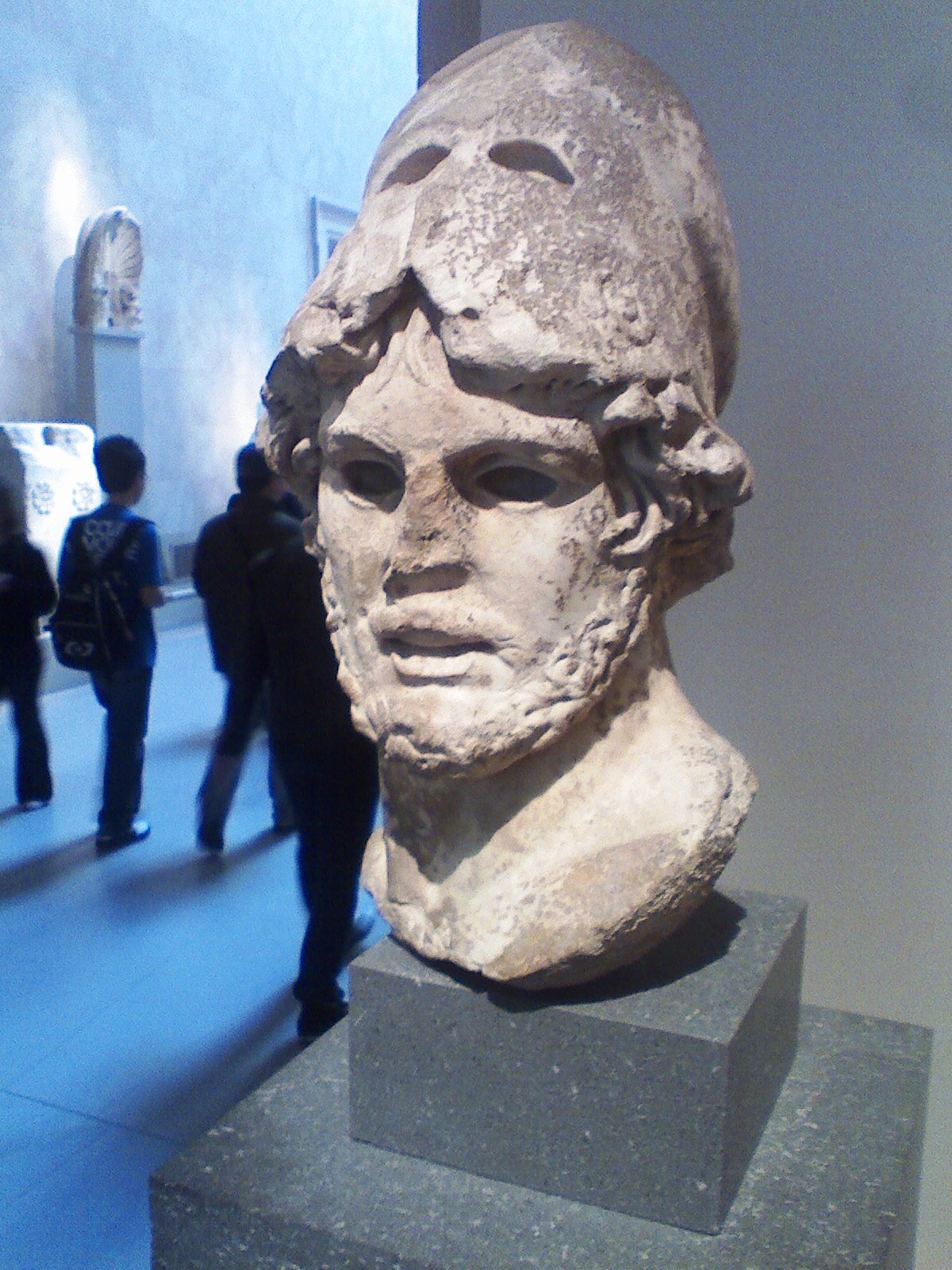
Thanks to Dellbabe, we have an impressive selection of helmets, with a few statues to boot.


Handouts

Handouts:

An odd thing to say during tax week: "No one I’ve met is looking for a handout" JWF reminds us of some of Obama's supporters, who very much were looking for a handout.

Yet what struck me about the line was something different: why would a tax refund be a "handout" in any case? I'll be getting a tax refund this year, partially because I paid withholding at a higher rate than proved to be necessary, and partially because we bought a house and were eligible for the tax credit associated with that.

In the first case, it's not a "handout," because the government is simply returning money of mine that they've held onto for a year or so, collecting the interest (which they will be keeping).

In the second case, it's not a handout, because the government is still returning my money. It's just decided, for policy reasons, that they might like to have me spend my money directly to help stabilize the housing market, rather than spending my money for me. All that money was paid by me into the fund, though, and they held onto it. If they send it back, it was mine to start with.

It's important to understand how this works, because this 'health care' business is going to work the same way. The government decided to make itself a party to my transaction, in order to make housing purchases more attractive. We bought the house back in the fall. The government will, they say, return the tax credit to me soon. So essentially I fronted the money twice: once to the government (in taxes), and once to the bank (for the house). The government held onto "their" portion of that money for another six months (collecting the interest!). Now presumably they'll consent to keep their part of the bargain by refunding "their part" of my money to me.

This was Dennis the Peasant's explanation of how your forced health insurance purchases will work. If you are in the income range to be eligible for government "assistance," it comes as a refundable tax credit. So, this is the deal:

1) You front the money, both by paying taxes and paying for the insurance.

2) Maybe we'll pay you back the tax part.

3) We keep the interest.

4) We kindly imply, on tax week, that we don't think you're "looking for a handout" by collecting your refund.

What a deal!

Politically Correct Stoics

Politically Correct Stoics:

In the opening pages of Dr. Lara Denis' "Kant's Conception of Virtue, we find an interesting account of the Stoic position on happiness.

No matter how poor, ill, or hated the virtuous person is, Stoics claimed she is happy.
I would love to see the citation for any Stoic writer who "claimed she" would be happy.

I understand that the idea behind this sort of locution, and I realize that it's probably the editors of the journal applying a "standard" to the author's text. Nevertheless, in the interest of making female readers feel good about being included, or perhaps making the point that women should always be included, they have introduced an inaccuracy into the text.

You might say that's a small thing, but philosophers have written papers over whether "London is pretty" and "Londres est jolie" can be said reliably to express the same belief. Not only does substituting "he" and "she" fail to express the same proposition, one of the propositions is true and the other is false.

Aside from the political correctness that bedevils academic writing these days, the piece is a good one; it offers a brief history of how the concept of "virtue" has evolved, at least as far as Kant. However, I think she misses the real truth about these different visions of virtue: they aimed at producing different kinds of people. Particularly with the ancients, it won't do to say that Aristotle thought X was virtuous, and St. Thomas Aquinas added Y to the concept. Aristotle was trying to create a man who was a Homeric hero, with a love of wisdom ("Cunning as the gods in council," as they said of Odysseus), personal courage, friendships and magnificence. St. Thomas Aquinas was ready to dispense with magnificence in the Homeric sense of the term, defined wisdom completely differently, and in addition added Christian charity (caritas), faith, and hope.

Sedition

Sedition:


'If the EPA gets no budget... if HHS gets no budget...'

Well, actually, that would be a revolution in and of itself.

Should we defend Israel?

Should We Defend Israel?

I don't mean, "Should America defend Israel?" with this question. It's plain enough, under this administration, that America won't.

What I mean is, should we? We remember the Abraham Lincoln Brigade and the Lafayette Escadrille: so we could consider the option of an independent military response by American fighting men, who act as free citizens without reference to our government.

Is this something we should consider? American Jews might well do so, for reasons of religion and community; but what of the rest of us? If so, why? If not, why not?

Benvenuto Cellini

Benvenuto Cellini:

I have a few more pictures of the Met, thanks to Dellbabe, that I will post up over the weekend. Today I wanted to put up something a little different. Italian artist Benvenuto Cellini produced some of that type of Renaissance sculpture that once fired the world's imagination. It combines heroic realism with the ancient myths, as in this statue of Perseus with the head of Medusa.


In addition to his sculpture, painting, and goldwork, he wrote an autobiography that an email group I read has been discussing this week. It's a fascinating piece, which has seventy-nine mentions of the word "sword" and fifteen more of "dagger," including here:

Walking with all haste, I passed the bridge of the Exchange, and went up along a wall beside the river which led to my lodging in the castle. I had just come to the Augustines—now this was a very perilous passage, and though it was only five hundred paces distant from my dwelling, yet the lodging in the castle being quite as far removed inside, no one could have heard my voice if I had shouted—when I saw four men with four swords in their hands advancing to attack me.
It's a remarkable piece, more like The Three Musketeers than any work of nonfiction. There are duels and murders, revenge and brawls, necromancers calling forth demons, vanished lovers. There is also a description of the business of making art, especially certain medals of steel that were desired by the Pope.
Go get 2 big mirrors.

Put them opposite one another.

Stand between them and look into one.

Seems to go on forever, right?

That's sort of the feeling I get when I read articles like this.

Music for a Thursday

Music for a Thursday:

Let's start with an interesting piece, not exactly like anything you'll probably have heard lately.


And now a Spanish piece:


Just right for spring, I'd say. Perhaps a cup of sangria would go with it, in the long afternoon.