DPRK Deal

DPRK Nuclear Deal: Good, Bad, or Ugly?

We notice today that the six-party talks, ongoing lo these several years, have produced a deal with North Korea to stand down somewhat from its nuclear ambitions. I'd like to examine the deal, look at where it is deficient, how it contrasts with the Clinton-era deal.

First, the details. I've highlighted the parts I think are important:

U.S. officials on Tuesday defended the Bush administration's policy shift on North Korea, which coincided with an agreement by Pyongyang to begin to close down its nuclear program.

North Korea now has 60 days to shut down its Yongbyon nuclear complex and readmit nuclear inspectors. In return, it will get 50,000 tons of fuel oil or financial aid of an equal amount.

Once Pyongyang takes additional steps to disable its nuclear program, including taking inventory of its plutonium stockpile, it will qualify for another 950,000 tons of fuel oil or equivalent aid, according to the terms of the deal. The aid package is worth $300 million.

North Korean state media reported that the agreement called only for a "temporary suspension" of Pyongyang's nuclear program, according to wire reports.

U.S. Secretary of State Condoleezza Rice drew a distinction between the first 60-day period, when she said nuclear activities will be suspended, and the later "disablement phase."

"The disabling of these facilities is a sign that the North Koreans may, in fact, be ready to make a strategic choice," she said at a briefing in Washington. "I will not take it as a complete sign until we've seen that disablement, but obviously disablement is an important step forward."
OK, let's dispense with the easiest of these first: North Korean state media's analysis is of no interest at all. Insofar as they differ from everyone else, it's just because they're lying to their own people. That's the usual system for the DPRK, so it's no surprise; it has no relevance to the actual deal.

Now, a more important matter: plutonium. As China E-Lobby points out, we've seen no public mention of the highly enriched uranium project -- the one that the DPRK hid from Clinton-administration officials. Insofar as this was the form of cheating they used before, it's odd that it's not prominently addressed. One might almost think that we were intentionally leaving them a loophole.

That's the main thing to watch going forward. These "nuclear inspectors" -- are they going to have access to the HEU sites, or just Yongbyon? That site depends on unenriched uranium, which can be reprocessed into plutonium. But the HEU can be used for nukes too.

If we don't see an answer to that question in the press ASAP, we'll want to start pressing our representatives to get an answer.

I'll take a moment to address John Bolton's objection.
"It sends exactly the wrong signal to would-be proliferators around the world: If you hold out long enough and wear down the State Department negotiators, eventually you get rewarded," said Bolton, who was also involved with North Korea earlier as the State Department's undersecretary for arms control.

"It makes the [Bush] administration look very weak at a time in Iraq and dealing with Iran it needs to look strong," he said.
I see his point, which isn't without merit. On the other hand, it also sends a signal to Iran that we're not going to have our attention divided. The DPRK matter will be set aside for the moment: that means we are free to focus our attention on Iraq and Iran. That ought to be somewhat intimidating.

Next: how does this compare with the Clinton-era deal? The answer is that it compares favorably, for one reason. Unlike the Clinton-era deal, this one is brokered by China. You are not required to believe in Chinese good-faith to see the value in this. The Chinese want to be taken seriously as a world power. They have considerable "face" invested in this deal. For the DPRK, cheating against the US is one thing, a thing that in fact has no real downside. Cheating against the US and China both is another.

That is not to say they won't do it. The DPRK is right up against the wall, and desperate people do desperate things. What I am saying is, when they break faith with the deal, we will be in a position to manage their downfall more effectively. Because China will be embarrassed by their bad faith, they will offer less support to the regime when the time for confrontation arises.

Where does all this leave us? The DPRK is off the "Axis of Evil" list for a few years. They will be salvaged from the collapse they so richly deserve; in return, we don't have to devote resources to managing that collapse until we've had time to deal with Iraq and Iran, and China will be forced into a more supportive position when the time comes that we do have to manage the collapse. Iran has to deal with our undivided attention for the next period.

I'd call it a deal that borders on good and ugly, if the HEU issue is considered in a form not yet in the press. If that issue is not considered, it's just ugly -- although there are a few good points to be had from it, it's mostly about pushing the problems down the road to let us deal with other problems now.

Spitting

More Spitting on Soldiers:

With an arrest, this time. This case will be one to watch.

Kids OK

The Kids are All Right:

Fuzzybear Lioness has a story from a waiting room filled with military children.

Four 5-and-6-year-old boys were playing with the giant, interlocking plastic tiles. They had created very-impressive plane-like structures, which some boys were obviously riding. Others were carefully placing large numbers of dinosaur figures into enclosed portions of the structures. I asked what they were doing, and received the following community reply as several boys pitched in to flesh out the story for me...
Those kids are going to turn out all right.
Video Blogging:

The rich media tools are not something I'll claim to understand. But all the same, here are two links you won't want to miss.

I'm still not going to vote for him, but this is the funniest thing I've seen in ages.

And this is the best thing to come from France since... Napoleon? Depends on your point of view, I guess. Dumas? Well, it's cool. Roman style, eh? Try it with six.

Horsemen!

The French Bluff:

Ahem. An article on a new French bestseller:

A distinguished French literary professor has become a surprise bestselling author by writing a book explaining how to wax intellectual about tomes that you have never actually read.

Pierre Baynard, 52, specialises in the link between literature and psychoanalysis, and says it is perfectly possible to bluff your way through a book that you have never read — especially if that conversation happens to be taking place with someone else who also hasn’t read it. All of which just goes to confirm what I’ve always thought about French academics, which is that mostly they are oversubsidised frauds.

Obviously I haven’t read Mr Baynard’s book; but it is in the spirit of his oeuvre that I shall proceed to write about it anyway.
And write he does, very well. I love the comment on Ulysses.

Open Letter Ladybug

An Open Letter on Border Security:

A Texas border schoolteacher who blogs under the name "Miss Ladybug" has composed an open letter to George Bush. She is alarmed by the lack of effort to secure the border, and mystified as well. You may wish to read her thoughts.

Bam!

Roughnecks v. Terrorists:

Michael Yon's piece on the Roughnecks is too good to summarize. But it's also too good to resist summarizing. 2-7 Cav payback for five soldiers killed in a Hummer earlier this week; night gunfighting; Kiowas and .50 cals. It's the kind of reporting that made him famous.

Interrogator's Nightmare

"An Iraq Interrogator's Nightmare"

This is an important piece to read. I'm not sure what to say about it yet, however; except one thing. This line, above all of it, strikes me:

I failed to disobey a meritless order, I failed to protect a prisoner in my custody, and I failed to uphold the standards of human decency.
It is not the first or the last part that concern me. A soldier has no right to consider whether an order is "meritless," but only whether it is illegal. However, this man was -- his biography says -- a contractor, who can of course refuse an order. He is free to go.

But this part of the line is important:
I failed to protect a prisoner in my custody.
That is a formulation that uses the language of honor. A failure of honor is serious.

The other two parts of the statement are statements of guilty feeling, without any formal standing in the law or in the military's code of honor. A contractor is not the one who is asked to decide whether or not an order is meritless, except for himself, with the remedy of leaving. Nor is he the one who decides whether or not the policy upholds the standards of human decency. That is done by the military, with the oversight of Congress to ensure that the People's common interests are upheld.

The man is saying he personally feels guilty about what he did. I am sorry that he is tormented. I have a genuine sympathy for any man who suffers as he says he does. But it is not at all unusual to find that you feel guilty about what you did in the war, any war; nor is it a reliable sign that anything is wrong. Sadly, it is entirely to be expected. He is far from the only man to suffer nightmares.

The middle part of his confession, though, is formally correct. It is therefore serious. A man who has custody of a prisoner does have a duty to protect him. If he fails in that duty, an answer must be given.

The 82nd will have to show that the conduct he claims he was ordered to perform either did not occur; or that it was not inconsistent with his duty to protect his prisoner. That is a point of honor, and the military cannot neglect those. I will await their word on the subject with interest.

Galt on Marcotte

Galt on Marcotte:

Jane Galt worries that the furor over the recent Marcotte business indicates an attempt to shut down religious criticism. She indicates that this isn't really a shifting of the national dialogue, but perhaps just an assertion of new power by the backcountry:

What the right is doing here is attempting to shift the Overton Window of Political Possibilities. The “window” is the space of acceptable ideas for political discourse. So, for instance, right now being either pro-choice or pro-life falls inside the window; it is mainstream and acceptable to hold either view. But being (say) pro-Nazi falls outside that window; being pro-Nazi means that you’ll get fired from political campaigns, because your views are that far outside of the window of accepted political views.

Should criticizing (and even making fun of) the political positions of the Catholic church, the Pope, and the conservative Christian movement be “within the window” of acceptable views? Or should criticizing the Pope — even on perfectly true grounds, such as pointing out that he supports pro-life and anti-gay policies — be outside the window of what it’s politically acceptable to say and to criticize?
I think this captures the essence of the argument, although I'm not sure that Amp is right about this being an attempt to shift it; my admittedly limited knowlege of Non-Coastal-Elite-America indicates that in most of the country, slagging off the Pope, or indeed making fun of religion qua religion, is mostly verboten.
Speaking as a proud member of the non-coastal non-elite, a backcountry North Georgia wearer of Stetson hats, I'd like to answer Ms. Galt's charge. Let's hear a few good religion jokes.

Q: How can you tell a Baptist from a Methodist?
A: A Methodist will share his beer with you.

Q: How can you tell a Presbyterian from either?
A: The Presbyterian will stop the church bus off at the liquor store if you ask him.

(That last one is really true, at least sometimes -- my father's church softball team would do so.)

Here's an audio recording from the Late Great Lewis Grizzard: Mama Wanted Me to Be A Preacher. You can enjoy not just the preacher jokes, but the pure Southern accent.

My favorite preacher joke:
One day a preacher was walking to church, when a local family passed him in their wagon. "Howdy, preacher!" the father called. "Want a ride?"

The preacher did, so they took him on in. The father asked, "What's the sermon going to be about today?"

"Fire and brimstone," the preacher answered. "I'm going to read 'em the Ten Commandments, first to last. I'm all fired up -- why, for the very reason you saw me walking today. Do you know that, in this very community, somebody stole my bicycle?"

"You don't say!" the father replied, and on in they went.

Sure enough, the preacher got up and started on his sermon. Suddenly in the middle of the Ten Commandments, though, he stopped right there, thanked everyone for coming, and sent them on home to dinner.

The farmer saw the preacher again later in the week, and he went over to ask him about it. "I thought you were going to do the fire and brimstone, all the way through?" he asked.

"Well, I was," the preacher said. "But then I got as far as 'Thou Shalt Not Commit Adultery,' and durn if I didn't I remember where my bicycle was."
That may have been a Grizzard joke too -- or one of my father's. :)

Joatmoaf had a good one the other day, about a preacher and a cowboy:
A Baptist Preacher was seated next to a cowboy on a flight to Texas.

After the plane took off, the cowboy asked for a whiskey and soda, which was brought and placed before him. The flight attendant then asked the preacher if he would like a drink.

Appalled, the preacher replied, "I'd rather be tied up and taken advantage of by women of ill-repute, than let liquor touch my lips."

The cowboy then handed his drink back to the attendant and said, "Me too. I didn't know we had a choice."
Then there was Jerry Clower's famous story (which I quote from memory):
Local Baptist boy married a Methodist girl. His daddy insisted she be baptized properly, not just sprinkled on top of the head like the Methodists do.

His son tried to convince the girl, but it was no good. So he came back to his daddy with a compromise. "What if she walked out into the water up to her knees?" he asked.

"That won't do, boy."

"And what if she went out with the preacher up to her neck, would that be good enough?"

"I won't stand for it," his father said. "It's got to be a real baptism if she's gonna marry into my house."

"Well," the boy said, "What if they went out in the water until just the top of her head stuck out?"

"No sir," his father replied.

The young man shook his head. "See, I knowed all the time it was just that spot on top of the head that counted."
And then there's the old folk song, "The Preacher and the Bear," my favorite version of which was done by Jerry Reed. The lyrics speak to a preacher's dilemma when faced with a grizzly bear who has also been given certain gifts. Atop the branches of a tree, the preacher shouts:
Hey Lord you delivered Daniel
from the bottom of the lion's den;
You delivered Jonah
from the belly of the whale and then
The Hebrew children from the fiery furnace,
so the good books do declare:

Hey Lord if you can't help me,
For goodness sake don't help that bear!
The point here is Chesterton's point about the pessimist. Marcotte doesn't get into trouble for criticizing religion; she gets in trouble because she doesn't love the thing she criticizes.

She's not required to, of course, but that's where her trouble arises. It's not the humor. It's the hatred.

Good Reads

Good Reading Today:

Bill Roggio has had two excellent and informative pieces this week: On "the snake eater," an intelligence system that BlackFive refers to as "like S.C.M.O.D.S." Bill was one of the people who got it off the ground -- a clear example of a citizen making something happen, along with our old friends at Spirit of America and others. The Belmont Club has further thoughts.

Bill's second good piece is on Al Qaeda's anti-air teams, who have managed to take down several US and Blackwater choppers.

Kim du Toit penned a good piece on the importance of fighting your own battles. The idea that the police are the ones charged with protecting you and enforcing the law is poison to the individual and to society at large. Those are common duties of all citizens, for which we should be prepared.

Finally, Claudia Rosett has a piece on how the Voice of America speaks for Iran. Apparently we've had this trouble with some of our other propaganda efforts, too.

Middle Ground

Middle Ground on the Fetus/Child Question:

Today's story out of Texas strikes me as one of those things that is so sensible that it's shocking to see the government have anything to do with it. Surely it's the influence of the jury, plus the fact that we're talking about Texas.

A former youth pastor was sentenced to death Wednesday for killing a teenager and her fetus in what is believed to be the first such order in Texas, the nation's busiest death penalty state.

Adrian Estrada, 23, was convicted Friday of one count of capital murder for the death of Stephanie Sanchez and the fetus, of which he was the father.
The Texas law in question may be objectionable to many -- whether a fetus is a person is a metaphysical position, and therefore subjective, as Joseph and I have been discussing. Regardless of which, it allows them to address this particular crime:
Sanchez, 17, was three months pregnant Dec. 12, 2005, when her body was found in her family's home. She had been choked and stabbed 13 times. During the trial, DNA evidence was presented to show Estrada was the father.

Estrada, a former youth pastor for a church, admitted to the stabbing the day after the killings. Prosecutors also said he worked out at a gym and went shopping after the crime. He showed no emotion when his punishment was read.
It's hard to argue against the idea that a man who tries to get out of fatherhood by murdering his pregnant girlfriend ought to hang. Unless you're opposed to the death penalty itself -- personally, I think we ought to use it much more widely than we do -- this surely is a matter in which the penalty ought to apply.

I gather that the man here has been convicted of a single count of capital murder. As I understand it, capital murder requires that you commit murder while also committing a separate felony -- shooting a guy while robbing his store, for example. (This understanding arise from Georgia law, however; Texas readers, shout out of I've misread the situation re: Texas law.)

Thus, the reason the death penalty can apply here is because there are two separate crimes: killing the mother, and killing the child. That's one count of murder, and another, separate count of murder comitted while in the process of committing the first murder. That allows you to go to the death penalty, which is what is deserved.

Surely, whether you agree that a fetus is a child or not, we can all agree that this is the right result -- Quakers and other anti-death penalty theorists aside.

Of course, his defense attorney has a right to be heard too:
Estrada's attorney, Suzanne Kramer, had argued that her client made bad decisions.

"It that enough to execute him? Is that enough to kill him?" she asked the jury.
Yes, it is. Next case.

UPDATE: In the comments, Joe points out that I have confused "capital murder" with "felony murder." I regret the error, which I shall blame on insufficient coffee at the time of writing. :)

Heresy: Environment, Holocaust, etc

Modern Heresies:

Frank Furedi has a piece in Spiked Online defending free thought from what he calls "modern inquisitions." It began with the campaign to squash Holocaust denial, and perhaps if it had stopped there, everything would have been fine. It didn't:

At a time when moralists find it difficult clearly to differentiate between right and wrong, they are forced to find some other way to draw the line between acceptable and unacceptable behaviour. So they seize examples of unambiguous evil – paedophilia, the Holocaust, pollution – in order to define potential moral transgression. Today’s heresy hunters strive to construct new taboos....

The Holocaust has been transformed into an all-purpose moral metaphor adopted by a variety of special interest campaigns and crusades. This Holocaust brand has been co-opted for other experiences, too; we now hear debates about the African-American Holocaust, the Serbian Holocaust, the Bosnian Holocaust, the Rwandan Holocaust. Anti-abortionist crusaders protest about the ‘Holocaust of fetuses’ and animal rights activists denounce the ‘Holocaust of seals’ in Canada. Such manipulation of the Holocaust metaphor turns an historic tragedy into a caricature. Many US Jews were angered when an animal rights organisation launched a campaign that compared the slaughter of livestock to the murder of Jews in the Holocaust. A campaign exhibition, called ‘Holocaust on Your Plate’, juxtaposed images of people in concentration camps with pictures of animals in pens.

Many co-opt the Holocaust brand to win legitimacy and backing for their campaigns. And they insist that anyone who questions their version of events should be treated in a manner similar to those who deny the real Holocaust. ‘Do Armenian citizens of France not deserve the same protection as their Jewish compatriots?’, asked an advocate of criminalising the denial of the Armenian genocide of 1915 (5). In the past two decades, accusing someone of denial has become the twenty-first-century equivalent of labelling them a heretic. Those who deny the claims of fashionable campaigners and causes can expect to be censored and treated with intolerance. Following the precedent set by laws against Holocaust denial, the French National Assembly passed a law in October last year that could sentence to a year’s imprisonment anyone who denies the Armenian genocide.

The act of denial has been transformed into a generic evil. This is clear in the way that the stigmatisation of denial has leapt from the realm of historic controversies over genocides to other areas of debate. Denial has become a kind of free-floating blasphemy, which can attach itself to a variety of issues and problems. One environmentalist writer argues that the ‘language of “climate change”, “global warming”, “human impacts” and “adaptation” are themselves a form of denial familiar from other forms of human rights abuse’ (6). It seems that some people can no longer tell what a difference in opinion looks like – it’s all just ‘denial’.

The charge of denial has become a secular form of blasphemy. A book written by an author who is sceptical of today’s prevailing environmentalist wisdom was dismissed with the words: ‘The text employs the strategy of those who, for example, argue that gay men aren’t dying of AIDS, that Jews weren’t singled out by the Nazis for extermination, and so on.’ (7) This forced association of three highly charged issues – pollution, AIDS, the Nazi Holocaust against the Jews – shows how denial has become an all-purpose blasphemy.
It's a good piece, one that explores each of these ideas in greater depth -- and gives special attention, at the end, to serious questions about the real problem of Holocaust denial. It is, as he said at the beginning, a clear example of bad behavior; but should we therefore shut down free speech?

My sense has always been that we should let people hold to what they will, and let evidence and argument sort it out. It seems to me that there's no advantage to criminalizing Holocaust denial, for example, because it is readily disproven. Thus, someone who insists on cleaving to it discredits himself except with those who wish likewise to believe the claim.

There are problems arising from criminalizing the act of Holocaust denial, too, several of which the author considers at length. But here is one more: if they are free to speak their minds, Holocaust deniers will normally tell you who they are. Particularly for a Europe worried about resurgent fascist movements, this is a real advantage. It's easier to keep a head count if everyone you want to count is ready to stand up and wave.

PJM Specials

Specials Today: Islamic Angels Have No Free Will

Salim Mansur writes at PJM a piece called "The Cool Water of the Koran." It is meant to respond to some critics of Islam who have suggested that the trouble lies in the Koran itself; Salim Mansur disagrees.

One thing I found fascinating in his piece was the Islamic version of the "free will" argument:

The Koran instructs individuals to choose the right path. Because human beings, in contrast to angels and all other members of God’s creation, are endowed with free will it instructs them to choose among alternatives. It is in our freedom to choose we become fully human, and freedom means responsibility and accountability for choices made and acts committed. The Koran reminds us over and over again that we are responsible for the consequences of our conduct.
This is something new to me. I can see how someone could believe that "lower life forms" such as paramecia lacked free will; I'm not clear how anyone could believe a dog does -- or, as dogs are said to be unpopular among many devout Muslims, a cat. Indeed, it's especially hard to believe a cat has no free will.

But an angel? This is a real oddity. In every other system I know that believes in beings higher than men, those beings that are closer to god/truth/etc are freer than lower beings. There is a hierarchy of free will and awareness, that runs through paramecia to dogs and cats and people and on to the higher beings, whether they are gods or angels or beings of light -- or demons.

Indeed, in Christian belief, it is the wrongful expression of that will that caused the greatest of angels to fall and become the worst of devils. I'm told that Islam likewise believes in an idea of Satan, or Shaitan, so I wondered what they made of him. Here it is:
In Islam, Allah created everything in pairs. The pair for a human is a jinn, two beings of higher intelligence created with free will....

Iblis was of jinn race and was supposedly a devoted servant of Allah. He attained a very high status and was brought close with the Angels. But Allah knew Iblis well and the intentions of Iblis and therefore the Shayṭān was named Iblis (meaning "desperate"). The angels do not have free will and do not sin, because they do not know how to sin. When Allah created human, Allah commanded all the angels to prostrate (sujood) to Adam and his people. All angels did so, except Iblis, who refused Allah's direct command.

Iblis was proud and considered himself superior to Adam, since Adam was made from clay and Iblis was created from smokeless fire. For this act of disobedience, Allah cursed the Shayṭān to the Lake of Fire for eternity, but gave the Shayṭān the respite till the Day of Judgment at his request.
So we have an intermediate class, so to speak, of creatures: "jinn," who are lower than angels but who have free will like men.

That doesn't explain away the question of the angels, though. It's fascinating that Islam -- alone, as far as I know, among religions -- considers that it is possible to be a "higher" being but lack free will. What would it mean to be "higher," if it doesn't mean what it means for every other religion: to be more aware, and freer? It points to the Islamic ideal, I suppose: perfect submission to Allah.

The extinction of free will then would be a positive good. The death of knowledge would be good, if it meant that you would "no longer know how to sin."

I must admit that I don't feel better about the Koran after reading this piece. I do thank the author, however, for what was obviously intended as a kind and enlightening effort.

Tech Note

Tech Notes:

I saw once when I loaded the blog today a warning that it wants to install some sort of "Microsoft Data Access" product. I assume this is a New Blogger thing, but I don't know anything about it. So, if your browser asks you if you "trust this website," don't let any trust you might have in me influence your decision. I've got no idea what it is they want you to have on your computer, or why they want it there.

Please note the PJM Straw Poll thing on the sidebar. You're (obviously) not obligated to take part, but if you want to, I put up a link.

Horses I Have Known III

Horses I Have Known, III:

This short series has gotten a good response, so I suppose I'll continue it occasionally. Cassandra (who is on vacation) wanted me to do one of these posts for the benefit of her readers, so it will be cross-posted both at Grim's Hall and Villainous Company.

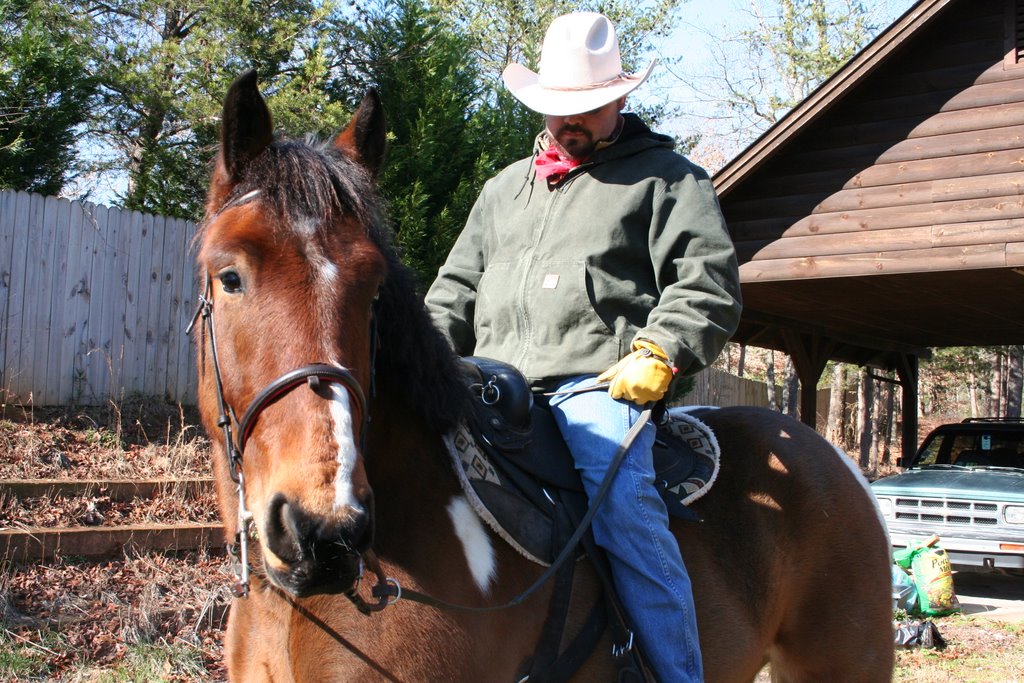
Here we have another draft horse, a Belgian cross named for the paragon of ladies, Odysseus' wife Penelope:

Her namesake was capable of some deception, but our Penelope is without guile. She is a sweet horse, very happy to have affection but in no way pushy. You can tell how well behaved she is by looking at the bridle: she requires the least tack of any horse I know, except for Celtic, who was sold last month.

In spite of her size, Penelope can get up to a good speed at the canter. Her trot is rough to ride, but the canter is quite smooth. She is a little bit lazy compared to non-coldbloods, but for a draft horse she's not sluggish.

She's been clipped, so she has to wear a blanket in cold weather even though the breed is well-adapted to far colder climates than Georgia. You can see what her regular winter coat would look like, though, on her unclipped legs. The long hair down the leg is called 'feathering.' Note the well-sculpted, thick and powerful muscles in her neck.


Penelope can get up to a good speed, I said, for a draft horse. If you really want to cover ground, though, what you want is a gaited horse (scroll down to "ambling"). This little fellow is a Tennesee Walking Horse, in a pinto pattern called Tobiano. His name is Doc.


Doc's only fault as a horse is that he doesn't like to stand still (though he is quite relaxed here, as evident by his cocked leg and easy ears). What he does like to do is run. Tennessee Walkers are famous for their very smooth "running walk," and Doc has a nice one, but what he wants to do is running run. Even that, though, is tremendously smooth compared to, say, Penelope's nice canter.

Doc's a fully-trained horse, and needs nothing from me except a companion to take him out. His owner, a nice older lady, enjoys him for the smoothness of his gait. She doesn't want to run, and he does. So, she has me exercise him late in the week, so he can get the running he wants to do out of his system. Then, when she has time to ride him on the weekend, he is not quite so tempted to take off with her.

I'm happy to do it. He's a pleasure.

Brain Trust

Brain Trust:

The Washington Post has a good article on 'officers with PhDs' forming around Petraeus. It includes David Kilcullen, the author of the concept of "disaggregation."

Good to see.

PeaceMaker Review - Part 3

PeaceMaker Review - Part 3

In part 1, I discussed the game as a game; in part 2 I talked about the limitations. I ought to say something about lessons a person could learn by reflecting on this game. None of this is particularly profound.

One lesson is a lesson of sympathy for elected leaders generally, especially in bad situations. The initial response to anything you do is almost always a speech or protest by someone who hates you for doing it; and the people on both sides will gratuitously protest against you now and again. You receive lots of blame for things you can't possibly control. And the worst thing you can do is try to react to all these protests on a turn-by-turn basis...you'll be accused of vascillating, and your ratings will plunge. The game is simple (a good thing for playability), so you aren't hit with information overload, endless reports and lots of pestering from advisors - but what you get is quite frustrating enough. Almost never will you see a news story about someone who likes you - not until you are getting close to victory. It must be even worse for an extrovert (who might actually like campaigning to get the office in the first place). Sometimes we seem to give our elected leaders all the responsibility, but none of the respect, of pharaohs and God-kings. It's good to keep our ideas of what they can do realistic, especially when they are checked by voters and legislative process.

Another is the importance of resolution. The game itself, in tutorial mode, gives you this hint. You have a long term goal that requires repeated actions (such as increasing police action against militants); you've got angry protestors calling on you to do the opposite; if you react to the protestors instead of staying the course, you're hanging yourself. You might have to moderate your pace, and alternate one goal with another, but you have to keep to your goals. In cruder computer games, a news story about public opinion would be a clue that you needed to act immediately; in this one, it may be better ignored. Perhaps a player could remember not to be too distracted by the story of the day, nor judge events too superficially based on the headlines.

Another thing is something I referred to in part 2. At some times and in some places, the fate of millions rests in the hands of a few. Here, in the game and in reality, the fate of millions seems to rest in the hands of the millions themselves. It is the attitudes common in quite a large population that have to change in order for peace to "ensue." In Iraq, as of last year's opinion polls, only a tiny minority supported Tawheed Wa'al-Jihad (a/k/a al-Qaida in Iraq), yet it wasn't hard to see how much trouble they could cause - now take the problem to a country where a majority voted for Hamas. We aren't in a situation that can be saved by a few great men in a few months or years.

As I said, nothing profound, but these were my thoughts when I played. Earlier this evening I tried the hardest levels (= highest level of violence) and got pretty badly creamed, so I may not have understood the winning strategies as well as I thought, or else the designers didn't expect the game always to be winnable when the militants were too numerous and too active. If so, that may be the most realistic aspect of the game. If not, well, imagine the level of violence a little bit higher, and the game would most definitely be unwinnable within the strictures it sets. That's more insight than many commentators bring to the issue. So, at least, a tip of the hat to the designers of this game. And a low bow, and profuse thanks, to Grim, for inviting me to play and write.

PeaceMaker Review - Part 2

PeaceMaker Review - Part 2

The developers made no secret of their hope that the game could encourage partisans to see each other's points of view, and so encourage some changes in attitude. To that end, the game is available in Hebrew and Arabic. I fear this hope is in vain.

The problem with modeling the conflict as a computer game is obvious: the result is only as convincing as the assumptions that went into the program. The assumption that the game is winnable means that one side could make the right solutions - and peace would follow. (Actually, most Americans who are partisan on this conflict believe that; they just disagree on which side needs to stop being so unreasonable. If you are a partisan, you'll actually be more comfortable playing the opposite side.)

Related to this is the assumption that both populations - Israeli, Palestinian - are ready, or close to ready, for peace. I like the fact that, if you're playing Israel, you have to help the Palestinian economy to reach your destination. That is a sound strategic lesson. But the timing has to be right. One of my favorite books is Liddell Hart's biography of Scipio Africanus, maybe the finest strategist ever. When Scipio's opponents were exhausted from fighting and ready to make peace, he was famously magnanimous (especially for his time) - and the result was that when he subjugated Spain, it stayed subjugated; and Carthage had an excellent chance of staying at peace as a Roman satellite (it did for generations, and could've forever). He displayed the same insight in dealing with a mutiny early in his career: enough fear and executions to cow the bulk of the troops, then magnaminity and back pay.

This, however, is a lesson we do not need this game for. It is commonly drawn from the peace settlements of the two World Wars (in fact, Liddell Hart, who was writing between the wars, drew it out in the book on Scipio). Once the enemy is down, you cut his throat or help him to his feet; kicking him makes future trouble. However, for this to work, the enemy has to be down, in the sense that he is exhausted, beaten, or for some other reason ready to give up whatever made him want to keep fighting. Every enemy proclaims and believes that he is ready to fight to the death, right up until he decides he isn't. The game is assuming that the Palestinian Arabs are already there or else can never get there. Now there are many who draw the opposite lesson from the election of Hamas (their charter is quite hostile to the existence of Israel; see Article 11 especially). The game doesn't gloss over the miltant nature of Hamas - if you're the PA, Hamas is always ready to denounce your peace initiatives and make a few inflammatory statements to send your numbers south - but it does appear to assume that most of the Palestinian population does not have strong sympathy with Hamas and will, with a little prosperity, reject them.

Israel does not really have a military option in this game - the "send troops" button might as well be labeled "lose the game now" - yet some Israeli partisans argue that the bloody fighting that ends the game at -50 is actually needed before economic buildups, humanitarian assistance, peaceful rhetoric, and internationally-brokered deals can bring a lasting peace. And some Palestinian partisans argue that Israel has been conducting unrestrained warfare for decades, a view that I can't agree with. This game will not change a partisan's mind on that issue. The lessons I have been repeating here are commonplace, and someone who walks in with those views won't walk out with different ones. Someone who agrees with the game's hidden premises will be delighted to see them confirmed, but that won't inspire a change of heart, which the designers seem to be hoping for.

Part 3 will come this evening - and will discuss some salutary lessons that I think the game can teach.

PeaceMaker Review - Part 1

Peacemaker Review - Part 1

Hello, all - I'm that long-winded infidel character you may have seen in comments around here. Grim recently received an invitation to play a new computer game, and proclaim its vices and virtues in this Hall. He has done me the honor of handing this task to me, and I hope to give satisfaction.

The game is called PeaceMaker, and it is a short strategy game based on the Israel-Palestine conflict. I intend to review it in three parts: first to discuss it as a game, then to discuss its limitations as a model of a real conflict, then to talk about the useful lessons that it can teach. Before I proceed, there are two things you should know:

1 - There is already an excellent review from a gamer's standpoint at Gamasutra. I will not be so thorough.

2 - I have to tell you: I played the game several times, but I didn't pay a penny for it; I received it as a free download. If you decide to buy it, you must pay $20. And the company that made it, Impact Games, plies its wares on the Pajamas Media network.

Now, on to the game aspects -

PeaceMaker is a turn-based strategy game; a single game takes 1-2 hours (if you're slow like me). You can play as either the Israeli Prime Minister or the President of the Palestinian Authority. The game tracks two vital opinion scores that start at zero: what the Palestinian population thinks of you, and what one other group thinks of you (the Israeli population if you're Israel, the "world community" if you're Palestine). If both scores reach 100, then Israel and Palestine reach a two-state solution, and you win a Nobel Peace Prize and the game. If both fall below -50, a "third intifada" sweeps the land and you lose. If the opinion of the people who elected you (Palestinians if you're PA, Israelis if you're Israel) falls well below -50, you are removed from office and you lose. The game also tracks the opinions of other entities (the UN, the US, Jewish settlers, Arab militants, etc.) and polls that measure your performance in different areas -- such as economy (Palestine), leadership (Israel), or security (both).

There's a medium-sized list of actions that you can take. Every turn, you click on one action. It has its result - including any effect on the opinion scores - then random events occur (if they do), and it's the next turn. The available actions depend on which side you're on: they include security actions, like sending in the Army (Israel) or training the police (Palestine); political actions like making speeches to the world community (either side) or asking the UN for foreign aid (Palestine); and economic actions like offering medical care to the Palestinians (Israel) or asking the EU to fund agricultural projects (Palestine). Some of the actions Should Never Be Taken.

As noted in the Gamasutra article, the results are not as simple as you might expect. If you're Israel, a suicide bomber strikes, and you send in the Army, your Israeli popularity will go up a little bit - but your PA popularity will go down a lot, and as a result there will be more attacks, which will lower your Israeli popularity, and the situation spirals. The temptation is to play see-saw-Margery-Daw, doing something tough to please the Israelis, then making a conciliatory gesture to please the Palestinians, then getting tough again. But the non-player entities see through that and it doesn't help you at all. You can find the right strategies with a little experience.

I played the game without a manual, and believe it should be sold that way (there is a tutorial to show you basic gameplay mechanics). Part of the game's appeal is the way you flail at first, looking for anything that'll fix your numbers quickly. If the designers tell you what effects the actions will have up front, the game is reduced to a pointless exercise. Of course, this means some of my statements about how the game works may be in error; I am going by how it looked to me when I played it, and not by any documentation.

The game is intended to be educational. At the beginning, you can click on a "timeline" of major events in the Israel-Palestine conflict. It's written in very neutral language: "1948: Israel declares independence and the first Arab-Israeli war ensues," or, "1968-80: Jewish settlements emerge in the West Bank and Gaza." (As if no human choices were involved in these acts...) There's a map, and you can click on the cities to see their populations and little notes about their significance, but the map has no effect on gameplay; every action you take is "nationwide."

To be blunt, if you're looking for a strategy game to play just for fun, this one is not for you. It has very little replay value. Once you have figured out the right basic strategies, there is little pleasure in repeating them. There are higher levels of difficulty, based on how often bad random events happen, but by the time you play those levels you know how to beat the game. Unlike other strategy games, this one doesn't let you see the things you're building, count the money you're making, or watch your tactical plan come together. Given the frustrations and the educational nature, this game could actually be used as punishment for a difficult adolescent - stay in detention 'til you beat PeaceMaker on Tense level, and then there's a short quiz on the Israel-Palestine conflict.

Other notes: The game is highly accelerative. Once you get the scores above 50, attacks have fallen off so much that the rest of the game is a breeze; conversely, if they fall below -25, you might as well restart the game. Thus, the hardest part of the game is easily the beginning. It can be frustrating - you get the numbers to creep up to 11 and 6, a suicide bomber strikes and makes them fall to 4 and -2, you get them to creep up again, there's an atrocity and they fall...but once the numbers get well above zero, you can notice how much easier it's getting.

You don't see how much money you have - the PA does have an "Economy bar" - but the economic side of the game is important.

I respectfully disagree with the Gamasutra reviewer on one thing: I thought the Palestinian side was the easier one to play. This may be because the right actions were more obvious to me.

The remainder of my review will focus on the strategic and moral sides of the game, and what it can and can't teach.

Superbowl notes

Superbowl: First Half

Indiana is stomping Chicago so far, in spite of all the turnovers, in spite of the fact that Chicago was the only one to make a score on a turnover, and in spite of the fact that the opening runback basically spotted Chicago 6 points. The Bears -- for whom I'm rooting -- had best get their act together over halftime. That whole "run the ball at them until the defense wears out" only works if you don't go 3-and-out every time.

Whose idea was it to put Prince in the halftime show?

Commercials seem weak this year. I think Budweiser's are all right, but the others... mostly off.

UPDATE: Oh, except that Gina Torres -- Firefly's Zoe -- was in one of the Sierra Mist commercials (the one in the dojo). Nice to see she's working, though I am sure we all wish she had a different project.

Selfish Punks

Those Selfish Punks:

The Independent in the UK has a story today called, "Generation Y Speaks: it's all us, us, us." Yeah, those young people, only thinking of themselves. Let's see what they want now:

Michelle Harrison, director of HeadlightVision, part of the Henley Centre, said: “In 1997, when Tony Blair moved into No 10, almost 70% of our respondents opted for the ‘community-first’ approach.”

“This held steady for the first couple of Blair years but by 1999 individualism was on the rise. At face value, it seems that last year (when individualists outnumbered community-firsts) we formally fell out of love with the Blair project. Over the decade we have seen a fast-moving shift towards people feeling more individualistic.”

Today, 52% feel “looking after ourselves” will best improve the quality of life, according to the poll of more than 2,000 people.
Wait... so what they want is to be left alone? To take responsibility for their own lives?

Hallelujah!

It's stronger among the poor, too, the ones who need it most:
Among poorer people in the social brackets C2, D and E, that rises to 60%. “Poorer people . . . gave up on the Blair project five years ago . . . Less affluent people . . . are focusing on making ends meet and avoiding hassle on the streets in their less ‘desirable’ neighbourhoods,” said Harrison.
"Avoiding hassle on the streets" is a euphemism for "avoiding rape, robbery, and other violence."

Now, what's a good individualist way of approaching that problem? Anyone? Hint: it used to be a prominent feature of English life, before the "community first" folks made their communities into places where all prey will be safely disarmed.

Happy Superbowl

Happy Superbowl Sunday:

I'll be taking off the evening to watch the game with my father. I'd like to take a moment to point to a couple of things.

First, Joseph W. -- who has been debating with me for a week or so on the issues of souls and metaphysics -- has offered to review the Peacemakers game mentioned below. I've invited him to join the Hall as a co-blogger for that purpose, and also because I like arguing with him.

Michael Yon has given an interview to PJM from Mosul, where he is embedded with the 2/7 Cav -- Custer's old unit, most famous in Iraq for its role in the second battle of Fallujah.

PJM has also started a JetBusters site, to try and shut down production and use of private jets. This is InstaPundit's idea as a means of fighting carbon emissions.

I always wanted to own a private plane myself, although not a jet -- one of those bush planes that would let you fly into the Alaskan backcountry and land on a lake. My sense about the science involved is close to InstaPundit's, though. I don't put a lot of faith in the UN's appointed groups, and having read a lot of the science myself, I don't find that I'm convinced that there is nearly as much "consensus" as the press suggests. However, I have other reasons for wanting energy independence and lower carbon emissions that have nothing to do with whether Global Warming is genuinely menacing or human-caused.

So, I'm broadly open to a lot of "green" measures, even if my reasons for it are different from those of the people who proposed the ideas. In addition, I am a genuine conservationist, who would love to see a larger amount of wild land and low-impact land in America (open, however, to public travel and hunting and fishing in managed ways -- I'm a conservationist, not an evironmentalist). However, I do have two basic concerns:

1) Not trampling on peoples' rights, and,

2) Not doing damage to the economy.

The very first commenter at PJM points out that GulfStream is a major employer in Savannah, a town which (in my experience) depends on major employers. If you recommend banning their product, you'll put them in quite a bind. That seems like the wrong approach to me.

What might be a right approach is paying them more to produce something else -- perhaps replacement parts for military aircraft. Thoughts?

NASCAR Notes

Saturday Notes:

For NASCAR fans out there, I saw Bill Elliot at lunch. I was eating with my father at the Dawsonville Pool Room, and Elliot came in and had a bite too. He sat right under a portrait of himself, painted in the days when he was "Awesome Bill from Dawsonville," or "Million Dollar Bill" after the Winston Cup victory. Of course, it would have been hard for him to sit anywhere in that place that wasn't near a picture of himself.

Nice guy. Dawsonville is a small town, so no fuss was made about him being there -- everybody knows most everybody, including Bill. He used to sell cars up here, too, and several of the people will have bought a Ford from him.

Another note: Captain's Quarters had a good post on George Soros' comments at Davos.

He went on to say that Turkey and Japan are still hurt by a reluctance to admit to dark parts of their history, and contrasted that reluctance to Germany's rejection of its Nazi-era past. "America needs to follow the policies it has introduced in Germany," Soros said. "We have to go through a certain de-Nazification process."
This is highly inflammatory and, quite frankly, anti-American. We do not purge people from the political process here. We use elections and free speech to determine the policies the nation wants implemented, and we elect our leaders on the basis of a free and unfettered franchise. Equating Republicans to Nazis and then suggesting that the government impose a process to exclude them from public office makes Soros much more of a fascist than anything he decries.
CQ notes that Obama has been Soros' favorite prospective '08 candidate, and looks for a repudiation of this idea. It would be nice, though I wouldn't expect it, given how much money there is to be had from remaining Soros' favorite.

I still think Bill Richardson is the best in the Democratic field so far. By the way, the second week of that PJM Straw Poll is ongoing. Grim's Hall is standing for Richardson on the D side, and Duncan Hunter on the R side.

Also, you'll sometimes see ads on the sidebar for a new video game that tries to simulate a political peacemaking process for the Israel-Palestine conflict. Grim's Hall has been offered an evaluation copy, should we wish to review it. If any of my co-bloggers would like to have a go, drop me a line and I'll arrange it. I'm a little curious about it, but Israel/Palestine has never been one of my areas of interest. Another of you could probably do a better job of telling if it model the conflict well.

Weirdness

Weirdness:

Fuzzy has tagged me with a meme called "Six Weird Things." I'm a little bemused by it.

"Post 6 weird things about yourself and tag 6 people. Leave a comment on their blogs to let them know they're tagged."

Well, I never pass these things on, though as always, anyone who reads here is welcome to play in the comments.

Usually, though, I at least know what to say. In this case, though, I'm being asked what makes me unusual. There are probably only two kinds of replies to make: things you already know ("Grim has a particular fondness for Stetson hats and bowie knives"), and things that are none of your business (thanks aye).

So, rather than bore you by repeating things about myself you already know, I'll invite you to post your favorite weird things about me in the comments. I'd appreciate some gentleness in how you phrase it. :)

Pundits

Molly Ivins died on Wednesday, same day Grim posted about that idiot Arkin.

When I arrived home from night classes, I kissed the three kiddoes goodnight (Kaitlin, Emily, and Barrett), walked my two dogs (a Chocolate Lab named Belle and a Great Dane named Max), tried to entice the dogs to eat my wife's cat, and settled in for another hour of hitting the books. Finally, bedtime rolled around so I turned on the news and I crawled into bed and it was then that I heard the good news. For those who have seen 'Boondock Saints', I did the William DaFoe 'river dance' jig and then crawled back into bed.

I've heard that it's necessary to have the extreme ends of both sides in order to better gauge the middle-ground. I don't know if I believe that or not; what I do believe is this lovely piece of gnomic wisdom from the Bubbamal translation of the Havamal:

Bubbamal 22.
And let me tell you about them idiots
who're always laughin' like hyeeners at stupid shit;
they ought to realize that they ain't exactly prizes,
but they ain't figured that one out yet.

I lament the fact that it is only going to get worse as the days wear on.

Election Fraud

Election Fraud:

Feeling bad about how little trust there is in our elections? Read this, which features famous gunfighter Johnny Ringo in the role of Democratic Party delegate and election official:

Almost every election in the post-Civil War era held the fervor of a religious crusade, and the first Tuesday in November of 1880 caused high fever in the West. Republican James Garfield [Who was later assassinated... -Grim] and Democrat Winfield Hancock battled for the presidency, while Pima County [Arizona]'s most contested race centered on Bob Paul's bid to unseat Sherriff Charile Shibell. Garfield won the presidency by fewer than 10,000 popularvotes.... The race in Pima County proved even more complex. Democrat Shibell, despite appointing Wyatt Earp as his Tombstone district deputy, was perceived as more an administrator than a tough lawman and received the support of the [outlaw gang known as the] cowboys. Oddly, outlaw John Ringo served as a delegate at the Pima County Democratic convention despite a question of his legitimacy because he had no legal residence. The Democrats chose to avoid problems and seat Ringo [shades of The Man Who Shot Liberty Valance, there]....

Shibell won reelection by a close margin as rumors ran through town of massive election fraud. The San Simon Cienega precinct recorded 103 votes for Shibell and one for Paul, in a district that had no more than 50 eligible voters. All but one of the 23 Democrats on the ticket received those 103 votes... while nearly all the Republican candidates polled only one vote each. The [Tombstone] Epitaph noted: "The odd vote is said to have een cast by a Texas cowboy, who when questioned as to why he was voting the Republican ticket, said: 'Well, I want to show those fellows that there wasn't any intimidation at this precinct.'"

From Casey Tefertiller's Wyatt Earp: The Life Behind the Legend, p. 53-4. Election fraud on the frontier... but of course, we know it was better in the cities. Ha ha!

Well, out of such things is democracy made. Maybe it will make you feel better about the current situation -- or even the problems in Iraq, where democracy is having a similarly rough start amid armed and dangerous factions.

CFR Thailand

CFR on Thailand:

The Council on Foreign Relations has a new fact sheet on the Thai insurgency. I appreciate people trying to make the complex nature of the insurgency easy to understand, and for the most part this is a good primer. On the other hand, there's this:

Why isn’t the new government’s approach working to end the insurgency?

Experts say Thaksin's stance set in motion a rise in bloodshed that will take time to control. "Once the spiral of violence starts it is difficult to stop," says Croissant. Liow predicts "the problem will get worse before it gets better" and that Thaksin's policy mistakes "set the government behind several decades in terms of critical intelligence gathering" necessary for effective counterinsurgency operations.
What? You stage a military coup against an elected government and suddenly you get "decades" before you have to prove effectiveness in your COIN activities? Maybe we should revisit that Arkin idea after all...

Seriously, guys, that's not helpful. The military coup in Thailand seems to have had the backing of the palace, which is a reasonable source for legitimacy -- the monarchy in Thailand is not only widely beloved, but has produced monarchs of the sort you really might want to follow, including the current one. Cutting them "decades" of slack, however, is too much. Ultimately, if you just want to say that the King's people were right to back the overthrow of the democracy, just say it.

Trunk Monkey

The Trunk Monkey:

I know it sounds odd, but I have seen nothing lately so encouraging about the good sense of the American people than this ad. That is, of course, precisely right.

Arkin II

Arkin II:

I don't think I'm going to spend any more time on Arkin, thanks. However, he's decided he's enjoying the attention, and so has a second piece on the awfulness of the military (at least, that part of it which supports the war it's fighting).

In deference to my diverse readership, I'll offer links to three different pieces, from which you can choose depending on your own leanings.

If you want an outraged-but-reasoned response, here's Cassandra.

If you want a thoughtful-but-not-especially outraged response, try Ed Driscoll.

Or, if you want the full flavor of outrage, there's always Jimbo.

As for me, I think I'm going to take Eric Blair's position -- forget this guy.

J. Reagan

The Ultimate Indoor Philosophy:

Via Arts & Letters Daily, we have an article on Judith Reagan. Reagan, who once promised to 'eat the testicles' of a man who'd crossed her by giving someone besides her a job she wanted, practices what must be the last word in indoor philosophy.

It would have been a hard couple of months, even if she had been eating.

Judith Regan loves to fast. She likes the high you get, the way it makes you feel clear, intuitive, even telepathic, transforming your skin into a baby’s and launching your energy level into the stratosphere. Says Natalia Rose, Upper East Side detoxing guru, “She loves eating really clean. When I tell her my big picture of how I want everyone to understand their connection to the light, and by healing each other we heal the world, she totally believes that.”
Later in the article, our guru of this particular metaphysics explains the system further.
A gorgeous brunette in a striped cashmere sweater drifted into the room—it was Natalia Rose, on to talk about a book that she had published with Regan, and about living clean. “Negative emotions are something in a food context,” said Rose, her face glowing with health. “What’s happening in our head is happening in our colon.”
So, human morality is reducible to brain activity; and brain activity is reducible to colonic activity. If indoor philosophy is the philosophy of people who spend their lives inside rooms, this is the philosophy that arises from living in just one room: the bathroom.

It's interesting that the philosophy claims a higher ethical purpose: "to heal the world." All that is demanded of devotees, however, is obsessive attention to themselves. By purchasing extravagant diets and trips to exotic spas, they purify themselves to the point that they become a healing force in the world.

Sound familiar? By pursuing their connection to the 'inner light' through devotion to attending to their body, they are fulfilling Chesterton's prediction perfectly.
Of all conceivable forms of enlightenment the worst is what these people call the Inner Light. Of all horrible religions the most horrible is the worship of the god within. Any one who knows any body knows how it would work; any one who knows any one from the Higher Thought Centre knows how it does work. That Jones shall worship the god within him turns out ultimately to mean that Jones shall worship Jones. Let Jones worship the sun or moon, anything rather than the Inner Light; let Jones worship cats or crocodiles, if he can find any in his street, but not the god within.
Well, how does that doctrine work itself out? Let Reagan tell us herself.
In her office the day before she was fired, she had a meeting with Anna David, the author of the book Party Girl—You’re so gorgeous you should be on the cover of your book!—and chatted in the corridors with some of her staff: One of the moms told her about her ex-husband, who seemed to be ignoring their kids at Christmastime and reneging on special presents. “Of course he doesn’t have to get them presents,” she fumed. “He’s a man—the only thing they’re good for is semen. They’re inseminators! That’s all they are!”

A stray male walked down the hallway.

“Not you,” she called after him, dissolving in laughter. “Every man except you!”
Ah, yes. Spreading healing among... well, not "mankind," exactly, but perhaps to the occasional "stray male."

Of course, if Judith shall worship Judith, it makes sense for her to feel that Jones has fallen from the pure faith. If the image of perfection is your own perfect self, than anyone who is different from you -- by sex, by race, by metaphysics -- is removed from that purity precisely by the degree of difference. Even if Jones were a fellow devotee, he is a man. Probably his colon is unclean; certainly his chromosomes are.
Well, this works.

And Arkin can DIAF.

Ahem

Ahem:

You should probably read Fuzzy's post about Mr. Arkin. This is a remarkable sort of writing:

These soldiers [from the NBC piece, who said you can't support the soldiers without supporting their mission] should be grateful that the American public, which by all polls overwhelmingly disapproves of the Iraq war and the President's handling of it, do still offer their support to them, and their respect.

Through every Abu Ghraib and Haditha, through every rape and murder, the American public has indulged those in uniform, accepting that the incidents were the product of bad apples or even of some administration or command order.
I'd have to say that the soldiers probably are grateful to their fellow American citizens who do support them. I'm not sure they ought to be grateful to Mr. Arkin's ilk, who would like to suggest that Abu Ghraib and Haditha, rape and murder are not unusual violations of the military's accustomed discipline and honor.

Nor do I think that they shouldn't be allowed to say what they said. There is a fine line in what military men can express in terms of political ideas, but given that these were low-ranking servicemen plainly speaking for themselves, I think they're in line.

Oh, Arkin also goes on to suggest that a military coup would be likely, 'if this weren't the United States.' I agree that the United States is uniquely unlikely to suffer a military coup, but I wonder if he has given any thought as to why that might be. "Because the military wouldn't consider participating in a coup," is one answer; "Because the American people are well enough armed to resist it" is another. Neither of these stabilizing factors have anything to do with Arkin's kind.

Not Quite Yet

104.3: Not Quite Yet

I went into the barn this morning to get the axe, and the radio was on (as always). It was set to 104.3 FM out of Atlanta, which is a country music station. The disc jockey was saying that it was George H. W. Bush's birthday, and he was going skydiving as he always did.

'President Bush won't be joining him,' the jockey said. 'He wanted to go, but the last time he got into an airplane he couldn't find the way out. See, he has this problem finding exits. Yeah.'

That was a poor attempt at humor, I thought, just from a structural view. A joke normally relies on something unexpected to create the sense that there's something funny about what was said. This wasn't humor, but simple mockery. I thought to myself, "That's the end for Bush, then. When they feel comfortable mocking him on country music stations in Atlanta, it's all over."

Well, I went off and did some chores, and about half an hour later was back in the barn to get some hay. The disc jockey had a caller on the air -- which this station normally doesn't do, I don't think -- and she was reading him the riot act.

"I love George Bush," he was saying defensively. "I mean, I think he makes fun of himself sometimes?"

She gave him another load of verbal buckshot.

The message is clear: If you're Leno or Letterman, or MTV, or a disc jockey on a rock and roll station, or a professional comic, or just about anyone else, you can make fun of the President.

If your business is country music, though, it's still not quite time. Willie Nelson excepted, of course -- old Willie can do just about what he wants. He's earned it.

Maybe if it had been a better joke?

I don't recall Clinton having defenders who were ready to assert that it was wrong to mock him; maybe there were some, but I seem to remember him being roundly mocked by everyone, left and right, although for different reasons. Probably that's to do with the fact that Clinton's supporters weren't Southerners, for whom it's important that the people they respect not be mocked. GWB seems to have hit rock bottom in terms of his approval ratings, but that bottom is solid. That lady who called the radio station wasn't someone I'd be in a hurry to tangle with, from the sound of her.

I don't think this is an important story, just an interesting one.

ABTF

"A Bridge Too Far":

Given the difficulties with the "New Blogger," I'll take the liberty of reminding everyone that we were meant to watch the movie this weekend. If you have comments, leave them here. It's a fine discussion to be had.

Which reminds me -- Eric, you get to pick the next movie. I don't think you've picked yet. I'm only going to ban Gladiator. Anything else is fair game.

Updation

Updation:

I apologize to all my co-bloggers, who will have to create Google accounts to post here. Blogger went through the "hey, want to Beta test the New Blogger?" phase, to the "the New Blogger is now available!" phase, and has finally reached the, "The New Blogger is now mandatory if you ever want to access your blog again, buddy," phase.

So, we're stuck with it. Hopefully it won't be too painful.

On a happier note, I see that FreeSpeech is up and running again. Del Simmons used to run one of the best blogs in the 'sphere, until... well, let's call it a little lesson in the dangers of unbridled libertarianism. It was a great theory, giving anyone who asked an author's account, but in practice...

Anyway, once he gets his legs under him, I'll expect to see some good discussions going on over there again.

(The title of this post is in honor of the Commissar.)

Indoor Philosophy

Indoor Philosophy:

Edward Abbey famously slammed a whole school of metaphysics using a phrase I think he had from Muir himself. Muir used the phrase "indoor philosophy" to explain why Bostonians in the company of Emerson refused to let the old man join in one of Muir's wild treks.

He seemed as serene as a sequoia, his head in the empyrean; and forgetting his age, plans, duties, ties of every sort, I proposed an immeasurable camping trip back in the heart of the mountains. He seemed anxious to go, but considerately mentioned his party. I said: "Never mind. The mountains are calling; run away, and let plans and parties and dragging lowland duties all gang tapsal-teerie. We'll go up a cañon singing your own song, "Good-by, proud world! I'm going home, in divine earnest. Up there lies a new heaven and a new earth; let us go to the show." But alas, it was too late,—too near the sundown of his life. The shadows were growing long, and he leaned on his friends. His party, full of indoor philosophy, failed to see the natural beauty and fullness of promise of my wild plan, and laughed at it in good-natured ignorance, as if it were necessarily amusing to imagine that Boston people might be led to accept Sierra manifestations of God at the price of rough camping.
Abbey took the phrase and used it as a weapon. "In metaphysics, the notion that earth and all that's on it is a mental construct is the product of people who spend their lives inside rooms," he said. "It is an indoor philosophy."

I find that I have the same complaint with Stephen Pinker's latest, "The Mystery of Consciousness." This is a fascinating piece, as it should be since it treats a fascinating problem. What is the nature of consciousness?

I'd like you to read his article in full, but I want to treat a couple of parts of it. First, the scientific data he advances to us is full of import. The advances in our understanding of the working of the brain are astonishing at times, and something I greatly enjoy thinking about. His explanation of how people are less rational than they think they are, or even than they seem to be, is I think one of the most useful lessons to be learned about Mankind.
When an experimenter got people to endure electric shocks in a sham experiment on learning, those who were given a good rationale ("It will help scientists understand learning") rated the shocks as more painful than the ones given a feeble rationale ("We're curious.") Presumably, it's because the second group would have felt foolish to have suffered for no good reason. Yet when these people were asked why they agreed to be shocked, they offered bogus reasons of their own in all sincerity, like "I used to mess around with radios and got used to electric shocks."
There is a lot to be said for his work on "the Easy Problem," as he calls it. What I want to point to is what he has to say about "the Hard Problem."
The Hard Problem, on the other hand, is why it feels like something to have a conscious process going on in one's head--why there is first-person, subjective experience. Not only does a green thing look different from a red thing, remind us of other green things and inspire us to say, "That's green" (the Easy Problem), but it also actually looks green: it produces an experience of sheer greenness that isn't reducible to anything else. As Louis Armstrong said in response to a request to define jazz, "When you got to ask what it is, you never get to know."

The Hard Problem is explaining how subjective experience arises from neural computation. The problem is hard because no one knows what a solution might look like or even whether it is a genuine scientific problem in the first place. And not surprisingly, everyone agrees that the hard problem (if it is a problem) remains a mystery.
He says this early in the piece, but then goes a long time before he explains what he means by 'not a genuine scientific problem in the first place.' What he means is that it may not be possible to approach the problem through science.
TO APPRECIATE THE HARDNESS OF THE HARD PROBLEM, CONSIDER how you could ever know whether you see colors the same way that I do. Sure, you and I both call grass green, but perhaps you see grass as having the color that I would describe, if I were in your shoes, as purple. Or ponder whether there could be a true zombie--a being who acts just like you or me but in whom there is no self actually feeling anything. This was the crux of a Star Trek plot in which officials wanted to reverse-engineer Lieut. Commander Data, and a furious debate erupted as to whether this was merely dismantling a machine or snuffing out a sentient life.

No one knows what to do with the Hard Problem. Some people may see it as an opening to sneak the soul back in, but this just relabels the mystery of "consciousness" as the mystery of "the soul"--a word game that provides no insight.

Many philosophers, like Daniel Dennett, deny that the Hard Problem exists at all. Speculating about zombies and inverted colors is a waste of time, they say, because nothing could ever settle the issue one way or another. Anything you could do to understand consciousness--like finding out what wavelengths make people see green or how similar they say it is to blue, or what emotions they associate with it--boils down to information processing in the brain and thus gets sucked back into the Easy Problem, leaving nothing else to explain. Most people react to this argument with incredulity because it seems to deny the ultimate undeniable fact: our own experience.

The most popular attitude to the Hard Problem among neuroscientists is that it remains unsolved for now but will eventually succumb to research that chips away at the Easy Problem. Others are skeptical about this cheery optimism because none of the inroads into the Easy Problem brings a solution to the Hard Problem even a bit closer. Identifying awareness with brain physiology, they say, is a kind of "meat chauvinism" that would dogmatically deny consciousness to Lieut. Commander Data just because he doesn't have the soft tissue of a human brain. Identifying it with information processing would go too far in the other direction and grant a simple consciousness to thermostats and calculators--a leap that most people find hard to stomach. Some mavericks, like the mathematician Roger Penrose, suggest the answer might someday be found in quantum mechanics. But to my ear, this amounts to the feeling that quantum mechanics sure is weird, and consciousness sure is weird, so maybe quantum mechanics can explain consciousness.

And then there is the theory put forward by philosopher Colin McGinn that our vertigo when pondering the Hard Problem is itself a quirk of our brains. The brain is a product of evolution, and just as animal brains have their limitations, we have ours. Our brains can't hold a hundred numbers in memory, can't visualize seven-dimensional space and perhaps can't intuitively grasp why neural information processing observed from the outside should give rise to subjective experience on the inside. This is where I place my bet, though I admit that the theory could be demolished when an unborn genius--a Darwin or Einstein of consciousness--comes up with a flabbergasting new idea that suddenly makes it all clear to us.
I'll ask Karrde, given that his education in mathematics is far better than mine, to explain how mathematics has some problems that cannot be solved even in theory. The point is that science as a whole has some similar limitations. There are some questions it cannot answer, even in theory. Pinker's answer is that this is a fault of our brains; but perhaps someone may develop a better theory. Yet this too is subject to the limit that Dennett identifies.

What this means is -- barring some future Einstein who throws open windows that for now are closed to us -- what we have in the "Hard Problem" is a problem of metaphysics, not a problem of science. Metaphysics is in the realm of philosophy, which is an art rather than a science.

Metaphysics is the art of trying to guess the rules that lay behind the world. For example, given a world in which conscious people suffer terribly, inevitably decay and die -- well, what kind of a world is that? We can learn everything there is to know about how people suffer and decay and die, without knowing anything more about why the universe is set up that way.

A famous example of a metaphysical question is the status of the human fetus. Is it a person, or is it a clump of cells? There is finally no scientific way to decide. You can know a lot of scientific facts about it. You can know the moment when it can survive outside the womb, for example. You can know the point at which its genetic code is set. You can know the point at which it develops a brain.

None of those items of knowledge, though, do anything at all to answer the question, "Is it a person?" Finally, you just have to go with your gut.

Metaphysics is ultimately about judgment calls, which you make as much because they feel right for any other reason. This is where we return to the problem of "indoor philosophy." The philosophy that is all in the head uses only the rational part of the brain; metaphysics cannot be done there only. You need to feel as well as think to come to stable results.

Pinker's conclusion is that we should find the Easy Problem destructive to our idea of a soul; and that we should therefore rebuild our metaphysics based on his best guess about the Hard Problem.
Whatever the solutions to the Easy and Hard problems turn out to be, few scientists doubt that they will locate consciousness in the activity of the brain. For many nonscientists, this is a terrifying prospect. Not only does it strangle the hope that we might survive the death of our bodies, but it also seems to undermine the notion that we are free agents responsible for our choices--not just in this lifetime but also in a life to come. In his millennial essay "Sorry, but Your Soul Just Died," Tom Wolfe worried that when science has killed the soul, "the lurid carnival that will ensue may make the phrase 'the total eclipse of all values' seem tame."

MY OWN VIEW IS THAT THIS IS backward: the biology of consciousness offers a sounder basis for morality than the unprovable dogma of an immortal soul. It's not just that an understanding of the physiology of consciousness will reduce human suffering through new treatments for pain and depression. That understanding can also force us to recognize the interests of other beings--the core of morality.
He's entitled to that view, which I think is honestly delivered. He tells us cleanly where the lines are -- this is science, and that is just how I feel about it. Nothing wrong with that.

My own sense is different, and it is just as well informed. This is the one place where the old advertising line really works: "I'm not a doctor, but I play one on TV." That's all right. Playing one on TV imparts its own sense of things, which a real doctor would not have. This isn't a medical question. I'm not a neuroscientist, but I am a man.

My sense of things is that the brain and its activity isn't all there is; that it is as if we were studying a television set. You can study the television, and it will show you everything about how the picture is being formed on the screen. Every process involved is resident right there in the television. If you damage parts of the set, the reception blurs. The television still thinks its putting the image together correctly, but we can see it isn't -- just like a damaged brain can't quite get its information together, but can't tell that it is failing to do so.

Yet you can break that set with a hammer, and the signal is still there. You can't see it anymore -- without the set, have no way of sensing that it still exists -- but you can't stop the signal. That's my sense of the soul, and of what it means to die.

Eyesight works that way. The eye receives and the brain interprets light. The eye takes the light waves, converts them into electric signals that the brain can understand, and the brain projects them into a three-dimensional image of the world around you. It's fair to say that there may be seven dimensions instead of three, and our brain simply can't understand or interpret them.

What you can't do is get hung up on the eye and the brain, and forget that the light came from somewhere. If the eye shuts down, the light is still there. If the television set breaks down, the signal is still there. If the brain shuts down, the soul is still there.

That's an outdoor philosophy. I can't prove it, but I've felt the cold and seen death, and it seems right to me. I recognize that it's subject to McGinn's problem -- that it is a sense that may simply be a quirk of the brain. Well, it may be. But so, as the man himself says, may be any other explanation.

A scientist, who spends his life in rooms, may come to love the rational too much. A man has a rational and an irrational side to his soul. The scientist, focusing so much on the one, may come to see the other as a liability, a quality to be overcome with data and analysis.

So it may be, in scientific questions. I'm not against rationality, and I am eager to learn what new secrets science has to reveal.

But science has a place, and metaphysics another. Until and unless some future Einstein finds a way to transport these questions from the one realm to the other, we should approach them as whole men. That's a metaphysical position too -- a belief that the irrational part of us is valuable and vital, and something we should seek to involve in the most important questions of life.

I can't prove it, anymore than Pinker can prove the opposite. I invite the reader to follow Muir -- to camp rough in the high country -- to meet the brown bear of the forest -- and see if he still doubts it.

Perhaps it's only a trick of the brain that makes the man accept it. But perhaps that is the brain he was meant to have; perhaps that is the man he was meant to be.

Meant by whom? I don't know. But I have heard that a man can seek manifestations in the Sierra.

ABG

"Orchid Daze" at the ABG:

Today, grandma was meant to run off with the boy, and I was meant to take my wife on a nice horseback ride up into the Georgia hills. This plan changed due to a last-minute invitation by grandma to the wife to go down to the Atlanta Botanical Gardens for an art show. The "Orchid Daze" exhibit featured blown-glass orchids, mixed in with the large collection of real orchids, and glass frogs in with the real Amazon frogs, which was to inspire a blah-blah-blah about the cunningness of man-made artwork to reflect the beauty of nature.

It's not that I don't know anything about art. It is, I think, that I know too much about it. My mother (that is, grandma) is an artist and an art-teacher; as I just mentioned, my wife is an equine artist. I've grown up with art education, then, and when dating I spent years hanging around the world-famous Savannah College of Art and Design, discussing art theory and going to exhibits both of famous artists and up and coming ones. I've been surrounded by art and art theory, folk art and fine art, since I was a child.

I've long ago figured out that there are just three kinds of artists: craftsmen, spiritualists, and people who are faking it. There are more of the last kind than anyone else, and they make up almost all the "concept" artists. The more somebody has to say about what their art means, the less it is really worth. Not in terms of dollars -- most consumers of art aren't smart enough to see through the line of salesmanship to realize they are buying a piece of canvas with one red line on it. (This is a fact that the Pop Artist, Warhol and the like, openly enjoyed.) The real depth of the work, though, is not going to be found in concept art.

This Frabel is a craftsman, and his stuff is good. His orchids in particular are very good. It's no wonder they liked them at the garden -- but if you're not that into orchids (and I am definitely not), you'll quickly tire.

On the other hand, there was some faker art out in the gardens that was... well, as you'd expect it wasn't that great. There was one real exception to the rule, however: the six-ton skull.

What made this piece great was not the concept, which... ah, well, read the article if you want the line of chatter. Supposedly it's all about earthy feminism and a 'new age of martiarchy.' Hey, maybe some people find it deeply feminine to sit in a giant skull and meditate. That wasn't what made it work, though.

What made the six-ton skull great wasn't its feminist qualities, but the fact that it was a huge, brightly-colored skull that you were allowed to crawl on. It wasn't its ability to speak to martiarchy, in other words, but its ability to speak to children.

Every child in the place, and especially every boy, loved it. They could clamber all over it. They could sit in the nose like a chair. They could crawl down into the jaws and howl out through the teeth. They could stick palm fronds out through the mouth like a big tongue, and try to "lick" other kids as they ran past. They could sit inside and scream, making it echo.

They loved it. That doesn't make it "great art" -- after all, kids love Barney the Dinosaur. Still, it does make it a worthy investment on the part of the Garden. I say that without knowing exactly how much was invested -- even a six-ton skull is only so valuable. Assuming they didn't let the line of chat drag more money out of them than was reasonable, though, it was a nifty thing to buy.

Oz Day

Happy Australia Day:

I had meant to say some words about the wonderful people of Australia, our most faithful ally and truest friend in the world. I had meant to say something about their history, landscape, and enviable culture.

But why gild the lily? (H/t: InstaPundit.)

PJM 2

PJM Specials Today:

The second part of the "Islands" series is available. It's interesting to see his comments on the role of "political correctness," Philippines style, in hampering the GWOT. To whit, if the government is seen as being too compliant with the US, political opposition flares. Thus, needed laws don't get passed.

There is certainly some truth to the complaint. There is another side, too. In Indonesia, for example, the US State Department pushed pretty hard -- and Australia's Foreign Ministry also -- for radical cleric Abu Bakar Bashir to be arrested on charges of supporting terrorism. The Indonesian government ended up doing just that, but the charges that were necessary to satisfy the US/Oz were not supportable given the admissable evidence and judicial climate. As a result, Bashir ended up getting off lightly. His early freedom was taken as a public rebuke to the US and made him a rallying point for Islamists in Indonesia.

Still, the point is well taken. You have to balance the pressure you bring to bear with the reality of the political situation. Less than optimal results happen if you err on either side.

Today's report from Baghdad is here.

HiHK: ID

Horses I have Known II: Design v. Evolution

Since you folks liked the horse pictures so much the last time, I thought I'd post a couple more. I have all these pictures because my wife, who is an equine artist (chiefly a sculptrix, but also a painter) is always trotting out to get photos of the beasties to use as references.

Today's horse is Tobias:


(The truck in the background, for reasons most of you will understand, is named "Serenity.")

Tobias is obviously a draft horse, a heavy, stocky horse of substance. Drafts are cold bloods, horses that we have for hundreds of years bred to be powerful, and easygoing. This is because they are meant to pull carts or plows, or work in teams, and it is harder to control a horse in that context than it is to do so while riding them with proper tack. As a result, you need a brave horse (i.e., it won't spook easily) that is gentle and easygoing.

The problem is that the horse's evolved nature runs totally against both propositions. In spite of their size, horses are prey animals in the wild. They are thus conditioned by a million years' survival to spook easily, and to respond to such spooks by running like the devil in the opposite direction. These are not desirable qualities, but they are deeply embedded. (A side note -- there is a piece in this month's Equus that argues that cold bloods branched off from the rest of horses at a much earlier period in evolution, which explains both their different dietary needs and some tempermental differences. See "Nutrition: Feeding Big Eaters" in the EQ Consultants column, p. 74-5.)

What can you do about that? Well, one thing you can do is breed horses that aren't particularly smart. They will go happily about their business because they are bad at threat recognition. However, genuinely dumb horses create other problems for the working horseman.

What people have done instead is select horses for breeding that have shown a certain tendency to go on "autopilot" when they're in harness. Humans do this too, so you'll understand what I mean. If you regularly make a trip by car, you get to where you can make it without thinking about it. Thus, your brain is free to be otherwise occupied. You may only be pulled back to full consciousness if something unexpected happens on the road. If a semi suddenly pulls out in front of you, you're suddenly "awake" -- but otherwise, the autopilot takes you there.

The best draft horses are bred for a similar quality. Tobias is a good example. He is a smart beast, when he's out of his harness -- but you tack him up, and he sort of sighs and his brain goes away. He does his job, but you can tell he is not all there while you're working him.

For example, he will walk straight into a tree.

You have to be very careful, therefore, about where this horse's ears are pointed. That's where he's going to go. If they're pointed at a tree, you have to turn him. This is the opposite of a horse like the Colonel, who has a good sense for his surroundings. The Colonel has excellent trail sense. Tobias is smart enough to have it, and in alarming situations -- for example, if you are riding him down a steep and rocky hillside -- you can feel his brain come awake. Like with you and the semi, he's suddenly "all there" and careful. Most of the time, he's not, and you'd better be watching where he's going.

He's a good looking beast, though:


Tobias is a former driving horse, and has only recently begun to be trained for trail riding. He hasn't learned to neck-rein yet, which is one of the things I like to teach the horses. He still rides like he thinks he's pulling a cart, and he still steers like a wheelbarrow.

He has the best of his breeding, though. He's gentle and sweet, and he never fails to come over when he sees you to seek some friendly attention. He's afraid of absolutely nothing -- today I thought he was going to run the UPS truck off the road rather than give way. He's a bit lazy, which is common with cold bloods, but he's a good horse all around.

Best to BlSp

Good Wishes to BloodSpite:

Horseman and former Special Forces blogger Bloodspite had some hard news this week. I'm a little late getting to this, as I don't get around to reading "the community" as quickly as some -- but I do get by eventually. I join with Fuzzy in wishing him all the best.

It looks like people have been responsive, but for what it's worth -- drop him an email, if you have the time.

Dick Cheney's death stare

"Dick Cheney's Death Stare"

Heidi at Euphoric Reality laughs at Wolf Blitzer, who backpedals as fast as I've ever seen a media personality go. His guest was Dick Cheney, and so of course it was necessary to ask about his lesbian daughter.

This is such a popular topic that Google shows over million hits. Yay.

I understand Wolf's real question, which was this: "Focus on the Family is an important Republican interest group. They've taken it upon themselves to lecture your daughter and suggest she is immoral. Don't you wish to defend her against them, and therefore create a rift within your party?"

Of course, the answer is, "No, and no thanks for asking."

It's none of Focus on the Family's business, of course, and they could usefully shut up. The same goes for people who would like to publicize the dispute to the greatest degree possible, because it might hurt the Republican party. I have noticed that busybodies, in both parties, have trouble minding their own business. I believe there is even a Hank Williams song on the topic.

For those who can't carry a tune, a nice quiet death stare is almost as good.

Op Baghdad

Operation Baghdad:

PJM also has a reporter in Baghdad. Mohammed Fadhil is reporting on the fighting in the city. The reporting is informative, and the picture of the Stryker flying the Jolly Roger is worth the price of admission by itself.