Showing posts with label The Met. Show all posts

Night At The Museum

A most excellent evening recently at the Metropolitan Museum of Art (in New York City)! Of course I thought of all of you. I think of you often, and snap pictures, and then life takes over and they remain in my phone.

It was called The Grand Tour (symbolic of how, years ago, a young person wasn't fully educated until they had taken a year or so and traveled around the world (did I ever mention the Met is snooty? You must go to the NY Historical Society to get the other-side-of-the-tracks story). 

There were some great things going on: lectures (one on Medieval beekeeping!), demonstrations, live music, and receptions throughout the museum (all my favorite spots, the American Wing (sculpture), the Petite Sculpture Hall (European sculpture, including one of Perseus, Rodin's Burghers of Calais, and some things I've seen but had not ever paid enough attention to - a later post), the Temple of Dendur (which is a great place to hear a concert), and Arms and Armor (happy sigh!)

It was fabulous being there at night. I was quite taken by the artwork and how different it looked at that time of day.

I attended a presentation of armor (photos below), and learned:

Firearms predated plate armor by 300 years and they lived together for about 300 years. The first firearm was from around 1320 and probably came from the far east. Northern Italy and Germany were the main armor makers because of ideal conditions in their region (nearby water, ability to have heat from forrest nearby, water to cool armor being made).


These replica helmets (above) were made in Philadelphia and Austria.The presenter said there is always a battle (no pun intended) in museum-world about whether to show original pieces or to show replicas, which could then show the recently restored padding and straps.


The presenter showed up how flexible this gauntlet was; unbelievable -- it can move quite fluidly.

The mail on the table was enormously flexible, and was very much like fabric.


We learned how there would be more metal in the front of the helmet, to deflect arrows, and less in the back, to save on materials. We also learned that plate armor was brought about by increased use of the crossbow. And that they would be shined up nicely not just to look good, though that was a part, but to help result in a "glancing shot," that is a shot where the arrow, which is already at a disadvantage since it must hit the steel at exactly the proper angle and at its highest velocity in order to penetrate, glides right off instead of penetrating the armor.


This picture was taken in the gift shop. I have never seen it before but it's a field trip kids from a long time ago took, to Arms and Armor.

I'll post some of the sculpture another time. I want to see if I can find some daytime shots to compare the shots I got at night.

Night at the Museum and The Chariot

Night at the Museum?

 (Roman men, Hellenistic ladies, and little blue dudes from Egypt -- could be fun!)


And how about taking this baby for a spin?


Explanations for "The Chariot" - as it's known by museum goers, after the jump.

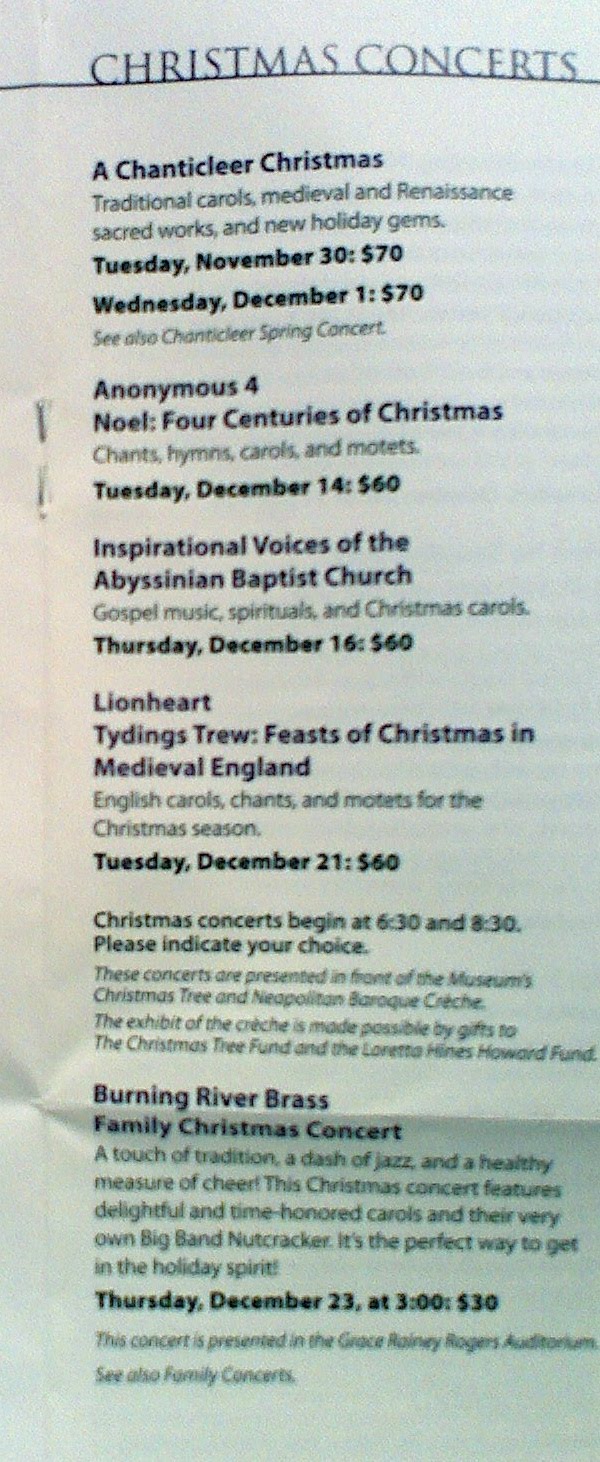
Holiday concerts at the Met


I highly recommend seeing Chanticleer perform, for the Christmas holiday, in the Medieval Hall, where the beautiful creche is displayed every year (http://www.metmuseum.org/special/Christmas2005/images.asp).
 It is not to be missed.
Anonymous 4 is also quite good.

Time for that trip to New York City yet?

Various pics

This one goes with Grim's story of the Marine carrying his girlfriend up the mountain. Semper Fi, she says. Indeed.


And here is a little Belle Heures teaser. I didn't forget you guys and risked life and limb taking pictures with my cell phone, whilst evading no fewer than three minders in the exhibit. I felt so Mission Impossible. (I just went to a translation site to be cute and put that in French for effect and don't you know its spelt the exact same way?!)

This might be the one that I took through a magnifying glass they supplied. The aureola have real texture and look as though they were painted yesterday, though my little cell phone camera cannot reflect the true skill used.


And another one taken of two Mourners they had near the Belle Heures stuff.


And this is a little bit of information related to the conversation we were having about traditional religious orders. It's from the newsletter of a group of cloistered monks I support.


Archers

In keeping with the Robin Hood theme, here are a few other archers. The first is from my most recent purchase at the Met - a book titled Battle; A Visual Journey Through 5,000 years of Combat (by R.G. Grant), which is an excellent history of warfare, giving broad brush strokes of what happened, between whom, using what, when, and showing how said-particulars fit into the historical scheme of things.


This is in the European Sculpture Court, which has some fabulous classics sculpture, including a Perseus holding Medusa's head, cast in white marble. The only reason I don't post it is, wonderful as it is, it doesn't come close to the one Grim posted a bit ago, which I think is in Italy. Some of my favorite Rodin sculpture is in this room, a section of the Burghers of Calais.


Here are those crazy Burghers!,
though the picture cannot do them justice; you must gaze at their pained expressions in person.


Onward...


This is the American Wing of the Met. It is simply fabulous, filled with breathtaking sculpture in an open and airy setting. It abuts the Medieval Hall and the Arms and Armor Hall, and resides next to the Tiffany displays, which are something to behold. The bronze sculpture I posted to accompany Grim's Mother's Day poem comes from this room.


Saber with Emeralds

I'm having a girly-girl fit.  All you guys will groan, I'm sure. Yes, it's only a ceremonial saber, but it's so pretty.


Isn't it wonderful?

And while I'm at it...

Old door, Hadrian, Marcus Aurelius, Faustina


For your info:

I just had to know, so I looked up Hadrian, and searched for Faustina within those results, and got this:
As Hadrian died shortly after and Antoninus Pius assumed the throne, Marcus soon shared in the work of the high office. Antoninus sought for Marcus to gain experience for the role he would one day have to play. And with time, both seemed to have shared true sympathy and affection for each other, like father and son. As these bonds grew stronger Marcus Aurelius broke off his engagement to Ceionia Fabia and instead became engaged to Antoninus' daughter Annia Galeria Faustina (Faustina the Younger)in AD 139.  An engagement which should lead to marriage in AD 145.
Faustina would bear him no fewer than 14 children during their 31 years of marriage. But only one son and four daughters were to outlive their father.

In AD 139 Marcus Aurelius was officially made caesar, junior emperor to Antoninus, and in AD 140, at the age of only 18, he was made consul for the first time.

Also of interest:
http://en.wikipedia.org/wiki/Faustina_the_Younger

Never listen to gossip!