Today, grandma was meant to run off with the boy, and I was meant to take my wife on a nice horseback ride up into the Georgia hills. This plan changed due to a last-minute invitation by grandma to the wife to go down to the Atlanta Botanical Gardens for an art show. The "Orchid Daze" exhibit featured blown-glass orchids, mixed in with the large collection of real orchids, and glass frogs in with the real Amazon frogs, which was to inspire a blah-blah-blah about the cunningness of man-made artwork to reflect the beauty of nature.
It's not that I don't know anything about art. It is, I think, that I know too much about it. My mother (that is, grandma) is an artist and an art-teacher; as I just mentioned, my wife is an equine artist. I've grown up with art education, then, and when dating I spent years hanging around the world-famous Savannah College of Art and Design, discussing art theory and going to exhibits both of famous artists and up and coming ones. I've been surrounded by art and art theory, folk art and fine art, since I was a child.
I've long ago figured out that there are just three kinds of artists: craftsmen, spiritualists, and people who are faking it. There are more of the last kind than anyone else, and they make up almost all the "concept" artists. The more somebody has to say about what their art means, the less it is really worth. Not in terms of dollars -- most consumers of art aren't smart enough to see through the line of salesmanship to realize they are buying a piece of canvas with one red line on it. (This is a fact that the Pop Artist, Warhol and the like, openly enjoyed.) The real depth of the work, though, is not going to be found in concept art.
This Frabel is a craftsman, and his stuff is good. His orchids in particular are very good. It's no wonder they liked them at the garden -- but if you're not that into orchids (and I am definitely not), you'll quickly tire.
On the other hand, there was some faker art out in the gardens that was... well, as you'd expect it wasn't that great. There was one real exception to the rule, however: the six-ton skull.
What made this piece great was not the concept, which... ah, well, read the article if you want the line of chatter. Supposedly it's all about earthy feminism and a 'new age of martiarchy.' Hey, maybe some people find it deeply feminine to sit in a giant skull and meditate. That wasn't what made it work, though.
What made the six-ton skull great wasn't its feminist qualities, but the fact that it was a huge, brightly-colored skull that you were allowed to crawl on. It wasn't its ability to speak to martiarchy, in other words, but its ability to speak to children.
Every child in the place, and especially every boy, loved it. They could clamber all over it. They could sit in the nose like a chair. They could crawl down into the jaws and howl out through the teeth. They could stick palm fronds out through the mouth like a big tongue, and try to "lick" other kids as they ran past. They could sit inside and scream, making it echo.
They loved it. That doesn't make it "great art" -- after all, kids love Barney the Dinosaur. Still, it does make it a worthy investment on the part of the Garden. I say that without knowing exactly how much was invested -- even a six-ton skull is only so valuable. Assuming they didn't let the line of chat drag more money out of them than was reasonable, though, it was a nifty thing to buy.

ABG

Oz Day
I had meant to say some words about the wonderful people of Australia, our most faithful ally and truest friend in the world. I had meant to say something about their history, landscape, and enviable culture.
But why gild the lily? (H/t: InstaPundit.)
PJM 2
The second part of the "Islands" series is available. It's interesting to see his comments on the role of "political correctness," Philippines style, in hampering the GWOT. To whit, if the government is seen as being too compliant with the US, political opposition flares. Thus, needed laws don't get passed.
There is certainly some truth to the complaint. There is another side, too. In Indonesia, for example, the US State Department pushed pretty hard -- and Australia's Foreign Ministry also -- for radical cleric Abu Bakar Bashir to be arrested on charges of supporting terrorism. The Indonesian government ended up doing just that, but the charges that were necessary to satisfy the US/Oz were not supportable given the admissable evidence and judicial climate. As a result, Bashir ended up getting off lightly. His early freedom was taken as a public rebuke to the US and made him a rallying point for Islamists in Indonesia.
Still, the point is well taken. You have to balance the pressure you bring to bear with the reality of the political situation. Less than optimal results happen if you err on either side.
Today's report from Baghdad is here.
HiHK: ID
Since you folks liked the horse pictures so much the last time, I thought I'd post a couple more. I have all these pictures because my wife, who is an equine artist (chiefly a sculptrix, but also a painter) is always trotting out to get photos of the beasties to use as references.
Today's horse is Tobias: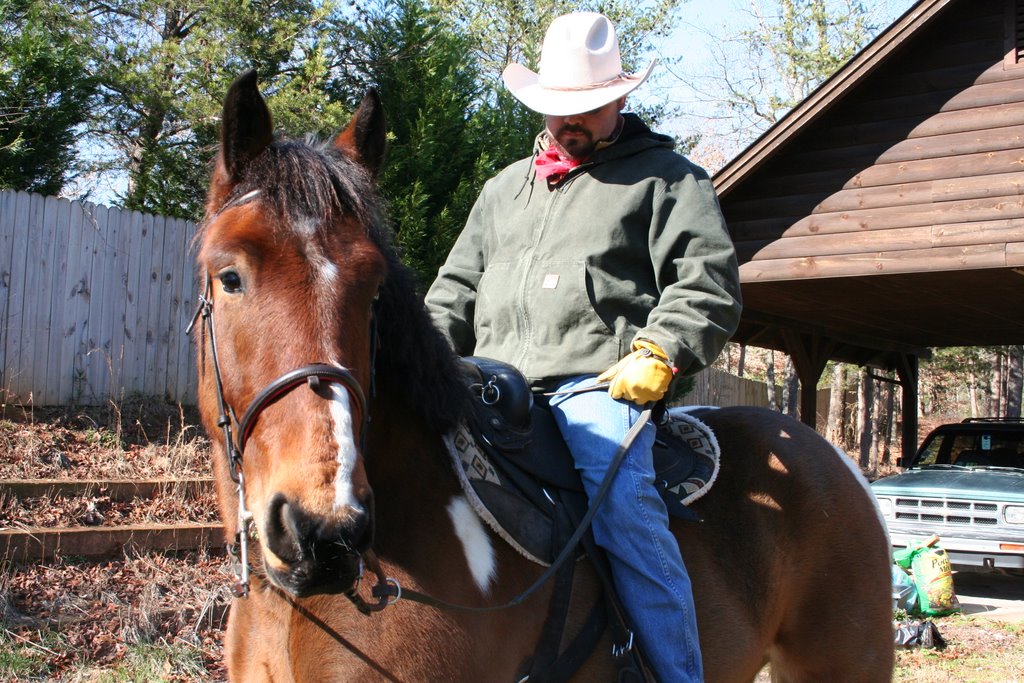
(The truck in the background, for reasons most of you will understand, is named "Serenity.")
Tobias is obviously a draft horse, a heavy, stocky horse of substance. Drafts are cold bloods, horses that we have for hundreds of years bred to be powerful, and easygoing. This is because they are meant to pull carts or plows, or work in teams, and it is harder to control a horse in that context than it is to do so while riding them with proper tack. As a result, you need a brave horse (i.e., it won't spook easily) that is gentle and easygoing.
The problem is that the horse's evolved nature runs totally against both propositions. In spite of their size, horses are prey animals in the wild. They are thus conditioned by a million years' survival to spook easily, and to respond to such spooks by running like the devil in the opposite direction. These are not desirable qualities, but they are deeply embedded. (A side note -- there is a piece in this month's Equus that argues that cold bloods branched off from the rest of horses at a much earlier period in evolution, which explains both their different dietary needs and some tempermental differences. See "Nutrition: Feeding Big Eaters" in the EQ Consultants column, p. 74-5.)
What can you do about that? Well, one thing you can do is breed horses that aren't particularly smart. They will go happily about their business because they are bad at threat recognition. However, genuinely dumb horses create other problems for the working horseman.
What people have done instead is select horses for breeding that have shown a certain tendency to go on "autopilot" when they're in harness. Humans do this too, so you'll understand what I mean. If you regularly make a trip by car, you get to where you can make it without thinking about it. Thus, your brain is free to be otherwise occupied. You may only be pulled back to full consciousness if something unexpected happens on the road. If a semi suddenly pulls out in front of you, you're suddenly "awake" -- but otherwise, the autopilot takes you there.
The best draft horses are bred for a similar quality. Tobias is a good example. He is a smart beast, when he's out of his harness -- but you tack him up, and he sort of sighs and his brain goes away. He does his job, but you can tell he is not all there while you're working him.
For example, he will walk straight into a tree.
You have to be very careful, therefore, about where this horse's ears are pointed. That's where he's going to go. If they're pointed at a tree, you have to turn him. This is the opposite of a horse like the Colonel, who has a good sense for his surroundings. The Colonel has excellent trail sense. Tobias is smart enough to have it, and in alarming situations -- for example, if you are riding him down a steep and rocky hillside -- you can feel his brain come awake. Like with you and the semi, he's suddenly "all there" and careful. Most of the time, he's not, and you'd better be watching where he's going.
He's a good looking beast, though:
Tobias is a former driving horse, and has only recently begun to be trained for trail riding. He hasn't learned to neck-rein yet, which is one of the things I like to teach the horses. He still rides like he thinks he's pulling a cart, and he still steers like a wheelbarrow.
He has the best of his breeding, though. He's gentle and sweet, and he never fails to come over when he sees you to seek some friendly attention. He's afraid of absolutely nothing -- today I thought he was going to run the UPS truck off the road rather than give way. He's a bit lazy, which is common with cold bloods, but he's a good horse all around.
Best to BlSp
Horseman and former Special Forces blogger Bloodspite had some hard news this week. I'm a little late getting to this, as I don't get around to reading "the community" as quickly as some -- but I do get by eventually. I join with Fuzzy in wishing him all the best.
It looks like people have been responsive, but for what it's worth -- drop him an email, if you have the time.
Dick Cheney's death stare
Heidi at Euphoric Reality laughs at Wolf Blitzer, who backpedals as fast as I've ever seen a media personality go. His guest was Dick Cheney, and so of course it was necessary to ask about his lesbian daughter.
This is such a popular topic that Google shows over million hits. Yay.
I understand Wolf's real question, which was this: "Focus on the Family is an important Republican interest group. They've taken it upon themselves to lecture your daughter and suggest she is immoral. Don't you wish to defend her against them, and therefore create a rift within your party?"
Of course, the answer is, "No, and no thanks for asking."
It's none of Focus on the Family's business, of course, and they could usefully shut up. The same goes for people who would like to publicize the dispute to the greatest degree possible, because it might hurt the Republican party. I have noticed that busybodies, in both parties, have trouble minding their own business. I believe there is even a Hank Williams song on the topic.
For those who can't carry a tune, a nice quiet death stare is almost as good.
Op Baghdad
PJM also has a reporter in Baghdad. Mohammed Fadhil is reporting on the fighting in the city. The reporting is informative, and the picture of the Stryker flying the Jolly Roger is worth the price of admission by itself.
RF in PHIL
Richard Fernandez of the Belmont Club, longtime resident of the Philippines, is back there on special assignment to PJM. He has a very useful writeup on the background of the conflict in the southern, Muslim regions. He also has a much darker forecast than mine about the region's prospects.
For example, when counterterrorist intelligence learned that Jemaah Islamiyah cadres were being trained in terrorist skills in a Moro Islamic Liberation Front area, they hesitated to raid the site because the Moro Islamic Liberation Front was a officially a "peace partner" of the government.I still think exactly that is the way forward -- using the MILF's natural pursuit of its own interests to deny the area to the JI. The MILF has been a "peace partner" in more than name, having assisted government forces on several occasions; and its spokesman, Eid Kabalu, has a devotion to peaceful rhetoric unusual in armed Muslim movements. Even when his brother was killed by police in a drug raid, he kept to formulations built around investigations and negotiations. Rhetoric is just words, but you'd have to go a long way to find another movement of this type which was as willing to be judicious with its words.A Filipino intelligence official attempted to square the circle by persuading his Muslim contacts in the MILF to attack the JI camp with government sanction. Asked whether this may have tipped the JI off into escaping, the official said "That was a risk, but what else was there to do? The official policy is to pursue a political settlement whether anyone really wants it or not." But if the chance of a comprehensive political solution seemed distant ("They’ll solve the Israeli-Palestine problem before we solve this") a military solution seemed equally remote.
There is little doubt that some elements of the MILF, and its parent organization the MNLF (Moro National Liberation Front), have had contacts with terrorist groups. There are persistant reports that the two have allowed terrorists to train in their camps. However, there is also a record of cooperation -- sometimes grudging, sometimes ready -- that marks the MILF and MNLF alike as a different sort of movement from al Qaeda or Jemaah Islamiyah. If the right tools can be found, we should be able to disaggregate the MILF from the true terrorist groups in Southeast Asia. Given the fact that Mindanao is beyond the capacity of the RP government to truly control, that seems a wise policy.
Knife Fighting
Kim du Toit suggests this as a preemptive defense, should you shoot someone who comes at you with a knife. The original post is here. The pictures are graphic.
I'd like those of you who are interested in the subject of knife fighting to take a look at those pictures. This is what a good knife can do when used improperly.
Photo 1 shows three slash wounds across the back, two across the spine. The knife was used right-to-left on the top, left-to-right on the second wound, and top-to-bottom on the vertical wound. In each case, the knife was used to slash instead of stab, and it was held with the blade leading -- whereas it should have been held with the backstrap leading.
The wounds did serious damage to the muscle, but were not in any way life-threatening (save for the possibility of blood loss). The two vertical wounds could have been stabs directed at the spine, in almost any situation in which it was possible to deliver those two blows. The vertical wound should have been a stab driven into the lung.
If the knife had been held correctly (the opposite way from how it was held), and the knife's wielder had known where to stop slashing and drive it home, the victim here would be dead.
Photo 2 is the same, but a single wound. A stab delivered there would have penetrated the liver and/or lower lung, depending on the angle.
Photo 3? Again, the same. I wonder if these wounds were all delivered by the same person. The incompetence is noteworthy. The fighter had four separate opportunities to kill his opponent, but delivered blows that were only ugly, not incapacitating.
Absolutely any of those wounds could have been fatal, and would surely have been incapacitating, if the wielder had known how to fight. If you are interested in the ancient arts of fencing and bladework as a form of self-defense, learn from the example. Hold the blade upwards toward your thumb, not downwards toward your little finger. Slash until you are over something vital, then drive home with the weight of your body behind the attack.
This is the way to use a blade. A gun automates this process, and is therefore easier for some, either physically or mentally. If you choose a blade, though, this is how it is done.
3 from AL
Arts & Letters Daily has three outstanding pieces today, which is unusually good even for them. The first is on Andrew Jackson, from the War of 1812 to his "assault on habeus corpus." The piece gives a good sense of Jackson, and while it disagrees with him, I think it gives a window into why he was so widely beloved by Americans.
The second looks at the 'nonwar' on Iran, with Israel, the US, and Saudia Arabia as allies. Confronting and stopping Iran is obviously the most important problem currently extant in the Middle East, though our allies (Saudi Arabia and Pakistan particularly) likewise present problems.
The third is Christopher Hitchen's review of Mark Steyn's newest book. In any conflict between the two gentlemen, I have to side with Steyn -- but both are deep thinkers, and important allies in the current struggle to defend the West and its best traditions. It's worth seeing where they cross.
SF use of pack animals
Secrecy News, which I just cited the other day, has a real gem in today's issue. It points us to a new Army Field manual, on the use of pack animals by Special Forces.
The comments on elephants are hilarious, as SN notes. But I liked the manual overall -- it's a pretty good primer on horsemanship, as well as packing. It suffers from the usual Army FM problems, but within the genre, it's a good one. The section on first aid and common disorders for pack animals is particularly good. Indeed, the entire fourth chapter is full of useful information for horsemen that might otherwise take a long time to learn.
Good work, Army.
Links
Bthun, in the comments to a post at Cassidy's place, points to a fascinating talk on Jefferson and the Barbary pirates. It's a video recording, but very interesting.
Also, here are couple of good reads on education, thanks to Arts & Letters Daily. The first posits that reading is more than a skill, but rather a compliation of everything you've learned. As a result, you can't improve overall reading comprehension among students without teaching them a very broad base of knowledge indeed:
An educational experiment in 1989 pitted a group of students with high reading scores, selected especially for their lack of interest in baseball, against a group of low-scoring students who happened to be avid baseball fans. The two groups were asked to demonstrate their reading comprehension of a passage on baseball. Can you guess which team won?A followup piece looks at the degree to which even librarians no longer like books. The nexus of the two pieces is this: if we want smarter students, we need to increase the awareness of the whole tradition of the West among those students; but we've settled on the easier task of teaching them to use search engines.
PJM has a piece that says the State of the Union is a disaster. And, indeed, it is. I think, though, it is for far wider and deeper reasons than contemplated here. We've talked about the cracking structural faults in the Republic's foundational institutions.
What if we can't fix it? I wonder.
SN CRS
Regular readers of Grim's Hall know that excessive government secrecy is one of my major complaints. Often, others who share the complaint point to the Bush administration, and it does seem that Bush has a particular love for secrecy. That said, it's not only the administration that suffers from this particular addiction.
Today's Secrecy News notes that the new Democratic-led Congress has tightened the rules regulating Congressional Research Service contacts with the media. As SN notes, "The new policy 'will obviously have a chilling effect on staff,' said one CRS analyst on a not-for-attribution basis. 'That's what it is intended to do.'"
Much of the CRS' research is on pragmatic matters, and the service is meant to be nonpartisan. As a result, there is often little reason to deny public access to their work -- or to make it hard for journalists (or even bloggers) to ask a few questions about it.
Sovay, if she drops by, will also be interested in today's SN update on the Hatfill case.
Go Bears
Now that was a fine set of championship games. Congratulations to the victors! I am pleased to say that my favored teams won in both of the conference championships.
Now, though, I have to decide whether to root for the Colts -- who are the native team of the in-laws, and led by Peyton Manning, an old UT vet -- or the Bears, to whom I feel a certain primal loyalty. They play the kind of ball I like best: a defense-heavy, running game. I remember the "wild bunch" of 1985, and want to see the Bears back on top of the league.
Well, I have a couple of weeks to sort that out. My thanks to all of the players for a fine couple of games today.
Some Horses
I thought that some of you might like to see a couple of the horses I've been working with lately. I mentioned Sequila a few months back. Sequila is an Appaloosa mare of foundation stock. Here's a photo of the little brat:
Sequila is always a pain to get saddled. Yesterday, I went out to get her from the second field. I knew she was there, because when I topped the hill on the way down to the fields, I could see her. When I got out into the field, though, she'd totally vanished. The other horses were out there, but no Sequila.
Knowing her, I figured she'd jumped the fence or something when she saw me coming with a rope. I walked out to see if I could figure out where she'd crossed, when I came to a low place in the field, just a dip in the land. There was Sequila, laying down to hide from me.
If a horse could grumble, this one would have when I showed up there and put the rope on her. She'd also stripped off her halter, so I put the rope on her "war bridle" fashion. Naturally, when I started back to the barn, she didn't want to come -- but when the rope pinched down, she grudgingly agreed. As usual, she had her ears plastered back for the saddling. I always take some time to soothe her and scratch her during the process, but you never get a better reaction from her than to see her ears raise forward an inch.
Sequila is a bad-tempered brat, and though she's very smart, she uses all her intelligence in the service of evil. Nevertheless, once you get the saddle on her, she's a real pleasure to ride. She's got a great canter in particular. The canter is a three-beat gait just short of a gallop, but faster than the two-beat trot. The trot is easy on the horse, but harder on the rider. The canter is easy to ride, if you've ever done any boxing -- just like you were taught in the ring, you let your body snap like a whip. This distributes away all the energy, and makes it a pleasure.
Anyway, we had a great ride yesterday, and by the end of it she was too tired to fight. She was gentle and sweet while I put her blanket on her, and took her back to the field.
My favorite horse we have right now is a grey quarter horse. He has a registered name which I've forgotten, but I call him "Colonel Mosby" after the famous cavalry officer (the "Gray Ghost," is why). The Colonel is a friendly animal, and a lot of fun to be around, but a bit sickle-hocked, as well as being cow-hocked. It gives his trot a kind of sway to it, which is really sort of fun. It's going to be hard on his joints, though, as he gets older.
The Colonel and I get along very well, but apparently he tries to pull the reins out of other riders' hands. As a result, we are training him with a martingale and a noseband. Personally, I don't see the need, but his owner really wants to break the habit. I just do what the owners want. If it were my own, I would avoid the training aids, and just use a good bit to "communicate" my displeasure if he tried to yank the reins out of my hands.
Here's a picture of the Colonel:
Here's a second, where you can see the cow-hocked confirmation:
As you can see, he's a very good horse in spite of everything. I like a smart, friendly horse best of all. This one is about the friendliest I have ever met, which goes a long way with me.
Choosing a Stetson
Doc Russia wrote the top post on first aid kits, giving us the benefit of his skills and knowledge. I'm going to write about an item of kit that I know a little something about, which you can expect to use more often than a first aid kit -- but which can be just as useful to your survival, if you spend a lot of time outside.
I'm going to say a few words about how to pick a Stetson hat. Most of what I have to say will be useful to you if you prefer another brand of hat, or a custom hat; but a Stetson is what my grandfather passed to me, and so Stetsons are what I wear. Also, I want to warn you a bit about some bad marketing ideas Stetson is undertaking at this time, so you avoid getting a bad hat that ought to have been good.
Don't get me wrong -- they still make hats in the old fashion. They just also now make hats in other fashions, one of which is very good, and the others of which are not. The old fashion is their "authentic X" beaver felt; the new fashion that is very good is the buffalo felt hat.
Stetson is, however, making the same bad mistake that Harley Davidson made a few decades ago. They're letting their brand be affixed to substandard products. They've added their product name to several lines of cheap hats, including wool felt (their "Stallion" line, for example) and various Australian style hats. It took Harley years to overcome the collapse in their value that this marketing strategy brought on. I hope the folks at Stetson will reconsider before they ruin an old and highly-respected name.
By the way, if you want an Australian hat, buy an Akubra -- they're not expensive, they're better than the Stetson variants, and they're the real thing. Don't buy from David Morgan (who sells some fine goods, but overcharges for their Akubras). Rather, buy from the Strand Hatter in Australia. They'll be glad to ship to you, they have more styles on offer, and it's cheaper.
If you're buying a Stetson, though, don't buy online at all. This is one of the few items you will always get cheaper at a bricks-and-mortar store. Find a good feed-and-seed, or a Western wear store, that can order one for you. If you have more than one in the area, shop around. You'll often get prices half of what you can find online.
CHOOSING A STYLE:
The main thing about the style of hat you pick is the use you intend for it. That's why you should pick one style over another.
I will only give you one general rule on style that is aesthetic: the bigger the man, the bigger the hat. This is to to with width, not height. A broad shouldered man needs a broad brim, as a small brim will look foolish on him. If you have a big chest and a thick neck, you don't want to wear something tiny. Get a big hat. By contrast, if you're a relatively slim fellow, a big hat will look a bit awkward.
That said, choose what suits your life. If you're outside a lot in open country, you'll want a broader brim to shade your face and eyes. If you spend most of your time in wooded country, you'll want a smaller or upturned brim to make it easier to move around the trees. If you live in a city, you may want a smaller hat like a fedora that's easy to fit in the tighter spaces of crowds and elevators. Function is more important than look.
CHOOSING A FELT:
Use determines this also. You'll need to know how much rain your area gets, how hot it's going to be, and how bright. You'll also need to know if you want it mostly for horseback riding, or walking afoot, or for use on camping expeditions.
There are three kinds of hats Stetson makes that I recommend: authentic beaver felt, buffalo felt, and woven Panama straw hats. The straw hats are actually made under contract in Panama, but they're very good. I am not going to say more about them than that -- just pick a style you like, in your size, and buy it if you like Panama straw hats. These are good for summer wear in hot climates (like the South). They breathe well, but offer more substantial protection from the sun than the sort of straw hat you can buy at Walmart. I have one of these, but remember, you'll get it cheaper than that if you work with a local store.
You might want a straw hat as well as a felt hat, if you live in a hot enough place. Otherwise, one hat can do you for your whole life, if it's the right hat.
Now, as to the felt hats: never buy a wool felt hat, or a "fur" felt hat that doesn't tell you what kind of fur. It's probably rabbit. They're cheap and good looking, but when they get wet, they get soggy. You can put Scotch-guard on them if you want, but you're better off buying a better hat. (Same for those Aussie hats, by the way: they're mostly rabbit fur felt. Great hats, when it's not raining.)
Also, I wouldn't buy a Stetson "fur" felt hat that isn't either from its American Buffalo collection, or bearing "authentic X" beaver-felt. For example, its "Gun Club" hats have Xs stamped in the hatband, but they are substandard hats. One of them I encountered had water-soluble dye! Great, just what everyone wants: first rainstorm, and black or dark-brown dye is dripping over your face and into your clothes.
What you want is a beaver-fur felt hat, or a hat from Stetson's American Buffalo collection. They have different qualities, though, so let me tell you a bit about how they're different.
First, the buffalo hats are cheaper. You can get them for half the price of a modestly good beaver hat.
Second, the buffalo felt is a lot less stiff. It'll seem stiff in the store, because it's been starched. Once you've used it for a while, in wind and rain, it will become somewhat floppy. It holds its shape well enough, but when the wind hits it the brim will push up, for example.
This has good and bad effects. Buffalo felt hats are ideal for hiking and camping, for example. If you're hiking under trees or through canyons, they'll give against limbs or rocks. If you're wanting to fan a fire to life, they've got a bit more "snap" than a beaver. The best thing I've ever found for kindling a fire, in fact, is my buffalo Stetson.
For horseback riding, they're less ideal. They're fine at the trot, but you get up into a canter or a gallop, and the wind you generate can take the hat right off your head, even if the hat fits perfectly.
They are also not as waterproof. If you live in a climate with a wet season, or you think you might get caught out in a long rain, a beaver is what you want.
The amount of beaver fur felt in the hat is expressed as a number of "X"s. This is not a standard. Every manufacturer uses different percentages. Thus, a XXX hat may have ten percent beaver felt, or only five, or twelve. A XXXX hat may be twenty-five percent, but it may be less. It used to be that 20X was 100% beaver, but that's not true any more either.
I find that a XXXX hat (that's four X's) is good enough for the roughest wear. If you want a purer hat, and can afford it, go for it: but beaver pelts get more expensive every year. That's why even a XXXX hat, far from a 20X or 100X hat, costs twice what a buffalo hat costs.
CHOOSING A SIZE & SHAPING YOUR HAT:
You only need two things to shape a hat. The first is hot water. The second is a hat jack. The hat jack is optional, actually, but it does help.
You want to make sure that you get the right size. The biggest mistake you're apt to make is to try the hat on, and decide which one feels best. That seems reasonable, but it's the wrong way around.
What you want is a hat that fits you all the way around your head. You want to make sure there is no place at which you can fit a fingertip between the band and your skull. A lot of people have more-or-less oval shaped heads. The hat from the factory may be tight front and back, but with a gap at the temple. Though it's too tight, the hat is too big.
You want to find a hat that is the right size for your head. Try on several, until you find the one that seems likely to fit if all the gaps were expanded into the tight areas. We can do that -- I'm about to tell you how. Once it's shaped to your head, this hat will fit perfectly.
Take your hat home, and pour water into a kettle. Boil the water, so a stream of hot steam blows out of the spout. Fold the sweat band inside the hat down, and expose the felt to the steam until the hat is moist and warm all the way around. Now, fold the sweat band up, and put it on your head (or the hat jack). Wear it until it is cool and dry. The hat will now be formed to your head.
By the way, the same tactic will let you reshape the brim or the bash. The bash is somewhat harder to do, but if you're patient, you can learn. The brim is easy: just steam it, put it where you want it, and let it cool.
This technique will also let you repair a hat that's gotten out of shape through use.
OTHER HATS / CUSTOM HATS:
Resistol hats and Stetson hats are closely related these days. Custom hats depend on the hatmaker. I've seen some good results and some bad ones. I can only endorse two from personal experience.
Peter Brothers makes fine hats. I gave one of these as a gift once, and it was beautiful.
Also, Sackett's in Jasper, GA, has a hat maker who goes by the name "the Hat Man." He is a fine old gentleman of eighty years or so, who used to make hats for the Hollywood cowboys back in the heydey of the Western film. They don't have a web page, but you can reach them at 678 454-4677. His stuff is outstanding. I've never owned any of it, but I've seen what he can do close up.
Any kind of felt hat you buy -- rabbit, wool, whatever -- can be reshaped/resized using the steam method I was talking about above. You can put it back into shape that way as often as you like without hurting it.
The only thing it might not work on are those "crushable" hats you see for sale at department stores these days. I wouldn't suggest buying one of those, as they are neither waterproof nor likely to last through hard wear.
CONCLUSION:
A single good hat will last you a lifetime. It can protect you from rain or sun, keep you warm, kindle a fire, or dip water to dump on the head of a pretty girl... I mean, to offer for your horse to drink. This should give you a basic notion of how to buy a hat that will fit you and last, will be well-made of high quality materials, and suit the practical needs of your life.
If you have any questions, shout out.
Movie Night
Anyone feel like having a "movie night" next weekend? I was thinking of 'A Bridge Too Far'. That said, I won't be making the Grim style long posts that analyze the movie; I'll be keeping it short. I'm back in college after a six year hiatus, and these philosophy courses, my major, have me doing some heavy reading.
Thank God for the Chinese
China Daily is an English-language, state-run mouthpiece publication for the People's Republic of China. It can be counted upon to put forth the official propaganda of the state. This stuff is naked propaganda of a type that you just don't see in the free world. For example:
The railroad station in the Angolan town of Dondo hasn't seen a train in years. Its windows are boarded up, its pale pink facade crumbling away; the local coffee trade that Portuguese colonialists founded long ago is a distant memory, victim of a civil war that lasted for 27 years. Dondo's fortunes, however, may be looking up. This month, work is scheduled to start on the local section of the line that links the town to the deep harbor at Luanda, Angola's capital. The work will be done by Chinese construction firms, and as two of their workers survey the track, an Angolan security guard sums up his feelings. "Thank you, God," he says, "for the Chinese."Just the sort of thing China Daily loves. All the world is joined in praise of the wise leadership of Hu Jintao, and the Chinese Communist Party!
That sentiment, or something like it, can be heard a lot these days in Africa, where Chinese investment is building roads and railways, opening textile factories and digging oil wells. You hear it on the farms of Brazil, where Chinese appetite for soy and beef has led to a booming export trade. And you hear it in Chiang Saen, a town on the Mekong River in northern Thailand, where locals used to subsist on whatever they could make from farming and smuggling--until Chinese engineers began blasting the rapids and reefs on the upper Mekong so that large boats could take Chinese-manufactured goods to markets in Southeast Asia.
Only one thing is different in this case.
The article was originally printed in Time. The editors of China Daily are only reprinting it.
If you'd like to compare it with something the Chinese wrote for themselves, you might consider their opinion piece from the same issue, "China Implementing Harmonious Diplomacy." I'd have to say the folks at Time have learned the lessons well.
Straw Poll
Pajamas Media is running a 2008 Presidential Straw Poll. You can vote here, just click on the flag.
It's a little unusual, in that you get to vote for a nominee from each party. That might give us a sense of which candidates have the biggest cross-party appeal, since it will let us know which Democrat is most acceptable to Republicans, and vice versa, while also allowing independents of various stripes to select which candidates best suit them.
I'm going to endorse -- for the purposes of this poll only -- these candidates:
Democratic Party: Bill Richardson
Republican Party: Duncan Hunter
Richardson is the best of the Democratic list, being NRA endorsed, and a successful diplomat. He's weak, in my reading, on North Korea. Even though that was one of the areas of his success as a diplomat, his proposal to directly engage the DPRK in negotiations is foolish. The DPRK wants us to slim down from the six-way talks to bilateral talks, as a breakdown in the six-way talks reflects badly on China. Since China is the only party that can really put pressure on the DPRK, it is in our interests to have Chinese "face" concerned with their ability to bring the DPRK to a settlement on these issues. If we go to bilateral talks, the DPRK is free to break off from the talks at any time. There is no practical penalty to doing so; they will blame the US, which will cost them nothing.
China, meanwhile, wants to be in the six-way talks as a point of international prestige. The price tag for that is forcing at least some concessions from the DPRK every time we come to the table. If we're going to try to resolve the DPRK's nuclear situation through diplomacy, the six-way talks are the right way.
That said, he's a pretty good, moderate candidate. Among the Democratic party's current national leadership, I'd say he was the best by a long shot.
On the Republican side, I think Duncan Hunter may need an introduction to many readers, but a few words should suffice. He is a former Army Ranger (75th), former Airborne (173rd in Vietnam), and has in Congress chaired the Armed Services Committee. Our friends at China E-Lobby have endorsed him in the Presidential race over all candidates of both parties. He is stronger on the immigration/border problem than Richardson (from my point of view), but has a weakness in his connection to a firm involved in Duke Cunningham's scandals. Investigations have not found that Hunter committed any inappropriate actions, as Wikipedia notes:
A Department of Defense inspector general found that the department awarded ADCS, a company owned by Brent Wilkes, a $9.8 million contract in mid-1999 after "inquiries from two members of Congress." Hunter has repeatedly acknowledged that he joined with Representative Randy Cunningham that year to contact Pentagon officials, who then reversed a decision and gave ADCS the contract, one of its first big ones.Again, compared to the rest of the field he looks pretty good. It's amazing how much chaff there is in each of the parties' candidate fields this time around.
Between 1994 and 2004, Wilkes and ADCS gave $40,700 in campaign contributions to Hunter. In 2003, Wilkes's foundation hosted a "Salute to Heroes" gala to give Hunter an award, just as it did for Cunningham a year earlier. The Wilkes Foundation also gave $1,000 in 2003 to a charity run by two of Hunter's staffers. However, Hunter has not been found to have committed any crimes or ethical violations. Wilkes is currently an unindicted co-conspirator.
Second choices, for me, if it interests you:
Democratic: Hillary Clinton (Yes, I know, but she's tough.)
Republican: Newt Gingrich (Yes, I know, but he's smart.)
Haditha unmasked
I haven't said anything about the Haditha case, except that we ought to keep silent about it until the process is complete. I also detest reporting based on anonymous sources.
Nevertheless, I will pass on this article, which my anonymous source says lines up with his anonymous sources, though the article is based on still yet other anonymous sources.
So what does that mean about the accuracy of the piece? Hell if I know. But if you're compiling reports and analysis on the subject, here's one thing more to read. It's got some analysis of the investigation itself that I won't endorse, but you can match up the analysis with how the case appears in the press.
I wish to stress that you should apply your own critical analysis to what's offered here. See if the accusations it makes match up with the details from the case as it develops. If so, this may explain why the case is developing as it is. If not, set it aside. I'm offering it as information, not intelligence.