Saltire and Slander

Are the 'neck and neck' polls in Scotland on independence wrong? We saw something like that happen in the Eric Cantor race here, so it certainly does come up once in a while. In addition to the other potential errors the newspaper identifies the samples I've seen have been very small, so it could be we don't really know what people are thinking.

There is another problem, reports The Guardian: journalists are committed to rooting against independence.
Perhaps the most arresting fact about the Scottish referendum is this: that there is no newspaper – local, regional or national, English or Scottish – that supports independence except the Sunday Herald. The Scots who will vote yes have been almost without representation in the media.

There is nothing unusual about this. Change in any direction... requires the defiance of almost the entire battery of salaried opinion.
There's a lot of that here at home, too. The TEA Party did so badly in the press in part because, in its early days when it was a genuinely popular movement, it really wanted to make some major changes -- and the press' bills are paid by relationships with existing powers. The huge defense of then-Senator Obama, which is similar to the huge defense being put on for the 'Better Together' campaign in the UK, was motivated not by a desire for "Change!" but out of a sense that he was a committed member of their own class. The movement represented change for the rest of us, but for the elite press it was the most soothing and constant of opinions that he forwarded.

Well, that all-hands-on-deck approach worked here in 2008. Maybe they'll carry the fight for their friends in the United Kingdom, too.

We'll see soon enough.

And lemme have a package of those Corn Nuts

Evidence of reverent funerals is often taken as a sign of cognitive function in early man.

What, I'm supposed to be an executive or something?

The buck may or may not stop moving somewhere between here and there:
One comes away from Baker’s account with the sense what what really offends Obama about ISIS is that the terrorist group has forced him to make a decision:
Mr. Haass said attention to nuance was a double-edged attribute. “This is someone who, more than most in the political world, is comfortable in the gray rather than the black and white,” he said. “So many other people in the political world do operate in the black and white and are more quote-unquote decisive, and that’s a mixed blessing. He clearly falls on the side of those who are slow or reluctant to decide because deciding often forces you into a more one-sided position than you’re comfortable with.”
I don't know. Someone who's more quote-unquote decisive might not be so terrible.  I mean, we don't want him to be "decisive" decisive, but he could at least make a multi-sided decision, provisionally.

Milestones in diplomacy

We've gone beyond "WRDC and are CMTS" and are solidly into "there's going to be some kind of coalition at some point."

Disturbing the Peace

"The woman was arrested on suspicion of racially aggravated public order offences."

Teddy Bears and Turrets

The school district's got itself an RV.

Checking off the boxes

This pedagogical rant hits all the high spots about the Man keeping us down in Math:  culturally responsive, gatekeeper, internalized deep anxiety, old white men, role models, motivation, activating voices, self-advocation for communities, equity, rote, drill, high-stakes testing, and meaningful dialogue.

The Founding Adolescents

The Death of Adulthood in American Culture.
In suggesting that patriarchy is dead, I am not claiming that sexism is finished, that men are obsolete or that the triumph of feminism is at hand. I may be a middle-aged white man, but I’m not an idiot. . . . This slow unwinding has been the work of generations. For the most part, it has been understood — rightly in my view, and this is not really an argument I want to have right now — as a narrative of progress. A society that was exclusive and repressive is now freer and more open. But there may be other less unequivocally happy consequences. It seems that, in doing away with patriarchal authority, we have also, perhaps unwittingly, killed off all the grown-ups.
* * *
From the start, American culture was notably resistant to the claims of parental authority and the imperatives of adulthood. Surveying the canon of American literature in his magisterial “Love and Death in the American Novel,” Leslie A. Fiedler suggested, more than half a century before Ruth Graham, that “the great works of American fiction are notoriously at home in the children’s section of the library.” Musing on the legacy of Rip Van Winkle and Huckleberry Finn, he broadened this observation into a sweeping (and still very much relevant) diagnosis of the national personality: “The typical male protagonist of our fiction has been a man on the run, harried into the forest and out to sea, down the river or into combat — anywhere to avoid ‘civilization,’ which is to say the confrontation of a man and woman which leads to the fall to sex, marriage and responsibility. One of the factors that determine theme and form in our great books is this strategy of evasion, this retreat to nature and childhood which makes our literature (and life!) so charmingly and infuriatingly ‘boyish.’”

Pakistan with exposed knees

P.J. O'Rourke delivers a nuanced appeal for intercultural respect, drawing on his mellow days as a foreign correspondent to speculate on future coverage of an independent Scotland.  The comments thread is a little excitable.

The peaceful savage

From Before the Dawn:  Recovering the Lost History of Our Ancestors, by Nicholas Wade:
Both [Lawrence H.] Keeley and [Steven] LeBlanc believe that for a variety of reasons anthropologists and their fellow archaeologists have seriously underreported the prevalence of warfare among primitive societies.  "While my purpose here is not to rail against my colleagues, it is impossible to ignore the fact that academia has missed what I consider to be some of the essence of human history," writes LeBlanc. "I realized that archaeologists of the postwar period had artificially 'pacified the past' and shared a pervasive bias against the possibility of prehistoric warfare," says Keeley.
Keeley suggests that warfare and conquest fell out of favor as subjects of academic study after Europeans' experiences of the Nazis, who treat them, also in the name of might makes right, as badly as they were accustomed to treating their colonial subjects.  Be that as it may, there does seem a certain reluctance among archaeologists to recognize the full extent of ancient warfare.  Keeley reports that his grant application to study a nine-foot-deep Neolithic ditch and palisade was rejected until he changed his description of the structure of "fortification" to "enclosure."  Most archaeologists, says LeBlanc, ignored the fortifications around Mayan cities and viewed the Mayan elite as peaceful priests. But over the last 20 years Mayan records have been deciphered.  Contrary to archaeologists' wishful thinking, they show the allegedly peaceful elite was heavily into war, conquest and the sanguinary sacrifice of beaten opponents.
Archaeologists have described caches of large round stones as being designed for use in boiling water, ignoring the commonsense possibility that they were slingshots.  When spears, swords, shields, parts of a chariot and a male corpse dressed in armor emerged from a burial, archaeologists asserted that these were status symbols and not, heaven forbid, weapons for actual military use.  The large number of copper and bronze axes found in Late Neolithic and Bronze Age burials were held to be not battle axes but a form of money.  The spectacularly intact 5,000-year-old man discovered in a melting glacier in 1991, named Ötzi by researchers, carried just such a copper axe.  He was found, Keeley writes dryly, "with one of these moneys mischievously hafted as an ax.  He also had with him a dagger, a bow, and some arrows; presumably these were his small change."
It was a peaceful religion, as they say.

A Point of Commonality

I don't know if it's true, as Charles Barkley says, that every black parent in the South whips their children with willow switches. I do know it's true that my grandmother, who was Southern but quite white, certainly made use of them as she felt appropriate. I only received such a lesson from her once, and at the time I thought it was unfair because she was angry that we were playing ball near the street -- but we hadn't even gone into the street. I later discovered that my great-grandfather was killed by a car, walking across the street to get the mail from his mailbox. The woman driving the car that killed him never saw him, apparently.

I'm of the opinion that it did me no harm, even if the particular incident was in a sense unjust. My father, who was on the receiving end of far more whippings from her as a boy, is one of the best men I've ever known. He is generous, gentle, and -- far from being a 'child abuser,' as the overwrought discussion suggests of any parent raised as he was -- my sister would always try to arrange to be punished by him instead of my mother, because he was too scared of hurting her to paddle with any strength.

Ecclesiasticus gives advice on raising children that begins "Whoever loves his son will beat him frequently," and of course Proverbs 13:24 holds that "whoever spares the rod hates his son."

Certainly you shouldn't abuse children. But can we stop painting people like my grandmother as monsters, 'child abusers,' and the like? Is it too much to ask that we express our culture's desire to move away from spanking children in terms that don't require us to despise and hate so many who were doing what they thought was best, and had been taught was right, even by the wise of their communities and cultures?

'Your Dossier Is Fat With The Blood Of Kittens'

Apparently Sergeant Shlock and my dog have something in common.

He's a great dog, really. It's just that he's a country dog, and there's just no explaining to him the difference between squirrels and cats. Everybody's happy when you catch the squirrel!

"Can't tame woild rabbit"

...says the girl's father in Watership Down...explaining why she can't keep Hazel (whom she's rescued from her cat), so that he ends up being released at a critical point in the story. Adams put a lot of trouble into researching rabbits for his story, and now I see evidence of why he was right.

According to this story, the genetic code of domestic rabbits (who've been living with humans for 1400 years or so) is different from their wild cousins' in about a hundred places...some of those important for development of behavior.

"Selection during domestication might have focused on tameness and lack of fear," says Pat Heslop-Harrison of the University of Leicester in the UK. "As a farmer, you neither want the animal to hurt you, nor for the animal to die from stress." Keeping lookout and fleeing from potential predators uses up lots of an animal's energy, which humans would rather see turned into meat. Because rabbits were only domesticated relatively recently, the new sequences are not all present in all domestic rabbits. As a result, Andersson says escaped domestic rabbits could revert to wild-like forms over just a few generations - assuming they survived in the wild.
It's unsurprising when you know about the famous Russian fur fox experiment...which took under 50 years to breed the wild foxes into something far more doglike (down to the floppy ears the breeders weren't expecting...they were just looking for tameness). The wiki on domestication gives estimated dates for various creatures that live with us...at least some of that based on genetic evidence.

Aye or Die!

We gotcher veto, right here

Nothing says "You're on the unpopular side of an issue" like a legislative veto override.

How to reduce federal spending

Michelle Obama came up with it, and it's brilliant:  impose unpopular regulations on the programs funded with the federal spending until the public rejects their products or services, to the point where it becomes more cost-effective for the programs to decline the federal subsidies.  Bonus:  less regulation.

Here's another effective response to dumb, intrusive regulations.  The Bank Street Brewhouse in New Albany, Indiana, wanted to serve only beer to customers, and to encourage them to complete their meals by patronizing nearby street-food vendors.  Indiana liquor laws, however, permit a business to maintain a retail liquor license only if it operates a restaurant on the premises, defined as the ability to serve hot sandwiches, hot soup, coffee with milk, and soft drinks in a sanitary manner.  Thus was born the "Bank Street Brewhouse Indiana Statutory Compliance Restaurant Menu":

Our Famous Hotdog Sandwich
Microwaved to perfection, including both weenie
and bun, sans condiments.
$10.00
Chef Campbell's Soup of the Day
Served in a bowl.  Your choice of whichever can is
on top of the stack.
$10.00
Instant Coffee
Caffeinated only.  Available black, or black.
$5.00
Powdered Milk
With or without water.
$5.00
Sprecher Craft Soft Drinks
Different flavors . . . market pricing.

H/t AEI.

The prisoner's lament

King Richard I of England (the Lion-Hearted) composed this song at the end of the 12th century, while imprisoned by the Duke of Austria during the Third Crusade.  He wrote it in his first language, an Old French dialect, with another version in a related Romance dialect that still maintains a precarious existence in Provençe and the Catalan areas of Spain.  Richard's enemies claimed he didn't even know English, but he probably did, though it's true that he exhibited almost no attachment to the country that revered him, preferring instead to live in France.


No prisoner can tell his tale well without expressing his pain,
But to console himself he can write a song.
 
I've many friends, but all their gifts are poor;
They'd be ashamed to know how for two winters I've been held for ransom.
My men-at-arms and barons know full well:
The English, Normans, Poitevins, 
Gascons. 
I would not abandon the poorest companion in prison,
And I don't say this merely to reproach, but still, I am a prisoner.
Richard did finally win his release, through the help of his mother, Eleanor of Aquitaine, despite the connivances to the contrary by his brother John and King Phillip II of France, the son (by a later wife) of Eleanor's ex-husband Louis VII.

Friday Night AMV


Learning to fly.
I was a pilot once, I wish I'd had one of these. At least I can still enjoy listening to Tom.

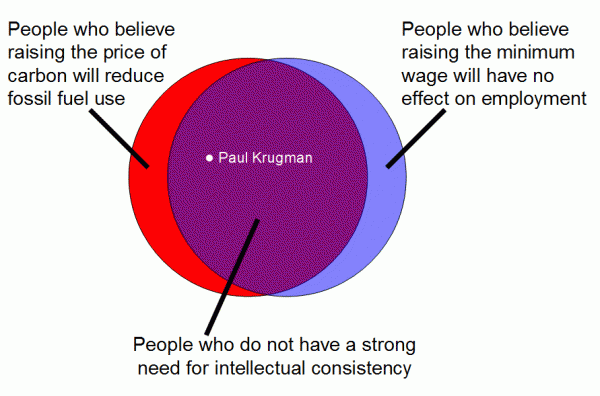
Fun with Venn

From AEI:


Stormy weather

Over the last hour my internet (wifi) connection got wonkier than usual, and we noticed that we kept losing the satellite TV as we tried to watch the news over lunch.  It may an effect of the second and more powerful wave of this week's predicted solar storm, which apparently arrived at midday today.