

A True Victory
The NRA's Institute for Legislative Action normally trumpets their successes on law-making matters; given the general turn against anti-gun legislation, these are less crucial than they were twenty years ago. However, this report is not about legislation, but about an even more substantial victory:
To bring the rate of accidental gun deaths down to so low a level requires influencing the behavior of millions. This required a commitment to gun safety in perhaps a hundred million households nationwide; it required discipline and education on the part of all those families. Nevertheless, quietly, it was achieved.
Data recently released by the National Center for Health Statistics shows that in 2008, the number and per capita rate of firearm accident deaths fell to an all-time low. There were 592 firearm accident deaths (0.19 such accidents per 100,000 population) in 2008, as compared to 613 accidents (.20 per 100,000) in 2007. In 2008, the chance of a child dying in a firearm accident was roughly one in a million.
Firearm accidents accounted for 0.5% of all accidental deaths; well below the percentages accounted for by motor vehicle accidents, falls, fires, poisonings, and several other more common types of mishaps.I say this is more substantial because it relies upon moving a far greater number of people. To achieve a victory in Congress, as difficult as that can be, requires affecting the behavior of fewer than 300 people -- often far fewer, since bad bills can often be killed in committee.
To bring the rate of accidental gun deaths down to so low a level requires influencing the behavior of millions. This required a commitment to gun safety in perhaps a hundred million households nationwide; it required discipline and education on the part of all those families. Nevertheless, quietly, it was achieved.
Canceling the Mass in Christmas
The sorting out of Iraq's internal tensions was inevitable given our rapid departure; but the threats against Christians are not new.
Chaldean Archbishop Louis Sako of Kirkuk in northern Iraq told the agency Aid to the Church in Need that Christians will spend Christmas in "great fear" because of the risk of new attacks.
All services and Masses have been scheduled for daylight hours, he said in an interview with Rome-based AsiaNews.
"Midnight Christmas Mass has been canceled in Baghdad, Mosul and Kirkuk as a consequence of the never-ending assassinations of Christians," he said, citing the Oct. 31, 2010, attack on the Syrian Catholic cathedral that left 57 people dead in the Iraqi capital.Something to think about, this Christmastide.
Yuletide: Scottish Shortbread

The following bit of history is from The King Arthur Flour 200th Anniversary Cookbook. The book is an outstanding example of what a cookbook should be, and by far the finest one I've ever seen when it comes to any sort of bread. I think they're more experts on baking than history, but so far everything else they've written about bread has proven to be right. So why not 'history of bread'?
Scottish shortbread was originally made from oatmeal and was served on the Winter Solstice, the shortest day of the year. The edges of the round "cake" were notched, symbolizing the sun which was being entreated to return. Nowadays in Scotland, shortbread is mostly made with wheat flour but the edges are still marked with those symbolic notches. It is served on Hogmanay (New Year's Eve) and New Year's morning to "first-footers," those revelers who have stayed up all night to see the New Year and are the first to go from house to house, visiting and celebrating.

Stuff the Net Is Good at
Here's something interactive websites are really useful for: walking us through concepts in geometry. If you're trying to home school a kid, this sure would be a helpful tool. There are clear and well-organized explanations, too, better than the gibberish we often encounter in printed textbooks. I linked to the parabola page, but the site is broad.
Cherry-Picked Climate Emails Explained
We can all relax; ClimateGate2 was completely overblown. The University of East Anglia has posted explanations of some of the troubling quotations taken unfairly out of context, such as: "I too don’t see why the schemes should be symmetrical. The temperature ones certainly will not as we’re choosing the periods to show the warming," “Getting people we know and trust [into IPCC] is vital," and "Any work we have done in the past is done on the back of the research grants we get - and has to be well hidden."
Yeah, I still don't get it, either.
Yeah, I still don't get it, either.
North Korea Goes Dark in Mourning
 Wait, that's not mourning, that's just Kim Jong Il's legacy. Meanwhile, the Cuban government declared three days of mourning, presumably because he made them look good. (On the same principle, Nicaragua and Venezuela expressed sincere condolences.) I suppose he gets points, too, for reducing North Korea's carbon footprint, reducing light pollution for stargazers, and all but eliminating income inequality in his country in the only way we know from experience to be possible.
I keep looking at that satellite photograph. What would that area of the world have looked like if the U.S. hadn't gotten into the Korean War? On the other hand, why weren't China and North Viet Nam dumb enough to achieve the same fate? They certainly tried hard enough.

The Washington Post (h/t Maggie's Farm) explains it in a succinct chart:

Orientis Partibus
This version is from Hungary. The song is in Latin, so that pilgrims from anywhere might have understood it if they had learned enough of the language to appreciate the Mass.
Most of these old Latin songs are called by their first few words. "Orientis Partibus" means, "Out of the east came..." Well, what came? This version from Italy gives you a good idea:
We are a little early for the Feast of the Ass, but this will give you time to plan.
[The 14th of January] is a particularly bittersweet feastday with a vivid, raucous history of celebration worthy of the medieval epoch. It is that of the Flight in Egypt, also known as Festum Asinorum, the Feast of the Ass....
This event, amongst others, was celebrated in the Middle Ages as a play, inspired by the pseudo-Augustinian "Sermo contra judaeos, paganos, et Arianos de Symbolo," (a sermon which I burn to read, being an adjuration both to Jews and Gentiles--historial, philosophical, and prophetic). At the climax of the lively procession, the ass exchanged the wizard Balaam, who was marching to curse God's chosen people, for the virgin Mother of God, who was flying into Egypt to save her Son. All fittingly culminated in the Mass, at the end of which the officiating priest did not say 'Ite Missa est' nor did the congregation respond 'Deo gratias.' Instead there was a startling exchange of: 'Heehaw, heehaw, heehaw!'You can read more about the Feast -- which was chiefly a French festival, though we have seen the appeal of the Latin song far afield -- in this article.
Songs from All Saints
The notes say that All Saints' choir was a children's choir until 1968, at which point the school that fed the choir closed, and the choir became one of adult sopranos.
Fish Fraud
 Restaurant-goers no doubt will be shocked to learn that fish are sometimes mislabeled on menus. According to an expose in the Boston Globe,
The rampant mislabeling of fish that consumers buy can be largely traced to this: the lack of anything like the regulations imposed on meat suppliers.OK, call me a bomb-throwing anarchist, but I'd probably trace the problem to several other factors before I called in the regulators. First, fish are known by a bewildering variety of names, so it's hardly fraud to call escolar "white tuna" if that's a common euphemism. Second, the average patron would scream and run out of the room if the fish showed up on his plate still looking like a fish. Eek! Eyes! Fins! So most of us are used to seeing our fish show up filleted and anonymous, barely identifiable as fish any more, let alone a specific species. Whose fault is that? Third, not that many palettes can distinguish one roughly similar fish from another by taste and texture. My husband can; I can't. I may need an educated palette more than I need a regulator.
So this isn't a problem I'm eager to see Congress solve. I'll all for rating agencies of the Michelin variety who are willing to award stars to restaurants who practice truth in fish, but I'm really not interested in seeing federal regulators show up to harass my local restaurateurs. If the fish isn't carrying dangerous pathogens and I can't tell the difference by eating it, then I feel I ought to be left to the task of frequenting the restaurants that do the best job of winning my confidence regarding the source of their food.
One for Eric Blair
Apparently the tomb of Scipio Africanus, and others of his lineage, is now open to visitors for the first time in two decades.
For those of you not familiar with the general who defeated Hannibal, here is his biography. He was noted not only for his military excellence, but for his attention to virtue.
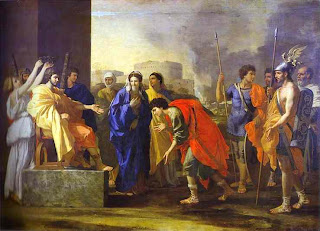
This painting of him celebrates his reunion of a captured maiden and her fiance, when under the prevailing law he had every right to take her as a war prize. Not only that, he gave back the ransom her parents had sent to buy her liberty.
For those of you not familiar with the general who defeated Hannibal, here is his biography. He was noted not only for his military excellence, but for his attention to virtue.

This painting of him celebrates his reunion of a captured maiden and her fiance, when under the prevailing law he had every right to take her as a war prize. Not only that, he gave back the ransom her parents had sent to buy her liberty.
Driving is a Grandfathered Liberty
Frank J. is a comedy writer, but I think he's really on to something here.
Imagine if cars hadn’t been around for a century, but instead were just invented today. Is there any way they’d be approved for individual use? It’s an era of bans on incandescent bulbs; if you suggested putting millions of internal-combustion engines out there....
“So you’re proposing that people speed around in tons of metal? You must mean only really smart, well-trained people?”
“No. Everyone. Even stupid people."
“Won’t millions be killed?”
“Oh, no. Not that many. Just a little more than 40,000 a year.”
“And injuries?”
“Oh . . . millions.”
There’s no way that would get approved today.
Driving is basically a grandfathered freedom from back when people cared less about pollution and danger and valued progress and liberty over safety.The next question is, how long will this grandfathered freedom last?
Ignorance is Bliss
Wired talks about a study that appears to demonstrate that ignorance is good for democracy.
Not surprisingly, when the majority of animals had a strong preference to move to one location, the group moved there. Even when the majority’s preference was equal in strength to the minority’s preference, the majority won out. However, when the strength of the minority’s preference was increased past a certain threshold, the minority could dictate the group’s behavior. These results suggest that an opinionated minority can win out over a majority with weaker convictions.
Things got more interesting when the researchers added animals without a preference to the model. Under these conditions, even when the minority’s preference was extremely strong, the presence of the “uninformed” individuals actually returned control to the majority. The more uninformed individuals there were, the stronger this effect became (up to a point; eventually noise took over).
The researchers then used an experimental approach to ask the same questions using golden shiners, a very social species of fish known for their schooling behavior. Some fish were trained to swim to a yellow target in the tank, and some were trained to move toward a blue target. Intrinsically, the fish preferred the yellow target—even after training, their preference for the yellow target was stronger than their preference for the blue target. This created an natural way to test the researchers’ theories.
The results from these lab tests mirrored the findings of the computational model. When the minority of fish in the tank were those trained to go to the yellow target (meaning they had a strong preference for the option), they won out and the group went there. When untrained fish were introduced into the tank, however, the majority regained control, even though their preference for the blue target was weaker.In this country, we seem to move toward whatever a vocal minority wants, unless there is an opposing vocal minority: then, it has been my observation, the minority usually wins that has the worse idea. Perhaps we need more ignorance to straighten things out, although I'm also increasingly thinking that we just need less social tolerance for vocal minorities.
Rabbit in the Headlights
Author Jeff Wise specializes in the human response to fear. His book "Extreme Fear" examines how many people have coped with paralyzing danger, from wild animal attacks to forest fires to aircraft emergencies. He notes that exercise helps the brain cope with anxiety; nervous parachuters on their way to a drop perform better on mental puzzles like crosswords in proportion to their physical fitness. Another trick is either to be in control, or at least to visualize oneself in control. (I learned decades ago that imagining myself behind the throttle in a commercial aircraft cut way down on the fear of flying that used to afflict me from time to time.) Staying warm is surprisingly effective, too. Scuba divers without wetsuits tend to have more panic-related mishaps.
In a recent article for Popular Mechanics, Wise tries to unravel how an Air France co-pilot over the tropical Atlantic in 2009 could have responded so disastrously to anxiety-provoking severe weather and a relatively minor icing-up incident by putting his aircraft into a completely unnecessary and deadly stall. Part of the explanation may be that most of us lose our higher brain functions under the influence of extreme fear and must fall back on rote training. Repetitive training under high stress can be a life-saver, but the Air France pilot, unfortunately, fell back on a singularly inappropriate routine.
These recommendations are nothing very startling or new, except for one: studies show that having sex cuts down measurably on the fear of public speaking. Now they tell me.
I'm not sure if the movie "Three Kings" is one I'd recommend to this audience without reservations, but one line did stick with me. George Clooney counsels a terrified young recruit by explaining: "Here's how it works. You do the thing you're scared ****less of, and you get the courage afterwards, not before."
A Climate Skepticism Denialist
 Skepticism about skepticism: this is very meta. I followed a link from my favorite science compilation page, Not Exactly Rocket Science, to this article from a British blogger agonizing over recent polling data suggesting that the global warming narrative is losing steam in Great Britain. The number of her countrymen who believe claims about environmental threats are exaggerated is 37%, a sharp increase from the 24% with similar beliefs a decade ago. But she's quick to point out that data can be misleading, especially in the hands of media with an interest in presenting a narrative:
The survey also considered whether people agreed more with these two statements: “We worry too much about the future of the environment and not enough about prices and jobs today” and “People worry too much about human progress harming the environment”* (p95). From this, the BSA report argues that the public are more sceptical that a threat exists. I’m not sure that follows. Maybe, but it’s a jump to cite scepticism. It could just be that people think we worry too much. Perhaps they just think there are other things to worry about. As the report itself suggests, the “financial pinch” of the recession may well be having an impact on the ways people make choices about the environment. Or, perhaps people agree that climate change is happening, just that there is nothing we can do. Again, this doesn’t mean climate sceptics aren’t winning the communications battle here, I just mean I don’t necessarily see that from the data. It all rather depends on how we unpack and then define denialism/ climate scepticism, and I don’t think the report does that very clearly (not that it necessarily should, but we need to keep that lack of definition in mind when reading the data).The blogger also notes that, in evaluating sweeping claims, it's important to examine the source of the underlying data:
One final thing that bugged me about this report was that it didn’t really examine how and where people got their information about the environment from, and yet still felt able to make loose connections between the timing of Climategate and the apparent rise in scepticism. From the final pages: “we conclude that media coverage may make a difference – not least ‘new’ media and the internet ‘blogosphere’ where unfounded opinion can sometimes be favoured over scientific fact” (p106). The impact of the media on people’s understanding, reasoning and framing of any issue, perhaps in particular ones including esoteric expertise like climate science, is incredibly complex, and the BSA report writers should have known better. They should certainly know better than to make loose comments about unfounded opinion on blogosphere (which is a large, diverse and porous area of activity). I also don’t see how they can look at a change over ten years and say it has to be something that happened in 2009, no matter how much media ink was spilled. To their credit they do also say it could also be matter of fatigue and refer to financial cost, etc.Don't you hate it when people are secretive about their data sources? She concludes with this poignant plea:
Personally, I’d like to see them acknowledge that they don’t know and call for investment in more research here.The only thing missing was a demand for sounder science before society was expected to invest trillions of dollars and wreck the world economy to address a potentially non-existent threat. I do admire the blogger's choice of art, though:

RIP Christopher Hitchens
When the embassies of Denmark were burning around the globe, Christopher Hitchens organized the only protest I ever wanted to attend: a manifestation in support of the Mark. I went, and he was there giving speeches and talking to the press about "solidarity." The concept was one from his Trotsyite youth; by then he applied it to the defense of Western civilization instead.
His last piece was on Nietzsche, informed by his own intense suffering from the radiation cure that failed to save him.
In the brute physical world, and the one encompassed by medicine, there are all too many things that could kill you, don’t kill you, and then leave you considerably weaker. Nietzsche was destined to find this out in the hardest possible way, which makes it additionally perplexing that he chose to include the maxim in his 1889 anthology Twilight of the Idols. (In German this is rendered as Götzen-Dämmerung, which contains a clear echo of Wagner’s epic. Possibly his great quarrel with the composer, in which he recoiled with horror from Wagner’s repudiation of the classics in favor of German blood myths and legends, was one of the things that did lend Nietzsche moral strength and fortitude. Certainly the book’s subtitle—“How to Philosophize with a Hammer”—has plenty of bravado.)
In the remainder of his life, however, Nietzsche seems to have caught an early dose of syphilis, very probably during his first-ever sexual encounter, which gave him crushing migraine headaches and attacks of blindness and metastasized into dementia and paralysis. This, while it did not kill him right away, certainly contributed to his death and cannot possibly, in the meanwhile, be said to have made him stronger.In what follows he examined the intensity of his own suffering with a clear eye. It is a powerful piece, and it underlies why this morning finds us reading tributes to him from people who disagreed with him sharply. And that category includes almost everyone. Catholics were outraged by his attacks on Mother Theresa. Feminists hated his writings on women. Capitalists grind their teeth at his kind words for Trotsky; Leftists, at his support of the Iraq war.
Wherever he planted his flag, he defended it fearlessly: and in the vigor of his defense, even his enemies of the hour gained insight, and sharpened their steel. We are told we ought to love our enemies; this is the sort it is easy to love. Thus, not in spite but indeed because of his outrages, he has no want of men to mourn for him.
A Telephone Town Hall?
Apparently my congressman decided to call his entire district tonight to invite us to have a 'town hall' meeting by phone. That's about a hundred and fifty thousand people; I had no idea that you could run a teleconference with that many participants.
I write my congressman from time to time (in fact, I'd just written him today), but I had never spoken to him before. Listening to his comments, I learned several things about him.
1) He apparently does not believe that the 14th Amendment includes birthright citizenship, which he would like to end. I was under the impression that it does, but having looked into the controversy, it sounds like there may be an argument to be made here -- the question arises based on whether one is fully subject to the jurisdiction of the United States government or not. Children of ambassadors of foreign nations born in the United States, for example, are not granted citizenship.
I'm not sure that window is wide enough to admit of denying birthright citizenship to the children of illegal aliens, although I can see how one would structure an argument from it: 'If their parents had subjected themselves to our jurisdiction, they would not have been present to have the child on our soil. Thus...' etc.
2) He believes that the government is going "to destroy this country" if people do not begin demanding Constitutionally limited government.
3) He has confidence in the House, but thinks the Senate is broken. His contention is that the House has sent forward 28 bipartisan bills that would improve the jobs picture, but that Harry Reid in the Senate won't let them make the floor.
4) He was very quick to make sure that elderly citizens on the call understood that Social Security was secure. If they were afraid of cuts, he would ensure they understood that there was absolutely no proposal to cut 'a single penny' from their check.
5) However, when another citizen raised the possibility that there would not actually be elections in the fall -- due to some sort of Obama-led coup -- he did not offer the same level of reassurance. Whether that is pure politics, or because he has concerns about a coup, I could not say.
Still, I would have thought the danger of a coup was far more remote than the danger of cuts to Social Security. The question about Social Security (and Medicare and Medicaid and Federal Pensions) is not if they will be cut, but how much, and when, and which of the programs will suffer most. The danger of a coup is surely fantastic at this point: no left-leaning coup could be effected in the face of a military that would not support it, and an armed citizenry that would not support it.
6) He believes that regulations and taxes on business are the reason our economy is not recovering. In seeking advice on how to vote on the economy, he has chiefly sought such advice from small businessmen and factory owners. However, he also cited a conversation with Laffer, of the Laffer curve, whom he said had approved of his own bill on the subject of the economy (which bill will never, however, apparently pass the Harry-Reid-controlled-Senate; I think he had more to say about Sen. Reid than anyone else).
7) Not surprising given the district, but he is an outspoken Evangelical Christian. He did think to say something nice about Hanukkah at the end of the call, though; and he had earlier said that he was against all foreign aid except to Israel. ('We're borrowing money to give it away,' being the reason for opposing all foreign aid; but apparently Israel is worth it.)
All in all, an interesting experience -- and apparently he will be doing more such calls in the future.
I write my congressman from time to time (in fact, I'd just written him today), but I had never spoken to him before. Listening to his comments, I learned several things about him.
1) He apparently does not believe that the 14th Amendment includes birthright citizenship, which he would like to end. I was under the impression that it does, but having looked into the controversy, it sounds like there may be an argument to be made here -- the question arises based on whether one is fully subject to the jurisdiction of the United States government or not. Children of ambassadors of foreign nations born in the United States, for example, are not granted citizenship.
I'm not sure that window is wide enough to admit of denying birthright citizenship to the children of illegal aliens, although I can see how one would structure an argument from it: 'If their parents had subjected themselves to our jurisdiction, they would not have been present to have the child on our soil. Thus...' etc.
2) He believes that the government is going "to destroy this country" if people do not begin demanding Constitutionally limited government.
3) He has confidence in the House, but thinks the Senate is broken. His contention is that the House has sent forward 28 bipartisan bills that would improve the jobs picture, but that Harry Reid in the Senate won't let them make the floor.
4) He was very quick to make sure that elderly citizens on the call understood that Social Security was secure. If they were afraid of cuts, he would ensure they understood that there was absolutely no proposal to cut 'a single penny' from their check.
5) However, when another citizen raised the possibility that there would not actually be elections in the fall -- due to some sort of Obama-led coup -- he did not offer the same level of reassurance. Whether that is pure politics, or because he has concerns about a coup, I could not say.
Still, I would have thought the danger of a coup was far more remote than the danger of cuts to Social Security. The question about Social Security (and Medicare and Medicaid and Federal Pensions) is not if they will be cut, but how much, and when, and which of the programs will suffer most. The danger of a coup is surely fantastic at this point: no left-leaning coup could be effected in the face of a military that would not support it, and an armed citizenry that would not support it.
6) He believes that regulations and taxes on business are the reason our economy is not recovering. In seeking advice on how to vote on the economy, he has chiefly sought such advice from small businessmen and factory owners. However, he also cited a conversation with Laffer, of the Laffer curve, whom he said had approved of his own bill on the subject of the economy (which bill will never, however, apparently pass the Harry-Reid-controlled-Senate; I think he had more to say about Sen. Reid than anyone else).
7) Not surprising given the district, but he is an outspoken Evangelical Christian. He did think to say something nice about Hanukkah at the end of the call, though; and he had earlier said that he was against all foreign aid except to Israel. ('We're borrowing money to give it away,' being the reason for opposing all foreign aid; but apparently Israel is worth it.)
All in all, an interesting experience -- and apparently he will be doing more such calls in the future.
Subscribe to:
Posts (Atom)