There's Something Odd About this Test

Harvard's Project Implicit has an interesting set of tests online, which are meant to show you where your implicit biases may be.  You may be strongly or moderately biased toward light skinned people, for example -- if their tests are accurate, 56% of people are.

However, there's something strange about the methodology that I can't quite place.  It's based on how fast you can process words and images.  I took the religion test, and it tells me that my biases work out this way:

Strongest positive bias:  Islam
Moderate positive bias:  Christianity/Judiasm (tie)
Less positive bias:  Hinduism

Now, while I make no bones about having some biases in this department, I'm pretty sure that isn't an accurate picture of how my biases actually shake out.  I can understand how this method would lead to a bad result on Hinduism:  of course there will be a processing delay there, because Hindu concepts aren't something my brain uses often.  I have to take the instant to remember what "karma" is before I can sort the word, and the concept is packed back in the back of the brain.  

The other religions have concepts I use regularly, so naturally they would come out on top.  If you were to ask me, though, I would think I had the strongest bias toward Christianity.  That suggests there is something odd about the method of determining biases; otherwise, I'd have to accept the existence of an unconscious bias in favor of Islam over my own faith.  I think I do have a stronger pro-Islam bias than many Americans, having known some very brave Muslims that I liked and admired, but still, that seems unlikely.

A Failure of Education


"Faith in humanity," yes.  However, there is a little matter of physics.

It takes a train more than a mile to stop once it begins to apply the brakes. Even if the engineer has very good eyes, then, he may just kill your 4-year-old child simply because the train won't stop in time to do otherwise.

Well, 4-year-olds are nimble. Not like you tied her to the track, I hope?


Atholl Highlanders

Honestly, the pipes never get old.

Speak, of the Old Things:

For Barnabas and his Gentile Christian followers, the covenant between God and the Jews was a sham; it was never ratified. When, bringing down the Law from Sinai, Moses saw that the Jews were engaged in the worship of the golden calf, he smashed into pieces the two stone tablets inscribed by God's hand, and thus rendered the Jewish covenant null and void. It had to be replaced by the covenant sealed by the redemptive blood of the "beloved Jesus" in the heart of the Christians (Barn. 4. 6-8; 14. 1-7). 
Barnabas's portrait of Jesus is considerably more advanced than the Didache's "Servant" of God. He calls Jesus "the Son" or "the Son of God" no less than a dozen times. This "Son of God" had existed since all eternity and was active before the creation of the world. It was to this pre-existent Jesus that at the time of "the foundation of the world" God addressed the words, "Let us make man according to our image and likeness" (Barn. 5.5; 6.12). The quasi-divine character of Jesus is implied when Barnabas explains that the Son of God took on a human body because without such a disguise no one would have been able to look at him and stay alive (Barn. 5. 9-10). 
The ultimate purpose of the descent of "the Lord of the entire world" among men was to enable himself to suffer "in order to destroy death and show that there is resurrection" (Barn. 5. 5-6). We are in, and perhaps slightly beyond, the Pauline-Johannine vision of Christ and his work of salvation. 
The type of outlook represented by the Didache has no place in the religious vision of Barnabas. The parting of the ways between Jewish and Gentile Christianity is manifest already at this stage and the Epistle of Barnabas marks the start of the future doctrinal evolution of the church on exclusively Gentile lines. Half a century after Barnabas, for the bishop of Sardis, Melito, the Jews are judged guilty of deicide: "God has been murdered...by the right hand of Israel" (Paschal Homily 96). Jewish Christianity makes no sense any longer.

The Didache is the last flowering of Judaeo-Christianity. In the second century, and especially after the suppression of the second revolt of the Jews by Hadrian in 135 CE, its decline began.
And it fell, as Chesterton said of Carthage, like nothing has fallen since... well, perhaps the image is inapt here.  If it is, though, we might ask just why.

Christmas Cookies


When you cut them with a knife before baking, the shape aftewards is inexact; but this a cross pattée (or "Cross Patty" in English-language heraldry).  Some few of you will understand why that is the right cross for this house; but for the rest of you, isn't it cool to have a sugar cookie that is nearly four inches square?

An Argument for Polyandry

Since we're on the subject of the pipes, and since we've walked this ground in great detail this year, here's a counterargument to Aquinas' concern that polyandry is against nature.

Once Again, Ready for the Solstice

No danger this year of the sun's not coming back out of the cave.

A Wee Walk Around the Office:


One wonders two things:  how anyone did anything at work that day; and why we have accepted a society in which men sit in cubicles instead of playing the warpipes.

No, really.  Why do we do this?  So we can pay for this?  So those programs can pay for this?  We spend a lot of our lives on wasted garbage, which we have every right to hate:  most of it accomplishes nothing beyond satisfying the internal urges of some bureaucracy, and for what?

We who work could work a lot less if we were working only for ourselves, and those we love.  I wonder why we endure it.  Charity to the poor is a great good, so I have heard:  faith, hope, and charity.  Yet we have passed charity, which encourages the virtues, and moved to a thing which seems to destroy them.

So, What Do You Say...

...is it the new Bluesmobile, or what?

Gloria!


But you must think you know a more familiar version of the lyric "Gloria In Excelsis Deo."  As, indeed, you do.

Einarr Þambarskelfir

It occurs to me that there may be a few of you -- I trust not too many -- who are unmoved by the opening line of Mr. Walker's description of his book.  "Who is Olav Trygvasson," you few may be asking, "and why should I care that he is dead?"

Well, now!  You few have missed a tale.


Once, Olav Trygvasson sailed against the forces of a man, a man who had driven his own wife from his arms.  She had come to Olav, declared herself a free woman, and married him.  He in turn set out to defend her rights.  Yet she was the former wife of a powerful king, Burislav, who held her still to be his own; and she was the sister of the king of the Danemark, who wished to see Norway brought under his own command.

So it was that Olav's fleet came under the combined assault of Danish and Wendish fleets, with Swedish allies.  Olav sailed in the most famous Viking ship to grace the sagas, a mighty warship named Ormen Lange, "The Long Serpent."  He saw the enemy coming, and made ready for battle.

The Viking war-band, as the Anglo-Saxons before them, preferred to fight with a shield-wall.  This meant a band of men at the front of their effort locked shields together, and lashed over them with axe or sword or, most likely, spear.  Ranks of spearmen stood behind them to reinforce the shield-wall, to prevent cavalry from simply jumping it, and to step into the ranks of anyone killed.  The shield-wall formation was powerful as long as the cavalry opposing it did not overwhelm its ability to countermaneuver.  There are few horses on these ships, though, and so that danger is readily faced.

In order to facilitate the shield-wall, the warriors of each side lashed their ships together into long lines.  The business then was to drive into your enemy's line with your wall, and push to the rear, clearing the ship of your enemies by slaying them or driving them into the sea.  Olav Trygvasson was a great warrior and a successful, so that his men fought under the comforting weight of mail -- and this gave them great staying power against their foes.

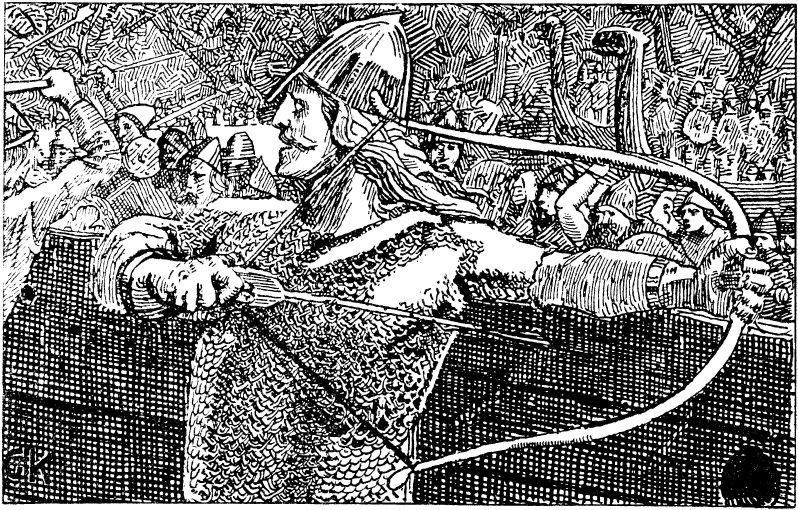
Yet I do not come to praise Olav Trygvasson, but one of his loyal friends.  Einarr Þambarskelfir was a true master of his craft:  in his case, the craft of archery.  When the weight of the foes facing Olav brought the enemy even onto the Long Serpent, Einarr made the difference.  He stood at the rear of the ship, by Olav, and shot with his mighty bow so that no one could withstand him.  That, until:

Einar Thambarskelfir, one of the sharpest of bowshooters, stood by the mast, and shot with his bow. Einar shot an arrow at Earl Eirik [...] Then said the earl to a man called Finn, [...] "Shoot that tall man by the mast." Finn shot; and the arrow hit the middle of Einar's bow just at the moment that Einar was drawing it, and the bow was split in two parts. "What is that," cried King Olaf, "that broke with such a noise?" "Norway, king, from your hands," cried Einar. "No! not quite so much as that," says the king; "take my bow, and shoot," flinging the bow to him. Einar took the bow, and drew it over the head of the arrow. "Too weak, too weak," said he, "for the bow of a mighty king!" and, throwing the bow aside, he took sword and shield, and fought Valiantly.
Einarr, too strong for the king's bow, survived the battle that Olav Trygvasson did not.  In later years he made himself master of Norway by his own hand, and in spite of the designs of kings... but that, though true, is another story.

The Christmas Gift Thread

It's getting to the point at which we are thinking about provisioning gifts to commemorate the holidays, and show respect, friendship, or love.

In addition to showing respect or friendship to those to whom we give the gifts, though, we can do so also to those whose creations we choose as gifts.  I'd like to make some recommendations, and then throw the discussion open for your suggestions.  The idea should be that we highlight as potential gifts things made by our friends, and/or those we respect and wish to encourage in their arts.

Books:

West Oversea, by Lars Walker. "King Olaf Trygvesson is dead, but his sister’s husband, Erling Skjalgsson, carries on his dream of a Christian Norway that preserves its traditional freedoms. Rather than do a dishonorable deed, Erling relinquishes his power and lands. He and his household board ships and sail west..."


Tale of the Tigers, by Julianne Ochieng.  "What is the Tale of the Tigers?  At a southwestern university, a young man and a young woman do something that’s done every day: they fall in love. There’s just one thing–he’s white and she’s black. Set in the early 1990s, Tale of the Tigers tells the story of how the tables have turned on race relations and sexual jealousy and of how two young Americans weather the storm of that heritage in the post-Civil Rights Era."

Music:

I met and was very impressed by the harpist Sarah Marie Mullen.  I'd like to recommend her music, especially for those interested in the Celtic harp; but she is classically trained and, particularly in Harper's Bizarre, extends to French, Andalusian, and some eastern European forms.

Weapons of War:

I would appreciate suggestions from you in this area.  Of the three best weaponsmiths I knew, one died last year; another gave up his work due to arthritis; the third went out of business due to the economy.  I know no craftsman whose work in steel suits me, although there are some reasonably good production companies now.

Tradition?

Today's xkcd:


It happens this is also the answer to the problem posed in this article on the stagnation of culture:
Rewind any other 20-year chunk of 20th-century time. There’s no chance you would mistake a photograph or movie of Americans or an American city from 1972—giant sideburns, collars, and bell-bottoms, leisure suits and cigarettes, AMC Javelins and Matadors and Gremlins alongside Dodge Demons, Swingers, Plymouth Dusters, and Scamps—with images from 1992. Time-travel back another 20 years, before rock ’n’ roll and the Pill and Vietnam, when both sexes wore hats and cars were big and bulbous with late-moderne fenders and fins—again, unmistakably different, 1952 from 1972. You can keep doing it...

Look at people on the street and in malls—jeans and sneakers remain the standard uniform for all ages, as they were in 2002, 1992, and 1982. Look through a current fashion or architecture magazine or listen to 10 random new pop songs; if you didn’t already know they were all things from the 2010s, I guarantee you couldn’t tell me with certainty they weren’t from the 2000s or 1990s or 1980s or even earlier. (The first time I heard a Josh Ritter song a few years ago, I actually thought it was Bob Dylan.)
The 1980s were the era when the Baby Boomers grew up, reached their late 30s and crossed into their 40s.   They stopped wanting anything new about that time, and settled into middle age.  The culture locked down with them, because the size of their cohort means that advertising, the movies, all the cultural industries look to them first and last.

If you were born in the 1980s, then, the world you know has never changed in any serious way.  The political parties have always occupied the same basic positions:  Reagan was the last sea change.  You don't remember JFK, so Democrats have always been anti-war.

If this demographic trend is as suggestive as it seems to be, American culture will not change much for another twenty years or so.  There are a lot of interesting things going on, but they're going on in corners:  they'll not have a chance to influence the big show.

Let's Have Some Oratorio -

It's the season of Handel, the missus and I are going to see one of his operas this weekend, it's also close to Hannukah, and I don't need an excuse anyway. An old favorite of mine:

Let's Have a Song

A good song of Scotland:


From the Baltimore Consort, an amazing group that I have somehow never managed to arrange to see live.  They're one of the best early music groups performing today.  Those of you in the D.C. area should take advantage of your proximity, and arrange to hear them play.

One for Lars

From Medievalists.net:  "Archaeologists uncover early Christian community in Norway."

Against Rape

The Pennsylvania liquor board has pulled an anti-rape ad that it developed, over charges that the ad consists in blaming the victim.  Here's the text of the ad:

"SHE DIDN'T WANT TO DO IT, BUT SHE COULDN'T SAY NO:  When your friends drink, they can end up making bad decisions like going home with someone they don't know very well.  Decisions like that leave them vulnerable to dangers like date rape.  Help your friends stay in control and stay safe."

The website Jezebel objects:
Rape is not just a bad thing that happens to someone after drinking too much, a wave of nausea that ends in vomit that smells like Red Bull. It's not something the victim conjures up with a mixture of alcohol and phermones. It's a deliberate act on the part of the rapist, a violation of another person committed solely because the rapist wanted to rape. The sooner we acknowledge this, the sooner we'll be rid of stupid, finger wagging ads like these.
I'm not a big fan of public service ads like these either.  However, if we're going to have them, it is important that they be able to speak the truth.

As our co-blogger Joseph W. points out, from his perspective as a JAG lawyer, the ties between alcohol and rape are undeniable.  If we're going to flood the airwaves with warnings about not letting your friends drink and drive, why not ads that warn that you should probably not let your friends go home drunk with strangers?

To say that is not in any way to justify rape.  We can still place the full weight of the crime upon the shoulders of the rapist.  There is no suggestion that the woman deserves to be raped.  All that is being said is that she is vulnerable to being raped in this condition, and therefore you who are her friends ought to watch out for her.

I understand the objection to similar statements about wearing short skirts, but this ad is crucially different.  If you say "Don't wear a short skirt if you don't want to be raped," you do seem to be setting up a limit on women's behavior and free expression as a kind of price for safety.  This ad does not do that, however:  it doesn't suggest that women shouldn't drink.  It does suggest that they be responsible about it, but that's good advice for a whole host of reasons.  Yet even that is not a limit on women's behavior:  what the ad ends up advising is that if your friend decides to get really drunk, you should help her watch out for her safety.

This provokes another quote from the Havamal, a poem that is coming up surprisingly often when discussing feminist issues:
A better burden can no man bear
on the way than his mother wit:
and no worse provision can he carry with him
than too deep a draught of ale.

Less good than they say for the sons of men
is the drinking oft of ale:
for the more they drink, the less can they think
and keep a watch o'er their wits.
That's as true for women as for men.  The truth is no insult.  I hold it to be true that rapists should be hanged, and that women should not in any way be blamed for having been raped.  I also hold it to be true that it is wise to keep an eye on how much you drink, and in what company, and not to drink very much if you are not with people you trust completely.  I also hold it to be true that, if your friend happens to get really smashed, you have a duty as a friend to make sure they get home in one piece.

Why is it so difficult to speak these simple truths when it comes to rape, as opposed to avoiding the danger of being beaten and robbed in an alley?  Via Lars Walker, a report from Norway:


Lars notes the response of Norway's justice minister to the report:
After a police report in Oslo said that Muslims were raping Norwegian women out of a religious conviction that this was the proper thing to do,  a stormy public debate erupted, reports Bello, and “the government ministers, most of them avowed anti-Semites, claimed that the report and its publication serve Israel and its policy of occupation.” 
Norway’s justice minister defended the police report but also said that “Israel must be glad to hear about it.”
Do you comprehend the breathtaking Orwellianism here? “If we talk about the one thing these rapists have in common, we'll look like Nazis. Therefore, to distance ourselves from the Nazis, we'll find a way to scapegoat the Israelis.” 
We need to be able to speak the truth in these matters.  If we cannot speak the truth, it would be better to say nothing at all.

Even if you prefer to say nothing, however, your duty to your friends remains.  This is what friendship means:  it means we take care of each other.

Michele Bachmann's Path to Victory

So I got this video via email from the campaign.


It's certainly true that she doesn't waver.  I can't argue against that proposition:  it's why I stopped supporting her.  She doesn't waver even when she's wrong.

Still, consider the argument.  She is who she says she is, at least; and she's no cronyist, and no elite.  I doubt she wins Iowa, but if she does consolidate a strong position early in spite of polling data and what we might expect?  We could do worse, I suppose, in spite of everything.

Y Gododdin

Before the battle of Stirling Bridge, William Wallace watched from hiding on a hilltop as the English force began to cross the river below.  That hilltop had been the site of an ancient fort:
A hillfort comprising a single oval bank with another rampart 30m further down the slope, was first recorded on the summit in the 18th century. Originally interpreted as the camp of Wallace’s troops, recent investigations revealed the structure was much older, as charcoal recovered from the inner rampart returned a radiocarbon date of AD 560-730. 
Stirling Council Archaeology Officer Murray Cook, who in September led a community excavation at the site, said this means the fort could have been one of the main centres of the Gododdin, a Britonnic people who lived in northeast England and southern Scotland. Part of this tribe formed the kingdom of Manaw, which local place names such as Clackmannan and Slamannan suggest could have included the area around Abbey Craig. But this high-status settlement also appears to have come to a dramatic end, destroyed by a fire so intense that its stones fused together.
Gododdin was one of the kingdoms of the Old North, now almost forgotten.  There was a time when these kingdoms were the frontier of our civilization, but few now even know their names.  Its companion, Ystrad Clud, is remembered now only as 'Strathclyde,' which used to have administrative functions within Scotland.

As for Gododdin, it is chiefly remembered for a single verse from its surviving poetry:
He fed black ravens on the rampart of a fortress
Though he was no Arthur
Among the powerful ones in battle
In the front rank, Gwawrddur was a palisade.
This is often taken to be the earliest surviving reference to the man we know as King Arthur.  The reference  assumes its audience needs no explanation of why a raven-feeder, a palisade in the front ranks of battle, is not shamed by the comparison.