
A Wee Walk Around the Office:
One wonders two things: how anyone did anything at work that day; and why we have accepted a society in which men sit in cubicles instead of playing the warpipes.
No, really. Why do we do this? So we can pay for this? So those programs can pay for this? We spend a lot of our lives on wasted garbage, which we have every right to hate: most of it accomplishes nothing beyond satisfying the internal urges of some bureaucracy, and for what?
We who work could work a lot less if we were working only for ourselves, and those we love. I wonder why we endure it. Charity to the poor is a great good, so I have heard: faith, hope, and charity. Yet we have passed charity, which encourages the virtues, and moved to a thing which seems to destroy them.

Gloria!
But you must think you know a more familiar version of the lyric "Gloria In Excelsis Deo." As, indeed, you do.
Einarr Þambarskelfir
It occurs to me that there may be a few of you -- I trust not too many -- who are unmoved by the opening line of Mr. Walker's description of his book. "Who is Olav Trygvasson," you few may be asking, "and why should I care that he is dead?"
Well, now! You few have missed a tale.

Once, Olav Trygvasson sailed against the forces of a man, a man who had driven his own wife from his arms. She had come to Olav, declared herself a free woman, and married him. He in turn set out to defend her rights. Yet she was the former wife of a powerful king, Burislav, who held her still to be his own; and she was the sister of the king of the Danemark, who wished to see Norway brought under his own command.
So it was that Olav's fleet came under the combined assault of Danish and Wendish fleets, with Swedish allies. Olav sailed in the most famous Viking ship to grace the sagas, a mighty warship named Ormen Lange, "The Long Serpent." He saw the enemy coming, and made ready for battle.
The Viking war-band, as the Anglo-Saxons before them, preferred to fight with a shield-wall. This meant a band of men at the front of their effort locked shields together, and lashed over them with axe or sword or, most likely, spear. Ranks of spearmen stood behind them to reinforce the shield-wall, to prevent cavalry from simply jumping it, and to step into the ranks of anyone killed. The shield-wall formation was powerful as long as the cavalry opposing it did not overwhelm its ability to countermaneuver. There are few horses on these ships, though, and so that danger is readily faced.
In order to facilitate the shield-wall, the warriors of each side lashed their ships together into long lines. The business then was to drive into your enemy's line with your wall, and push to the rear, clearing the ship of your enemies by slaying them or driving them into the sea. Olav Trygvasson was a great warrior and a successful, so that his men fought under the comforting weight of mail -- and this gave them great staying power against their foes.
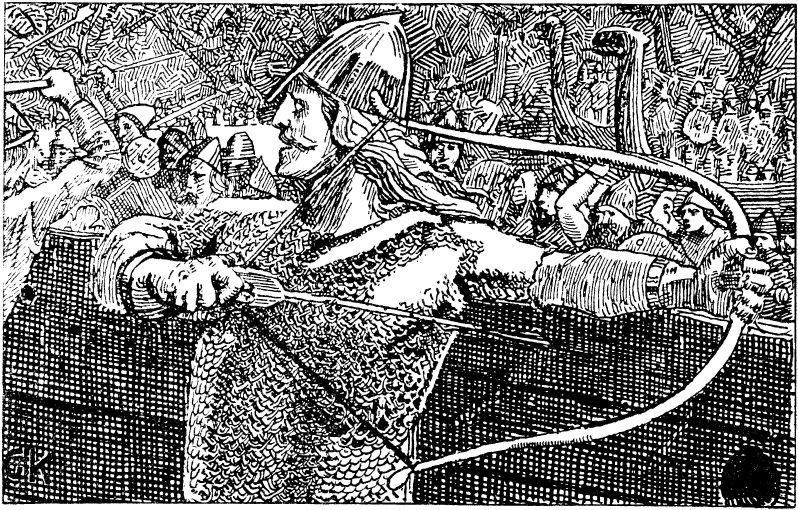
Yet I do not come to praise Olav Trygvasson, but one of his loyal friends. Einarr Þambarskelfir was a true master of his craft: in his case, the craft of archery. When the weight of the foes facing Olav brought the enemy even onto the Long Serpent, Einarr made the difference. He stood at the rear of the ship, by Olav, and shot with his mighty bow so that no one could withstand him. That, until:
Well, now! You few have missed a tale.
Once, Olav Trygvasson sailed against the forces of a man, a man who had driven his own wife from his arms. She had come to Olav, declared herself a free woman, and married him. He in turn set out to defend her rights. Yet she was the former wife of a powerful king, Burislav, who held her still to be his own; and she was the sister of the king of the Danemark, who wished to see Norway brought under his own command.
So it was that Olav's fleet came under the combined assault of Danish and Wendish fleets, with Swedish allies. Olav sailed in the most famous Viking ship to grace the sagas, a mighty warship named Ormen Lange, "The Long Serpent." He saw the enemy coming, and made ready for battle.
The Viking war-band, as the Anglo-Saxons before them, preferred to fight with a shield-wall. This meant a band of men at the front of their effort locked shields together, and lashed over them with axe or sword or, most likely, spear. Ranks of spearmen stood behind them to reinforce the shield-wall, to prevent cavalry from simply jumping it, and to step into the ranks of anyone killed. The shield-wall formation was powerful as long as the cavalry opposing it did not overwhelm its ability to countermaneuver. There are few horses on these ships, though, and so that danger is readily faced.
In order to facilitate the shield-wall, the warriors of each side lashed their ships together into long lines. The business then was to drive into your enemy's line with your wall, and push to the rear, clearing the ship of your enemies by slaying them or driving them into the sea. Olav Trygvasson was a great warrior and a successful, so that his men fought under the comforting weight of mail -- and this gave them great staying power against their foes.
Yet I do not come to praise Olav Trygvasson, but one of his loyal friends. Einarr Þambarskelfir was a true master of his craft: in his case, the craft of archery. When the weight of the foes facing Olav brought the enemy even onto the Long Serpent, Einarr made the difference. He stood at the rear of the ship, by Olav, and shot with his mighty bow so that no one could withstand him. That, until:
Einar Thambarskelfir, one of the sharpest of bowshooters, stood by the mast, and shot with his bow. Einar shot an arrow at Earl Eirik [...] Then said the earl to a man called Finn, [...] "Shoot that tall man by the mast." Finn shot; and the arrow hit the middle of Einar's bow just at the moment that Einar was drawing it, and the bow was split in two parts. "What is that," cried King Olaf, "that broke with such a noise?" "Norway, king, from your hands," cried Einar. "No! not quite so much as that," says the king; "take my bow, and shoot," flinging the bow to him. Einar took the bow, and drew it over the head of the arrow. "Too weak, too weak," said he, "for the bow of a mighty king!" and, throwing the bow aside, he took sword and shield, and fought Valiantly.Einarr, too strong for the king's bow, survived the battle that Olav Trygvasson did not. In later years he made himself master of Norway by his own hand, and in spite of the designs of kings... but that, though true, is another story.
The Christmas Gift Thread
It's getting to the point at which we are thinking about provisioning gifts to commemorate the holidays, and show respect, friendship, or love.
In addition to showing respect or friendship to those to whom we give the gifts, though, we can do so also to those whose creations we choose as gifts. I'd like to make some recommendations, and then throw the discussion open for your suggestions. The idea should be that we highlight as potential gifts things made by our friends, and/or those we respect and wish to encourage in their arts.
Books:
West Oversea, by Lars Walker. "King Olaf Trygvesson is dead, but his sister’s husband, Erling Skjalgsson, carries on his dream of a Christian Norway that preserves its traditional freedoms. Rather than do a dishonorable deed, Erling relinquishes his power and lands. He and his household board ships and sail west..."
Tale of the Tigers, by Julianne Ochieng. "What is the Tale of the Tigers? At a southwestern university, a young man and a young woman do something that’s done every day: they fall in love. There’s just one thing–he’s white and she’s black. Set in the early 1990s, Tale of the Tigers tells the story of how the tables have turned on race relations and sexual jealousy and of how two young Americans weather the storm of that heritage in the post-Civil Rights Era."
Music:
I met and was very impressed by the harpist Sarah Marie Mullen. I'd like to recommend her music, especially for those interested in the Celtic harp; but she is classically trained and, particularly in Harper's Bizarre, extends to French, Andalusian, and some eastern European forms.
Weapons of War:
I would appreciate suggestions from you in this area. Of the three best weaponsmiths I knew, one died last year; another gave up his work due to arthritis; the third went out of business due to the economy. I know no craftsman whose work in steel suits me, although there are some reasonably good production companies now.
In addition to showing respect or friendship to those to whom we give the gifts, though, we can do so also to those whose creations we choose as gifts. I'd like to make some recommendations, and then throw the discussion open for your suggestions. The idea should be that we highlight as potential gifts things made by our friends, and/or those we respect and wish to encourage in their arts.
Books:
West Oversea, by Lars Walker. "King Olaf Trygvesson is dead, but his sister’s husband, Erling Skjalgsson, carries on his dream of a Christian Norway that preserves its traditional freedoms. Rather than do a dishonorable deed, Erling relinquishes his power and lands. He and his household board ships and sail west..."
Tale of the Tigers, by Julianne Ochieng. "What is the Tale of the Tigers? At a southwestern university, a young man and a young woman do something that’s done every day: they fall in love. There’s just one thing–he’s white and she’s black. Set in the early 1990s, Tale of the Tigers tells the story of how the tables have turned on race relations and sexual jealousy and of how two young Americans weather the storm of that heritage in the post-Civil Rights Era."
Music:
I met and was very impressed by the harpist Sarah Marie Mullen. I'd like to recommend her music, especially for those interested in the Celtic harp; but she is classically trained and, particularly in Harper's Bizarre, extends to French, Andalusian, and some eastern European forms.
Weapons of War:
I would appreciate suggestions from you in this area. Of the three best weaponsmiths I knew, one died last year; another gave up his work due to arthritis; the third went out of business due to the economy. I know no craftsman whose work in steel suits me, although there are some reasonably good production companies now.
Tradition?
Today's xkcd:

It happens this is also the answer to the problem posed in this article on the stagnation of culture:
If you were born in the 1980s, then, the world you know has never changed in any serious way. The political parties have always occupied the same basic positions: Reagan was the last sea change. You don't remember JFK, so Democrats have always been anti-war.
If this demographic trend is as suggestive as it seems to be, American culture will not change much for another twenty years or so. There are a lot of interesting things going on, but they're going on in corners: they'll not have a chance to influence the big show.
It happens this is also the answer to the problem posed in this article on the stagnation of culture:
Rewind any other 20-year chunk of 20th-century time. There’s no chance you would mistake a photograph or movie of Americans or an American city from 1972—giant sideburns, collars, and bell-bottoms, leisure suits and cigarettes, AMC Javelins and Matadors and Gremlins alongside Dodge Demons, Swingers, Plymouth Dusters, and Scamps—with images from 1992. Time-travel back another 20 years, before rock ’n’ roll and the Pill and Vietnam, when both sexes wore hats and cars were big and bulbous with late-moderne fenders and fins—again, unmistakably different, 1952 from 1972. You can keep doing it...The 1980s were the era when the Baby Boomers grew up, reached their late 30s and crossed into their 40s. They stopped wanting anything new about that time, and settled into middle age. The culture locked down with them, because the size of their cohort means that advertising, the movies, all the cultural industries look to them first and last.
Look at people on the street and in malls—jeans and sneakers remain the standard uniform for all ages, as they were in 2002, 1992, and 1982. Look through a current fashion or architecture magazine or listen to 10 random new pop songs; if you didn’t already know they were all things from the 2010s, I guarantee you couldn’t tell me with certainty they weren’t from the 2000s or 1990s or 1980s or even earlier. (The first time I heard a Josh Ritter song a few years ago, I actually thought it was Bob Dylan.)
If you were born in the 1980s, then, the world you know has never changed in any serious way. The political parties have always occupied the same basic positions: Reagan was the last sea change. You don't remember JFK, so Democrats have always been anti-war.
If this demographic trend is as suggestive as it seems to be, American culture will not change much for another twenty years or so. There are a lot of interesting things going on, but they're going on in corners: they'll not have a chance to influence the big show.
Let's Have Some Oratorio -
It's the season of Handel, the missus and I are going to see one of his operas this weekend, it's also close to Hannukah, and I don't need an excuse anyway. An old favorite of mine:
Let's Have a Song
A good song of Scotland:
From the Baltimore Consort, an amazing group that I have somehow never managed to arrange to see live. They're one of the best early music groups performing today. Those of you in the D.C. area should take advantage of your proximity, and arrange to hear them play.
From the Baltimore Consort, an amazing group that I have somehow never managed to arrange to see live. They're one of the best early music groups performing today. Those of you in the D.C. area should take advantage of your proximity, and arrange to hear them play.
Against Rape
The Pennsylvania liquor board has pulled an anti-rape ad that it developed, over charges that the ad consists in blaming the victim. Here's the text of the ad:
"SHE DIDN'T WANT TO DO IT, BUT SHE COULDN'T SAY NO: When your friends drink, they can end up making bad decisions like going home with someone they don't know very well. Decisions like that leave them vulnerable to dangers like date rape. Help your friends stay in control and stay safe."
The website Jezebel objects:
As our co-blogger Joseph W. points out, from his perspective as a JAG lawyer, the ties between alcohol and rape are undeniable. If we're going to flood the airwaves with warnings about not letting your friends drink and drive, why not ads that warn that you should probably not let your friends go home drunk with strangers?
To say that is not in any way to justify rape. We can still place the full weight of the crime upon the shoulders of the rapist. There is no suggestion that the woman deserves to be raped. All that is being said is that she is vulnerable to being raped in this condition, and therefore you who are her friends ought to watch out for her.
I understand the objection to similar statements about wearing short skirts, but this ad is crucially different. If you say "Don't wear a short skirt if you don't want to be raped," you do seem to be setting up a limit on women's behavior and free expression as a kind of price for safety. This ad does not do that, however: it doesn't suggest that women shouldn't drink. It does suggest that they be responsible about it, but that's good advice for a whole host of reasons. Yet even that is not a limit on women's behavior: what the ad ends up advising is that if your friend decides to get really drunk, you should help her watch out for her safety.
This provokes another quote from the Havamal, a poem that is coming up surprisingly often when discussing feminist issues:
Why is it so difficult to speak these simple truths when it comes to rape, as opposed to avoiding the danger of being beaten and robbed in an alley? Via Lars Walker, a report from Norway:
Lars notes the response of Norway's justice minister to the report:
Even if you prefer to say nothing, however, your duty to your friends remains. This is what friendship means: it means we take care of each other.
"SHE DIDN'T WANT TO DO IT, BUT SHE COULDN'T SAY NO: When your friends drink, they can end up making bad decisions like going home with someone they don't know very well. Decisions like that leave them vulnerable to dangers like date rape. Help your friends stay in control and stay safe."
The website Jezebel objects:
Rape is not just a bad thing that happens to someone after drinking too much, a wave of nausea that ends in vomit that smells like Red Bull. It's not something the victim conjures up with a mixture of alcohol and phermones. It's a deliberate act on the part of the rapist, a violation of another person committed solely because the rapist wanted to rape. The sooner we acknowledge this, the sooner we'll be rid of stupid, finger wagging ads like these.I'm not a big fan of public service ads like these either. However, if we're going to have them, it is important that they be able to speak the truth.
As our co-blogger Joseph W. points out, from his perspective as a JAG lawyer, the ties between alcohol and rape are undeniable. If we're going to flood the airwaves with warnings about not letting your friends drink and drive, why not ads that warn that you should probably not let your friends go home drunk with strangers?
To say that is not in any way to justify rape. We can still place the full weight of the crime upon the shoulders of the rapist. There is no suggestion that the woman deserves to be raped. All that is being said is that she is vulnerable to being raped in this condition, and therefore you who are her friends ought to watch out for her.
I understand the objection to similar statements about wearing short skirts, but this ad is crucially different. If you say "Don't wear a short skirt if you don't want to be raped," you do seem to be setting up a limit on women's behavior and free expression as a kind of price for safety. This ad does not do that, however: it doesn't suggest that women shouldn't drink. It does suggest that they be responsible about it, but that's good advice for a whole host of reasons. Yet even that is not a limit on women's behavior: what the ad ends up advising is that if your friend decides to get really drunk, you should help her watch out for her safety.
This provokes another quote from the Havamal, a poem that is coming up surprisingly often when discussing feminist issues:
A better burden can no man bearThat's as true for women as for men. The truth is no insult. I hold it to be true that rapists should be hanged, and that women should not in any way be blamed for having been raped. I also hold it to be true that it is wise to keep an eye on how much you drink, and in what company, and not to drink very much if you are not with people you trust completely. I also hold it to be true that, if your friend happens to get really smashed, you have a duty as a friend to make sure they get home in one piece.
on the way than his mother wit:
and no worse provision can he carry with him
than too deep a draught of ale.
Less good than they say for the sons of men
is the drinking oft of ale:
for the more they drink, the less can they think
and keep a watch o'er their wits.
Why is it so difficult to speak these simple truths when it comes to rape, as opposed to avoiding the danger of being beaten and robbed in an alley? Via Lars Walker, a report from Norway:
Lars notes the response of Norway's justice minister to the report:
After a police report in Oslo said that Muslims were raping Norwegian women out of a religious conviction that this was the proper thing to do, a stormy public debate erupted, reports Bello, and “the government ministers, most of them avowed anti-Semites, claimed that the report and its publication serve Israel and its policy of occupation.”
We need to be able to speak the truth in these matters. If we cannot speak the truth, it would be better to say nothing at all.Norway’s justice minister defended the police report but also said that “Israel must be glad to hear about it.”Do you comprehend the breathtaking Orwellianism here? “If we talk about the one thing these rapists have in common, we'll look like Nazis. Therefore, to distance ourselves from the Nazis, we'll find a way to scapegoat the Israelis.”
Even if you prefer to say nothing, however, your duty to your friends remains. This is what friendship means: it means we take care of each other.
Michele Bachmann's Path to Victory
So I got this video via email from the campaign.
It's certainly true that she doesn't waver. I can't argue against that proposition: it's why I stopped supporting her. She doesn't waver even when she's wrong.
Still, consider the argument. She is who she says she is, at least; and she's no cronyist, and no elite. I doubt she wins Iowa, but if she does consolidate a strong position early in spite of polling data and what we might expect? We could do worse, I suppose, in spite of everything.
It's certainly true that she doesn't waver. I can't argue against that proposition: it's why I stopped supporting her. She doesn't waver even when she's wrong.
Still, consider the argument. She is who she says she is, at least; and she's no cronyist, and no elite. I doubt she wins Iowa, but if she does consolidate a strong position early in spite of polling data and what we might expect? We could do worse, I suppose, in spite of everything.
Y Gododdin
Before the battle of Stirling Bridge, William Wallace watched from hiding on a hilltop as the English force began to cross the river below. That hilltop had been the site of an ancient fort:
As for Gododdin, it is chiefly remembered for a single verse from its surviving poetry:
A hillfort comprising a single oval bank with another rampart 30m further down the slope, was first recorded on the summit in the 18th century. Originally interpreted as the camp of Wallace’s troops, recent investigations revealed the structure was much older, as charcoal recovered from the inner rampart returned a radiocarbon date of AD 560-730.
Stirling Council Archaeology Officer Murray Cook, who in September led a community excavation at the site, said this means the fort could have been one of the main centres of the Gododdin, a Britonnic people who lived in northeast England and southern Scotland. Part of this tribe formed the kingdom of Manaw, which local place names such as Clackmannan and Slamannan suggest could have included the area around Abbey Craig. But this high-status settlement also appears to have come to a dramatic end, destroyed by a fire so intense that its stones fused together.Gododdin was one of the kingdoms of the Old North, now almost forgotten. There was a time when these kingdoms were the frontier of our civilization, but few now even know their names. Its companion, Ystrad Clud, is remembered now only as 'Strathclyde,' which used to have administrative functions within Scotland.
As for Gododdin, it is chiefly remembered for a single verse from its surviving poetry:
He fed black ravens on the rampart of a fortressThis is often taken to be the earliest surviving reference to the man we know as King Arthur. The reference assumes its audience needs no explanation of why a raven-feeder, a palisade in the front ranks of battle, is not shamed by the comparison.
Though he was no Arthur
Among the powerful ones in battle
In the front rank, Gwawrddur was a palisade.
Bourbon in Your Eyes
Following on T99's post of lounge-singing in Morocco, here's a young lady doing it the American way.
Islamic Cleric Rules Men Should Do the Cooking
An Islamic cleric residing in Europe said that women should not be close to bananas or cucumbers, in order to avoid any “sexual thoughts.”
The unnamed sheikh, who was featured in an article on el-Senousa news, was quoted saying that if women wish to eat these food items, a third party, preferably a male related to them such as their a father or husband, should cut the items into small pieces and serve.Apparently we've got it all wrong, boys. All that foolishness about cooking your wife or girlfriend a good meal on date night? Just shooting yourself in the foot.
Medieval "PTSD"?
Or, a journalist discovers Geoffroi de Charny.
Oh, yes, by definition. But: "on the one hand / on the other hand"? What exactly is the conflict between being conscientious and being a warrior?
De Charny also suggested what the knights should do to resist the stress factors. He said knights should fight for a good cause to avoid succumbing to the pressures of war. A ‘good cause’ should be God’s cause – a war for a higher and just cause, to reinstate law and order – and not for personal gain.
“On the one hand we can see that de Charny was a very conscientious man – and in the Middle Ages conscience was regarded as God’s way of telling us how to relate to rights and wrongs.
“On the other hand, he was a warrior who took part in several wars over a period of 30 years, including a crusade to the city we call Ismir. War and crusades are by definition violent,” says Heebøll-Holm.
Oh, yes, by definition. But: "on the one hand / on the other hand"? What exactly is the conflict between being conscientious and being a warrior?
Hamiltonians versus Jeffersonians
This is a banner day for interesting articles. Dr. Mead has one in which he points out that both President Obama and Mr. Gingrich have declared themselves to be in the tradition of Theodore Roosevelt, and that Roosevelt himself would have told you he was in the tradition of Hamilton. The Jeffersonians, though one is in the race, aren't really in the hunt:
That fight was essentially over three things that divide us intensely today: the role of the federal government, the nature of the credit system, and the future of the social hierarchy. Alexander Hamilton favored a strong federal government at home and abroad, a centralized credit system similar to the British one with a Bank of the United States acting as our central bank, and believed that the best educated and most widely experienced people in the United States constituted a natural aristocracy and should play the leading role in our politics. Thomas Jefferson disagreed with virtually everything Hamilton believed. He wanted a weak federal government, detested Hamilton’s banking system, and feared that the alliance of a social elite with a powerful government and a strong central bank would turn the US into a European-style aristocratic or monarchical society.I've always thought of myself as a member of the Jeffersonian tradition in this regard. For reasons laid out yesterday, I don't think my side has any hope of recapturing the Presidency at any nearby point. I wouldn't have picked Ron Paul as the guidon-bearer for Jeffersonianism, though; after all, Jefferson was an expansionist, and fought the Barbary States.
Barbarians on the Thames
That is the title of Theodore Dalrymple's latest piece, which he describes as a postmortem on the British riots. He begins by denying the existence of final causes in history, which we were just discussing the other day:
Complex human events have no single or final explanation. The last word on the outbreak of looting and rioting that convulsed large parts of England, including London, in August will therefore never be heard. But some of the first words were foolish, or at least shallow, reflecting the typical materialistic assumptions of the intelligentsia.
As usual, he goes on to make some very good points.
What Does the Administration Mean By "Human Rights"?
I read an interesting headline at ABC News this morning: "Rick Perry Says Human Rights for Gays ‘Not in America’s Interests’."
Of course, I'm thinking, that can't be what he said. The man's had some trouble expressing himself clearly at times, but even so I couldn't imagine that anyone would say "human rights for gays are not in America's interests."
And of course, it turns out, that's not what he said at all. What he said was that special rights for gays were not in America's national security interests -- and that foreign aid decisions, which is what all this is about, should be based on national security interests and nothing else.
Secretary Clinton recently gave a speech in which she announced the policy change in which gay rights will be considered in making foreign aid decisions. However, she appears to deny the governor's premise that what is at issue are special rights, saying, "Gay rights are human rights, and human rights are gay rights."
There's nothing in her speech that suggests she is interested in "special" rights, and I'm not sure just what Governor Perry means by that. If he means that gays should not have a special right to redefine the basic institutions of society to suit them, I suppose I agree with him; but if he's opposed to the things Secretary Clinton was actually talking about, I don't think those include special rights at all.
Still, let's consider his statement a little more carefully. Here's the meat of his remarks:
This administration’s war on traditional American values must stop.....
But there is a troubling trend here beyond the national security nonsense inherent in this silly idea. This is just the most recent example of an administration at war with people of faith in this country. Investing tax dollars promoting a lifestyle many Americas of faith find so deeply objectionable is wrong.
Now, it is true that "people of faith" tend to be morally opposed to male homosexuality, not just in this country but in most countries. This is especially true in the countries Secretary Clinton is talking about when she says that being gay should never be a criminal offense -- that is generally true only in the Islamic world.
Secretary Clinton spoke to this issue directly, however, in a way that seems to make clear that the governor's concerns are not well founded.
Of course, it bears noting that rarely are cultural and religious traditions and teachings actually in conflict with the protection of human rights. Indeed, our religion and our culture are sources of compassion and inspiration toward our fellow human beings. It was not only those who’ve justified slavery who leaned on religion, it was also those who sought to abolish it. And let us keep in mind that our commitments to protect the freedom of religion and to defend the dignity of LGBT people emanate from a common source. For many of us, religious belief and practice is a vital source of meaning and identity, and fundamental to who we are as people. And likewise, for most of us, the bonds of love and family that we forge are also vital sources of meaning and identity. And caring for others is an expression of what it means to be fully human. It is because the human experience is universal that human rights are universal and cut across all religions and cultures.I generally hate the phrase "fully human" wherever I encounter it -- what is the point of the adjective here? -- and the last line is not quite right. Still, the objection I would raise to it is not that there aren't universal human rights, but that she's eliding past the true reason why they exist.
It happens to be true that Secretary Clinton is poking a finger in the eye of some people of faith, then: Iranian ones, though, not American ones. This is still a strange decision from an administration that declared it was going to rebuild relationships with the Islamic world, but I expect it's because they really believe in it enough to justify the hardship it's going to create for their diplomatic efforts.
That this comes at the same time that the US government is shutting down its commission on religious freedom is bad timing, but it's not the State Department's fault. The Senate is responsible for this because of the question of funding.
Now, Governor Perry may still be right that (a) foreign aid decisions should be based only on national security issues, and (b) this push is not only not going to help us in that regard, it's actually going to be harmful because it will further irritate relations with the Islamic world. I'm not sure I agree with (a), but if you do, (b) surely follows.
Subscribe to:
Posts (Atom)