I noticed with some pleasure that Congress has re-approved the slaughter of horses for meat today.
It's a terrible shame to see a horse put down for any cause. Human beings and horses get along very well, and in an ideal world more men and women would have the chance to have a relationship with a horse. Nevertheless, we are where we are, and the well-meaning attempt to ban the slaughter of horses has led to reliably worse results.
Horses who could no longer be slaughtered were instead left to starve. Instead of a quick and painless death, they were rendered economically worthless. The intention was, I suppose, that people should simply care for the animals until they died of old age; but rather predictably, what they did instead was refuse to lay out money for feed or hay for animals who could not promise any sort of economic return. Trapped on dry lots, with neither food nor water, they were left to perish in the most brutal conditions.
If they can be sold for meat, they'll be sold by weight. That means they'll eat, at least, until the end. This may seem unkind but it is far better. Good on Congress for getting one right, and for learning from its mistakes. Let's hope it points to a trend.


Today's Great Accomplishment
Today, my neighbor's dog Callie wandered up the hill from her home in the valley below. I generally like all dogs, and usually know all the neighbors' dogs (even if I don't know the neighbors, in which case I assign the dog a name. I do know this neighbor, though, a fine older gentleman and the owner-operator of a log-hauling semi).
Now, Callie loves to play fetch. So, I got a stick and threw it for her several times. My own dog, Buck, was there also, but Buck never learned to play fetch. I tried to teach him more than once over the years, but he would just watch the stick fly through the air and then look at me. "Oh, well," I thought, "I guess he's just not interested."
Callie sure was interested, though. She was running after the stick, biting the stick, and growling fiercely when I'd try to take the stick back from her.
Then one time I threw the stick through the air and Buck went chasing after it! I'd never been able to convey to him what I wanted him to do, but watching Callie he had suddenly worked out the rules of the game. Once he understood, he played with the same enthusiasm she has always shown.
There's the Order of Reason at work for you.
Now, Callie loves to play fetch. So, I got a stick and threw it for her several times. My own dog, Buck, was there also, but Buck never learned to play fetch. I tried to teach him more than once over the years, but he would just watch the stick fly through the air and then look at me. "Oh, well," I thought, "I guess he's just not interested."
Callie sure was interested, though. She was running after the stick, biting the stick, and growling fiercely when I'd try to take the stick back from her.
Then one time I threw the stick through the air and Buck went chasing after it! I'd never been able to convey to him what I wanted him to do, but watching Callie he had suddenly worked out the rules of the game. Once he understood, he played with the same enthusiasm she has always shown.
There's the Order of Reason at work for you.
I never know that anyone is "thinking," except insofar as they can communicate something to me that reminds me of the internal process I identify by the work "thinking."The lower animals are limited by the lack of language, and so they have a lesser access to the order than we have. Yet to see one observe a game and learn its rules, across species?
My Kind of Male Character
Since T99 is putting up the challenge, I suppose I ought to think about an example of what I like to see in how men are portrayed. I'd like to put forward an example from John Wayne -- Red River, surely, or Rio Bravo. But the truth is that my favorite of all is from a 1980s movie of no special fame.
This rendition of the end scene, if you don't know the movie, is just as good even in a foreign tongue.
Here is one who has learned to live in fellowship with a horse or a hawk or a sword, and thus has every strength that might bring glory to a man: but in spite of that he has not lost the most important thing. If you don't know the film, perhaps you should see it, though in truth the music is terrible. All the same, it may be the best we have ever done at capturing the ideal -- and at understanding the importance of lies and sin, embodied in the character portrayed by Matthew Broderick, in maintaining faith against the hardships of the world. It is those lies that turn the warrior from despair and even suicide, and sustain him until the hour when God's grace brings him joy.
There lies a subtle lesson.
This rendition of the end scene, if you don't know the movie, is just as good even in a foreign tongue.
Here is one who has learned to live in fellowship with a horse or a hawk or a sword, and thus has every strength that might bring glory to a man: but in spite of that he has not lost the most important thing. If you don't know the film, perhaps you should see it, though in truth the music is terrible. All the same, it may be the best we have ever done at capturing the ideal -- and at understanding the importance of lies and sin, embodied in the character portrayed by Matthew Broderick, in maintaining faith against the hardships of the world. It is those lies that turn the warrior from despair and even suicide, and sustain him until the hour when God's grace brings him joy.
There lies a subtle lesson.
My kind of female character
If they're going to show cleavage, this is how I'd prefer they did it. Ziva's no wimp, and she can sing, too.
I didn't realize until just now that that's a Tom Waits song.
Schadenfreude
Little Red's comment made me think of the lyrics to this politically incorrect old shape-note song, Greenwich (183), with its grim satisfaction at the comeuppance in store for rich and powerful villains:
Lord, what a thoughtless wretch was I
To mourn and murmur and repine
To see the wicked placed on high
In pride and robes of honor shine
But oh, their end, their dreadful end
Thy sanctuary taught me so
On slippery rocks I see them stand
And fiery billows roll below
There's nothing like this in my 1980 Episcopal hymnbook, I'll tell you that. It would give the editors the vapors just to hear it. Sure is fun to sing, though: "But oh, their end, their dreadful end . . . ."
Averroes
Now let us turn our attention to this article from Humanities on Averroes.
There is some good work here, but finally the author misses the point both on the history and the philosophy. Historically, the reason that the last Islamic philosopher of any weight was probably Averroes isn't the pressures Islam placed on his teachings; it's that Christian Spain conquered his city within fifty years of his death, and much of the rest of the peninsula. Meanwhile, in the famous schools of Baghdad mentioned by the articles, the Mongol horde arrived. The result was that Islamic scholarship was decimated at both ends; there was no one left to teach, and no one in the Islamic world with time to learn.
That is the historic reason that Averroes' torch passed to Christian thinkers. Any civilization is in danger of destruction in every generation, if it fails to pass its lessons to its children. To lose all of one's schools in a generation is a tragedy, and a blow, from which few if any civilizations have recovered. Islam has a chance to recover cuttings of its old traditions from us, and restore them. If it does, it may yet flourish anew.
Philosophically, the author misreads Averroes' contention about what philosophy is for. Averroes does indeed say that "anyone who declares these interpretations to those not adept in them is himself an unbeliever because of his calling people to unbelief." So does the Jewish philosopher Maimonides, who holds strongly that a particular interpretation of a crucial passage in the Torah should not be expounded philosophically 'in the presence of two' -- and Jewish philosophy has, and Jewish philosophers have, continued to be at the forefront of the field.
No, rather, Averroes held that philosophy was the highest way of pursuing the questions of the divine, and that metaphysics -- he followed Aristotle's definition of metaphysics as the study of 'being qua being' -- was "either obligatory or recommended by religious law." Since he was a qadi, a sha'riah judge, this opinion should carry some weight even today.
Those of you interested in the subject may find Richard C. Taylor's article on the subject more interesting; sadly, it is not available online without a subscription of some sort. However, even your public library can almost certainly obtain it for you, if you only know to ask for it.
Cornpone
 My mother-in-law makes what she calls "hot water cornbread," which I think may also be called cornpone or corn dodgers. They should be simple to reproduce here at home, right? You just take cornmeal and salt, and add boiling hot water. How much? Well, as much cornmeal as you need for your batch, enough salt that they taste right, and then add water until the consistency is right. Then you form the piping hot dough into little pads in your palms about the size of a squashed egg, and pop them into an inch or so of oil heated to about the right temperature, cooking them first on one side, then the other, until they're the right color.
I'm experimenting with making the dough wetter (the two on the left) and drier (the two on the right). My third and fourth batches this morning are getting pretty edible, though they still don't taste like my mother-in-law's. One cup of cornmeal makes about six dodgers.
More on the Jobs Picture
Zero Hedge has a guest post that is really an advertisement for a report on what skills will be in demand in the future. They don't get around to telling you what skills you'll need in the ad, but they do explain what the challenges are that will be facing future workforces.
The challenges they list begin with automation, which we were just discussing ourselves, and go on from there. See what you think.
The challenges they list begin with automation, which we were just discussing ourselves, and go on from there. See what you think.
Stonehenge

News from Stonehenge:
Archeologists have discovered two new pits at the mysterious Stonehenge site that shed potential light on its ritual use. The pits are aligned in a celestial pattern, suggesting that they could have been used for sunrise and sunset rituals; the pits pre-date the construction of the famous rock formations more than 5,000 years ago.
The discovery was the handiwork of a group called the Stonehenge Hidden Landscapes Project, which has been working at the Stonehenge site since last year. The project's leaders are an international team of archeologists who've been using geophysical imaging techniques to develop a profile of the site's ritual uses. Investigators theorize that the pits, positioned within the Neolithic Cursus pathway, could have formed a procession route for ancient rituals celebrating the sun moving across the sky at the midsummer solstice.
"The Internet Miniskirt"
A writer named E. J. Graff wrote a piece by this name at the American Prospect last week; I happened on it this morning. The subject is the sexual threats that haunt women who enter the public space, especially to venture strong opinions. She offers numerous examples, if examples are needed -- I expect that all of us have observed this behavior at some point -- and then concludes:
After a certain age—say, by 19—women know that we must keep our heads up and our eyes open in the back stacks of libraries or hidden areas of public parks, lest we encounter flashers or worse; be alert when walking at night or in empty areas; stay near streetlights and away from parked cars; keep our keys splayed in our fingers as potential weapons if jumped; check our back seats before getting into our cars and to lock the car instantly on getting in; make sure a friend knows where we are at all times....
A lot of men have no idea how fully women's lives are limned by caution and fear. This is the invisible burka for women in the West. I don't mean to exaggerate it—god forbid that I should be mocked by Katie Roiphe, who has made a silly career of asserting that sexual violence is just flirting by another name—but neither should this gendered background noise continue to go unnoticed.
Here's the larger question for me: Why do so many men feel comfortable having and acting on such sexually violent attitudes toward women? What will it take to end this underlying beastly treatment of women who dare to be anything but silent bodies? How do we end this epidemic of violent disrespect? I am honestly asking for your thoughts.I have no use whatever for the kind of man she is describing. I am going to offer my thoughts, since she asks for them, with the understanding that I would also like to see a society in which this kind of behavior was driven out of the public space.
Before I do that, I want to say a few words to clarify the nature of the problem.
Ms. Graff says that a lot of men have no idea of the degree to which women's lives are full of the fear of violence. I would gently suggest, as a counterpoint, that she herself does not seem to appreciate the degree to which men have a very different relationship to violence. She understands that men are more likely to cause violence, especially sexual violence to women: what she doesn't seem to appreciate is that men are also far, far more likely to experience violence. The exception is sexual violence (see table 5), but otherwise the vast majority of violence is targeted at men. This is true not only of criminal violence, but of lawful violence: the number of men versus women who are imprisoned, say, or the number of men versus women killed in war.
Thus, if by the age of 19 a woman learns to carry her keys in a certain way, a man by that age has learned to fight. He will probably have had to do so. I have been punched, kicked, mobbed by groups of up to three, machinegunned, mortared, rocketed, and shot at with an AK-47 at various points. I suspect that most men have been in fights, if not as adults than as young men: certainly we fought often where I grew up. I've also studied violence -- not only in the martial arts, but also chronicles from Thucydides to Froissart to T. E. Lawrence, military histories, and theoretical works from Sun Tzu to Vegetius to Clausewitz.
Violence in politics is the ordinary condition of humankind. There has almost never been a state of affairs in which it was unusual, let alone unheard of, for anyone entering politics to be subject to violent intimidation if not actual attacks. This is why -- as Hannah Arendt reminds us -- Machiavelli held courage to be the most important political virtue.
Nor is violence outside of politics an unusual condition. When Ms. Graff writes that a woman learns always to 'keep her head up and eyes open' and to 'always look in the back seat of her car before getting in,' I am strongly reminded of the opening lines of the Havamal, where the god Odin is giving advice to the wise:
At every door-way,
ere one enters,
one should spy round,
one should pry round
for uncertain is the witting
that there be no foeman sitting,
within, before one on the floor
ere one enters,
one should spy round,
one should pry round
for uncertain is the witting
that there be no foeman sitting,
within, before one on the floor
Likewise, on travel:
Let a man never stir on his road a step
without his weapons of war;
for unsure is the knowing when need shall arise
of a spear on the way without.
without his weapons of war;
for unsure is the knowing when need shall arise
of a spear on the way without.
This is not new, then, nor is it unusual. There are ways of dealing with it so that you can go about your life unafraid, and these strategies include: study and practice, such as I described above; the habit of keeping and bearing arms, which has been my constant habit since youth; constructing friendships with people who will stand up for you, and with you, and fighting for them in return; and of course "keeping your head up and your eyes open," with which Ms. Graff is plainly familiar. It's an excellent practice.
If we can see the problem of violence and threats in this broader light, we can begin to make sense of the question she's after. How do we put a stop to this state of affairs in which there is violent disrespect for women in the public space? I will suggest that it's not a problem for women, but a problem that men and women need to think about in concert.
Possibly the most popular post I have I ever written was "Social Harmony," which treats the problem of violence in society.
Very nearly all the violence that plagues, rather than protects, society is the work of young males between the ages of fourteen and thirty. A substantial amount of the violence that protects rather than plagues society is performed by other members of the same group. The reasons for this predisposition are generally rooted in biology, which is to say that they are not going anywhere, in spite of the current fashion that suggests doping half the young with Ritalin.
The question is how to move these young men from the first group (violent and predatory) into the second (violent, but protective). This is to ask: what is the difference between a street gang and the Marine Corps, or a thug and a policeman? In every case, we see that the good youths are guided and disciplined by old men. This is half the answer to the problem.
But do we not try to discipline and guide the others? If we catch them at their menace, don't we put them into prisons or programs where they are monitored, disciplined, and exposed to "rehabilitation"? The rates of recidivism are such that we can't say that these programs are successful at all, unless the person being "rehabilitated" wants and chooses to be. And this is the other half of the answer: the discipline and guidance must be voluntarily accepted. The Marine enlists; the criminal must likewise choose to accept what is offered.
The Eastern martial arts provide an experience very much like that of Boot Camp. The Master, like the Drill Instructor, is a disciplined man of great personal prowess. He is an exemplar. He asks nothing of you he can't, or won't, do himself--and there are very many things he can and will do that are beyond you, though you have all the help of youth and strength. It is on this ground that acceptance of discipline is won. It is the ground of admiration, and what wins the admiration of these young men is martial prowess.
Everyone who was once a young man will understand what I mean. Who could look forward, at the age of sixteen or eighteen, to a life of obedience, dressed in suits or uniforms, sitting or standing behind a desk? How were you to respect or care about the laws, or the wishes, of men who had accepted such a life? The difficulty is compounded in poor communities, where the jobs undertaken are often menial. How can you respect your father if your father is a servant? Would you not be accepting a place twice as low as his? Would you not rather take up the sword, and cut yourself a new place? Meekness in the old men of the community unmakes the social order: it encourages rebellion from the young.....
The martial virtues are exactly the ones needed. By a happy coincidence, having a society whose members adhere to and encourage those virtues makes us freer as well--we need fewer police, fewer courts, fewer prisons, fewer laws, and fewer lawyers. This is what Aristotle meant when he said that the virtues of the man are reflected in the society. Politics and ethics are naturally joined.Now, true virtues are virtues for anyone. Courage is a true virtue because, no matter what you want out of life and no matter what your opinions or values are, courage will help you achieve it. The martial virtues are likewise true virtues -- and Ms. Graff shows some evidence of them! After all, she has learned to arm herself (if only with car keys), keep aware, and ensure that she has friends she can count on to come after her. These are things that she apparently wishes she did not have to do, but perhaps she should take pride in them instead. These are strengths, which allow her to live the life she wishes to live in the teeth of a dangerous world. It should be a joy to defy the wicked.
There is another answer, though, which is indicated by "Social Harmony." Women cannot do this alone. Partly this is because young men need old men with the right values, to whom they can look up to for an example. It is critical that old men set this example, and it is critical that society supports them in doing so. When an old man by example teaches his son to refer to all women as "ma'am," society should support his efforts to instill a sense of reflexive respect for ladies. When the old man disciplines the young man for failing to show this reflexive respect, society should reinforce him by showing honor to the old man for doing it. This will point out the path to receiving honor for the young man, who by nature hungers for honor above all things.
The other part is that women should encourage men to take up and enjoy the role of defender. This is archetypal: the form here is that of the Lady of the Lake.
The key things that matter are these: the lady is noble of spirit; she, like the Lady of the Lake or Queen Victoria, has the power to bestow arms, or to approve of their use in her defense and interests; she is morally worthy of service; and she calls men to channel their feelings of admiration for her, even love for her, into practical service.It is a commonplace among scholars who write about the Arthurian legends to assert that the Lady of the Lake is a kind of holdover from an ancient goddess of sovereignty. Numerous forms of the myth appear in journal articles; what people rarely stop to ask is why there should be so many such forms in which a woman bestows a weapon upon a man. If men did not care about womens' approval, why would this myth be so strong and so pervasive? The truth is that men care very deeply about this.
To be entrusted by a lady with her defense, as in marriage, is perhaps the highest honor that a man can know; outside of marriage, it is nevertheless a high reward. It is a pleasure as well, one that opens the way for the kind of friendship that can only arise in conditions of genuine trust.
It is also, I would warrant, why the 'Western burka' wears so much lighter than the Eastern one. General James Mattis got into hot water a few years ago for making a remark along these lines.
"You go into Afghanistan, you got guys who slap women around for five years, because they didn't wear a veil," Mattis said. "You know guys like that ain't got no manhood left anyway. So it's a hell of a lot of fun to shoot 'em."I imagine Ms. Graff would not care for the general's celebration of violence, even in as good a cause as ending the abuse of women who did not wish to be subjected to the burka. Even so, note the definition of manhood he offers to his Marines: it is one that is not only opposes violence toward women who wish to speak and be seen in public, but defines manhood in terms of defending rather than abusing those women.
No doubt I am not the kind of man Ms. Graff would completely approve of either: she and I obviously differ on politics in fairly fundamental ways (although I may have to read her book on marriage, since she starts from exactly the right question and then arrives at the opposite conclusion that I have reached: I imagine it's an interesting argument).
For all we may disagree, she would never be safer than in my company. If she does not wish to endorse my service, she shall have it anyway: if I am wrong in this, I shall gladly die in my error. If she does not approve of me, though, she ought to demand such a defense from the men of whom she does approve. It will please them no end to be asked, and it will go a long way to establishing the space she desires.
I realize that a feminist theorist may have objections to the idea of seeking protection from men, but they should rethink this question. A woman who has developed the martial virtues in herself, as Ms. Graff has done, should have no fear of forming an alliance to defend her interests. Nor should she want to construct a society in which the men she admires are denied one of the greatest pleasures that life affords them.
I realize that a feminist theorist may have objections to the idea of seeking protection from men, but they should rethink this question. A woman who has developed the martial virtues in herself, as Ms. Graff has done, should have no fear of forming an alliance to defend her interests. Nor should she want to construct a society in which the men she admires are denied one of the greatest pleasures that life affords them.
If they are good and strong men -- good enough and strong enough to succeed at establishing and upholding the example -- young men will follow them. Bad men will fly from them.
What's so funny about peace, love, and understanding?
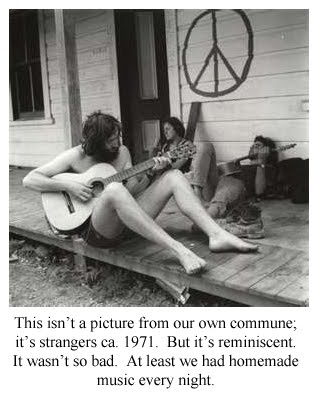 Grim got me going on my favorite daydream: how to reconstruct society after the collapse. Yes, I know I'm just re-enacting an early childhood existential catastrophe, so sue me. I still find post-apocalyptic fantasies engaging, and I'm not alone.
My husband, whom I met and married when we both lived in a communal household, sent me this Atlantic piece about the revival of communes. People who tried them out in youth are re-thinking them in retirement. It's sort of a return to the village or clan, at a time of disenchantment with broken families and anonymous suburbs or apartment complexes. I was particularly taken with the thought experiment of "Who would come if I stood out in my front yard and yelled for help?" I know what would happen here, or what would have happened in our old communal home; I'm less sure what would have happened in the suburb we inhabited in the interim.
We spent long years on our own experiment, which wasn't even a true income-sharing commune, just a way of sharing some living expenses in close quarters. I guess if a flaw in the system could be found, we found it, repeatedly. In our semi-dotage, though, we continue to flirt with the idea, the more so whenever the world threatens to collapse personally or societally.
We're not really cut out for it, I suppose: too solitary and wrapped up in each other, a Bokonan "duprass," as Kurt Vonnegut would say.
Or on art supplies
 This time of year, I start looking about for nieces, nephews, and children of friends who might share my twin passions for Robert Heinlein books and art supplies, so that I can replay some kind of childhood drama about ever being able to put my hands on enough of each. I've struck out so far on Heinlein. I used to experiment on various kids with a paperback or two, especially the "juvenilia" series, but I never made any converts.
I usually do a little better with art supplies. I can't go into an art supply store without experiencing an almost irresistible urge to try each medium and buy every single color manufactured in it. All those trays of every color in the spectrum, in oil paint! Pastel crayons! Ink! Colored pencils! Chalk! Water color! Embroidery thread! Yarn! Craft paper! I still remember afternoons of bliss at a neighbor's house with a young friend who had the 64-color Crayola set: magenta, burnt sienna, gold, forest green, brick red, lemon yellow, everything I could possibly want in life.
What really makes my heart race are the 128-color sets, but I usually start with something smaller and try to find out if they've got the bug or not. Perhaps none of these young people have quite the orgasmic reaction I remember from my youth, but they often seem happy to scribble away with their new colored pencils on their suddenly adequate supply of large expanses of paper canvas. Because of course there are the beautiful papers. I generally opt for Strathmore pads, reasonably priced, heavyweight paper with a nice texture, just the thing for engaging one of my young relatives or friends with their new set of colors.
 www.dickblick.com is a terrific mail-order resource for art supplies: great discounts and a wide variety of the basics in high-quality versions. In response to a well-timed email promo, I just sent off for some colored pencil sets and paper pads, but in order to get the full value of my discount and free shipping, I was forced to add in some gorgeous bright red Bombay India Ink (for my calligraphy pens) and a handful of tiny, lovely white china bristle paintbrushes. Who ever has anything like enough fine paintbrushes?
The only thing wrong with the dickblick site is that they don't find a way to spread pictures of all the options all over the screen; they make me click through too many pages to get to the good stuff. They'd make a lot more money off of me if they'd recreate the impact of walking into a store and being surrounded by rack after rack of COLOR COLOR COLOR. I want them all.
If not in this generation, perhaps in the next, my eyes will meet the eyes of a kindred spirit on Christmas morning, saying Yes!
Maybe I'd spend the $1,500 on a marimba
You never know what you'll find on YouTube. This is Philip Glass's "Openings" on a marimba, of all things. I'm very fond of this piece as it was composed for the piano. The 3-on-2 rhythm makes it sound more complicated than it is; a piano amateur can easily play it. How this guy can get the same effect with four mallets in two hands, I have no idea. I love it, despite the false notes sprinkled in.
The Thermomix!
Megan McArdle astonished me this afternoon by penning a piece in which she confessed to buying a $1,500 food processor. I had no idea that such a thing existed.
It does:
You can judge for yourself whether or not it's worth the money -- it strikes me that you could hire an out of work chef to come to your house and cook dinner for you fifteen or twenty times for the same money -- but I was amused by the first comment on the video:
It does:
You can judge for yourself whether or not it's worth the money -- it strikes me that you could hire an out of work chef to come to your house and cook dinner for you fifteen or twenty times for the same money -- but I was amused by the first comment on the video:
thank god they hired an experienced porn director for the promo[.]Well, obviously.
To Keep and Bear Armor
You probably saw this link to U.S. Palm's new Defender body armor for civilians at Instapundit. It's an interesting concept.
I have a set of civilian body armor that I received as a gift in Iraq, though I didn't use it there -- the military had provided me with a set of Interceptor armor that was more practical for warfare. I've still got the other set, though it's packed away.
The probability of a home invasion in rural Georgia approaches zero, especially for those of us with dogs and rifles. Still, in an area without those advantages, I can see how keeping a set handy might be a sensible precaution. I would like to say, though, that if you already have a handgun and two hundred dollars to spend to improve your defensive capacity at home, the more sensible thing would be to use the money to buy a shotgun.
I have a set of civilian body armor that I received as a gift in Iraq, though I didn't use it there -- the military had provided me with a set of Interceptor armor that was more practical for warfare. I've still got the other set, though it's packed away.
The probability of a home invasion in rural Georgia approaches zero, especially for those of us with dogs and rifles. Still, in an area without those advantages, I can see how keeping a set handy might be a sensible precaution. I would like to say, though, that if you already have a handgun and two hundred dollars to spend to improve your defensive capacity at home, the more sensible thing would be to use the money to buy a shotgun.
The Economic Crisis
This week several Euro countries have been slashed to junk rating, and even Germany was not able to sell about a third of the bonds it offered -- no one was willing to buy them. A diagnosis at Zero Hedge holds:
The problem is that both of these theories are wrong about the origins of wealth, and how wealth is produced. Understanding that issue is the beginning of an understanding of how to build a stable system.
In spite of economics' reputation as 'the dismal science' (a nickname, as you recall, that came from Malthus' writings on population growth), it isn't actually a science but an art. In the arts, it is not uncommon to discover that a fashionable idea plays out badly in the end, and older forms are proven to be more valuable than we thought they were when we set them aside.
The problem with monetary theory is that it begins from an assumption that wealth increases as debt increases (because, according to the theory, 'every asset is someone else's liability' -- if I borrow money from you, my debt is a liability of mine and an asset of yours). The debt of the public sector is thus the wealth of the private sector (because we own the bonds). Thus, you can repair the economy by taking on more debt (which increases private wealth, allowing the private sector to stimulate itself by trading debts as if they were wealth).
Wealth doesn't come from debt, and in fact it doesn't come from money. Wealth comes from production -- a fact that Marx understood better than modern economists, with his labor theory of wealth. Marx's problem was that he tried to make labor account for all wealth, whereas in fact it accounts for only some increases in wealth. Marx was smart enough, though, to know that it wasn't money that creates wealth.
If I have a factory or a farm that is producing wealth for me, I can take on a debt in order to expand my operations. According to monetary theory, wealth is created because I take on a debt to the bank, increasing the bank's wealth. In fact, wealth is being created whether I take on the debt or not -- it is the factory or the farm that is creating the wealth. All the debt does is allow me to expand the wealth-creating instrument faster than I could have done otherwise.
Since we have mentioned the “W” word [Weimar], we have an obligation to discuss what strategies best preserved the wealth of German investors during that dark period. (“Life was madness, nightmare, desperation, chaos,” writes Fergusson. We are not quite there yet – but we also note that sensible financial commentators have already begun to refer to Japan as our Weimar in waiting.)
Other, more valuable foreign currencies, for example. In 1923, that meant the US Dollar. This time round, since the Swiss National Bank has lost the plot, we would favour the Canadian and Singapore Dollars. Back then, the answer lay in gold, and we think it does this time, too, as the finest currency protection paper money can buy.
One can also consider gold and silver mining companies – John Hathaway of Tocqueville Asset Management has written very nicely about the “Golden Mulligan” being presented to investors who missed the gold bull on the way up....
Yale Economist Robert Shiller has suggested that one of the reasons for equity investors’ irrational exuberance in the 1990s (it was Shiller, and not Greenspan, who coined the phrase) was the fall of the Berlin Wall- which seemed to conclusively display the superiority of western free market capitalism over the discredited Soviet model.
Now the superiority of the western model is so apparent that we have cash-strapped eurocrats looking to raise money from the Communist leaders of a country, most of whose citizens live in abject poverty. This writer is proud to call himself British; he would be disgusted to be regarded as European.The two problems at the core of the collapse seem to me to be the idea of monetary manipulation as a way out of the crisis, and the idea of Keynesian stimulus as a way out of the crisis. The two models are sometimes said to be in competition; in truth, they are mutually-reinforcing points of failure.
The problem is that both of these theories are wrong about the origins of wealth, and how wealth is produced. Understanding that issue is the beginning of an understanding of how to build a stable system.
In spite of economics' reputation as 'the dismal science' (a nickname, as you recall, that came from Malthus' writings on population growth), it isn't actually a science but an art. In the arts, it is not uncommon to discover that a fashionable idea plays out badly in the end, and older forms are proven to be more valuable than we thought they were when we set them aside.
The problem with monetary theory is that it begins from an assumption that wealth increases as debt increases (because, according to the theory, 'every asset is someone else's liability' -- if I borrow money from you, my debt is a liability of mine and an asset of yours). The debt of the public sector is thus the wealth of the private sector (because we own the bonds). Thus, you can repair the economy by taking on more debt (which increases private wealth, allowing the private sector to stimulate itself by trading debts as if they were wealth).
Wealth doesn't come from debt, and in fact it doesn't come from money. Wealth comes from production -- a fact that Marx understood better than modern economists, with his labor theory of wealth. Marx's problem was that he tried to make labor account for all wealth, whereas in fact it accounts for only some increases in wealth. Marx was smart enough, though, to know that it wasn't money that creates wealth.
If I have a factory or a farm that is producing wealth for me, I can take on a debt in order to expand my operations. According to monetary theory, wealth is created because I take on a debt to the bank, increasing the bank's wealth. In fact, wealth is being created whether I take on the debt or not -- it is the factory or the farm that is creating the wealth. All the debt does is allow me to expand the wealth-creating instrument faster than I could have done otherwise.
Now, if that is the case, the function of money is not to create wealth, but to serve as a store of value and an accounting mechanism for trade. Proper monetary policy would therefore be to sustain the stability of your store of value, so that trades and debts in that money are stable and reliable for those making such trades or taking on such debts. The political policies associated with such stability are counterindicated by all the best advice of modern economists, and therefore opposed to what the politicians would do if they could come to an agreement.
In America this is sometimes called the 'strong dollar' policy, but actually it's the pre-Federal Reserve policy. The Federal Reserve was created to stabilize the dollar through monetary policy; instead the banks who lead it have used that as a pretense for profiteering manipulations that have cost the dollar 96% of its purchasing value since the creation of the Fed in 1913. This is what we would expect to happen if we gave control of our wealth to professional gamblers, and indeed it is just what did happen.
The value of the dollar in terms of what it could purchase, before the Fed, actually was stable. You can test this assumption with this calculator. Put in an amount, say $100, with the starting year 1790 and the ending year 1890. The value in terms of the consumer price index is almost the same. Now go from 1790 to 1890. Suddenly it takes over a thousand dollars to equal a hundred dollars in 1790 purchasing power.
This is one of the three major problems with the global economy. Once we have a stable currency, we can perhaps address the other two. The first of these is the unsustainable nature of entitlements, both here and in Europe; and the second is that the modern technological economy has no place for many people who once could be gainfully employed. (The link is to an optimistic counterargument; the facts regarding unemployment among the unskilled are surely known to all of you reading this page.)
The first two problems are given to conservative solutions; the last one really is not, and will require a new conceptual model from us. The closest extant one is what the British used to call "outdoor relief," that is, government make-work that uses the unskilled even though it is uneconomic to do so.
The first two problems are given to conservative solutions; the last one really is not, and will require a new conceptual model from us. The closest extant one is what the British used to call "outdoor relief," that is, government make-work that uses the unskilled even though it is uneconomic to do so.
Happy Thanksgiving
Things for which to be thankful:

The Land

Good Cheer
We had a fine family meal today, thanks mostly to my sister, who cooked for everyone. I only made croissant rolls, with 128 layers of butter, some filled with chocolate or cheese. Here are two of the many pies that appeared at the feast, along with a glass of good beer.

The Old Home
This stone ring appears on my father's land. I built it some years ago out of stones plowed up by the county when they were fixing the road. It was good to have a day to go back to the ancestral home, and spend time with the people I grew up among.
I hope your Thanksgiving was a fine one: that you had time to reflect on good things, and be grateful.
In the throes of pansies
 I'm lost in crochet world again. My niece will be married in six months, carrying, I hope, a crocheted-lace ribbon tied around her bouquet, possibly in this pattern, but in all-white thread:
 Now my sister says she's making about a dozen chocolate-brown silk purses as guest-gifts, and would like to affix several crocheted flowers of some kind to each of them, in deep colors. I'm thinking pansies. The stylized pansies in the ribbon pattern above didn't seem right to me, so I've been trying to fashion my own pattern. These are my first experiments, done with a double strand of embroidery thread, which amounts to about a size 70. I ended up with flowers about an inch across.
Update:  Another effort, closer to 2 inches across. I'm liking this pattern. I've just got to fiddle with the shape of the large pair of petals in back, and work on making the tiny, tiny stiches more regular. It's hard to see the row of stitches you're working into, even with my (seldom-used) glasses on under a bright light, but a contrasting color keeps you honest. As you can tell from the photo, the size-13 crochet hook is so small you can barely see the hook at the tip. The colors, by the way, are much more brilliant in real life than I can make them appear with my phone camera.
 Another effort, closer to 2 inches across. I'm liking this pattern. I've just got to fiddle with the shape of the large pair of petals in back, and work on making the tiny, tiny stiches more regular. It's hard to see the row of stitches you're working into, even with my (seldom-used) glasses on under a bright light, but a contrasting color keeps you honest. As you can tell from the photo, the size-13 crochet hook is so small you can barely see the hook at the tip. The colors, by the way, are much more brilliant in real life than I can make them appear with my phone camera.
There's nothing like trying to crochet a flower to make you think hard about how it's structured. In the case of pansies: a radial pattern, three small petals on top, often variegated in color, and two behind, usually in a contrasting but solid color. The middle of the three-petal group is larger and usually double-lobed. Here are a number of beautiful pansies I found searching on the net:

 And then I stumbled on something that made me want to drop crocheting and go learn how to work in metal. Did you ever see anything so gorgeous? Look how the pansy stems twist around the base. Follow the link to see what those crazy jewelers put inside this jade Faberge egg with pansies. For some kinds of exuberant excess, you really need an imperial family to plunder the entire country, so they can amass enough wealth to employ over-the-top jewelers.
Rep. Bachmann on Pakistan
She's good and right on the question she takes on here. Let's review Pakistan's relationship with the United States.
Pakistan signed a mutual defense agreement with the United States in 1954. In 1965, it fell into war with India over the Kashmir vale. The terms of the agreement suggest we should have backed them up; we did not, but declared something like neutrality in the conflict. Of course, we were involved in Vietnam at the time, and the Cold War, and this was a distraction from that twilight struggle; but we broke our word.
A second war in 1971 produced significant American support for Pakistan -- and also their greatest loss in their history as a nation. The American perspective on this conflict is that we did all we could do, being constrained by the Soviet Union and China (then working with India, ironically enough). The Pakistani perspective, I learned from listening to their liaison officer at USCENTCOM last summer, was that America let them down. We were supposed to 'mutually defend' them, and they lost almost half their territory.
Add to that the current issues over the drone strikes -- which the US continues to execute in spite of the clear statement by Pakistan's legislature that it opposes them because of civilian casualties -- and we have a menu of complaints on offer. We continue to carry out those strikes not with their permission (as in Yemen) but in violation of their sovereignty as a nation state.
In other words, some of Pakistan's complaints are invalid -- but others are not entirely unfair.
There isn't a happy relationship here, but there is a relationship. We're better off when it's stronger than otherwise. Pakistan is divided internally between factions that support anti-US forces, and factions that oppose them for reasons of their own. We have to play in this game.
The lady is right, in other words; and by the way, Fallon ought to fire his band. Go hire some of those OWS drummers; whatever else can be said for the movement, those guys have their moments. And clearly they're unemployed, so you can probably get them for a reasonable rate.
(H/t for the video: DL Sly.)
Subscribe to:
Posts (Atom)