Be sure to read Cassandra's response to our thread below.


How to Love a Woman
Hegel on How To Love a Woman:
Why was his love worth dying over, though? She was an idea -- that is to say, she was not just a girl, with all the problems any individual girl might have. She was an ideal girl: it was his mind which had made her an ideal that was worth dying over.
We remember here our discussion around Chaucer's A Knight's Tale, and the objection raised by female readers that the young knights didn't know -- and therefore could not love -- the lady at all. Hegel seems entirely subject to that line of attack.
But now consider his further remarks on passion.
Well, and she is not; so is this not a lie? And are you not betraying her, if you will not take her as she is rather than demanding some perfection no one can possess?
Here I am reminded of Cassandra's wise words, directed towards men: that biology is not an adequate excuse for bad behavior. It is not what you are that makes you worthy of love, but what you could be; and the fact of trying to be that better thing.
Or we may turn to the Christian admonition to love the sinner, and hate the sin: this is nothing more than to love the idealized vision of the person, separated from their (actual) sin. You are asked to love them not as they are, but as they should be.
Now I wonder if Hegel isn't on to something. I hate to ascribe anything good to German Idealism: but let's talk it over, and see if there isn't something here.
This post arises out of reading Hegel's philosophy of mind, which makes a fairly extraordinary claim about the nature of passionate love. I'd like to explore it with you.
The claim begins in paragraph 448, on the mental faculty of attention. The issue of attention is that you are free to give it, or not; and therefore, if you are to have a passion, it is because you have chosen to give it your attention.
But what is the thing to which you are giving your attention? It is an idea: and, therefore, it is your idea. After all, it exists in your mind, and the thoughts you have are your own. He offers an example:
Thus we know, for example, that if anyone is able to form a clear picture to himself, say in a poem, of the feelings of joy or sorrow that are overwhelming him he rids himself of the thing that was oppressing his mind and thereby procures for himself relief or complete freedom. For although by contemplating the many aspects of his feelings he seems to increase their power over him, yet he does in fact dimnish this power by making his feelings into something confronting him, something that becomes external to him. Goethe, for instance, particularly in his Werther, brougth himself relief while subjecting the readers of this this romance to the power of feeling.The book he mentions, The Sorrows of Young Werther, sparked a wave of suicides across Europe. The title character is a suicide, killing himself over losing his love.
Why was his love worth dying over, though? She was an idea -- that is to say, she was not just a girl, with all the problems any individual girl might have. She was an ideal girl: it was his mind which had made her an ideal that was worth dying over.
We remember here our discussion around Chaucer's A Knight's Tale, and the objection raised by female readers that the young knights didn't know -- and therefore could not love -- the lady at all. Hegel seems entirely subject to that line of attack.
But now consider his further remarks on passion.
[P]assion is neither good nor bad; the title only states that a subject has thrown his whole soul -- his interests of intellect, talent, character, enjoyment -- on one aim and object. Nothing great has been and nothing great can be accomplished without passion. It is only a dead, too often, indeed, a hypocritical moralizing which inveighs against the form of passion as such.So to have thrown your whole soul into a vision of beauty, that is passion. To have passion for a woman is, then, not to have some physical longing alone; that belongs to mere appetites, which rank much lower on his scale of mind. Rather, what you have is a longing for an idea of what the woman would be if she were as perfect as you wish her to be.
Well, and she is not; so is this not a lie? And are you not betraying her, if you will not take her as she is rather than demanding some perfection no one can possess?
Here I am reminded of Cassandra's wise words, directed towards men: that biology is not an adequate excuse for bad behavior. It is not what you are that makes you worthy of love, but what you could be; and the fact of trying to be that better thing.
Or we may turn to the Christian admonition to love the sinner, and hate the sin: this is nothing more than to love the idealized vision of the person, separated from their (actual) sin. You are asked to love them not as they are, but as they should be.
Now I wonder if Hegel isn't on to something. I hate to ascribe anything good to German Idealism: but let's talk it over, and see if there isn't something here.
Getting the Civil War right
Getting the Civil War Right:
[Bangs head on wall for a few minutes.]
WHY do we have people who are not trained historians writing history textbooks? Is there some shortage of people with degrees in history? The last I heard there was such a glut of Ph.D.'s in history that few could find jobs.
OK. So, one bad approach: quoting Wikipedia and the Sons of Confederate Veterans' website, uncited, in a textbook.
The inclusion of alternative claims is not bad, if they are properly sourced and the controversy around them is explained. The Civil War remains highly controversial in terms of our understanding of it, even among professional historians -- a fact the article plays down to an unhappy degree. There is not general agreement about any of the basic questions of the war. There are probably more books written about it than any other topic in American history.
We went down to Stone Mountain for the Highland Games this weekend, as recently mentioned. I had occasion to point out the relief sculpture on the mountain to a child. I told him the three riders were important men from the war's history, Confederate generals. Could he guess which ones?
"Fredrick Douglass?" he guessed. On examination, this proved to be the only name he knew to be associated with the war.
There are two further errors in that approach: not teaching the controversies, yes, but apparently not even teaching the allegedly 'settled' history. All that the schools appear to convey is the politically correct narrative.
That's not to say that children shouldn't learn about Frederick Douglass, who was a wise and interesting man -- Eric was citing him in an email he sent me just the other day. Absolutely they should know who he was, and what he had to say. I just want them to know a little more, too.
There are doubtless many who would say that we shouldn't spend a lot of time on the American Civil War at all, it being ancient history and all that. Nevertheless, it was one of the most crucial moments in the American story, and we need to know how to think about it.
This story about the Virginia textbook shows one wrong way of handling the matter.
The author, Joy Masoff, who is not a trained historian but has written several books, said she found the information about black Confederate soldiers primarily through Internet research....Excuse me.
[Bangs head on wall for a few minutes.]
WHY do we have people who are not trained historians writing history textbooks? Is there some shortage of people with degrees in history? The last I heard there was such a glut of Ph.D.'s in history that few could find jobs.
OK. So, one bad approach: quoting Wikipedia and the Sons of Confederate Veterans' website, uncited, in a textbook.
The inclusion of alternative claims is not bad, if they are properly sourced and the controversy around them is explained. The Civil War remains highly controversial in terms of our understanding of it, even among professional historians -- a fact the article plays down to an unhappy degree. There is not general agreement about any of the basic questions of the war. There are probably more books written about it than any other topic in American history.
We went down to Stone Mountain for the Highland Games this weekend, as recently mentioned. I had occasion to point out the relief sculpture on the mountain to a child. I told him the three riders were important men from the war's history, Confederate generals. Could he guess which ones?
"Fredrick Douglass?" he guessed. On examination, this proved to be the only name he knew to be associated with the war.
There are two further errors in that approach: not teaching the controversies, yes, but apparently not even teaching the allegedly 'settled' history. All that the schools appear to convey is the politically correct narrative.
That's not to say that children shouldn't learn about Frederick Douglass, who was a wise and interesting man -- Eric was citing him in an email he sent me just the other day. Absolutely they should know who he was, and what he had to say. I just want them to know a little more, too.
Illustrations
An Illustration:
'You know who's dumb? That Sarah Palin. What an air head she is. Did you hear she said Tea Partiers were going to party like it was 1773? What a moron! We all know... ummmm....'
Pizza Pizza
Scuze me while I interject women's work.


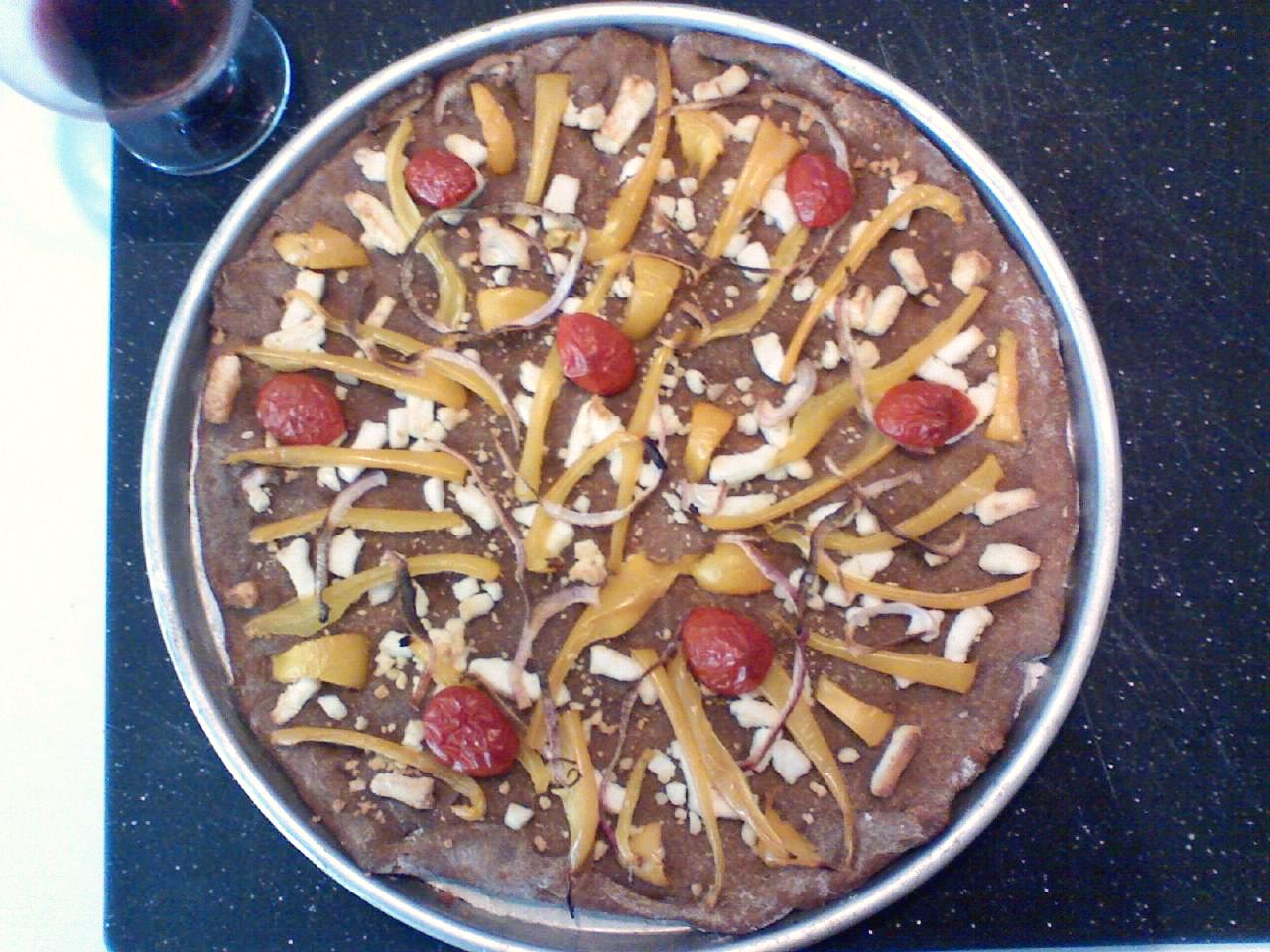
I highly recommend a pizza stone. Makes a much better homemade pizza than a regular pan. This particular recipe (above) called for feta cheese, goat cheese and yellow peppers (doesn't sound like much but the two cheeses work well together). I added some thinly sliced red onion and halved cherry tomatos, but not the section belonging to a certain fifteen year-old.
Below is the whole wheat version, which met its end on a regular pan. Even though the pan was floured, it came out like a cookie that wasn't worth scraping off.
A Related Problem
A Related Problem:
So, we've all been thinking about the problem of female politicians, right? To whit, sexist remarks appear to be highly effective against them.
Especially among women. Look at any poll you like, and you'll find that the Sarah Palins and Christine O'Donnells poll far worse among women than men. Men are willing to give them a chance, along partisan lines -- in other words, as ready to vote for them as for any other person who came along in their preferred party. Women are much less willing.
Is this related to why women prefer a male boss? (Not just in the UK.)
Now, as far as men pushing sexist attacks -- think of Candidate Obama talking about how Sen. Cliton 'periodically' -- we could resolve the problem by restoring the old codes of honor and violence. The best restraint on men's bad behavior is other men; and as gentlemen are more disciplined than other men, they will tend to win out given time and the liberty to employ their arms.
Failing that, you get boors. Since apparently boorishness is highly effective against female candidates... well, do the math.
What to do about women who won't give women an even break, though? I don't have an answer to that, being opposed to violence against women; I think you ladies may have to sort that one out on your own.
I understand that some of you may think that these female candidates aren't exactly your very best foot being put forward. Well, let me just say that I can't think of a single male politician who represents what is best about manhood. Or mankind. I'm thrilled when we can find one who represents something that is even pretty good. Most of the time we make do with one who is corrupt in a way that doesn't cause serious problems.
Far too much of the time, we can't get even that.
Give them an even break. I don't like my politicians either, men every one of them. So far, they're the best I can do.
Half a Hooah
Half a Hooah, Lady:
And maybe even when it's not entirely consensual, in cases where it's genuinely deserved.
MKH posts a video, and a retraction. I kind of liked the video.
The lady writes:
As a matter of policy, I don’t comment on my personal life in public, but I will clarify that his tirade thoroughly mischaracterizes my political views. For instance, I do not believe that laws against assault should be repealed — nor do I think there should be an exception in cases when one’s ex-boyfriend behaves unacceptably on national television, though I admit that’s a tougher question.Now that's just too bad. As longtime readers know, I've often favored just such a repeal -- at least for consensual fistfights between gentlemen, and perhaps for more serious (but equally consensual) affairs.
And maybe even when it's not entirely consensual, in cases where it's genuinely deserved.
SMHG
The Stone Mountain Scottish Highland Games:
A good time was had by all.
Top that, Vegas girl.
(Of course the baby wasn't really drinking the whisky. I was there when they put the bottle in the chair with her, for humorous effect. She's a sweet kid, though; and she was just sacked out come Sunday afternoon.)
Socrates:
Socrates's problems were our own. He lived in a city-state that was for the first time working out what role true democracy should play in human society. His hometown – successful, cash-rich – was in danger of being swamped by its own vigorous quest for beautiful objects, new experiences, foreign coins....
Rather than a brainiac grey-beard, we should think of him as his contemporaries knew him: a bustling, energetic, wine-swilling, man-loving, vigorous, pug-nosed, sword-bearing war-veteran: a citizen of the world, a man of the streets.
2 AL D
Treason, or Renaissance?
Confer:
I expect we largely agree about the answer, but I'm interested in proofs. So: Why? Can you prove it?
Watson derives the German genius from deep springs. Germanness as a notion long predated an all-German state. German protestantism, high literacy, well organised universities and a Jewish citizenry devoted to German high culture all played their role. How all that ended in Hitler is one of the questions of historiography. Watson devotes many pages to German soul-searching over the Third Reich, and the "treason" of a cultured middle class in voting him in and turning against the Jews and the west.
Confer:
Germany’s attempt to create a multi-cultural society has failed completely, Chancellor Angela Merkel said at the weekend, calling on the country’s immigrants to learn German and adopt Christian values.I expect to see the same thing happen in America, as we've discussed; so let's go ahead and hash it out. Is this a new sort of the "treason" of the Third Reich, where the mainstream culture is turning hard against internal elements that are non-Christian, non-"German"? Or is this is the start of a rebirth, a rekindling of the German nation that gave us Beethoven?
Merkel weighed in for the first time in a blistering debate sparked by a central bank board member saying the country was being made “more stupid” by poorly educated and unproductive Muslim migrants. …
This approach has failed, totally,” she said, adding that immigrants should integrate and adopt Germany’s culture and values.
“We feel tied to Christian values. Those who don’t accept them don’t have a place here,” said the chancellor.
I expect we largely agree about the answer, but I'm interested in proofs. So: Why? Can you prove it?
The Orcs of Zork
The Orcs of Zork:
So, about thirty years ago video games were still in their early stages. There was a kind of video game that as far as I know has faded almost entirely from modern efforts: and of them all, the greatest was Zork I: The Great Underground Empire. It starts outside a house, with a mailbox; inside the house there is an elvish sword, a lantern, and a trapdoor hidden beneath a rug. You can play it here.
Obviously Iowahawk was a fan.
WELCOME TO ADVENTURE! WOULD YOU LIKE INSTRUCTIONS?H/t: Dad29.
>YES
YOU ARE SOMEWHERE IN BELTWAY FOREST, WHERE SOME HAVE FOUND TREASURES OF GOLD ALTHOUGH SOME HAVE ENTERED AND NEVER BEEN SEEN AGAIN. MAGIC IS SAID TO WORK IN THE FOREST. I WILL BE YOUR EYES AND HANDS. DIRECT ME WITH SIMPLE COMMANDS.
YOU ARE IN AN OVAL OFFICE. THERE IS SNOW OUTSIDE. YOU ARE BEHIND A DESK. ON DESK THERE IS A BUST OF CHURCHILL.
Life Among the Volcanoes
 Life Among the Volcanoes
I like to use Bing's search engine as my default page, so every morning I'm greeted with a new interesting image. This morning's is a beautiful patchwork of crops planted over a dormant volcano field in or near the Virunga Mountains in Rwanda, just west of Lake Victoria. Near my home in the Coastal Bend of Texas, you mostly see cotton and sorghum in flat fields that reach to the horizon. Rwanda's fields are more interesting. I don't know what these crops are, but typical crops for the region might be coffee, tea, beans, sorghum, bananas, and pyrethrum-producing daisies. Rwanda is slowly recovering from the paroxysm of murderous hatred that engulfed it in the mid-90s and nearly destroyed the export agriculture and tourism business on which nearly its entire economy depends.
The little icons in the bottom right of each day's Bing picture give you background information and the option to scroll back through the last week's images. There are also little pop-up squares here and there in each image with links to related information.
Freedom
Freedom:
As gas prices remain unstable, it's nice to have an option besides a big truck. So, I decided to take Major Leggett's longstanding advice and buy a motorcycle. This one was for sale locally, at a very reasonable price.
It even has a security system.
Thanks to Mr. Wolf of BLACKFIVE, who was very helpful as always.
 $1 Billion Doesn't Buy As Much House As It Used To
Maybe I have unrealistic expectations, but for a billion bucks I'd want more than 27 stories, three helipads with air-traffic control office, a six-floor parking garage, a ballroom, a 50-seat cinema, rooftop gardens, three floors of hanging gardens, a health spa, a dance studio, swimming pools, lounges, a vehicle maintenance area, and guest rooms. I think that budget would also entitle me at least to a state-of-the-art operating theater complete with MRI, a 20,000-sq.-ft. Roman bath with mosaic murals done in gold and lapis lazuli, a monorail, and a small nuclear reactor.
It turns out the house didn't cost a billion dollars to build, only about $77 million (real estate inflation in Mombai, where land goes for $10,000/sq. meter, accounts for the rest), which I guess explains why they had to do without some amenities.
The home's tycoon builder is just my age. Hey, when did I fall off the fast track?
Calico Jack
Calico Jack:
Probably many of you have not heard of "Calico Jack" Rackham, a pirate famous mostly because of his crew. Specifically, he is famous for having the two most famous female pirates in history aboard his ship when it was captured: Anne Bonny and Mary Read. (Both women were excluded from the general death sentence for piracy on account of being pregnant. Calico Jack himself was not so excused.)
That's his flag on the truck at 0:07 and 3:05.
They don't know it. In a way, though, I have to think that his spirit would be pleased.
Ants
What Do You Know About Ants?
It's probably wrong.
The interesting question, though, is why it's wrong.
Quasi
"Quasi"
I've long been sanguine about China's rise; but it's a matter that needs watching and some management from us, as there is a potential for disruption. The two chief dangers are internal pride leading to unnecessary conflicts; and, on the other side, a demographic collapse resulting from the One Child policy that may lead to internal instability.
This story is about the second problem.
In a speech to the Chinese Communist Party (CCP) politburo on the eve of the October 1 National Day, Hu urged party cadres to "boost [society's] harmonious factors to the maximum degree" through implementing policies that "match the wishes of the people, that take care of the people's worries, and that can win over the hearts of the people".That doesn't sound so bad, right? Except...
To fully understand the import of Hu's message, it is instructive to compare the background of Mao Zedong's 1957 landmark address - "On the correct handling of contradictions among the people" - and the situation unraveling today.There's a little bit of the mailed fist in the velvet glove. 'Just like Mao, I'd like to propose that we put aside our differences and get along. Just. Like. Mao.'
The late chairman's speech on fomenting unity among the nation's disparate sectors was made in the wake of the Hungarian Incident of 1956, an early climax of Eastern Europe's rebellion against the communist yoke.
In China too, intellectuals were beginning to have misgivings about the dictatorial rule of Mao and his comrades. By and large, Mao proposed reconciliatory measures to iron out differences among social groupings. He indicated that while there were signs of disaffection with the authorities, these were "contradictions among the people" because even oppositionists shared "the fundamental identity of [all] the people's interests". He recommended that the CCP "use the democratic method of persuasion and education" to woo the disgruntled elements.
Hu is invoking Mao's authority at a special juncture in his career - and in the country's development.
Subscribe to:
Comments (Atom)