

Pizza Pizza
Scuze me while I interject women's work.


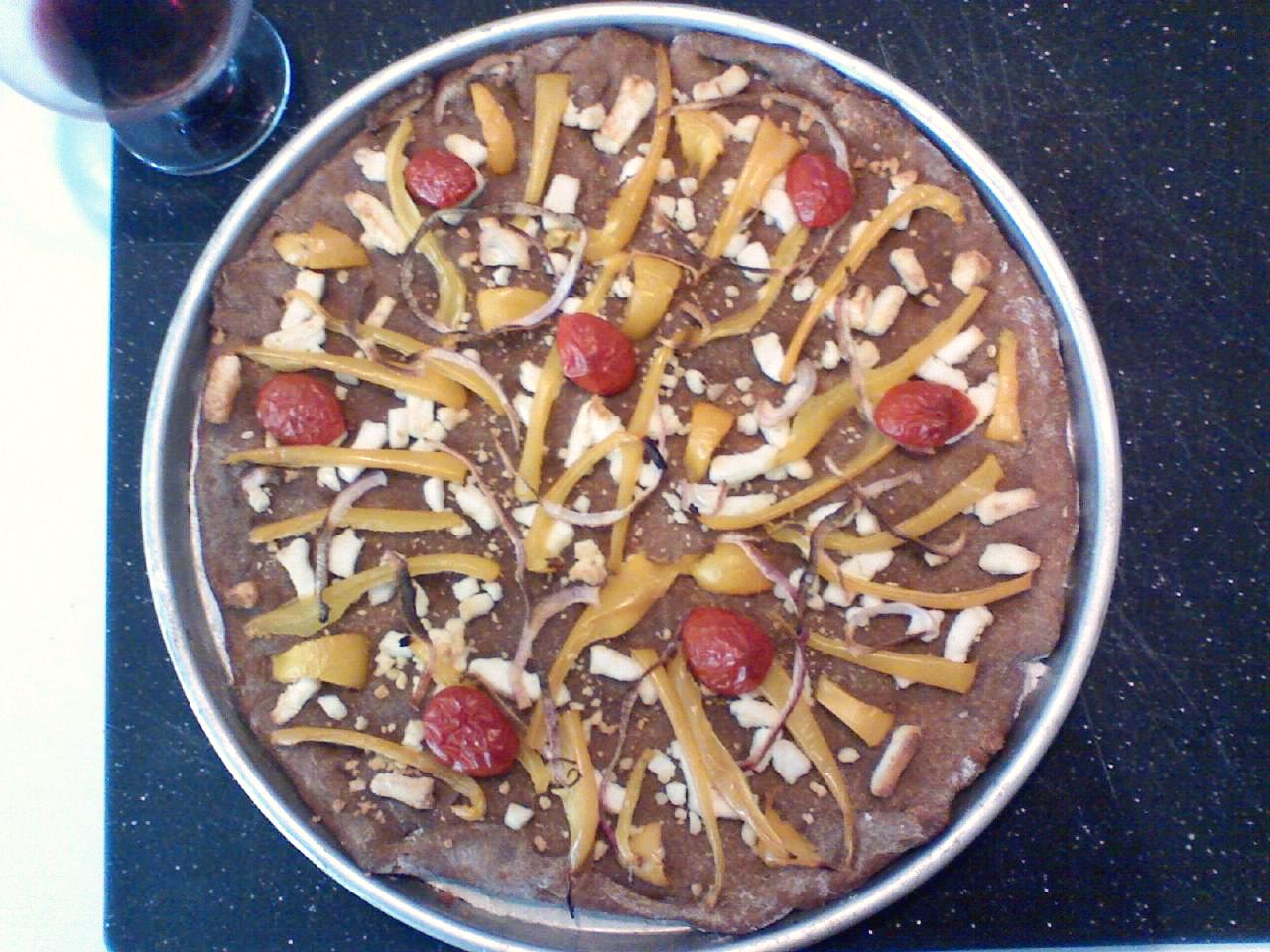
I highly recommend a pizza stone. Makes a much better homemade pizza than a regular pan. This particular recipe (above) called for feta cheese, goat cheese and yellow peppers (doesn't sound like much but the two cheeses work well together). I added some thinly sliced red onion and halved cherry tomatos, but not the section belonging to a certain fifteen year-old.
Below is the whole wheat version, which met its end on a regular pan. Even though the pan was floured, it came out like a cookie that wasn't worth scraping off.
A Related Problem
A Related Problem:
So, we've all been thinking about the problem of female politicians, right? To whit, sexist remarks appear to be highly effective against them.
Especially among women. Look at any poll you like, and you'll find that the Sarah Palins and Christine O'Donnells poll far worse among women than men. Men are willing to give them a chance, along partisan lines -- in other words, as ready to vote for them as for any other person who came along in their preferred party. Women are much less willing.
Is this related to why women prefer a male boss? (Not just in the UK.)
Now, as far as men pushing sexist attacks -- think of Candidate Obama talking about how Sen. Cliton 'periodically' -- we could resolve the problem by restoring the old codes of honor and violence. The best restraint on men's bad behavior is other men; and as gentlemen are more disciplined than other men, they will tend to win out given time and the liberty to employ their arms.
Failing that, you get boors. Since apparently boorishness is highly effective against female candidates... well, do the math.
What to do about women who won't give women an even break, though? I don't have an answer to that, being opposed to violence against women; I think you ladies may have to sort that one out on your own.
I understand that some of you may think that these female candidates aren't exactly your very best foot being put forward. Well, let me just say that I can't think of a single male politician who represents what is best about manhood. Or mankind. I'm thrilled when we can find one who represents something that is even pretty good. Most of the time we make do with one who is corrupt in a way that doesn't cause serious problems.
Far too much of the time, we can't get even that.
Give them an even break. I don't like my politicians either, men every one of them. So far, they're the best I can do.
Half a Hooah
Half a Hooah, Lady:
And maybe even when it's not entirely consensual, in cases where it's genuinely deserved.
MKH posts a video, and a retraction. I kind of liked the video.
The lady writes:
As a matter of policy, I don’t comment on my personal life in public, but I will clarify that his tirade thoroughly mischaracterizes my political views. For instance, I do not believe that laws against assault should be repealed — nor do I think there should be an exception in cases when one’s ex-boyfriend behaves unacceptably on national television, though I admit that’s a tougher question.Now that's just too bad. As longtime readers know, I've often favored just such a repeal -- at least for consensual fistfights between gentlemen, and perhaps for more serious (but equally consensual) affairs.
And maybe even when it's not entirely consensual, in cases where it's genuinely deserved.
SMHG
The Stone Mountain Scottish Highland Games:
A good time was had by all.
Top that, Vegas girl.
(Of course the baby wasn't really drinking the whisky. I was there when they put the bottle in the chair with her, for humorous effect. She's a sweet kid, though; and she was just sacked out come Sunday afternoon.)
Socrates:
Socrates's problems were our own. He lived in a city-state that was for the first time working out what role true democracy should play in human society. His hometown – successful, cash-rich – was in danger of being swamped by its own vigorous quest for beautiful objects, new experiences, foreign coins....
Rather than a brainiac grey-beard, we should think of him as his contemporaries knew him: a bustling, energetic, wine-swilling, man-loving, vigorous, pug-nosed, sword-bearing war-veteran: a citizen of the world, a man of the streets.
2 AL D
Treason, or Renaissance?
Confer:
I expect we largely agree about the answer, but I'm interested in proofs. So: Why? Can you prove it?
Watson derives the German genius from deep springs. Germanness as a notion long predated an all-German state. German protestantism, high literacy, well organised universities and a Jewish citizenry devoted to German high culture all played their role. How all that ended in Hitler is one of the questions of historiography. Watson devotes many pages to German soul-searching over the Third Reich, and the "treason" of a cultured middle class in voting him in and turning against the Jews and the west.
Confer:
Germany’s attempt to create a multi-cultural society has failed completely, Chancellor Angela Merkel said at the weekend, calling on the country’s immigrants to learn German and adopt Christian values.I expect to see the same thing happen in America, as we've discussed; so let's go ahead and hash it out. Is this a new sort of the "treason" of the Third Reich, where the mainstream culture is turning hard against internal elements that are non-Christian, non-"German"? Or is this is the start of a rebirth, a rekindling of the German nation that gave us Beethoven?
Merkel weighed in for the first time in a blistering debate sparked by a central bank board member saying the country was being made “more stupid” by poorly educated and unproductive Muslim migrants. …
This approach has failed, totally,” she said, adding that immigrants should integrate and adopt Germany’s culture and values.
“We feel tied to Christian values. Those who don’t accept them don’t have a place here,” said the chancellor.
I expect we largely agree about the answer, but I'm interested in proofs. So: Why? Can you prove it?
The Orcs of Zork
The Orcs of Zork:
So, about thirty years ago video games were still in their early stages. There was a kind of video game that as far as I know has faded almost entirely from modern efforts: and of them all, the greatest was Zork I: The Great Underground Empire. It starts outside a house, with a mailbox; inside the house there is an elvish sword, a lantern, and a trapdoor hidden beneath a rug. You can play it here.
Obviously Iowahawk was a fan.
WELCOME TO ADVENTURE! WOULD YOU LIKE INSTRUCTIONS?H/t: Dad29.
>YES
YOU ARE SOMEWHERE IN BELTWAY FOREST, WHERE SOME HAVE FOUND TREASURES OF GOLD ALTHOUGH SOME HAVE ENTERED AND NEVER BEEN SEEN AGAIN. MAGIC IS SAID TO WORK IN THE FOREST. I WILL BE YOUR EYES AND HANDS. DIRECT ME WITH SIMPLE COMMANDS.
YOU ARE IN AN OVAL OFFICE. THERE IS SNOW OUTSIDE. YOU ARE BEHIND A DESK. ON DESK THERE IS A BUST OF CHURCHILL.
Life Among the Volcanoes
 Life Among the Volcanoes
I like to use Bing's search engine as my default page, so every morning I'm greeted with a new interesting image. This morning's is a beautiful patchwork of crops planted over a dormant volcano field in or near the Virunga Mountains in Rwanda, just west of Lake Victoria. Near my home in the Coastal Bend of Texas, you mostly see cotton and sorghum in flat fields that reach to the horizon. Rwanda's fields are more interesting. I don't know what these crops are, but typical crops for the region might be coffee, tea, beans, sorghum, bananas, and pyrethrum-producing daisies. Rwanda is slowly recovering from the paroxysm of murderous hatred that engulfed it in the mid-90s and nearly destroyed the export agriculture and tourism business on which nearly its entire economy depends.
The little icons in the bottom right of each day's Bing picture give you background information and the option to scroll back through the last week's images. There are also little pop-up squares here and there in each image with links to related information.
Freedom
Freedom:
As gas prices remain unstable, it's nice to have an option besides a big truck. So, I decided to take Major Leggett's longstanding advice and buy a motorcycle. This one was for sale locally, at a very reasonable price.
It even has a security system.
Thanks to Mr. Wolf of BLACKFIVE, who was very helpful as always.
 $1 Billion Doesn't Buy As Much House As It Used To
Maybe I have unrealistic expectations, but for a billion bucks I'd want more than 27 stories, three helipads with air-traffic control office, a six-floor parking garage, a ballroom, a 50-seat cinema, rooftop gardens, three floors of hanging gardens, a health spa, a dance studio, swimming pools, lounges, a vehicle maintenance area, and guest rooms. I think that budget would also entitle me at least to a state-of-the-art operating theater complete with MRI, a 20,000-sq.-ft. Roman bath with mosaic murals done in gold and lapis lazuli, a monorail, and a small nuclear reactor.
It turns out the house didn't cost a billion dollars to build, only about $77 million (real estate inflation in Mombai, where land goes for $10,000/sq. meter, accounts for the rest), which I guess explains why they had to do without some amenities.
The home's tycoon builder is just my age. Hey, when did I fall off the fast track?
Calico Jack
Calico Jack:
Probably many of you have not heard of "Calico Jack" Rackham, a pirate famous mostly because of his crew. Specifically, he is famous for having the two most famous female pirates in history aboard his ship when it was captured: Anne Bonny and Mary Read. (Both women were excluded from the general death sentence for piracy on account of being pregnant. Calico Jack himself was not so excused.)
That's his flag on the truck at 0:07 and 3:05.
They don't know it. In a way, though, I have to think that his spirit would be pleased.
Ants
What Do You Know About Ants?
It's probably wrong.
The interesting question, though, is why it's wrong.
Quasi
"Quasi"
I've long been sanguine about China's rise; but it's a matter that needs watching and some management from us, as there is a potential for disruption. The two chief dangers are internal pride leading to unnecessary conflicts; and, on the other side, a demographic collapse resulting from the One Child policy that may lead to internal instability.
This story is about the second problem.
In a speech to the Chinese Communist Party (CCP) politburo on the eve of the October 1 National Day, Hu urged party cadres to "boost [society's] harmonious factors to the maximum degree" through implementing policies that "match the wishes of the people, that take care of the people's worries, and that can win over the hearts of the people".That doesn't sound so bad, right? Except...
To fully understand the import of Hu's message, it is instructive to compare the background of Mao Zedong's 1957 landmark address - "On the correct handling of contradictions among the people" - and the situation unraveling today.There's a little bit of the mailed fist in the velvet glove. 'Just like Mao, I'd like to propose that we put aside our differences and get along. Just. Like. Mao.'
The late chairman's speech on fomenting unity among the nation's disparate sectors was made in the wake of the Hungarian Incident of 1956, an early climax of Eastern Europe's rebellion against the communist yoke.
In China too, intellectuals were beginning to have misgivings about the dictatorial rule of Mao and his comrades. By and large, Mao proposed reconciliatory measures to iron out differences among social groupings. He indicated that while there were signs of disaffection with the authorities, these were "contradictions among the people" because even oppositionists shared "the fundamental identity of [all] the people's interests". He recommended that the CCP "use the democratic method of persuasion and education" to woo the disgruntled elements.
Hu is invoking Mao's authority at a special juncture in his career - and in the country's development.
Gnashing
And There Shall Be Wailing and Gnashing of Teeth:
Here's a story that is going to produce some upset in the hearts and stomachs of many a liberal blogger. How can it be?
As to which, let me assure you that the Republicans really aren't very much captured by us extremists. Yet.
When they are, you'll know it: they'll be carefully following the Constitution.
 Bogus Bank, Member F.D.I.C.
Did you think it was bad enough that mountains of money was loaned to homeowners who couldn't even remotely be expected to keep up their mortgage payments, on the strength of blatantly fraudulent mortgage applications? That's only half the problem. Some of the mortgages, at least, should have been worth real money, if not necessarily 100% of the face amount. But it now seems that a scary number of banks did the equivalent of throwing their mortgage assets on the campfire and dancing around the flames.
Back in the Stone Age of home finance, a buyer borrowed cash to buy a house. The cash went to the seller, who used part of it to pay off his mortgage and pocketed any excess. The buyer got title to the home: a nice, official, signed original document that was duly filed in the local county real estate records. The buyer's bank got a signed promissory note (i.e., an IOU) along with a signed deed of trust that basically said, "I, the owner of this home, agree that if I don't pay the IOU, the bank can foreclose on my home." The bank then put the original IOU and deed of trust (together, a "mortgage") in its vault and filed a formal, signed, notarized notice of the deed of trust in the same county real estate records where the title was filed. Some years later, either the process repeated itself upon sale of the home, or the owner finished paying off the IOU and obtained a signed, original "release" document from the bank, which was also filed in the county real estate records.
Way back when, it wasn't terribly common for the bank to sell its mortgage. When it did happen, the buyer traded money for the original mortgage documents and filed a notice of the transfer in the county records. A couple of decades ago, this process really got into gear as a lot of lenders started selling truckloads of their mortgages wholesale, either to Fannie and Freddie or just to corporate entities set up to sell "mortgage-back securities." Suddenly all that fusty old procedure got very inconvenient, especially since the same mortgage might be sold and resold repeatedly -- each transfer requiring a physical trip to the county office and the payment of a fee. And then someone has to take custody of the mortgages themselves and remember where they are, at least for a few weeks or months, until they're sold again.
This part of the story is commonplace. We've been hearing dark reports for years that a lot of the closings in this churning frenzy might not have been scrupulously carried out, with the result that buyers on the tail-end might not actually be able to put their hands on the purpose of the whole exercise: the original mortgages. When news began to come out in recent weeks of every single state's attorney general joining in actions to address fraud in the foreclosure process, I assumed that the main problem was that the documents were stacked at the back of some warehouse, like the Ark of the Covenant, and nobody could remember which aisle they were on. I thought that banks had been skating through foreclosures without being challenged to produce the originals, and were now looking blank as more and more homeowners and courts were forcing them to dot their i's and cross their t's.
But it's worse than that. Banks found it so inconvenient to file evidence of mortgage sales in the real estate records that many of them began to use a substitute, called the Mortgage Electronic Registration Systems (MERS), which may or may not have any legal validity in the absence of a physical transfer of the underlying documents. MERSCORP, the operator of the system, is not what you would call a solid institution. It has no employees. It licenses employees of its customers to use the title "VP of MERSCORP" in foreclosure proceedings. Customers can buy the right to use its corporate seal on foreclosure paperwork for twenty-five bucks. It's a pretty shady operation, and its computer techs are perhaps not strictly from the top drawer. Banks liked MERS so much, however, that they took to shredding the original foreclosure documents as soon as they were electronically registered in MERS.
Then came the housing crisis, with its flood of defaulted mortgages that necessitated foreclosure proceedings on an unprecedented scale. In the 23 states that require all foreclosures to proceed by lawsuit, a lender must represent formally to the court, generally under penalty of perjury, that it holds a valid mortgage, something that in most states probably requires possession of an original document. In the 27 states that allow "non-judicial foreclosure," like Texas, a bank does not file a lawsuit to initiate a foreclosure. It simply sends a series of form letters to the borrower and, if no timely cure payment is received, the home is auctioned off after a specified number of days (in Texas, 21). It's up to the borrower to contest the foreclosure with a lawsuit seeking a temporary restraining order and injunction (or bankruptcy) if he believes the bank is foreclosing in error. At some point in that lawsuit, the bank would be called upon to prove it holds a valid mortgage, perhaps by coughing up an original document. In practice, however, most borrowers lack the knowledge or the resources to file a lawsuit contesting a foreclosure, and they would be unlikely to suspect the lender's faulty title, anyway.
It's surprising, however, how seldom lenders actually do produce their original documents in court proceedings. Documents filed in court, and particularly documents produced in response to opposing counsel's discovery requests, generally are copies. Of course, it's fraud for a bank to assert that a copy is a true copy of an existing original if the original does not, in fact, exist. Up to this point, however, you can imagine that most foreclosing lenders actually believe they have the originals and are simply too rushed or disorganized to have checked in 100% of cases.
Not so for the banks who shredded their documents, or who never managed to get originals of whole batches of mortgages in sloppy closings of mortgage-backed securities transactions. These banks quickly began to realize there was a little something missing in their paper trail. No problem! An enterprising company called "DOCX" sprang onto the market. They specialized in filling gaps in the documentation, ostensibly by creating certificates to reflect the true state of the electronic mortgage title record. Only, these documents didn't look like certificates of an electronic status; they looked a lot like what purported to be original mortgages or mortgage assignments. It's just that they were made up out of whole cloth, with faked details like notarizations. What's more, sometimes the electronic record was distressingly buggy and full of holes. Increasingly, DOCX began to fix that problem by engaging in pure fiction. Nor was DOCX the only contributor to a fantasy edifice of legal documents. A rash of lawsuits is working its way through the system now alleging that banks made up foreclosure authorization documents, including notices to borrowers of a summons to court, and presented them to local law enforcement officials to induce them to evict the home's occupants -- some of whom didn't even have a mortgage and never received a summons to anything (the paper-pushers were not always scrupulous in getting the address right). The DC Caller article linked above has some examples that will curl your hair, like the widespread use of bogus social security numbers of military personnel. Between the mortgage-assignment mills and the foreclosure mills, it's unbelievable what blatant fraud low-level employees are now beginning to testify to.
Lest you think I'm enlisting your sympathy in favor of homeowners who simply want to skip their mortgage obligations, bear in mind that it's very important to ensure that a foreclosing lender is the right foreclosing lender, because otherwise there's still a lender out there that holds the true right to foreclose and that didn't collect the proceeds of the foreclosure sale. If a borrower truly has defaulted and should be foreclosed on, we want the buyer at the foreclosure sale to get good title so the home can go back into the market. But title insurance companies around the country are starting to throw up their hands and say, "If you think we're issuing a policy to insure title in these circumstances, you're dreaming." The whole process is about to grind to a halt.
The state of the law in most if not all parts of this country is that shredding an original mortgage has much the same effect as tearing up a check written on a bank account, subject to some technical exceptions and cure processes that are extremely unsuitable for high-volume portfolios. I'd like to think that some banks kept things kosher and can produce the unshredded documents that prove they own a real mortgage. Those banks can take over the business of the banks that shredded their assets and/or engaged in outright fraud. What worries me is the question of how many banks, if any, were doing it right. Bank of America recently was advised to set aside $10 to $20 billion to buy back properties sold in botched foreclosures. This could be a really big crash -- and taxpayers, via Fannie and Freddie, are on the hook for a very large piece of it.
Grim's
Grim's... er, Grimm's Fairy Tales:
Details, details:
The most profound contrast between the Grimms’ Snow White and Disney’s is the ending. In both versions, the stepmother dies. Her death is necessary for the “happy ending” to take place — namely, the marriage of Snow White and the prince. It is necessary for our hope not to be disappointed, and we cheer it however it comes. In the Disney version, the stepmother is chased to a mountain precipice by the dwarfs and the animals of the forest. While trying to roll a boulder onto the dwarfs, lightening strikes the precipice, she falls, and dies. In the Grimm tale, the stepmother attends the wedding of Snow White, where she is made to put on a pair of red-hot iron shoes and dance to her death.
My New Sign
The Sign on my Office Door:
Sovay, whom some of you will remember from the early days of the blog, sent me this today. I liked it so much it went up on the door to my office.
Better get started.
Pathetic
Pathetic, Arrogant, Alarming:
You would have thought that someone elected to Congress would have been curious to know just what powers the Constitution gave them. Apparently, at some point, they stopped asking the question.
What's even worse is that a Federal judge just issued a ruling that purports to provide an answer to the question. All you'd have to say is, "As you know, the question is before the courts, but the initial ruling held that the interstate commerce clause is broad enough to embrace that power."
Insofar as that's true, we need a Constitutional amendment to restrict the interstate commerce clause. The more crucial issue here, though, is the attitude that it simply doesn't matter: that any citizen asking for you to account for the Constitutionality of your actions is to be treated dismissively, and indeed angrily.
This is a Congresswoman?
The questioner asks: So, ma'am, what is the Constitutional basis for the individual mandate?
'I don't see where in the Constitution it lets us build an interstate highway system.'
The questioner rightly points out that Congress is specifically authorized to build post roads in Article I, Section 8.
'I don't see where in the Constitution we're empowered to do civil rights legislation.'
Really? You've never seen the 14th Amendment? If you're in a hurry: read the first and last sections.
Section 1. All persons born or naturalized in the United States, and subject to the jurisdiction thereof, are citizens of the United States and of the State wherein they reside. No State shall make or enforce any law which shall abridge the privileges or immunities of citizens of the United States; nor shall any State deprive any person of life, liberty, or property, without due process of law; nor deny to any person within its jurisdiction the equal protection of the laws.I'm astonished and alarmed by this line of argument. The political class apparently believes the Constitution is irrelevant; and in spite of having taken an oath to uphold it, time and again we find that they are deeply ignorant of what it says.
Section 5. The Congress shall have power to enforce, by appropriate legislation, the provisions of this article.
You would have thought that someone elected to Congress would have been curious to know just what powers the Constitution gave them. Apparently, at some point, they stopped asking the question.
What's even worse is that a Federal judge just issued a ruling that purports to provide an answer to the question. All you'd have to say is, "As you know, the question is before the courts, but the initial ruling held that the interstate commerce clause is broad enough to embrace that power."
Insofar as that's true, we need a Constitutional amendment to restrict the interstate commerce clause. The more crucial issue here, though, is the attitude that it simply doesn't matter: that any citizen asking for you to account for the Constitutionality of your actions is to be treated dismissively, and indeed angrily.
Subscribe to:
Posts (Atom)