Among the military, the number of Republicans declines sharply. They aren't becoming Democrats: they're becoming independents.
One of the great stabilizing forces of our country has been the two party system. If you don't like Party A, try Party B. Because you can always elect someone of Party B (Scott Brown!), that keeps disputes within the realm of politics. Third parties aren't like that.
If the uniformed military is rejecting the two party system, we're in for an interesting ride.

Warning
A Warning Sign:

What on earth is this?
What On Earth Is This?
Here is a musical instrument I have never seen before.
It's obviously got a 'drone,' like a bagpipe; and clearly the crank is being used to generate air pressure. Anyone know what this is, or what it's history might be?
UPDATE: Apparently it's called a "hurdy gurdy." The drone is right, but those keys that look like valves aren't releasing air pressure; the wheel is moving against strings that the keys are modulating (except the 'drone strings'). I've seen the words "hurdy gurdy" before, but not the instrument!
This tune is the "horse brawl" (Branle des chevaux).
The Pope Should What Now?
Why Should the Pope Stand Trial?
A good reason to be interested would be care and concern for the victims. Is that his motivation?
If it is, fine for him. But it seems it is more likely, given his work and extensive writing on the subject, that he is riding his anti-religion hobby horse. His motivation, in other words, would then not be the good of the victims, but "the harm of the universal church."
If then-Cardinal Ratzinger's decisions on the Congregation for the Doctrine of the Faith were wrong in this matter, it was not because of having an interest in "the good of the universal church." At least he was working for the good, rather than the harm, of something valued by more than a billion people. No, his fault was in putting that good above justice; and indeed, perhaps in misunderstanding where "the good" really lay.
In using the victims as a means to pursue his own agenda, Dr. Dawkins is guilty of every moral failing he accuses the Pope of having. You might say, "Well, but he is merely opining; the Pope was responsible," but that isn't right either: Dawkins is offering to use his status as a citizen to enforce an arrest, which means that he is assuming a responsible role. He assures us he is serious about it. He must, then, be held to account for how he uses the power he claims.
Dr. Richard Dawkins opines that the Pope should stand trial for... well, see for yourself.
Pope Benedict XVI is the head of the institution as a whole, but we can't blame the present head for what was done before his watch. Except that in his particular case, as archbishop of Munich and as Cardinal Ratzinger, head of the Congregation for the Doctrine of the Faith (what used to be called the Inquisition), the very least you can say is that there is a case for him to answer...Dr. Dawkins' interest in this matter is what? He's an atheist, so it's not that he is a stakeholder in Catholicism. He's a biologist by training. Why is he interested in this?
It is completely clear that, together with a nod to the welfare of the "young" priest, Ratzinger's primary concern, and the reason he refused to unfrock Kiesle (who went on to re-offend) was "the good of the universal church".
A good reason to be interested would be care and concern for the victims. Is that his motivation?
If it is, fine for him. But it seems it is more likely, given his work and extensive writing on the subject, that he is riding his anti-religion hobby horse. His motivation, in other words, would then not be the good of the victims, but "the harm of the universal church."
If then-Cardinal Ratzinger's decisions on the Congregation for the Doctrine of the Faith were wrong in this matter, it was not because of having an interest in "the good of the universal church." At least he was working for the good, rather than the harm, of something valued by more than a billion people. No, his fault was in putting that good above justice; and indeed, perhaps in misunderstanding where "the good" really lay.
In using the victims as a means to pursue his own agenda, Dr. Dawkins is guilty of every moral failing he accuses the Pope of having. You might say, "Well, but he is merely opining; the Pope was responsible," but that isn't right either: Dawkins is offering to use his status as a citizen to enforce an arrest, which means that he is assuming a responsible role. He assures us he is serious about it. He must, then, be held to account for how he uses the power he claims.
Militia
The Militia:
Article I of the US Constitution holds that Congress has the power:
You simply cannot Constitutionally create a state militia for the purpose of resisting the Federal government. The Constitution clearly establishes the authority of the Federal government to command any such militias, explicitly in the case of insurrection.
There's nothing wrong with state lawmakers organizing a militia. As long as you don't....
...some conservative members of the Oklahoma Legislature say they would like to create a new volunteer militia to help defend against what they believe are improper federal infringements on state sovereignty.... the proponents say they don't know how an armed force would be organized nor how a state-based militia could block federal mandates.Well, it can't.
Article I of the US Constitution holds that Congress has the power:
To provide for calling forth the Militia to execute the Laws of the Union, suppress Insurrections and repel Invasions;Article II states:
To provide for organizing, arming, and disciplining, the Militia, and for governing such Part of them as may be employed in the Service of the United States, reserving to the States respectively, the Appointment of the Officers, and the Authority of training the Militia according to the discipline prescribed by Congress.
The President shall be Commander in Chief of the Army and Navy of the United States, and of the Militia of the several States, when called into the actual Service of the United States; he may require the Opinion, in writing, of the principal Officer in each of the executive Departments, upon any subject relating to the Duties of their respective Offices, and he shall have Power to Grant Reprieves and Pardons for Offenses against the United States, except in Cases of Impeachment.So, the state has a perfect right to form a militia. However, Congress has the power to call that militia into Federal service, which places them under the direct command of the President of the United States.
You simply cannot Constitutionally create a state militia for the purpose of resisting the Federal government. The Constitution clearly establishes the authority of the Federal government to command any such militias, explicitly in the case of insurrection.

Mine Is An Evil Laugh
BWHAAHAHAHAHAHAHA!!!!
Hahahahahahahahahhahahahahahahaha.
The law apparently bars members of Congress from the federal employees health program, on the assumption that lawmakers should join many of their constituents in getting coverage through new state-based markets known as insurance exchanges.Allahpundit adds, "Who knew that when Pelosi said they’d have to pass the bill so that people could find out what’s in it, 'people' meant Congress?"
But the research service found that this provision was written in an imprecise, confusing way, so it is not clear when it takes effect.
The new exchanges do not have to be in operation until 2014. But because of a possible “drafting error,” the report says, Congress did not specify an effective date for the section excluding lawmakers from the existing program.
Under well-established canons of statutory interpretation, the report said, “a law takes effect on the date of its enactment” unless Congress clearly specifies otherwise. And Congress did not specify any other effective date for this part of the health care law.
Interesting
Interesting:
Which, by the way, what are the "gender stereotypes" at work here?
That's why the race questions are questions about prejudice. In order to test whether they are prejudiced about sex -- rather than merely performing rational calculations, as well as a child might be expected to do -- we'd need similar questions. Yet sex proves to be a reasonable predictor for "naughtiness" too!
It's become a working assumption of our culture that there are real differences between men and women, but that racism is really a sort of falsehood that we carry around with us. An odd report lends some credence to the idea that might be the case.
Never has a human population been found that has no racial stereotypes. Not in other cultures or far-flung countries. Nor among tiny tots or people with various psychological conditions.So, a disorder can block racial prejudice; but people continue to recognize and impute importance to sex differences even here.
Until now.
Children with Williams syndrome, a rare genetic disorder that makes them lack normal social anxiety, have no racial biases. They do, however, traffic in gender stereotypes, said study researcher Andreas Meyer-Lindenberg of the University of Heidelberg in Germany.
Which, by the way, what are the "gender stereotypes" at work here?
That is, 99 percent of the 40 children studied pointed to pictures of girls when asked who played with dolls and chose boys when asked, say, who likes toy cars.Unlike the racial stereotype questions, that is a question with a fairly high predictive value. The probability of X given Y is the test here: does the probability of a child being naughty (X) vary substantially given their race (Y)? Not that I know of, factoring for socioeconomic differences. Yet the probability of playing with dolls instead of cars (X) really does vary substantially given sex (Y). While far from a perfect predictor, sex does offer substantial predictive value here.
That's why the race questions are questions about prejudice. In order to test whether they are prejudiced about sex -- rather than merely performing rational calculations, as well as a child might be expected to do -- we'd need similar questions. Yet sex proves to be a reasonable predictor for "naughtiness" too!
A Paradox of Defense
A Paradox of Defense:
This is why boxers practice combinations: so they can train their body to react without thought, but bring the art into their subconscious. This is why the Zen martial arts practice "no mind," for the same reason. And it is why Bruce Lee said, "Before I learned martial arts, a punch was just a punch and a kick was just a kick. When I studied martial arts, a punch was no longer just a punch and a kick was no longer just a kick. Now I understand martial arts, and a punch is just a punch and a kick is just a kick."
George Silver, a seventeenth century gentleman, wrote:
Set two unskillful men together at the rapier and dagger, being valiant, and you shall see, that once in two bouts there shall either one or both of them be hurt. Then set two skillful men together, being valiant at the rapier and dagger, and they shall do the like. Then set a skillful rapier and dagger man, the best that can be had, and valiant man having no skill together at rapier & dagger, and once in two bouts upon my credit in all the experience I have in fight, the unskillful man, do the other what he can for his life for the contrary, shall hurt him, and most commonly if it were in continuance of fight, you shall see the unskillful man to have the advantage. And if I should choose a valiant man for service of the prince, or to take part with me or any friend of mine in a good quarrel, I would chose the unskillful man, because unencumbered with false fights, because such a man stands free in his valor with strength and agility of body, freely takes the benefit of nature, fights most brave, by loosing no opportunity, either soundly to hurt his enemy, or defend himself.Now, we know that doesn't prove out: but it is definitely the case that you go through a period in which you become less effective when you are learning a new art. The man who walks in off the street will throw a punch or a kick without thinking about it; after he has been taught for a while, he will be focusing his mind on every aspect of the punch and the kick, trying to plan his next moves, and thereby lose all these advantages that Silver describes.
But the other standing for his defence, upon cunning Italian wards, Punta reversa, the Imbrocata, Stocata, and being fast tied unto these false fights, stands troubled in his wits, and nature thereby racked through the largeness or false lyings or spaces, whereby he is in his fight as a man half maimed, loosing the opportunity of times and benefit of nature, & whereas before being ignorant of these false rapier fights, standing in the free liberty of nature given to him by God, he was able in the field with his weapons to answer the most valiant man in the world, but now being tied unto that false, fickle uncertain fight, thereby has lost in nature his freedom, is now become scarce half a man, and every boy in that fight is become as good a man as himself.
This is why boxers practice combinations: so they can train their body to react without thought, but bring the art into their subconscious. This is why the Zen martial arts practice "no mind," for the same reason. And it is why Bruce Lee said, "Before I learned martial arts, a punch was just a punch and a kick was just a kick. When I studied martial arts, a punch was no longer just a punch and a kick was no longer just a kick. Now I understand martial arts, and a punch is just a punch and a kick is just a kick."
A Georgia SCOTUS Justice?
A Georgia SCOTUS Justice?
Of course, all I know about her is what I've read in the source linked here; this is merely an initial impression. Still, given that the President is certain to appoint someone with whom I have strong disagreements on judicial and legal philosophy, this one sounds initially like the sort of opponent I would prefer.
I'm sure that none of the President's potential nominees are going to be wholly acceptable to me, but it isn't to be expected that they should be. That said, this one sounds much better than the others I've read about:
Former Georgia Supreme Court chief justice Leah Ward Sears is also on the short list, a senior White House official tells ABC News.Two things about her are good things to know. The first is that she was appointed by Zell Miller, who -- while certainly not a Republican-style conservative -- was no leftist even during his centrist period, when he believed more in governmental activism than he did later. Second, her ability to maintain a friendship with Clarence Thomas suggests that she is not predisposed to despise conservatives, as so many on the left seem to do. That quality -- the ability to see past our differences and maintain a friendship in spite of philosophical disagreements -- is one that we should value very highly in a potential Justice.
Sears, who will turn 55 in June, was the first female African-American chief justice in US history, and when nominated for the state supreme court by then-Gov. Zell Miller in 1992, she became the first woman and the youngest person to ever sit on the court.
She stepped down from the court last year and currently practices law at Schiff Hardin.
A graduate of Emory University Law School, Sears was on President Obama’s short list last year. A member of the left-leaning American Constitution Society, she is also a friend of conservative Justice Clarence Thomas.
Of course, all I know about her is what I've read in the source linked here; this is merely an initial impression. Still, given that the President is certain to appoint someone with whom I have strong disagreements on judicial and legal philosophy, this one sounds initially like the sort of opponent I would prefer.
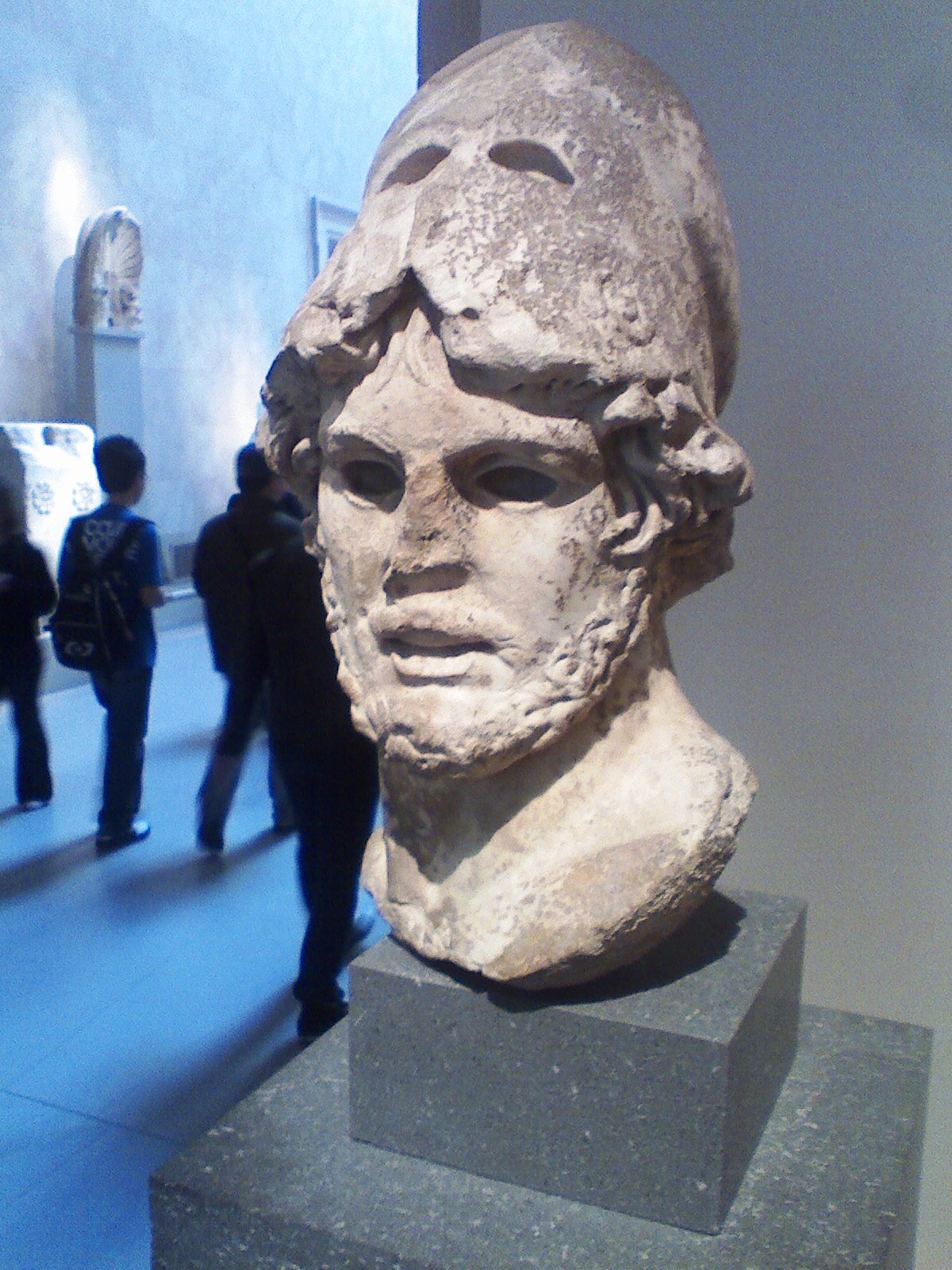
Helmets Galore
Helmets Galore:
Thanks to Dellbabe, we have an impressive selection of helmets, with a few statues to boot. 




Handouts
Handouts:
An odd thing to say during tax week: "No one I’ve met is looking for a handout" JWF reminds us of some of Obama's supporters, who very much were looking for a handout.
Yet what struck me about the line was something different: why would a tax refund be a "handout" in any case? I'll be getting a tax refund this year, partially because I paid withholding at a higher rate than proved to be necessary, and partially because we bought a house and were eligible for the tax credit associated with that.
In the first case, it's not a "handout," because the government is simply returning money of mine that they've held onto for a year or so, collecting the interest (which they will be keeping).
In the second case, it's not a handout, because the government is still returning my money. It's just decided, for policy reasons, that they might like to have me spend my money directly to help stabilize the housing market, rather than spending my money for me. All that money was paid by me into the fund, though, and they held onto it. If they send it back, it was mine to start with.
It's important to understand how this works, because this 'health care' business is going to work the same way. The government decided to make itself a party to my transaction, in order to make housing purchases more attractive. We bought the house back in the fall. The government will, they say, return the tax credit to me soon. So essentially I fronted the money twice: once to the government (in taxes), and once to the bank (for the house). The government held onto "their" portion of that money for another six months (collecting the interest!). Now presumably they'll consent to keep their part of the bargain by refunding "their part" of my money to me.
This was Dennis the Peasant's explanation of how your forced health insurance purchases will work. If you are in the income range to be eligible for government "assistance," it comes as a refundable tax credit. So, this is the deal:
1) You front the money, both by paying taxes and paying for the insurance.
2) Maybe we'll pay you back the tax part.
3) We keep the interest.
4) We kindly imply, on tax week, that we don't think you're "looking for a handout" by collecting your refund.
What a deal!
Politically Correct Stoics
Politically Correct Stoics:
I understand that the idea behind this sort of locution, and I realize that it's probably the editors of the journal applying a "standard" to the author's text. Nevertheless, in the interest of making female readers feel good about being included, or perhaps making the point that women should always be included, they have introduced an inaccuracy into the text.
You might say that's a small thing, but philosophers have written papers over whether "London is pretty" and "Londres est jolie" can be said reliably to express the same belief. Not only does substituting "he" and "she" fail to express the same proposition, one of the propositions is true and the other is false.
Aside from the political correctness that bedevils academic writing these days, the piece is a good one; it offers a brief history of how the concept of "virtue" has evolved, at least as far as Kant. However, I think she misses the real truth about these different visions of virtue: they aimed at producing different kinds of people. Particularly with the ancients, it won't do to say that Aristotle thought X was virtuous, and St. Thomas Aquinas added Y to the concept. Aristotle was trying to create a man who was a Homeric hero, with a love of wisdom ("Cunning as the gods in council," as they said of Odysseus), personal courage, friendships and magnificence. St. Thomas Aquinas was ready to dispense with magnificence in the Homeric sense of the term, defined wisdom completely differently, and in addition added Christian charity (caritas), faith, and hope.
In the opening pages of Dr. Lara Denis' "Kant's Conception of Virtue, we find an interesting account of the Stoic position on happiness.
No matter how poor, ill, or hated the virtuous person is, Stoics claimed she is happy.I would love to see the citation for any Stoic writer who "claimed she" would be happy.
I understand that the idea behind this sort of locution, and I realize that it's probably the editors of the journal applying a "standard" to the author's text. Nevertheless, in the interest of making female readers feel good about being included, or perhaps making the point that women should always be included, they have introduced an inaccuracy into the text.
You might say that's a small thing, but philosophers have written papers over whether "London is pretty" and "Londres est jolie" can be said reliably to express the same belief. Not only does substituting "he" and "she" fail to express the same proposition, one of the propositions is true and the other is false.
Aside from the political correctness that bedevils academic writing these days, the piece is a good one; it offers a brief history of how the concept of "virtue" has evolved, at least as far as Kant. However, I think she misses the real truth about these different visions of virtue: they aimed at producing different kinds of people. Particularly with the ancients, it won't do to say that Aristotle thought X was virtuous, and St. Thomas Aquinas added Y to the concept. Aristotle was trying to create a man who was a Homeric hero, with a love of wisdom ("Cunning as the gods in council," as they said of Odysseus), personal courage, friendships and magnificence. St. Thomas Aquinas was ready to dispense with magnificence in the Homeric sense of the term, defined wisdom completely differently, and in addition added Christian charity (caritas), faith, and hope.
Sedition
Sedition:
'If the EPA gets no budget... if HHS gets no budget...'
Well, actually, that would be a revolution in and of itself.
Should we defend Israel?
Should We Defend Israel?
I don't mean, "Should America defend Israel?" with this question. It's plain enough, under this administration, that America won't.
What I mean is, should we? We remember the Abraham Lincoln Brigade and the Lafayette Escadrille: so we could consider the option of an independent military response by American fighting men, who act as free citizens without reference to our government.
Is this something we should consider? American Jews might well do so, for reasons of religion and community; but what of the rest of us? If so, why? If not, why not?
Benvenuto Cellini
Benvenuto Cellini:
I have a few more pictures of the Met, thanks to Dellbabe, that I will post up over the weekend. Today I wanted to put up something a little different. Italian artist Benvenuto Cellini produced some of that type of Renaissance sculpture that once fired the world's imagination. It combines heroic realism with the ancient myths, as in this statue of Perseus with the head of Medusa.
In addition to his sculpture, painting, and goldwork, he wrote an autobiography that an email group I read has been discussing this week. It's a fascinating piece, which has seventy-nine mentions of the word "sword" and fifteen more of "dagger," including here:
Walking with all haste, I passed the bridge of the Exchange, and went up along a wall beside the river which led to my lodging in the castle. I had just come to the Augustines—now this was a very perilous passage, and though it was only five hundred paces distant from my dwelling, yet the lodging in the castle being quite as far removed inside, no one could have heard my voice if I had shouted—when I saw four men with four swords in their hands advancing to attack me.It's a remarkable piece, more like The Three Musketeers than any work of nonfiction. There are duels and murders, revenge and brawls, necromancers calling forth demons, vanished lovers. There is also a description of the business of making art, especially certain medals of steel that were desired by the Pope.
Go get 2 big mirrors.
Put them opposite one another.
Stand between them and look into one.
Seems to go on forever, right?
That's sort of the feeling I get when I read articles like this.
Put them opposite one another.
Stand between them and look into one.
Seems to go on forever, right?
That's sort of the feeling I get when I read articles like this.
Music for a Thursday
Music for a Thursday:
And now a Spanish piece:
Just right for spring, I'd say. Perhaps a cup of sangria would go with it, in the long afternoon.
Let's start with an interesting piece, not exactly like anything you'll probably have heard lately.
And now a Spanish piece:
Just right for spring, I'd say. Perhaps a cup of sangria would go with it, in the long afternoon.
Phronesis
Phronesis:
This is the kind of thing that breaks a man's heart:
Where does morality come from? The modern consensus on this question lies close to the position laid out by the eighteenth-century Scottish philosopher David Hume. He thought moral reason to be “the slave of the passions”. Hume's view is supported by studies that suggest that our judgements of good and evil are influenced by emotional reactions such as empathy and disgust. And it fits nicely with the discovery that a rudimentary moral sense is universal and emerges early. Babies as young as six months judge individuals on the way that they treat others and even one-year-olds engage in spontaneous altruism.... I predict that this theory of morality will be proved wrong in its wholesale rejection of reason. Emotional responses alone cannot explain one of the most interesting aspects of human nature: that morals evolve.That would be a shocking, revolutionary idea except that Aristotle came up with it. The process is called phronesis.
Constitutional Convention Roundup
Constitutional Convention Roundup:
The idea that the states should call a constitutional convention -- supported here, as regular readers well know -- is apparently starting to pop up in a lot of places. Here are a few places that are talking about the idea.
The Wall Street Journal
The Washington Post's Ezra Klein (opposed, naturally)
The Epoch Times: "In South Carolina, Lt. Gov. Andre Bauer is asking state lawmakers to support a resolution calling for a constitutional convention to amend the Constitution and overturn 'socialized medicine.'"
Politics at Gather.com
FOX News
See also this piece on "the Virginia Plan," which demonstrates that the Founders considered and rejected the idea that the Congress should be able to overturn state legislation.
Subscribe to:
Comments (Atom)