Former Special Forces blogger BloodSpite has a suggestion for those concerned about immigration, as well as a parable. The parable will be immediately comprehensible to anyone who has lived in, or passed through, the Deep South.


A Death in the Family
A Death in the Family:
My wife's father is dead, having passed away in a peaceful sleep while sitting in his favorite chair. I have mentioned him here from time to time, but I would like to give him a proper eulogy.
He joined in the Army in 1946, as a young officer and navigator on bombers. He served in the Army Air Force and then the Air Force. He was stationed in Germany at the beginning of the postwar period, when the Werewolves were still active. He was charged with guarding the payroll for his unit, a perilous duty at the time.
Later he was stationed in Libya, where he and his unit fought bandits attempting to raid military supplies. He left the military in the 1950s, and became an aerospace engineer for General Motors' defense contracting sections. During that time he worked on numerous secret programs, and was one of the designers of the Stealth program.
He took the usual oaths to keep our country's secrets, and kept them faithfully. Even in his seventies, talking to me in our occasional chats on national defense and policy, he never revealed any of the secrets -- many long obsolete -- that he had promised to keep.
In his youth he had fierce red hair and an Irish temper, and sailed the Carribean as an officer of the United States' Power Squadrons; in his age, his hair had turned to white, and to me he was always a perfect gentleman. When I asked for his daughter's hand, he smiled and told me he had no objections, but that he had raised her to make her own decisions.
I liked him and I'll miss him. He was a fine man.
3G PIII
Three Good, Part III:
Those who supported him did so in large part because they agreed with him. The argument was that the perjury was on a matter of no real importance, having only to do with a sexual liason with a girl who was past the legal age of consent. Indeed, as I recall, there was even a legalistic argument that the offense did not rise to perjury at all, because even though he had lied under oath, it was about a matter that was not legally material to the subject at hand. That there was a point of honor -- that a man keeps his oaths, or is no man at all -- was simply not something they believed to be true.
There were some on the pro-impeachment side who were motivated by this principle of honor. They were chiefly among the citizenry, not the political class. The reason that the price Mansfield cites was paid by Republican politicians is because they were guilty -- not of pushing too hard, but of hypocrisy. There are few in Congress who are fit even to say the word "honor." It is so obvious in their conduct, that the People of the United States were disgusted to see them parading around under its flag.
From there, Mansfield makes another serious error -- one caught, in the comments below, by our friend and co-blogger Major Joel Leggett. Mansfield argues that revulsion against the duel that killed Hamilton ended dueling as a political force in America. Joel responds:
The failure to understand that is another critical error in the Mansfield piece. The Hamilton duel was deeply flawed by the point that Mansfield praises: Hamilton's intent not to fire his piece. The point of the duel is a radical affirmation of respect: you allow your opponent a chance to kill you, and he allows you the same. To refuse to fire is to assert that you are not equal to your opponent, but either better or worse than he is.
Hamilton showed faith and fidelity to his Christian principles, but not enough to refuse to attend the duel -- he cared for the accolades of this world enough that he could not refuse to participate in the institution. He showed some fidelity to the culture of honor, but not enough to participate fully in its rituals either: the duel would have been unsatisfactory even if he had survived.
His refusal to fire would have been another insult. Rather than resolving the feud, as was the purpose of the duel, it would have furthered and deepened it.
The real lesson of the Hamilton duel is that you should either fight, or not fight; you should choose pacifism, or else to fight for justice in the world. A priest or a pacifist can get by on his principles, which are widely respected, even though he must rely on others for protection.
A fighting man must fight, in his own defense and others'. This is necessary, and it is proper. The priests of the world depend upon him.
The last article is from Noel, authored by Harvey Mansfield, and titled "The Founders' Honor." It attempts to explore what honor meant to the Founders, who were willing to fight and even to die for it. Mansfield begins, though, badly.
Yet the biggest recent events in American politics make sense only when seen as motivated by a sense of honor. When President Clinton was impeached, he refused to resign, one could say, for reasons of both honor and self-interest. But the Democrats in public office who supported him could have done so only for honor. They did not want to give in to those prissy, self-righteous Republicans, who would have crowed in triumph at his fall. In refusing to sacrifice their tainted champion as self-interest would have dictated, the Democrats paid a price. Their candidate Al Gore, chief among Clinton loyalists, suffered from "Clinton fatigue" (or Clinton disgust) in the electorate, and he lost a close election he probably would have won if Clinton had resigned and had taken his bad odor with him, leaving Gore to run as a relatively unembarrassed incumbent.Whatever the Clinton saga was about, it was not about the honor of politicians -- except just one politician, Clinton, who had no interest in fighting for his honor. He swore an oath to tell the truth, violated it, got caught, and then shrugged it off as a matter of no importance.
The Republicans for their part might have been well advised by self-interest to leave well enough alone, and not insist on impeachment in the House or a trial in the Senate. But they were overcome by their outrage. They felt it necessary to uphold law and propriety against a liar who had, at long last, been caught in his lie. So the Republicans refused to "move on" and diminished their advantage from Clinton fatigue because they seemed too eager for his removal.
Those who supported him did so in large part because they agreed with him. The argument was that the perjury was on a matter of no real importance, having only to do with a sexual liason with a girl who was past the legal age of consent. Indeed, as I recall, there was even a legalistic argument that the offense did not rise to perjury at all, because even though he had lied under oath, it was about a matter that was not legally material to the subject at hand. That there was a point of honor -- that a man keeps his oaths, or is no man at all -- was simply not something they believed to be true.
There were some on the pro-impeachment side who were motivated by this principle of honor. They were chiefly among the citizenry, not the political class. The reason that the price Mansfield cites was paid by Republican politicians is because they were guilty -- not of pushing too hard, but of hypocrisy. There are few in Congress who are fit even to say the word "honor." It is so obvious in their conduct, that the People of the United States were disgusted to see them parading around under its flag.
From there, Mansfield makes another serious error -- one caught, in the comments below, by our friend and co-blogger Major Joel Leggett. Mansfield argues that revulsion against the duel that killed Hamilton ended dueling as a political force in America. Joel responds:
That statement is absolutely historically inaccurate. Andrew Jackson’s duel with the Benton brothers in May of 1813, nine years after the Hamilton/Burr affair, had significant political ramifications through out the Old Southwest (The Southeast today) and ultimately contributed to Jackson’s national reputation, which in turn propelled him to the White House.Quite right. In the South, dueling and its honor-based culture continued to be a very important political force through at least the Civil War. The caning of Sumner, for example, was very much a part of the duelist culture. The reason it was a caning and not a duel was only that Sumner was thought unfit for the honor of a duel. A gentleman duels only with equals. The duel, indeed, is principally about finding a way for the gentleman who has received offense at the hand of an equal to affirm their equality, and thus restore the balance on which the society depends. Normally this is done through the exchange of letters among the seconds; but if it comes to it, the willingness to face each other's fire fairly restores and affirms that these men are equals.
The failure to understand that is another critical error in the Mansfield piece. The Hamilton duel was deeply flawed by the point that Mansfield praises: Hamilton's intent not to fire his piece. The point of the duel is a radical affirmation of respect: you allow your opponent a chance to kill you, and he allows you the same. To refuse to fire is to assert that you are not equal to your opponent, but either better or worse than he is.
Hamilton showed faith and fidelity to his Christian principles, but not enough to refuse to attend the duel -- he cared for the accolades of this world enough that he could not refuse to participate in the institution. He showed some fidelity to the culture of honor, but not enough to participate fully in its rituals either: the duel would have been unsatisfactory even if he had survived.
His refusal to fire would have been another insult. Rather than resolving the feud, as was the purpose of the duel, it would have furthered and deepened it.
The real lesson of the Hamilton duel is that you should either fight, or not fight; you should choose pacifism, or else to fight for justice in the world. A priest or a pacifist can get by on his principles, which are widely respected, even though he must rely on others for protection.
A fighting man must fight, in his own defense and others'. This is necessary, and it is proper. The priests of the world depend upon him.
3G PII
Three Good, Part II:
But then, I belong to the movement Summers says is already supporting these women: the one that believes in human liberty above all. Freedom House is a name I know and support. It's no surprise to find myself, again, on the same side.
The second piece is by Christina Hoff Summers. It is called, "The Subjection of Islamic Women and the fecklessness of American Feminism."
The subjection of women in Muslim societies--especially in Arab nations and in Iran--is today very much in the public eye. Accounts of lashings, stonings, and honor killings are regularly in the news, and searing memoirs by Ayaan Hirsi Ali and Azar Nafisi have become major best-sellers. One might expect that by now American feminist groups would be organizing protests against such glaring injustices, joining forces with the valiant Muslim women who are working to change their societies. This is not happening.I will leave aside the particular fights she undertakes with the leadership figures of American feminism -- on genital mutilation v. elective cosmetic surgery, on comparing Islamic regimes that hang gays with Christian social groups that are disgusted by them. I am interested, however, in her overarching point: that women are actually, really being subjugated in the Islamic world in a way the Christian world never considered -- and that those who claim to care about women ought to devote their energies to supporting those women above all.
If you go to the websites of major women's groups, such as the National Organization for Women, the Ms. Foundation for Women, and the National Council for Research on Women, or to women's centers at our major colleges and universities, you'll find them caught up with entirely other issues, seldom mentioning women in Islam. During the 1980s, there were massive demonstrations on American campuses against racial apartheid in South Africa. There is no remotely comparable movement on today's campuses against the gender apartheid prevalent in large parts of the world.
It is not that American feminists are indifferent to the predicament of Muslim women. Nor do they completely ignore it. For a brief period before September 11, 2001, many women's groups protested the brutalities of the Taliban. But they have never organized a full-scale mobilization against gender oppression in the Muslim world. The condition of Muslim women may be the most pressing women's issue of our age, but for many contemporary American feminists it is not a high priority. Why not?
The reasons are rooted in the worldview of the women who shape the concerns and activities of contemporary American feminism. That worldview is--by tendency and sometimes emphatically--antagonistic toward the United States, agnostic about marriage and family, hostile to traditional religion, and wary of femininity. The contrast with Islamic feminism could hardly be greater.
This past November more than 100 Muslim lawyers, scholars, and activists from 25 countries gathered in New York City for the express purpose of supporting the modernization of Islamic jurisprudence and reviving the spirit of ijtihad, a once vibrant Islamic tradition of independent thinking and reasoning about sacred texts. The organizing group, the Women's Islamic Initiative in Spirituality and Equity (WISE), plans to launch an international shura, a consultative council of Muslim women leaders who will advise religious and political leaders on women's issues. They are also establishing a scholarship fund for the training of gifted female students to become Koranic scholars, or muftia. These women would be licensed to render fatwas, religious judgments that, while nonbinding, drive custom and practice in Islamic societies.This is an interesting argument for two reasons. First, it points to exactly the sort of "economic/social engagement rubs off" method that was described below. Second, it points also to a domestic American feminism that was once healthier than the type we have today -- and also far more successful, because it could appeal to men and traditionally-minded women as well.
The WISE participants were a who's who of Muslim women lawyers, writers, and rights advocates. Perhaps the most affecting speaker was Mukhtar Mai. She is the Pakistani woman who, in 2002, was gang-raped by four men because of crimes allegedly committed by her brother. After the rape, which was sanctioned by an all-male village council, Mukhtar Mai was expected to preserve the "honor" of her family by killing herself. Instead, she and her family went to the police, even at the risk of being charged for the "crime" of being raped. A local imam, outraged by her treatment, denounced the attack in his Friday sermon. Reporters soon appeared, and Mukhtar's case became a cause célèbre.
The conference participants varied widely in their politics and their relation to Islam. Unlike the present American feminist movement, which has no place for traditionally religious women, Islamic feminism is inclusive. Some of its proponents wear the veil, others oppose it. Some want egalitarian mosques, others don't mind traditional arrangements where men and women are separated. Even a few non-Muslims were present. What unites them in feminism is their commitment to the universal dignity of women. They are all vehemently opposed to such practices as forced marriages, honor killings, genital cutting, child marriage, and wife-beating. They are passionately dedicated to the educational, economic, legal, and political advancement of women.
The feminism that is quietly surging in the Muslim world is quite different from its contemporary counterpart in the United States. Islamic feminism is faith-based, family-centered, and well-disposed towards men. This is feminism in its classic and most effective form, as students of women's emancipation know. American women won the vote in the early 20th century through the combined forces of progressivism and conservatism. Radical thinkers like Elizabeth Cady Stanton, Victoria Woodhull, and Alice Paul played an indispensable role, but it was traditionalists like Frances Willard (president of the Women's Christian Temperance Union) and Carrie Chapman Catt (founder of the League of Women Voters) who brought the cause of women's suffrage into the mainstream.
I asked Daisy Kahn, executive director of the American Society for Muslim Advancement and organizer of the WISE conference, how Americans can help. Her answer was simple: "Support us. Embrace our struggle." That is already happening, though mostly outside feminist circles. There are scores of independent organizations--groups like Freedom House, Global Giving, the Independent Women's Forum, Project Ijtihad, Equality Now, and the Initiative for Inclusive Security--that have begun to work in effective ways to support Muslim women. Such groups, both liberal and conservative, may not identify themselves as feminist, but they embody the ideals and principles of the classical, humane feminism of Stanton, Anthony, and Willard.Though I am no feminist and never have been one, I admit that I find the possibility both pleasant and even exciting. I am, as Sir Walter Scott put it, "a friend to the weaker party." In Islamic societies, that is women, whose case is worse than it has ever been in the West -- even in ancient Greece, where women were treated as permanent children, it was not quite so bad.
Those "First Wave" reformers made history. Their classical "equity" feminism was predominant in the United States long before the current band of activists and theorists transformed and debased it beyond recognition. Their understanding of equality was never at war with femininity, never at war with men, or with family, or with logic or common sense. It is alive again in Islamic feminism.
But then, I belong to the movement Summers says is already supporting these women: the one that believes in human liberty above all. Freedom House is a name I know and support. It's no surprise to find myself, again, on the same side.
3 Good Pieces
Three Good Pieces, Part One:
Similarly, the American forces have won every single engagement at the platoon level or larger since 2003; yet there are many idiot politicians and unthinking citizens who have let the insurgent propaganda war convince them that we are losing. If that conviction continues to the point that those politicians and citizens move to withdraw our forces, we will in fact have lost the war -- by choosing to surrender to a foe who never won a single engagement.
The second mistake Luttwak speaks of is the mistake of assuming it is easy to change these societies. This speaks both to those who thought that force would do it, and those who think that diplomacy and concessions will do it. "Backwards societies must be left alone," Luttwak states.
Which is almost right. In 2003, I wrote a piece called The Black Mail, which argued that change can come only slowly, and because these societies choose it for themselves. What is necessary, however, is to create conditions whereby the tribal/older societies engage with the modern world -- so that the natural tendencies of capitalism and liberty will destabilize and force changes over time.
That leads us to a middle position between Luttwak's "leave them alone" and the fierce and continual engagement and meddling advocated by both the hawkiest hawks and the doviest doves. Neither invading nor negotiating with Syria is necessary, for example; what is necessary is to win in Iraq, since we are there, and let them rub against it.
This was an argument made in the runup to the Iraq war, and one on which the principled could fall on either side. The pro-invasion argument was that, if we could begin to see democratic changes in Iraq, the consequences of seeing it and having contact with a democratic Arab state would spread through the whole region. That would reduce the likelihood of further wars in the future, and bring the whole region (slowly) into alignment with the wider world.
The other argument would be that, if this principle can work, invasion should not be necessary at all -- only further, deeper economic engagement. Though slower, there would be no need to fight a war at all. Thus, this principle would not justify an invasion.
I believe Luttwak would make that point, which is quite right. Insofar as the process may be speeded by war, yet that can only be a side benefit for war, not a justification for war. If a war is justified, it must be on other grounds.
Meanwhile, concessions and negotiations with a given autocratic regime can be justified only if they permit the increased economic/social engagement. If the concessions are only being used to prop up an existing regime's credibility or stability, they are not justified. For example, no concessions to North Korea are justified. The regime should be isolated and allowed to collapse, because it cannot be meaningfully engaged. The government refuses to allow it.
In the Middle East, that is not the case. Even in Saudi Arabia, there is some economic/social interaction, and Muslims (particularly Muslim women) are drawing from the ideas they find in those interactions. The society is changing in positive ways, if slowly.
The last mistake Luttwak discusses -- I am combining his "first" and "fourth" into an overarching "third" -- is the mistake of assuming that what happens in the Middle East is important. By this, he explictly means "including the Israel/Palestine conflict." I've always agreed with this posture: the idea that this conflict is overriding in its implications for the world is simply wrong. That it is widely believed does not change the fact that it is wrong, as Luttwak demonstrates.
I still endorse it, however, as slow change is better than no change at all; and better than fighting a region-wide war. We have committed to Iraq, for reasons beyond the reason of changing their society; and we must continue it for as long as necessary to win, because there is no set of options in defeat that is as good as the worst option that comes from success. America, having begun a war, must win it.
Luttwak here is on far more stable ground than in his last piece. His policy prescriptions are close to what I would advocate, even if I think he is drawn into error on a few points. I await your thoughts with interest.
Two via Arts & Letters Daily, and one via our friend Noel of Sharp Knife and Cold Fury. I'll post each of them separately.
The first is another piece by Mr. Luttwak. It is an argument for ignoring the Middle East. I post it for three reasons: because it strikes me as something that may somewhat redeem Mr. Luttwak's standing in the eyes of our Eric Blair; because it is well reasoned and contains interesting information; and because I almost agree with it.
Luttwak argues, correctly, that there are four basic mistakes intelligence and security analysts make with the Middle East. First, they assume that it has some actual power because its nations maintain large conscription armies; but in fact, all of these armies are effectively worthless.
[T]he [overestimation] mistake keeps being made by the fraternity of middle east experts. They persistently attribute real military strength to backward societies whose populations can sustain excellent insurgencies but not modern military forces....I dissent with Luttwak on one point: the modern insurgent fights what is principally an information war. If "the publicity is excellent" to the degree that his aims are achieved in the political realm, the insurgent has won regardless of the facts on the battlefield.
[When calling Iran dangerous a]ll the symptoms [of that mistake] are present, including tabulated lists of Iran's warships, despite the fact that most are over 30 years old; of combat aircraft, many of which (F-4s, Mirages, F-5s, F-14s) have not flown in years for lack of spare parts; and of divisions and brigades that are so only in name. There are awed descriptions of the Pasdaran revolutionary guards, inevitably described as "elite," who do indeed strut around as if they have won many a war, but who have actually fought only one—against Iraq, which they lost. As for Iran's claim to have defeated Israel by Hizbullah proxy in last year's affray, the publicity was excellent but the substance went the other way, with roughly 25 per cent of the best-trained men dead, which explains the tomb-like silence and immobility of the once rumbustious Hizbullah ever since the ceasefire.
Similarly, the American forces have won every single engagement at the platoon level or larger since 2003; yet there are many idiot politicians and unthinking citizens who have let the insurgent propaganda war convince them that we are losing. If that conviction continues to the point that those politicians and citizens move to withdraw our forces, we will in fact have lost the war -- by choosing to surrender to a foe who never won a single engagement.
The second mistake Luttwak speaks of is the mistake of assuming it is easy to change these societies. This speaks both to those who thought that force would do it, and those who think that diplomacy and concessions will do it. "Backwards societies must be left alone," Luttwak states.
Which is almost right. In 2003, I wrote a piece called The Black Mail, which argued that change can come only slowly, and because these societies choose it for themselves. What is necessary, however, is to create conditions whereby the tribal/older societies engage with the modern world -- so that the natural tendencies of capitalism and liberty will destabilize and force changes over time.
That leads us to a middle position between Luttwak's "leave them alone" and the fierce and continual engagement and meddling advocated by both the hawkiest hawks and the doviest doves. Neither invading nor negotiating with Syria is necessary, for example; what is necessary is to win in Iraq, since we are there, and let them rub against it.
This was an argument made in the runup to the Iraq war, and one on which the principled could fall on either side. The pro-invasion argument was that, if we could begin to see democratic changes in Iraq, the consequences of seeing it and having contact with a democratic Arab state would spread through the whole region. That would reduce the likelihood of further wars in the future, and bring the whole region (slowly) into alignment with the wider world.
The other argument would be that, if this principle can work, invasion should not be necessary at all -- only further, deeper economic engagement. Though slower, there would be no need to fight a war at all. Thus, this principle would not justify an invasion.
I believe Luttwak would make that point, which is quite right. Insofar as the process may be speeded by war, yet that can only be a side benefit for war, not a justification for war. If a war is justified, it must be on other grounds.
Meanwhile, concessions and negotiations with a given autocratic regime can be justified only if they permit the increased economic/social engagement. If the concessions are only being used to prop up an existing regime's credibility or stability, they are not justified. For example, no concessions to North Korea are justified. The regime should be isolated and allowed to collapse, because it cannot be meaningfully engaged. The government refuses to allow it.
In the Middle East, that is not the case. Even in Saudi Arabia, there is some economic/social interaction, and Muslims (particularly Muslim women) are drawing from the ideas they find in those interactions. The society is changing in positive ways, if slowly.
The last mistake Luttwak discusses -- I am combining his "first" and "fourth" into an overarching "third" -- is the mistake of assuming that what happens in the Middle East is important. By this, he explictly means "including the Israel/Palestine conflict." I've always agreed with this posture: the idea that this conflict is overriding in its implications for the world is simply wrong. That it is widely believed does not change the fact that it is wrong, as Luttwak demonstrates.
The late King Hussein of Jordan was the undisputed master of this genre. Wearing his gravest aspect, he would warn us that with patience finally exhausted the Arab-Israeli conflict was about to explode, that all past conflicts would be dwarfed by what was about to happen unless, unless… And then came the remedy—usually something rather tame when compared with the immense catastrophe predicted, such as resuming this or that stalled negotiation, or getting an American envoy to the scene to make the usual promises to the Palestinians and apply the usual pressures on Israel. We read versions of the standard King Hussein speech in countless newspaper columns, hear identical invocations in the grindingly repetitive radio and television appearances of the usual middle east experts, and are now faced with Hussein's son Abdullah periodically repeating his father's speech almost verbatim.Quite right on every point. What does it all mean?
What actually happens at each of these "moments of truth"—and we may be approaching another one—is nothing much; only the same old cyclical conflict which always restarts when peace is about to break out, and always dampens down when the violence becomes intense enough. The ease of filming and reporting out of safe and comfortable Israeli hotels inflates the media coverage of every minor affray. But humanitarians should note that the dead from Jewish-Palestinian fighting since 1921 amount to fewer than 100,000—about as many as are killed in a season of conflict in Darfur.
Strategically, the Arab-Israeli conflict has been almost irrelevant since the end of the cold war. And as for the impact of the conflict on oil prices, it was powerful in 1973 when the Saudis declared embargoes and cut production, but that was the first and last time that the "oil weapon" was wielded. For decades now, the largest Arab oil producers have publicly foresworn any linkage between politics and pricing, and an embargo would be a disaster for their oil-revenue dependent economies. In any case, the relationship between turmoil in the middle east and oil prices is far from straightforward. As Philip Auerswald recently noted in the American Interest, between 1981 and 1999—a period when a fundamentalist regime consolidated power in Iran, Iran and Iraq fought an eight-year war within view of oil and gas installations, the Gulf war came and went and the first Palestinian intifada raged—oil prices, adjusted for inflation, actually fell. And global dependence on middle eastern oil is declining: today the region produces under 30 per cent of the world's crude oil, compared to almost 40 per cent in 1974-75. In 2005 17 per cent of American oil imports came from the Gulf, compared to 28 per cent in 1975, and President Bush used his 2006 state of the union address to announce his intention of cutting US oil imports from the middle east by three quarters by 2025.
Yes, it would be nice if Israelis and Palestinians could settle their differences, but it would do little or nothing to calm the other conflicts in the middle east from Algeria to Iraq, or to stop Muslim-Hindu violence in Kashmir, Muslim-Christian violence in Indonesia and the Philippines, Muslim-Buddhist violence in Thailand, Muslim-animist violence in Sudan, Muslim-Igbo violence in Nigeria, Muslim-Muscovite violence in Chechnya, or the different varieties of inter-Muslim violence between traditionalists and Islamists, and between Sunnis and Shia, nor would it assuage the perfectly understandable hostility of convinced Islamists towards the transgressive west that relentlessly invades their minds, and sometimes their countries.
We devote far too much attention to the middle east, a mostly stagnant region where almost nothing is created in science or the arts—excluding Israel, per capita patent production of countries in the middle east is one fifth that of sub-Saharan Africa. The people of the middle east (only about five per cent of the world's population) are remarkably unproductive, with a high proportion not in the labour force at all.Emphasis added. This has been the central problem with the model I advocate, that of change-through-economic involvement, particularly in Saudi Arabia. Many have no need to work because of oil revenue, and the government's use of that revenue to prop up the institutions of the existing tribal society. That has not prevented change, but it has slowed it to a remarkable degree.
I still endorse it, however, as slow change is better than no change at all; and better than fighting a region-wide war. We have committed to Iraq, for reasons beyond the reason of changing their society; and we must continue it for as long as necessary to win, because there is no set of options in defeat that is as good as the worst option that comes from success. America, having begun a war, must win it.
Luttwak here is on far more stable ground than in his last piece. His policy prescriptions are close to what I would advocate, even if I think he is drawn into error on a few points. I await your thoughts with interest.
Of course they're terrorists
Of Course They're Terrorists:
A) A group that is organized for the purposes of using violence to effect social or political change, and
B) Directs that violence primarily against noncombatants or economic infrastructure necessary to the normal operation of civilian economies, and,
C) Wears false or no uniforms, and obeys none of the customary laws of war, and,
D) Is not part of the authorized military forces of any nation.
Groups that meet A-C but not D are spies, but not terrorists; not that it matters, since the laws of war permit you to shoot spies summarily as well. Groups that meet A and C but not B and D are guerrillas, whose status is usually better under the laws of war. Groups that meet A, C, and D but not B are unlawful combatants, but not terrorists. Groups that meet all four tests are terrorists.
So, does ALF/ELF meet all these tests?
They direct the fires not against soldiers or police, but primarily against civilian economic structures. The ranger stations are the sole exception, possibly, depending on whether the rangers are peace officers or fire watch officers -- both types of officers sometimes use the title "ranger." That's test B.
They wear no uniform. That's test C.
They are part of no military force. That's test D.
So, yes, they're clearly terrorists. They should be subject to the laws of war. The government has (unwisely) chosen to subject them to civilian law, as if they were part of rather than enemies of the society from which those laws and protections arise. That is a needless generosity on the part of the Federal government. That said, they are certainly entitled, if they are going to insist on treating this as a criminal matter, to prosecute it using laws against terrorism.
I steadfastly oppose using laws passed to address terrorism to prosecute crimes of other sorts. Terrorism really isn't a law-enforcement matter anyway -- they should be treated as members of groups of brigands or pirate companies, which is to say, as outside the protections of society and subject to the rules of customary international law, which allow the officers of any nation to execute them on capture.
So, what about ELF?
Prosecutors want Judge Ann Aiken to declare the group terrorists — something defense attorneys argue has never happened in 1,200 arsons nationwide claimed by Earth Liberation Front and Animal Liberation Front.Are ELF/ALF terrorists? What is a terrorist?
The defense argues that branding their clients terrorists is more about politics than sentencing.
"The Government has Attorney General Alberto Gonzales' political agenda to advance with this case, and nothing else to lose if the Court declines to impose the enhancement," wrote attorney Terri Wood, who represents Stanislas G. Meyerhoff.
A) A group that is organized for the purposes of using violence to effect social or political change, and
B) Directs that violence primarily against noncombatants or economic infrastructure necessary to the normal operation of civilian economies, and,
C) Wears false or no uniforms, and obeys none of the customary laws of war, and,
D) Is not part of the authorized military forces of any nation.
Groups that meet A-C but not D are spies, but not terrorists; not that it matters, since the laws of war permit you to shoot spies summarily as well. Groups that meet A and C but not B and D are guerrillas, whose status is usually better under the laws of war. Groups that meet A, C, and D but not B are unlawful combatants, but not terrorists. Groups that meet all four tests are terrorists.
So, does ALF/ELF meet all these tests?
The fires targeted forest ranger stations, meat packing plants, wild horse corrals, lumber mill offices, research facilities, an SUV dealer and, in 1998, Vail Ski Resort. No one was injured, the defense notes in legal motions.ELF and ALF are organized to set these sorts of fires (ELF alone claims 1,200 arsons), as a means of forcing social or political change. They are, then, devoted to the purpose of using violence and destruction for those purposes. That's test A.
The case, known as Operation Backfire, is the biggest prosecution ever of environmental extremists, and has turned on its head the prevailing idea that arsonists have generally acted alone, said Brent Smith, director of the Terrorism Research Center at the University of Arkansas.
"We thought these people operated for the last 15 years under this kind of uncoordinated violence approach, just like the extreme right was doing — leaderless resistance," Smith said. "That's why this case is so very different."
Prosecution filings argue that though the defendants were never convicted of terrorism, they qualify for the label because at least one of the fires each of them set was intended to change or retaliate against government policy.
They direct the fires not against soldiers or police, but primarily against civilian economic structures. The ranger stations are the sole exception, possibly, depending on whether the rangers are peace officers or fire watch officers -- both types of officers sometimes use the title "ranger." That's test B.
They wear no uniform. That's test C.
They are part of no military force. That's test D.
So, yes, they're clearly terrorists. They should be subject to the laws of war. The government has (unwisely) chosen to subject them to civilian law, as if they were part of rather than enemies of the society from which those laws and protections arise. That is a needless generosity on the part of the Federal government. That said, they are certainly entitled, if they are going to insist on treating this as a criminal matter, to prosecute it using laws against terrorism.
Hitchens/Sharpton
Hitchens/Sharpton:
Ouch. Hitchens seriously outclassed Sharpton. I think the fault is Sharpton's for not being up to his standard. It's a shame that G. K. Chesterton wasn't there to take the field against him instead.
The Media Are Fools
The Media Are Fools:
A great truth -- the global media has simply refused to stop and consider the question of whether they are being used by terrorists as weapons. Today's example: this story from the AP, entitled, "Extremist taunts his victims from prison."
The article explains that Eric Robert Rudolph, against whom I have a particular grudge because I lost a bet about him, has been writing pointless screeds and mailing them to a friend. The friend has a website, run in the name of the so-called "Army of God" group Rudolph claimed to represent; and the existence of that website has been tormenting the victims of Rudolph's bombings.
Here's the problem:
Nobody remembered that the so-called "Army of God" existed. Nobody was looking for the website. Nobody would have read the articles.
Thanks to the AP's story, many people will see these rants who would otherwise have been totally ignorant of their existence. The AP story says that one of the victims "is worried that Rudolph's messages could incite someone to violence against abortion providers."
Well, the odds of that just increased from "nearly zero" to "quite possibly." Those perhaps-inspiring-to-a-lunatic rants have just been drawn to the attention of millions.
Terrorist groups cannot survive, and certainly cannot win any of their goals, without the media oxygen on which they depend. The media, if they are a responsible group of people with any love for civilization, need to learn this lesson.
They need to stop being the real weapon of terrorists. They're free -- the 1st Amendment protects them. They've got to choose to stop. I don't know how to say it any plainer.
Getting Older
Getting Older:
Today I settled down to clean out my safe, the bottom shelf of which had become clogged with loose ammunition. After returning from the gun range, I sometimes just dump the unused ammo into the safe (to keep it secure) without taking the time to sort it by caliber and return it to the proper boxes. Quite a bit of it had accumulated over the years, so I finally got around to putting it all back where it belonged.
While doing so, I came across something interesting: a Viking dragon belt buckle, made by an old friend of ours at the Crafty Celts. I had no memory of buying it, or even thinking about buying it. It's just the sort of thing I'd like, though.
So I went to my wife, and asked if she'd bought it. She said she had no idea at all. The matter was a little puzzle for a while, until we checked the receipt and discovered that she had bought it back in October. Apparently, it was intended as a birthday present for me, or possibly a Christmas present.
So I got in May. Well, it's still nice. I can't say a thing about her forgetting my (birthday? Christmas?) present, though -- it's already the case that it seems wholly explicable to me. I'm not even all that old. But I'm old enough to understand.
Deepthought South Hate Crime 2
The South & Hate Crimes, Updated & Revised:
Deep Thought has updated his famous piece on the South and hate crimes, in the wake of last week's uproar involving Fort Pillow. He's a little angry about the rhetoric that was reflexively directed at Southerners just because some Congressman decided to quote a Civil War general, on the subject of military tactics.
I think the people who reacted so badly about the reference to Gen. Nathan Bedford Forrest probably only know two things about him: that he was commanding at Ft. Pillow, and that he founded the KKK. They probably don't know that there are conflicting historical claims about what happened at Ft. Pillow, and they certainly don't know that Forrest ordered the KKK to disband when it stopped being about resisting Northern domination, and became about punishing blacks. He also was the first white man to address the Pole Bearers association, an early civil rights group, during which address he made a point of endorsing black civil rights, including voting rights.
In any event, he was a natural cavalryman -- and it's hard not to have some respect for a man who had more than thirty horses shot out from under him and kept riding into battle all the same. If you are talking about warfighting, as the Congressman was on this occasion, it's proper to cite him. The man knew something about it.
On Kung Fu
On Kung Fu:
I once had a professor, back in my days as a philosophy student, who asked me how anyone could claim both to be a Buddhist, and also a fighting man. As I recall my answer, it was something like: a Buddhist who is a fighting man makes no secret about it, and seeks no direct conflict. It's thus not his fault if someone else attacks him and gets hurt, in the same way that it's not a sword's fault if a fool should throw himself upon it.
That long-past discussion was brought to mind by this article on kung fu and its place in the Chan tradition. Chan Buddhism, which is the Chinese ancestor of Zen Buddhism, is also the progenitor of the kung fu systems of martial arts. Now, in San Francisco, we have an earnest American Buddhist trying to bring the Chan tradition here -- but the Chinese disciple he was sent by the main temple is more of a fighter than a priest.
D'Artagnan
Racehorse:
We haven't had any horse stories here in a while. We got a new horse in yesterday, a beautiful fleabitten grey Thoroughbred named D'Artagnan. I haven't gotten any photos of him yet, but will.
We had several people out at the farm wanting a trail ride this morning, so the farm's owner asked me to lead them out. "You can try D'artagnan!" she said brightly.
"What can you tell me about him?" I asked.
"Well, he sometimes bucks if you try to turn right," she replied.
"We may need to turn right on the trail," I mentioned.
She shrugged. "Racehorses are like that," she said. "They spend their whole lives turning left."
"Racehorse," I said without enthusiasm.
"Ex-racehorse," she answered. "I'll lunge him for you."
So I'm watching the horse being lunged while I get my kit together, and he's bucking and kicking up a storm. "Seems like an energetic fellow," I said.
"He won't buck under saddle," she promised.
"He's wearing a saddle right now," I pointed out.
She coughed. "I mean, once you're in the saddle."
So, off we went. He was a great horse. He didn't like to go right, as she noted, but the only reason I know was that he had a much harder mouth on the right. He may be an "ex-racehorse," but he's got lots of spirit and wants to go. I was leading a party of fairly green riders, so we were just taking a relaxing walk, but I could feel that he wanted to push out. The woman riding behind me was on a horse named Bella, who is also hot to trot.
Then, coming up a hill, D'Artagnan walked under a dead branch that stretched across the trail. I guess he didn't see it, but it was low enough I couldn't duck it. It broke against my body, thick enough that it made a huge CRACK!
Guess it sounded like a starting gun.
That horse took off from a start to a dead run, just like a racehorse should. Bella came right on behind him.
I grabbed the reigns and pulled back and in hard, with a sharp "Ho!" I didn't expect it to matter at all, though, with Bella running right behind him, close enough that he could feel her breath on his hip. Horses are herd animals, after all, and when they get going together they feed off each other. I figured it'd be a ride before I'd be able to get him under control.
He dropped out of the run and back to a walk without the slightest complaint. Horse didn't run three steps. He did just what he was supposed to do.
Later, back at the barn, and was telling the owner about him. The limb had been the only problem, I said, but I was impressed with how responsive he was with another horse right there, pushing hard.
She smiled. "There are some things," she said, "that racehorses are used to."
Donkey Pic
Keep His Head Up, Son:A Palestinian boy tries to control his donkey in the village of Jabel Mukaber in east Jerusalem, Wednesday, May 9, 2007. The Palestinian economy can't recover unless Israel dismantles a network of obstacles that has carved up the West Bank into a dozen enclaves and restricted Palestinian access to more than half the territory, the World Bank said in an exceptionally harsh report Wednesday. (AP Photo/Emilio Morenatti)
Not exactly sure how those troubles are related, though.
I guess the Palestinians have a lot of troubles. I can't do anything about those Israelis, but the donkey problem can be solved.
Not exactly sure how those troubles are related, though.
WTF?
Whiskey Tango Foxtrot:
I know the Washington Times isn't always fair, but... surely this is a joke? "Dems: Use intelligence funds to study [global] warming."
A) Does anyone think that there is a scarcity of funds to study global warming? In academic circles, including "global warming" or "carbon" in your proposal is the best way to ensure you get the grant you wanted.
B) Does anyone think our intelligence systems are in such good shape that we can afford distractions?
I mean, if Congress really wants to devote funds to studying the issue, that's fine. But surely the intelligence budget isn't the place to go for the funds; and surely the Permanent Select Committee on Intelligence has more pressing oversight duties.
H/t: Cassidy.
A Crime Prevented
A Crime that Tried to Happen:
The story has a happy ending, though. Among his several valuable possessions, he had one priceless tool at hand.
H/t: Kim.
Blogger Machine Dreamer, a disabled gentleman, had a home invasion. The robber came knowing he was visibly home, came with a truck to take away all of his things, and came right through the door in spite of the dog barking loudly on the other side.
Anyone relying on a dog to protect them, take note.
I noticed a Budget rental truck, a 16 footer cube-van coming down the road towards my cul de sac. It seemed to be looking for an address but it stopped at my drive and began nosing in.What bothers him most about the episode was that someone must have tipped this guy off. Someone he knows -- a pizza deliveryman, perhaps -- found a criminal and told him that this guy, disabled, lived alone in a house that had some expensive electronics.
It now had my complete attention.
It began to climb my drive and I was alarmed to note the lack of license plates or unit number markings. I also noted that it was driven by a black fellow in his twenties with dark glasses whom I had not previously made the aquaintence of....
My main floor is sort of "U" shaped and I was on one end looking out my window when the dog began earning her keep at the other end where the door to the garage is located.
Then there was a knock on that door. It was in my mind that there was still a small chance this was not a home invasion.
Wrong!
I heard to doorknob turn, I heard the door scrape across the carpet and the dog's barking take on a hysterical note.
The story has a happy ending, though. Among his several valuable possessions, he had one priceless tool at hand.
H/t: Kim.
Dix Plot
The Dix Plot:
I have to admit that, this time, Wonkette hits the tone just right:
Ok. So, the plot was: six dudes from New Jersey buy some guns and storm Fort Dix. The Fort Dix that is full of lots and lots of Army reservists with way, way more guns. And, like, extensive military training and s***. Yes, thank god these terrorists have been caught and locked up before they could be killed within minutes of deciding to carry out the dumbest ****ing terrorist plot we’ve ever heard of.Yeah, that would have worked out great. But, now they can live at taxpayer expense for the rest of their lives. Maybe that's the real plan: "If enough of us get caught, we'll bankrupt the Great Satan."
VE DAY
VE Day:
Bthun sends a newsreel from 62 years ago. The reel of the British forces linking up with the Russians is classic:
Russian Soldier, shaking British soldier's hand: (*Unintelligible Speech*)
First British Soldier to Russian Soldier: "Ah!"
Second British Soldier to First British Soldier: "What does that mean?"
First British Soldier to Second British Soldier: "How do I know?"
Third British Soldier to Russian Soldier: "Well, all of the best old man!"
These newsreels were straight-out pro-government propaganda, telling the populace of the glories of the state. To what degree did these images enslave the British mind to the government?
That is easily answered. Within two months, victorious war leader Winston Churchill was voted out of office by the British electorate.
My Rifle
"My Rifle"
There is more than that, though. Like all the best technology, this machine is for something. If you love a tractor, it's because it helps you feed your family, to clear and maintain and master the land. The rifle, too, has a job. Here's how the gentleman describes that job:
There are well-educated men who say that this is madness:
You cannot name the culture that has not sacralized its weapons -- that has not decorated them, or named them, or built rituals around them. Traditional American society is the same as any other traditional society. Those who view this as strange are the ones who are cut off from their roots. They are the ones who have chosen to walk away from what their grandfathers believed.
America has come "to terms" with the gun, long ago. Our gentleman from Tennessee knows everything about his rifle -- both how it works, and what it is for, and what it is not. His words have echoes in the heroic poetry of every nation.
It is others who do not understand: he understands perfectly.
This is my rifle, the man says, and then he tells you why. Kim du Toit noticed, and added:
Change a few of the words, and the man could be talking about a car, or a machine tool.... Real Men know all too well what the Wrangler is talking about.That's true: the simple joy of working with a machine, making it function, having it do just what you want -- that is obvious in the man's words.
There is more than that, though. Like all the best technology, this machine is for something. If you love a tractor, it's because it helps you feed your family, to clear and maintain and master the land. The rifle, too, has a job. Here's how the gentleman describes that job:
This is the rifle I'll grab if I ever have need of a longarm in a place other than a rifle range. This is the rifle that stands by to defend me and mine if necessary. This is the rifle that marks my personal line in the sand, the line that none who come looking for trouble shall pass with impunity.That assertion is at the core of heroic philosophy, whether that expressed by Greeks or Norsemen or those Pakistani tribemen we were talking about a few weeks ago. "This land is mine, these people are mine, I shall keep them safe, none shall harm them while I live."
There are well-educated men who say that this is madness:
Some years ago, the distinguished historian Richard Hofstadter told me that, after a lifetime of studying American culture, what he found most deeply troubling was our country's inability to come to terms with the gun — which in turn strongly affected our domestic and international attitudes. Emotions of extreme attachment to and even sacralization of the gun pervade American society.... Much has been said, with considerable truth, about the role of the frontier in bringing about this psychological condition. I would go further and suggest that American society, in the absence of an encompassing and stable traditional culture, has embraced the gun as a substitute for that absence, and created a vast cultural ideology we can call "gunism." Paradoxically, this highly destabilizing object became viewed as a baseline and an icon that could somehow sustain us in a new form of nontraditional society. That new society was to be democratic and egalitarian, so that the gun could be both an "equalizer," as it is sometimes known, and also a solution to various social problems.That is to misread the nature of the thing entirely. The importance of the rifle here isn't about "the absence of an encompassing and stable traditional culture," but the mark of one. A culture that lacks this value will not survive. Violence does not exist on the frontier alone, but pervades the world. If peace and civilization are to exist, men must defend them. A culture that has survived understands it entirely.
You cannot name the culture that has not sacralized its weapons -- that has not decorated them, or named them, or built rituals around them. Traditional American society is the same as any other traditional society. Those who view this as strange are the ones who are cut off from their roots. They are the ones who have chosen to walk away from what their grandfathers believed.
America has come "to terms" with the gun, long ago. Our gentleman from Tennessee knows everything about his rifle -- both how it works, and what it is for, and what it is not. His words have echoes in the heroic poetry of every nation.
It is others who do not understand: he understands perfectly.
French Vote
French Vote, Sarkozy Wins!
Well, actually the voting is far from over. That's just how I'd gamble if I were inclined to gamble on things. I don't have much to go on, except this BBC article. They interviewed voters at one precinct and labeled the story "French voters bucking trends," so I figure I'm also justified in drawing conclusions about the whole race based on the same single data set.
Only three pro-Sarkozy voters were encountered by the BBC, two women pensioners and a young professional, who were used to explain that "the centre-right candidate [Sarkozy] does have his supporters... both among older residents and the young professionals[.]" The two pro-Sarkozy speakers said he "does not change his opinion all the time" and has a program that is "coherent" and "properly costed."
The other voter said that Sarkozy "stands for reform" and "will take on public sector workers" whose unions have prevented that reform.
All the rest of the speakers are voting for his opponent, Ms. Royal. Their reasons for preferring her policies?
A) "I don't want Sarkozy, his social ideal is America.... France is not a violent society like the US."
B) "Sarkozy speaks well -- but his unspoken message is frightening. His ideas are racist."
C) "Segolene [Royal]'s policies are much more tolerant and humane than Sarkozy's."
D) Sarkozy is "brutal."
E) Sarkozy is "a sleek version" of Jean-Marie Le Pen (who leads France's largest far-right party, Le Front National).
F) "Sarkozy is too radical."
G) "Sarkozy is too close to big money, and it's about time we had a woman president."
That last statement is the only positive reason articulated for voting for Ms. Royal. Everyone else only cites reasons for voting against Sarkozy -- his racism, his radicalism, his unspoken violence, his connections to big money, that he likes America.
If we were to draw trends from this one data set (like the BBC), we'd say: the election is all about Sarkozy. His supporters are voting for him; his opponents are voting against him. Royal's policies and thoughts just don't seem to make an appearance, even among her strongest supporters.
Actually, of course, I've been following the election more broadly; but the overall trends do seem to be the same. Royal's last rallying message to her supporters was that a Sarkozy win would be dangerous and "could trigger violence and brutality across the country." Even for her, at the last, the election was all about him.
Good Reading
Some Excellent Finds:
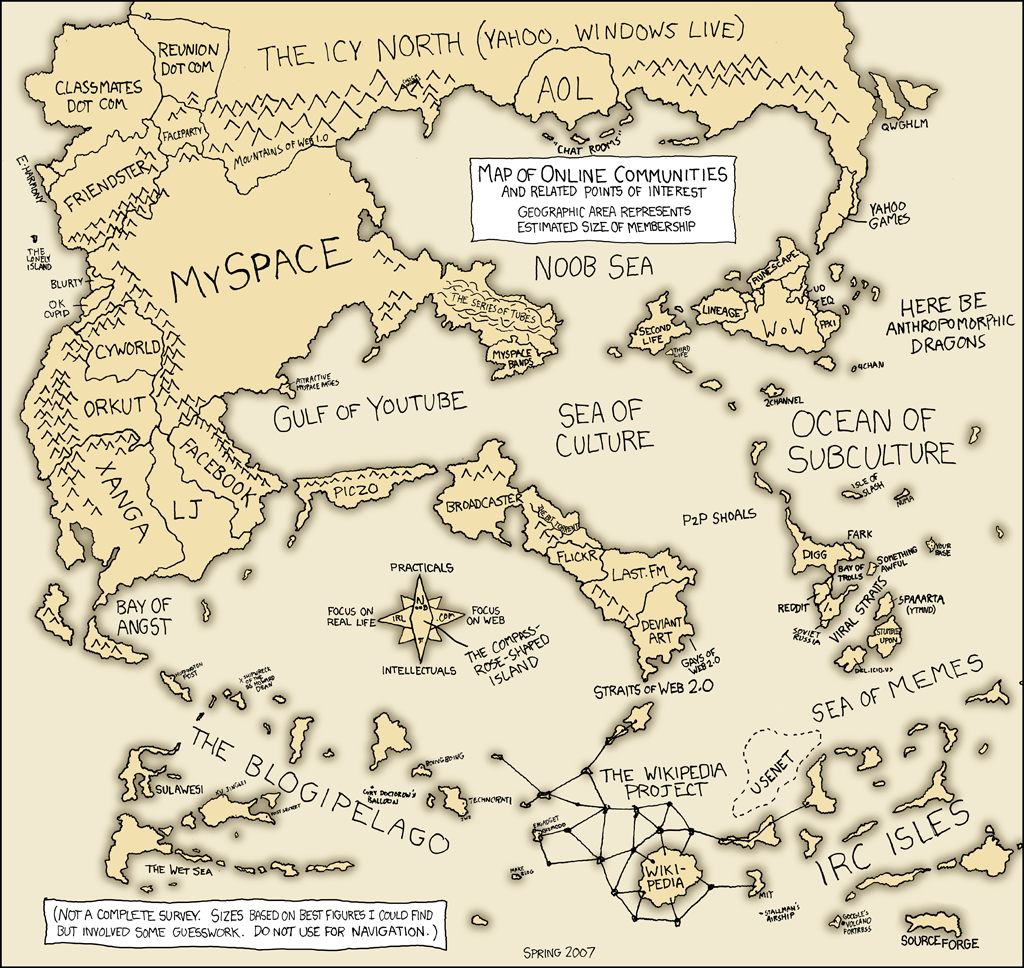
XKCD produces a map of the internet, graphed according to a particularly insightful compass rose.
I'm a little late in getting around to reading "Why We Fight Over Foreign Policy" from the Hoover Review, but it's a good piece. It explains, in a fair-minded way, the three main streams of thought in American foreign policy debates, and why an honorable person can hold any of them as predominant.
As the piece notes, there are bad actors in all schools: pure politicans of no principles who assert whatever happens to be of party or personal benefit. This is not that useful in understanding those scoundrels -- rather, it is a chart to understanding the good-hearted people who are suckered into voting for them.
That's highly useful in itself. One thing America needs is more of a sense that most of us are decent, for whom the Federal Government is at best a parasite, and at worst a common foe. The politicians are the problem. Those other Americans who seem so alienated are still trying to do something right, according to their own understanding.
Subscribe to:
Posts (Atom)