Ouch. Hitchens seriously outclassed Sharpton. I think the fault is Sharpton's for not being up to his standard. It's a shame that G. K. Chesterton wasn't there to take the field against him instead.


The Media Are Fools
The Media Are Fools:
A great truth -- the global media has simply refused to stop and consider the question of whether they are being used by terrorists as weapons. Today's example: this story from the AP, entitled, "Extremist taunts his victims from prison."
The article explains that Eric Robert Rudolph, against whom I have a particular grudge because I lost a bet about him, has been writing pointless screeds and mailing them to a friend. The friend has a website, run in the name of the so-called "Army of God" group Rudolph claimed to represent; and the existence of that website has been tormenting the victims of Rudolph's bombings.
Here's the problem:
Nobody remembered that the so-called "Army of God" existed. Nobody was looking for the website. Nobody would have read the articles.
Thanks to the AP's story, many people will see these rants who would otherwise have been totally ignorant of their existence. The AP story says that one of the victims "is worried that Rudolph's messages could incite someone to violence against abortion providers."
Well, the odds of that just increased from "nearly zero" to "quite possibly." Those perhaps-inspiring-to-a-lunatic rants have just been drawn to the attention of millions.
Terrorist groups cannot survive, and certainly cannot win any of their goals, without the media oxygen on which they depend. The media, if they are a responsible group of people with any love for civilization, need to learn this lesson.
They need to stop being the real weapon of terrorists. They're free -- the 1st Amendment protects them. They've got to choose to stop. I don't know how to say it any plainer.
Getting Older
Getting Older:
Today I settled down to clean out my safe, the bottom shelf of which had become clogged with loose ammunition. After returning from the gun range, I sometimes just dump the unused ammo into the safe (to keep it secure) without taking the time to sort it by caliber and return it to the proper boxes. Quite a bit of it had accumulated over the years, so I finally got around to putting it all back where it belonged.
While doing so, I came across something interesting: a Viking dragon belt buckle, made by an old friend of ours at the Crafty Celts. I had no memory of buying it, or even thinking about buying it. It's just the sort of thing I'd like, though.
So I went to my wife, and asked if she'd bought it. She said she had no idea at all. The matter was a little puzzle for a while, until we checked the receipt and discovered that she had bought it back in October. Apparently, it was intended as a birthday present for me, or possibly a Christmas present.
So I got in May. Well, it's still nice. I can't say a thing about her forgetting my (birthday? Christmas?) present, though -- it's already the case that it seems wholly explicable to me. I'm not even all that old. But I'm old enough to understand.
Deepthought South Hate Crime 2
The South & Hate Crimes, Updated & Revised:
Deep Thought has updated his famous piece on the South and hate crimes, in the wake of last week's uproar involving Fort Pillow. He's a little angry about the rhetoric that was reflexively directed at Southerners just because some Congressman decided to quote a Civil War general, on the subject of military tactics.
I think the people who reacted so badly about the reference to Gen. Nathan Bedford Forrest probably only know two things about him: that he was commanding at Ft. Pillow, and that he founded the KKK. They probably don't know that there are conflicting historical claims about what happened at Ft. Pillow, and they certainly don't know that Forrest ordered the KKK to disband when it stopped being about resisting Northern domination, and became about punishing blacks. He also was the first white man to address the Pole Bearers association, an early civil rights group, during which address he made a point of endorsing black civil rights, including voting rights.
In any event, he was a natural cavalryman -- and it's hard not to have some respect for a man who had more than thirty horses shot out from under him and kept riding into battle all the same. If you are talking about warfighting, as the Congressman was on this occasion, it's proper to cite him. The man knew something about it.
On Kung Fu
On Kung Fu:
I once had a professor, back in my days as a philosophy student, who asked me how anyone could claim both to be a Buddhist, and also a fighting man. As I recall my answer, it was something like: a Buddhist who is a fighting man makes no secret about it, and seeks no direct conflict. It's thus not his fault if someone else attacks him and gets hurt, in the same way that it's not a sword's fault if a fool should throw himself upon it.
That long-past discussion was brought to mind by this article on kung fu and its place in the Chan tradition. Chan Buddhism, which is the Chinese ancestor of Zen Buddhism, is also the progenitor of the kung fu systems of martial arts. Now, in San Francisco, we have an earnest American Buddhist trying to bring the Chan tradition here -- but the Chinese disciple he was sent by the main temple is more of a fighter than a priest.
D'Artagnan
Racehorse:
We haven't had any horse stories here in a while. We got a new horse in yesterday, a beautiful fleabitten grey Thoroughbred named D'Artagnan. I haven't gotten any photos of him yet, but will.
We had several people out at the farm wanting a trail ride this morning, so the farm's owner asked me to lead them out. "You can try D'artagnan!" she said brightly.
"What can you tell me about him?" I asked.
"Well, he sometimes bucks if you try to turn right," she replied.
"We may need to turn right on the trail," I mentioned.
She shrugged. "Racehorses are like that," she said. "They spend their whole lives turning left."
"Racehorse," I said without enthusiasm.
"Ex-racehorse," she answered. "I'll lunge him for you."
So I'm watching the horse being lunged while I get my kit together, and he's bucking and kicking up a storm. "Seems like an energetic fellow," I said.
"He won't buck under saddle," she promised.
"He's wearing a saddle right now," I pointed out.
She coughed. "I mean, once you're in the saddle."
So, off we went. He was a great horse. He didn't like to go right, as she noted, but the only reason I know was that he had a much harder mouth on the right. He may be an "ex-racehorse," but he's got lots of spirit and wants to go. I was leading a party of fairly green riders, so we were just taking a relaxing walk, but I could feel that he wanted to push out. The woman riding behind me was on a horse named Bella, who is also hot to trot.
Then, coming up a hill, D'Artagnan walked under a dead branch that stretched across the trail. I guess he didn't see it, but it was low enough I couldn't duck it. It broke against my body, thick enough that it made a huge CRACK!
Guess it sounded like a starting gun.
That horse took off from a start to a dead run, just like a racehorse should. Bella came right on behind him.
I grabbed the reigns and pulled back and in hard, with a sharp "Ho!" I didn't expect it to matter at all, though, with Bella running right behind him, close enough that he could feel her breath on his hip. Horses are herd animals, after all, and when they get going together they feed off each other. I figured it'd be a ride before I'd be able to get him under control.
He dropped out of the run and back to a walk without the slightest complaint. Horse didn't run three steps. He did just what he was supposed to do.
Later, back at the barn, and was telling the owner about him. The limb had been the only problem, I said, but I was impressed with how responsive he was with another horse right there, pushing hard.
She smiled. "There are some things," she said, "that racehorses are used to."
Donkey Pic
Keep His Head Up, Son:A Palestinian boy tries to control his donkey in the village of Jabel Mukaber in east Jerusalem, Wednesday, May 9, 2007. The Palestinian economy can't recover unless Israel dismantles a network of obstacles that has carved up the West Bank into a dozen enclaves and restricted Palestinian access to more than half the territory, the World Bank said in an exceptionally harsh report Wednesday. (AP Photo/Emilio Morenatti)
Not exactly sure how those troubles are related, though.
I guess the Palestinians have a lot of troubles. I can't do anything about those Israelis, but the donkey problem can be solved.
Not exactly sure how those troubles are related, though.
WTF?
Whiskey Tango Foxtrot:
I know the Washington Times isn't always fair, but... surely this is a joke? "Dems: Use intelligence funds to study [global] warming."
A) Does anyone think that there is a scarcity of funds to study global warming? In academic circles, including "global warming" or "carbon" in your proposal is the best way to ensure you get the grant you wanted.
B) Does anyone think our intelligence systems are in such good shape that we can afford distractions?
I mean, if Congress really wants to devote funds to studying the issue, that's fine. But surely the intelligence budget isn't the place to go for the funds; and surely the Permanent Select Committee on Intelligence has more pressing oversight duties.
H/t: Cassidy.
A Crime Prevented
A Crime that Tried to Happen:
The story has a happy ending, though. Among his several valuable possessions, he had one priceless tool at hand.
H/t: Kim.
Blogger Machine Dreamer, a disabled gentleman, had a home invasion. The robber came knowing he was visibly home, came with a truck to take away all of his things, and came right through the door in spite of the dog barking loudly on the other side.
Anyone relying on a dog to protect them, take note.
I noticed a Budget rental truck, a 16 footer cube-van coming down the road towards my cul de sac. It seemed to be looking for an address but it stopped at my drive and began nosing in.What bothers him most about the episode was that someone must have tipped this guy off. Someone he knows -- a pizza deliveryman, perhaps -- found a criminal and told him that this guy, disabled, lived alone in a house that had some expensive electronics.
It now had my complete attention.
It began to climb my drive and I was alarmed to note the lack of license plates or unit number markings. I also noted that it was driven by a black fellow in his twenties with dark glasses whom I had not previously made the aquaintence of....
My main floor is sort of "U" shaped and I was on one end looking out my window when the dog began earning her keep at the other end where the door to the garage is located.
Then there was a knock on that door. It was in my mind that there was still a small chance this was not a home invasion.
Wrong!
I heard to doorknob turn, I heard the door scrape across the carpet and the dog's barking take on a hysterical note.
The story has a happy ending, though. Among his several valuable possessions, he had one priceless tool at hand.
H/t: Kim.
Dix Plot
The Dix Plot:
I have to admit that, this time, Wonkette hits the tone just right:
Ok. So, the plot was: six dudes from New Jersey buy some guns and storm Fort Dix. The Fort Dix that is full of lots and lots of Army reservists with way, way more guns. And, like, extensive military training and s***. Yes, thank god these terrorists have been caught and locked up before they could be killed within minutes of deciding to carry out the dumbest ****ing terrorist plot we’ve ever heard of.Yeah, that would have worked out great. But, now they can live at taxpayer expense for the rest of their lives. Maybe that's the real plan: "If enough of us get caught, we'll bankrupt the Great Satan."
VE DAY
VE Day:
Bthun sends a newsreel from 62 years ago. The reel of the British forces linking up with the Russians is classic:
Russian Soldier, shaking British soldier's hand: (*Unintelligible Speech*)
First British Soldier to Russian Soldier: "Ah!"
Second British Soldier to First British Soldier: "What does that mean?"
First British Soldier to Second British Soldier: "How do I know?"
Third British Soldier to Russian Soldier: "Well, all of the best old man!"
These newsreels were straight-out pro-government propaganda, telling the populace of the glories of the state. To what degree did these images enslave the British mind to the government?
That is easily answered. Within two months, victorious war leader Winston Churchill was voted out of office by the British electorate.
My Rifle
"My Rifle"
There is more than that, though. Like all the best technology, this machine is for something. If you love a tractor, it's because it helps you feed your family, to clear and maintain and master the land. The rifle, too, has a job. Here's how the gentleman describes that job:
There are well-educated men who say that this is madness:
You cannot name the culture that has not sacralized its weapons -- that has not decorated them, or named them, or built rituals around them. Traditional American society is the same as any other traditional society. Those who view this as strange are the ones who are cut off from their roots. They are the ones who have chosen to walk away from what their grandfathers believed.
America has come "to terms" with the gun, long ago. Our gentleman from Tennessee knows everything about his rifle -- both how it works, and what it is for, and what it is not. His words have echoes in the heroic poetry of every nation.
It is others who do not understand: he understands perfectly.
This is my rifle, the man says, and then he tells you why. Kim du Toit noticed, and added:
Change a few of the words, and the man could be talking about a car, or a machine tool.... Real Men know all too well what the Wrangler is talking about.That's true: the simple joy of working with a machine, making it function, having it do just what you want -- that is obvious in the man's words.
There is more than that, though. Like all the best technology, this machine is for something. If you love a tractor, it's because it helps you feed your family, to clear and maintain and master the land. The rifle, too, has a job. Here's how the gentleman describes that job:
This is the rifle I'll grab if I ever have need of a longarm in a place other than a rifle range. This is the rifle that stands by to defend me and mine if necessary. This is the rifle that marks my personal line in the sand, the line that none who come looking for trouble shall pass with impunity.That assertion is at the core of heroic philosophy, whether that expressed by Greeks or Norsemen or those Pakistani tribemen we were talking about a few weeks ago. "This land is mine, these people are mine, I shall keep them safe, none shall harm them while I live."
There are well-educated men who say that this is madness:
Some years ago, the distinguished historian Richard Hofstadter told me that, after a lifetime of studying American culture, what he found most deeply troubling was our country's inability to come to terms with the gun — which in turn strongly affected our domestic and international attitudes. Emotions of extreme attachment to and even sacralization of the gun pervade American society.... Much has been said, with considerable truth, about the role of the frontier in bringing about this psychological condition. I would go further and suggest that American society, in the absence of an encompassing and stable traditional culture, has embraced the gun as a substitute for that absence, and created a vast cultural ideology we can call "gunism." Paradoxically, this highly destabilizing object became viewed as a baseline and an icon that could somehow sustain us in a new form of nontraditional society. That new society was to be democratic and egalitarian, so that the gun could be both an "equalizer," as it is sometimes known, and also a solution to various social problems.That is to misread the nature of the thing entirely. The importance of the rifle here isn't about "the absence of an encompassing and stable traditional culture," but the mark of one. A culture that lacks this value will not survive. Violence does not exist on the frontier alone, but pervades the world. If peace and civilization are to exist, men must defend them. A culture that has survived understands it entirely.
You cannot name the culture that has not sacralized its weapons -- that has not decorated them, or named them, or built rituals around them. Traditional American society is the same as any other traditional society. Those who view this as strange are the ones who are cut off from their roots. They are the ones who have chosen to walk away from what their grandfathers believed.
America has come "to terms" with the gun, long ago. Our gentleman from Tennessee knows everything about his rifle -- both how it works, and what it is for, and what it is not. His words have echoes in the heroic poetry of every nation.
It is others who do not understand: he understands perfectly.
French Vote
French Vote, Sarkozy Wins!
Well, actually the voting is far from over. That's just how I'd gamble if I were inclined to gamble on things. I don't have much to go on, except this BBC article. They interviewed voters at one precinct and labeled the story "French voters bucking trends," so I figure I'm also justified in drawing conclusions about the whole race based on the same single data set.
Only three pro-Sarkozy voters were encountered by the BBC, two women pensioners and a young professional, who were used to explain that "the centre-right candidate [Sarkozy] does have his supporters... both among older residents and the young professionals[.]" The two pro-Sarkozy speakers said he "does not change his opinion all the time" and has a program that is "coherent" and "properly costed."
The other voter said that Sarkozy "stands for reform" and "will take on public sector workers" whose unions have prevented that reform.
All the rest of the speakers are voting for his opponent, Ms. Royal. Their reasons for preferring her policies?
A) "I don't want Sarkozy, his social ideal is America.... France is not a violent society like the US."
B) "Sarkozy speaks well -- but his unspoken message is frightening. His ideas are racist."
C) "Segolene [Royal]'s policies are much more tolerant and humane than Sarkozy's."
D) Sarkozy is "brutal."
E) Sarkozy is "a sleek version" of Jean-Marie Le Pen (who leads France's largest far-right party, Le Front National).
F) "Sarkozy is too radical."
G) "Sarkozy is too close to big money, and it's about time we had a woman president."
That last statement is the only positive reason articulated for voting for Ms. Royal. Everyone else only cites reasons for voting against Sarkozy -- his racism, his radicalism, his unspoken violence, his connections to big money, that he likes America.
If we were to draw trends from this one data set (like the BBC), we'd say: the election is all about Sarkozy. His supporters are voting for him; his opponents are voting against him. Royal's policies and thoughts just don't seem to make an appearance, even among her strongest supporters.
Actually, of course, I've been following the election more broadly; but the overall trends do seem to be the same. Royal's last rallying message to her supporters was that a Sarkozy win would be dangerous and "could trigger violence and brutality across the country." Even for her, at the last, the election was all about him.
Good Reading
Some Excellent Finds:
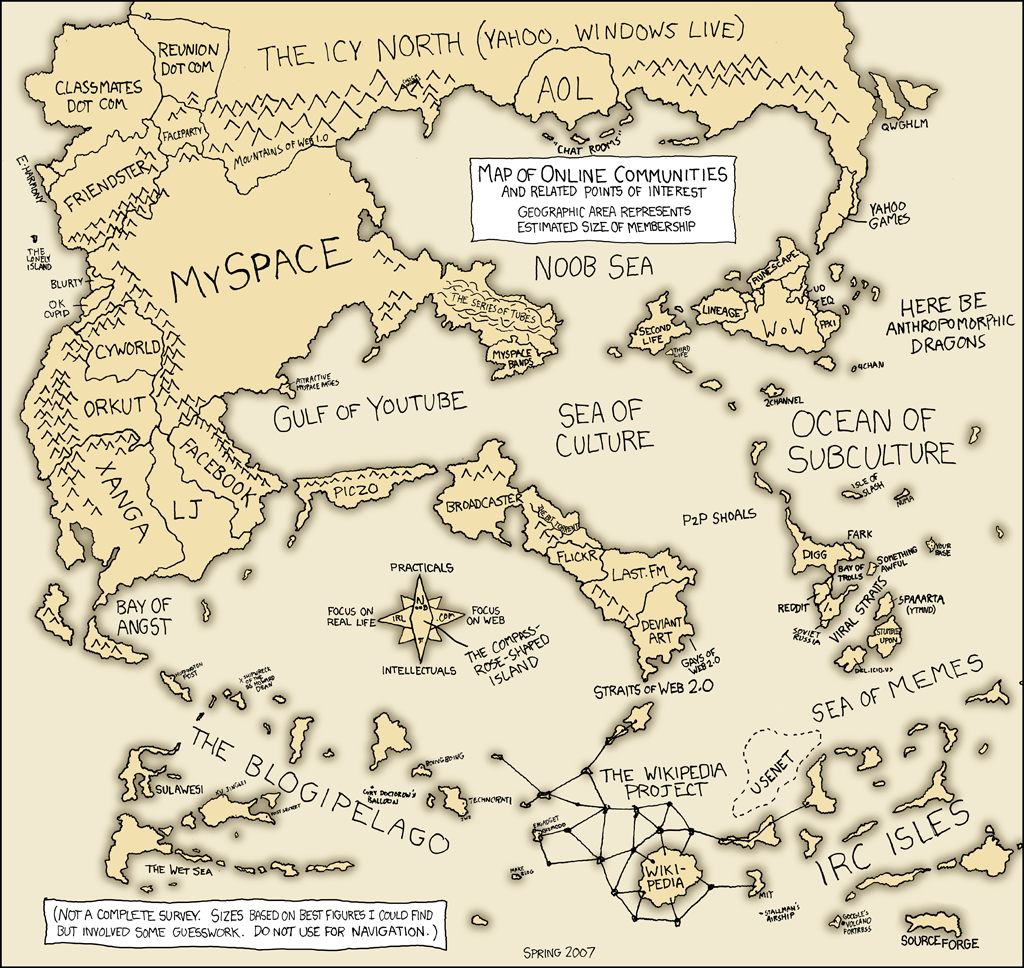
XKCD produces a map of the internet, graphed according to a particularly insightful compass rose.
I'm a little late in getting around to reading "Why We Fight Over Foreign Policy" from the Hoover Review, but it's a good piece. It explains, in a fair-minded way, the three main streams of thought in American foreign policy debates, and why an honorable person can hold any of them as predominant.
As the piece notes, there are bad actors in all schools: pure politicans of no principles who assert whatever happens to be of party or personal benefit. This is not that useful in understanding those scoundrels -- rather, it is a chart to understanding the good-hearted people who are suckered into voting for them.
That's highly useful in itself. One thing America needs is more of a sense that most of us are decent, for whom the Federal Government is at best a parasite, and at worst a common foe. The politicians are the problem. Those other Americans who seem so alienated are still trying to do something right, according to their own understanding.
New Poem
New Poem:
Russ Vaughn has turned his imagination to the current impasse over military funding. Russ isn't trying to be nice, so if you're easily offended by slaps at the Democratic leadership, you probably won't enjoy his poem.
On the other hand, if you're easily offended by the Democratic leadership, you'll probably enjoy it a lot.
Can't sleep?
Apparently their Patrons were Having Trouble Sleeping:
Visitors to the Gaia Napa Valley Hotel and Spa won't find the Gideon Bible in the nightstand drawer. Instead, on the bureau will be a copy of ``An Inconvenient Truth,'' former Vice President Al Gore's book about global warming.Isn't the correct way to say that, "They'll also find that the Gaia isn't equipped with working urinals"? Having stayed in a place like that in China, let me assure you, the environment does not benefit.
They'll also find the Gaia equipped with waterless urinals...
Tragedy
Tragedy:
Over at Arts and Letters Daily a note has been posted about a new book from the Tolkien estate.
Ostensibly, the tale of the Children of Hurin was written by J.R.R. Tolkien during his lifetime. Like many of the stories hinted at in the text of the Lord of the Rings, the tale of Hurin and his children was set in Middle Earth. Tolkien penned many versions, revisions, and emendations of these tales as he worked on his mythology.
After the death of J.R.R. Tolkien, his son Christopher took up the task of gathering and publishing what he could of these writings. Some tales were published in the collection titled The Silmarillion. Other tales (and fragments, and original versions, and emendations) were published in a multi-volume History of Middle Earth series. This series read more like a scholarly study of Tolkien's work than a novel.
Now one of the major elements of Tolkien's mythology has been published as a complete book. It is the tale of The Children of Hurin.
The tale does promise much of what we saw in the Lord of the Rings: a focus on a few individuals caught in the middle of a titanic struggle between good and evil. Like in the epic war against Sauron, the evil side has the stronger army. However, in this story (set in what would be ancient history to the hobbits who saw the War of the Ring), the hope of victory is scant.
The tale that unfolds around the family of Hurin is a tale of curses, fate, courageous resistance against evil, murders, attempts to hide from fate, and the evil will of the Dark Lord--primarily manifested through one of his servants, a malicious dragon.
Other tragedies can be found in the vast mythological world that Tolkien created. However, this tragedy was the one that Tolkien poured most of his thought and energy into. The story that resulted contains many elements which can be found in other tragedies--especially the Norse stories which Tolkien loved. But The Children of Hurin also contains many elements which are the result of long thought about the nature of evil, the virtuous response to evil, and the multifarious ways in which evil presents itself in the world.
Like Tolkien's other writings, this book is one that is worth reading, and reading again.
Over at Arts and Letters Daily a note has been posted about a new book from the Tolkien estate.
Ostensibly, the tale of the Children of Hurin was written by J.R.R. Tolkien during his lifetime. Like many of the stories hinted at in the text of the Lord of the Rings, the tale of Hurin and his children was set in Middle Earth. Tolkien penned many versions, revisions, and emendations of these tales as he worked on his mythology.
After the death of J.R.R. Tolkien, his son Christopher took up the task of gathering and publishing what he could of these writings. Some tales were published in the collection titled The Silmarillion. Other tales (and fragments, and original versions, and emendations) were published in a multi-volume History of Middle Earth series. This series read more like a scholarly study of Tolkien's work than a novel.
Now one of the major elements of Tolkien's mythology has been published as a complete book. It is the tale of The Children of Hurin.
The tale does promise much of what we saw in the Lord of the Rings: a focus on a few individuals caught in the middle of a titanic struggle between good and evil. Like in the epic war against Sauron, the evil side has the stronger army. However, in this story (set in what would be ancient history to the hobbits who saw the War of the Ring), the hope of victory is scant.
The tale that unfolds around the family of Hurin is a tale of curses, fate, courageous resistance against evil, murders, attempts to hide from fate, and the evil will of the Dark Lord--primarily manifested through one of his servants, a malicious dragon.
Other tragedies can be found in the vast mythological world that Tolkien created. However, this tragedy was the one that Tolkien poured most of his thought and energy into. The story that resulted contains many elements which can be found in other tragedies--especially the Norse stories which Tolkien loved. But The Children of Hurin also contains many elements which are the result of long thought about the nature of evil, the virtuous response to evil, and the multifarious ways in which evil presents itself in the world.
Like Tolkien's other writings, this book is one that is worth reading, and reading again.
Washington, Jefferson, Today:
Thanks to bthun, who wrote to point out that on this date in 1789, Washington delivered his first inaugural address. The page links to numerous other pages, including the online libraries for the papers of Madison and Jefferson. You can search their documents for anything that interests you -- including each others' names, should you like to read their correspondence.
Also at the Jefferson site are several historical articles. I thought the one called "American Sphinx" was, in spite of being a few years old, remarkably telling. It begins with a Jefferson reenactment, which drew four hundred people in small-town New England. It ends with an Iranian dissident:
At the end of August, The Washington Post published a long story on a wealthy Iranian named Bahman Batmanghelidj. His picture looked familiar, and then I recognized him as the philanthropist I met in Worcester. It turned out that Batmanghelidj was rallying opposition to the Merchant and Ivory film on Jefferson, which supposedly sanctions the story of Jefferson's liaison with Sally Hemings.It's remarkable the power these great men still hold, two hundred years on.
"Americans don't realize," Batmanghelidj warned, "how profoundly Jefferson and his ideas live on in the hopes and dreams of people in other countries. This movie will undercut all that. People around the world will view it as the defining truth about Jefferson. And of course it is a lie."
Well, yes, it almost certainly is. But then so is a hefty portion of the more attractive sources of Jefferson's image. Batmanghelidj's crusade was just the latest skirmish in the escalating struggle over Jefferson's legacy. The stakes are high, as can be seen in the stark formulation of James Parton, one of Jefferson's earliest biographers: "If Jefferson is wrong, America is wrong. If America is right, Jefferson was right."
Influence
It's Nice to be an Influence:
Which means what? It means that if you weight the system to 'prevent another Virginia Tech,' it will learn to treat all cases from a pro-lockup perspective. You can't really prove the guy was wrong to lock you up, so he has nothing to lose; but if he didn't lock you up and you happened to go on and do something bad, he's liable at least for criticism, and possibly for legal difficulties.
Thus, there's a strong economic incentive for a psychologist to strip liberties on any occasion they're asked to do so; and no economic disincentive, given that there is no standard of proof that can "prove" sanity or stability. There may be a moral or ethical disincentive; and then again, there may not be.
Inalienable rights aren't, sadly, in a practical sense -- our government has busied itself finding ways to alienate them almost from the moment it proclaimed them. Putting the power to alienate a man from his rights in the hands of people who have no reason to do anything else, and no final, scientific and falsifiable standards against which their decisions can be challenged, is no way for a liberty-loving people to act.
Although sometimes I feel bad when my passing comments inspire prolonged reflection, I do find it gratifying when a mathematician agrees with me:
I am hesitant to apply the label witch-doctor to doctors who study and attempt to heal minds, but the label may be valid. First, a quick case-study.Yeah, it is. But you mean before the fact. The case is even worse than that: it's impossible to distinguish between them even after the fact, except in one case: the rare case where a 1B engages in murder or suicide. A 2A can't prove he is not a 1A; and a 1B who doesn't end up hurting anyone looks just like a 2B.
If a person comes before a mental health examination for anti-social tendencies (with or without any noted predilection towards weapons ownership), the possibilities are:
(1A) The person is a danger to himself and others, and the examiner decides that he must be locked up.
(1B) The person is a danger to himself and others, but the examiner decides that he should not be locked up. (This could happen through several modes. Two possibilities are that the examiner misjudges the level of danger, or the examiner misjudges the examinee as not being dangerous.)
(2A) The person is not a danger to himself and others, but the examiner decides that he must be locked up . (Here the examiner erroneously diagnoses a non-dangerous person as dangerous.)
(2B) The person is not a danger to himself and others, and the examiner decides that he should not be locked up.
Given that this is a prediction of future actions based on present observations, and that the future actions cannot be compared to a control-case in a lab, I can agree that such determination is much closer to the activities of a witch-doctor than the activities of a scientist.
A determination that a person is likely to be a danger to himself and others requires a lower level of proof than the determination that he certainly will be a danger to himself and others in the future. A prediction that a person certainly will engage in pychopathic murder is a prediction that requires omniscient foreknowledge. Absent such certainty, it is very hard to distinguish between cases (1A) and (2A) given above--or between cases (1B) and (2B).
Which means what? It means that if you weight the system to 'prevent another Virginia Tech,' it will learn to treat all cases from a pro-lockup perspective. You can't really prove the guy was wrong to lock you up, so he has nothing to lose; but if he didn't lock you up and you happened to go on and do something bad, he's liable at least for criticism, and possibly for legal difficulties.
Thus, there's a strong economic incentive for a psychologist to strip liberties on any occasion they're asked to do so; and no economic disincentive, given that there is no standard of proof that can "prove" sanity or stability. There may be a moral or ethical disincentive; and then again, there may not be.
Inalienable rights aren't, sadly, in a practical sense -- our government has busied itself finding ways to alienate them almost from the moment it proclaimed them. Putting the power to alienate a man from his rights in the hands of people who have no reason to do anything else, and no final, scientific and falsifiable standards against which their decisions can be challenged, is no way for a liberty-loving people to act.
Subscribe to:
Posts (Atom)