Iraq poll

A Poll in Iraq:

If you haven't seen this opinion poll of Iraqis, take a look at it. It's interesting: a plurality of Iraqis think the nation is going in the right direction; more Iraqis as a percentage than Americans think so; and sixty percent of those polled give their own local security a favorable rating.

Obviously, this has a lot to do with the quality of information: Americans are depending on a media that won't set foot outside the hotel for the most part, plus hired stringers they're paying to produce "newsworthy" (i.e., bad) stories, plus some news organizations that are actually attempting to produce bad news (e.g., the Italian communist news). The Iraqis actually live there, and can see whether things seem to be getting better or worse directly.

A second factor may be the absence of a retreat option for the Iraqis. From an American perspective, the question "Is Iraq going the right or the wrong direction" will normally be read "Will we be able to leave a peaceful Iraq soon, or not?" Given that there are hostile factions with permanent interests in conflict, the odds of perfect peace in the region are small; Saddam enforced what he called "peace" by killing massive numbers of people, in effect waging a permanant war. America is trying to help build a form of government that will allow those interests to be negotiated, along with a military/police structure capable of encouraging negotiation by being a credible threat. This is taking a while, for several reasons, and Americans are really trying to decide, "Is this all worth it?" Americans are thus not really thinking about the question "Is it getting better?", but are silently inserting "Are we almost done?"

Iraqis, on the other hand, are not thinking about a "real" question when asked if things are getting better or not. If the question is "Are things getting better?", the answer is either yes or no; but whichever it is, the Iraqis aren't going anywhere.

From an American perspective, is it getting better -- which is to say, is this all worth it?

Here we see the problem of answering the one question as if it were the other. Of course it is worth it; and more than that, it's morally required of us. Afghanistan shows what happens when an Islamic state is left in civil war because Western powers lost interest in it. If we, in the 1990s, had stood up to helping Afghans recover from the war against the Soviets that we helped to worsen and continue, there might never have been a Taliban, a haven for al Qaeda, a 9/11. We didn't, because we felt we had no further interest. Iraq, now that we have destroyed Saddam's government, is a place to which we owe a similar debt. Like postwar Japan, if we rebuild it carefully and correctly, it will pay dividends long into the future; like Afghanistan, if we fail it, we shall someday rue that failure of spine and ethics.

Is it getting better, though? Well, there are good signs, and evil prognostications.

My own sense is that the odds of successful negotiation in Iraq are greatly increased by the strengthening of the Iraqi Army, who is now on display in Baghdad, where their example will not be missed; and the completion of the network of border forts discussed here recently, which can serve as an anvil to the IA's hammer if the Sunni insurgents insist on fighting instead of talking. A credible military option always makes diplomacy easier. Those forts and that army gives the central government the power to drive the tribes that refuse to negotiate, break them on the anvil, and then lock their remnants beyond the borders; having that power, they will likely find that the tribes are more willing to accept carrots than insist on the sticks.

My own preferred response to the question of Iraq is the one offered by General Mattis, surely the greatest general of our age.

"It is mostly a matter of wills," Lt. Gen. James N. Mattis said during an exclusive interview with the North County Times. "Whose will is going to break first? Ours or the enemy's?" ...

Mattis, who led the Marines in the invasion of Afghanistan in 2001 and led the 1st Marine Division in the invasion of Iraq and march to Baghdad in early 2003, said he was once asked by an Iraqi when he would leave that country.

"I said I am never going to leave. I told him I had found a little piece of property down on the Euphrates River and I was going to have a retirement home built there.

"I did that because I wanted to disabuse him of any sense that he could wait me out."

Why shouldn't an American be able to build a retirement home on the Euphrates, just as he might build one on the Rhine if he wished? Our forces will someday leave, because they are no longer needed, but we hope to bring Iraq into a wider world. The hope should be that America never leaves -- our soldiers do, but our financiers, our businessmen, our diplomats, friends and companions, these Americans tie Iraq into a world larger than that created by thoughts ever turned to ethnic conflict.

Is that possible? My sense has always been that there is only one way to find out if you can do a thing, and that is to do it. If you succeed, you know for certain that it can be done. If you fail, you don't know for certain that it can't be done: most likely, you didn't do it right. Try again, if you can; or, if you cannot, having suffered some injury along the way that forbids a second chance, let others learn from the failure.

For that reason, I am disinclined to hear that anything "cannot be done," which I have heard from very smart people on the subject of Iraq since the beginning. I talked to a fellow from the CATO institute about Iraq a few months ago, and he was one of the type: his speech was flavored with words like "cannot," "impossible," and "never." Nonsense. Too many of these people, who not only are smart but make their livings by being smart, have said such things and are now committed to them. They must, to continue to be thought smart, be proven right: which means they are committed to failure.

I'll take my stand with General Mattis, gladly.
General, when you're done in Iraq, we need you in the White House. We've been looking for someone like you for a while.

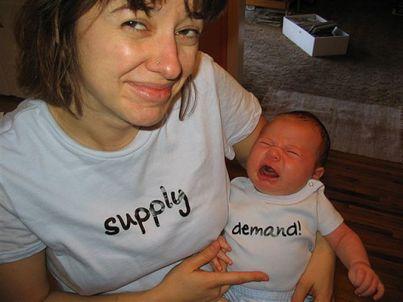
A Law explained

A Basic Law of Economics, Explained:

Here, with thanks to Cowboy Blob.

Not Cutting Aid for wounded soldiers

Cutting Aid for Wounded Soldiers in an Election Year:

A war fought with IEDs produces a larger percentage of brain injuries than in previous wars, fought mostly with rifles. The overpressure of the blast waves, detonated at close range, have been the source of an unfortunate number of such cases.

Congress, of course, is cutting funding for brain-injury programs. Their explanation was that "there were so many priorities" that they could not get to it.

It is plain to see that some things are more dangerous to one's brain than an enemy IED. Service in Congress would appear to be one of them. Unlike the soldiers, however, the Congressmen have no honorable explanation for their malady.

Good Job

Good Job:

It is always good to see these kidnapper gangs busted up, and it is always good to see weapons caches recovered.

Iraqi army soldiers conducted a raid and rescued a kidnap victim after receiving a tip from a concerned Iraqi citizen that led them to a location in Baghdad’s Adhamiyah neighborhood Friday night. The Iraqi citizen lead soldiers from 1st Battalion, 2nd Brigade, 6th Iraqi Army Division, to a house where the victims and a weapons cache were located. Inside the building they seized two rocket-propelled grenade launchers, 20 RPG rounds, nine RPG propellant charges, an AK-47, two sniper rifles and 12 hand grenades. Two suspected terrorists were detained in connection with the kidnapping.
Well done -- Iraqi Army working with Iraqi citizens. But the Coalition hasn't left yet either:
In a separate event, Multi-National Division – Baghdad Soldiers rescued three kidnap victims after receiving a tip from an Iraqi citizen southeast of Baghdad Friday afternoon. Soldiers from Company C, 1st Battalion, 61st Cavalry Regiment, 4th Brigade Combat Team, 101st Airborne Division, were approached by a young man who informed an interpreter there were kidnap victims inside a nearby house. MND-B Soldiers moved to the house, where they found three victims tied up, blindfolded and lying on the floor with a kidnapper watching over them. Soldiers entered the house and rescued the victims and detained the kidnapper.
Good work all around.
Ithaca:

Ahem. This reminds me of something.

The old man next looked upon Ulysses; "Tell me," he said, "who is that other, shorter by a head than Agamemnon, but broader across the chest and shoulders? His armour is laid upon the ground, and he stalks in front of the ranks as it were some great woolly ram ordering his ewes."

And Helen answered, "He is Ulysses, a man of great craft, son of Laertes. He was born in rugged Ithaca, and excels in all manner of stratagems and subtle cunning."

On this Antenor said, "Madam, you have spoken truly. Ulysses once came here as envoy about yourself, and Menelaus with him. I received them in my own house, and therefore know both of them by sight and conversation. When they stood up in presence of the assembled Trojans, Menelaus was the broader shouldered, but when both were seated Ulysses had the more royal presence. After a time they delivered their message, and the speech of Menelaus ran trippingly on the tongue; he did not say much, for he was a man of few words, but he spoke very clearly and to the point, though he was the younger man of the two; Ulysses, on the other hand, when he rose to speak, was at first silent and kept his eyes fixed upon the ground. There was no play nor graceful movement of his sceptre; he kept it straight and stiff like a man unpractised in oratory- one might have taken him for a mere churl or simpleton; but when he raised his voice, and the words came driving from his deep chest like winter snow before the wind, then there was none to touch him, and no man thought further of what he looked like."
Ah, son of Laertes, here are more fine sons who act 'like rams among sheep.' I'm not sure how formidable in council they will prove, but every man can't be Odysseus.

H/t: MilBlogs.

Happy B-Day Clinton

A Clintonian Birthday:

Russ Vaughn has composed some birthday wishes for Bill Clinton. It's just as off-color as you'd expect, given the Clinton legacy.

Ooh-Rah:

Here's a great story that shows why we should be proud to have the allies we have. This guy is what "British Sergeant Major" is all about.

H/t John (Arrgh!) at MilBlogs.

Plato Sucks

Plato Sucks:

I feel a lot better after reading this critique of Plato from the London Guardian.

[The Republic] is long, sprawling and meandering. Far from holding water, its arguments range from ordinarily leaky to leaky in that zany way which leaves some interpreters unable to recognise them as ever intended to hold water at all. Its apparent theory of human nature is fanciful, and might seem inconsistent. Its apparent political implications are mainly disagreeable, and often appalling. In so far as Plato has a legacy in politics, it includes theocracy or rule by priests, militarism, nationalism, hierarchy, illiberalism, totalitarianism and complete disdain of the economic structures of society, born in his case of privileged slave-ownership. In Republic he managed to attach himself both to the most static conservatism and to the most wild-eyed utopianism.... [Socrates] is shown as the spokesman for a repressive, authoritarian, static, hierarchical society in which everything up to and including sexual relations and birth control is regulated by the political classes, who deliberately use lies for the purpose.
Wow. If that's how the Left treats Plato, I never had a chance. :)

Beer & The Wood

Swords and Songs and Beer:

Today is a day I mark with celebration each year: the day that I first encounter a seasonal Oktoberfest brew for sale. Ah! Autumn, as good as Spring, is coming at last.

The 2004 post celebrating the first October beer is here, and explains the history of October beer for the English-speaking world. Follow the link (or just click this one) to an article called "Dragon's Milk: English October Beer."

On the same topics, a post from back in 2003 on the Merry life of Robin Hood, and a song by yours truly on the subject.

A merry day to you. Would that we could gather over a butt of good October in person.

Swords:

Kim du Toit has cause this week to recommend the keeping of swords. Good on him -- there is nothing better than a sword.

Let me recommend (as I did to Kim) the work of Alex Cameron, one of the last surviving members of the medieval Glaswegian Swordmakers Guild. I own a few pieces of his work, including a customized sword made just the right length for a man of my height and length of arm. It hangs, polished mirror-bright, on the wall of my office.

I have never owned one of these, but I certainly wish I had. If anyone wants a report on the quality of such a thing, enough to help fund the purchase of one, let me know. :)

Camping again

Off Again:

I am taking advantage of three days' unseasonably cool weather to go into the Wild. I will return Monday, or thereabouts.

In the meanwhile, there are a number of good posts at BlackFive. There are also some posts from me there, as I sometimes post things there for that audience I don't put up here. Froggy has more on the Navy SEAL recently (and, sadly, posthumously) awarded the Silver Star. BlackFive himself has reposted an old piece on the difference between the illegal immigration problem, and the Jihadi problem. Jimbo has a good piece on the recent terror attacks, which were thwarted by means that certain people will regard as violations of civil liberties. And so forth.

If you can't get out and enjoy the weather also, by all means enjoy the writing. I'll see you next week.

Chickens

Chicken, Road, Crossing:

John's post at MilBlogs is very funny. The comments include some additional suggestions which are just as funny.

Hate Crimes

Hate Crimes & The South:

Via Southern Appeal, a truly remarkable piece on the accounting of hate crimes. I had always opposed the legislation creating such offenses on the grounds that it criminalized thought -- that, in other words, the crime was already a crime, so all you were punishing here was the attitude. You have a right to think and say what you want, in America, so it seemed improper.

On the other hand, that accounting has made it possible to undermine some old stereotypes, so deeply rooted that even I -- proud Southerner -- am astonished by the results.

For example:

* That it is fifty times more likely that a man will be victim of a race-based hate crime in Minnesota than in Alabama.

* That the bottom four states for such crimes are all Southern states, including my own Georgia.

* That the worst regions of the country are the deepest Blue states, especially the northeast and upper mid-west.

Outstanding. It's the kind of thing you'd want to believe about your homeland in spite of the evidence. How wonderful to see that the evidence, in fact, is on your side.

Goodbye, Cynthia

Goodbye, Now:

Lest anyone think that I am totally opposed to all forms of innovation, allow me to congratulate my Fourth District countrymen on ridding themselves of the worst representative in Congress. Well done!

A Marine finally makes it home after 44 64 years.

Its sad that this gets ignored by the news, because something like this has happened each month this year since May.

Those JPAC people are to be commended.

Update: mea culpa--I can't do simple math anymore.

fool headlines

A Foolish Headline:

From the Associated Press: "Mideast fight ramps up despite diplomacy."

One might better say, "due to diplomacy." The impending US-French "peace plan" means that a ceasefire demand from the UN will be forthcoming. It is thus increasingly important to all parties to resolve the situation on the ground into something they will find to their advantage in case the ceasefire takes effect. The increased intensity of the fighting is therefore a direct result of the diplomacy.

I know the average reader things diplomacy = peace, but a professional analyst of the events ought to have learned better by now.

Tribes S Iraq

The Tribes Together:

I think this article is an interesting case study. It shows the effect of an authoritarian government on a once-independent tribal structure, and how the fall of that government negatively impacted the tribes. On the other hand, the main tribe discussed here was only too glad to take the risks associated with freedom -- the sheikh ordered no resistance to Coalition forces, and not one shot has been fired by his men.

Though they are still relearning the skills lost during Saddam's regime, the Obide tribes are coming together with the Guerarie, Jabor, and Gueranie tribes to bring renewed prosperity to the south of Iraq. The Iraqi Army, now able to conduct independent operations in many areas, is beginning to have troops they can spare for aiding civil reconstruction missions. Speaking of which, the Iraqi TRADOC has opened, which includes a version of DLI.

The development of an Iraqi TRADOC is an interesting development in and of itself, and it shows that the development of the Iraqi army is full-scale: not just building combat forces to hold the line so the Coalition doesn't have to, but building a fully-independent military capable of developing doctrine and lessons-learned, and coming to its own conclusions about what to do in the future. Rather than simply tying them to US training and doctrine, we've taught them how to build their own.

Another interesting story: the completion of the border outposts in the West of Iraq.

What interests me here is the opportunity to do a little military science. Take a look at the picture of the fort. You can tell from the way a fort is constructed what kind of forces they're expecting to oppose. The high walls and turrets give them the ability to repel attempts to overrun the forts, and provide overlapping fields of fire on any attempt to take any of the walls.

This is a fort set up to repel an infantry attack. It lacks defenses against artillery (such as thick, sloping walls) and heavy cavalry (such as ditches). Given the 20-40 man size of the garrison, they're well prepared to hold off small-scale raids by smugglers or terrorist units, but not heavier opposition.

That's perfectly sensible given the situation on the ground there, and just what you'd expect. I mention it only as an item of interest for readers who are learning about military science, not for experienced hands. There's a great deal to be learned from even a quick snapshot, if you know what you should be looking for.

Christian Muslim

A Christian Muslim American:

Sovay tells me -- and sends a link to back it up -- that our self-described "Muslim American" was a recent convert to Christianity, although he had stopped attending church and turned up at an Islamic center not long before the shooting.

He told the Christian group he'd joined that he'd 'seen too much anger in Islam,' which prompted his conversion. Assuming that statement is accurate, we can read that his community of faith in earlier days was not of the more moderate Islamic type. We all know, having seen it played out in Afghanistan and elsewhere, that the angrier sort of imam declares that apostasy is punishable by death and damnation.

If I were a journalist, and could manage an interview, I'd ask him about this. Was this the act of a man who had been raised to believe that apostates went to Hell -- who then left the faith due to concerns about its anger -- and then began to fear for his soul? What if the old imams were right? Would that prompt him to stop attending those Christian meetings -- to return to Islamic centers -- and then, raised to believe in the angry Islamic way, to try to redeem his soul with blood?

The story also says he had trouble holding a job, and was confusing to those who knew him. It's likely that the main thing behind the shooting was his own instability, rather than Islamic teachings.

On the other hand, we've also seen this model before -- in Palestinian suicide bombers, particularly the female ones. Many times they have (as he had) advanced education and good prospects. They often carry out their attacks mainly because of points of honor -- because they have been raised to believe that only in this way can they remove some stain on their soul.

It would be worth asking if that is the case here. We ought to find out -- if we can -- why he felt he should kill in Islam's name, by declaring himself a Muslim just before he opened fire.

Stories from CENTCOM

CENTCOM Still Cares:

More news stories CENTCOM would like you to see:

Iraqi Army captures four terrorists.

MultiNational Division, Baghdad captures four more.

The latter four were dressed up as Iraqi policemen. Good catch by MND-B.

B-M-Spirit

Body-Mind-Spirit:

Jake Ross, one of Matt Furey's disciples, has a similar business built on the idea of teaching you hand-to-hand combat. I've mentioned that I like the Furey exercise program, which works and works well. Somehow I've gotten on Jake Ross' mailing lists, and I have to say, I have my doubts about his program.

He sent an email out yesterday, one of many he's sent, but a particularly bothersome one:

War is very simple, but the simple things in war are very difficult.
To quote a famous 18th century soldier.

And what is a street fight but a war, one guy at a time? So, it's
important that we focus on what makes the biggest difference in street
combat.

Let's think about hunting. The whole point of shooting the prey is to
kill it cleanly. The smaller the weapon, the lesser the energy, the
more difficult the kill. While this may add a certain panache to the
hunt, it's not the intelligent, high percentage way to hunt. So, we see
hunters using weapons powerful enough to kill the prey, with a decent
shot, without taking the chance of a wounding, but not a non-killing,
hit.

So, when you're discussing street defense, the question is always
there, in the back of your mind, like the scent of an old cellar. "What
happens if I give him my best shot and he doesn't fall?"

What, indeed.

So, you need to learn to strike with real power. Enough power to
really damage the person you hit.

Let's talk more about this later,

Jake Ross
I'll start by answering the question he proposes: What happens if you hit a guy as hard as you can, and he doesn't fall? Answer -- hit him again.

The body has several natural defense mechanisms to pain and blows. There are endorphins, adrenaline, reduction of blood in certain areas likely to be affected, and so forth. These mechanisms have developed over millions of years, to make your body able to take a pretty stiff blow without stopping you from doing what you need to do.

However, they do have operational limits. Sometimes, a particularly powerful blow can overcome them -- which is what Mr. Ross is selling. He wants to teach you to hit harder. Good on him, if he can.

But you can also overpower these defenses by hitting more than once. If your best isn't good enough, your best twice or three times could be.

You can test this yourself. Take a hairbrush with a hard back. Hit yourself on the leg with it, hard as you can. Now do it again, same spot. Now a third time.

As you can see, your body's ability to shrug off the pain diminishes quickly. You can take the first blow, and it's a shock. By blow number three, you're not resisting the pain any more -- you get it all. The same principle applies to defensive blows.

(An aside: The Chinese say that life force -- qi -- flows through the body in channels, which flow can be disrupted by strikes along those channels, or at particular points on the channel. Leaving aside the question of whether or not qi really exists or functions as claimed, qi theory also agrees with the multiple-blow thesis. By the third blow, my teacher told me, all the defense is gone, and the body is receiving full damage from the strike. Since it's possible to verify the basic idea empirically (e.g. with the hairbrush), I pass along the information.)

The same idea is at work with firearms. Some people -- like me -- prefer a heavy caliber that hits harder, a .44 Special or .45 Colt. Other people, though, achieve roughly the same result with a light caliber that allows them to deliver multiple shots on target. The body may be able to (temporarily) overcome the shock of a .38 Special wound, but it is not likely to overcome the shock of four of them.

The point here is this: if your enemy doesn't fall to your best shot, that doesn't mean you can't beat him. You can. Hit him again, just as hard, in the same spot if you're able.

This brings me to what I really wanted to write about today.

In every fight between men, there are really three contests going on at the same time: a contest of bodies, a contest of minds, and a contest of spirits. Of the three, the spiritual contest is the one that matters most. The mental contest is second. The physical contest, though not unimportant, is really the least of the three.

The Jake Ross method seems to be focused on the physical. He scorns the importance of the mental contest -- see how his letter is satisfied with citing "a famous 18th century soldier." The source of that quote, readers of Grim's Hall know well, was Clausewitz, whose On War remains one of the most important texts of military science ever written.

If you're serious about teaching people how to fight, you have to teach them how to think about fighting. You have to take that aspect of it seriously. The paraphrase of Clausewitz refers to his doctrine of friction, which is one of the most important ideas ever recognized by military science.

The spiritual aspects are even more important. Mr. Ross is selling by suggesting that you should be afraid -- 'what if he doesn't fall'? That's the wrong attitude to take to a fight. The right attitude is, "Whatever it takes, he's going down."

Mr. Ross wants to teach you to hit harder. Well and good, but it's not the real answer. The real answer is to learn to keep hitting. It's the area of the spirit in which contests are won, whether fights between men in the street, or wars between nations.

Consider the conflict in Iraq, if you doubt it: there is no way that the enemy can defeat the United States physically or mentally, yet it could still win if it exhausts the spirit of the nation to see through to victory. It has always been the case, from the beginning, that the only place where we could be defeated was in our own national will.

By the same token, the United States can clear the field of its foes every time they raise their heads. Yet the real arena of victory has always been the hearts of the populace.

Another of Clausewitz's theories was the culminating point of victory, that point at which a fighting force is excused by the populace for whatever it does, because the populace identifies with it. In Iraq, in spite of the continuing difficulties, we are approaching that point. The population wearies of the militias, of the kidnappings, of the constant danger hanging over their heads. Sunni and Shi'ite alike weary of these things. The Iraqi Security Forces have just promised to handle security nationwide by the end of the year. The people are increasingly placing their faith in those forces, and turning against the militias. When we cross the tipping point on this one, we will at last have stability in Iraq.

The opposite is happening in Lebanon. Israel began with attacks on civilian transportation infrastructure, from naval blockades to attacks on the airport. This, combined with the deaths of Lebanese innocents caused by Hezbollah's dishonorable tactics of hiding among civilians, has led to a resurgence of support for Hezbollah. For the moment, at least, Lebanon identifies with Hezbollah. Israel may be able to achieve strategic goals in the area, as for example reducing the number of rocket launchers and perhaps creating a buffer zone. It will not be able to win an existential fight with Hezbollah at this time, however: for now, Hezbollah is safely across the point at which many of the people of Lebanon will protect and shelter them, and even aid them out of a sense of identity.

(Another aside: this idea of a buffer zone is a doubtful strategum, it seems to me; if the UN sends a force to secure such a zone, as it says it may, why wouldn't Hezbollah simply carry on attacking from that zone? Does anyone think the UN will really be able, to say nothing of being willing, to stop them? If Israel needs to respond, it won't be attacking merely the sovereign territory of Lebanon -- it will be attacking territory guarded by the armed forces of several nations, each of whom will then be interested in reprisals. Hezbollah will be given a safer haven than it has now.)

It is the realm of the spirit that really matters. This echoes through the writings of the greatest martial artists and military scientists alike. Napoleon said that "Morale is to the physical as three is to one." The Chinese general Sun Tzu wrote that "seizing the enemy without fighting is the most skillful." How to do this? Either you have out-thought him, so that there is no point to his trying to fight you from the inferior position into which you have put him; or you have convinced him that he cannot win, and thus defeated his spirit without having to fight his body.

Then there is Clausewitz again. In his writings on what he called the 'trinity,' he said that there were three elements that governed success in war: National will, political strategy, and the sum of the ways that the various skirmishes and other conflicts worked out on the ground according to the wager of battle. The first was the most important, he wrote.

And what is that trinity, but a restatement of the same idea? National will is the realm of the spirit; politics and strategies the realm of the mind; and the conflict itself is the physical realm. The first and most important is the will -- it is the spirit. If we find ourselves flagging, that is what we must turn ourselves to reinforcing.

So, if you are approached by a man you think you may have to strike in self defense, do not fear that you can't knock him down even if you hit your hardest. Resolve, rather, that you will.