The papers want you to know that this is Trump's fault, and maybe that's true. He is charting a course that America will have to travel alone for a while. If it succeeds, it will draw others to it in time. If not, of course it won't. Time will tell.

The Anglosphere Slips Away
Following the British decision to adopt a left-wing government that is now prosecuting thousands on free-speech issues, both Canada and now Australia have had left-wing governments win elections they had been expected to lose. The Canadian fellow looks especially likely to run the country right into the ground.

Review: American Anarchy by M. Willrich
Willrich, Michael. American Anarchy: The Epic Struggle between Immigrant Radicals and the US Government at the Dawn of the Twentieth Century. New York: Basic Books, 2023.
Readers have already heard from me twice about this book since I've been reading it. I finished re-reading the epilogue last night,* and am now ready to formally review it.
The author Michael Willrich is a good historian and also a good writer. These qualities do not always travel together, and it is not without cost when they do. There is some risk to being a good historian that arises from being a good writer, namely, that you can tend to shade the reader's perceptions of the history by incorporating dramaticism that will tend to make some of the characters seem like heroes, or victims, or villains. There is some of that going on here, though Willrich's real heroes are not the anarchists but the liberals who ended up supporting them.
Indeed, this is the main lesson he wants you as a reader to take away from the work. Here is his summation in the epilogue:
The government's decades-long war against anarchy spurred the growth of federal institutions designed to repress political dissent. The same struggle also inspired the emergence of a modern movement for civil liberties, grounded in the Bill of Rights, including broad freedoms of speech, freedom from warrantless searches and 'third degree' interrogations, and rights of due process...It is the great irony of the story told in these pages that the many trials of the anarchists -- working-class thinkers who denounced the liberal ideal of the rule of law as a dangerous delusion -- breathed new life into the Bill of Rights and spurred a probing public debate about the proper legal limits of government power[.] (374)
The real heroes of his work are liberal lawyer Harry Weinberger and liberal Assistant Secretary of Labor Louis Post, not the anarchists that we spend so much time with during the telling. The villains are J. Edgar Hoover, Palmer, and a host of others who erected the police state we still labor under in their attempt to police immigrants they didn't trust.
The victims, mostly, are the anarchists, although Willrich doesn't attempt to hide that their movement did indeed engage in numerous bombings and bombing plots, stabbings, shootings, and other mayhem. He does note that many other charges were made but not proven by any evidence or arrests, but he does so fairly: in the case of the largest bombing, which police could never solve, he points out that historians have since identified the probable criminal as an Italian anarchist. Similarly diligent, he points out that one of Emma Goldman's moving stories about the Statue of Liberty is impossible given the fact that the Statue hadn't been assembled yet at the time that she says it happened.
I recommend the book, which is insightful and illustrative. It is surprisingly relevant to the current moment when we are experiencing an even larger-scale attempt at mass deportation, a Federal government that is trying to limit due process in such cases in order to streamline them. While his heroes are the liberals, Republicans do get a nice word towards the end for standing up to the Wilson administration's tyrannical overreach. He quotes their platform of 1920: "[I]n view of the vigorous malpractice of the Departments of Justice and Labor, an adequate public hearing before a competent administrative tribunal should be assured to all." (376)
The weakness of the book, aside from the dramatic elements, is the author's lack of interest in philosophy. He takes no care to explain, and barely even to name, the different factions of anarchist thought. These are intricate and interesting, then and into the present day. The effect of this lack of interest is to convey the idea that anarchism was some sort of amorphous blob of working-class thought, perhaps mere utopian thinking (so he describes it in the epilogue), when in fact it was (and is still, in newer forms) deeply detailed and thoroughly considered with clear philosophical factions. You will learn almost nothing about anarchism by reading this book, but you will nevertheless learn a lot about America.
* I read the epilogue the first time when I first started reading the book. This is a tip I learned in my graduate studies in history that I pass along to you, which is most useful when trying to tackle a large historical monograph: read the first and the last parts immediately, and then the rest of it. The author will introduce his topic and give you a hint of what he or she thinks the main lesson is in his introduction, and then will reaffirm that in the conclusion. Once you know the basic thing the author wants to convey, the whole work will make more sense because it will all fit into that pattern. You can then read and digest the book much faster and more effectively because you will understand why every part of it is being introduced and described, and what the author hopes you will get out of each piece of evidence.
German Democracy

By an 'independent investigation' they mean exactly what our Democratic friends mean when they say that the Department of Justice is meant to be 'independent' of the President -- that is, that it should be controlled wholly by an administrative state that is not under the control of any democratically elected official. This just what Weber warned about (see the sidebar).
The democratically elected officials, meanwhile, also have to ask the EU bureaucracy for permission to fund NATO in line with their treaty obligations (which, allegedly, make up part of the supreme law as they were democratically enacted and ratified). We are meant to believe that it is vitally important that no radical right-wingers be allowed to assume those democratic offices, which don't control the secret police or the budget but are controlled both above and below by 'administrative states.'
So "this is democracy," German style. An independent secret police deciding to spy upon a political party to which the government is hostile, and then the courts taking steps to ban it from participation. But if they did somehow get to participate and win, they still wouldn't be in charge of anything. They'd be controlled by the administrators above them and below them.
In fairness to the Germans, we weren't that far off of that in 2016, when the government was using spy powers targeting Carter Page to collect and read all of his communications with anyone, and then was allowed to further read all of the communications of anyone they collected that way -- i.e., the Trump campaign. And then they opened investigations like Crossfire Hurricane and Crossfire Razor, took down and tried to imprison a sitting National Security Advisor on made-up perjury charges based documents they edited long after the fact and disappeared, and then....
And by the way, what did we ever learn about that assassin in Butler last summer? How'd that happen? Well, perhaps that's just paranoia -- unlike the rest of it, which is clearly established fact.
It's Unconstitutional
Harmeet K. Dhillon,* Assistant Attorney General for Civil Rights, has joined the Solicitor of the United States in asking the Supreme Court to hear an FPC case against Hawaii's firearms ban. It is, after all, a direct violation of the Second Amendment. Why shouldn't the US government urge the Supreme Court to engage that issue in favor of the restoration of a natural and Constitutional right? That is the exact (and arguably sole) legitimate function of a government, to defend the natural rights of its citizens.
This at least is a very welcome move.
* I was introduced to Harmeet once via email, and was very surprised to learn -- as it was not suggested in the email and I didn't yet know her -- that 'Harmeet' is a feminine name in the Punjab. It is not in most of India, but I won't claim to know much about India. The reason it surprised me is that Hindi is an Indo-European language, and in all the Indo-European languages I know well enough to work in "Har-*" is a masculine formulation in names. In Semitic languages our expectations don't hold, but within our broad language family they usually do.
At the time I was so surprised that I looked it up. In English the only two female names that start with "Har-" are "Harmony," which is of recent vintage, and "Harriet." Now Harriet is an interesting one; it is the feminine version of "Harry." But "Harry" is an Anglicized version of "Henri," which is more obviously Anglicized as "Henry." The reason that "Harry" is popular in the English-speaking world is the reason we find it in Shakespeare: the Hundred Years War produced several kings named Henry, whom due to the long animosity with France the English wished to distance from their French roots. Thus, it became popular to use a name that started with "Har-" rather than "Hen-," and that spread to English women as well.
"Har-" in Hindi and Punjabi is a reference to a male god, Shiva, and having friendship with him. So, you see, I learned something just as a consequence of meeting our now-Assistant Attorney General. She's a smart lady, too.
Prediction

By the end of the year, although Trump is still president, Rubio runs the entire government.
Hey, we're only 100 days in. It could happen.
Wouldn't Like My Clothes Either, Addendum
The NYT/Esquire style guy didn't like Hegseth's, but apparently I spoke too soon in saying they wouldn't like mine. They just did a full writeup this week of the jeans I buy from the Tractor Supply Company. (Locally they are not $50, but $35).
Wrangler’s 13MWZ jeans have remained largely unchanged since their inception. (According to Rivetti, the last major change came in 1963, with the introduction of a new standard fabric for the line.)... Wrangler’s jeans are, ultimately, still utilitarian. The 11⅛-inch high rise (skinny jeans might have a 9- or 9½-inch rise) and two additional belt loops in the back help a rider’s shirt stay tucked in while they’re sitting in a saddle, according to Wrangler. The thicker, flat-felled seam — usually on the inside of the pant leg — is instead placed on the outer part of the leg, since this is more comfortable for someone on horseback....
Wrangler’s jeans also have hard, smooth, copper-colored rivets on the back pockets, creating a more-durable fabric attachment. For its 13MWZ jeans, Wrangler uses a kind of fabric called “broken twill.” Most jeans are made from a rightward-angled twill (this is why denim looks like a series of diagonal lines). Wrangler’s broken twill fabric, however, changes direction, from right to left, every several stitches, giving it an almost chevron-like appearance. The result, Kristy explained to me, is a fabric that physically has more opportunities to fold over itself, making it feel a little less rigid. This allows Wrangler to use heavier, harder-wearing denim without sacrificing comfort....Compared with comparably priced jeans I’ve worn from Levi’s and Uniqlo, the 13MWZ jeans are made from a heavier-weight denim that doesn’t start to feel slouchy after a few wears. And the copper rivets and tight stitching make the Wranglers feel sturdier than their counterparts.
I stand corrected. They can sometimes appreciate the clothes I wear.
Some Progress in local EMS
The sponsor of the EMS bill here in NC that we were recently discussing has given way a bit.
HB-675 would eliminate the state standard — a standard multiple EMS leaders interviewed by SMN said is nationally renowned — and instead require paramedics and EMTs to be certified through a national registry, which those same EMS leaders said is far less stringent. While the bill originally mandated that all paramedics and EMTs would need to recertify, at an April 25 meeting at AB Tech between Pless and dozens of first responders, he said he would amend that so that it only applies to new personnel. On April 29, the bill was officially amended.
So locally, at least, it is still sometimes possible to move the levers on stupid government ideas.
Mind Your Business
The Fugio cent coin of 1787, also known as the Franklin cent because Benjamin Franklin reputedly designed, had a different national motto than the one we've come to know.
I am pleased to learn this fact.
The Cathar Heresy
This is the first time I've ever heard it suggested that we don't know what the Cathars believed.
“Cathars”–the target of (a) the first intra-Europe crusade... that resulted in the deaths of tens of thousands (often by fire) and the desolation of vast swathes of southern France, and (b) an inquisition that killed more–are a source of fascination and mystery. They left little of a written record, and most of that which is “known” about them was written by a Catholic Church that ruthlessly persecuted them as “heretics.” Thus, what their “heresies” actually were is unknown.In his fascinating The Rest is History Podcast, historian Tom Holland conjectures that their heresies had nothing to do with dualism or celibacy... they were in a way proto-Protestants who believed that salvation was not dependent on the intermediation of priests, bishops, archbishops, and Popes. One could become a “bon homme” destined for heaven by one’s own conduct and faith without priestly intermediation. This clashed with Pope Innocent III’s aggressive centralizing efforts to enforce the primacy of the priesthood and the formal church.Put simply, this was a clash between self-governing rural traditionalists and an extremely assertive–and in fact murderous–bureaucratic government with universalist pretensions insistent on controlling the private and public lives of everyone.
(H/t Hot Air). You can read a summary of what we commonly teach that they believed at Wikipedia. You can read an extended analogy to the present conflict at the first link.
UPDATE: Dad29 sends this from an older edition of the Catholic Encyclopedia he had on hand:
The essential characteristic of the Catharist faith was Dualism, i.e. the belief in a good and an evil principle, of whom the former created the invisible and spiritual universe, while the latter was the author of the material world. A difference of opinion existed as to the nature of these two principles. Their perfect equality was admitted by the absolute Dualists, whereas in the mitigated form of Dualism the beneficent principle alone was eternal and supreme, the evil principle being inferior to him and a mere creature. In the East and the West these two different interpretations of Dualism coexisted. The Bogomili in the East professed it in its modified form. In the West, the Albanenses in Italy and almost all the non-Italian Cathari were rigid Dualists; mitigated Dualism prevailed among the Bagnolenses and Concorrezenses, who were more numerous than the Albanenses in Italy, though but little represented abroad. (For an exposition of absolute Dualism, see ALBIGENSES; on the mitigated form, see BOGOMILI.) Not only were the Albanenses and Concorrezenses opposed to each other to the extent of indulging in mutual condemnations, but there was division among the Albanenses themselves. John of Lugio, or of Bergamo, introduced innovations into the traditional doctrinal system, which was defended by his (perhaps only spiritual) father Balasinansa, or Belesmagra, the Catharist Bishop of Verona. Towards the year 1230 John became the leader of a new party composed of the younger and more independent elements of the sect. In the two coeternal principles of good and evil he sees two contending gods, who limit each other's liberty. Infinite perfection is no attribute even of the good principle; owing to the genius of evil infused into all its creatures, it can produce only imperfect beings. The Bagnolenses and Concorrezenses also differed on some doctrinal questions. The former maintained that human souls were created and had sinned before the world was formed. The Concorrezenses taught that Satan infused into the body of the first man, his handiwork, an angel who had been guilty of a slight transgression and from whom, by way of generation, all human souls are derived. The moral system, organization, and liturgy of absolute and mitigated Dualism exhibit no substantial difference, and have been treated in the article on the Albigenses.
The philosophical argument against Dualism, by the way, is that it is impossible. If there were a Good principle and also an Evil principle that defined the universe between them, there would still have to be a third thing that was the substrate that existed which allowed them to interact. The third thing would then be prior to both of the so-called 'first principles,' and being prior, would itself be the First Thing.
There can't be any other number of multiple first principles for this same reason. The Highlander tag line was "There can be only One," but in fact it was known since Ancient Greece. It was stated in theological form by Avicenna in his Metaphysics of the Healing.

"Unprecedented"
It must be some feature of human nature to want things to be 'the greatest' or 'the worst' ever. Perhaps that increases the sense of drama and thus the meaning of living through the particular challenges being faced at a given moment. Certainly the President loves to use these superlatives; so do his opponents, when discussing him.
I notice, however, that the NYT piece I just linked has historians stating that there is 'no clear precedent' for the use of the 1798 law to remove immigrants, and then listing several precedents but giving exceptions for them ('there was a war on!'). The next entry is 'dismantling a Federal agency,' for which apparently none of the 35 historians could think of a precedent. Well, I can: the Department of Education was originally founded in 1867, but reorganized several times and eventually dissolved by Eisenhower. If it gets dissolved again by Trump, as USAID is being, it won't be unprecedented (but will be a step forward).
[UPDATE: What about going after universities? Nope.]
Similarly, an organization I have a great deal of support for is the Eternally Radical Idea, a group of free speech advocates. They're currently running a multi-part series called "Cancel culture is happening on a historic scale." We've just discussed how much worse things were under Woodrow Wilson. What do they have to say about that?
If you’re wondering why we haven’t discussed censorship during the time of the Civil War, World War I, or World War II, it’s because there is no real comparison. As bad as things have been for free speech since 2014, no one is arguing that America has been in a situation as big or as bad as it was during those major wars.
So, 'a historic scale,' except for the periods of time when real history was happening. Here is what they do say about it:
Over the course of that year, there were 3,600 labor strikes involving a reported four million workers, including over 350,000 steel workers and 400,000 miners.... Riots broke out during Bolshevist protests in New York, Boston, and Cleveland (another great book on this topic is “Perilous Times: Free Speech in Wartime: From the Sedition Act of 1798 to the War on Terrorism” by Geoffrey R. Stone). Through all of this, fear of Bolshevism was reaching a fever pitch.And then came the bombs.Thirty-six mail bombs were delivered on May Day to the homes of American leaders, including Supreme Court justices, important businessmen, cabinet members, and politicians. Some of the bombs injured and even killed several people.* Then, eight additional, larger bombings occurred in cities across the country.Attorney General A. Mitchell Palmer, whose D.C. home was destroyed** by one of the bombs, vowed revenge. With the help of up-and-coming FBI agent J. Edgar Hoover, Palmer orchestrated a series of raids against suspected Bolshevik sympathizers — launching what would later be called the Palmer Raids, wherein the government arrested 4,000 to 5,000 suspected political radicals and deported 800 to 900.*** In many cases, suspects were arrested for speech or association with communist or anarchist groups that would be fully protected under the First Amendment today, but it would not be until 1925, in Gitlow v. New York, that the First Amendment began having any teeth at all and decades before it would be strongly interpreted to protect membership in subversive organizations.
They then go on to say, 'But you don't have to look at America, look at what the UK is up to; they're also arresting thousands in the present day over allegedly offensive speech.' And that's true, and it's a good point. However, it has definitely been worse at other historical periods; England used to hang men for speech that displeased the crown.
* According to American Anarchy, which I have almost finished now, only two people were harmed by these bombs -- one of them badly maimed, however.
** 'Damaged' more than 'destroyed.' It did mess up his library.
*** The American Anarchy author states that the actual figure may have been as high as 10,000. A lot of the arrests were done by local police partners rather than Federal authorities themselves. They were arrested without warrants, and held without bail or access to counsel until an Assistant Secretary of Labor named Louis Freeland Post stood up for their due process rights -- immigration having been assigned to the Department of Labor at that time. This basically ended the whole campaign of the Palmer raids in a disgraceful Federal retreat and embarrassment, a risk the current administration is also running.
The Cathedral of May
.png)
Robin and His Mother Go to Nottingham Fair
Oil on canvas, 1917
N.C. Wyeth
The first of May opens one of the two best months of the year, the other locally being October. (Further north it is probably September. By the same token The Hobbit, written in England, claims that elvish singing is not a thing to miss under the stars of June, and of Elrond as being 'kind as summer.') It is a great time to be out in the beauty of nature, learning to know something about God by knowing his works.
It always made me think of the stories of Robin Hood in the Greenwood of Sherwood Forest, or how the Knights of the Round Table would 'go into a forest to seek adventure.' The great American painter N.C. Wyeth illustrated both of those things in his career.

It hung upon a thorn, and there he blew three deadly notes
Oil on Canvas, 1917
N.C. Wyeth
The Arthurian mythos was much harder for Disney, which didn't quite manage it. They did make a movie about it, but it is definitely not one of their best animations. The later Excalibur was appropriately mythic, if a little on the psychedelic side.
Try the real forest, if you're able, and see if it isn't enough by itself.
Health and Ideology
The French seem to be turning up in their youth the same finding we have had in ours: "the most satisfied young men with their lives are those who feel the closest to the radical right," I would translate that underlined part. (H/t IP). Defining what "the right" (let alone the "radical right") is in France gives us a very different picture from how the same terms are used in America, but there is a kind of attachment to traditional culture, patriotism, religion, and traditional values in common.
Surprisingly to me, this is well attested in the literature and has been robustly studied (understanding, of course, that psychology has been having a particularly severe replication crisis for more than a decade). I cite that study because it cites many other studies on aspects of how conservatism is aligned with health, physical as well as mental. The authors' assumption is that this is causal in the one direction: those who were already healthy are likely to be conservatives because they don't experience the bad things that cause one to question conservative assumptions. Still, they have to admit quite a lot along the way:
Vigor aligns with conservatives' higher propensity toward happiness (Taylor, Funk, & Craighill, 2006), life-satisfaction (Schlenker, Chambers, & Le, 2012), and meaning and purpose in life (Newman, Schwarz, Graham, & Stone, 2019).... Having had more energy and, thus, the capacity to work hard and be productive, adolescents who were healthy as children may also exhibit higher levels of Maturity (hard-working, responsible, productive, dependable, and goal-oriented). Maturity aligns with conservatives' strong work ethic, anti-leisure, and achievement striving (Furnham, 1990; Jost et al., 2003; McHoskey, 1994; Mudrack, 1997) — and, endorsement of sentiments like, “The worst part about being sick is that work does not get done” (Furnham, 1990). Thus, through Maturity, healthy children may demonstrate conservative ideology in adulthood.... healthy children may be more inclined toward Tidiness (neat, clean, orderly, and organized). Tidiness aligns with the characterization of conservatives as clean, organized, and orderly (Carney et al., 2008; Schwartz et al., 2014), thus, through the tidiness personality trait, healthy children may demonstrate conservative ideology in adulthood. [Emphasis added]
This leads to a prediction that shows a straight-line probability of health being associated with conservativism, but the implication they would forward is that the causality goes from 'being healthy' to 'being conservative' and not the other way around, or as mutually reinforcing phenomena.

Yet we see shifts leftward among young women in spite of the fact that they have, over the same period, experienced a shift from near-parity to actual superiority in work outcomes, educational outcomes, rates of pay (younger women make more than their male cohorts, unlike in prior generations), and social power as demonstrated by movies and literature increasingly portraying female leads, and making female characters actually superior to the males around them. We also see that same cohort of young women experiencing greater mental distress -- though not any increased lack of vigor, or opportunities to work hard and develop maturity. (Here's a French graph showing that the connection holds there as well.)
Here is another article that takes the question on from a wide-scale perspective, citing the document I was citing about childhood health along with many other surveys.
Liberal girls tended to be significantly more depressed than boys, particularly after 2011. However, ideological differences swamped gender differences. Indeed, liberal boys were significantly more likely to report depression than conservatives of either gender.... he well-being gap between conservatives and liberals is not unique to youth. The gap manifests clearly across all age groups and is present as far back as the polling goes. In the General Social Survey, for instance, there has been a consistent 10 percentage point gap between the share of conservatives versus liberals who report being “very happy” in virtually every iteration since 1972 (when the GSS was launched).Academic research consistently finds the same pattern.
The findings are fascinating, and you may want to go through them in detail. To skip ahead to the conclusion, however, they suggest that there might be mutual reinforcement going on after all:
The well-being gap between liberals and conservatives is one of the most robust patterns in social science research. It is not a product of things that happened over the last decade or so; it goes back as far as the available data reach. The differences manifest across age, gender, race, religion, and other dimensions. They are not merely present in the United States, but in most other studied countries as well. Consequently, satisfying explanations of the gaps in reported well-being between liberals and conservatives would have to generalize beyond the present moment, beyond isolated cultural or geographic contexts, and beyond specific demographic groups....1. There are likely some genetic and biological factors that simultaneously predispose people towards both mental illness/ wellness and liberalism/ conservatism, respectively.2. Net of these predispositions, conservatism probably helps adherents make sense of, and respond constructively to, adverse states of affairs. These effects are independent of, but enhanced by, religiosity and patriotism (which tend to be ideological fellow-travelers with conservatism).3. Some strains of liberal ideology, on the other hand, likely exacerbate (and even incentivize) anxiety, depression, and other forms of unhealthy thinking. The increased power and prevalence of these ideological frameworks post-2011 may have contributed to the dramatic and asymmetrical rise in mental distress among liberals over the past decade.4. People who are unwell may be especially attracted to liberal politics over conservatism for a variety of reasons, and this may exacerbate observed ideological gaps net of other factors.
So, if you are both a liberal and unhappy, would converting to conservatism and adopting traditional values make you happier? 1 and 4 suggest the effect might not be as pronounced for a convert as for someone who was already healthy and happy; but 2 and 3 suggest that it might, indeed, have a positive effect on your life.
Willie Nelson at 92
Happy birthday to one of the few remaining Outlaws.
Former wife Connie Nelson: He’d open every show with “Whiskey River” and he got so sick of that song. I remember at one point he said “God, I hate doing (that song) every night, it just grinds on me.” Well, it pissed him off that he was tired of it, so — this will tell you everything about Willie — he started opening AND closing the show with it. That’s who Willie is right there, it’s just total stubbornness. He’s gonna show whatever is bothering him that he can overcome it. He knew that by doing that song twice a night, that he'd have to get over it.
I won't post it twice, at the beginning and the end, but feel free to listen to it a second time if you want.
He is still making music. His latest album is called "Oh What a Beautiful World."
Immigration and the Underground Railroad

All analogies always break. Analogies are comparisons of two things that are not perfectly alike, otherwise they'd be the same thing being compared to itself. This being the case, at some point you'll find at least one place where the things are not alike. The question is whether the breaking point of the analogy comes before or after the analogy has borne the weight you wanted it to bear rhetorically.
To say that something is analogical is to say that it has a sort of proportion to the other thing; they are shaped, in other words, in similar ways. Two unlike things can be analogical to the same object: a baseball diamond and a playing card diamond, for example. Indeed, two opposed things can both be analogical to the same object. In this case, Federal immigration enforcement is being analogized to slave patrols or Nazi Jew-hunters. It is just as legitimate to analogize the illegal immigration system to slavery, in which case the Federal immigration enforcement is... well, you'll see, because I'm going to spell out both analogies after the jump.
Deportations by the Boatload
Still reading American Anarchy, a remarkable book that was well worth the time it is taking from my evenings. I had not realized how incredibly destructive the First World War was to the United States history and traditions, but I now see that the powers seized by the government in that war laid the foundation for the whole security state. The Bureau of Investigation's counterintelligence work in immigrant communities gave rise to the FBI and all the other three-letter police agencies. The NYPD allowed members of its bomb squad (focused as they were on Russian Jewish and Italian bomb-making threats in the migrant communities) to be commissioned into US Army Intelligence and to operate as military counterintelligence within the civilian community. The Espionage Act and later the Sedition Act violated the First Amendment as we understand it today almost completely,* and people were sent to prison for arguing that the draft was unconstitutional or that registering for Selective Service was.
The Department of Labor, which had been given control of immigration (there was some honesty! Mass immigration was always about providing cheap labor) began stripping the citizenship and arranging for deportations of aliens who had too much to say about America's injustice to workers. Whole shiploads at a time were eventually being sent to now-Soviet Russia.
Everything we hear complaints about today was being done at a far worse level during the Wilson administration. Woodrow Wilson is of course one of the most admired of Democratic Presidents among today's progressives, even though he was a terrible racist who segregated Washington D.C. He was powerful and effective at transforming the state towards his vision, though, having promised to keep America out of War and then leading her to it instead once re-elected.
Just today, the WaPo has an editorial arguing that our current moment is different that bows to Wilson as well as to other Presidents who've violated the constitutional order to resolve crises:
At the beginning of the Civil War, Abraham Lincoln was the government of the United States for 11 weeks, not even calling Congress back into session until he could get the Union war effort begun in a direction he single-handedly established. He blockaded Southern ports, a belligerent act widely understood to be the sole province of Congress. He spent tax dollars that had not been appropriated to raise, provision and deploy troops — all without specific legislative authorization. Later in the war he signed the Emancipation Proclamation, which by the conventions of the day amounted to a monumental taking of private property.Lincoln’s powers were later dwarfed by Woodrow Wilson in World War I, who could, among other things, direct Americans as to how much sugar they could add to their morning coffee. Wilson was granted by a compliant Congress the power to distribute fuels and other public necessaries; to fix wheat prices and coal prices; to take over factories and mines; and to regulate the production of intoxicants. Enhanced legal constraints were created by Congress to control treasonous utterances and punish disloyalty, which the president executed, energetically, through the federal courts.And during the Great Depression, and then the Second World War, Franklin D. Roosevelt ran a command economy. For a time, he shut down the nation’s banks.
The author, Russell Riley of the University of Virginia, only alludes to the horrors of the Espionage and Sedition Acts. He does mention that unlike the current President, President Wilson had the support of Congress and the courts. He adds later:
Wilson became America’s closest approximation to a prime minister, openly courting congressional authorization for virtually everything he did. His Congress was a full governing partner.
So too the Supreme Court, which ruled 9-0 against any suggestion that being drafted against your will to fight and possibly die in a war you didn't support was a violation of the Thirteenth Amendment's clause against involuntary servitude; also against the claim that it was a violation of the First Amendment's freedom of conscience protections.**
It's been a whole lot worse, and all on the side of consolidating Federal power and control over all levels of American life. At least this administration is sometimes on the side of reducing such power and control, even if they are more enamored of power and control than I wish they were.
* As for freedom of speech or the press, the Supreme Court didn't see anything wrong with imprisoning you for things like talking bad about the Navy or the war or the President, or suggesting that the draft was wrong or illegal. They only thought the First Amendment prevented prior restraint on speech, but you could be punished however the government liked after you'd been allowed to speak. You could print what you liked as long as you went to prison for it, and with the understanding that so would anyone who helped to distribute the things you printed, that military intelligence would be employed to raid their homes and arrest their compatriots, and that the US Mail would censor and destroy any you tried to send by mail, even in sealed envelopes that the government was free to open and read through to ensure it wasn't forbidden thought being sent. Or birth control advice.
** The draft did allow for conscientious objectors, but only if they were from 'well recognized' religions, and not for secular reasons nor for religions that weren't recognized by the state. The latter omission would today be regarded as a 'establishment of religion' violation, but the SCOTUS of that era didn't think so; they were satisfied that they were willing to admit more than one religion into the category.
EMS and Battlefield Medicine Update
Some impressive advances being talked about here.
When I started in EMS in the early 90s, artificial blood was a hot area of research. More than 30 years later, we're still working on it. The key trick is to get a fluid that can carry oxygen to supply the body's tissues. So far, only real blood does that. Artificial blood could save a lot of lives in civilian EMS and on the battlefield.
Although there were medics before the 1960s, my understanding of the history of the field is that current EMS is the product of the Vietnam War. Military doctors and medics got used to working together and, when they returned home, understood they could do something similar in a civilian setting. The GWOT has improved civilian EMS as well. Talking to young medics today, the advances made in the last 20 years are pretty cool (not to, uh, mention all the life saving).
Disinformation
Here is a rather thorough debunking of a claim about former CIA director Casey's remarks on disinformation, which prove themselves to be disinformation.
The Rebirth of the Bobarosa
Totally destroyed by Hurricane Helene, the Bobarosa Saloon is now back in business. Any of you motorcycle riders who decide to head up there, let me know and maybe we can link up.
Talking versus Competence
You may have seen this on Instapundit, which is where I first saw it: every male member of the Supreme Court talks less than every female member; all the male members put together talk less than Kentaji Brown Jackson does alone.
It strikes me that the graph ordering them shows an almost perfectly inverse relationship between the quality of the justice and how much that person talks. I think Gorsuch may be better than Kavanaugh, but he talks very slightly more. Otherwise, the relationship holds completely.
Jackson is of course illegitimate, since she was not nominated by a President who was competent to exercise his office.
Spring Bash 2025
Saturday definitely did not go the way I had planned. I was going to take my son to a Tolkien-themed event in Asheville, but he came down sick and wasn't fit to travel.
I had planned (and scheduled) to drop off my bike to be serviced at the Asheville Harley dealer -- the one that became an Air America-style ad hoc airfield during the hurricane relief -- so I went ahead and took the bike over even without him to pick me up and go on to the other thing. Turned out they were having their Spring Bash the same day, so I ended up sticking around for it.

Good turnout for 9 AM. Kept getting bigger all day.

I like the brass handlebars on this one.

"Crosscut Groove," a local blues band, played live all day.
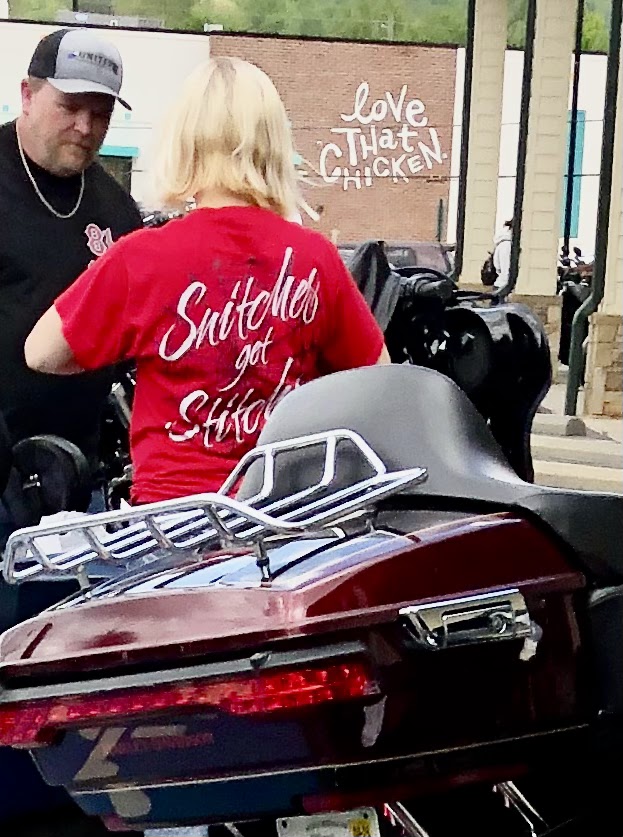
"Snitches get Stitches" is a great t-shirt.

North Carolina-style Pulled Pork sandwiches: $5 flat, cash.
Unfortunately I turned out to need the ride home because the bike had a frozen piston in the rear brake caliper, so they had to order a new one (or part it out and fix it, but they charge $145/hour for shop labor, so it was cheaper just to have them get a part). I couldn't ride it home since they'd disabled the brakes (which had been working fine as far as I could tell before), so I had to leave it there until they could get the part. I stayed overnight at a local motel and then my wife came to get me today. She wanted to go to the arboretum.

I think she said this was some kind of orchid.

Plants are pretty boring, but they did have a model railroad that was pretty cool.

View from above.
So kind of a sideways weekend. Not a terrible party, though.
Random Images and a Song
Now that Lent, Holy Week and Easter have passed, I’ll post a song that is a bit irreverent. Also, some photography from my life.


Love those Springer forks.

For some, a freshly cut stick is the best thing in life.

Gotta make sure you’re not going anywhere.

The local market, just thirteen miles away. It’s pretty Wild West: almost every man you meet there is wearing a gun except me. I wear a knife.

A non-controversial statue also by the Sylva library.
This is the Way
Civilians with permits stopped the attacks more frequently and faced a lower risk of being killed or injured than police. Officers who intervened during the attacks were far more likely to be killed or injured than those who apprehended the attackers later.
…[A]rmed citizens reduce the number of deaths in active-shooter incidents significantly more than the police do. In fact, armed citizens reduce the number of people killed by 49 percent, while the police increase the number killed by 16 percent in comparison to the omitted class (shooters who are arrested later or stopped by unarmed citizens or stop of their own accord).
Good paper by John Lott and Carlisle Moody.
A Recruiting Boom
As you may recall, military recruiting has been terrible since the Afghanistan withdrawal demonstrated that the American military was not led by serious people. It was thought that this might be a lasting problem, similar to the recruitment shortfalls in the 1970s after the Vietnam War was thrown away by Congress.

“This is the start of a long drought for military recruiting,” said Ret. Lt. Gen. Thomas Spoehr of the Heritage Foundation, a think tank. He said the military has not had such a hard time signing recruits since 1973, the year the U.S. left Vietnam and the draft officially ended. Spoehr said he does not believe a revival of the draft is imminent, but “2022 is the year we question the sustainability of the all-volunteer force.”The pool of those eligible to join the military continues to shrink, with more young men and women than ever disqualified for obesity, drug use or criminal records. Last month, Army Chief of Staff Gen. James McConville testified before Congress that only 23% of Americans ages 17-24 are qualified to serve without a waiver to join, down from 29% in recent years.An internal Defense Department survey obtained by NBC News found that only 9% of those young Americans eligible to serve in the military had any inclination to do so, the lowest number since 2007.
Apparently not.

He may not dress the right way for Esquire, but having a fighting man as SECDEF seems to be having a positive effect on morale and recruitment.
An Alternative Look at Student Loans
The White House says it is going to go aggressively after student loans in default. He's also planning on resumption of payments, and cancelation of some of the easier-term payment plans.
Student loans are an effective culture war tool for the President, because his support tends to be strongest with those who have less education. If you've been to graduate school, the odds that you will support him were much smaller than they are for the general public in all three of his elections.
When I hear Republicans talking about this, they tend to describe it in terms of fairness: you took a loan, you ought to pay it back in full (with interest). When I hear Democrats talking about it, they also talk in terms of fairness: the government made a deal with the students that included loan forgiveness at some point (usually 20 years, sometimes 10 for those in public service jobs), and it's not fair to revoke that deal now.
There's an alternative way of looking at the problem that I haven't heard people discussing. The government has essentially inflated these debts twice. It did so first by making student loans the main way of paying for college, so that the costs soared as the colleges could add on fees and higher tuition knowing that Uncle Sam would foot the bill. That's not the fault of anyone who wanted an education, but it is a fact that they had to deal with.
Then, since the 1990s but especially under President Obama, the government made deals on how much former students had to pay that caused their loans to increase again. If you were in the Public Service Loan Forgiveness program and also Income Based Repayment, you weren't paying enough every month to pay off the debt in the 10 years it would take for you to get to forgiveness. Therefore, your loan balance continued to grow. You could have chosen a more expensive option, but since the government was promising to forgive the debt, why should you take money out of your family's pocket to do so? You were keeping up your end of the deal the government had made with you.
As a result of the first inflation, it now costs almost thirty times as much to go to college as it did in the 1970s. As a result of the second, people who owed X amount now may owe 2X as a consequence of keeping faith with the government. Assuming you relied on loans to go to college as many do X was, thus, thirty times what it used to be, and now is sixty times what it was. 100% of that vast increase in debt is due to government action, the largest part of which no one could escape except by virtue of being born earlier than they were.
The government is basically altering the deal with people after the fact, mostly in order to punish them for political opinions. Likewise, Biden's ham-handed and failed attempts at student loan forgiveness were mostly to reward people for their political opinions.
That's not really a legitimate function of government. It's certainly not fairness, no matter how you look at it. It's more like extortion in the one case and bribery in the other; criminal behavior in either case, when it isn't being done by the government.
In Praise of my Father
Today was my father’s birthday. Because of the damnable algorithms I have been seeing all day ads for products that you should buy to capture your father’s story before it’s gone.
Well, it’s gone, you bastards. He told me so many stories so many times that I thought I could never forget them, but I have.
He was the best man I ever met, and far better than I could ever relate. I cannot imagine that he needs my prayers nor yours, but pray for him anyway, as you might pray for me. I definitely need your prayers.
Not Quite, Doc
You'd think an expert opinion might indeed be forthcoming from a man with these qualifications:
John D. Bessler is a law professor at the University of Baltimore School of Law, an adjunct professor at the Georgetown University Law Center and a visiting scholar at the University of Minnesota Law School’s Human Rights Center.
I wanted to agree with him, because as you know I also have 8th Amendment concerns about Trump and especially his stated intention to deliver American citizens to foreign prisons. However, the professor's logic doesn't work.
The Eighth Amendment’s ban on cruel and unusual punishment prohibits this course of action. White House lawyers should read the U.S. Supreme Court’s landmark decision in Trop v. Dulles. The court barred the government from rendering U.S. citizens stateless, which is similar to what Trump is threatening to do if Americans are imprisoned abroad.During World War II, Albert Trop, an American citizen, was serving as a U.S. Army private in Morocco. He escaped a stockade and was taken into custody the next day and court-martialed. Convicted of desertion, he was sentenced to three years of hard labor, forfeiture of pay and a dishonorable discharge. When Trop applied in 1952 for a passport, his application was denied on the ground that, under the Nationality Act of 1940, he had lost his U.S. citizenship by virtue of his conviction.In Trop, the Supreme Court held that denationalization as a punishment is a violation of the cruel and unusual punishments clause of the Eighth Amendment....The Trop case makes clear that any effort to incarcerate U.S. citizens abroad would be an Eighth Amendment violation. Were that to happen, people would — as a practical matter — be deprived of their fundamental constitutional rights.
Apparently the professor missed the part of his own story in which Trop was incarcerated in Morocco. That wasn't an issue for the court. They just said that he couldn't be denaturalized. Trump hasn't proposed denaturalizing American citizens, just having them incarcerated outside the territorial USA. Trop was so incarcerated himself, presumably by the US Army but there's no reason the prison couldn't be run by foreign contractors instead of American soldiers or prison guards.
Likewise here:
The case of Kilmar Abrego García, an immigrant and longtime Maryland resident who the Trump administration admitted in court was sent in error to El Salvador, illustrates the threat. The Supreme Court ordered the administration to facilitate García’s return, but it has resisted taking action. Judge J. Harvie Wilkinson III — a Reagan appointee — warned in his Fourth Circuit order on April 17 that “the government is asserting a right to stash away residents of this country in foreign prisons without the semblance of due process that is the foundation of our constitutional order.”
The government’s claim that nothing can be done for García now that he’s out of U.S. custody, Wilkinson observed, “should be shocking not only to judges, but to the intuitive sense of liberty that Americans far removed from courthouses still hold dear.”
That's surprisingly irrelevant to the case of Trump doing the same thing to American citizens. The reason they have no authority to do anything about Garcia is that he is a Salvadoran citizen, in El Salvador, under the control of his own lawful government. An American citizen abroad continues to enjoy US protection (and, in fairness to Trump, he has been pretty energetic about getting US citizens out of foreign prisons during his tenure). Whereas the US has no lawful power to demand El Salvador do much of anything for its own citizens, the US has a keen interest in protecting American citizens abroad.
I would like to believe that this is forbidden by the Constitution and specifically by the 8th Amendment, but this is not a good set of arguments for that being the case. I think the conditions in CECOT plainly violate the 8th Amendment, and that it shouldn't be legal to send Americans there under any circumstances. I wouldn't want to send them even to a nicer and more humane prison in El Salvador (or anywhere else).
The Times Are A'Changing
PJM points out that comedian Larry David's mockery of Trump-as-Adolf doesn't line up beautifully with their actual coverage of Adolf back when he was a going concern.
Pulitzer Prize-winning “journalist” Anne O’Hare McCormick traveled to Berlin to become the first reporter from an American news outlet to interview the new chancellor, and she turned out to be an intriguing choice for the Times editors to make to conduct this interview, for she appears to have been something of a Hitler fan. In the presence of this man whose name has become today synonymous with evil, she was decidedly starry-eyed... Oh, the Führer’s eyes! “His eyes,” she told the world, “are almost the color of the blue larkspur in a vase behind him, curiously childlike and candid. He appears untired and unworried. His voice is as quiet as his black tie and his double-breasted black suit.”Hitler speaks “slowly and solemnly but when he smiles—and he smiled frequently in the course of the interview—and especially when he loses himself and forgets his listener in a flood of speech, it’s easy to see how he sways multitudes.” What’s more, “Herr Hitler has the sensitive hand of the artist.” He tells McCormick coyly: “Ah! Women! Why, women have always been among my stanchest [sic] supporters. They feel that my victory is their victory.”
By coincidence, the history I am currently reading contains a similar off-key note from the NYT. When WWI broke out -- I not II -- the NYT loved the new Espionage Act and its crackdown on free speech, especially speech by recent immigrants with radical views. They liked the draft too:
Powerful New Yorkers viewed [Federal law enforcement agencies] as allies in their effort to turn the war into a moment of broader social reckonings. The New York Times welcomed the arrival of the military draft as "a long and sorely needed means of disciplining a certain insolent foreign element in this nation." [Willrich, Anarchy, 190]
On the one hand, I suppose it would be a lot to ask of an institution to remain perfectly consistent over a hundred years of change such as we've experienced. Still, it's interesting to see that they took a very Trumpian position a hundred years ago, or even in Adolf's day.
On the other hand, they do show perfect consistency in wanting to use Federal agencies to force the rest of the country into line with their views. "Disciplining a certain insolent... element in this nation" is one thing they've been clear supporters of right down the line.
The Controversial Monument
I mentioned this the other day, but on the assumption that it will probably be defaced or destroyed, I went and took some photos of it for history's sake.


The local town is not exactly the right place for such sentiments anymore, although it was rededicated in 1996, which is surprisingly late. These days it's a quite blue town.

A Beatles and Grateful Dead-themed restaurant side-by-side on Main Street.

A typical house with Ukraine flag replacing the American one, anti-Trump/Musk signage, muticultural multicolored sign, and Peace Sign.
Probably the local college kids will just spraypaint it over and over until the county gets tired of having to pay to clean it and arranges for it to be moved. But these days, you never know. The Georgia Guidestones got the dynamite stick, after all.
Birth Control vs. Women's Suffrage
So, I am reading Michael Willrich's, AMERICAN ANARCHY: The Epic Struggle Between Immigrant Radicals and the US Government at the Dawn of the Twentieth Century (New York: Basic Books Perseus, 2023) which I mentioned recently. I am not ready to review it in full yet, but it has indeed been extremely enlightening. Not about the philosophy; the author doesn't really care about the ideas, and makes no attempt to elucidate them. He's a historian, not a philosopher, but he takes his part seriously -- that is, getting the facts straight and presenting them honestly.
One subset of the book that I have just finished was the way in which birth control arguments developed independently from the women's suffrage movement. I was quite surprised by this, as in my lifetime and my parents' as well the two things were presented as part of the same general feminist struggle for additional rights for women.
That was not true at the beginning, however. Women's suffrage was a comfortably middle-class issue, with some wealthy women also quite engaged in it. Birth control was an anarchist movement, attempting to help poorer workers deal with the burden of large families. Richer women didn't have a problem with obtaining birth control, because their private physicians could prescribe it under existing laws.
The obscenity laws that forbade even discussing or printing materials about birth control were protected first and foremost by the churches' influence on society. Anarchists wanted to reduce the amount of religious law affecting private conduct. The Suffrage movement, meanwhile, had been joined at the hip from the beginning with the Temperance movement, an intensely religious movement to drive out the demon alcohol from society -- which the anarchists also did not want, many of them being Germans and Italians, whose cultures were built around beer and wine respectively.
The same class distinctions turned up in Prohibition as in birth control, in fact: even during the period of Prohibition, the 18th Amendment which was ratified just a year before the 19th Amendment, those same private physicians could prescribe you whiskey. The rich were omitted from both the obscenity laws and the anti-drinking laws through the same back door.
Likewise, Suffrage was successful because it was an anti-immigrant move -- more men than women had migrated in the 19th century and early 20th century (as indeed also today), so giving women the vote was plausible to a lot of older American men (the ones who voted it in) because it diluted the migrant vote by more or less doubling the old American vote. Just as Prohibition was anti-immigrant, so too Suffrage in its way.
So these things really didn't belong to the same 'feminist' movement at all, not at first. They were oppositional drives by women of quite different classes and mostly different ethnicities.
What brought them together, you may be amused to learn, was a trial of 'Queen of Anarchists' Emma Goldman for passing contraception pamphlets. At her conviction, one member of the three judge panel (all male, of course) foolishly remarked not only that her pamphlets were obscene, but that he thought that the women who kept asking for 'equal votes' could do a lot more good by encouraging women to have more children instead.
That one remark, widely reported, incensed the wealthy women so much that birth control very quickly became taken up by the Suffrage movement as well. They were successful in getting birth control laws overturned well before getting either of their real desiderata, Prohibition or Suffrage.
The rest is history.
UPDATE: I wondered how Wikipedia told the same story, and they emphasize mostly different things. They suggest the movement started in 1914, which actually isn't the case according to Willrich's book, which mentions several predecessors among the anarchist movement dating into the 19th century. It also plays up Margret Sanger, who fled the country to avoid prosecution. Her husband ended up taking the rap for her after some police entrapment around his wife's work.
Sanger and Goldman are reported by Willrich to have been increasingly antagonistic to each other over these issues. Sanger was one of the upper class women, younger and less famous than Goldman but more well-connected socially. She initially favored birth control over abortion, on the correct grounds that abortion necessarily involves taking life no matter how early it is done; but we all know how her organization turned out in the end.
Yeah, You Wouldn't Like My Clothes Either
A writer for the NYT and Esquire decides that it's very important to detail how SECDEF Hegseth doesn't dress like one of the elite.
250th Anniversary
As it was Holy Saturday, I thought that should take precedence, but it's a good time to remember these things. I'm looking forward to the 250th celebrations.
Hoplophobia
A good insight here, but coupled with a lot of irrational fear of weapons.
The good:
[E]very time we build a new tool of state power — every time we cheer on its use against our enemies — we increase the chances it will be turned around and used against us. And each time it happens, people act surprised.
That’s where we are now, again. President Trump is openly using the machinery of the federal government to prosecute political enemies. He wants to “root out” the deep state, deport migrants unilaterally and deploy the military on U.S. soil. He has made no secret of it.
Liberals see this and panic. They’re right to be alarmed — but they’re wrong to treat this as something new. What they’re witnessing isn’t the sudden collapse of American democracy. It is the logical consequence of decades spent building and normalizing a government that increasingly operates with few real limits.
This didn’t start with Trump. Many of the very tools Trump wants to wield were built with bipartisan support. The post-9/11 security state — with its surveillance dragnet, indefinite detention, “black sites” and bloated executive authority — was cheered on by both parties in the name of fighting terror.
President Barack Obama didn’t dismantle that machinery — he streamlined it. He claimed the right to kill U.S. citizens abroad without trial, used the Espionage Act against whistleblowers and expanded domestic counterterrorism. He helped perfect the arsenal that Trump would later inherit.
It was the left, not the right, that normalized censoring disfavored online speech during the pandemic, often using intelligence-linked partners to do so. It was establishment liberals who applauded when the FBI investigated Trump-world operatives — not on the basis of principle, but because they liked the target.
The bad:
There’s a well-known finding in psychology called the “weapons effect.” It describes how the mere presence of a weapon increases the likelihood that it will be used — not just by hardened criminals or soldiers in combat but by anyone, in ordinary settings, even and especially in the home. The deadly object creates a condition of heightened possibility. Violence moves closer to the realm of the likely.
We rarely admit that this applies to government.
As I remarked at AVI's place, this is really a logical deduction rather than a 'finding in psychology.' A weapon that doesn't exist has a zero probability of being used. A weapon that does exist has a non-zero probability. Even if it's very low, logic dictates that the presence of a weapon makes it more likely that one will be used than if one is not present.
However, it wasn't just a logical error. He expands on this later in ways he would have been wiser to leave out.
The ugly:
Cultural neuroscience tells us that environments shape behavior more than we realize. The tools we surround ourselves with — whether in a home or in a bureaucracy — subtly shape what we think is possible. In a household with a loaded firearm, the gun doesn’t just sit there. Its presence hovers. In moments of anger, fear, confusion or desperation, it calls to be used.
"Cultural neuroscience"? Cultures do not have neurons, so he must mean a form of actual neuroscience that likes to talk about culture and its effects.
This gun-fear is irrational, however. I have a revolver that hangs from my bedpost in a gun belt. It's been there for decades. I check it nightly, clean it regularly, but otherwise it really does just sit there in the holster. It doesn't have a 'presence' to 'hover.' It never 'calls' to me or to anyone else. This kind of talk is senseless.
Still, the good part is really pretty good. It would have perhaps been better to use Chekhov's Gun as the metaphor, rather than reaching for 'psychology and cultural neuroscience.' In a drama -- which politics is, among other things that it is -- guns that are introduced or even displayed are usually used. I once saw a Roy Rogers film with a rifle that hung on the wall the whole movie without anyone using it for anything; I can remember how strange that seemed in a movie, even though it's exactly what I was just describing as the real fact of my own home.
The state is a kind of weapon, or a set of weapons, which are designed to be used chiefly against us. And that's something to remember when Trump is doing it, too: an excellent reason to stand firm against his police-state impulses is that what goes around comes around. Well, it's been around and it's come around again, but the cycle doesn't stop with him.
Senses of Humor
Out in Montana, some local police came up with a game.
The secret game came to light Thursday, when Bozeman Police Chief Jim Veltkamp held a press conference to reveal details about the game. In his statement to the press, Veltkamp insisted the rights of those stopped by BPD were not violated as part of the game.Veltkamp said officers, “Were engaged in a bingo competition where success in the game hinged on whether they engaged in actions listed on the bingo card.”“It did look like your standard bingo card,” added Veltkamp. “They filled in squares of things they wanted to see happen or have happened in order to check off that box in the bingo card.”Other categories included “FOOT PURSUIT FOR ARRESTABLE OFFENSE” and “APPLY TQ OR CHEST SEAL,” referring to the use of a tourniquet or sealing wounds to a person’s torso to stop blood loss.“One of those was to do a search warrant on a car,” said Veltkamp. “Which in and of itself, that is part of their duties. The concern is if they manipulated anything in order to be able to search a car.”It took two and half months for the BPD, the Bozeman City Attorney's Office and the Gallatin County Attorney's Office to release information about the game.At the press conference held at the Bozeman Public Safety Center, Veltkamp said the game went on for 12 days until someone alerted command staff, who shut down the game.
I get the concern that improper searches or arrests might have been motivated by the desire to check off a bingo block. However, I have to say that the game sounds like it was probably just good fun. I could easily see a Firefighter or EMS version of this (especially since some of the things overlap -- "Apply Successful CPR" or "TQ" for example).
It would never be permitted, just as the police had to cancel this one as soon as leadership learned about it. The problem is that members of the public do not always share the dark sense of humor that tends to develop in public safety. The hardest I usually ever laugh is often on EMS Continuing Education training night, which our various EMTs and Paramedics have to take regularly and which is helpful for me even though I don't require it. You need a sense of humor to confront injury, sickness, and death on a regular basis. It's good for them to laugh. It helps them help others.
It does hurt people's feelings, though, so you have to keep it behind closed doors.
James' New Story
As you may also have seen at his blog or AVI's, James has published a new story in a collection called Magic Malfunction. I've just ordered a copy and so haven't read it yet, but I can't imagine that at least his part of it won't be good.
Subscribe to:
Posts (Atom)