"The ship was identified as an Arleigh Burke-class destroyer belonging to the Navy’s 7th Fleet."
Those do seem to be having some trouble lately.
Nor is this the worst water-borne event to come out of Harvey.


Smaller Government
Congress may not deserve its low ratings for a change.
An analysis by the Pew Research Center that looked at every piece of legislation that received final approval from Congress found this Congress tied for fifth most productive in the past 30 years.Doing what, you ask?
...overturning Obama-era rules, using a little-known law call the Congressional Review Act.That's under-selling it. The regulations are an undisputed bright-spot in the Trump administration: for every new regulation they have proposed, they've killed sixteen existing ones. They have focused especially on Obama-era regulations intended to 'fundamentally transform America.' The economic benefits are real.
The 1996 law gives this Congress a shortcut to overturn any rules submitted after mid-June of 2016. Before now, the Act had only been used once.... This Republican-led Congress, however, has shown no qualms about using the act to chip away at Barack Obama’s legacy. While Congress hasn’t been able to repeal and replace Obamacare, which Republicans have been promising for the seven years since it was passed, they have gotten rid of regulations around mountaintop removal for coal mining, a rule that kept internet service providers from using selling customers data to advertisers without their permission, and a Securities and Exchange Commission regulation that requires corporations to disclose payments to foreign governments.... President Trump promised repeatedly during his campaign to slash regulations, and Congress has delivered: While congressional “productivity” is high, regulatory activity is at an all-time low.
In a statement, OMB Director Mick Mulvaney boasted about how much the administration has been able to cut down on regulatory red tape and improve American prosperity.Smaller-government efforts like this would never have been considered under the second Clinton administration. That's a fact worth keeping in mind as a partial counterweight to the criticisms, though many of those are valid.
“Government is using muscles it hasn’t used in a really long time, exposing and removing redundant and unnecessary regulation,” he said.
“In the first five months of this administration alone the net cost of our regulatory agenda has been less than zero dollars. Contrast that with the last five months of Fiscal Year 2016 when the Obama administration imposed almost $7 billion in costs on our economy through regulation."
Deforestation in Haiti: A Big Lie
Turns out one of the most commonly-told stories of environmental degradation simply doesn't check out. The actual forestation in Haiti is more than an order of magnitude higher than the 2% reported in the disaster stories: 30%, similar to the US or Germany.
"The Rise of a Moral Panic"
A good piece by a doctor of geography (to include culture and politics, he notes in his bio) on the irrationality attending our current debate.
That's a part of the irrationality that the author is rightly describing. Just this week, I noticed that the press was describing the transcript of the President's remarks as being that of his "rant." In addition, they left out a very significant piece of evidence contradicting the "moral panic" picture: the benediction by Alveda King, which was attended by a very warm reception from the crowd. The benediction itself is an appeal for unity and brotherhood not divided by things like race; the crowd's embrace of King and her message would seem to suggest -- at minimum -- reconsidering the panic that these are all 'racists' or even 'Nazis.' It is unclear to me if they simply cannot see the evidence that is right in front of their eyes, or if they are actively rejecting that it could be true or real, or if -- I should not like to believe, but it is possible -- they are actively suppressing exculpatory information in order to further the moral panic.
There is cause for concern about a rising confidence among true white supremacists. As noted here recently, I've seen a Klan flag being flown openly when I had never seen one in decades. It is right and proper to oppose such things, in a rational but committed fashion.
Nevertheless, one must avoid the irrational excesses that are becoming all too common. I meet Trump voters every day when I go out in the world around me. I buy gas from them, I have other sorts of businesslike exchanges, I overhear their conversations in line at the grocery store. This panic is out of order. The harm it is causing is worse than any potential harm from the handfuls of genuine Klansmen and Nazis scattered here and there across a vast nation.
The classic example of a moral panic involves a society losing its mind over witchcraft, as when more than twenty innocent people, mostly women, were hanged or otherwise killed following the Salem witch trials of 1692. In general, a moral panic concerns something that would be bad, perhaps horrific, if real, but whose reality is imagined or exaggerated to the point of social hysteria, and the popular reaction to which leads individuals and institutions to abandon reason, evidence, and common sense....Lord is a TV personality, and I don't watch television. I don't know that Gorka is an "odious" person, though; I've never met the guy, but I know a guy who knows him and who tells me that Gorka's been badly mistreated. The press hates Trump so much that they're looking to hate anyone associated with Trump, and if there are things they can misrepresent in a way that makes that guy look even worse than Trump, well, then that guy becomes a weapon against Trump.
It should be obvious from history that uninformed or illiterate attacks on odious people like Gorka or Lord lead inevitably to uninformed or illiterate attacks on good people. Perhaps CNN dismissed Lord on a pretext, or perhaps it finally just no longer thought he was worth the trouble. And the Vitézi Rend is an obscure bit of knowledge, easy for dilettantes to posture over because so few others are equipped to challenge their “expertise.” The okay sign is a different matter. It is familiar, common, mundane. What does it say that so many repeat the myth of the “white power” sign? One possibility is that people have no confidence in their own understanding of the sign; another is that they acknowledge that it used to mean “okay,” but are willing to surrender such a common expression to extremists instantly when challenged. Both possibilities are disturbing, because they suggest that we lack the mental tools and strength to respond to this phenomenon. When pressed, we will sacrifice our culture and our way of life. Charlottesville demonstrated, at least for the moment, that we are not willing to cede control of our streets to white nationalism. But if we cede control of our rhetoric, of our intellectual spaces, and even of our ordinary language, the real battle will be lost.
That's a part of the irrationality that the author is rightly describing. Just this week, I noticed that the press was describing the transcript of the President's remarks as being that of his "rant." In addition, they left out a very significant piece of evidence contradicting the "moral panic" picture: the benediction by Alveda King, which was attended by a very warm reception from the crowd. The benediction itself is an appeal for unity and brotherhood not divided by things like race; the crowd's embrace of King and her message would seem to suggest -- at minimum -- reconsidering the panic that these are all 'racists' or even 'Nazis.' It is unclear to me if they simply cannot see the evidence that is right in front of their eyes, or if they are actively rejecting that it could be true or real, or if -- I should not like to believe, but it is possible -- they are actively suppressing exculpatory information in order to further the moral panic.
There is cause for concern about a rising confidence among true white supremacists. As noted here recently, I've seen a Klan flag being flown openly when I had never seen one in decades. It is right and proper to oppose such things, in a rational but committed fashion.
Nevertheless, one must avoid the irrational excesses that are becoming all too common. I meet Trump voters every day when I go out in the world around me. I buy gas from them, I have other sorts of businesslike exchanges, I overhear their conversations in line at the grocery store. This panic is out of order. The harm it is causing is worse than any potential harm from the handfuls of genuine Klansmen and Nazis scattered here and there across a vast nation.
Tex Updates
UPDATE: Elise reports hearing from Tex. She & house are ok.
Friday 1728 Romeo: Tex reports internet down, power and other comms still up. Wind moderate.
Friday 2100 Romeo: Tex wrote to say that the worst of the storm would make landfall just west of her, which is of course the worst case. As of 1930 she was still receiving messages, but has since gone quiet. It may be that the atmospheric disturbance is too great right now.
"" 2200 R: Radar shows she was right. The red wall of the eye is lashing them now, with landfall just west. No comms still, but that is to be expected under the circumstances.
Saturday 1244 R: Still nothing from Tex. My phone still says that the last message delivered/read was yesterday at 1930, so probably cell networks are just down. Local firefighters were holding at the station because it was too dangerous to move, but the station stayed up. There are reports of buildings that didn't, or didn't quite, but they sound institutional so far. A well constructed house had a better chance.

Friday 1728 Romeo: Tex reports internet down, power and other comms still up. Wind moderate.
Friday 2100 Romeo: Tex wrote to say that the worst of the storm would make landfall just west of her, which is of course the worst case. As of 1930 she was still receiving messages, but has since gone quiet. It may be that the atmospheric disturbance is too great right now.
"" 2200 R: Radar shows she was right. The red wall of the eye is lashing them now, with landfall just west. No comms still, but that is to be expected under the circumstances.
Saturday 1244 R: Still nothing from Tex. My phone still says that the last message delivered/read was yesterday at 1930, so probably cell networks are just down. Local firefighters were holding at the station because it was too dangerous to move, but the station stayed up. There are reports of buildings that didn't, or didn't quite, but they sound institutional so far. A well constructed house had a better chance.
Babylonian Trig
Mathematicians have finally figured out an ancient set of carvings. Turns out, the Babylonians were very solid on their trigonometry.
Of course, invention in Iraq did not end with ancient Babylon.
The true meaning of the tablet has eluded experts until now but new research by the University of New South Wales, Australia, has shown it is the world’s oldest and most accurate trigonometric table, which was probably used by ancient architects to construct temples, palaces and canals.The ancients in general were better at math than we understand them to have been. We have forms of math they didn't have, but they had forms we have lost or abandoned, and sometimes they end up enabling pretty sophisticated mental work. In this case, it looks like the ancient Babylonians invented a form that was actually better than anything that has replaced it.
However unlike today’s trigonometry, Babylonian mathematics used a base 60, or sexagesimal system, rather than the 10 which is used today. Because 60 is far easier to divide by three, experts studying the tablet, found that the calculations are far more accurate.
“Our research reveals that Plimpton 322 describes the shapes of right-angle triangles using a novel kind of trigonometry based on ratios, not angles and circles,” said Dr Daniel Mansfield of the School of Mathematics and Statistics in the UNSW Faculty of Science.
“It is a fascinating mathematical work that demonstrates undoubted genius. The tablet not only contains the world’s oldest trigonometric table; it is also the only completely accurate trigonometric table, because of the very different Babylonian approach to arithmetic and geometry.
Of course, invention in Iraq did not end with ancient Babylon.
A Confederate Without Monuments
An interesting counterexample: a favored deputy of Robert E. Lee's who is largely uncelebrated in statuary. Why?
Senator William Mahone was one of the most maligned political leaders in post-Civil War America. He was also one of the most capable. Compared to the Roman traitor Cataline (by Virginia Democrats), to Moses (by African American congressman John Mercer Langston), and to Napoleon (by himself), Mahone organized and led the most successful interracial political alliance in the post-emancipation South. Mahone’s Readjuster Party, an independent coalition of black and white Republicans and white Democrats that was named for its policy of downwardly “readjusting” Virginia’s state debt, governed the state from 1879 to 1883.Like the United Irishmen's union of Protestant and Catholic in 1798, it's one of history's tragic missed opportunities.
During this period, a Readjuster governor occupied the statehouse, two Readjusters represented Virginia in the United States Senate, and Readjusters represented six of Virginia’s ten congressional districts. Under Mahone’s leadership, his coalition controlled the state legislature and the courts, and held and distributed the state’s many coveted federal offices. A black-majority party, the Readjusters legitimated and promoted African American citizenship and political power by supporting black suffrage, office-holding, and jury service. To a degree previously unseen in Virginia, and unmatched anywhere else in the nineteenth-century South, the Readjusters became an institutional force for the protection and advancement of black rights and interests....
The Readjusters lost power in 1883 through a Democratic campaign of violence, electoral fraud, and appeals to white solidarity. While Democrats suppressed progressive politics in the state, other groups of elite white Virginians worked fast to eradicate the memory of Virginia’s experiment in interracial democracy.
Fellow Southerners, Rejoice!
New York City's Saturday Night Live has deigned to allow us to feel pride in some features of our heritage. The following are authorized:offensive stereotypes regional norms in order to secure that crucial approval from our Northern neighbors.
They got rocking chairs on big porches. They got the friedest food you ever tasted. They got cheap cigarettes. They got cute nicknames like Scooter, June Bug, Colonel Poopy Conner,” she said. “They got big fat guys in tiny little ties, and got drive-though liquor stores.Be sure to conform to these

The end of drought
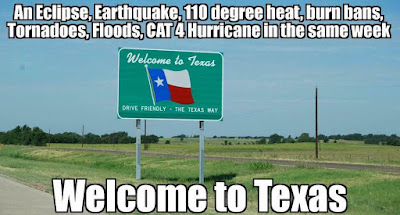
If you start to hear "Rockport" or the "Lamar Peninsula" on the national weather, think of us. We're just north of Corpus Christi and looking to be in the direct path of whatever Harvey develops into.
The storm having strengthened overnight, we bit the bullet and decided to put up the storm shutters. We'd waited so late that I almost didn't bother calling our window guys and asking if they could fit us into their schedule to help us with installation, but to my undying amazement, the owner answered the phone right away and in response to my tentative question hesitated, then said, "Well, I don't know. We couldn't get out there before this afternoon." This afternoon? Yeah, that would be . . . fine. (I picture Goldie Hawn's character in Overboard sniffing, "I almost had to wait.")
Having become so much more fit in the last two years, I'm not having any trouble carrying the dozens and dozens of heavy aluminum interlocking corrugated panels up from the garage to the porch on the main living floor, but it's a much trickier business getting the panels installed on the third-floor bedroom windows, which can worked on only from the shed roof over the porch 20 feet in the air. There are also approximately one million little butterfly nuts to screw in even for the windows that are easily accessible from the porch on the main living floor, so I'll be very glad of the help when they arrive.
I don't know if we're looking at a bit of a blow or a big one, or whether it will be a bit of rain or 20+ inches. For my own sake, I hope for 20 inches, but I know that will create a hardship for others in this area. For me, it would just fill up my poor pond for the first time in a couple of years.
We've nearly finished putting everything in the garage that would be likely to become a projectile: a clean sweep fore and aft. If there are high winds, we have only tree limbs to worry about, and that's as it may be. Our propane tank is full; we've tested the generator. We have 20,000 gallons of fresh water in the cistern. Despite the worsening forecasts, I expect this to be a small to medium storm, not a big monster. Nevertheless, it's starting to look like Allison, which drifted over Houston in about 2000 and wandered around for a week without major steering currents, dropping truly amazing amounts of rain. Being flat as a pancake, this area holds up well under huge rainfalls, so although some houses will inevitably take on water, at least it won't be a dangerous current.
The storm having strengthened overnight, we bit the bullet and decided to put up the storm shutters. We'd waited so late that I almost didn't bother calling our window guys and asking if they could fit us into their schedule to help us with installation, but to my undying amazement, the owner answered the phone right away and in response to my tentative question hesitated, then said, "Well, I don't know. We couldn't get out there before this afternoon." This afternoon? Yeah, that would be . . . fine. (I picture Goldie Hawn's character in Overboard sniffing, "I almost had to wait.")
Having become so much more fit in the last two years, I'm not having any trouble carrying the dozens and dozens of heavy aluminum interlocking corrugated panels up from the garage to the porch on the main living floor, but it's a much trickier business getting the panels installed on the third-floor bedroom windows, which can worked on only from the shed roof over the porch 20 feet in the air. There are also approximately one million little butterfly nuts to screw in even for the windows that are easily accessible from the porch on the main living floor, so I'll be very glad of the help when they arrive.
I don't know if we're looking at a bit of a blow or a big one, or whether it will be a bit of rain or 20+ inches. For my own sake, I hope for 20 inches, but I know that will create a hardship for others in this area. For me, it would just fill up my poor pond for the first time in a couple of years.
We've nearly finished putting everything in the garage that would be likely to become a projectile: a clean sweep fore and aft. If there are high winds, we have only tree limbs to worry about, and that's as it may be. Our propane tank is full; we've tested the generator. We have 20,000 gallons of fresh water in the cistern. Despite the worsening forecasts, I expect this to be a small to medium storm, not a big monster. Nevertheless, it's starting to look like Allison, which drifted over Houston in about 2000 and wandered around for a week without major steering currents, dropping truly amazing amounts of rain. Being flat as a pancake, this area holds up well under huge rainfalls, so although some houses will inevitably take on water, at least it won't be a dangerous current.
How To Thank a Firefighter
A farmer in England knows how.
Firefighters in Wiltshire, England rescued 18 piglets and two sows from a barn that was going up in flames in February, according to the BBC. The fire ended up consuming 60 tons of hay. Six months later, the farm gave the firefighters sausage made from the pigs to thank them.I imagine it was. There's a great butcher shop not far from here where we get fresh sausage on a regular basis. It never disappoints.
“I’m sure vegetarians will hate this,” said Rachel Rivers, the manager of the farm where the pigs were saved.
Rivers and farm owner Canon Gerald Osbourne defended the gift, saying raising and slaughtering livestock is their livelihood.
“I gave those animals the best quality of life I could ever give until the time they go to slaughter and they go into the food chain,” Rivers said, adding that “you do feel sad at the end of it.”
The firefighters, who barbequed the sausage, didn’t seem to mind. They called the meat “fantastic.”
This Day A.D. 1305
"I can not be a traitor, for I owe him no allegiance. He is not my Sovereign; he never received my homage; and whilst life is in this persecuted body, he never shall receive it. To the other points whereof I am accused, I freely confess them all. As Governor of my country I have been an enemy to its enemies; I have slain the English; I have mortally opposed the English King; I have stormed and taken the towns and castles which he unjustly claimed as his own. If I or my soldiers have plundered or done injury to the houses or ministers of religion, I repent me of my sin; but it is not of Edward of England I shall ask pardon."Requiescat in pace Sir William Wallace.
Think "Bruce," not "E"
ESPN is getting a lot of well-deserved flack after pulling a reporter of Asian heritage from a UVA football game. His name, as I'm sure you've heard, was Robert Lee.
S. E. Cupp says this should be taken to settle the monuments debate.
Or maybe it's just getting going.
Still, whether it's winding down or just getting started remains to be seen.
S. E. Cupp says this should be taken to settle the monuments debate.
Or maybe it's just getting going.
Ghana has said it will remove a statue of Mahatma Gandhi from a university campus in the nation’s capital where it had sparked protests over the leader’s allegedly racist attitudes....It's ironic to see a Hindu guru from India roped up for using a slur that originates from Muslim criticisms of those who reject Islam. But of course there are plenty of reasons to criticize Gandhi; it's just that he's a kind of secular saint (who wasn't, himself, at all secular) to the very sort of American who wants to pull down other monuments.
The petition, which had more than 1,700 supporters on Thursday, cited letters Gandhi wrote during his time in South Africa as evidence that he advocated for the superiority of Indians over black Africans. It also took issue with his use of the derogatory term kaffir to refer to native Africans and criticized the lack of statues of African heroes and heroines on campus.
Still, whether it's winding down or just getting started remains to be seen.
The Hate Goes To Eleven
As longtime readers know, I always prefer to read transcripts of speeches instead of listening to them. Many rhetorical tricks don't work as well in print as in voice, and you can get a better feel for the strength of the argument by reading it instead. It was tough to find one today! There are lots of articles about how bad the speech was, about how crowds were light and drifted away during the speech, about how James Clapper questioned the President's fitness to serve after hearing it, but transcripts are thin on the ground.
I finally did locate one. Normally these things are simply titled, "Transcript of [Whoever's] Remarks." This time, the transcript was titled: "President Trump Ranted For 77 Minutes in Phoenix. Here’s What He Said."
It was only by reading the transcript that I discovered, left out of all of the media coverage, that Alveda King was there. With a little more research, I discovered that she wasn't just there present, but had a speaking role in the form of providing a long opening prayer.
That's the sort of thing I'd have thought highly relevant, given the recent weeks of concern about whether or not the President supports white supremacists. I'd have expected to have seen it mentioned more prominently in coverage of the speech.
I finally did locate one. Normally these things are simply titled, "Transcript of [Whoever's] Remarks." This time, the transcript was titled: "President Trump Ranted For 77 Minutes in Phoenix. Here’s What He Said."
It was only by reading the transcript that I discovered, left out of all of the media coverage, that Alveda King was there. With a little more research, I discovered that she wasn't just there present, but had a speaking role in the form of providing a long opening prayer.
That's the sort of thing I'd have thought highly relevant, given the recent weeks of concern about whether or not the President supports white supremacists. I'd have expected to have seen it mentioned more prominently in coverage of the speech.
Our Secretary of Defense

Reagan made the same point, without the language that some are objecting to in Mattis' statement. I suppose it's fair enough to say that it's possible to make the point without the language; but maybe America needs to hear that kind of language from a guy like Jim Mattis more than we used to do.
Bad Day for BLM
Not guilty on almost all charges for the Bundy crew, with a few that the jury refused to decide one way or the other.
Beer Muscles
A strongman competition that looks like a good time. I understand there will be beer for drinking, too.
The Anti-Free Speech Strategy
It's all part of a grand design, writes an academic in the pages of the Washington Post:
The whole thing urges a rethinking of "free speech absolutism." If I were the editor of the Washington Post, I would have declined to print it. Ordinarily, I would have explained, my paper was so committed to free speech that we would publish the ideas even of those hostile to the most basic American values. But in this case, the dangers associated with her point might be best illustrated by example.
Here’s the dilemma college presidents face in the fall: Either uphold free speech on campus and risk violent counterprotests, or ban conservative provocateurs and confirm the “freedom of speech” crisis on campuses. Either way their institution’s legitimacy is undermined.Brilliant! How did they ensure the risk of violent counterprotests?
This impossible dilemma is no accident. It has been part of a strategy, deployed first by conservatives and perfected by the alt-right.
The whole thing urges a rethinking of "free speech absolutism." If I were the editor of the Washington Post, I would have declined to print it. Ordinarily, I would have explained, my paper was so committed to free speech that we would publish the ideas even of those hostile to the most basic American values. But in this case, the dangers associated with her point might be best illustrated by example.
The Feminization of Christianity
That is the title of a longer essay at The Art of Manliness, the essay being written by Brett & Kate McKay. There's no problem (I would think) with there being feminine forms of Christianity, as half of humanity is female and the faith is not only for men. The problem, the authors suggest, is that Christianity has become so feminine that it is no longer attractive to men -- which means that men don't go to church, and that the culture as a whole shifts away from Christianity.
They say the seeds for this transformation lay in the High Middle Ages:
Still, in the Middle Ages, the eroticism of the faith is as likely to provide an erotic attraction for men as well as for women. As late as The Faerie Queene, the church-as-bride metaphor was being employed in a kind of dual way: Una symbolizes the church that is the bride of Christ, but Una herself weds to St. George as his reward for his dragonslaying virtue. The Grail Maiden, daughter of King Pelles, ends up seducing Lancelot (right after he too slays a dragon; Elaine only later marries him) and being the mother of Galahad (who fulfills the Grail quest through chastity, not eroticism). Lancelot is chosen by God to father Galahad on Elaine, according to the story, because he (like St. George) is a living flower of valorous knighthood. Service to God and erotic success are linked for men in these stories. Living out the noble virtues honored by the faith makes one worthy of love and beauty, which will be put by God to further service through the stability of one's marriage and the fates of one's children.
Thus, if the Bride of Christ narrative was as important for female mystics as the authors imply, that only creates parity, not a "feminization" of Christianity in the High Middle Ages. One might, of course, question whether or not eroticism is really even appropriate as a religious motivation; but whether it is or is not, it certainly was not an exclusively female (let alone 'feminizing') one. It was a regular justification for the most manly of the virtues (though note that, in The Faerie Queene, there is a female knight exercising these mostly-manly virtues; and there is at least one in the older Arthurian corpus as well).
As for their later periods, I am less well placed to provide a useful critique.
They say the seeds for this transformation lay in the High Middle Ages:
[I]n the Middle Ages, female mystics, following the lead of Catholic thinkers like Bernard of Clairvaux, began developing an interpretation of the bridegroom/bride relationship as representing that which existed not only between Christ and the collective church, but Christ and the individual soul. Jesus became not only a global savior, but a personal lover, whose union with believers was described by Christian mystics with erotic imagery. Drawing on the Old Testament’s Song of Songs, but again, using it as an allegory to describe God’s relationship with an individual, rather than with his entire people (as it had traditionally been interpreted), they developed a new way for the Christian to relate to Christ – one marked by intimate longing.I know quite a bit about the expressions of Christianity in the High Middle Ages, and I'd have to say that this was at that time very much an undercurrent of the faith. The roots may lay there, but that isn't how you see the faith being portrayed in either the scholarly writing of churchmen, or else the popular songs and tales of the era. It could be that they are right that this undercurrent informed a major shift in later periods, of course.
For example, the German nun Margareta Ebna (1291-1351) described Jesus as piercing her “with a swift shot from His spear of love” and exulted in feeling his “wondrous powerful thrusts against my heart,” though she complained that “[s]ometimes I could not endure it when the strong thrusts came against me for they harmed my insides so that I became greatly swollen like a woman great with child.”
The idea of Christian-as-Bride-of-Christ would migrate from Catholicism to Protestantism, and be picked up even by the dour Puritans who journeyed to American shores. Mather himself declared that “Our SAVIOR does Marry Himself unto the Church in general, But He does also Marry Himself to every Individual Believer.” Mather’s fellow Puritan leader, Thomas Hooker, preached that:“Every true believer . . . is so joined unto the Lord, that he becomes one spirit; as the adulterer and the adultresse is one flesh. . . . That which makes the love of a husband increase toward his wife is this, Hee is satisfied with her breasts at all times, and then hee comes to be ravished with her love . . . so the will chuseth Christ, and it is fully satisfied with him. . . . I say this is a total union, the whole nature of the Saviour, and the whole nature of a believer are knit together; the bond of matrimony knits these two together, . . . we feed upon Christ, and grow upon Christ, and are married to Christ.”That which was present at the founding of the country, grew to become part and parcel of American Christianity, especially its evangelical strain, and continues to play a significant role in influencing the language and ethos of the faith today.
In Why Men Hate Going to Church, David Murrow points to examples of how the bridal imagery born in the Middle Ages continues into the modern age, citing books with titles like Falling in Love With Jesus: Abandoning Yourself to the Greatest Romance of Your Life, and authors who “vigorously encourage women to imagine Jesus as their personal lover”:“One tells her readers to ‘develop an affair with the one and only Lover who will truly satisfy your innermost desires: Jesus Christ.’While much of what Murrow calls “Jesus-is-my-boyfriend imagery” is directed at women, Murrow believes it has become suffused throughout the entire faith, and “migrate[d] to men as well.” “These days,” he writes, “it’s fairly common for pastors to describe a devout male as being ‘totally in love with Jesus.’ I’ve heard more than one men’s minister imploring a crowd of guys to fall deeply in love with the Savior.’”
Another offers this breathless description of God’s love: ‘This Someone entered your world and revealed to you that He is your true Husband. Then He dressed you in a wedding gown whiter than the whitest linen. You felt virginal again. And alive! He kissed you with grace and vowed never to leave you or forsake you. And you longed to go and be with Him.’”
Still, in the Middle Ages, the eroticism of the faith is as likely to provide an erotic attraction for men as well as for women. As late as The Faerie Queene, the church-as-bride metaphor was being employed in a kind of dual way: Una symbolizes the church that is the bride of Christ, but Una herself weds to St. George as his reward for his dragonslaying virtue. The Grail Maiden, daughter of King Pelles, ends up seducing Lancelot (right after he too slays a dragon; Elaine only later marries him) and being the mother of Galahad (who fulfills the Grail quest through chastity, not eroticism). Lancelot is chosen by God to father Galahad on Elaine, according to the story, because he (like St. George) is a living flower of valorous knighthood. Service to God and erotic success are linked for men in these stories. Living out the noble virtues honored by the faith makes one worthy of love and beauty, which will be put by God to further service through the stability of one's marriage and the fates of one's children.
Thus, if the Bride of Christ narrative was as important for female mystics as the authors imply, that only creates parity, not a "feminization" of Christianity in the High Middle Ages. One might, of course, question whether or not eroticism is really even appropriate as a religious motivation; but whether it is or is not, it certainly was not an exclusively female (let alone 'feminizing') one. It was a regular justification for the most manly of the virtues (though note that, in The Faerie Queene, there is a female knight exercising these mostly-manly virtues; and there is at least one in the older Arthurian corpus as well).
As for their later periods, I am less well placed to provide a useful critique.
Eclipse Glasses
I rode up into the totality footprint yesterday. It was really something. I'm glad that America had a moment of something special that we could all do together, even if for most of the country it was only a partial eclipse.
In the aftermath, you may have some of these special sunglasses people bought to watch the thing. Instead of throwing them away, send them to this group that wants to stockpile them for kids in South America next year. Why not? It won't cost but a postage stamp, and you probably won't need them again.
In the aftermath, you may have some of these special sunglasses people bought to watch the thing. Instead of throwing them away, send them to this group that wants to stockpile them for kids in South America next year. Why not? It won't cost but a postage stamp, and you probably won't need them again.
Is the Field of Medieval Studies Adequately Diverse?
There has been a raft of articles and petitions on the topic recently.
What I don't find in any of them are statistics to back up the assertion. That's odd: there's a similar debate in philosophy, and I know that the numbers there are roughly 70/30 male/female. "Medieval Studies" as such doesn't exist in a lot of places; it's often a subset of the language studies (e.g., readings of Middle English are done in the English department; the languages of Oc and Oui in the French department, etc). Language studies are dominated by women, and have been for decades. (Link is to the graph for English studies, but the trend holds in general for language departments.) It could be that women are more inclined to study contemporary literature instead of dead versions of the language, of course; I don't have statistics on that, but it's a possibility.
Alternatively, it can be done in the History department, where women are rapidly approaching the majority but are still not quite there. Nevertheless, women don't have to be in an absolute majority for the field to be adequately diverse: if women earned 45% of doctorates in the field rather than 51%, that would simply counterbalance the language fields where women earn north of 60% of doctroates.
So I'd be a little surprised to learn that there is a significant lack of diversity on the male/female axis. What about ethnicity?
Again, philosophy is said to have a diversity problem because under 25% of degrees are earned by ethnic or racial minorities of any kind. It's about the same for English literature degrees. You might think that people are most likely to study their own language's literature than to learn a foreign language well enough to appreciate its literature in the original. But actually whites are more likely to pursue a degree in other languages, too. Partly this may be because language degrees are chiefly valuable economically to translators, so that if you want to be a translator and you aren't bilingual, you'd be the sort to seek a degree; someone who already speaks a foreign language plus English would be more likely to pursue an actual degree in some other field. Those aren't the people we're interested in, though; we want to know who studies the medieval version of the language, not the contemporary one.
History degrees are even lower: only 18% of such degrees are awarded to minorities of any kind that is measured. Of course, again, we don't have figures on medieval history particularly.
If there is a disparity, what would likely explain it? The articles suggest it is a kind of prejudice for a world that is more Christian and whiter. But there are other factors that could be at play:
1) A Medieval Studies degree is a luxury good, and a medieval language degree even moreso. Unlike philosophy degrees, the training for which has very wide application in terms of problem solving, a degree in Middle English trains you to teach Chaucer and Malory, and a few other less-well-known figures. Electing to invest in such a rarefied education may not seem like a good option to a larger percentage of people from ethnic minority groups, who may be more likely to be struggling to find a place for themselves and their families than secure enough to chase after that one job in a million teaching Chaucer.
2) People tend to be interested in history insofar as they feel connected to it. If you are of Scottish extraction, you may be more interested in Scottish history than someone who is Chinese. Medieval history is chiefly European, and thus it wouldn't be too surprising if people of European extraction were the ones most often drawn to it. But that only means "white people" in the American sense; in Europe, where I would expect Medieval History and Language to be much larger fields given the direct access to the primary sources, there would be plenty of diversity in the sense of "white people" breaking down into Germans, French, Spaniards, etc.
3) A lot of the love of the medieval period comes from literature: Tolkien, the stories of King Arthur and his noble knights, Ivanhoe. Who reads this stuff? Maybe that's a clue to who develops a love for the field. These things have been taken off the curricula of high schools, just because the literature field is seeking diversity in what they expose kids to. That means that people have to seek these things out on their own, and who does that? As above, "people tend to be interested... insofar as they feel connected to it."
My guess is that there might well be a lack of ethnic diversity in the various American fields that get roped together as Medieval Studies; there probably is perfectly adequate sexual diversity, and in Europe diversity is what I would expect to be the case unless we insist on reading all the Germans and French and so forth as simply "white." If it's a problem, I doubt it can be solved by conferences, however. You're going to have to change the economic incentives, plus get more people to read the literature that causes you to love the period. That means altering high school curricula again. Are people seeking greater diversity likely to want to make that trade? It would mean exposing a very large number of Americans to less diverse readings in high school, in the hope of attaining a larger still-very-small number of American Ph.D.s in Medieval History from non-white backgrounds. If diversity is the goal, I'm not at all sure that's a good trade.
What I don't find in any of them are statistics to back up the assertion. That's odd: there's a similar debate in philosophy, and I know that the numbers there are roughly 70/30 male/female. "Medieval Studies" as such doesn't exist in a lot of places; it's often a subset of the language studies (e.g., readings of Middle English are done in the English department; the languages of Oc and Oui in the French department, etc). Language studies are dominated by women, and have been for decades. (Link is to the graph for English studies, but the trend holds in general for language departments.) It could be that women are more inclined to study contemporary literature instead of dead versions of the language, of course; I don't have statistics on that, but it's a possibility.
Alternatively, it can be done in the History department, where women are rapidly approaching the majority but are still not quite there. Nevertheless, women don't have to be in an absolute majority for the field to be adequately diverse: if women earned 45% of doctorates in the field rather than 51%, that would simply counterbalance the language fields where women earn north of 60% of doctroates.
So I'd be a little surprised to learn that there is a significant lack of diversity on the male/female axis. What about ethnicity?
Again, philosophy is said to have a diversity problem because under 25% of degrees are earned by ethnic or racial minorities of any kind. It's about the same for English literature degrees. You might think that people are most likely to study their own language's literature than to learn a foreign language well enough to appreciate its literature in the original. But actually whites are more likely to pursue a degree in other languages, too. Partly this may be because language degrees are chiefly valuable economically to translators, so that if you want to be a translator and you aren't bilingual, you'd be the sort to seek a degree; someone who already speaks a foreign language plus English would be more likely to pursue an actual degree in some other field. Those aren't the people we're interested in, though; we want to know who studies the medieval version of the language, not the contemporary one.
History degrees are even lower: only 18% of such degrees are awarded to minorities of any kind that is measured. Of course, again, we don't have figures on medieval history particularly.
If there is a disparity, what would likely explain it? The articles suggest it is a kind of prejudice for a world that is more Christian and whiter. But there are other factors that could be at play:
1) A Medieval Studies degree is a luxury good, and a medieval language degree even moreso. Unlike philosophy degrees, the training for which has very wide application in terms of problem solving, a degree in Middle English trains you to teach Chaucer and Malory, and a few other less-well-known figures. Electing to invest in such a rarefied education may not seem like a good option to a larger percentage of people from ethnic minority groups, who may be more likely to be struggling to find a place for themselves and their families than secure enough to chase after that one job in a million teaching Chaucer.
2) People tend to be interested in history insofar as they feel connected to it. If you are of Scottish extraction, you may be more interested in Scottish history than someone who is Chinese. Medieval history is chiefly European, and thus it wouldn't be too surprising if people of European extraction were the ones most often drawn to it. But that only means "white people" in the American sense; in Europe, where I would expect Medieval History and Language to be much larger fields given the direct access to the primary sources, there would be plenty of diversity in the sense of "white people" breaking down into Germans, French, Spaniards, etc.
3) A lot of the love of the medieval period comes from literature: Tolkien, the stories of King Arthur and his noble knights, Ivanhoe. Who reads this stuff? Maybe that's a clue to who develops a love for the field. These things have been taken off the curricula of high schools, just because the literature field is seeking diversity in what they expose kids to. That means that people have to seek these things out on their own, and who does that? As above, "people tend to be interested... insofar as they feel connected to it."
My guess is that there might well be a lack of ethnic diversity in the various American fields that get roped together as Medieval Studies; there probably is perfectly adequate sexual diversity, and in Europe diversity is what I would expect to be the case unless we insist on reading all the Germans and French and so forth as simply "white." If it's a problem, I doubt it can be solved by conferences, however. You're going to have to change the economic incentives, plus get more people to read the literature that causes you to love the period. That means altering high school curricula again. Are people seeking greater diversity likely to want to make that trade? It would mean exposing a very large number of Americans to less diverse readings in high school, in the hope of attaining a larger still-very-small number of American Ph.D.s in Medieval History from non-white backgrounds. If diversity is the goal, I'm not at all sure that's a good trade.
Johnny Cash's Legacy
Rosanne Cash wrote an open letter condemning supremacism in any form. It was in reference to someone wearing a shirt with Johnny Cash's image on it, and a desire to make clear that he wasn't associated with their movement.
Billboard magazine elected to reprint a 1964 letter by Johnny Cash himself, one that was aimed at standing up for Native Americans. I assume everyone here knows the Ballad of Ira Hayes, who was one of the Marines at Iwo Jima as well as a member of the Pima people. Cash was a good guy for standing up for anyone who'd had a hard shake.
He also sang songs about the Civil War, including a version of the one Raven posted in the comments the other day.
It's a pretty good example of what "Heritage, not Hate" looks like when it's true.
Billboard magazine elected to reprint a 1964 letter by Johnny Cash himself, one that was aimed at standing up for Native Americans. I assume everyone here knows the Ballad of Ira Hayes, who was one of the Marines at Iwo Jima as well as a member of the Pima people. Cash was a good guy for standing up for anyone who'd had a hard shake.
He also sang songs about the Civil War, including a version of the one Raven posted in the comments the other day.
It's a pretty good example of what "Heritage, not Hate" looks like when it's true.
A Memorial's Story
Posted without comment.
Dulce et decorum est
"Let me tell you a story. Once, there were two brothers, Milton and Calvin. Milton was eighteen and Calvin was sixteen, and they lived with their parents on a small farm in red clay country, a few acres of bottomland. War came. Important men in fine clothes made fancy speeches, and of course they were right because they had university degrees and they were important and anyway war was a grand adventure, so Milton joined up. He joined the Guilford Greys and he had a fine uniform and a great hat. Calvin wanted to come too. He begged and pleaded and threatened to run away until it was decided that Calvin would come with Milton, and Milton would keep him safe. And so the boys went to war.
"It wasn't fun and it wasn't shiny. It wasn't glorious and it wasn't neat. It was horrible and dark and scary and the brothers stuck together, and Milton took care of Calvin. And then there was a terrible losing battle called The Wilderness, a running awful messy battle in deep forest with enemies and friends strung out all over the place, and Calvin was shot. The enemy was moving in, and Calvin was shot, and figures with bayonets were moving through the powdersmoke, and they were retreating. The lieutenant ordered Milton to retreat but he wouldn't. His brother was wounded on the field, and he wouldn't leave him. And so he stayed with his brother's unconscious body, and put his hands in the air when they saw him.
"Milton and Calvin were captured, and they were taken to a POW camp at a place called Elmira. 12,100 men were sent to Elmira, and 2,970 of them died there in the next twelve months, 24.5%, a rate comparable with Andersonville and British held by the Japanese in World War II. (For comparison, the death rate of Germans held by Americans in World War II was 0.15%.) Calvin was one of the ones who died. He was buried in a mass grave in a long burial trench at Woodlawn Cemetery.
"Milton was one of the ones who lived. When the war ended, some of the POWs were given train tickets home. Not Milton. He started walking. He walked eight hundred miles. He got home. He explained to his mother and father that he had failed. Calvin wasn't safe. He was rotting in a trench. He died when he was eighteen years old. Milton hadn't taken care of him.
"But Milton lived. He was now his family's breadwinner. He got a job on the railroad as a brakeman. He moved into town. Eventually he married and built a little house with four rooms right near the railroad track. He had two sons, Calvin and Luther. And he told them the story, he told them about Calvin. His sons did ok. Calvin became a fireman, and eventually fire chief. Luther became a master plumber and pipefitter, and he installed lots of new flush commodes in houses in town.
"My father remembered as a child when his grandfather Luther contributed to build the Confederate Memorial in Woodlawn Cemetery. It's a bronze stele of a young man in uniform mounted on granite with an inscription that reads "In memory of the confederate soldiers of the war between the states who died in Elmira Prison and lie buried here." It stands over the old mass grave amid rows of white crosses, one for each of the 2,970 men. Milton was dead by the time it was erected, in 1937, but Luther contributed in honor of the uncle he'd never known. Calvin left no works of art, no good work, not even fine installed toilets or trains that reached the station safely. He left no children, no genes to pass down the ages. He left nothing but a brother's love.
"Now the Nazis have claimed our story, have claimed our statues, and protesters march with banners and shout to tear down these memorials, these horrific symbols of evil people which were raised in hate to intimidate and frighten. They've taken our story, and we will lose the statues too. We will lose Calvin, and all the young men like him. We can't even tell the story for fear of being reviled. I can't post this out of friendslock for fear of destroying my life. If I do, I'll be called a Nazi and a racist and an evil person who should be killed. They've taken our story.
"Maybe, when enough time has passed, when these Nazis too are gone, we can tell it again. Or maybe it will be lost forever, like so many stories have been. Or maybe someone who isn't American can tell it, someone who is free from this particular constellation of issues. But right now all I can do is grieve -- for what the Nazis have taken from us, and from my friends who are posting that only evil people would defend these memorials. These memorials don't belong to them. They belong to Milton and Calvin. Maybe one day, if I live long enough, I can say that."
Accountable to the Public
A law enforcement group called "Major County Sheriffs of America" wants you to learn from last weekend that militias shouldn't be trusted to keep the peace.
First of all, the police didn't in fact do their job. How accountable do we expect that they are going to be for not doing so? The mayor and governor appear to have ordered them not to do it. Possibly the mayor and governor might be turned out at the next election, maybe, but the police? There is I think no possibility whatsoever that they will be held accountable. Nobody's going to lose his job, nobody's going to jail for nonfeasance, nobody's going to get a pay cut. They obeyed orders, and that will be enough.
Secondly, the lack of accountability for law enforcement officers is not unique to situations in which not doing their jobs appropriately is ordered. It also happens when they make mistakes, get scared, and sometimes even when they do wrong on purpose. If a militia member shoots somebody, I guarantee you they'll face the full array of legal accountability. Even if they were completely justified in the shooting -- in a situation of self defense or defense of an innocent, against an immediate danger of death or grievous bodily harm -- they'll be arrested and subject to investigation. Most likely they will be charged, and the justification of their action tested in court before a judge and a jury of their peers. If they were not justified in any way, they will be convicted and go to jail. They are personally, immediately accountable to the public through criminal law in a way that law enforcement officers regularly prove not to be.
Thirdly, unlike law enforcement officers, they will be personally accountable to the public via civil law. They can be personally sued in civil court for any harm caused by the shooting. This will include both documented harm and also more subjective categories like 'pain and suffering,' 'estimated lost wages,' etc.
Lots of law enforcement officers do a good job of keeping the peace in their community. It may very well be that it would be better for everyone if the police stopped conflict between protest groups instead of having us rely on militias. However, when the police fail to do so appropriately they are certainly not more accountable to the public than private citizens who belong to militias. Police are much, much less so.
“Any group that considers themselves a public safety group other than law enforcement is of concern because that is not their job. It’s the law enforcement’s job,” said Sandra Hutchens, president of Major County Sheriffs of America, told Defense One. The group is an association of elected sheriffs “representing counties or parishes with 500,000 population or more.”There are a few things to say about that argument.
One reason the presence of heavily armed men patrolling during “alt-right” events adds a new level of danger is because no one is entirely sure why they are even there or to whom they are accountable, including the militia members themselves. Law enforcement officers, on the other hand, are “accountable to the public always; that’s a very important point in this,” said Hutchens, who also is the sheriff-coroner for Orange County, Calif. “If we’re not doing it appropriately, then we’re accountable to the people and the government.”
First of all, the police didn't in fact do their job. How accountable do we expect that they are going to be for not doing so? The mayor and governor appear to have ordered them not to do it. Possibly the mayor and governor might be turned out at the next election, maybe, but the police? There is I think no possibility whatsoever that they will be held accountable. Nobody's going to lose his job, nobody's going to jail for nonfeasance, nobody's going to get a pay cut. They obeyed orders, and that will be enough.
Secondly, the lack of accountability for law enforcement officers is not unique to situations in which not doing their jobs appropriately is ordered. It also happens when they make mistakes, get scared, and sometimes even when they do wrong on purpose. If a militia member shoots somebody, I guarantee you they'll face the full array of legal accountability. Even if they were completely justified in the shooting -- in a situation of self defense or defense of an innocent, against an immediate danger of death or grievous bodily harm -- they'll be arrested and subject to investigation. Most likely they will be charged, and the justification of their action tested in court before a judge and a jury of their peers. If they were not justified in any way, they will be convicted and go to jail. They are personally, immediately accountable to the public through criminal law in a way that law enforcement officers regularly prove not to be.
Thirdly, unlike law enforcement officers, they will be personally accountable to the public via civil law. They can be personally sued in civil court for any harm caused by the shooting. This will include both documented harm and also more subjective categories like 'pain and suffering,' 'estimated lost wages,' etc.
Lots of law enforcement officers do a good job of keeping the peace in their community. It may very well be that it would be better for everyone if the police stopped conflict between protest groups instead of having us rely on militias. However, when the police fail to do so appropriately they are certainly not more accountable to the public than private citizens who belong to militias. Police are much, much less so.
Pershing Is Worth Studying, But...
...the lesson you'll learn from him is uncertain.
It is not in fact the case that Pershing ended Islamic terrorism in the Philippines for 35 years. The story to which the President is alluding is almost certainly false.
(UPDATE: I stand corrected. According to Pershing's autobiography of the period, which was unpublished until the University of Kentucky Press put it out in 2015, he did in fact bury Moros with dead pigs:
So that's news to me -- when I studied the period, that was understood to be a falsehood.)
Pershing did have a fairly successful stint as military governor. He instituted a number of changes (including not 'shooting people with pigs blood,' but actually donating land for the construction of mosques) that helped bring people closer to the government. He did succeed in transitioning to a civilian government, although it still needed armed guards everywhere.
Partially this was because he decided to disarm the Moros, which led to a series of pretty punishing battles. Nor was he successful: I've been to these places, and the Moro's aren't disarmed yet.
What actually ended the Moro rebellions against Americans in the Philippines was the loss of the islands to the Japanese, though. Then the Moros fought the Japanese instead. Since the end of WWII, there have been regular resurgences of violence. Pretty much anybody who decides they're going to go down there and run the place ends up fighting the Moros. There have been successful counterinsurgencies, but they don't last because ultimately the Moros just don't want to be ruled by anyone else.
So maybe the lesson is, "Certain people should probably be left alone." I'd like it if that was the lesson government officials took from this, but I doubt that it will be.
UPDATE: A good longer piece from 2012 on Pershing in Mindanao, from Small Wars Journal.
It is not in fact the case that Pershing ended Islamic terrorism in the Philippines for 35 years. The story to which the President is alluding is almost certainly false.
(UPDATE: I stand corrected. According to Pershing's autobiography of the period, which was unpublished until the University of Kentucky Press put it out in 2015, he did in fact bury Moros with dead pigs:
So that's news to me -- when I studied the period, that was understood to be a falsehood.)
Pershing did have a fairly successful stint as military governor. He instituted a number of changes (including not 'shooting people with pigs blood,' but actually donating land for the construction of mosques) that helped bring people closer to the government. He did succeed in transitioning to a civilian government, although it still needed armed guards everywhere.
Partially this was because he decided to disarm the Moros, which led to a series of pretty punishing battles. Nor was he successful: I've been to these places, and the Moro's aren't disarmed yet.
What actually ended the Moro rebellions against Americans in the Philippines was the loss of the islands to the Japanese, though. Then the Moros fought the Japanese instead. Since the end of WWII, there have been regular resurgences of violence. Pretty much anybody who decides they're going to go down there and run the place ends up fighting the Moros. There have been successful counterinsurgencies, but they don't last because ultimately the Moros just don't want to be ruled by anyone else.
So maybe the lesson is, "Certain people should probably be left alone." I'd like it if that was the lesson government officials took from this, but I doubt that it will be.
UPDATE: A good longer piece from 2012 on Pershing in Mindanao, from Small Wars Journal.
A Story of American Unity
Those of you who are fans of old cowboy movies will of course know the closing scene from Rio Grande, in which General Philip Sheridan orders the band to play 'Dixie' in tribute to one of the ladies whose home he had burned during his Shenandoah Campaign. It's a romanticized Hollywood sequence; I have no idea if anything like it ever happened.
But here's a true story about Sherman, whose burning campaign through Georgia is even more famous than Sheridan's.
I guess there are probably statues to them, too. For now.
UPDATE: A similar story of seeking unity from the funeral of Robert E. Lee.
But here's a true story about Sherman, whose burning campaign through Georgia is even more famous than Sheridan's.
On 19 February, a funeral service was held at his home, followed by a military procession. General Joseph E. Johnston, the Confederate officer who had commanded the resistance to Sherman's troops in Georgia and the Carolinas, served as a pallbearer in New York City. It was a bitterly cold day and a friend of Johnston, fearing that the general might become ill, asked him to put on his hat. Johnston famously replied: "If I were in [Sherman's] place, and he were standing in mine, he would not put on his hat." Johnston did catch a serious cold and died one month later of pneumonia.Of course, like other figures, we have to remember the bad with the good. Sheridan went on to command an equally brutal series of wars against various Native American tribe-nations. Those campaigns were conducted under Sherman's higher authority, and with his blessing -- as well they might have been, since Sheridan's total warfare approach was based on Sherman's model.
I guess there are probably statues to them, too. For now.
UPDATE: A similar story of seeking unity from the funeral of Robert E. Lee.
Principles for Getting Things Right
Amid the controversy over who was to blame, whether it was 'one side' or 'both sides' (or if, indeed, there were more than two sides!), I thought it would be useful to say what we should be for rather than just what we ought to be against.
1) Upholding the Constitution
2) Opposing Racism
3) Opposing Violence Against Innocents
4) Defending a Public Space for all Americans
The scorecard on this list for C'ville:
White Nationalists / KKK / Nazis: Wrong on points 1, 2, 3, and 4.
Antifa / Communists: Wrong on points 1 and 4. (Communists also have a bad history on 3, but we're just talking about this weekend.)
Nonviolent Peaceful Counterprotesters: Not in violation of any points, but ineffective on 4.
Government/Police: Complete abdication of duty on 3 and 4 at all levels until it was too late. Democratic mayor/governor opposed 1st Amendment on allowing the rally to happen at all; Republican President seems weak on 2 at times, though at other times he says appropriate things. If our government is taken as a whole, it failed on all four principles.
III% Militias: The only ones who did the right thing at every level, opposed radicals committed to destroying the Constitution or effecting racism, stopped attacks in real time while the police stood aside, and did so without resorting to significant force.
That ought to be a significant finding. It's not just 'both sides' of the protesters who did at least some things wrong, it's both sides of the government, too. The only good citizens were the nonviolent protesters and the III%ers.
1) Upholding the Constitution
2) Opposing Racism
3) Opposing Violence Against Innocents
4) Defending a Public Space for all Americans
The scorecard on this list for C'ville:
White Nationalists / KKK / Nazis: Wrong on points 1, 2, 3, and 4.
Antifa / Communists: Wrong on points 1 and 4. (Communists also have a bad history on 3, but we're just talking about this weekend.)
Nonviolent Peaceful Counterprotesters: Not in violation of any points, but ineffective on 4.
Government/Police: Complete abdication of duty on 3 and 4 at all levels until it was too late. Democratic mayor/governor opposed 1st Amendment on allowing the rally to happen at all; Republican President seems weak on 2 at times, though at other times he says appropriate things. If our government is taken as a whole, it failed on all four principles.
III% Militias: The only ones who did the right thing at every level, opposed radicals committed to destroying the Constitution or effecting racism, stopped attacks in real time while the police stood aside, and did so without resorting to significant force.
That ought to be a significant finding. It's not just 'both sides' of the protesters who did at least some things wrong, it's both sides of the government, too. The only good citizens were the nonviolent protesters and the III%ers.
The Real Right
Well said.
These hypothetical fine people on the “Unite the Right” side [posited by Trump] still would not be conservatives, or even American patriots, because they’ve given up on America. They, like the left, reject the existence of an American people and equality of all before the law, and instead embrace identity politics and the ideology of government-enforced multiculturalism....
The Charlottesville crowd agrees with the left that there is no American people, only multiple, distinct peoples inhabiting the same space, whose interaction must be refereed by the state. In other words, they’re multiculturalists who merely want whites to grab their share of the spoils....
The proper response to this is not Romney’s and Rubio’s desperate pleas to be eaten last, but a forthright assertion that race and ethnicity have no place in American law. No quotas or set-asides. No Census Bureau tabulation of race or ethnicity. No ethnic or religious preferences in immigration law. We need a high wall of separation between ethnicity and state.
High Crimes and Misdemeanors
Tonight in my email, a letter from Democracy for America urging me to sign a petition to impeach the President over today's press conference.
Really. Here's the petition, if any of you want to sign it.
I'm trying to decide if they think his press conference constitutes a high crime, or a misdemeanor. High crime, I'm thinking.
UPDATE: MoveOn has added their call, in a fundraising email, to impeach the President over yesterday's press conference. "Begin the impeachment process. For months now, we've been demanding that Congress begin the process to remove Donald Trump from office. Yesterday's behavior was yet another example of just how unfit he is for the office of the presidency. And how urgently impeachment is needed."
Really. Here's the petition, if any of you want to sign it.
I'm trying to decide if they think his press conference constitutes a high crime, or a misdemeanor. High crime, I'm thinking.
UPDATE: MoveOn has added their call, in a fundraising email, to impeach the President over yesterday's press conference. "Begin the impeachment process. For months now, we've been demanding that Congress begin the process to remove Donald Trump from office. Yesterday's behavior was yet another example of just how unfit he is for the office of the presidency. And how urgently impeachment is needed."
The Roads are Built on Faerie Rings
An Irish MP has a theory for why the infrastructure is crumbling.
It's a possibility. The folk in Iceland have had some success by figuring out how to work around the elves.
It's a possibility. The folk in Iceland have had some success by figuring out how to work around the elves.
That's the Spirit
Caesar Civitella, who killed more than a dozen Nazis in World War II and helped capture more than 3,800, has a message for the neo-Nazis who staged a deadly rally in Virginia over the weekend.
"I would tell them that we have no use for Hitler-type philosophy in the U.S. and that they can either stop being a Nazi or people will give them bodily injury," said Civitella, 93, of St. Petersburg.
Radicalizing Immigration
If you look at America's most strongly conservative states, they tend to be places with high diversity -- Texas borders Mexico, the Deep South has larger black populations than elsewhere, and so forth. If you look at the eras of large-scale immigration, you tend to find violence. Immigration plus assimilation works out well for America in the long run, but in the short run it tends to provoke upset and tends to drive conservative reactions.
The obvious exception is California, where a large surge in immigration has been coupled with a complete end to conservative politics. Republicans are simply not to be found in the state government or its Federal delegations. The alliance between minorities in the state's big cities and an elite of tech companies in Silicon Valley has settled all questions in the liberal direction. Republicans and conservatives still exist in the state, but they are voiceless and powerless in democratic government.
That's the model that the 'emerging Democratic majority' has been aiming at all these years. The problem is that it works to the degree that it does in California because the immigration surge happened quickly (Reagan was governor a generation ago) and the tech jobs keep a large part of the white population convinced not to pursue their own version of identity politics. It's easy to buy the argument from white privilege when you are, in fact, privileged. It's not as easy to sell that argument in Alabama or West Virginia -- or Michigan.
For the last eight years the Federal government acted as if it believed that this 'emerging Democratic majority' should be helped along. They banned states from enforcing Federal immigration laws to prevent them from being more vigorously enforced, while also winking at 'sanctuary cities' that refused to enforce Federal immigration laws at all. Whatever their intentions, it looked like they were trying to shift the population's demographics a little more quickly than the law allowed.
People on the left may be waking up to the fact that it may not be possible to get to a nation that looks like California. These policies may be making more parts of the country look like Texas or Mississippi.
For now, they're still looking at this as a strictly moral issue: prejudice is bad, so these people acting out of prejudice are bad people, and we want to be on the side of the good (meaning non-prejudice: these are of course white people writing at Vox, who are thinking about the issue from their own perspective, not about how identity politics actively encourages racial prejudice from minorities). I agree that there should be no racial prejudice, and that we should -- as a moral concern -- strive against it in our hearts. But there is also an environmental psychology issue. Raising the discomfort level people feel makes them more conservative, because conservatives are characterized by being sensitive to threats in their environment. If you increase the perceived number of threats, you are going to make more people functionally conservative.
That's true even of people who share the moral concern about prejudice. Even if people are striving against prejudice in their heart, if you disrupt their community economically or culturally in a way that feels threatening, you're going to find more total prejudice. A good person who is trying hard may be able to suppress prejudice in themselves 50% of the time, say; maybe it's 70%, or 90%. Whatever the figure is, if you increase the number of times a day that their environment provokes an opportunity for prejudice, you're going to increase the total amount of prejudice even if they continue to suppress it in their hearts at the same rate.
If you wanted to put the brakes on this, oddly enough, you'd do what Trump claims to be doing: you'd slow legal immigration, clamp down on illegal immigration, and work on improving the economy so that people felt less personally threatened by the immigration that there is. That would be the sensible policy for lowering the temperature so that we can assimilate the large wave of immigration we've had recently with the minimum of racism, prejudice, or violence.
But that's not the conversation we're having. Mark Lilla's getting close, though.
The obvious exception is California, where a large surge in immigration has been coupled with a complete end to conservative politics. Republicans are simply not to be found in the state government or its Federal delegations. The alliance between minorities in the state's big cities and an elite of tech companies in Silicon Valley has settled all questions in the liberal direction. Republicans and conservatives still exist in the state, but they are voiceless and powerless in democratic government.
That's the model that the 'emerging Democratic majority' has been aiming at all these years. The problem is that it works to the degree that it does in California because the immigration surge happened quickly (Reagan was governor a generation ago) and the tech jobs keep a large part of the white population convinced not to pursue their own version of identity politics. It's easy to buy the argument from white privilege when you are, in fact, privileged. It's not as easy to sell that argument in Alabama or West Virginia -- or Michigan.
For the last eight years the Federal government acted as if it believed that this 'emerging Democratic majority' should be helped along. They banned states from enforcing Federal immigration laws to prevent them from being more vigorously enforced, while also winking at 'sanctuary cities' that refused to enforce Federal immigration laws at all. Whatever their intentions, it looked like they were trying to shift the population's demographics a little more quickly than the law allowed.
People on the left may be waking up to the fact that it may not be possible to get to a nation that looks like California. These policies may be making more parts of the country look like Texas or Mississippi.
For now, they're still looking at this as a strictly moral issue: prejudice is bad, so these people acting out of prejudice are bad people, and we want to be on the side of the good (meaning non-prejudice: these are of course white people writing at Vox, who are thinking about the issue from their own perspective, not about how identity politics actively encourages racial prejudice from minorities). I agree that there should be no racial prejudice, and that we should -- as a moral concern -- strive against it in our hearts. But there is also an environmental psychology issue. Raising the discomfort level people feel makes them more conservative, because conservatives are characterized by being sensitive to threats in their environment. If you increase the perceived number of threats, you are going to make more people functionally conservative.
That's true even of people who share the moral concern about prejudice. Even if people are striving against prejudice in their heart, if you disrupt their community economically or culturally in a way that feels threatening, you're going to find more total prejudice. A good person who is trying hard may be able to suppress prejudice in themselves 50% of the time, say; maybe it's 70%, or 90%. Whatever the figure is, if you increase the number of times a day that their environment provokes an opportunity for prejudice, you're going to increase the total amount of prejudice even if they continue to suppress it in their hearts at the same rate.
If you wanted to put the brakes on this, oddly enough, you'd do what Trump claims to be doing: you'd slow legal immigration, clamp down on illegal immigration, and work on improving the economy so that people felt less personally threatened by the immigration that there is. That would be the sensible policy for lowering the temperature so that we can assimilate the large wave of immigration we've had recently with the minimum of racism, prejudice, or violence.
But that's not the conversation we're having. Mark Lilla's getting close, though.
It works for them. It doesn't work for us. It's that simple. It's killing us. The task isn't to deliver a moral judgment on whether appealing to identity is a good or bad thing. We're talking about trying to seize power in this country....I would feel better about his theorizing if he were less interested in 'seizing power' as the end of his politics, and more interested in avoiding the violence and division that is coming out of this method. But maybe that's just a way of trying to be rhetorically persuasive to people who are committed to identity politics. In any case, I would rather that they listened to him for a bad reason than ignored him for a good one. The way out of this mess lies in the direction he's pointing, whatever their reasons for taking that path.
The other thing is that Fox News and conservative radio have managed to take characteristics that we have, exaggerate them, and turn us into a kind of specter. This specter, for people who don't come from our classes, don't share our education, don't share all of our values, is something that leaves them with the impression that we have contempt for them, and they have developed contempt for us. We're unable just to make people feel culturally comfortable....
So yes, we have to emphasize certain things and not emphasize other things. We compromise. We try to remain silent on things that will be too contentious. It's not about being morally pure. It is about seizing power so you can help the people you care about. That's all that matters right now.
Conscience and Policing
Recently we were talking about how the Supreme Court-endorsed standard for military servicemembers defying an order was that the order should be so unlawful as to 'shock the conscience.' What about the police?
We're seeing reports out of Virginia that the police didn't intervene in street combat because they had been instructed not to do so absent orders. There is a lot of speculation about the motive behind that order; I'll leave that for now. The governor says he felt the orders were justified. My question is, how can this order not shock the conscience enough to justify violating it?
The National Guard was on hand too, and also did not intervene. But the National Guard is typically not used as the first line of defense in these cases, and may well have received a 'standby' order as an indication that the police had it under control. In fact, the police apparently weren't even trying to control the situation.
Last night, in North Carolina, the Sheriff decided that the best response to protesters destroying a monument was to film it but not interfere. "Collectively, we decided that restraint and public safety would be our priority," he explained. Leaving all other issues aside, how is 'public safety' coherent with people pulling down a giant bronze statue onto their heads? Nobody had hard hats or proper equipment. Even if you feel like they were completely justified in destroying this statute without lawful authority, their manner of doing so put lots of people at risk of injury. The police chose not to stop them. This is taking the side of public safety?
It may well be that the police have chosen sides in this drama; if so, likely they aren't all on the same side. Alternatively, they may have decided to absent themselves from the drama as it is safer for them to arrest single individuals later than to try to make arrests from a mob.
Donald Trump says he's going to bring law and order to bear on all this. So far, there's little sign of it. Absent that, you can't blame people for deciding they're going to have to protect themselves and their interests independently. Is that what leaders in government think that they want? Do police?
UPDATE: In related news, the Washington Post published this article by an associate professor calling for "direct action" -- which he specifies can look liked "armed self defense" -- as the only workable response to white nationalists. Maybe the professor is right; maybe nothing but vigilante justice will suppress a group like the Klan.
But the Klan are vigilantes too. That's really their whole thing: nightriding, lynching, fiery crosses in the dark. If you endorse vigilantism here, you have to figure it's going to go both ways.
UPDATE: Three Percenters reportedly did "more to break up altercations than the police." Which, good for them: they were acting as good citizens, which is what the movement is all about.
UPDATE: ACLU accuses VA governor of intentionally provoking violence by police stand-down so he could void the permits that a Federal court forced him to issue on 1A grounds.
We're seeing reports out of Virginia that the police didn't intervene in street combat because they had been instructed not to do so absent orders. There is a lot of speculation about the motive behind that order; I'll leave that for now. The governor says he felt the orders were justified. My question is, how can this order not shock the conscience enough to justify violating it?
The National Guard was on hand too, and also did not intervene. But the National Guard is typically not used as the first line of defense in these cases, and may well have received a 'standby' order as an indication that the police had it under control. In fact, the police apparently weren't even trying to control the situation.
Last night, in North Carolina, the Sheriff decided that the best response to protesters destroying a monument was to film it but not interfere. "Collectively, we decided that restraint and public safety would be our priority," he explained. Leaving all other issues aside, how is 'public safety' coherent with people pulling down a giant bronze statue onto their heads? Nobody had hard hats or proper equipment. Even if you feel like they were completely justified in destroying this statute without lawful authority, their manner of doing so put lots of people at risk of injury. The police chose not to stop them. This is taking the side of public safety?
It may well be that the police have chosen sides in this drama; if so, likely they aren't all on the same side. Alternatively, they may have decided to absent themselves from the drama as it is safer for them to arrest single individuals later than to try to make arrests from a mob.
Donald Trump says he's going to bring law and order to bear on all this. So far, there's little sign of it. Absent that, you can't blame people for deciding they're going to have to protect themselves and their interests independently. Is that what leaders in government think that they want? Do police?
UPDATE: In related news, the Washington Post published this article by an associate professor calling for "direct action" -- which he specifies can look liked "armed self defense" -- as the only workable response to white nationalists. Maybe the professor is right; maybe nothing but vigilante justice will suppress a group like the Klan.
But the Klan are vigilantes too. That's really their whole thing: nightriding, lynching, fiery crosses in the dark. If you endorse vigilantism here, you have to figure it's going to go both ways.
UPDATE: Three Percenters reportedly did "more to break up altercations than the police." Which, good for them: they were acting as good citizens, which is what the movement is all about.
Yingling called both sides protesting in Charlottesville “jackasses” and said his group was there only to guard the First Amendment, which protects the right to free speech. He said that the response to his call to attend the rally was small, because other members feared being associated with white supremacists.So it's certainly possible to do this well, and I find the conduct of the militias to be praiseworthy. Still, my guess is that not every vigilante is going to be so well behaved, or so interested in protecting civic norms. The Klan certainly won't be. But maybe the III% response is the only valid one, as the government apparently intends to play no useful role.
Another militia whose members were reportedly present in Charlottesville as well, the “Three Percenters,” issued a “stand down” order in response to the protests, and denounced any members that chose to attend a neo-Nazi or white supremacy demonstrations, The Trace reported....
Local law enforcement came under fire for its lackluster response to the violence. According to reporters from ProPublica, militia members from New York state played a more active role in breaking up altercations than the police.
UPDATE: ACLU accuses VA governor of intentionally provoking violence by police stand-down so he could void the permits that a Federal court forced him to issue on 1A grounds.
"Lions Ate Him"
Richard Fernandez:
The asymmetry in the strategic goals of Red and Blue derives from the importance of the state to each. For progressives, survival means retaining ascendance over the state. For the Red or Populist side, the goal is merely to keep the state from being ascendant over them. This asymmetry is the great weakness of the Progressives. If they don't win they lose. For Rebels, if they don't lose they win.... A progressive movement that has routinely regarded the pacification of Vietnam, Iraq or Cuba uneconomical must surely realize the suppression of half of America is infeasible. The raised tone and heightened warnings of cultural elites inspires little confidence. They are reminiscent of lion-tamers shouting to keep the beasts under control. It's strategic asymmetry at work. For progressives, the show means controlling the lions. For the lions all they have to do to end the performance is walk out of the ring. They don't even have to bite the tamers.I'm all for that. Which is the way out of the ring?
Don't Need Any Nazis
We don't need the Klan back either, but we definitely don't need any Nazis down South. We don't need them, and I don't want them.
I really don't get the antisemitism at these so-called Southern rallies either. Jews have been in the South since before George Washington spoke to the Hebrew Congregation in Savannah on his trip down here. Jewish gentlemen fought duels in the South with everyone else, proving that in the old days they were considered the equals of everyone else. This antisemitism isn't Southern heritage, it's a foreign import. We are well-off without it.
As a matter of fact there are certain aspects of Southern heritage we are well-off without, and it's been hard work overcoming them. I mean the racist aspects, of course. The last thing I want to see is anyone trying to bring that poison back into a culture that has labored for generations to sweat it out.
UPDATE:
This is what I'm talking about.

All my life I've heard advocates of flying the Confederate flag say that it's a matter of "Heritage, not Hate." I think most of them I've heard saying that believed it. I see the Confederate flag flying all the time in rural Georgia, most often alongside (and subordinate to) the American flag. I think most of those people would have an explosive reaction to somebody bringing a Nazi swastika into their neighborhoods.
How do you make the argument that the Confederate flag is not the equivalent of the swastika, though, with these Klansmen and neo-Nazis marching them side-by-side? They portray themselves as defenders of the South, but they are the living symbol of the argument critics of the South love to make. I have no use for them, and would be glad if they did not feel welcome to show their faces again.
I really don't get the antisemitism at these so-called Southern rallies either. Jews have been in the South since before George Washington spoke to the Hebrew Congregation in Savannah on his trip down here. Jewish gentlemen fought duels in the South with everyone else, proving that in the old days they were considered the equals of everyone else. This antisemitism isn't Southern heritage, it's a foreign import. We are well-off without it.
As a matter of fact there are certain aspects of Southern heritage we are well-off without, and it's been hard work overcoming them. I mean the racist aspects, of course. The last thing I want to see is anyone trying to bring that poison back into a culture that has labored for generations to sweat it out.
UPDATE:
This is what I'm talking about.

All my life I've heard advocates of flying the Confederate flag say that it's a matter of "Heritage, not Hate." I think most of them I've heard saying that believed it. I see the Confederate flag flying all the time in rural Georgia, most often alongside (and subordinate to) the American flag. I think most of those people would have an explosive reaction to somebody bringing a Nazi swastika into their neighborhoods.
How do you make the argument that the Confederate flag is not the equivalent of the swastika, though, with these Klansmen and neo-Nazis marching them side-by-side? They portray themselves as defenders of the South, but they are the living symbol of the argument critics of the South love to make. I have no use for them, and would be glad if they did not feel welcome to show their faces again.
The Hárbarðsljóð
Racy stuff for a Friday night -- a thousand year old poem. As our favorite cowboy Old Norse expert points out, many of the sexually explicit verses were left out of the 19th century translations of this material. Our contemporaries have no similarly limiting sentiments.
Res Ipsa Loquitur
Ezra Klein writes a piece titled: Behind the Google diversity memo furor is fear of Google’s vast, opaque power.
Good point. For example, another headline: Google accused of manipulating searches, burying negative stories about Hillary Clinton.
Concern about 'vast, opaque power' is very American, and very proper. The Constitution and the Federalist structure of the country were designed to limit vast, opaque and unaccountable power as much as possible. Corporations have at times been competing sources of such power: it was an alliance of private interests that compelled the United States government to adopt the Federal Reserve system, for example. (There's a Georgia connection to this story.) People remain concerned about the Fed to this day, and there are valid reasons for this buried among the wilder conspiracy theories about it. It's not properly accountable, and it exercises vast and opaque powers that affect all of us.
So the concern is not ridiculous, and in fact it is quite reasonable for Americans to be suspicious of such things. What to do?
UPDATE: "No one expects the Google inquisition."
UPDATE: Reason magazine:
Good point. For example, another headline: Google accused of manipulating searches, burying negative stories about Hillary Clinton.
For example, when typing “Hillary Clinton cri,” Google’s auto-complete function brings up as its top choice “Hillary Clinton crime reform,” even though competing search engines Bing and Yahoo show the most popular search topics are “Hillary Clinton criminal charges” and “Hillary Clinton crime.”Is that a real problem? Maybe Google just knows that this particular author was really interested in crime reform in other contexts, and built that out of his personalized search history. Or maybe it's manipulation designed to hide negative stories about a favored candidate.
While that could reflect legitimate differences in the engines’ algorithms, Mr. Lieberman said that a search of “Hillary Clinton crime reform” on Google trends showed that “there weren’t even enough searches of term to build a graph on the site.”
“Which begs the question, why on Earth is it the first potential result?” he said, adding, “Apparently far more people are searching for ‘Hillary Clinton crimes’ than ‘Hillary Clinton crime reform.’ Google just doesn’t want you to know or ask.”
Concern about 'vast, opaque power' is very American, and very proper. The Constitution and the Federalist structure of the country were designed to limit vast, opaque and unaccountable power as much as possible. Corporations have at times been competing sources of such power: it was an alliance of private interests that compelled the United States government to adopt the Federal Reserve system, for example. (There's a Georgia connection to this story.) People remain concerned about the Fed to this day, and there are valid reasons for this buried among the wilder conspiracy theories about it. It's not properly accountable, and it exercises vast and opaque powers that affect all of us.
So the concern is not ridiculous, and in fact it is quite reasonable for Americans to be suspicious of such things. What to do?
UPDATE: "No one expects the Google inquisition."
UPDATE: Reason magazine:
The situation is compounded by the fact that Damore's text is not in any sense the screed or rant that detractors call it. In fact, it starts with the statement, "I value diversity and inclusion, am not denying that sexism exists, and don't endorse using stereotypes" and continuesPeople generally have good intentions, but we all have biases which are invisible to us. Thankfully, open and honest discussion with those who disagree can highlight our blind spots and help us grow, which is why I wrote this document.The result is a discussion of possible causes, including genetic and cultural influences, for why Google's attempt to hire more women and minorities is going so badly despite massive and ongoing efforts to change that. I suspect that the real problem with the essay's logic (as opposed to, say, Damore's personality and reputation within Google, of which I know nothing) is calling attention to the costs and effectiveness of diversity programs along with their benefits, which are simply taken for granted.
What to Make of This?
I'm just going to say it. #NRA & @DLoesch are quickly becoming domestic security threats under President Trump. We can't ignore that.The NRA are allies of President Trump, so... just what are you saying, Congresswoman?
— Kathleen Rice (@RepKathleenRice) August 11, 2017
Can Ethics Require Future Knowledge?
Obviously this argument on abortion is not one I favor; you've all been around long enough to know what I think about abortion, and if not, you can work through the arguments given in the comments of this old post from Cassandra's place. Those of you who didn't hang out there often will recognize a number of your comrades from the Hall!
But I'm not here today to talk about my position on abortion, or even this professor's position on abortion. I'm here to talk about a weird feature of her metaphysical argument that seems to me to disable it as an ethical argument.
The first thing she asserts that an unconscious, unfeeling early stage fetus lacks moral standing (e.g., any right not to be killed for convenience). That's a familiar enough stance, and if you accept it as true the rest of her argument that nothing morally bad happens in early stage abortions follows:
1) This kind of being has no moral standing.
2) An action is morally bad only if it harms a being with moral standing.
∴
3) The action of killing this being is not morally bad.
Obviously the way to reject that argument is to reject either or both of the premises, 1 or 2. That's not what I want to talk about.
What I want to talk about is the way that she then goes on to assert that all of us, when we were early stage fetuses did have moral standing. This is because each of us, in that stage, were early-stage persons. It's only the fetuses that don't have a future that lack moral standing.
As a metaphysical argument, I can grasp what that's supposed to mean. For illustrative purposes, imagine an all-knowing being sitting in judgment on the issue. This being can see, now, which of the many fetuses have a future or do not have one. A certain number will die in miscarriages, for example; those lack moral standing. Others will live to be fully-grown human beings, and these do have moral standing.
As an ethical argument, though, this approach surely fails. Ethics is practical philosophy: it's supposed to answer the question, "What ought I to do?" Since human beings cannot possibly have the knowledge of which fetuses have a future, this model can't provide us with any sort of ethical guidance except insofar as our actions determine that the fetus does not have a future.
Ordinarily it would be a big red flag to argue that another being is allowed to determine whether or not one has moral standing! But this leaves us in a very strange place, ethically: it seems to argue that early stage abortion is always a non-issue morally unless you fail at it. The one thing that you ethically must never do is to try and fail to kill a fetus, because then it might prove to be a person later -- meaning that it (he or she!) already had moral standing, and you attempted murder.
That seems impossibly weak ground for such a conclusion. It would also create the weird case in which your action was blameworthy because it was attempted murder, but if you had succeeded it would not have been a murder at all. So you attempted to do something that was not wrong (nor right, as an act against a being with no moral standing), but committed a crime because you failed to do the non-wrong, non-right thing.
That's just not going to work.
But I'm not here today to talk about my position on abortion, or even this professor's position on abortion. I'm here to talk about a weird feature of her metaphysical argument that seems to me to disable it as an ethical argument.
The first thing she asserts that an unconscious, unfeeling early stage fetus lacks moral standing (e.g., any right not to be killed for convenience). That's a familiar enough stance, and if you accept it as true the rest of her argument that nothing morally bad happens in early stage abortions follows:
1) This kind of being has no moral standing.
2) An action is morally bad only if it harms a being with moral standing.
∴
3) The action of killing this being is not morally bad.
Obviously the way to reject that argument is to reject either or both of the premises, 1 or 2. That's not what I want to talk about.
What I want to talk about is the way that she then goes on to assert that all of us, when we were early stage fetuses did have moral standing. This is because each of us, in that stage, were early-stage persons. It's only the fetuses that don't have a future that lack moral standing.
As a metaphysical argument, I can grasp what that's supposed to mean. For illustrative purposes, imagine an all-knowing being sitting in judgment on the issue. This being can see, now, which of the many fetuses have a future or do not have one. A certain number will die in miscarriages, for example; those lack moral standing. Others will live to be fully-grown human beings, and these do have moral standing.
As an ethical argument, though, this approach surely fails. Ethics is practical philosophy: it's supposed to answer the question, "What ought I to do?" Since human beings cannot possibly have the knowledge of which fetuses have a future, this model can't provide us with any sort of ethical guidance except insofar as our actions determine that the fetus does not have a future.
Ordinarily it would be a big red flag to argue that another being is allowed to determine whether or not one has moral standing! But this leaves us in a very strange place, ethically: it seems to argue that early stage abortion is always a non-issue morally unless you fail at it. The one thing that you ethically must never do is to try and fail to kill a fetus, because then it might prove to be a person later -- meaning that it (he or she!) already had moral standing, and you attempted murder.
That seems impossibly weak ground for such a conclusion. It would also create the weird case in which your action was blameworthy because it was attempted murder, but if you had succeeded it would not have been a murder at all. So you attempted to do something that was not wrong (nor right, as an act against a being with no moral standing), but committed a crime because you failed to do the non-wrong, non-right thing.
That's just not going to work.
The Castle of Maidens
Edinburgh Castle is so old that its founding is shrouded in myths and legends. Some of these are Arthurian, although the site of the castle has apparently been defended since at least the Bronze Age.

Morgan Le Fay

Some historians claim that the first name of Castle Rock was Alauna, meaning “rock place”, found in the Ptolemy’s map of the 2nd century.
Since 1350, there have been many stories and legends about Castle Rock and Edinburgh Castle. There is a source in the Orygynale Cronykil by Andrew of Wyntoun, that the previous name of Edinburgh Castle was “Maiden’s Castle”, which was found by a legendary King of the Britons, Ebraucus. This name occurs frequently up until the 16th century.
In the 17th century, it was believed that the “maidens” were a group of nuns who were replaced with clerics after they’d been ejected from the castle, but this story has been ignored by historians since the 19th century. Other historians connect the name with the Arthurian legend “Cult of the Nine Maidens”, in which it is said that the site once held a shrine to one of the nine sisters, the powerful enchantress Morgain la Fee.
There is one general reference for Castle Rock and it goes back to the early Middle Ages. The reference was found in the epic Welsh poem I Gododdin where Castle Rock is called “the stronghold of Eidyn”. It consists of a series of elegies about the King Mynyddog Mwynfawr of the Brittonic kingdom of Gododdin and his warriors who died in a battle at Catraeth in 600 AD.
Iraqi Support for Israel
I remember reading years ago about how Saddam's support for the Palestinians was not shared by many Iraqis, who viewed them quite negatively. So I wasn't surprised by this article.
In Light of Terrorism, Support for Israel in Iraq Rises
The Israeli Foreign Ministry is surprised to receive thousands of messages from Iraq in support of Israel in light of the crisis on the Temple Mount and recent terror attacks, with Iraqis saying they 'recognize the State of Israel,' and even calling Palestinians 'traitors and terrorists.'
Les Paul with Billy Gibbons and a Young John Lee Hooker
Mr Paul plays a mean deadpan when he's telling a joke.
Here's John Lee Hooker early on. I enjoy hearing him talk.
Here's John Lee Hooker early on. I enjoy hearing him talk.
Jim Mattis on DPRK
The second paragraph is pretty clear and easy to understand.
UPDATE: Just in case that wasn't clear enough.
UPDATE: Just in case that wasn't clear enough.
Google Should Talk To This Guy

What this guy just told me, and the rest of the world, is that two-bit managers at Google can read all the things that they pretend to provide 'private' spaces for on any of your platforms. Now, Google owns Blogger too, so whatever I put out here they can read. But I was always intending this to be published for the world's consumption; there's no presumption of privacy about the things you publish on Blogger. What I've learned from this guy is that the pretense of privacy they are using to market some of their products is a lie. They don't and won't respect it, and allow even the least important manager to use violations of presumed privacy to hurt people of whose opinions they don't approve.
Edward Abbey wrote that, "No tyranny is so irksome as petty tyranny: the officious demands of policemen, government clerks, and electromechanical gadgets." To that you can add the petty tyrants who work for the electromechanical gadgets, I suppose. Nor do I forget that their plan, their hope, was to align that class of tyrants with the petty tyrants of government. One seamless technological experience of being told what to think and how to live, and being punished for any deviations.
More on the Memo
Some academics respond to the memo, for what it's worth:
#1: The author of the Google essay on issues related to diversity gets nearly all of the science and its implications exactly right.I think the last one has an interesting point: some of the misconception about what the science says comes from the fact that even scientific journals filter for results that are "pleasing and progressive." That is naturally going to distort the debate downstream. That's how you get a guy like the former Google admin quoted below who argues, essentially, 'I'm sure the author was wrong on the science, though I am not qualified to discuss the science and must defer to experts.'
#2: I think it’s really important to discuss this topic scientifically, keeping an open mind and using informed skepticism when evaluating claims about evidence. In the case of personality traits, evidence that men and women may have different average levels of certain traits is rather strong. For instance, sex differences in negative emotionality are universal across cultures; developmentally emerge across all cultures at exactly the same time; are linked to diagnosed (not just self-reported) mental health issues; appear rooted in sex differences in neurology, gene activation, and hormones; are larger in more gender egalitarian nations; and so forth (for a short review of this evidence, see here.)
But it is not clear to me how such sex differences are relevant to the Google workplace. And even if sex differences in negative emotionality were relevant to occupational performance (e.g., not being able to handle stressful assignments), the size of these negative emotion sex differences is not very large (typically, ranging between “small” to “moderate” in statistical effect size terminology; accounting for less than 10% of the variance).
#3: Among commentators who claim the memo’s empirical facts are wrong, I haven’t read a single one who understand sexual selection theory, animal behavior, and sex differences research.
#4: As a woman who’s worked in academia and within STEM, I didn’t find the memo offensive or sexist in the least. I found it to be a well thought out document, asking for greater tolerance for differences in opinion, and treating people as individuals instead of based on group membership.
Within the field of neuroscience, sex differences between women and men—when it comes to brain structure and function and associated differences in personality and occupational preferences—are understood to be true, because the evidence for them (thousands of studies) is strong. This is not information that’s considered controversial or up for debate; if you tried to argue otherwise, or for purely social influences, you’d be laughed at....
Some of these ideas have been published in neuroscientific journals—despite having faulty study methodology—because they’ve been deemed socially pleasing and “progressive.” As a result, there’s so much misinformation out there now that people genuinely don’t know what to believe.
Markets Explain Cooperation in the Animal World
A biological theory suggests that the reason animals don't always kill each is economics.
Cooperation was common in nature—not just between animals of the same species but also between different species (for example, a plant and its pollinator). But the origins of cooperation were a mystery. How could two animals work together when Darwin’s theory of evolution taught about survival of the fittest? Shouldn’t natural selection always favor ruthless self-interest?Markets are the biological basis for altruism: Socialists hardest hit.
“It was one of the early questions in behavioral biology,” says Hammerstein. “Why do animals not always kill each other? Why is aggression limited?”...
In 1994, Noë and Hammerstein laid out their new theory of biological markets in the journal Behavioral Ecology & Socialbiology. The paper fused the biologists’ different styles: Hammerstein developed the mathematical models, while Noë dug through the scientific literature for evidence from the field. Examples turned up across the animal kingdom. Male scorpion flies offer females a “nuptial gift” of prey before mating. In some species of bird, such as the purple martin, a male will allow another male to occupy part of his territory in exchange for help raising his young. Lycaenid butterfly caterpillars produce a sweet “nectar” whose only purpose is to attract ants, which eat the nectar and protect the caterpillars from predators.
In each example the “exchange rate” is not fixed but rather contingent on the supply of available partners. “It is essentially a supply-demand theory,” says Frans de Waal, the eminent primatologist from Emory University and a former mentor of Noë. The more male scorpion flies available on the market, the larger the nuptial gift the female will demand. The male purple martin chooses the most juvenile-looking and least threatening tenant. And the caterpillars adjust the amount of nectar they produce to the number of ants in the vicinity.
No One May Discuss This
One of the things discussed in the article cited immediately below was the firing of the Google employee who wrote a memo critical of diversity efforts at Google. Software engineers trending young, he may well have been too young to remember that it cost the President of Harvard his job to raise the same sort of issues even as a theoretical possibility he expressed that he hoped was not the case.
A recent alumnus of Google writes that this sort of thinking has no place in any organization except for purpose-defined hate groups.
The views expressed may well be wrong; perhaps it is even very likely that they are wrong. All the same, how much value should we put in the claim that 'all the studies' show X if not-X is a forbidden position that will cost you your career to entertain? Of course all the studies conducted by programs that refuse to consider the possibility of not-X support X. Of course all the people credentialed by programs that insist on X as a prerequisite for remaining in the program will assert X. That's not a significant finding in support of X being really true. Nor does the credential you get from this program, in which the hypothesis is required to be proven by the experiment, likely to inspire much confidence.
So there's a real problem. Assume for a moment that he's right that you can't even entertain the question -- can't even float the question -- without creating a hostile work environment. Maybe he is right about that: certainly both here and in the Harvard case, the reaction to the question was explosive. (NPR reports that female software engineers at Google skipped work today from upset.) So it can't be done if it'll create a hostile work environment, not under current American law. That's just it, then. It would cause too many problems to ask, and that's the end of it. We'll just have to assume the truth of the thing that we'd like to believe.
Haven't we tried that model before? Indeed, isn't that the very model that Progressives like to mock as pre-modern, benighted, backwards, anti-science?
A recent alumnus of Google writes that this sort of thinking has no place in any organization except for purpose-defined hate groups.
What you just did was incredibly stupid and harmful. You just put out a manifesto inside the company arguing that some large fraction of your colleagues are at root not good enough to do their jobs, and that they’re only being kept in their jobs because of some political ideas. And worse than simply thinking these things or saying them in private, you’ve said them in a way that’s tried to legitimize this kind of thing across the company, causing other people to get up and say “wait, is that right?”...I notice that this last author opens by asserting that the views expressed are wrong, but declines to defend the proposition that they are: that belongs, he says, to someone with a different set of credentials than his own. What credentials would those be, I wonder? It sounds as if this proposition can only be studied from the perspective of disproving it, as it would be "fundamentally corrosive" to any organization to entertain them, such that any organization devoted to serious study would have to reject them outright. Certainly Harvard did.
Do you understand that at this point, I could not in good conscience assign anyone to work with you? I certainly couldn’t assign any women to deal with this, a good number of the people you might have to work with may simply punch you in the face, and even if there were a group of like-minded individuals I could put you with, nobody would be able to collaborate with them. You have just created a textbook hostile workplace environment.... Not all ideas are the same, and not all conversations about ideas even have basic legitimacy.
If you feel isolated by this, that your views are basically unwelcome in tech and can’t be spoken about… well, that’s a fair point. These views are fundamentally corrosive to any organization they show up in, drive people out, and I can’t think of any organization not specifically dedicated to those views that they would be welcome in. I’m afraid that’s likely to remain a serious problem for you for a long time to come.
The views expressed may well be wrong; perhaps it is even very likely that they are wrong. All the same, how much value should we put in the claim that 'all the studies' show X if not-X is a forbidden position that will cost you your career to entertain? Of course all the studies conducted by programs that refuse to consider the possibility of not-X support X. Of course all the people credentialed by programs that insist on X as a prerequisite for remaining in the program will assert X. That's not a significant finding in support of X being really true. Nor does the credential you get from this program, in which the hypothesis is required to be proven by the experiment, likely to inspire much confidence.
So there's a real problem. Assume for a moment that he's right that you can't even entertain the question -- can't even float the question -- without creating a hostile work environment. Maybe he is right about that: certainly both here and in the Harvard case, the reaction to the question was explosive. (NPR reports that female software engineers at Google skipped work today from upset.) So it can't be done if it'll create a hostile work environment, not under current American law. That's just it, then. It would cause too many problems to ask, and that's the end of it. We'll just have to assume the truth of the thing that we'd like to believe.
Haven't we tried that model before? Indeed, isn't that the very model that Progressives like to mock as pre-modern, benighted, backwards, anti-science?
Subscribe to:
Posts (Atom)