
The Hall Skull Bedecked for the Yuletide
A Song of Joy
A Song of Feasting
A Song of Wassailing
A Song of Making Merry

A small medical team and a young doctor starting a practice in internal medicine had driven up from Sun Yat-sen Medical University in a van modified for surgery. Pulling in on bulldozed earth, they found a small fleet of similar vehicles—clean, white, with smoked glass windows and prominent red crosses on the side. The police had ordered the medical team to stay inside for their safety. Indeed, the view from the side window of lines of ditches—some filled in, others freshly dug—suggested that the hilltop had served as a killing ground for years.That is only to set the stage. We understand about harvesting organs from executed prisoners, yes, but what about people who were never prisoners -- who were summarily executed by China's armed police?
Thirty-six scheduled executions would translate into 72 kidneys and corneas divided among the regional hospitals. Every van contained surgeons who could work fast: 15-30 minutes to extract.
[T]he armed police saw the ambulance and waved him over.What about the ones who were butchered alive?
“This one. It’s this one.”
Sprawled on the blood-soaked ground was a man, around 30, dressed in navy blue overalls. All convicts were shaved, but this one had long hair.
“That’s him. We’ll operate on him.”
“Why are we operating?” Enver protested, feeling for the artery in the man’s neck. “Come on. This man is dead.”
Enver stiffened and corrected himself. “No. He’s not dead.”
“Operate then. Remove the liver and the kidneys. Now! Quick! Be quick!”... As Enver’s scalpel went in, the man’s chest heaved spasmodically and then curled back again.... Enver worked fast, not bothering with clamps, cutting with his right hand, moving muscle and soft tissue aside with his left, slowing down only to make sure he excised the kidneys and liver cleanly.
[I]t took years for him to understand that live organs had lower rejection rates in the new host, or that the bullet to the chest had—other than that first sickening lurch—acted like some sort of magical anaesthesia....
Nijat finally understood. The anticoagulant. The expensive “execution meals” for the regiment following a trip to the killing ground. The plainclothes agents in the cells who persuaded the prisoners to sign statements donating their organs to the state. And now the medical director was confirming it all: Those statements were real. They just didn’t take account of the fact that the prisoners would still be alive when they were cut up.What about ethnic cleansing via the murder of babies?
If a Uighur couple had a second child, even if the birth was legally sanctioned, Chinese maternity doctors, she observed, administered an injection (described as an antibiotic) to the infant. The nurse could not recall a single instance of the same injection given to a Chinese baby. Within three days the infant would turn blue and die. Chinese staffers offered a rote explanation to Uighur mothers: Your baby was too weak, your baby could not handle the drug.What bothers me isn't the existence of evil: the structure of the world is not our fault. What bothers me is the lack of a way to respond to it without creating a worse evil: economic sanctions could collapse China, leading to millions of innocent deaths and civil war; smiting the wicked with the sword would lead to an international war. This is what bothers me about the world.
Data recently released by the National Center for Health Statistics shows that in 2008, the number and per capita rate of firearm accident deaths fell to an all-time low. There were 592 firearm accident deaths (0.19 such accidents per 100,000 population) in 2008, as compared to 613 accidents (.20 per 100,000) in 2007. In 2008, the chance of a child dying in a firearm accident was roughly one in a million.
Firearm accidents accounted for 0.5% of all accidental deaths; well below the percentages accounted for by motor vehicle accidents, falls, fires, poisonings, and several other more common types of mishaps.I say this is more substantial because it relies upon moving a far greater number of people. To achieve a victory in Congress, as difficult as that can be, requires affecting the behavior of fewer than 300 people -- often far fewer, since bad bills can often be killed in committee.
Chaldean Archbishop Louis Sako of Kirkuk in northern Iraq told the agency Aid to the Church in Need that Christians will spend Christmas in "great fear" because of the risk of new attacks.
All services and Masses have been scheduled for daylight hours, he said in an interview with Rome-based AsiaNews.
"Midnight Christmas Mass has been canceled in Baghdad, Mosul and Kirkuk as a consequence of the never-ending assassinations of Christians," he said, citing the Oct. 31, 2010, attack on the Syrian Catholic cathedral that left 57 people dead in the Iraqi capital.Something to think about, this Christmastide.

Scottish shortbread was originally made from oatmeal and was served on the Winter Solstice, the shortest day of the year. The edges of the round "cake" were notched, symbolizing the sun which was being entreated to return. Nowadays in Scotland, shortbread is mostly made with wheat flour but the edges are still marked with those symbolic notches. It is served on Hogmanay (New Year's Eve) and New Year's morning to "first-footers," those revelers who have stayed up all night to see the New Year and are the first to go from house to house, visiting and celebrating.

 Wait, that's not mourning, that's just Kim Jong Il's legacy. Meanwhile, the Cuban government declared three days of mourning, presumably because he made them look good. (On the same principle, Nicaragua and Venezuela expressed sincere condolences.) I suppose he gets points, too, for reducing North Korea's carbon footprint, reducing light pollution for stargazers, and all but eliminating income inequality in his country in the only way we know from experience to be possible.
[The 14th of January] is a particularly bittersweet feastday with a vivid, raucous history of celebration worthy of the medieval epoch. It is that of the Flight in Egypt, also known as Festum Asinorum, the Feast of the Ass....
This event, amongst others, was celebrated in the Middle Ages as a play, inspired by the pseudo-Augustinian "Sermo contra judaeos, paganos, et Arianos de Symbolo," (a sermon which I burn to read, being an adjuration both to Jews and Gentiles--historial, philosophical, and prophetic). At the climax of the lively procession, the ass exchanged the wizard Balaam, who was marching to curse God's chosen people, for the virgin Mother of God, who was flying into Egypt to save her Son. All fittingly culminated in the Mass, at the end of which the officiating priest did not say 'Ite Missa est' nor did the congregation respond 'Deo gratias.' Instead there was a startling exchange of: 'Heehaw, heehaw, heehaw!'You can read more about the Feast -- which was chiefly a French festival, though we have seen the appeal of the Latin song far afield -- in this article.
 Restaurant-goers no doubt will be shocked to learn that fish are sometimes mislabeled on menus. According to an expose in the Boston Globe,
The rampant mislabeling of fish that consumers buy can be largely traced to this: the lack of anything like the regulations imposed on meat suppliers.OK, call me a bomb-throwing anarchist, but I'd probably trace the problem to several other factors before I called in the regulators. First, fish are known by a bewildering variety of names, so it's hardly fraud to call escolar "white tuna" if that's a common euphemism. Second, the average patron would scream and run out of the room if the fish showed up on his plate still looking like a fish. Eek! Eyes! Fins! So most of us are used to seeing our fish show up filleted and anonymous, barely identifiable as fish any more, let alone a specific species. Whose fault is that? Third, not that many palettes can distinguish one roughly similar fish from another by taste and texture. My husband can; I can't. I may need an educated palette more than I need a regulator.
So this isn't a problem I'm eager to see Congress solve. I'll all for rating agencies of the Michelin variety who are willing to award stars to restaurants who practice truth in fish, but I'm really not interested in seeing federal regulators show up to harass my local restaurateurs. If the fish isn't carrying dangerous pathogens and I can't tell the difference by eating it, then I feel I ought to be left to the task of frequenting the restaurants that do the best job of winning my confidence regarding the source of their food.

Imagine if cars hadn’t been around for a century, but instead were just invented today. Is there any way they’d be approved for individual use? It’s an era of bans on incandescent bulbs; if you suggested putting millions of internal-combustion engines out there....
“So you’re proposing that people speed around in tons of metal? You must mean only really smart, well-trained people?”
“No. Everyone. Even stupid people."
“Won’t millions be killed?”
“Oh, no. Not that many. Just a little more than 40,000 a year.”
“And injuries?”
“Oh . . . millions.”
There’s no way that would get approved today.
Driving is basically a grandfathered freedom from back when people cared less about pollution and danger and valued progress and liberty over safety.The next question is, how long will this grandfathered freedom last?
Not surprisingly, when the majority of animals had a strong preference to move to one location, the group moved there. Even when the majority’s preference was equal in strength to the minority’s preference, the majority won out. However, when the strength of the minority’s preference was increased past a certain threshold, the minority could dictate the group’s behavior. These results suggest that an opinionated minority can win out over a majority with weaker convictions.
Things got more interesting when the researchers added animals without a preference to the model. Under these conditions, even when the minority’s preference was extremely strong, the presence of the “uninformed” individuals actually returned control to the majority. The more uninformed individuals there were, the stronger this effect became (up to a point; eventually noise took over).
The researchers then used an experimental approach to ask the same questions using golden shiners, a very social species of fish known for their schooling behavior. Some fish were trained to swim to a yellow target in the tank, and some were trained to move toward a blue target. Intrinsically, the fish preferred the yellow target—even after training, their preference for the yellow target was stronger than their preference for the blue target. This created an natural way to test the researchers’ theories.
The results from these lab tests mirrored the findings of the computational model. When the minority of fish in the tank were those trained to go to the yellow target (meaning they had a strong preference for the option), they won out and the group went there. When untrained fish were introduced into the tank, however, the majority regained control, even though their preference for the blue target was weaker.In this country, we seem to move toward whatever a vocal minority wants, unless there is an opposing vocal minority: then, it has been my observation, the minority usually wins that has the worse idea. Perhaps we need more ignorance to straighten things out, although I'm also increasingly thinking that we just need less social tolerance for vocal minorities.
 Skepticism about skepticism: this is very meta. I followed a link from my favorite science compilation page, Not Exactly Rocket Science, to this article from a British blogger agonizing over recent polling data suggesting that the global warming narrative is losing steam in Great Britain. The number of her countrymen who believe claims about environmental threats are exaggerated is 37%, a sharp increase from the 24% with similar beliefs a decade ago. But she's quick to point out that data can be misleading, especially in the hands of media with an interest in presenting a narrative:
The survey also considered whether people agreed more with these two statements: “We worry too much about the future of the environment and not enough about prices and jobs today” and “People worry too much about human progress harming the environment”* (p95). From this, the BSA report argues that the public are more sceptical that a threat exists. I’m not sure that follows. Maybe, but it’s a jump to cite scepticism. It could just be that people think we worry too much. Perhaps they just think there are other things to worry about. As the report itself suggests, the “financial pinch” of the recession may well be having an impact on the ways people make choices about the environment. Or, perhaps people agree that climate change is happening, just that there is nothing we can do. Again, this doesn’t mean climate sceptics aren’t winning the communications battle here, I just mean I don’t necessarily see that from the data. It all rather depends on how we unpack and then define denialism/ climate scepticism, and I don’t think the report does that very clearly (not that it necessarily should, but we need to keep that lack of definition in mind when reading the data).The blogger also notes that, in evaluating sweeping claims, it's important to examine the source of the underlying data:
One final thing that bugged me about this report was that it didn’t really examine how and where people got their information about the environment from, and yet still felt able to make loose connections between the timing of Climategate and the apparent rise in scepticism. From the final pages: “we conclude that media coverage may make a difference – not least ‘new’ media and the internet ‘blogosphere’ where unfounded opinion can sometimes be favoured over scientific fact” (p106). The impact of the media on people’s understanding, reasoning and framing of any issue, perhaps in particular ones including esoteric expertise like climate science, is incredibly complex, and the BSA report writers should have known better. They should certainly know better than to make loose comments about unfounded opinion on blogosphere (which is a large, diverse and porous area of activity). I also don’t see how they can look at a change over ten years and say it has to be something that happened in 2009, no matter how much media ink was spilled. To their credit they do also say it could also be matter of fatigue and refer to financial cost, etc.Don't you hate it when people are secretive about their data sources? She concludes with this poignant plea:
Personally, I’d like to see them acknowledge that they don’t know and call for investment in more research here.The only thing missing was a demand for sounder science before society was expected to invest trillions of dollars and wreck the world economy to address a potentially non-existent threat. I do admire the blogger's choice of art, though:

In the brute physical world, and the one encompassed by medicine, there are all too many things that could kill you, don’t kill you, and then leave you considerably weaker. Nietzsche was destined to find this out in the hardest possible way, which makes it additionally perplexing that he chose to include the maxim in his 1889 anthology Twilight of the Idols. (In German this is rendered as Götzen-Dämmerung, which contains a clear echo of Wagner’s epic. Possibly his great quarrel with the composer, in which he recoiled with horror from Wagner’s repudiation of the classics in favor of German blood myths and legends, was one of the things that did lend Nietzsche moral strength and fortitude. Certainly the book’s subtitle—“How to Philosophize with a Hammer”—has plenty of bravado.)
In the remainder of his life, however, Nietzsche seems to have caught an early dose of syphilis, very probably during his first-ever sexual encounter, which gave him crushing migraine headaches and attacks of blindness and metastasized into dementia and paralysis. This, while it did not kill him right away, certainly contributed to his death and cannot possibly, in the meanwhile, be said to have made him stronger.In what follows he examined the intensity of his own suffering with a clear eye. It is a powerful piece, and it underlies why this morning finds us reading tributes to him from people who disagreed with him sharply. And that category includes almost everyone. Catholics were outraged by his attacks on Mother Theresa. Feminists hated his writings on women. Capitalists grind their teeth at his kind words for Trotsky; Leftists, at his support of the Iraq war.

For Barnabas and his Gentile Christian followers, the covenant between God and the Jews was a sham; it was never ratified. When, bringing down the Law from Sinai, Moses saw that the Jews were engaged in the worship of the golden calf, he smashed into pieces the two stone tablets inscribed by God's hand, and thus rendered the Jewish covenant null and void. It had to be replaced by the covenant sealed by the redemptive blood of the "beloved Jesus" in the heart of the Christians (Barn. 4. 6-8; 14. 1-7).
Barnabas's portrait of Jesus is considerably more advanced than the Didache's "Servant" of God. He calls Jesus "the Son" or "the Son of God" no less than a dozen times. This "Son of God" had existed since all eternity and was active before the creation of the world. It was to this pre-existent Jesus that at the time of "the foundation of the world" God addressed the words, "Let us make man according to our image and likeness" (Barn. 5.5; 6.12). The quasi-divine character of Jesus is implied when Barnabas explains that the Son of God took on a human body because without such a disguise no one would have been able to look at him and stay alive (Barn. 5. 9-10).
The ultimate purpose of the descent of "the Lord of the entire world" among men was to enable himself to suffer "in order to destroy death and show that there is resurrection" (Barn. 5. 5-6). We are in, and perhaps slightly beyond, the Pauline-Johannine vision of Christ and his work of salvation.
The type of outlook represented by the Didache has no place in the religious vision of Barnabas. The parting of the ways between Jewish and Gentile Christianity is manifest already at this stage and the Epistle of Barnabas marks the start of the future doctrinal evolution of the church on exclusively Gentile lines. Half a century after Barnabas, for the bishop of Sardis, Melito, the Jews are judged guilty of deicide: "God has been murdered...by the right hand of Israel" (Paschal Homily 96). Jewish Christianity makes no sense any longer.And it fell, as Chesterton said of Carthage, like nothing has fallen since... well, perhaps the image is inapt here. If it is, though, we might ask just why.
The Didache is the last flowering of Judaeo-Christianity. In the second century, and especially after the suppression of the second revolt of the Jews by Hadrian in 135 CE, its decline began.

 No danger this year of the sun's not coming back out of the cave.
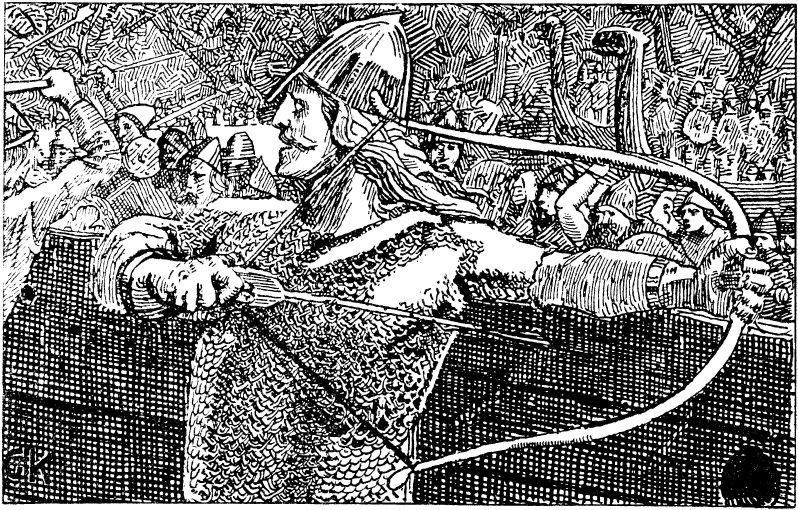
Einar Thambarskelfir, one of the sharpest of bowshooters, stood by the mast, and shot with his bow. Einar shot an arrow at Earl Eirik [...] Then said the earl to a man called Finn, [...] "Shoot that tall man by the mast." Finn shot; and the arrow hit the middle of Einar's bow just at the moment that Einar was drawing it, and the bow was split in two parts. "What is that," cried King Olaf, "that broke with such a noise?" "Norway, king, from your hands," cried Einar. "No! not quite so much as that," says the king; "take my bow, and shoot," flinging the bow to him. Einar took the bow, and drew it over the head of the arrow. "Too weak, too weak," said he, "for the bow of a mighty king!" and, throwing the bow aside, he took sword and shield, and fought Valiantly.Einarr, too strong for the king's bow, survived the battle that Olav Trygvasson did not. In later years he made himself master of Norway by his own hand, and in spite of the designs of kings... but that, though true, is another story.

Rewind any other 20-year chunk of 20th-century time. There’s no chance you would mistake a photograph or movie of Americans or an American city from 1972—giant sideburns, collars, and bell-bottoms, leisure suits and cigarettes, AMC Javelins and Matadors and Gremlins alongside Dodge Demons, Swingers, Plymouth Dusters, and Scamps—with images from 1992. Time-travel back another 20 years, before rock ’n’ roll and the Pill and Vietnam, when both sexes wore hats and cars were big and bulbous with late-moderne fenders and fins—again, unmistakably different, 1952 from 1972. You can keep doing it...The 1980s were the era when the Baby Boomers grew up, reached their late 30s and crossed into their 40s. They stopped wanting anything new about that time, and settled into middle age. The culture locked down with them, because the size of their cohort means that advertising, the movies, all the cultural industries look to them first and last.
Look at people on the street and in malls—jeans and sneakers remain the standard uniform for all ages, as they were in 2002, 1992, and 1982. Look through a current fashion or architecture magazine or listen to 10 random new pop songs; if you didn’t already know they were all things from the 2010s, I guarantee you couldn’t tell me with certainty they weren’t from the 2000s or 1990s or 1980s or even earlier. (The first time I heard a Josh Ritter song a few years ago, I actually thought it was Bob Dylan.)
Rape is not just a bad thing that happens to someone after drinking too much, a wave of nausea that ends in vomit that smells like Red Bull. It's not something the victim conjures up with a mixture of alcohol and phermones. It's a deliberate act on the part of the rapist, a violation of another person committed solely because the rapist wanted to rape. The sooner we acknowledge this, the sooner we'll be rid of stupid, finger wagging ads like these.I'm not a big fan of public service ads like these either. However, if we're going to have them, it is important that they be able to speak the truth.
A better burden can no man bearThat's as true for women as for men. The truth is no insult. I hold it to be true that rapists should be hanged, and that women should not in any way be blamed for having been raped. I also hold it to be true that it is wise to keep an eye on how much you drink, and in what company, and not to drink very much if you are not with people you trust completely. I also hold it to be true that, if your friend happens to get really smashed, you have a duty as a friend to make sure they get home in one piece.
on the way than his mother wit:
and no worse provision can he carry with him
than too deep a draught of ale.
Less good than they say for the sons of men
is the drinking oft of ale:
for the more they drink, the less can they think
and keep a watch o'er their wits.
After a police report in Oslo said that Muslims were raping Norwegian women out of a religious conviction that this was the proper thing to do, a stormy public debate erupted, reports Bello, and “the government ministers, most of them avowed anti-Semites, claimed that the report and its publication serve Israel and its policy of occupation.”
We need to be able to speak the truth in these matters. If we cannot speak the truth, it would be better to say nothing at all.Norway’s justice minister defended the police report but also said that “Israel must be glad to hear about it.”Do you comprehend the breathtaking Orwellianism here? “If we talk about the one thing these rapists have in common, we'll look like Nazis. Therefore, to distance ourselves from the Nazis, we'll find a way to scapegoat the Israelis.”
A hillfort comprising a single oval bank with another rampart 30m further down the slope, was first recorded on the summit in the 18th century. Originally interpreted as the camp of Wallace’s troops, recent investigations revealed the structure was much older, as charcoal recovered from the inner rampart returned a radiocarbon date of AD 560-730.
Stirling Council Archaeology Officer Murray Cook, who in September led a community excavation at the site, said this means the fort could have been one of the main centres of the Gododdin, a Britonnic people who lived in northeast England and southern Scotland. Part of this tribe formed the kingdom of Manaw, which local place names such as Clackmannan and Slamannan suggest could have included the area around Abbey Craig. But this high-status settlement also appears to have come to a dramatic end, destroyed by a fire so intense that its stones fused together.Gododdin was one of the kingdoms of the Old North, now almost forgotten. There was a time when these kingdoms were the frontier of our civilization, but few now even know their names. Its companion, Ystrad Clud, is remembered now only as 'Strathclyde,' which used to have administrative functions within Scotland.
He fed black ravens on the rampart of a fortressThis is often taken to be the earliest surviving reference to the man we know as King Arthur. The reference assumes its audience needs no explanation of why a raven-feeder, a palisade in the front ranks of battle, is not shamed by the comparison.
Though he was no Arthur
Among the powerful ones in battle
In the front rank, Gwawrddur was a palisade.
An Islamic cleric residing in Europe said that women should not be close to bananas or cucumbers, in order to avoid any “sexual thoughts.”
The unnamed sheikh, who was featured in an article on el-Senousa news, was quoted saying that if women wish to eat these food items, a third party, preferably a male related to them such as their a father or husband, should cut the items into small pieces and serve.Apparently we've got it all wrong, boys. All that foolishness about cooking your wife or girlfriend a good meal on date night? Just shooting yourself in the foot.
De Charny also suggested what the knights should do to resist the stress factors. He said knights should fight for a good cause to avoid succumbing to the pressures of war. A ‘good cause’ should be God’s cause – a war for a higher and just cause, to reinstate law and order – and not for personal gain.
“On the one hand we can see that de Charny was a very conscientious man – and in the Middle Ages conscience was regarded as God’s way of telling us how to relate to rights and wrongs.
“On the other hand, he was a warrior who took part in several wars over a period of 30 years, including a crusade to the city we call Ismir. War and crusades are by definition violent,” says Heebøll-Holm.
That fight was essentially over three things that divide us intensely today: the role of the federal government, the nature of the credit system, and the future of the social hierarchy. Alexander Hamilton favored a strong federal government at home and abroad, a centralized credit system similar to the British one with a Bank of the United States acting as our central bank, and believed that the best educated and most widely experienced people in the United States constituted a natural aristocracy and should play the leading role in our politics. Thomas Jefferson disagreed with virtually everything Hamilton believed. He wanted a weak federal government, detested Hamilton’s banking system, and feared that the alliance of a social elite with a powerful government and a strong central bank would turn the US into a European-style aristocratic or monarchical society.I've always thought of myself as a member of the Jeffersonian tradition in this regard. For reasons laid out yesterday, I don't think my side has any hope of recapturing the Presidency at any nearby point. I wouldn't have picked Ron Paul as the guidon-bearer for Jeffersonianism, though; after all, Jefferson was an expansionist, and fought the Barbary States.
Complex human events have no single or final explanation. The last word on the outbreak of looting and rioting that convulsed large parts of England, including London, in August will therefore never be heard. But some of the first words were foolish, or at least shallow, reflecting the typical materialistic assumptions of the intelligentsia.
This administration’s war on traditional American values must stop.....
But there is a troubling trend here beyond the national security nonsense inherent in this silly idea. This is just the most recent example of an administration at war with people of faith in this country. Investing tax dollars promoting a lifestyle many Americas of faith find so deeply objectionable is wrong.
Of course, it bears noting that rarely are cultural and religious traditions and teachings actually in conflict with the protection of human rights. Indeed, our religion and our culture are sources of compassion and inspiration toward our fellow human beings. It was not only those who’ve justified slavery who leaned on religion, it was also those who sought to abolish it. And let us keep in mind that our commitments to protect the freedom of religion and to defend the dignity of LGBT people emanate from a common source. For many of us, religious belief and practice is a vital source of meaning and identity, and fundamental to who we are as people. And likewise, for most of us, the bonds of love and family that we forge are also vital sources of meaning and identity. And caring for others is an expression of what it means to be fully human. It is because the human experience is universal that human rights are universal and cut across all religions and cultures.I generally hate the phrase "fully human" wherever I encounter it -- what is the point of the adjective here? -- and the last line is not quite right. Still, the objection I would raise to it is not that there aren't universal human rights, but that she's eliding past the true reason why they exist.
Because he is black, his opinions about race are controversial. If he were white, they probably would be unpublishable. This is a rare case in which we are all beneficiaries of American racial hypocrisy. That he works in the special bubble of permissiveness extended by the liberal establishment to some conservatives who are black (in exchange for their being regarded as inauthentic, self-loathing, soulless race traitors) must be maddening to Sowell, even more so than it is for other notable black conservatives.But of course, it is demonstrable (for me, and Plotinus) that he is not soulless: for after all, soul is our connection to intellect, and therefore to reason. And Sowell must share the same order of reason as this liberal establishment, else he could not understand the rules of their game. (Indeed, the phrase 'capable of understanding the rules' is almost an analysis of the word 'rational'; and notice that it is the potential to understand, rather than the actuality of understanding, that is at stake.)
It could happen tomorrow. A Soldier might say, “Sir, I want to go to Afghanistan, but I am afraid that by violating the Geneva Conventions, I could be accused of a war crime. I am caught in a bad place. I cannot violate the Geneva Conventions and so there is no need to send me to Afghanistan to fly. I must refuse that unlawful order. If ordered, I will go to Afghanistan but I cannot fly in violation.The answer is, you obey your damn orders.
A Soldier is obligated to obey the law. A Soldier is obligated not to obey unlawful orders.
What would you do?
"[t]he duty to disobey an unlawful order applies only to a positive act that constitutes a crime that is so manifestly beyond the legal power or discretion of the commander as to admit of no rational doubt of their unlawfulness."Pull an Abu Ghraib and the "Nuremberg defense" won't help you. But "Everyman His Own Supreme Court" is not the rule, nor never has it been.
[A]gents, primarily with the Drug Enforcement Administration, have handled shipments of hundreds of thousands of dollars in illegal cash across borders, those officials said, to identify how criminal organizations move their money, where they keep their assets and, most important, who their leaders are.Hundreds of thousands of dollars? That's not so bad....
[T]he former officials said that federal law enforcement agencies had to seek Justice Department approval to launder amounts greater than $10 million in any single operation.
But they said that the cap was treated more as a guideline than a rule, and that it had been waived on many occasions....
So far there are few signs that following the money has disrupted the cartels’ operations, and little evidence that Mexican drug traffickers are feeling any serious financial pain.*Sigh.*

