Einarr Þambarskelfir

It occurs to me that there may be a few of you -- I trust not too many -- who are unmoved by the opening line of Mr. Walker's description of his book.  "Who is Olav Trygvasson," you few may be asking, "and why should I care that he is dead?"

Well, now!  You few have missed a tale.


Once, Olav Trygvasson sailed against the forces of a man, a man who had driven his own wife from his arms.  She had come to Olav, declared herself a free woman, and married him.  He in turn set out to defend her rights.  Yet she was the former wife of a powerful king, Burislav, who held her still to be his own; and she was the sister of the king of the Danemark, who wished to see Norway brought under his own command.

So it was that Olav's fleet came under the combined assault of Danish and Wendish fleets, with Swedish allies.  Olav sailed in the most famous Viking ship to grace the sagas, a mighty warship named Ormen Lange, "The Long Serpent."  He saw the enemy coming, and made ready for battle.

The Viking war-band, as the Anglo-Saxons before them, preferred to fight with a shield-wall.  This meant a band of men at the front of their effort locked shields together, and lashed over them with axe or sword or, most likely, spear.  Ranks of spearmen stood behind them to reinforce the shield-wall, to prevent cavalry from simply jumping it, and to step into the ranks of anyone killed.  The shield-wall formation was powerful as long as the cavalry opposing it did not overwhelm its ability to countermaneuver.  There are few horses on these ships, though, and so that danger is readily faced.

In order to facilitate the shield-wall, the warriors of each side lashed their ships together into long lines.  The business then was to drive into your enemy's line with your wall, and push to the rear, clearing the ship of your enemies by slaying them or driving them into the sea.  Olav Trygvasson was a great warrior and a successful, so that his men fought under the comforting weight of mail -- and this gave them great staying power against their foes.

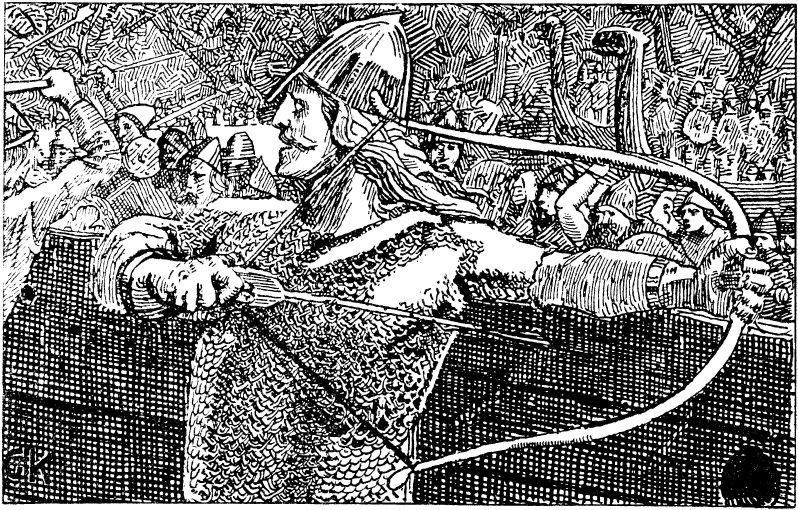
Yet I do not come to praise Olav Trygvasson, but one of his loyal friends.  Einarr Þambarskelfir was a true master of his craft:  in his case, the craft of archery.  When the weight of the foes facing Olav brought the enemy even onto the Long Serpent, Einarr made the difference.  He stood at the rear of the ship, by Olav, and shot with his mighty bow so that no one could withstand him.  That, until:

Einar Thambarskelfir, one of the sharpest of bowshooters, stood by the mast, and shot with his bow. Einar shot an arrow at Earl Eirik [...] Then said the earl to a man called Finn, [...] "Shoot that tall man by the mast." Finn shot; and the arrow hit the middle of Einar's bow just at the moment that Einar was drawing it, and the bow was split in two parts. "What is that," cried King Olaf, "that broke with such a noise?" "Norway, king, from your hands," cried Einar. "No! not quite so much as that," says the king; "take my bow, and shoot," flinging the bow to him. Einar took the bow, and drew it over the head of the arrow. "Too weak, too weak," said he, "for the bow of a mighty king!" and, throwing the bow aside, he took sword and shield, and fought Valiantly.
Einarr, too strong for the king's bow, survived the battle that Olav Trygvasson did not.  In later years he made himself master of Norway by his own hand, and in spite of the designs of kings... but that, though true, is another story.

The Christmas Gift Thread

It's getting to the point at which we are thinking about provisioning gifts to commemorate the holidays, and show respect, friendship, or love.

In addition to showing respect or friendship to those to whom we give the gifts, though, we can do so also to those whose creations we choose as gifts.  I'd like to make some recommendations, and then throw the discussion open for your suggestions.  The idea should be that we highlight as potential gifts things made by our friends, and/or those we respect and wish to encourage in their arts.

Books:

West Oversea, by Lars Walker. "King Olaf Trygvesson is dead, but his sister’s husband, Erling Skjalgsson, carries on his dream of a Christian Norway that preserves its traditional freedoms. Rather than do a dishonorable deed, Erling relinquishes his power and lands. He and his household board ships and sail west..."


Tale of the Tigers, by Julianne Ochieng.  "What is the Tale of the Tigers?  At a southwestern university, a young man and a young woman do something that’s done every day: they fall in love. There’s just one thing–he’s white and she’s black. Set in the early 1990s, Tale of the Tigers tells the story of how the tables have turned on race relations and sexual jealousy and of how two young Americans weather the storm of that heritage in the post-Civil Rights Era."

Music:

I met and was very impressed by the harpist Sarah Marie Mullen.  I'd like to recommend her music, especially for those interested in the Celtic harp; but she is classically trained and, particularly in Harper's Bizarre, extends to French, Andalusian, and some eastern European forms.

Weapons of War:

I would appreciate suggestions from you in this area.  Of the three best weaponsmiths I knew, one died last year; another gave up his work due to arthritis; the third went out of business due to the economy.  I know no craftsman whose work in steel suits me, although there are some reasonably good production companies now.

Tradition?

Today's xkcd:


It happens this is also the answer to the problem posed in this article on the stagnation of culture:
Rewind any other 20-year chunk of 20th-century time. There’s no chance you would mistake a photograph or movie of Americans or an American city from 1972—giant sideburns, collars, and bell-bottoms, leisure suits and cigarettes, AMC Javelins and Matadors and Gremlins alongside Dodge Demons, Swingers, Plymouth Dusters, and Scamps—with images from 1992. Time-travel back another 20 years, before rock ’n’ roll and the Pill and Vietnam, when both sexes wore hats and cars were big and bulbous with late-moderne fenders and fins—again, unmistakably different, 1952 from 1972. You can keep doing it...

Look at people on the street and in malls—jeans and sneakers remain the standard uniform for all ages, as they were in 2002, 1992, and 1982. Look through a current fashion or architecture magazine or listen to 10 random new pop songs; if you didn’t already know they were all things from the 2010s, I guarantee you couldn’t tell me with certainty they weren’t from the 2000s or 1990s or 1980s or even earlier. (The first time I heard a Josh Ritter song a few years ago, I actually thought it was Bob Dylan.)
The 1980s were the era when the Baby Boomers grew up, reached their late 30s and crossed into their 40s.   They stopped wanting anything new about that time, and settled into middle age.  The culture locked down with them, because the size of their cohort means that advertising, the movies, all the cultural industries look to them first and last.

If you were born in the 1980s, then, the world you know has never changed in any serious way.  The political parties have always occupied the same basic positions:  Reagan was the last sea change.  You don't remember JFK, so Democrats have always been anti-war.

If this demographic trend is as suggestive as it seems to be, American culture will not change much for another twenty years or so.  There are a lot of interesting things going on, but they're going on in corners:  they'll not have a chance to influence the big show.

Let's Have Some Oratorio -

It's the season of Handel, the missus and I are going to see one of his operas this weekend, it's also close to Hannukah, and I don't need an excuse anyway. An old favorite of mine:

Let's Have a Song

A good song of Scotland:


From the Baltimore Consort, an amazing group that I have somehow never managed to arrange to see live.  They're one of the best early music groups performing today.  Those of you in the D.C. area should take advantage of your proximity, and arrange to hear them play.

One for Lars

From Medievalists.net:  "Archaeologists uncover early Christian community in Norway."

Against Rape

The Pennsylvania liquor board has pulled an anti-rape ad that it developed, over charges that the ad consists in blaming the victim.  Here's the text of the ad:

"SHE DIDN'T WANT TO DO IT, BUT SHE COULDN'T SAY NO:  When your friends drink, they can end up making bad decisions like going home with someone they don't know very well.  Decisions like that leave them vulnerable to dangers like date rape.  Help your friends stay in control and stay safe."

The website Jezebel objects:
Rape is not just a bad thing that happens to someone after drinking too much, a wave of nausea that ends in vomit that smells like Red Bull. It's not something the victim conjures up with a mixture of alcohol and phermones. It's a deliberate act on the part of the rapist, a violation of another person committed solely because the rapist wanted to rape. The sooner we acknowledge this, the sooner we'll be rid of stupid, finger wagging ads like these.
I'm not a big fan of public service ads like these either.  However, if we're going to have them, it is important that they be able to speak the truth.

As our co-blogger Joseph W. points out, from his perspective as a JAG lawyer, the ties between alcohol and rape are undeniable.  If we're going to flood the airwaves with warnings about not letting your friends drink and drive, why not ads that warn that you should probably not let your friends go home drunk with strangers?

To say that is not in any way to justify rape.  We can still place the full weight of the crime upon the shoulders of the rapist.  There is no suggestion that the woman deserves to be raped.  All that is being said is that she is vulnerable to being raped in this condition, and therefore you who are her friends ought to watch out for her.

I understand the objection to similar statements about wearing short skirts, but this ad is crucially different.  If you say "Don't wear a short skirt if you don't want to be raped," you do seem to be setting up a limit on women's behavior and free expression as a kind of price for safety.  This ad does not do that, however:  it doesn't suggest that women shouldn't drink.  It does suggest that they be responsible about it, but that's good advice for a whole host of reasons.  Yet even that is not a limit on women's behavior:  what the ad ends up advising is that if your friend decides to get really drunk, you should help her watch out for her safety.

This provokes another quote from the Havamal, a poem that is coming up surprisingly often when discussing feminist issues:
A better burden can no man bear
on the way than his mother wit:
and no worse provision can he carry with him
than too deep a draught of ale.

Less good than they say for the sons of men
is the drinking oft of ale:
for the more they drink, the less can they think
and keep a watch o'er their wits.
That's as true for women as for men.  The truth is no insult.  I hold it to be true that rapists should be hanged, and that women should not in any way be blamed for having been raped.  I also hold it to be true that it is wise to keep an eye on how much you drink, and in what company, and not to drink very much if you are not with people you trust completely.  I also hold it to be true that, if your friend happens to get really smashed, you have a duty as a friend to make sure they get home in one piece.

Why is it so difficult to speak these simple truths when it comes to rape, as opposed to avoiding the danger of being beaten and robbed in an alley?  Via Lars Walker, a report from Norway:


Lars notes the response of Norway's justice minister to the report:
After a police report in Oslo said that Muslims were raping Norwegian women out of a religious conviction that this was the proper thing to do,  a stormy public debate erupted, reports Bello, and “the government ministers, most of them avowed anti-Semites, claimed that the report and its publication serve Israel and its policy of occupation.” 
Norway’s justice minister defended the police report but also said that “Israel must be glad to hear about it.”
Do you comprehend the breathtaking Orwellianism here? “If we talk about the one thing these rapists have in common, we'll look like Nazis. Therefore, to distance ourselves from the Nazis, we'll find a way to scapegoat the Israelis.” 
We need to be able to speak the truth in these matters.  If we cannot speak the truth, it would be better to say nothing at all.

Even if you prefer to say nothing, however, your duty to your friends remains.  This is what friendship means:  it means we take care of each other.

Michele Bachmann's Path to Victory

So I got this video via email from the campaign.


It's certainly true that she doesn't waver.  I can't argue against that proposition:  it's why I stopped supporting her.  She doesn't waver even when she's wrong.

Still, consider the argument.  She is who she says she is, at least; and she's no cronyist, and no elite.  I doubt she wins Iowa, but if she does consolidate a strong position early in spite of polling data and what we might expect?  We could do worse, I suppose, in spite of everything.

Y Gododdin

Before the battle of Stirling Bridge, William Wallace watched from hiding on a hilltop as the English force began to cross the river below.  That hilltop had been the site of an ancient fort:
A hillfort comprising a single oval bank with another rampart 30m further down the slope, was first recorded on the summit in the 18th century. Originally interpreted as the camp of Wallace’s troops, recent investigations revealed the structure was much older, as charcoal recovered from the inner rampart returned a radiocarbon date of AD 560-730. 
Stirling Council Archaeology Officer Murray Cook, who in September led a community excavation at the site, said this means the fort could have been one of the main centres of the Gododdin, a Britonnic people who lived in northeast England and southern Scotland. Part of this tribe formed the kingdom of Manaw, which local place names such as Clackmannan and Slamannan suggest could have included the area around Abbey Craig. But this high-status settlement also appears to have come to a dramatic end, destroyed by a fire so intense that its stones fused together.
Gododdin was one of the kingdoms of the Old North, now almost forgotten.  There was a time when these kingdoms were the frontier of our civilization, but few now even know their names.  Its companion, Ystrad Clud, is remembered now only as 'Strathclyde,' which used to have administrative functions within Scotland.

As for Gododdin, it is chiefly remembered for a single verse from its surviving poetry:
He fed black ravens on the rampart of a fortress
Though he was no Arthur
Among the powerful ones in battle
In the front rank, Gwawrddur was a palisade.
This is often taken to be the earliest surviving reference to the man we know as King Arthur.  The reference  assumes its audience needs no explanation of why a raven-feeder, a palisade in the front ranks of battle, is not shamed by the comparison.

Bourbon in Your Eyes

Following on T99's post of lounge-singing in Morocco, here's a young lady doing it the American way.

Islamic Cleric Rules Men Should Do the Cooking

An Islamic cleric residing in Europe said that women should not be close to bananas or cucumbers, in order to avoid any “sexual thoughts.”
The unnamed sheikh, who was featured in an article on el-Senousa news, was quoted saying that if women wish to eat these food items, a third party, preferably a male related to them such as their a father or husband, should cut the items into small pieces and serve.
Apparently we've got it all wrong, boys.  All that foolishness about cooking your wife or girlfriend a good meal on date night?  Just shooting yourself in the foot.

Medieval "PTSD"?

Or, a journalist discovers Geoffroi de Charny.

De Charny also suggested what the knights should do to resist the stress factors. He said knights should fight for a good cause to avoid succumbing to the pressures of war. A ‘good cause’ should be God’s cause – a war for a higher and just cause, to reinstate law and order – and not for personal gain. 
“On the one hand we can see that de Charny was a very conscientious man – and in the Middle Ages conscience was regarded as God’s way of telling us how to relate to rights and wrongs.
“On the other hand, he was a warrior who took part in several wars over a period of 30 years, including a crusade to the city we call Ismir. War and crusades are by definition violent,” says Heebøll-Holm.

Oh, yes, by definition. But: "on the one hand / on the other hand"? What exactly is the conflict between being conscientious and being a warrior?

Hamiltonians versus Jeffersonians

This is a banner day for interesting articles.  Dr. Mead has one in which he points out that both President Obama and Mr. Gingrich have declared themselves to be in the tradition of Theodore Roosevelt, and that Roosevelt himself would have told you he was in the tradition of Hamilton.  The Jeffersonians, though one is in the race, aren't really in the hunt:
That fight was essentially over three things that divide us intensely today: the role of the federal government, the nature of the credit system, and the future of the social hierarchy. Alexander Hamilton favored a strong federal government at home and abroad, a centralized credit system similar to the British one with a Bank of the United States acting as our central bank, and believed that the best educated and most widely experienced people in the United States constituted a natural aristocracy and should play the leading role in our politics. Thomas Jefferson disagreed with virtually everything Hamilton believed. He wanted a weak federal government, detested Hamilton’s banking system, and feared that the alliance of a social elite with a powerful government and a strong central bank would turn the US into a European-style aristocratic or monarchical society.
I've always thought of myself as a member of the Jeffersonian tradition in this regard.  For reasons laid out yesterday, I don't think my side has any hope of recapturing the Presidency at any nearby point.  I wouldn't have picked Ron Paul as the guidon-bearer for Jeffersonianism, though; after all, Jefferson was an expansionist, and fought the Barbary States.

Happy Pearl Harbor Day!

Why not celebrate by refusing to send a care package to deployed soldiers?

Barbarians on the Thames

That is the title of Theodore Dalrymple's latest piece, which he describes as a postmortem on the British riots. He begins by denying the existence of final causes in history, which we were just discussing the other day:
Complex human events have no single or final explanation. The last word on the outbreak of looting and rioting that convulsed large parts of England, including London, in August will therefore never be heard. But some of the first words were foolish, or at least shallow, reflecting the typical materialistic assumptions of the intelligentsia.
As usual, he goes on to make some very good points.

What Does the Administration Mean By "Human Rights"?

I read an interesting headline at ABC News this morning: "Rick Perry Says Human Rights for Gays ‘Not in America’s Interests’."

Of course, I'm thinking, that can't be what he said.  The man's had some trouble expressing himself clearly at times, but even so I couldn't imagine that anyone would say "human rights for gays are not in America's interests."  

And of course, it turns out, that's not what he said at all.  What he said was that special rights for gays were not in America's national security interests -- and that foreign aid decisions, which is what all this is about, should be based on national security interests and nothing else.

Secretary Clinton recently gave a speech in which she announced the policy change in which gay rights will be considered in making foreign aid decisions.  However, she appears to deny the governor's premise that what is at issue are special rights, saying, "Gay rights are human rights, and human rights are gay rights."

There's nothing in her speech that suggests she is interested in "special" rights, and I'm not sure just what Governor Perry means by that.  If he means that gays should not have a special right to redefine the basic institutions of society to suit them, I suppose I agree with him; but if he's opposed to the things Secretary Clinton was actually talking about, I don't think those include special rights at all.  

Still, let's consider his statement a little more carefully. Here's the meat of his remarks:
This administration’s war on traditional American values must stop..... 
But there is a troubling trend here beyond the national security nonsense inherent in this silly idea. This is just the most recent example of an administration at war with people of faith in this country. Investing tax dollars promoting a lifestyle many Americas of faith find so deeply objectionable is wrong.
Now, it is true that "people of faith" tend to be morally opposed to male homosexuality, not just in this country but in most countries.  This is especially true in the countries Secretary Clinton is talking about when she says that being gay should never be a criminal offense -- that is generally true only in the Islamic world.  

Secretary Clinton spoke to this issue directly, however, in a way that seems to make clear that the governor's concerns are not well founded.
Of course, it bears noting that rarely are cultural and religious traditions and teachings actually in conflict with the protection of human rights. Indeed, our religion and our culture are sources of compassion and inspiration toward our fellow human beings. It was not only those who’ve justified slavery who leaned on religion, it was also those who sought to abolish it. And let us keep in mind that our commitments to protect the freedom of religion and to defend the dignity of LGBT people emanate from a common source. For many of us, religious belief and practice is a vital source of meaning and identity, and fundamental to who we are as people. And likewise, for most of us, the bonds of love and family that we forge are also vital sources of meaning and identity. And caring for others is an expression of what it means to be fully human. It is because the human experience is universal that human rights are universal and cut across all religions and cultures.
I generally hate the phrase "fully human" wherever I encounter it -- what is the point of the adjective here? -- and the last line is not quite right.  Still, the objection I would raise to it is not that there aren't universal human rights, but that she's eliding past the true reason why they exist.

It happens to be true that Secretary Clinton is poking a finger in the eye of some people of faith, then:  Iranian ones, though, not American ones.  This is still a strange decision from an administration that declared it was going to rebuild relationships with the Islamic world, but I expect it's because they really believe in it enough to justify the hardship it's going to create for their diplomatic efforts.

That this comes at the same time that the US government is shutting down its commission on religious freedom is bad timing, but it's not the State Department's fault.  The Senate is responsible for this because of  the question of funding.

Now, Governor Perry may still be right that (a) foreign aid decisions should be based only on national security issues, and (b) this push is not only not going to help us in that regard, it's actually going to be harmful because it will further irritate relations with the Islamic world.  I'm not sure I agree with (a), but if you do, (b) surely follows.  

Soul and Sowell:

Commentary writes:
Because he is black, his opinions about race are controversial. If he were white, they probably would be unpublishable. This is a rare case in which we are all beneficiaries of American racial hypocrisy. That he works in the special bubble of permissiveness extended by the liberal establishment to some conservatives who are black (in exchange for their being regarded as inauthentic, self-loathing, soulless race traitors) must be maddening to Sowell, even more so than it is for other notable black conservatives.
But of course, it is demonstrable (for me, and Plotinus) that he is not soulless:  for after all, soul is our connection to intellect, and therefore to reason.  And Sowell must share the same order of reason as this liberal establishment, else he could not understand the rules of their game.  (Indeed, the phrase 'capable of understanding the rules' is almost an analysis of the word 'rational'; and notice that it is the potential to understand, rather than the actuality of understanding, that is at stake.)

The unity of the order of reason is one of the few things that survives the most severe skeptical assaults.  You can speak of Evil Demons; but an evil demon must share the same order of reason as you in order to fool you.  You can question whether you are a Brain in a Vat; but the mad scientist keeping you there must share the order of reason with you in order to be able to fool you.

If you have that, you have everything we really wanted out of metaphysics.  Including, as it happens, a soul for Thomas Sowell.

Now, Let's Not Go Overboard

Politico says that "Nervous Mitt fans" are urging their candidate to "hit Newt harder."  One of the strengths of the Gingrich campaign, though, has been its general refusal to hit fellow Republicans, but to concentrate fire on the Obama administration.  The Romney campaign has likewise been wise in this regard, with the effect that whichever candidate wins, they will not have been damaged by a bruising primary.

Indeed, the many debates have allowed the candidates to sort according to something like merit.  I'm not fond of any of the remaining options, to be sure; but the decisions people have made about the qualifications of the candidates are based on their capacity to answer questions, express their thoughts, and the positions these candidates have taken.  It has been a fairly responsible, positive campaign.

That I am unhappy with the choices is reflective of the fact that no one who shares my views is involved with politics at the level that could sustain a Presidential run -- a sad but unsurprising fact, since in general our political system puts all its incentives toward the kind of cronyist, rent-seeking, power-abusing, lying, thieving behavior that indeed we do observe.  It's not clear that someone who agrees with me could get elected to a high enough office to be taken seriously as a Presidential candidate; it's certainly true that they couldn't build the kind of support within the political system that would allow them to be elected President and govern successfully.  Everything they stand for would be about undercutting the political powerbases of those whose support they would be seeking:  of course they cannot win.

Our system will never produce a President I can wholly approve, then.  I do hope that we may be able to pick off a few victories at the edges, here and there.  When the crisis this mode of government produces finally arrives, we might then be able to use the leverage to sever the concentration of Federal power, and restore the Federalism and local independence that would allow for a more just system to exist.

Those objections aside, I am pleased by the relatively good behavior of our debaters.  Perhaps it is inevitable that the primary will get rougher and more bruising as we come down to the part where people begin to vote.  However, before we pull the pin on that grenade, I'd like to remind Team Mitt of just how bad things could get:


What say we just continue to be gentlemen about this, then?

Court-Martial as Spectacle

According to This Ain't Hell, Michael Yon's given what looks like, but in fact is not, an interesting dilemma:
It could happen tomorrow. A Soldier might say, “Sir, I want to go to Afghanistan, but I am afraid that by violating the Geneva Conventions, I could be accused of a war crime. I am caught in a bad place. I cannot violate the Geneva Conventions and so there is no need to send me to Afghanistan to fly. I must refuse that unlawful order. If ordered, I will go to Afghanistan but I cannot fly in violation.

A Soldier is obligated to obey the law. A Soldier is obligated not to obey unlawful orders.

What would you do?
The answer is, you obey your damn orders.

Every now and again, in court-martial practice, you run into someone with this new and brilliant idea. They or their families are antiwar activists; they'll disobey orders to deploy, proclaiming the war to be "illegal" according to their own understanding of international law; and in their fantasies they'll force their court-martial to decide the legality of the war. Even if they lose, so they dream, they'll be able to bring in a parade of experts to explain, in open court, why the war is evil - and do wonders for the cause.

It won't happen. A certain Dr. Yolanada Huet-Vaughn - a reservist and antiwar activist (who rather candidly admitted that she'd joined the reserves to lend credibility to her antiwar activities) - tried that very thing in the 1990's. The military appellate courts upheld her conviction, and here is the money quote:
"[t]he duty to disobey an unlawful order applies only to a positive act that constitutes a crime that is so manifestly beyond the legal power or discretion of the commander as to admit of no rational doubt of their unlawfulness."
Pull an Abu Ghraib and the "Nuremberg defense" won't help you. But "Everyman His Own Supreme Court" is not the rule, nor never has it been.

To my knowledge, the closest thing to a successful "court-martial as spectacle" was the 1925 trial of Billy Mitchell, which you can read about there. Then-COL Mitchell (his general's rank had been temporary) loved to make public pronouncements about the stupidity and incompetence of the Army, especially with respect to aviation. He was tried under the prior version of the General Article by a court composed of generals (as was natural; the members had to outrank him).

In reading about the trial, it didn't surprise me that Mitchell tried to justify his actions by claiming his statements were true. It did very much surprise me that the court let him do it. I'm used to trials where the defense researches issues and obtains documents months and weeks before trial. In his case, the court allowed his defense team to acquire reams of War Department documents right in the middle of trial, and the two sides fought it out improvised, like rats in a hole.

Mitchell achieved the public spectacle he wanted, but not the success. His factual claims fell apart as the evidence came in, and he was convicted pretty quickly. His sentence - a suspension from duty - was nugatory, but it led him to resign. And yet that is the most successful "court martial as spectacle" (from the defense point of view) that I know. (Does someone know another? I'm not counting war crimes tribunals - I understand that Tojo gained a measure of respect in Japan for his brave performance at his own trial.) Nowadays, I suspect, Mitchell would not receive so much accomodation - no more than I could defend against a violation of this article by claiming the contemptuous words were true.

"Heroic disobedience" is an issue we talked about long ago - and I believe it is a hallmark of liberty under the rule of law, that disobeying the law is not heroic. (What I mean is, if you find situations where violating the law is a noble and heroic act, that is a sign of tyranny.) Thus, on the civilian side in our system, you don't have to violate a law in order to challenge its constitutionality in court - you sue the official who enforces it, asking the court for an injunction or a "declaration" that the law is unconstitutional. If you win, it'll still be on the books, but not enforced. There is no need to violate it, or go to prison, in order to fight that good fight.

How I Got to Go to a Birthday Party While Heavily Sedated

Wistful childhood memories.

Frivolous Science

This may be old hat to those of you with rugrats in the house. You can make a non-Newtonian fluid with a starch suspension, such as a mixture of a little less than 2 parts cornstarch to one part water, a/k/a "oobleck" from the Dr. Seuss story. (If you can add a little fluorescent food coloring to it, so much the better in the oogliness department.) It becomes more viscous when subjected to pressure, which means, among other things, that you'll sink in it like quicksand unless you run over it quickly:


Put it on top of a speaker, and it will form writhing tendrils.


Useful information gleaned from comments sections: if your little brother puts it in your hair, just add some vegetable oil, and it will slither right off.

Wandering in random YouTube-association land, I found a new use for liquid nitrogen. When I was a kid hanging out with my dad at work, he used to get me out of his hair by giving me some to play with. He produced amusing effects by gargling it (just don't swallow). I wish I'd realized back then what it looked like when you poured it on top of water:


I think the kid was risking asphyxiation when he swam into the thick cloud.

For extra science fun, type in "Is it a good idea to microwave . . . " on YouTube.

More Things We Wish the Government Would Please Not Do

You might think that T99's post, in which we learned about the Fed 'servicing' the needs of the banks, represents the low point of today's news about the functioning of our government. Perhaps it does; but there is, at least, some competition for the honor.
[A]gents, primarily with the Drug Enforcement Administration, have handled shipments of hundreds of thousands of dollars in illegal cash across borders, those officials said, to identify how criminal organizations move their money, where they keep their assets and, most important, who their leaders are.
Hundreds of thousands of dollars?  That's not so bad....
[T]he former officials said that federal law enforcement agencies had to seek Justice Department approval to launder amounts greater than $10 million in any single operation. 
Wait, what?  You said "hundreds of thousands."  What happened to "hundreds of thousands"?  How'd we get to $10 million?
But they said that the cap was treated more as a guideline than a rule, and that it had been waived on many occasions....
So, on many occasions, they waived the rule limiting drug money laundering to not more than $10 million?

Well, at least if they're tracking that kind of money, it must be a highly effective operation.
So far there are few signs that following the money has disrupted the cartels’ operations, and little evidence that Mexican drug traffickers are feeling any serious financial pain.
*Sigh.*

We Must Have Missed a Decimal Point

So you thought it was a lot when TARP cost us $700 billion, right? Bloomberg News has pried information out the Fed via Freedom of Information Act requests, revealing that Fed Chairman Ben Bernanke actually pumped as much as $7.77 trillion into the banking system. When these guys say they're going to prevent another Lehman on their watch "at any cost," they're not kidding: that's more than half the gross national product.

J.P. Morgan tapped the Fed's Term Auction Facility for more than half the bank's cash holdings. "The six biggest U.S. banks, which received $160 billion of TARP funds, borrowed as much as $460 billion from the Fed.

Ouija Science


Maggie's Farm sent me to a list of "Eight Warning Signs for Junk Science," including:
  1. Science by press release.
  2. Rhetoric that mixes science with the tropes of eschatological panic (“a terrible catastrophe looms over us if theory X is true, therefore we cannot risk disbelieving it”).
  3. Rhetoric that mixes science with the tropes of moral panic (“only bad/sinful/uncaring people disbelieve theory X”).
  4. Consignment of failed predictions to the memory hole (also known as "moving the goal posts").
  5. Computer models replete with bugger factors that aren’t causally justified (if you don’t have a generative account that makes falsifiable predictions, you’re not doing science, you’re doing numerology.
  6. Convenience (if a ‘scientific’ theory seems tailor-made for the needs of politicians or advocacy organizations, it probably has been).
  7. Bad reps (past purveyers of junk science do not change their spots).
  8. Refusal to make primary data sets available for inspection.
The comments section delivered several valuable similar links: Seven Warning Signs of Quack Science, Six Symptoms of Pathological Science (includes "criticisms are met by ad hoc excuses made up on the spur of the moment"), and Ten Signs a Claimed Mathematical Breakthrough Is Wrong. I didn't understand most of that last one, but I enjoyed the author's conclusion that these are only warning signs, not disproofs. Even if a paper fails most or all of these tests, he cautions,"there might be nothing left to do except to roll up your sleeves, brew some coffee, and tell your graduate student to read the paper and report back to you."

One of the comments quoted this observation by my hero, Richard Feynman (in "Cargo Cult Science"): "When you have put a lot of ideas together to make an elaborate theory, you want to make sure, when explaining what it fits, that those things it fits are not just the things that gave you the idea for the theory; but that the finished theory makes something else come out right, in addition." His advice on the occasion of the Challenger disaster is apropos as well: "For a successful technology, reality must take precedence over public relations, for nature cannot be fooled."

Against the Counter-Thesis

Dad29 linked to a post on a longstanding historical debate on whether Islam, or internal dissolution, destroyed Western Roman civilization.  

With respect to the fact that the "counter-thesis" has been defended by some good historians over many years, I think we can say with some confidence that the counter-thesis is not correct.  Roman civilization in Britain, for example, was destroyed by pagan Angles, Saxons, Jutes and Danes.  By the time of Charlemagne, they had been re-Christianized chiefly by Gaelic monks who came from Ireland to what is now Scotland, and from Scotland south into the Germanic lands.

These Gaelic monks were never part of Roman civilization:  although the Romans appeared poised to invade Ireland from Chester, where they built a fortress for a legion ("Deva Victrix"), they did not follow through; and of course what is now Scotland was at the time mostly held by another civilization, the now-extinct Picts, who were beyond Hadrian's wall.  The Gaels (called "Scotti" by the Romans) had only begun to establish some footholds in what is now Scotland; even Dal Riada was not established until after 500 AD.

The collapse of Roman civilization in Britain happened before Mohammed was born; by the time he was alive, in fact, it was all over.

Islam may have been responsible for a similar destruction in Spain especially.  If the Saxons did it elsewhere, though, there should be a unifying cause that permitted both effects.  That will be found (I think) in the period of the barracks emperors; the consequent gutting of the native Roman military, and the civic culture that had produced it; and the rise of Germanic mercenary forces to supplant native-Roman ones, out of which grew Charlemagne's war band (and the Anglo-Saxon ruling system as well).

To put this in Aristotelian terms, Islam can only claim to be the efficient cause of the destruction of part of the Western Roman world.  The formal cause was the internal dissolution, which is universal to the areas affected by the various invasions.  

The final cause?  If we still believe in final causes in history, it would have to be something like the divine plan:  a will that there should be a Charlemagne, or a King Arthur.  Most Western thinkers today, however, don't believe in final causes in history anymore:  the idea has been discredited by Marxism (which argued for the inevitable collapse of capitalism from something like a 'final cause in the arc of history').

A Loving Portrait of Queen Victoria

The Telegraph insists on reading this in the base terms to which the age has become accustomed, but this is really a nice bit of portraiture.  Look at how the painter managed to capture the liquidity of the eyes, for example:  also the use of light, which shines on the eyes and nose at the correct angles to have come from a single source.

Photography spoils us:  anyone can get those details right with a digital camera and a little practice.  To have done it with oils on canvas is the mark of a craftsman.

Sex and Strategy

I don't feel we've spent enough time this week waging the war between men and women. The fertile comments section over at Megan McArdle's place sent me to a 2007 talk by Roy Baumeister engaging in the ever-popular game of using evolutionary biology to explain why men are from Mars and women from Venus. ("But that's no reason why they cain't be friends.") One of his more widely publicized explanations derived from 2004 research suggesting that our ancestral breeding population included twice as many women as men. In other words, women were twice as likely to have surviving progeny as men, so the reproductive competition was a game with much greater risks and rewards for men, who tended either to produce a lot more children than average or to suffer the extinction of their bloodline.

Baumeister concludes that this gender difference produced men who were willing to bet it all on risky ventures like discovering the New World, while women were content to stick with the status quo. He produces evidence that, although men and women may vary only slightly in their average capabilities in many areas, the bell curve is flatter for men, so the "tails" on both the negative and positive ends are greater for men. More geniuses, but more morons; more world leaders, but more homeless or incarcerated men. He believes this pattern can be explained by the effect of natural selection on the higher riskiness of male reproduction.

Myself, I wonder if you couldn't as easily argue that men, exposed to the risk of not reproducing at all, would be fiercely conservative and protective of their few opportunities, while women, virtually assured of reproducing no matter what, would be willing to throw caution to the wind and experiment. That's the problem with a lot of evolutionary biology, isn't it? It's fun to spot the patterns and try to reduce correlation to causation, but without a genetic mechanism it's hard to find a definitive answer. For instance, it's one thing to say that natural selection operated differently on men and women, and another to say that men ended up with the genes that worked well for men, while women ended up with the genes that worked well for women. In reality, of course, men pass their genes down to children of both sex, as do women. Unless you can tie a male trait to the Y-chromosome, or a female trait to the absence of the Y-chromosome, it's not easy to make a case for a genetic differentiation in the present generation on the ground of gender-based natural selection in past generations.

Baumeister's arguments may work a little better when he ties the unequal ratio of reproductive success to cultural norms rather than to supposedly innate heritable differences between men and women. He suggests that many cultural conventions make sense if you assume that only a few men can be expected to reproduce successfully, while most women can. This assumption leads a society to assume simultaneously that men should be the cannon fodder and that men should end up on top of the heap when it comes to wealth and power. As he points out, if half the men are killed and you're left with only the most successful half, you can rebuild your population fairly quickly. If half the women are killed off, you're in for a slow and dicey recovery.

At all events, I found Baumeister's talk highly entertaining, particularly when he analyzes the different areas where the sexes excel:
Research by Major and others back in the 1970s used procedures like this. A group of subjects would perform a task, and the experimenter would then say that the group had earned a certain amount of money, and it was up to one member to divide it up however he or she wanted. The person could keep all the money, but that wasn’t usually what happened. Women would divide the money equally, with an equal share for everybody. Men, in contrast, would divide it unequally, giving the biggest share of reward to whoever had done the most work.

Which is better? Neither. Both equality and equity are valid versions of fairness. But they show the different social sphere orientation. Equality is better for close relationships, when people take care of each other and reciprocate things and divide resources and opportunities equally. In contrast, equity — giving bigger rewards for bigger contributions — is more effective in large groups. I haven’t actually checked, but I’m willing to bet that if you surveyed the Fortune 500 large and successful corporations in America, you wouldn’t find a single one out of 500 that pays every employee the same salary. The more valuable workers who contribute more generally get paid more. It simply is a more effective system in large groups. The male pattern is suited for the large groups, the female pattern is best suited to intimate pairs.

Ditto for the communal-exchange difference. Women have more communal orientation, men more exchange. In psychology we tend to think of communal as a more advanced form of relationship than exchange. For example, we’d be suspicious of a couple who after ten years of marriage are still saying, “I paid the electric bill last month, now it’s your turn.” But the supposed superiority of communal relationships applies mainly to intimate relationships. At the level of large social systems, it’s the other way around. Communal (including communist) countries remain primitive and poor, whereas the rich, advanced nations have gotten where they are by means of economic exchange.
It rings true for me, anyway. I've always said I practice socialism under my own roof, and to a lesser degree within my small intimate circle, but I firmly believe competition works best for the country at large. And while I may not be an entirely conventional female in some ways, there's no doubt of my strong preference for small-scale social interaction. So the male-dominated institutional pattern of large, relative anonymous groups doesn't suit me, which is why I enjoyed practicing law in a big firm as long as I could toil away at difficult problems in small groups of like-minded professionals whom I trusted, but I hated networking and rainmaking and was perfectly awful at it.


Good Eyes


Reminds me of the shooting competition in Winchester '73.  The one where they're shooting dollars thrown into the air?  Then they start shooting postage stamps placed over the center of a ring, so they're passing the bullet through the ring itself.

With enough practice, I suppose anything is possible -- if your eyes are good enough.

Weatherproof agriculture

We must be thinking about this more lately because the rainfall here is so erratic, and because we lost so many plants this week to a completely unforecast freeze after nursing them through the drought all summer and finally getting some production off of them in recent weeks. I'm lost in admiration of the new book my husband received in the mail today, with detailed plans for a combination greenhouse and aquaponics system. There is a tall cylinder in the middle to hold a catfish tank, surrounded by a circular path, and lower aquaponics tanks on the perimeter. You feed the fish, and they feed the plants. This version is made from a kit meant for the top of a silo. The authors suggest that an alternative version would include a hottub surrounded by flowers.

Pressing Reform

Never let it be said that Congress isn't capable of coming together to tackle the important problems.  First horse slaughter, and now....
On Nov. 15, the Senate Armed Services Committee unanimously approved S. 1867, the National Defense Authorization Act, which includes a provision to repeal Article 125 of the Uniform Code of Military Justice (UCMJ).  Article 125 of the UCMJ makes it illegal to engage in both sodomy with humans and sex with animals.
This still has to get by the conference committee, because for some reason the House didn't think of this obvious improvement to good order and discipline.  Don't worry, though:  there's still time to get it done for the holidays.

I think every unit that worked closely with the Iraqi forces has stories to tell about the tender love between man and beast.  Perhaps this is all in the interest of cultural exchange?  Hearts and minds, I suppose.

Autumn Fire


Not chestnuts, but almonds roast on a steel plate this evening, each with a touch of chocolate.  


The hero of the hour on his favorite rug.

On Horse Flesh

I noticed with some pleasure that Congress has re-approved the slaughter of horses for meat today.

It's a terrible shame to see a horse put down for any cause.  Human beings and horses get along very well, and in an ideal world more men and women would have the chance to have a relationship with a horse.  Nevertheless, we are where we are, and the well-meaning attempt to ban the slaughter of horses has led to reliably worse results.

Horses who could no longer be slaughtered were instead left to starve.  Instead of a quick and painless death, they were rendered economically worthless.  The intention was, I suppose, that people should simply care for the animals until they died of old age; but rather predictably, what they did instead was refuse to lay out money for feed or hay for animals who could not promise any sort of economic return.  Trapped on dry lots, with neither food nor water, they were left to perish in the most brutal conditions.

If they can be sold for meat, they'll be sold by weight.  That means they'll eat, at least, until the end.  This may seem unkind but it is far better.  Good on Congress for getting one right, and for learning from its mistakes.  Let's hope it points to a trend.

Today's Great Accomplishment

Today, my neighbor's dog Callie wandered up the hill from her home in the valley below.  I generally like all dogs, and usually know all the neighbors' dogs (even if I don't know the neighbors, in which case I assign the dog a name.  I do know this neighbor, though, a fine older gentleman and the owner-operator of a log-hauling semi).

Now, Callie loves to play fetch.  So, I got a stick and threw it for her several times.  My own dog, Buck, was there also, but Buck never learned to play fetch.  I tried to teach him more than once over the years, but he would just watch the stick fly through the air and then look at me.  "Oh, well," I thought, "I guess he's just not interested."

Callie sure was interested, though.  She was running after the stick, biting the stick, and growling fiercely when I'd try to take the stick back from her.

Then one time I threw the stick through the air and Buck went chasing after it!  I'd never been able to convey to him what I wanted him to do, but watching Callie he had suddenly worked out the rules of the game.  Once he understood, he played with the same enthusiasm she has always shown.

There's the Order of Reason at work for you.
I never know that anyone is "thinking," except insofar as they can communicate something to me that reminds me of the internal process I identify by the work "thinking."
The lower animals are limited by the lack of language, and so they have a lesser access to the order than we have.  Yet to see one observe a game and learn its rules, across species?

Santa Anno

Here's a fine, brave piece.

My Kind of Male Character

Since T99 is putting up the challenge, I suppose I ought to think about an example of what I like to see in how men are portrayed.  I'd like to put forward an example from John Wayne -- Red River, surely, or Rio Bravo.  But the truth is that my favorite of all is from a 1980s movie of no special fame.


This rendition of the end scene, if you don't know the movie, is just as good even in a foreign tongue.


Here is one who has learned to live in fellowship with a horse or a hawk or a sword, and thus has every strength that might bring glory to a man:  but in spite of that he has not lost the most important thing.  If you don't know the film, perhaps you should see it, though in truth the music is terrible.  All the same, it may be the best we have ever done at capturing the ideal -- and at understanding the importance of lies and sin, embodied in the character portrayed by Matthew Broderick, in maintaining faith against the hardships of the world.  It is those lies that turn the warrior from despair and even suicide, and sustain him until the hour when God's grace brings him joy.

There lies a subtle lesson.

My kind of female character

If they're going to show cleavage, this is how I'd prefer they did it. Ziva's no wimp, and she can sing, too.

I didn't realize until just now that that's a Tom Waits song.

Schadenfreude

Little Red's comment made me think of the lyrics to this politically incorrect old shape-note song, Greenwich (183), with its grim satisfaction at the comeuppance in store for rich and powerful villains:
Lord, what a thoughtless wretch was I
To mourn and murmur and repine
To see the wicked placed on high
In pride and robes of honor shine

But oh, their end, their dreadful end
Thy sanctuary taught me so
On slippery rocks I see them stand
And fiery billows roll below
There's nothing like this in my 1980 Episcopal hymnbook, I'll tell you that. It would give the editors the vapors just to hear it. Sure is fun to sing, though: "But oh, their end, their dreadful end . . . ."


Averroes


Now let us turn our attention to this article from Humanities on Averroes.

There is some good work here, but finally the author misses the point both on the history and the philosophy.  Historically, the reason that the last Islamic philosopher of any weight was probably Averroes isn't the pressures Islam placed on his teachings; it's that Christian Spain conquered his city within fifty years of his death, and much of the rest of the peninsula.  Meanwhile, in the famous schools of Baghdad mentioned by the articles, the Mongol horde arrived.  The result was that Islamic scholarship was decimated at both ends; there was no one left to teach, and no one in the Islamic world with time to learn.

That is the historic reason that Averroes' torch passed to Christian thinkers.  Any civilization is in danger of destruction in every generation, if it fails to pass its lessons to its children.  To lose all of one's schools in a generation is a tragedy, and a blow, from which few if any civilizations have recovered.  Islam has a chance to recover cuttings of its old traditions from us, and restore them.  If it does, it may yet flourish anew.

Philosophically, the author misreads Averroes' contention about what philosophy is for.  Averroes does indeed say that "anyone who declares these interpretations to those not adept in them is himself an unbeliever because of his calling people to unbelief."  So does the Jewish philosopher Maimonides, who holds strongly that a particular interpretation of a crucial passage in the Torah should not be expounded philosophically 'in the presence of two' -- and Jewish philosophy has, and Jewish philosophers have, continued to be at the forefront of the field.

No, rather, Averroes held that philosophy was the highest way of pursuing the questions of the divine, and that metaphysics -- he followed Aristotle's definition of metaphysics as the study of 'being qua being' -- was "either obligatory or recommended by religious law."  Since he was a qadi, a sha'riah judge, this opinion should carry some weight even today.

Those of  you interested in the subject may find Richard C. Taylor's article on the subject more interesting; sadly, it is not available online without a subscription of some sort.  However, even your public library can almost certainly obtain it for you, if you only know to ask for it.

Cornpone

My mother-in-law makes what she calls "hot water cornbread," which I think may also be called cornpone or corn dodgers. They should be simple to reproduce here at home, right? You just take cornmeal and salt, and add boiling hot water. How much? Well, as much cornmeal as you need for your batch, enough salt that they taste right, and then add water until the consistency is right. Then you form the piping hot dough into little pads in your palms about the size of a squashed egg, and pop them into an inch or so of oil heated to about the right temperature, cooking them first on one side, then the other, until they're the right color.

I'm experimenting with making the dough wetter (the two on the left) and drier (the two on the right). My third and fourth batches this morning are getting pretty edible, though they still don't taste like my mother-in-law's. One cup of cornmeal makes about six dodgers.

More on the Jobs Picture

Zero Hedge has a guest post that is really an advertisement for a report on what skills will be in demand in the future.  They don't get around to telling you what skills you'll need in the ad, but they do explain what the challenges are that will be facing future workforces.

The challenges they list begin with automation, which we were just discussing ourselves, and go on from there.  See what you think.

Stonehenge


News from Stonehenge:
Archeologists have discovered two new pits at the mysterious Stonehenge site that shed potential light on its ritual use. The pits are aligned in a celestial pattern, suggesting that they could have been used for sunrise and sunset rituals; the pits pre-date the construction of the famous rock formations more than 5,000 years ago. 
The discovery was the handiwork of a group called the Stonehenge Hidden Landscapes Project, which has been working at the Stonehenge site since last year. The project's leaders are an international team of archeologists who've been using geophysical imaging techniques to develop a profile of the site's ritual uses. Investigators theorize that the pits, positioned within the Neolithic Cursus pathway, could have formed a procession route for ancient rituals celebrating the sun moving across the sky at the midsummer solstice.

"The Internet Miniskirt"

A writer named E. J. Graff wrote a piece by this name at the American Prospect last week; I happened on it this morning.  The subject is the sexual threats that haunt women who enter the public space, especially to venture strong opinions.  She offers numerous examples, if examples are needed -- I expect that all of us have observed this behavior at some point -- and then concludes:
After a certain age—say, by 19—women know that we must keep our heads up and our eyes open in the back stacks of libraries or hidden areas of public parks, lest we encounter flashers or worse; be alert when walking at night or in empty areas; stay near streetlights and away from parked cars; keep our keys splayed in our fingers as potential weapons if jumped; check our back seats before getting into our cars and to lock the car instantly on getting in; make sure a friend knows where we are at all times....
A lot of men have no idea how fully women's lives are limned by caution and fear. This is the invisible burka for women in the West. I don't mean to exaggerate it—god forbid that I should be mocked by Katie Roiphe, who has made a silly career of asserting that sexual violence is just flirting by another name—but neither should this gendered background noise continue to go unnoticed. 
Here's the larger question for me: Why do so many men feel comfortable having and acting on such sexually violent attitudes toward women? What will it take to end this underlying beastly treatment of women who dare to be anything but silent bodies? How do we end this epidemic of violent disrespect? I am honestly asking for your thoughts.
I have no use whatever for the kind of man she is describing.  I am going to offer my thoughts, since she asks for them, with the understanding that I would also like to see a society in which this kind of behavior was driven out of the public space.

Before I do that, I want to say a few words to clarify the nature of the problem.

Ms. Graff says that a lot of men have no idea of the degree to which women's lives are full of the fear of violence.  I would gently suggest, as a counterpoint, that she herself does not seem to appreciate the degree to which men have a very different relationship to violence.  She understands that men are more likely to cause violence, especially sexual violence to women:  what she doesn't seem to appreciate is that men are also far, far more likely to experience violence.  The exception is sexual violence (see table 5), but otherwise the vast majority of violence is targeted at men.  This is true not only of criminal violence, but of lawful violence:  the number of men versus women who are imprisoned, say, or the number of men versus women killed in war.

Thus, if by the age of 19 a woman learns to carry her keys in a certain way, a man by that age has learned to fight.  He will probably have had to do so.  I have been punched, kicked, mobbed by groups of up to three, machinegunned, mortared, rocketed, and shot at with an AK-47 at various points.  I suspect that most men have been in fights, if not as adults than as young men:  certainly we fought often where I grew up.  I've also studied violence -- not only in the martial arts, but also chronicles from Thucydides to Froissart to T. E. Lawrence, military histories, and theoretical works from Sun Tzu to Vegetius to Clausewitz.

Violence in politics is the ordinary condition of humankind.  There has almost never been a state of affairs in which it was unusual, let alone unheard of, for anyone entering politics to be subject to violent intimidation if not actual attacks.  This is why -- as Hannah Arendt reminds us -- Machiavelli held courage to be the most important political virtue.

Nor is violence outside of politics an unusual condition.  When Ms. Graff writes that a woman learns always to 'keep her head up and eyes open' and to 'always look in the back seat of her car before getting in,' I am strongly reminded of the opening lines of the Havamal, where the god Odin is giving advice to the wise:

At every door-way,
ere one enters,
one should spy round,
one should pry round
for uncertain is the witting
that there be no foeman sitting,
within, before one on the floor

Likewise, on travel:

Let a man never stir on his road a step
without his weapons of war;
for unsure is the knowing when need shall arise
of a spear on the way without.

This is not new, then, nor is it unusual.  There are ways of dealing with it so that you can go about your life unafraid, and these strategies include:  study and practice, such as I described above; the habit of keeping and bearing arms, which has been my constant habit since youth; constructing friendships with people who will stand up for you, and with you, and fighting for them in return; and of course "keeping your head up and your eyes open," with which Ms. Graff is plainly familiar.  It's an excellent practice.  

If we can see the problem of violence and threats in this broader light, we can begin to make sense of the question she's after.  How do we put a stop to this state of affairs in which there is violent disrespect for women in the public space?  I will suggest that it's not a problem for women, but a problem that men and women need to think about in concert.

Possibly the most popular post I have I ever written was "Social Harmony," which treats the problem of violence in society.

Very nearly all the violence that plagues, rather than protects, society is the work of young males between the ages of fourteen and thirty. A substantial amount of the violence that protects rather than plagues society is performed by other members of the same group. The reasons for this predisposition are generally rooted in biology, which is to say that they are not going anywhere, in spite of the current fashion that suggests doping half the young with Ritalin. 
The question is how to move these young men from the first group (violent and predatory) into the second (violent, but protective). This is to ask: what is the difference between a street gang and the Marine Corps, or a thug and a policeman? In every case, we see that the good youths are guided and disciplined by old men. This is half the answer to the problem. 
But do we not try to discipline and guide the others? If we catch them at their menace, don't we put them into prisons or programs where they are monitored, disciplined, and exposed to "rehabilitation"? The rates of recidivism are such that we can't say that these programs are successful at all, unless the person being "rehabilitated" wants and chooses to be. And this is the other half of the answer: the discipline and guidance must be voluntarily accepted. The Marine enlists; the criminal must likewise choose to accept what is offered. 
The Eastern martial arts provide an experience very much like that of Boot Camp. The Master, like the Drill Instructor, is a disciplined man of great personal prowess. He is an exemplar. He asks nothing of you he can't, or won't, do himself--and there are very many things he can and will do that are beyond you, though you have all the help of youth and strength. It is on this ground that acceptance of discipline is won. It is the ground of admiration, and what wins the admiration of these young men is martial prowess. 
Everyone who was once a young man will understand what I mean. Who could look forward, at the age of sixteen or eighteen, to a life of obedience, dressed in suits or uniforms, sitting or standing behind a desk? How were you to respect or care about the laws, or the wishes, of men who had accepted such a life? The difficulty is compounded in poor communities, where the jobs undertaken are often menial. How can you respect your father if your father is a servant? Would you not be accepting a place twice as low as his? Would you not rather take up the sword, and cut yourself a new place? Meekness in the old men of the community unmakes the social order: it encourages rebellion from the young.....
The martial virtues are exactly the ones needed. By a happy coincidence, having a society whose members adhere to and encourage those virtues makes us freer as well--we need fewer police, fewer courts, fewer prisons, fewer laws, and fewer lawyers. This is what Aristotle meant when he said that the virtues of the man are reflected in the society. Politics and ethics are naturally joined.
Now, true virtues are virtues for anyone.  Courage is a true virtue because, no matter what you want out of life and no matter what your opinions or values are, courage will help you achieve it.  The martial virtues are likewise true virtues -- and Ms. Graff shows some evidence of them!  After all, she has learned to arm herself (if only with car keys), keep aware, and ensure that she has friends she can count on to come after her.   These are things that she apparently wishes she did not have to do, but perhaps she should take pride in them instead.  These are strengths, which allow her to live the life she wishes to live in the teeth of a dangerous world.  It should be a joy to defy the wicked.

There is another answer, though, which is indicated by "Social Harmony."  Women cannot do this alone.  Partly this is because young men need old men with the right values, to whom they can look up to for an example.  It is critical that old men set this example, and it is critical that society supports them in doing so.  When an old man by example teaches his son to refer to all women as "ma'am," society should support his efforts to instill a sense of reflexive respect for ladies.  When the old man disciplines the young man for failing to show this reflexive respect, society should reinforce him by showing honor to the old man for doing it.  This will point out the path to receiving honor for the young man, who by nature hungers for honor above all things.

The other part is that women should encourage men to take up and enjoy the role of defender.  This is archetypal:  the form here is that of the Lady of the Lake.  
The key things that matter are these: the lady is noble of spirit; she, like the Lady of the Lake or Queen Victoria, has the power to bestow arms, or to approve of their use in her defense and interests; she is morally worthy of service; and she calls men to channel their feelings of admiration for her, even love for her, into practical service.
It is a commonplace among scholars who write about the Arthurian legends to assert that the Lady of the Lake is a kind of holdover from an ancient goddess of sovereignty.  Numerous forms of the myth appear in journal articles; what people rarely stop to ask is why there should be so many such forms in which a woman bestows a weapon upon a man.  If men did not care about womens' approval, why would this myth be so strong and so pervasive?  The truth is that men care very deeply about this.

To be entrusted by a lady with her defense, as in marriage, is perhaps the highest honor that a man can know; outside of marriage, it is nevertheless a high reward.  It is a pleasure as well, one that opens the way for the kind of friendship that can only arise in conditions of genuine trust.

It is also, I would warrant, why the 'Western burka' wears so much lighter than the Eastern one.  General James Mattis got into hot water a few years ago for making a remark along these lines.
"You go into Afghanistan, you got guys who slap women around for five years, because they didn't wear a veil," Mattis said. "You know guys like that ain't got no manhood left anyway. So it's a hell of a lot of fun to shoot 'em."
I imagine Ms. Graff would not care for the general's celebration of violence, even in as good a cause as ending the abuse of women who did not wish to be subjected to the burka.  Even so, note the definition of manhood he offers to his Marines:  it is one that is not only opposes violence toward women who wish to speak and be seen in public, but defines manhood in terms of defending rather than abusing those women.

No doubt I am not the kind of man Ms. Graff would completely approve of either:  she and I obviously differ on politics in fairly fundamental ways (although I may have to read her book on marriage, since she starts from exactly the right question and then arrives at the opposite conclusion that I have reached:  I imagine it's an interesting argument).  

For all we may disagree, she would never be safer than in my company.  If she does not wish to endorse my service, she shall have it anyway:  if I am wrong in this, I shall gladly die in my error.  If she does not approve of me, though, she ought to demand such a defense from the men of whom she does approve.  It will please them no end to be asked, and it will go a long way to establishing the space she desires.

I realize that a feminist theorist may have objections to the idea of seeking protection from men, but they should rethink this question.  A woman who has developed the martial virtues in herself, as Ms. Graff has done, should have no fear of forming an alliance to defend her interests.  Nor should she want to construct a society in which the men she admires are denied one of the greatest pleasures that life affords them.

If they are good and strong men -- good enough and strong enough to succeed at establishing and upholding the example -- young men will follow them.  Bad men will fly from them.

What's so funny about peace, love, and understanding?

Grim got me going on my favorite daydream: how to reconstruct society after the collapse. Yes, I know I'm just re-enacting an early childhood existential catastrophe, so sue me. I still find post-apocalyptic fantasies engaging, and I'm not alone.

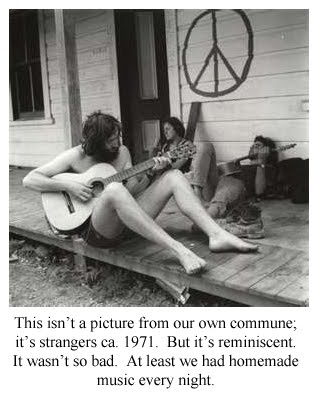
My husband, whom I met and married when we both lived in a communal household, sent me this Atlantic piece about the revival of communes. People who tried them out in youth are re-thinking them in retirement. It's sort of a return to the village or clan, at a time of disenchantment with broken families and anonymous suburbs or apartment complexes. I was particularly taken with the thought experiment of "Who would come if I stood out in my front yard and yelled for help?" I know what would happen here, or what would have happened in our old communal home; I'm less sure what would have happened in the suburb we inhabited in the interim.

We spent long years on our own experiment, which wasn't even a true income-sharing commune, just a way of sharing some living expenses in close quarters. I guess if a flaw in the system could be found, we found it, repeatedly. In our semi-dotage, though, we continue to flirt with the idea, the more so whenever the world threatens to collapse personally or societally.

We're not really cut out for it, I suppose: too solitary and wrapped up in each other, a Bokonan "duprass," as Kurt Vonnegut would say.

Or on art supplies

This time of year, I start looking about for nieces, nephews, and children of friends who might share my twin passions for Robert Heinlein books and art supplies, so that I can replay some kind of childhood drama about ever being able to put my hands on enough of each. I've struck out so far on Heinlein. I used to experiment on various kids with a paperback or two, especially the "juvenilia" series, but I never made any converts.

I usually do a little better with art supplies. I can't go into an art supply store without experiencing an almost irresistible urge to try each medium and buy every single color manufactured in it. All those trays of every color in the spectrum, in oil paint! Pastel crayons! Ink! Colored pencils! Chalk! Water color! Embroidery thread! Yarn! Craft paper! I still remember afternoons of bliss at a neighbor's house with a young friend who had the 64-color Crayola set: magenta, burnt sienna, gold, forest green, brick red, lemon yellow, everything I could possibly want in life.

What really makes my heart race are the 128-color sets, but I usually start with something smaller and try to find out if they've got the bug or not. Perhaps none of these young people have quite the orgasmic reaction I remember from my youth, but they often seem happy to scribble away with their new colored pencils on their suddenly adequate supply of large expanses of paper canvas. Because of course there are the beautiful papers. I generally opt for Strathmore pads, reasonably priced, heavyweight paper with a nice texture, just the thing for engaging one of my young relatives or friends with their new set of colors.

www.dickblick.com is a terrific mail-order resource for art supplies: great discounts and a wide variety of the basics in high-quality versions. In response to a well-timed email promo, I just sent off for some colored pencil sets and paper pads, but in order to get the full value of my discount and free shipping, I was forced to add in some gorgeous bright red Bombay India Ink (for my calligraphy pens) and a handful of tiny, lovely white china bristle paintbrushes. Who ever has anything like enough fine paintbrushes?

The only thing wrong with the dickblick site is that they don't find a way to spread pictures of all the options all over the screen; they make me click through too many pages to get to the good stuff. They'd make a lot more money off of me if they'd recreate the impact of walking into a store and being surrounded by rack after rack of COLOR COLOR COLOR. I want them all.

If not in this generation, perhaps in the next, my eyes will meet the eyes of a kindred spirit on Christmas morning, saying Yes!